Review: John Mellencamp

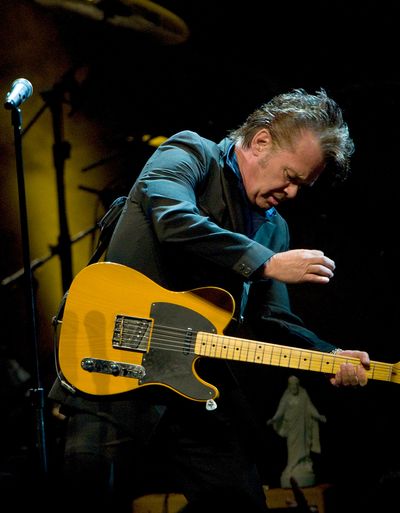
(Above: John Mellencamp tells the story of Jackie Brown at the Midland Theater in Kansas City.)

By Joel Francis
The Kansas City Star 

Friday night’s sold-out John Mellencamp show at the Midland Theater was the tale of two concerts. For the first 90 minutes, Mellencamp used his vast songbook to explore the nooks and crannies of American music. Opener “Authority Song” was stripped of its big country riff and rode bare bones on the spare bass and drum line. Later in the show, “Jack and Diane” was given the same treatment, with Miriam Strum’s violin shouldering the melody.

“No One Cares About Me” resembled prime-era Johnny Cash with a boom-chicka rhythm section and guitarist Andy York doing his best Carl Perkins impression. “Deep Blue Heart” sounded like an outtake from Bob Dylan’s “Time Out Of Mind.”

While there weren’t any jump-to-your-feet, hands-in-the-air climaxes during this part, there were a few goose bump-inducing moments. The smallest moments were the biggest, like Mellencamp’s poignant solo, acoustic delivery of “Jackie Brown,” where he was joined by Strum at the end.

A subdued “Check It Out” had the wistful air of someone watching their grandchildren play in the yard. Later, the entire theater clapped and sang along as Mellencamp sang “Cherry Bomb” without his band or his guitar.

It was clear, however, that the crowd wasn’t expecting a low-key evening. The chatter from the bar downstairs floated into the balcony during the quiet “Longest Days.” Story/songs “Right Behind Me” and “Easter Eve” lacked a traditional chorus and struggled to captivate the crowd.
After the beautiful violin/accordion duet of “New Hymn,” the full drum kit that had been tantalizing the crowd all night was finally put to use. Starting with the heartland hymn “Rain on the Scarecrow,” Mellencamp and his six-piece backing band cut loose and delivered 30 minutes of the expected energetic sing-alongs. With each song, the band raised the volume and dropped formality. Singles like “Pink Houses” drew the biggest responses, while the band seemed to relish trotting out album cuts “The Real Life” and “No Better Than This.”

In a way, Mellencamp served as his own opening act. As the audience found their seats an hour-long documentary played. The film showed Mellencamp on tour and as he recorded his latest album at Sun Studios in Memphis, the San Antonio hotel room where Robert Johnson once recorded, and First African Baptist Church in Savannah, Ga.

Mellencamp recorded the album using a single microphone to capture the entire band in one take. The approach may puzzle some fans, but it’s clear from the first half of the night that his songwriting chops are as strong as ever. The struggle will be to win fans over to new arrangements and sounds that don’t resemble the long-loved radio hits.

After a little more than two hours, the house lights were up, and Mellencamp was safely shuttled to his Airstream trailer parked behind the building. A large portion of the crowd lingered, whistling and clapping in vain as the stage was cleared. The evening wasn’t a complete success, but it was enough to leave them wanting more.

Setlist: Authority Song; No One Cares About Me; Deep Blue Heart; Death Letter; Walk Tall; The West End; Check It Out; Save Some Time To Dream (solo, acoustic); Cherry Bomb (a capella); Don’t Need This Body; Right Behind Me; Jackie Brown (solo, acoustic); Longest Days; Easter Eve; Jack and Diane; Small Town (solo, acoustic); New Hymn; Rain on the Scarecrow; Paper and Fire; The Real Life; Human Wheels; If I Die Sudden; No Better Than This; Pink Houses; R.O.C.K. in the U.S.A.

Keep reading:

Review: Bob Dylan

Review: Old 97s, Lucero

Review: T-Model Ford

Review: Sufjan Stevens

(Above: An excerpt from Sufjan Stevens’ 25-minute saga “Impossible Souls” performed at the Uptown Theater in Kansas City.)

By Joel Francis
The Kansas City Star

It’s unlikely one will ever find a reissue of “Tales of Topographic Oceans” in the record bins at Urban Outfitters or see hipsters sporting Emerson, Lake and Palmer shirts with their skinny jeans. But on Sunday night at the Uptown Theater, indie singer/songwriter Sufjan Stevens delivered a chunk of progressive rock that would have made fans of Gentle Giant and Yes proud.

The earthy folk rock of Stevens’ breakthrough albums – “Seven Swans,” “Michigan” and “Illinois” – has been replaced by electronic, adventurous rock landscapes. About an hour into his two-hour set, Stevens explained the shift saying songwriting was “no longer loyal” to him so he started playing with rudimentary sounds. 

 Sufjan Stevens shifts gears with his new “Age of Adz.”  Extended segments of noises and effects – particularly on the 25-minute journey “Impossible Soul” – made the set feel more like an art installation that a rock show at times. But whether channeling Genesis and the Flaming Lips or Paul Simon and Cat Stevens, the Uptown’s sold-out crowd hung on every note.

After tossing fans a bone with “Seven Swans,” Stevens and his 11-piece band focused exclusively on material from August’s hour-long “All Delighted People” EP and “The Age of Adz,” an album released this month. The poppy “Too Much” came with a boozy twin-trombone solo and could have been a dance hit in another dimension if not for the extended burps and warbles of guitars, organ and synthesizers in its second half.

As the band delivered its complex themes and arrangements, a large trapezoidal video screen reinforced the themes. Space opera “The Age of Adz” featured a film that looked like an animated Funkadelic album cover. Stevens later explained the number as an “explorative supernatural song about love and heartache” and added that a “broken heart doesn’t always bring the apocalypse, but it always feels like it.”Sure it’s pretentious, but it was also a lot of fun and more accessible than it sounds.

The songs felt intimate despite Steven’s everything-including-the-kitchen-sink approach. This was due in large part to his hushed, soft falsetto and intimate, yet inviting lyrics. Even the most bombastic material contained letters of encouragement, boasting self-affirming lyrics like “don’t be distracted” and “Sufjan, follow your heart.”

Several numbers were delivered with spare arrangements featuring little more than Steven’s voice and finger-picked guitar. “Heirloom” was just as delicate as its title, while “Futile Devices” was a soul-baring tribute to Stevens’ brother.  When Stevens later forgot the lyrics during the quiet “Enchanting Ghost” it only enhanced the intimacy.

Stevens prepped his crowd for “Impossible Soul,” informing them they were about to embark on an “intense, emotional, psychotherapy experiment.” The result was nowhere near as ponderous the introduction or running time implied. “Soul” is less a song than an exploration of a song idea from every conceivable angle. Melodies and themes were tackled via prog-rock, ‘80s dance and autotune before concluding with Stevens gingerly plucking his acoustic guitar. It was enough fun that the band slipped in a bit of Salt and Peppa’s “Push It” and one of the supporting singers danced around the stage spraying silly string.

The crowd’s patience with the new material was rewarded with three songs from “Illinois.” “Chicago” ended the main set and drew the biggest cheers of the night. After saying goodnight, Stevens returned alone and delivered “Concerning the UFO” on piano and “John Wayne Gacy, Jr.” on acoustic guitar. It was a bit creepy to hear the audience sing along with Steven’s haunting portrait of the serial killer and an odd note to end the show on.

As with the rest of the evening’s detours, no one seemed to mind. After five long years, the hero had finally returned to his fans. The path may not have been expected, but the results were just as spectacular.DM Stith: The opening act only got 20 minutes, but he had no trouble silencing the crowd. Armed only with his acoustic guitar, the singer/songwriter delivered four songs very much in mold of Stevens’ most popular work. Using several pedals and a sampler, Stith was able to recreate a percussion section and choir by building then looping a series of claps, stomps and harmony vocals. The trick may not be new, but it was still impressive. Stith’s songwriting was even better. It would be interesting to see what he could do with a full set. Several of his songs may be downloaded for free on the Website for Asthmatic Kitty, the label Stevens founded.

Sufjan Stevens Setlist: Seven Swans; Too Much; Age of Adz; Heirloom; I Walked; Futile Devices; Vesuvius; Now That I’m Older; Get Real, Get Right; Enchanting Ghost; Impossible Soul; Chicago. Encore: Concerning the UFO Sighting Near Highland, Illinois; John Wayne Gacy, Jr.

Keep reading:

Review: The Decemberists

Review: “Ripped” by Greg Kot

Review: Modest Mouse (2010)

Review: Smashing Pumpkins, Cake

(Above: The reconfigured Smashing Pumpkins incinerate the old country with “As Rome Burns,” a yet-unreleased track.)

By Joel Francis
The Kansas City Star

Billy Corgan has learned to compromise. After frustrating and confounding fans with obscure songs and indulgent jams on the Smashing Pumpkins’ 20th anniversary tour just two years ago, he has struck a balance between the old (and beloved) and the new.

The unspoken agreement of Saturday’s show at Sandstone Amphitheater was one for you, one for me. Fans seemed thrilled to meet Corgan and his reconstituted Pumpkins halfway. Opening with the drum roll into “Cherub Rock,” the quartet alternated between favorites like “Zero” and “Drown” with newer numbers such as “Song for a Sun” and unreleased material like “As Rome Burns.”
“We’ve found the songs you know tend to get the biggest cheers,” Corgan told the audience before launching into “Tonight, Tonight” and he was right. “Today” provided the first big sing-along moment of the night, turned the chorus of “Bullet With Butterfly Wings” over to the very vocal throng. Even “Stand Inside Your Love,” an underrated single from the original configuration’s final retail album, drew a big response.

The 80-minute setlist ignored “Gish” but drew from every other album in the band’s catalog and a couple soundtrack contributions. Most of the songs sounded pretty much like they were recorded. The only exceptions were new arrangements of “Adore”-era material. The new version of “Adore” rode Nicole Fiorentino’s bass, and discarded the drum programming for a full band sound. “Eye” was given a trippy intro full of shimmering guitars and big, echoing drums.

Smashpumpkins_fyi_ spf_09252010_135FNewer material dovetailed nicely with the familiar. “Tarantula,” from 2007’s forgotten “Zeitgeist,” emerged seamlessly from “Cherub Rock” just as “Drown” gave way to “As Rome Burns.” “Song for a Son” had a progressive feel and guitar lick similar to “Stairway to Heaven.” It was one of several of the night’s numbers to feature Corgan and Jeff Schroeder harmonizing on twin guitar solos.

Before breaking up at the dawn of the millennium, the Smashing Pumpkins were one of the most successful bands to come from the grunge era. Corgan and founding drummer Jimmy Chamberlain reconvened for “Zeitgeist,” recruiting supporting musicians for the subsequent tour, before Chamberlain left again last year.

Corgan may be the only founding member left in the band, but the new cast proved more than capable. Twenty-year-old Mike Byrne was a monster on the drums, having no trouble replicating the complex rolls and fills that are so much a part of the Pumpkin’s sound. The band was amazingly tight and precise, slithering across the changing dynamics and textures and following Corgan’s every move.

The stage set-up was basic, but impressive. The only effects were banks of lights set up above and behind the band, constantly strobing and changing. Two large metal fans were perched atop metal towers in the back at either side of the stage. The visual arrangement kept anyone from receiving the spotlight. The band was lit as a whole and the emphasis was placed on the music.

The band exited shortly before midnight against a wall of lights pointing into the audience. They were visible only as vague silhouettes, but had long established their identity.

Cake’s one-hour set preceding the Pumpkins couldn’t have been more different. Singer John McCrea chatted with the crowd between nearly every number, espousing his views on religion, American society and the gradual disappearance of three-four time. Along the way, the five-piece college rockers delivered audience favorites “Comfort Eagle” and “Frank Sinatra” and songs from their upcoming new album.

Although most of Cake’s songs ride a slow funk groove and McCrea’s tongue-in-cheek spoken/sung lyrics, two of evening’s best numbers veered from that formula. “Mexico” sounded like a lost Decemberists track, while new song “Bound Away” was a travelogue in the form of an Irish drinking song.

Smashing Pumpkins setlist: Cherub Rock, Tarantula, Adore, Song for a Son, Today, Drown, As Rome Burns, Freak, Tonight Tonight, Stand Inside Your Love, Eye, Bullet With Butterfly Wings, United States (including the Star-Spangled Banner and Moby Dick). Encore: Zero.

Cake setlist: Comfort Eagle, Rock and Roll Lifestyle, Sick of Me, War Pigs (Black Sabbath cover), Frank Sinatra, Wheels, Stickshfits and Safetybelts, Love You Madly, Guitar, Arco Arena, Mexico, Bound Away, Never There, The Distance.

Keep reading:

Review: Cake

Review – The Black Keys

Review: Alice in Chains

Out of the Tar Pit Back Onto the Stage

Neil Young, Santana celebrate the guitar

(Above: Santana and Nas put their spin on AC/DC’s “Back In Black” on the “George Lopez Show.” Believe it or not, this is one of the better moment’s on Santana’s new album.)

By Joel Francis
The Daily Record

It’s hard to believe it has been a ten years since “Supernatural.” Back then, Santana was just another fading Woodstock star. He has been living in the shadow of “Smooth” and “Maria Maria” ever since.

With a title like “Guitar Heaven: The Greatest Guitar Classics of All Time” one could be excused for thinking Santana’s latest album was a repackaging of “Oye Como Va,” “Soul Sacrifice” and the rest of the jams that made him a guitar icon. Instead we are gifted with an album much more panderous.

“Guitar Heaven” reunites Santana with label president/marketing guru Clive Davis for the first time since “Supernatural” and is the third consecutive album to follow its formula. The blueprint is simple: pair Santana’s guitar with some of the biggest pop voices of the moment in every genre. The twist this time is that every tune is a well-known cover, a great guitar classic, no less.

The result is a dozen pedestrian, uninspiring performances. None of the musicians associated with this project even pretend to muster the effort to add something new to these well-worn staples of classic rock radio stations. It’s hard to imagine anyone clamoring to hear Train’s Pat Monahan aping early Van Halen or anxiously waiting to see what Chris Daughtry could do with Def Leppeard’s “Photograph.”

Predictably, Davis invited Rob Thomas back into the fold, but this time the man who brought Santana his biggest hit is anything but smooth. The Matchbox 20 singer seems completely overwhelmed by “Sunshine of Your Love.” Joe Cocker fares better on the Jimi Hendrix staple “Little Wing,” but the performance still begs the question why anyone thought this project was necessary.

At best the outcome is merely redundant; at its worst it an embarrassment. The only inventive choices were including India.Arie and Yo-Yo Ma on “While My Guitar Gently Weeps” and rapper Nas trying to inject some hip hop into “Back In Black.”

Neil Young’s “Le Noise” is a true celebration of the guitar. For his 32nd album, Young worked with famed producer Daniel Lanois. Lanois’ productions are frequently criticized for their big echoy sound and stark separation of instruments. They can often sound like Lanois conformed the artists to his vision, rather than the other way around.

Although some of Lanois’ swampy trademark exists in “Le Noise,” his distinct fingerprints are absent for the most part. The reason is simple: there’s less for him to work with. All of the album’s eight tracks were cut live and feature only Young and his guitar. The result is a pastoral yet invigorating portrait of Young seated on his amp, volume cranked to 11, intimately and intently debuting his latest song cycle.

While the guitar makes all the noise, Young’s songwriting makes all the difference. Without a bed of strong material, “Le Noise” would be a curio, like “Arc,” the album-length experiment of feedback and noise Young released in 1991. These songs could just as easily been delivered acoustically. Fortunately, Young and Lanois muck them up with waves of feedback and distortion.

In the mid-‘90s, both Young and Santana were regularly releasing solid, if unremarkable albums that clearly came from the heart. Today their paths couldn’t be more different.

In movie terms, Young is the actor who with a questionable resume, but has remained unquestionably independent. Santana, on the other hand, resembles the washed-up actor willing to do anything to land one last big role.

But show-biz loves redemption stories. Let’s hope Santana has some Mickey Rourke in him.

Keep reading:

Review: “Neil Young – Long May You Run: The Illustrated History”

The Derek Trucks Band makes old-school rock new

CSNY – “Ohio”

Bruce Springsteen and Tom Morello – “The Ghost of Tom Joad”


John Legend and the Roots – “Wake Up!”

(Above: First Stephen Foster, then Ray Charles. Now John Legend and the Roots have “Hard Times.”)

By Joel Francis
The Daily Record

A little more than three months after releasing one of the best albums of their 17-year career, The Roots are back, this time with John Legend.

The pairing is inspired. The Roots have long have a reputation as the best band in hip hop. For the past couple years they’ve proved their mettle to the mainstream as the house band on “Late Night with Jimmy Fallon.” Legend is clearly a great talent, but often gets overwhelmed by slick production and light-weight songwriting. These 10 reinterpretations of classic soul protest songs offer the perfect platform for him to shine.

Legend lives up to the opportunity, singing with grit and emotion only hinted at on his solo albums, and feeding off the Roots’ vibe. Opening cut “Hard Times,” a lost Curtis Mayfield classic written for Baby Huey, feeds off a horn line ricocheting off of Ahmir “?uestlove” Thompson’s drums and Captain Kirk Douglas’ bright guitar. Black Thought’s rap in the middle reinforces the track’s message and feel. This is music to spark both revolution and revelry.

“Wake Up Everybody” features a guest rhyme from Common that feels like a verse from a lost hymn. Legend’s duet with Melanie Fiona here captures the same mood as a classic Marvin Gaye/Tammi Terrell number. “Little Ghetto Boy” – bolstered by another Black Thought cameo – and the buoyant gospel reading of Nina Simone’s “I Wish I Knew How It Would Feel to be Free” are other high points.

Unfortunately, the album can’t sustain these moments. Legend’s vocal shortcomings come to the foreground on “Wholy Holy.”Gaye’s voice soars effortlessly on the original, while Legend strains just to lift off. His over-singing on Bill Wither’s “I Can’t Write Left-Handed” is accidentally exposed by Douglas’ understated, tasteful soloing.

Not all of the blame lies at Legend’s feet. Normally an impeccable arranger, there are some surprising issues with Thompson’s choices. Les McCann’s “Compared to What” swings and skips like a rock skimming the top of a lake. Thompson’s slower arrangement is leaden in comparison. His treatment of Lincoln Thompson’s (no relation) reggae song “Humanity (Love the Way it Should Be)” hews closely to the original, but without the Jamaican patois it seems stiff and forced. The performance should have been reworked to emphasize what Legend could bring to the number.

“Wake Up” was inspired by Barack Obama’s 2008 presidential victory and Arcade Fire’s song “Wake Up.” The original plan was record an EP, and truthfully Legend and the Roots should have stayed with that concept. The handful of strong cuts present would have made for an outstanding mid-player. As is, this is a solid album with plenty of outstanding moments, but ample opportunity to skip to the next cut. Or, better yet, seek out the originals.

Keep reading:

Review: For The Roots It’s All In The Music

Marvin Gaye and Tammi Terrell – “Ain’t Nothing Like the Real Thing”

Fans delay Maxwell’s next album

Review: “How to Rap”

(Above: If you want to hang with Mos Def, Eminem and Black Thought, you’d be advised to do your homework first.)

By Joel Francis
The Daily Record

Two of the most common criticism of hip hop are, one, it’s not music and, two, anyone can do it. While the first complaint is purely subjective, it would be difficult to think anyone could agree with the second conclusion after reading “How To Rap.”

Drawing on interviews with more than 100 MCs, Paul Edwards has assembled a comprehensive primer for aspiring microphone magicians. Incredibly concise, Edwards and his subjects cover nearly every conceivable topic, including rhyme schemes, recording and performing, in 340 pages.

A diverse palette of interviewees matches the range of topics. Edwards culls insight from conscious rappers like Gift of Gab, underground MCs such as Aesop Rock and Mr. Lif and gangsta rappers like the Clipse. Legends Phife Dawg and Q-Tip from A Tribe Called Quest, Chuck D, Big Daddy Kane and Kool Moe Dee (who also provides the introduction), also lend insight. Local music fans will be delighted to read TechN9ne’s contributions.

At first glance, the text seems obvious. Much of the first section on content and styles should already be familiar to anyone with an interest deep enough in hip hop to pick up this book. Once the overview is out of the way, however, the book offers fascinating insight.

The flow diagram demonstrates how MCs line up their lyrics against the beats. The product is surprisingly similar to traditional notation and demonstrates how much forethought is put into delivery. This complexity is reinforced in the chapter explaining different styles of rhyming, rhyme schemes and placement. The pattern diagram ties these concepts together, allowing lyricists to illustrate how the syllables fall in their lyrics, pointing out repetitive patterns or other accidental traps.

Edwards stays out of the way, letting the artists break down each step in their own way. Not only does the reader learn this information firsthand, but receives several different perspectives on the process. Most of the time this format serves well, but sometimes Edwards’ narrative is repetitive. He frequently sets up a topic, only to have the first quote echo that statement. Edwards does a good job of editing the quotes, pruning the “you know what I mean” while maintaining each performer’s voice.

While a lot of the biggest names dropped frequently dropped among the pages – particularly Eminem and Dr. Dre – are absent, several of their collaborators, such as Lady of Rage, Devin the Dude and Royce da 5’9”, are able to provide insight in the missing legends’ creative process.

“How To Rap” lives up to its title, providing a meaty background on all facets of the vocal side of hip hop, while being slim enough to be stuck in a back pocket or jacket as the MC embarks upon the journey. Call hip hop what you like, but there’s no doubt it takes a talented person to do it well. Edwards’ book should arm the aspiring with the necessary tools for the scene.

Keep reading:

Chuck D looks forward in reverse

Review: Lupe Fiasco

Steddy P and DJ Mahf – “While You Were Sleeping”

Jazz, hip hop collide to celebrate landmark album

Review: Pavement

(Above: Pavement perform “Grounded” on Sept. 11, 2010, at the Uptown Theater in Kansas City, Mo.)

By Joel Francis
The Kansas City Star

About 20 minutes into Pavement’s set, lead singer and guitarist Stephen Malkmus announced to a crowded Uptown Theater that this was the band’s first time playing in Kansas City, if you don’t count Lollapalooza.

The house roared its appreciation for the underground rock band’s belated return, not just because this was only the second K.C. show in the group’s 20-year history, but because they’d been inactive for half of that time.

Saturday’s show would have been memorable even if it wasn’t a fan’s first time seeing the band, or the first time in a long time, as it was for most. The fervent crowd would have devoured anything their heroes delivered, but were treated to many of the band’s best-loved tunes, including three-quarters of the cuts off Pavement’s new greatest-hits compilation.

Calling any of Pavement’s songs “hits” is a bit misleading. Aside from “Cut Your Hair,” which appropriately featured the only rock star moment of the evening when Malkmus soloed behind is back, the band never had any chart success. In fact, it seems they went out of their way to avoid anything conventional. Their songs are anti-anthems, prone to taking left turns or ending just when they start to get settled.

This doesn’t lend itself to the campfire glow of a great sing-along, but the devoted still found a way to chime in. Numbers with a boisterous chorus like “Stereo” provided a natural opportunity to join in – the response to the line “no big hair” in “Cut My Hair” was especially boisterous. Less traditional songs like “Starlings of the Slipstream” and “Loretta’s Scars” still found plenty participating.

Malkmus was angled at stage right, with his fellow guitarist/foil/adversary Scott “Spiral Stairs” Kannberg at the other extreme. Kannberg took the vocals for two numbers, “Date w/ IKEA” and “Kennel District,” which closed the main set. Untethered by a microphone, bass player Mark Ibold – on leave from his current gig with Sonic Youth – roamed the stage, while drummer Steve West and percussionist Bob Nastanovich were positioned slightly off center in the back.

Nastanovich was the band’s secret weapon. Most of the time he was relegated to shaking a tambourine or egg, but would suddenly burst to the front of the stage screaming into the microphone. His pent-up energy was a nice change of pace from Malkmus trademark indifferent, slacker delivery, especially when the two styles were set against each other, as on “Conduit for Sale!”

On the brief instrumental “Heckler Spray,” Nastanovich’ second drum kit added some nice muscle. That set up a run through heavy, riff-based numbers “In the Mouth of Desert” and “Unfair.” Just as they seemed to be building momentum, Malkmus dropped the band to a hush with “Spit on a Stranger,” the prettiest song in their canon and the night’s only offering from their 1999 swan song “Terror Twilight.”

The only visual effects were several strings of large indoor/outdoor lights hung around the stage and into the audience. When lit, the theater felt like an elaborate backyard party. They created an especially jubilant atmosphere during upbeat numbers like “Silence Kit.” At one point between songs, Malkmus tried to toss his guitar up into the lights.

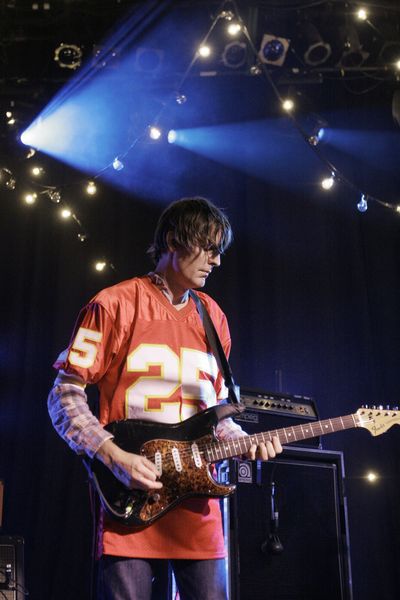
A devout sports fan, Malkmus performed in a Jamal Charles/Chiefs jersey. During the encore, he lamented that Charles now played for the “stupidest coach in the NFL.” Nastanovich echoed this sentiment urging the Chiefs to “fire (head coach Todd) Haley and hire Malkmus.”

The 100-minute set ended with “Range Life,” a playful tune that gently mocks the Smashing Pumpkins and Stone Temple Pilots (which seemed a lot more relevant when it came out in 1994). No one wanted to quit, however, so Malkmus veered into the Beatles “Ob-La-Di, Ob-La-Da.” Finally the big sing-along moment arrived. It may have taken longer than expected, but it was well worth the wait.

Setlist: Gold Soundz; Rattled by the Rush; Starlings of the Slipstream; Shady Lane; Date W/ IKEA; Frontwards; Heckler Spray > In the Mouth a Desert; Unfair; Spit on a Stranger; Stereo; Loretta’s Scars; Conduit for Sale!; Shoot the Singer; Silence Kit; Trigger Cut; Grounded; Perfume V; Cut Your Hair; Stop Breathin’; Box Elder; Fight This Generation; Debris Slide; Kennel District. Encore: Here; Lions (Linden); We Dance; Range Life (including Ob-La-Di, Ob-La-Da).

Keep reading:

Review – The Black Keys

Modest Mouse: Johnny Strikes Up the Band

Review – Arctic Monkeys

Hail Death Cab

Review: Yo La Tengo

Review: Girl Talk

(Above: Girl Talk’s Feed the Animals album from 2008.)

By Joel Francis
The Daily Record

Just because Gregg Gillis doesn’t play a musical instrument, doesn’t mean he can’t make you dance. For 80 minutes on Friday night, Gillis, better known as Girl Talk, had a packed Crossroads getting down in a downpour.

That set time may not look very long, but it was both exhausting and generous. Girl Talk specializes in creating ultimate mash-ups of literally hundreds of songs from nearly every genre and artists ranging from Boston, ODB, Radiohead, Simon and Garfunkel, Ben Folds and UGK. The shorter list would be the one encompassing all the artists Gills didn’t play. Suffice it to say, if it was a pop or club hit in the last 40 years, it was fair game for inclusion.

Girl Talk’s performance is more than matching beats per minute, however. He is the master of extracting the peak moment of a given song, pairing it with the pinnacle from another disparate track and creating a new climax higher than either cut could achieve alone.

The high-energy set was paced to jump from one high point to another, but a couple moments stand out. During Kelly Clarkson’s “Since U Been Gone” he teased out the verses, delaying the explosive chorus. When it finally hit a shockwave went through the crowd, amping the atmosphere even higher. He repeated the same trick drawing out the intro of the Smashing Pumpkins’ “Today,” before the glorious guitar riff detonated across the venue.

There’s a reason why most DJs are hidden in a booth at the back of a club: there’s usually not much visually going on. Gillis, though, took a cue from the Flaming Lips, flanked by a cast of dancing fans onstage and two assistants who were constantly streaming rolls of toilet paper and confetti into the crowd. They got an assist from Mother Nature, who provided an impressive lightning show in the sky above as the rain continued to pour throughout the night.

Although there was a video screen and basic light show, the most animated element of the night by far was Gillis himself. Taking the stage in a hoodie, it wasn’t long until he was shirtless and sweating profusely. His legs were never still, hopping back and forth between laptops on nearly every beat. Combine that with bouts of jumping on (and off) the table, arm waving and exuberant shout-outs and Gillis gave himself a heck of a cardio workout. The result was a performance far more entertaining than the typical person-behing-laptop/turntable.

Most of the set centered on recent hits, but Gillis mixed in two old tracks for the finale. The Isley Brothers’ “Shout” was virtually unaltered, save a hip hop beat underneath. The same trick that worked at the skating rink was just as effective on a larger scale with adults. The evening ended with John Lennon’s “Imagine,” which crawled at a snail’s pace compared to the rest of the night’s fare. Of course by then the message had already been received.

Keep reading:

Flaming Lips deserve Super Bowl halftime show

Chris Cornell – “Scream”

Review: Lupe Fiasco

Fourth of July – “Before Our Hearts Explode”

(Above:  The video for “Self Sabotage” off the Lawrence band Fourth of July’s sophomore album.)

By Joel Francis
Ink magazine

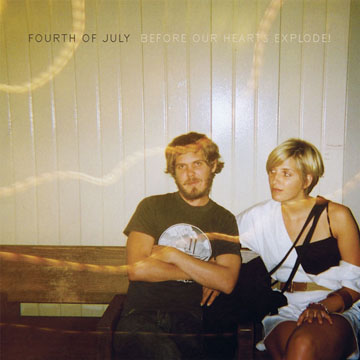
Fourth of July singer Brendan Hangauer appears on the cover of the Lawrence-based, indie quintet’s sophomore album seated next to a pretty blonde. Although she’s looking at him and leaning in, his arms are crossed and eyes stare straight ahead. The pair may be close in proximity, but they seem miles apart emotionally.

This is often how it goes in the closing stages of a relationship, when the pair faces loneliness and, of course, vast tracts of time to flip the whole scenario over and endlessly analyze.

These are the times that Hangauer, his brothers Patrick and Kelly, and Brian and Brendan Costello — another pair of siblings — relive on Before Our Hearts Explode. Breaking up, as the saying goes, may be hard to do, but it has rarely sounded like this much fun.

The album opens with “Friend of a Friend,” the story of an ex-girlfriend’s rebound lover. Driven by acoustic guitar and organ and powered by a nimble  electric guitar, it’s too bouncy to be bitter. The track sets the template for the next 40 minutes: an intimate survey of love’s rubble,  via jangly guitars and slacker vocals. It’s Bob Dylan’s Blood on the Tracks filtered through Camper Van Beethoven.

It’s also a ruse, albeit an effective one. Hangauer is broken and hurt but refuses to let his guard down. For every telling lyric such as “Don’t be so sure of things/not even wedding rings” or “you know you ruined us/when you slept with that little slut” there are a plethora of la-la-la or ooh-ooh-ooh choruses to mask the betrayal.

The facade breaks in only a couple places. “Song for Meghan,” the first ballad, arrives midway through the record. Hangauer’s unvarnished craving for an absent love resonates in Adrianne Verhoeven’s lovely vocal countermelody.

This is followed by “Moving On,” a song as caustic and cynical as anything by Elvis Costello. It also has a sweet undercurrent as Hangauer recalls brighter days. The same trumpet that amplified Hangauer’s longing on “Song for Meghan” now cuts through the track like a ray of sunlight forcing its way into a dark room through a crack in the shades.

Before Our Hearts Explode succeeds at having it both ways — a breakup record that provides the perfect accompaniment for playing Frisbee. Like all relationships it is never black and white. The good times are tucked alongside the most painful.

Keep reading:

thePhantom – “Bohemian Seduction Grooves”

A Shooting Star finds home with the Young Dubliners

Catching up with the Hot Club of Cowtown

Review: Slash

(Above: Slash + Myles Kennedy and co. perform “Civil War,” arguably Guns N Roses’ finest moment.)

By Joel Francis
The Kansas City Star

Slash will always be known as the top-hatted guitarist for Guns N’ Roses, but he’s built quite a body of work in the 15 years since leaving that band. Thursday night at Harrah’s Voodoo Lounge, Slash drew on all phases of his career – Snakepit, Velvet Revolver, his new solo album and, of course, Guns N’ Roses – during his two hour performance.

The early numbers were a quick survey of Slash’s career. “Ghost,” a number from his new self-titled effort opened the proceedings with a slinky, sleazy guitar riff. It was followed by the rough stomp of “Mean Bone” from Slash’s Snakepit days, the “Appetite for Destruction” classic “Nightrain” and Velvet Revolver’s “Sucker Train Blues.”

After a strong opening, the set got even better. “Back to Cali,” another new track, opened with vocalist Myles Kennedy of Alter Bridge and Slash standing shoulder-to-shoulder during a heated call and response that brought to mind Jimmy Page and Robert Plant. Both “Cali” and “Do It for the Kids” rocked harder than anything Slash’s former band came up with for “Chinese Democracy.” “Civil War” and “Rocket Queen,” two of the brightest moments from Slash’s Guns glory days, came next.

Guitarist Zakk Wylde once said playing with Ozzy Osbourne was like being in a glorified cover band, because the performances encompassed material from different eras and songwriters. The same could also be said by Slash’s four new band mates, but they didn’t seem to mind helping Slash recreate his finest moments any more than Wylde did with Ozzy.

Kennedy easily conjured the ghost of Axl Rose, replicating his vocal tics right down to the radio commentary at the end of “Civil War.” He had no problem nailing the high parts on “Rocket Queen,” either. Together, Kennedy and bass player Todd Kerns – who delighted romping around the stage and lip synching to all the Guns N’ Roses songs – came close to capturing the spirit of Velvet Revolver singer Scott Weiland’s tone.

Although the singer is generally regarded as the front man, this was purely Slash’s show. Kennedy dutifully moved himself and the mic stand back by the drums during each solo so Slash could have center stage. Although primarily stationed at stage left, the crowd followed Slash’s movements across the stage like plants chasing sunlight. Kennedy’s one moment in the spotlight came late in the set when Slash relinquished lead guitar duties during a cover of Alter Bridge’s “Rise Today.”

If the first half of the concert was a showcase for great songs Slash helped write, the second half was dedicated to showing off his guitar skills. Slash is the king of the oily riff that goes down smooth and leaves you feeling dirty. Those skills, however, tend to perish without the structure of a song.

Exhibit A was a tedious five-minute blues jam that culminated in the theme from “The Godfather,” another several-minute exercise. After noodling around for nearly 20 minutes – the blues jam was preceded by the instrumental “Watch This” – Slash ended his solos in the best way possible by dropping into the signature riff to “Sweet Child O’ Mine.”

Kennedy held the mic stand over the re-ignited crowd and let them lead the chorus, a trick he would perform again a few minutes later during “Paradise City.” The closing song, it encapsulated all the best elements of the night: energetic crowd participation, big riffs, great songwriting and killer solos. The night ended with some of Slash’s best solos as the ensemble stretched out over the melody.

For $30 fans could take home a recording of the concert. A line was already forming at the table in the back as the band took their final bows. The CDs are a nice souvenir for dedicated fans, but it’s hard to imagine any casual “best of Slash” playlist deviating too much from what he delivered onstage.

Setlist: Ghost; Mean Bone; Nightrain; Sucker Train Blues; Back from Cali; Do It For the Kids; Civil War; Rocket Queen; Fall to Pieces; Just Like Anything; Nothing to Say; Starlight; Watch This; blues jam > Theme from “The Godfather” > Sweet Child O’ Mine; Rise Today (Alter Bridge cover); Slither. Encore: By the Sword; Communication Breakdown (Led Zeppelin cover); Paradise City.

Keep reading:

Review: “I Am Ozzy”

Review: Motley Crue

Review: Alice in Chains