The Supremes – “Up the Ladder to the Roof,” Pop # 10, R&B # 5
By Joel Francis
The Daily Record
Life in the Supremes had been rocky for a while. First, Diana Ross got top billing, then founding member Florence Ballard was replaced by Cindy Birdsong. To add insult to injury, several tracks credited to Diana Ross and the Supremes were glorified Ross solo tracks, recorded with no input from Birdsong or Mary Wilson.
When Ross finally left to launch a solo career, Wilson regained control of the group. As the sole original member, she became the unofficial leader. For the first time in a while, Wilson’s voice was prominent among the backing vocals. In her autobiography, Wilson recalled that the backing vocals were recorded with the three Supremes sharing a microphone, something the group did frequently in the early days but had not done in years.
Although she never reached the same level of fame as her predecessor, Terrell was an excellent replacement for Ross. Terrell’s voice had greater range and tone with a strong gospel emphasis. Producer Frank Wilson (no relation to Mary), frequently told Terrell to dial back her performance during the recording of “Up the Ladder to the Roof” because he thought Motown listeners wouldn’t like her soulful delivery.
The title is a nod to Gerry Goffin and Carole King’s 1962 hit for the Drifters, “Up on the Roof.” In the Drifters’ song, the roof is a romanticized utopia, free of the worries and stress of urban life. For the Supremes, however, the roof represents not only sex (check the way Terrell coos the lines “where we can be closer to heaven” in the chorus) but commitment and a new life together, stopping just short of being a marriage proposal. Although the string arrangement gives the song an elegant feel, the funky wah-wah guitar and percussion breakdown in the middle is definitely a nod to the times.
“Up the Ladder” successfully launched the “new Supremes,” lodging at No. 10 on the Pop chart and making it all the way to No. 5 on the R&B chart. It was covered by Bette Midler in 1977, the a capella group the Nylons in the early ‘80s and Al Green during his gospel phase later in the decade.
The Originals – “Baby I’m For Real,” Pop # 14, R&B # 1
By Joel Francis
The Originals had appeared on nearly a dozen Motown hits before they finally landed one with their name on the label. As backing vocalists, the Detroit quartet saw their performances on “Function at the Junction,” “Twenty-Five Miles,” “For Once In My Life” and “My Whole World Ended (The Moment You Left Me)” – to name but a few – rise to the top of the chart.
When Marvin Gaye had the group sing on his singles “You” and “Chained” he felt an immediate rapport and took it upon himself to give them the breakout single they deserved. Working with his wife Anna (label boss Berry Gordy’s sister), Gaye penned the lyrics for “Baby I’m For Real.”
With its soft arrangement and doo-wop influences, the song was an about-face from the psychedelic soul singles Motown was sending to the top of the charts. Gordy balked, insisting Gaye release the other song he wrote and produced for the Originals, “You’re the One.” When it flopped, Gaye convinced his brother-in-law to release “Real.”
With its quivering strings, silky saxophone and smooth vocals, the song fit more into the Philly soul mold than the Motown model. Even the drums on the track are gentle and the performance floats by like a cloud across a lazy summer afternoon sky.
Gaye’s intentions were not entirely altruistic. He wanted to spread his wings and used the song’s success to convince Gordy that he was capable of producing hit material. The triumph of “Baby I’m For Real” was quickly parlayed into the Originals’ follow-up hit, “The Bells” and helped paved the way for Gaye’s groundbreaking “What’s Going On” album.
Nearly a generation after its original release, After 7 refurbished this classic and, blending it with Bloodstone’s “Natural High,” took it to No. 5 on the R&B chart. In 1972, soul singer Esther Phillps put her spin on the number. Faux-soulster Michael McDonald included his take on the more recent “Motown Two” album.
The Temptations – “I Can’t Get Next To You,” Pop # 1, R&B # 1
By Joel Francis
Surprisingly, “I Can’t Get Next To You” was the first Temptations single to top both the pop and R&B charts since “My Girl,” five long years before. Although these Temptations featured 80 percent of that lineup – David Ruffin had been replaced by Dennis Edwards – the group had been handed off from Smokey Robinson’s smooth, straightforward approach to Norman Whitfield’s groundbreaking psychedelic arrangements.
In other words, just because they had the same name and most of the same members, the Temptations of “My Girl” were long gone by the time “I Can’t Get Next To You” reigned at No. 1.
The song opens with canned applause and a barrelhouse piano roll that sets the song in an old parlor or juke joint before the chicken-scratch and wah guitars thrust the song into the future. Just as they did on the previous year’s “Cloud Nine,” the five Tempts trade lines, adding kinetic energy to the track. The guitars, electric piano and insistent drums and percussion make the song feel like a cousin to something Sly and the Family Stone would have cooked up. When Edwards finally erupts with the line “girl, you’re blowing my mind,” the song carries the same intensity and sexuality of James Brown’s hard funkin’ “Sex Machine.”
There was very little happening on Motown like this at the time. Ironically, the next act to incorporate this much funk was a group aimed at a younger audience, the Jackson 5. They Indiana quintet re-appropriated the bridge from “I Can’t Get Next To You” for their 1970 hit “ABC.”
One year after it’s mid-1969 release, Al Green transformed the song into a smoldering cry for love. Green eliminated the kaleidoscopic vocals and swirling arrangement, building the song around his voice and a slinky guitar line. The only element these versions hold in common is the lyrics. Green rode his arrangement to No. 11 on the R&B charts.
An unexpectedly versatile song penned by Whitfield and Barrett Strong, “I Can’t Get Next To You” was transformed into a jazz number by Woody Herman, converted to reggae by the Jay Boys and given the pop treatment by the Osmonds and Edwin McCain. Most recently, it was covered by Anne Lennox on her 1995 album “Medusa.”
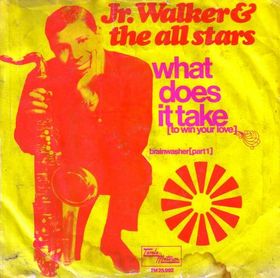
Jr. Walker and the All Stars – “What Does It Take (To Win Your Love),” Pop # 4, R&B # 1
By Joel Francis
“What Does It Take (To Win Your Love)” was Jr. Walker’s second chart-topper and first since 1965’s “Shotgun,” but the two songs couldn’t have been more different. While “Shotgun” was a raw roadhouse rumble with the horn dominating the vocals, “What Does It Take” was a smooth love song designed to drive traffic to the bedroom.
Although Walker penned many of the All Stars’ best numbers, like “Shake and Fingerpop,” “Hip City” and “Last Call,” he handed the reigns over to the songwriting and production duo of Harvey Fuqua and Johnny Bristol in a bid for greater pop success in the late ‘60s.
On paper it looked like a solid decision. Fuqua and Bristol were trusted entities. The latter discovered Walker, and the former gave Walker his first record deal. When Fuqua’s Harvey Records were purchased by Motown, Fuqua, Bristol and Walker became part of the Hitsville family.
While Fuqua and Bristol were successful in taking Walker back to the top of the charts, they did it by depriving Walker of his signature sound. The great saxophone that propelled so many All Stars singles was relegated to anonymous responses that could have been handled by any session player. Walker has overcome his initial microphone shyness to deliver a credible vocal, but his delivery his hardly distinct. All the right elements may be in place, but the product is competently forgettable.
Any thoughts that Walker strayed too far from the sound that made him great are reinforced by Kenny G’s 1986 cover featuring Bristol on lead vocals.
David Ruffin – “My Whole World Ended (The Moment You Left Me),” Pop # 9, R&B # 2
By Joel Francis
Former Temptation David Ruffin stuck pretty close to his old band’s template on his solo debut. The Harvey Fuqua/Johnny Bristol song was slated to be the Tempts’ next single, but Ruffin was able to sweet talk taking the song with him when he was fired. With backing vocals provided by the Originals, the song sounds enough like the Temptations casual listeners could be forgiven for thinking the news of Ruffin’s departure was nothing but a bad dream.
The lyrics also deal with the frequent Temptations theme of lost love. Like he did in “I Wish It Would Rain” and “Since I Lost My Baby,” Ruffin ruminates over how a promising relationship soured and what to do with the loneliness and ache.
A Top 10 pop hit that just missed the top spot on the R&B charts, “My Whole World Ended” was a promising start to Ruffin’s new career. Unfortunately, the problems that plagued him in the Temptations continued to haunt. Because he wasn’t a songwriter, Ruffin was dependent on others for material, and Ruffin’s erratic behavior and continued drug use didn’t endear him to many Hitsville songsmiths. Ruffin caused further problems when he started forcing his way onstage during Temptations concerts. Fans were ecstatic to hear the old singer deliver the hits, but the group, with new member Dennis Edwards, was less than enthused.
Despite these problems, Ruffin maintained a decent solo career. Although he never matched the success of “My Whole World Ended,” he had several minor hits peaking with another Top 10 smash on 1975’s “Walk Away From Love.”
There was a flurry of immediate covers after the release of “My Whole World” in early 1969. The Chi-Lites, Kiki Dee and the Spinners all recorded interpretations of the song within 18 months of its initial release.
Edwin Starr – “Twenty-Five Miles,” Pop # 6, R&B #6
By Joel Francis
If the horn arrangement on “Twenty-Five Miles” sounds like something out of the Stax studio, that’s because it is. Motown songwriters Harvey Fuqua and Johnny Bristol based their number on the obscure Wilson Pickett song “32 Miles Out of Waycross (Mojo Mama)” written by Bert Berns and Jerry Wexler and recorded in 1967.
It’s little surprise Fuqua and Bristol turned to a Pickett number when looking for material for Edwin Starr. Like Pickett, Starr was a strong baritone who sang from the throat. And like fellow Motown family member Levi Stubbs of the Four Tops, Starr’s voice was seeped in the Southern style.
Unlike, Stubbs, however, Starr didn’t have a string of hits under his belt, which made him a bit of an outcast at the label. A Detroit native who somehow escaped Berry Gordy’s eagle eye for talent, Starr’s biggest hit. to date was the 1965 song “Agent Double ‘O’ Soul” recorded on the Ric-Tic label. Three years later, when Motown purchased Ric-Tick in 1968, Starr joined the Hitsville stable.
“Twenty-Five Miles” opens with Benny Benjamin’s athletic drumming and he stays front and center as the funky scoutmaster that keeps Starr’s (and everyone on the dance floor) feet relentlessly moving. The bass line echoes a horn line that has become a staple of marching and pep bands across the country. The listener never learns what happens when Starr reaches his destination, but the energetic vocals definitely prove that getting there is half the fun.
Although “25 Miles” was a Top 10 hit, it often been overlooked when acts mine the Motown catalog. For nearly 20 years, Charles Wright and the Watts 103rd Street Rhythm Band were the only group to cover the song. Their version was released several months after Starr’s as an album track on “In the Jungle, Babe.” In 1989, UK dance outfit the Cookie Crew sampled “25 Miles” on their hit “Got to Keep On.” Australian boy band Human Nature covered “25 Miles” on their 2005 release “Reach Out: The Motown Album.”
Smokey Robinson and the Miracles – “Baby, Baby Don’t Cry,” Pop # 8, R&B # 3
By Joel Francis
“Baby, Baby Don’t Cry” ended the Miracles streak of seven consecutive Top 10 R&B hits and was the group’s fourth and final hit of 1968.
At four minutes, the song was one of Motown’s longest singles to date, but Smokey Robinson and Motown staff writers Al Clevelend and Terry Johnson made the most of every second. As a singer and arranger in 1950s doo wop group the Flamingos, Johnson wrote the arrangement for “I Only Have Eyes for You” and other genre classic. Recruited to Motown by Robinson in 1964, the pair turned in some of their finest work on this number.
“Baby, Baby Don’t Cry” starts on the piano, but gives way to Miracle Marv Tarplin’s immortal guitar line. A full orchestra stealthily enters after the third stanza and explodes on the chorus. Again, Robinson and Johnson apply a deft touch to the score as the horns punch lightly and the string soar. For the spoken interlude, the song scales back to guitar, bass and drums, but never loses its warmth and fullness. On the last verse, the song shifts gears again, as the key changes and the bass and organ lean on the throttle.
Rare among Motown hits, the Funk Brothers are completely absent on this recording. Strings and horns aside, the Miracles play all the instruments on this album, with Robinson’s wife Claudette’s distinct voice sitting atop the vocal arrangement.
Robinson’s singing performance on “Baby” is one of the best in his career. His voice aches with pain and sympathy, but is strong and encouraging at the same time. This is a man who clearly knows the sting of lost love and the warmth of new romance. It’s impossible to deny Robinson and the Miracles evocation that “love is here, standing by.”
It’s hard to imagine anyone improving or adding anything new to these four minutes of perfection, and for once the rest of the industry agreed. “Baby, Baby Don’t Cry” is a rare Motown hit that hasn’t been covered.
(Above: Richard “Popcorn” Wylie’s version of “Money (That’s What I Want)” is one of music writer Bill Dahl’s favorite early Motown songs.)
By Joel Francis The Daily Record
Chances are good that Chicago-based music writer Bill Dahl has penned the liner notes to at least one of your favorite reissues or compilations. Since 1985, Dahl has been commissioned to write the notes for hundreds of blues, R&B, rockabilly and rock collections on both major and boutique labels.
In 1998, Dhal was recognized with a Grammy nomination for his essay on Ray Charles’ sax section included in the “Ray Charles – Genius and Soul: The 50th Anniversary Collection” box set. In 2000, he received the Keepin’ the Blues Alive award from the Blues Foundation in Memphis. His book, “Motown: The Golden Years” was published in 2001. Dahl’s latest project was co-authoring the amazingly comprehensive liner notes for each of the 12 volumes in the Hip-O Select “Complete Motown Singles” series.
Dahl also writes regularly on his Web site. He recently spoke to The Daily Record via e-mail.
The Daily Record: What was your first exposure to Motown and how did you become interested in writing about it?
Bill Dahl: I started buying quite a bit of Motown vinyl—the Miracles, the Temptations, Jr. Walker, Marvin Gaye, the Four Tops—during the early ‘70s as an outgrowth of my record collecting interests, which were expanding rapidly from my original love of ‘50s rock and roll. I was getting into soul, blues, rockabilly, etc., and loving it all (much to the chagrin of my mainstream rock-loving high school classmates, who ragged me unmercifully; I guess I never was much of a conformist).
TDR: What are some of the more interesting stories or facts you learned in researching these liner notes?
BD: One thing that always impresses me is the loyalty the great majority of Motown’s ‘60s artists have to the company and Mr. Gordy to this day. I was fortunate to attend a charity tribute to him a few years ago in LA, and a virtual galaxy of Motown stars performed and paid homage to their beaming boss. Later, all of them trooped up to the stage at the end to sing the old Hitsville fight song!
I’ve found it interesting that several of the better-known songwriting teams had a similar setup to that of Lennon-McCartney—if one wrote it, both names went on automatically. It’s been a pleasure tracking down a lot of the lesser-known acts, including a lot of the Rare Earth label rockers, to get their intriguing stories. They’re too often overlooked and made their own contributions to Hitsville history.
TDR: What are some of the biggest misconceptions about Motown?
BD: The goofy and totally unfounded rumors that the mob was involved with the label, solely because a few very competent Caucasians wielded power in the front office. The only color Mr. Gordy cared about was green, so he hired the best person for the job. There were more than a few R&B labels where “da boys” were in up to their eyeballs (no names here), but Motown wasn’t one of them.
TDR: Motown’s big stars get a lot of attention. Who are some of the unheralded Motown artists worth checking out? Were there any long-forgotten gems you discovered as a result of working on the Complete Motown Singles notes?
BD: I remember being amazed by Richard “Popcorn” Wylie’s version of “Money (That’s What I Want),” which is on the first Complete Singles box. It sounds like B. Bumble and the Stingers meet Hitsville!
Gino Parks’ “Same Thing” (which I knew about already) and several others of his songs are fantastic, as are Singin’ Sammy Ward’s early blues numbers, like “Who’s The Fool.” I love Jr. Walker’s early instrumentals – “Mutiny,” with James Jamerson’s jazz bass solo, is astounding – Shorty Long, Brenda Holloway, Kim Weston, the Velvelettes, and some of Little Stevie Wonder’s overlooked early outings. Los Angeles guitarist Arthur Adams’ “It’s Private Tonight,” which came out on Motown-distributed Chisa (it’s on the 1970 box), is the perfect marriage of blues and soul.
TDR: How detrimental do you think Berry Gordy’s favoritism toward Diana Ross was to the label? How much better would Martha Reeves, Gladys Knight, Kim Weston and Mary Wells have fared otherwise?
BD: It wasn’t detrimental in the slightest; the Supremes made some of the biggest hits of the ‘60s at a time when the British Invasion was otherwise dominating our charts, and Diana Ross had a coquettish mainstream appeal that none of the rest had. Mary Wells ruined her own career by walking away from Motown when she turned 21. Gladys Knight and the Pips were already stars when they arrived at Motown and far bigger ones when they left, though they got even hotter at Buddah. Kim Weston’s Motown career was inextricably intertwined with that of her husband, Motown A&R chief Mickey Stevenson, for both better and worse. And Martha Reeves and her Vandellas had a series of incredible hits, much like the Marvelettes, that made both groups long-term mainstays.
TDR: There has been some disagreement over Tammi Terrell’s involvement on the duet albums with Marvin Gaye that bear her name. Did she return to the studio after her collapse and is that her voice on those songs? What was (Motown songwriter) Valerie Simpson’s role in these recordings?
BD: It’s impossible to say for sure, since Valerie has never admitted any possible lead vocal involvement (Marvin Gaye’s biography stated such unequivocally, but I’d be less inclined to buy in). I doubt we’ll ever know one way or the other for sure, though Valerie’s role as co-producer and co-writer on many of them was so crucial that Tammi was no doubt channeling her vocal approach when she sang them (if indeed she was on the last couple hits).
TDR: The Complete Motown Singles Collection series ends in 1972. Why stop there? What is your favorite post-1972 Motown single or moment?
BD: That was the end of the Detroit era—the Golden Years—so it seems like a reasonable place to end it, though you’d have to ask my boss Harry Weinger (Vice President of A&R for Universal Music – ed.) there. I’m not sure I have too many post-1972 favorites—I’m very partial to the 1959-72 Motown era we’ve covered on the Complete Motown Singles series—but Gloria Jones, Yvonne Fair, Chicago blues guitarist Luther Allison, and Jr. Walker’s “Peace, Love and Understanding” come to mind.
TDR: In your mind, what was the greatest single factor in the label’s decline? Was it the departure of Holland-Dozier-Holland, the move to Los Angeles, Gordy’s interest in movies or something else?
BD: I don’t think we can accurately say Motown declined, since it’s still a going entity today and enjoyed a ton of hits after 1972. Times change and so do musical tastes, so keeping the same sound in 1972 that sold so well in the mid-‘60s would have been a recipe for disaster. Certainly HDH’s departure was a blow, but that gave other writers and producers more room to create their own soulful magic, like Norman Whitfield. The move to Los Angeles hurt the artists and musicians that chose to remain in the Motor City, and didn’t help the local economy either.
Mr. Gordy’s early ‘70s interest in the film industry made him a lot harder to reach on the phone at the time, much to the frustration of some staffers, but artistically it had a negligible effect since he wasn’t all that active musically by then anyway other than with the Jackson 5.
TDR: Ultimately, what do you feel is Motown’s greatest and most lasting impact on music today? Why?
BD: As the top indie label of the ‘60s, Motown turned the industry on its ear. There had been successful African-American owned record labels prior to Motown—Duke/Peacock, Fire/Fury, and Vee-Jay come to mind—but none were so monumentally successful. Gordy’s mantra of making R&B attuned to pop sensibilities had never been pulled off so convincingly. He also did a masterful job of delegating authority in the A&R department. It sounds like a cliché to say these classic recordings will never die, but they won’t.
TDR: Now that this project is over, what is your next venture? Are there any more Motown projects on the horizon?
BD: There are no Motown projects immediately scheduled, but I wrote the notes on Reel Music’s CD reissue of Jimmy Ruffin’s fine “Ruff ‘n Ready” Motown LP, complete with a fresh in-depth interview with the gracious Mr. Ruffin, which is just coming out.
I’m hoping and praying that Rhino Handmade finally releases the wonderful Wilson Pickett boxed set that it’s been sitting on for more than two years. A recent proclamation on the label’s website says it’s been scheduled. I wrote a huge track-by-track essay for it, much like the ones in the Motown boxes. It’s got everything he did for Atlantic on it and plenty more. Interestingly, the Funk Brothers played on Pickett’s first solo platters for Double L, a fact scantily documented before I started doing research for this box.
Marvin Gaye – “I Heard It Through the Grapevine,” Pop # 1, R&B # 1
By Joel Francis
Producer and songwriter Norman Whitfield had finally triumphed. His fourth attempt at recording “I Heard It Through the Grapevine” had finally made it past Berry Gordy’s Quality Control meetings and triumphed at the top of the charts. Now, just over a year later, he wanted to release an earlier version of the song recorded by Marvin Gaye. Label honcho Berry Gordy had denied Whitfield’s request to release Gaye’s “Grapevine” before Gladys Knight had a hit with the song. His stance would not change. Whitfield was successful, however, in getting the song inserted on Gaye’s “In the Groove” album. Just as he had hoped, listeners started requesting “Grapevine” and DJs clamored for Motown to release the song as a single. Finally released in late October, 1968, “Grapevine” shot to the top of both the pop and R&B charts, outselling Knight’s version and becoming the biggest-selling Motown single to date. The song was so popular, Gaye’s album “In the Groove” was renamed “I Heard It Through the Grapevine.”
The path to getting the song recorded wasn’t much smoother. Whitfield spent a month recording the backing track with the Funk Brothers, Detroit Symphony and backing vocal group the Andantes. During these sessions, Gaye and Whitfield started to argue over the vocal arrangement. Whitfield, who worked primarily with the Temptations, wanted Gaye to sing above his natural ranges, as David Ruffin did on the Tempt’s hit “Ain’t To Proud To Beg.” Gaye initially resisted, but finally gave in. The combination of Gaye’s rasp and the Andantes convinced Whitfield he had a hit. Now he had to persuade Gordy.
Gaye’s version of “I Heard it Through the Grapevine” bears little resemblance to the song Knight took to No. 1. The defining organ line in Gaye’s arrangement barely appears in Knight’s version. Her reading was all about funk and atmosphere; Gaye’s speaks directly to the lyrics. His strained voice is haunting and filled with pain. And while the emphasis is placed on the strings, check out the great interaction between the bass and drums and the great drum sound. It almost sounds tribal.
This reading of “Grapevine” has become the definitive version, but that hasn’t stopped dozens of other artists from trying their hand. Hoping to strike lightning thrice, Whitfield gave the song to the Temptations, who included it on their 1969 album “Puzzle People.” In 1970, Creedence Clearwater Revival released a blistering 11 minute version that featured lots of fretwork and jamming from the usually concise quartet. Talk-box titan and funkmaster Roger Troutman took the song back to No. 1 on the R&B charts with his 1982 cover. The song was also famously co-opted by the California Raisins (and sung by former Jimi Hendrix drummer Buddy Miles) in 1986.
When the Temptations kicked David Ruffin out of the group in 1968, they cleaned house. Free of their troubled lead singer and his drug dependence and egocentric demands to rebill the quintet “David Ruffin and the Temptations,” founding member Otis Williams decided the psychedelic stylings of Sly and the Family Stone were the sound of the future. Although producer Norman Whitfield was reluctant to change the band’s sound with something “that ain’t nothing but a little passing fancy,” he eventually relented.
The wah guitar and flat cymbal sound that opens the song was completely unlike anything Motown had issued before. Instead of featuring one vocalist, the number finds all five Temptations passing the lead around. Williams and Whitfield’s early interest in Sly and the Family Stone is betrayed by the arrangement, which mirrors the San Francisco group’s No. 8 hit, “Dance to the Music.”
The lyrics also hit on what would become another touchstone of the post-Ruffin Temptations. The socially conscious themes of poverty, abuse and danger in the urban core would be repeated in the hits “Ball of Confusion,” “Run Away Child, Running Wild” and several other album tracks.
Williams has denied that the songs glorifies drugs as an escape to the world’s problems. For him, the key line is when Eddie Kendricks explains that cloud nine is “a world of love and harmony.”
“Cloud 9” brought Motown its first Grammy for Best Rhythm & Blues Group Performance, Vocal or Instrumental. The new category was just in its third year and had previously been awarded to Ramsey Lewis and Sam and Dave. The song paved the way for later psychedelic hits “Runaway Child, Running Wild,” “Psychedelic Shack.” These songs placed the Temptations on the vanguard of soul music and helped clear the way for Funkadelic, Earth Wind and Fire and the funk movement of the 1970s.
“Cloud 9” was run through the Motown stable and covered by Marvin Gaye, Gladys Knight and Edwin Starr. Meshell Ndgeocello performed the song live in the excellent Funk Brothers tribute/documentary “Standing in the Shadows of Motown.” The song has also been covered by reggae artist Carl Dawkins, Latin musician Mongo Santamaria and Rod Stewart.




 joelfrancis.com