Review: “How to Rap”

(Above: If you want to hang with Mos Def, Eminem and Black Thought, you’d be advised to do your homework first.)

By Joel Francis
The Daily Record

Two of the most common criticism of hip hop are, one, it’s not music and, two, anyone can do it. While the first complaint is purely subjective, it would be difficult to think anyone could agree with the second conclusion after reading “How To Rap.”

Drawing on interviews with more than 100 MCs, Paul Edwards has assembled a comprehensive primer for aspiring microphone magicians. Incredibly concise, Edwards and his subjects cover nearly every conceivable topic, including rhyme schemes, recording and performing, in 340 pages.

A diverse palette of interviewees matches the range of topics. Edwards culls insight from conscious rappers like Gift of Gab, underground MCs such as Aesop Rock and Mr. Lif and gangsta rappers like the Clipse. Legends Phife Dawg and Q-Tip from A Tribe Called Quest, Chuck D, Big Daddy Kane and Kool Moe Dee (who also provides the introduction), also lend insight. Local music fans will be delighted to read TechN9ne’s contributions.

At first glance, the text seems obvious. Much of the first section on content and styles should already be familiar to anyone with an interest deep enough in hip hop to pick up this book. Once the overview is out of the way, however, the book offers fascinating insight.

The flow diagram demonstrates how MCs line up their lyrics against the beats. The product is surprisingly similar to traditional notation and demonstrates how much forethought is put into delivery. This complexity is reinforced in the chapter explaining different styles of rhyming, rhyme schemes and placement. The pattern diagram ties these concepts together, allowing lyricists to illustrate how the syllables fall in their lyrics, pointing out repetitive patterns or other accidental traps.

Edwards stays out of the way, letting the artists break down each step in their own way. Not only does the reader learn this information firsthand, but receives several different perspectives on the process. Most of the time this format serves well, but sometimes Edwards’ narrative is repetitive. He frequently sets up a topic, only to have the first quote echo that statement. Edwards does a good job of editing the quotes, pruning the “you know what I mean” while maintaining each performer’s voice.

While a lot of the biggest names dropped frequently dropped among the pages – particularly Eminem and Dr. Dre – are absent, several of their collaborators, such as Lady of Rage, Devin the Dude and Royce da 5’9”, are able to provide insight in the missing legends’ creative process.

“How To Rap” lives up to its title, providing a meaty background on all facets of the vocal side of hip hop, while being slim enough to be stuck in a back pocket or jacket as the MC embarks upon the journey. Call hip hop what you like, but there’s no doubt it takes a talented person to do it well. Edwards’ book should arm the aspiring with the necessary tools for the scene.

Keep reading:

Chuck D looks forward in reverse
Review: Lupe Fiasco

Steddy P and DJ Mahf – “While You Were Sleeping”

Jazz, hip hop collide to celebrate landmark album

Review: Pavement

(Above: Pavement perform “Grounded” on Sept. 11, 2010, at the Uptown Theater in Kansas City, Mo.)

By Joel Francis
The Kansas City Star

About 20 minutes into Pavement’s set, lead singer and guitarist Stephen Malkmus announced to a crowded Uptown Theater that this was the band’s first time playing in Kansas City, if you don’t count Lollapalooza.

The house roared its appreciation for the underground rock band’s belated return, not just because this was only the second K.C. show in the group’s 20-year history, but because they’d been inactive for half of that time.

Saturday’s show would have been memorable even if it wasn’t a fan’s first time seeing the band, or the first time in a long time, as it was for most. The fervent crowd would have devoured anything their heroes delivered, but were treated to many of the band’s best-loved tunes, including three-quarters of the cuts off Pavement’s new greatest-hits compilation.

Calling any of Pavement’s songs “hits” is a bit misleading. Aside from “Cut Your Hair,” which appropriately featured the only rock star moment of the evening when Malkmus soloed behind is back, the band never had any chart success. In fact, it seems they went out of their way to avoid anything conventional. Their songs are anti-anthems, prone to taking left turns or ending just when they start to get settled.

This doesn’t lend itself to the campfire glow of a great sing-along, but the devoted still found a way to chime in. Numbers with a boisterous chorus like “Stereo” provided a natural opportunity to join in – the response to the line “no big hair” in “Cut My Hair” was especially boisterous. Less traditional songs like “Starlings of the Slipstream” and “Loretta’s Scars” still found plenty participating.

Malkmus was angled at stage right, with his fellow guitarist/foil/adversary Scott “Spiral Stairs” Kannberg at the other extreme. Kannberg took the vocals for two numbers, “Date w/ IKEA” and “Kennel District,” which closed the main set. Untethered by a microphone, bass player Mark Ibold – on leave from his current gig with Sonic Youth – roamed the stage, while drummer Steve West and percussionist Bob Nastanovich were positioned slightly off center in the back.

Nastanovich was the band’s secret weapon. Most of the time he was relegated to shaking a tambourine or egg, but would suddenly burst to the front of the stage screaming into the microphone. His pent-up energy was a nice change of pace from Malkmus trademark indifferent, slacker delivery, especially when the two styles were set against each other, as on “Conduit for Sale!”

On the brief instrumental “Heckler Spray,” Nastanovich’ second drum kit added some nice muscle. That set up a run through heavy, riff-based numbers “In the Mouth of Desert” and “Unfair.” Just as they seemed to be building momentum, Malkmus dropped the band to a hush with “Spit on a Stranger,” the prettiest song in their canon and the night’s only offering from their 1999 swan song “Terror Twilight.”

The only visual effects were several strings of large indoor/outdoor lights hung around the stage and into the audience. When lit, the theater felt like an elaborate backyard party. They created an especially jubilant atmosphere during upbeat numbers like “Silence Kit.” At one point between songs, Malkmus tried to toss his guitar up into the lights.

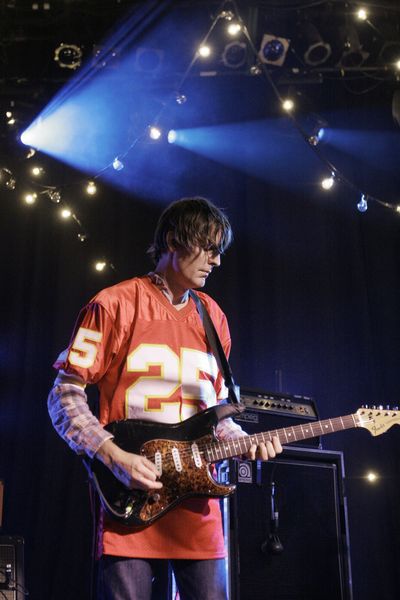
A devout sports fan, Malkmus performed in a Jamal Charles/Chiefs jersey. During the encore, he lamented that Charles now played for the “stupidest coach in the NFL.” Nastanovich echoed this sentiment urging the Chiefs to “fire (head coach Todd) Haley and hire Malkmus.”

The 100-minute set ended with “Range Life,” a playful tune that gently mocks the Smashing Pumpkins and Stone Temple Pilots (which seemed a lot more relevant when it came out in 1994). No one wanted to quit, however, so Malkmus veered into the Beatles “Ob-La-Di, Ob-La-Da.” Finally the big sing-along moment arrived. It may have taken longer than expected, but it was well worth the wait.

Setlist: Gold Soundz; Rattled by the Rush; Starlings of the Slipstream; Shady Lane; Date W/ IKEA; Frontwards; Heckler Spray > In the Mouth a Desert; Unfair; Spit on a Stranger; Stereo; Loretta’s Scars; Conduit for Sale!; Shoot the Singer; Silence Kit; Trigger Cut; Grounded; Perfume V; Cut Your Hair; Stop Breathin’; Box Elder; Fight This Generation; Debris Slide; Kennel District. Encore: Here; Lions (Linden); We Dance; Range Life (including Ob-La-Di, Ob-La-Da).

Keep reading:

Review – The Black Keys

Modest Mouse: Johnny Strikes Up the Band

Review – Arctic Monkeys

Hail Death Cab

Review: Yo La Tengo

Review: Girl Talk

(Above: Girl Talk’s Feed the Animals album from 2008.)

By Joel Francis
The Daily Record

Just because Gregg Gillis doesn’t play a musical instrument, doesn’t mean he can’t make you dance. For 80 minutes on Friday night, Gillis, better known as Girl Talk, had a packed Crossroads getting down in a downpour.

That set time may not look very long, but it was both exhausting and generous. Girl Talk specializes in creating ultimate mash-ups of literally hundreds of songs from nearly every genre and artists ranging from Boston, ODB, Radiohead, Simon and Garfunkel, Ben Folds and UGK. The shorter list would be the one encompassing all the artists Gills didn’t play. Suffice it to say, if it was a pop or club hit in the last 40 years, it was fair game for inclusion.

Girl Talk’s performance is more than matching beats per minute, however. He is the master of extracting the peak moment of a given song, pairing it with the pinnacle from another disparate track and creating a new climax higher than either cut could achieve alone.

The high-energy set was paced to jump from one high point to another, but a couple moments stand out. During Kelly Clarkson’s “Since U Been Gone” he teased out the verses, delaying the explosive chorus. When it finally hit a shockwave went through the crowd, amping the atmosphere even higher. He repeated the same trick drawing out the intro of the Smashing Pumpkins’ “Today,” before the glorious guitar riff detonated across the venue.

There’s a reason why most DJs are hidden in a booth at the back of a club: there’s usually not much visually going on. Gillis, though, took a cue from the Flaming Lips, flanked by a cast of dancing fans onstage and two assistants who were constantly streaming rolls of toilet paper and confetti into the crowd. They got an assist from Mother Nature, who provided an impressive lightning show in the sky above as the rain continued to pour throughout the night.

Although there was a video screen and basic light show, the most animated element of the night by far was Gillis himself. Taking the stage in a hoodie, it wasn’t long until he was shirtless and sweating profusely. His legs were never still, hopping back and forth between laptops on nearly every beat. Combine that with bouts of jumping on (and off) the table, arm waving and exuberant shout-outs and Gillis gave himself a heck of a cardio workout. The result was a performance far more entertaining than the typical person-behing-laptop/turntable.

Most of the set centered on recent hits, but Gillis mixed in two old tracks for the finale. The Isley Brothers’ “Shout” was virtually unaltered, save a hip hop beat underneath. The same trick that worked at the skating rink was just as effective on a larger scale with adults. The evening ended with John Lennon’s “Imagine,” which crawled at a snail’s pace compared to the rest of the night’s fare. Of course by then the message had already been received.

Keep reading:

Flaming Lips deserve Super Bowl halftime show

Chris Cornell – “Scream”

Review: Lupe Fiasco

Fourth of July – “Before Our Hearts Explode”

(Above:  The video for “Self Sabotage” off the Lawrence band Fourth of July’s sophomore album.)

By Joel Francis
Ink magazine

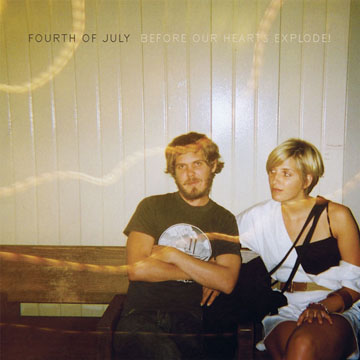
Fourth of July singer Brendan Hangauer appears on the cover of the Lawrence-based, indie quintet’s sophomore album seated next to a pretty blonde. Although she’s looking at him and leaning in, his arms are crossed and eyes stare straight ahead. The pair may be close in proximity, but they seem miles apart emotionally.

This is often how it goes in the closing stages of a relationship, when the pair faces loneliness and, of course, vast tracts of time to flip the whole scenario over and endlessly analyze.

These are the times that Hangauer, his brothers Patrick and Kelly, and Brian and Brendan Costello — another pair of siblings — relive on Before Our Hearts Explode. Breaking up, as the saying goes, may be hard to do, but it has rarely sounded like this much fun.

The album opens with “Friend of a Friend,” the story of an ex-girlfriend’s rebound lover. Driven by acoustic guitar and organ and powered by a nimble  electric guitar, it’s too bouncy to be bitter. The track sets the template for the next 40 minutes: an intimate survey of love’s rubble,  via jangly guitars and slacker vocals. It’s Bob Dylan’s Blood on the Tracks filtered through Camper Van Beethoven.

It’s also a ruse, albeit an effective one. Hangauer is broken and hurt but refuses to let his guard down. For every telling lyric such as “Don’t be so sure of things/not even wedding rings” or “you know you ruined us/when you slept with that little slut” there are a plethora of la-la-la or ooh-ooh-ooh choruses to mask the betrayal.

The facade breaks in only a couple places. “Song for Meghan,” the first ballad, arrives midway through the record. Hangauer’s unvarnished craving for an absent love resonates in Adrianne Verhoeven’s lovely vocal countermelody.

This is followed by “Moving On,” a song as caustic and cynical as anything by Elvis Costello. It also has a sweet undercurrent as Hangauer recalls brighter days. The same trumpet that amplified Hangauer’s longing on “Song for Meghan” now cuts through the track like a ray of sunlight forcing its way into a dark room through a crack in the shades.

Before Our Hearts Explode succeeds at having it both ways — a breakup record that provides the perfect accompaniment for playing Frisbee. Like all relationships it is never black and white. The good times are tucked alongside the most painful.

Keep reading:

thePhantom – “Bohemian Seduction Grooves”

A Shooting Star finds home with the Young Dubliners

Catching up with the Hot Club of Cowtown

Review: Slash

(Above: Slash + Myles Kennedy and co. perform “Civil War,” arguably Guns N Roses’ finest moment.)

By Joel Francis
The Kansas City Star

Slash will always be known as the top-hatted guitarist for Guns N’ Roses, but he’s built quite a body of work in the 15 years since leaving that band. Thursday night at Harrah’s Voodoo Lounge, Slash drew on all phases of his career – Snakepit, Velvet Revolver, his new solo album and, of course, Guns N’ Roses – during his two hour performance.

The early numbers were a quick survey of Slash’s career. “Ghost,” a number from his new self-titled effort opened the proceedings with a slinky, sleazy guitar riff. It was followed by the rough stomp of “Mean Bone” from Slash’s Snakepit days, the “Appetite for Destruction” classic “Nightrain” and Velvet Revolver’s “Sucker Train Blues.”

After a strong opening, the set got even better. “Back to Cali,” another new track, opened with vocalist Myles Kennedy of Alter Bridge and Slash standing shoulder-to-shoulder during a heated call and response that brought to mind Jimmy Page and Robert Plant. Both “Cali” and “Do It for the Kids” rocked harder than anything Slash’s former band came up with for “Chinese Democracy.” “Civil War” and “Rocket Queen,” two of the brightest moments from Slash’s Guns glory days, came next.

Guitarist Zakk Wylde once said playing with Ozzy Osbourne was like being in a glorified cover band, because the performances encompassed material from different eras and songwriters. The same could also be said by Slash’s four new band mates, but they didn’t seem to mind helping Slash recreate his finest moments any more than Wylde did with Ozzy.

Kennedy easily conjured the ghost of Axl Rose, replicating his vocal tics right down to the radio commentary at the end of “Civil War.” He had no problem nailing the high parts on “Rocket Queen,” either. Together, Kennedy and bass player Todd Kerns – who delighted romping around the stage and lip synching to all the Guns N’ Roses songs – came close to capturing the spirit of Velvet Revolver singer Scott Weiland’s tone.

Although the singer is generally regarded as the front man, this was purely Slash’s show. Kennedy dutifully moved himself and the mic stand back by the drums during each solo so Slash could have center stage. Although primarily stationed at stage left, the crowd followed Slash’s movements across the stage like plants chasing sunlight. Kennedy’s one moment in the spotlight came late in the set when Slash relinquished lead guitar duties during a cover of Alter Bridge’s “Rise Today.”

If the first half of the concert was a showcase for great songs Slash helped write, the second half was dedicated to showing off his guitar skills. Slash is the king of the oily riff that goes down smooth and leaves you feeling dirty. Those skills, however, tend to perish without the structure of a song.

Exhibit A was a tedious five-minute blues jam that culminated in the theme from “The Godfather,” another several-minute exercise. After noodling around for nearly 20 minutes – the blues jam was preceded by the instrumental “Watch This” – Slash ended his solos in the best way possible by dropping into the signature riff to “Sweet Child O’ Mine.”

Kennedy held the mic stand over the re-ignited crowd and let them lead the chorus, a trick he would perform again a few minutes later during “Paradise City.” The closing song, it encapsulated all the best elements of the night: energetic crowd participation, big riffs, great songwriting and killer solos. The night ended with some of Slash’s best solos as the ensemble stretched out over the melody.

For $30 fans could take home a recording of the concert. A line was already forming at the table in the back as the band took their final bows. The CDs are a nice souvenir for dedicated fans, but it’s hard to imagine any casual “best of Slash” playlist deviating too much from what he delivered onstage.

Setlist: Ghost; Mean Bone; Nightrain; Sucker Train Blues; Back from Cali; Do It For the Kids; Civil War; Rocket Queen; Fall to Pieces; Just Like Anything; Nothing to Say; Starlight; Watch This; blues jam > Theme from “The Godfather” > Sweet Child O’ Mine; Rise Today (Alter Bridge cover); Slither. Encore: By the Sword; Communication Breakdown (Led Zeppelin cover); Paradise City.

Keep reading:

Review: “I Am Ozzy”

Review: Motley Crue

Review: Alice in Chains

Woody Guthrie – “Deportees (Plane Wreck at Los Gatos)”

(Above: Arlo Guthrie pays tribute to his father as their friend Pete Seeger aids in a performance of “Deportees (Plane Wreck at Los Gatos).”)

By Joel Francis
The Daily Record

Illegal immigration is a hot-button topic in the current political landscape, but it is hardly a new issue. In January, 1948, a plane crashed carrying 28 migrant farmers being deported by the U.S. government. All 32 passengers were killed in this tragedy, but when newspapers and radio stations reported the incident they only mentioned the names of the pilot, co-pilot, stewardess and guard. The workers were described only as “deportees.”

This incensed Woody Guthrie, who felt the workers were just as human as the other victims. Thus inspired, he wrote a poem expressing the injustice of the situation. Since the workers’ names were not known – 60 years later, 12 of the victims are still unknown – he made up names.

Ten years later, Guthrie had been hospitalized at Greystone Park Psychiatric Hospital for what would later be diagnosed as Huntington’s disease. Although Guthrie was very much out of the public eye, learning his music became a rite of passage for the musicians in the burgeoning folk revival. Schoolteacher Martin Hoffman was inspired by Guthrie’s “Deportee” poem and set the words to music. The song was quickly passed around the folk community and Guthrie’s friend Pete Seeger added it to his repertoire.

Guthrie’s lyrics not only pay respect to the departed workers, but question the system that seduces workers to leave their families and risk their lives to find unsecured work under questionable conditions. In addition to the 28 workers who died in the plane crash, Guthrie jumps to first person and pays tribute to the other workers who either died on the job in America or perished trying to reach a better life.

“We died in your hills, we died in your deserts,
We died in your valleys and died on your plains.
We died ‘neath your trees and we died in your bushes,
Both sides of the river, we died just the same. “

After restoring humanity to the anonymous deportees and chronicling the plights of their families and countrymen, Guthrie delivers some damning questions in the final verse.

Is this the best way we can grow our big orchards?
Is this the best way we can grow our good fruit?
To fall like dry leaves to rot on my topsoil
And be called by no name except “deportees”?

In the 2004 book “Reefer Madness,” author Eric Schlosser raises many of the same questions with his essay “In the Strawberry Fields.” Drawing on firsthand accounts, Schlosser describes the conditions of the illegal farmers in the California strawberry fields. The workers’ living conditions and treatment are amount to slavery in all but name, he argues. Schlosser’s questions, like Guthrie’s, remain unanswered.

“Deportee (Plane Wreck at Los Gatos)” has been covered so often that Guthrie biographer Joe Klein declared it the “last great song” Guthrie wrote. Artists who have recorded their vision of the song, either in tribute, in protest or both, include Pete Seeger, Guthrie’s son Arlo Guthrie, the Byrds, Bruce Springsteen, the Kingston Trio, Joan Baez, Bob Dylan, Dolly Parton, the country super group the Highwaymen, Peter, Paul and Mary, Concrete Blonde, Nanci Griffith, the Los Lobos side group Los Super Seven, Old Crow Medicine Show and Billy Bragg.

Keep reading:

Bob Dylan – “Workingman’s Blues No. 2”

Bruce Springsteen and Tom Morello – “The Ghost of Tom Joad”

KC Recalls: Johnny Cash at Leavenworth prison

15 x 15

(Above: The only acceptable version of “Hoochie Coochie Man.”)

By Joel Francis
The Daily Record

A fun game has been going around the internet recently: Name 15 albums that influenced your taste in music today in 15 minutes. Because we never play anything straight up at The Daily Record, we twisted the rules a little and came up with 15 songs we dislike by artists we like.

  1. Led Zeppelin – “Stairway to Heaven.” Might as well get this heavy out of the way first. Classic rock radio has destroyed this great band’s best-known song. I’ve heard it so many times at this point I can conjure it up in my sleep. I never need to hear it again. Let me go one step further: I’d rather hear a half-hour live version of “Moby Dick” than have to sit through “Stairway” again.
  2. Joni Mitchell – “The Circle Game.” Joni Mitchell’s 1970 song about the cycles of life is actually a remarkable song. It works too well, though, leaving me completely depressed and feeling like I care about has decayed around me in just under 5 minutes. No wonder Mitchell selected this song to close her classic album “Ladies of the Canyon.” After this there’s nowhere to go.
  3. Beastie Boys – “Fight For Your Right To Party.” The Beastie Boys were a lot more creative and fun than the frat boy stereotype this dumb song earned them.
  4. Van Halen – “Love Walks In.” The Sammy Hagar period of the band is rightly painted as inferior to the original lineup, but you can’t help when you were born and I came of age right in the middle of Van Hagar. I never had a problem with Eddie switching from six-string to synths, but the sugary melody combined with lyrics about aliens made this song more than I could handle.
  5. Boogie Down Productions – “Jimmy.” Usually a master of the message, KRS-One’s sermon on safe sex comes off as both preachy and simplistic. The idiotic chorus destroys what little credibility may remain. The track did inspire the Young MC cut “Keep It In Your Pants” from his follow-up to “Stone Cold Rhymin’.” I wish I didn’t know these things, but I do and there’s nothing anyone can do about it.
  6. Anyone – “The Long Black Veil.” First performed by Lefty Frizzell in 1959, this country classic has become a staple for Johnny Cash, The Band, Emmylou Harris, Joan Baez, Bruce Springsteen and a dozen more. I can’t argue with any of those artists, but for a reason I could never put a finger on, it never resonated with me.
  7. Radiohead – “Creep.” This song introduced Radiohead to America, and for that I should be grateful, but “Pablo Honey” is the outlier in their catalog for me. In my mind, the catalog officially starts with “The Bends.”
  8. James Brown – “Killing Is Out, School Is In.” This song became the unintentional center point of Brown’s 2002 concert at the River Market. A lackluster set had already been derailed by a couple Janis Joplin covers by Brown’s then-wife and mayor Kay Barnes onstage proclamation of James Brown Day. Several years after Columbine, the message was not only no longer timely, but embarrassing. The song was later released as a single. Thankfully few heard it.
  9. David Bowie – “Changes.” Yet another song ruined by radio and turned into lazy shorthand for its era by television and movie producers.
  10. The Beatles – “The Long and Winding Road.” Dislike may be too strong a word for this song, but Paul McCartney had already delivered a better ballad for the “Let It Be/Get Back” project. This one feels like a syrupy afterthought to me.
  11. Steve Earle – “The Devil’s Right Hand.” This number brought Earle acclaim as a songwriter before he established himself as a recording artist in his own right. I think Lynyrd Skynyrd covered the same turf better with “Saturday Night Special.” The verses aren’t band, but the song is overly reliant on the repetitive chorus.
  12. The Who – “Behind Blues Eyes.” This sensitive number never seemed to fit in with the rest of “Who’s Next” and it seemed even more out of place as a single. Pete Townshend usually struck the right balance of being tough and vulnerable at the same time (see “The Song Is Over” or “How Many Friends”). He sounds weak and whiney on “Blue Eyes.” Limp Bizkit’s cover confirmed my instinct. Sympathy for Fred Durst? Never!
  13. Anyone but Muddy Waters – “Hoochie Coochie Man.” In the hands of Waters and the Chess studio pros, this is a blues masterpiece. For just about anyone else, it is usually a lame attempt for a middle-aged white guy to show he’s hep to the blooze. I’m looking at you Eric Clapton, Alexis Korner, Steven Seagal and Dion.
  14. Jay-Z – “Young Forever.” Alphaville’s 1984 hit “Forever Young” worked perfectly as the soundtrack to Napolean Dynamite’s dance with Deb. In the hands of Hova, however, it is ridiculous.
  15. Louie Armstrong – “What A Wonderful World.” There’s nothing wrong with Satchmo’s sublime performance. He manages to walk the tightrope between sincere and saccharine as the strings underneath support his presentation. Unfortunately, no one understood the song’s message, as it has a crutch when movie producers want to tug on heartstrings. Joey Ramone’s version was great upon release, but in the decade since it has become a hipster version of the same cliché.  I guess this leaves me with Wayne Coyne and the Flaming Lips’ weird yet heartfelt reading. I don’t think mainstream America is ready for that to be thrust down their throats – yet.

Keep reading:

Review: Flaming Lips New Year’s Freakout

Jay-Z – “The Blueprint 3″

Review: “Pops” by Terry Teachout

Review: “Ripped” by Greg Kot

(Above: A librarian at the Edmonton Public Library reviews Greg Kot’s book “Ripped.”)

By Joel Francis
The Daily Record

When I was in graduate school I wrote my précis – an abridged thesis – on how the internet was changing the music industry. It was an exciting time. Napster was in full swing and Metallica’s lawsuit was not only breaking news, but new research ripe for my writing. (Incidentally, the record industry’s great hope at the time was to create a new type of CD that could not be copied or ripped to computer.) I was praised for my paper, but the research did not age well. Barely two years after graduation, its findings were horribly outdated.

Greg Kot fares much better in his recent book “Ripped” How the Wired Generation Revolutionized Music.” Published in 2009, he takes the long view on the digital evolution of the past decade. The book opens with an overview of how the major labels wound up on the wrong side of their consumers at the turn of the century. In the first three chapters, Kot covers the consolidations that homogenized commercial radio and placed extra emphasis on the major labels’ profit margins; the labels’ revolt against the payola system they built and established; and how labels quashed their artists’ efforts to embrace the Internet.

That’s a lot to cover in 50 pages, but Kot is wise not to belabor these points. Other books – notably Steve Knopper’s “Appetite for Self-Destruction,” which appeared a few months earlier – cover this ground in far more depth. Kot’s summary provides a nice launching pad for the real meat of his book, namely how the net has allowed artists and fans to connect in unexpected ways with unexpected results.

Today Prince is a punching bag for declaring the internet “completely over,” but his actions in the mid-‘90s laid the groundwork for the path Radiohead, Nine Inch Nails and other bands currently follow. Walking away from his contract with Warner Bros., Prince built a network with his fans where he would release music directly to them, at a pace he dictated. Without the modern digital infrastructure, distribution was often slow and frustrating. It is puzzling that yesterday’s visionary opted out just when technology became the most accommodating.

Kot also discusses how the internet helped Wilco and Death Cab For Cutie develop an online cult following and how that translated to mainstream success. Another chapter is devoted to the impact of Pitchfork and other online tastemakers. The book ends with the stories of Lily Allen, Nine Inch Nail’s Trent Reznor and Radiohead and how their business models have turned the industry on its head.

A music critic and reporter for the Chicago Tribune, Kot draws on his day job to incorporate first-hand quotes delivered in the heat of the moment. Putting the reader in the speaker’s mind in real time keeps the stories fresh and makes the linear exposition more exciting. Very little is revealed through hindsight; the reader gets everything as it occurs.

“Ripped” shares many traits with Thomas Freidman’s 2006 exploration of the online paradigm “The World is Flat.” Both books hold few revelations for readers who followed the events unfold in real time, but are also handy encapsulations of everything that has occurred. At the same time, they are immensely in explaining to the uninitiated how we got to where we are. Whether “Ripped” deserves a spot on the bookshelf or a visit to the library depends on the reader’s level of knowledge. Either way, it is worth reading.

Keep reading:

Review – “Record Store Days”

Radiohead Rock St. Louis

Review – “King of the Queen City”

Review: Wilco returns to the Crossroads (2009)

Review: Alejandro Escovedo

(Above: Alejandro Escovedo and his Sensitive Boys revisit “Chelsea Hotel ’78” at the Record Bar on August 28, 2010.)

By Joel Francis
The Daily Record

Before playing a note, Alejandro Escovedo apologized for letting five years elapse since their last show in Kansas City. That show featured Escovedo’s True Believers band mate Jon Dee Graham, a string quartet and ended with Mott the Hoople covers around two a.m.

Saturday’s sold-out show at the Record Bar was a little more restrained in contrast, but no less potent. The strings were gone, and Graham was replaced by other True Believer, drummer Hector Munoz. He was part of a lean, four-piece band that knew how to wring maximum emotion from Escovedo’s songs. The 90-minute  show also ended at a more respectable time – just 30 minutes into the next day – with a Rolling Stones cover.

Escovedo’s songwriting holds more facets than a jewel, encompassing classical, country, Mexican, punk and classic rock. He displayed several of those sides, especially on the gorgeous instrumental “Fort Worth Blues” and the south of the border flavored “Rosalie.” Mostly, though, the quartet modulated between two modes – full-throttle rock and poignant acoustic ballads. Songs like “This Bed Is Getting Crowded” and “Tender Heart” were too mature to be straight-up punk, but they weren’t far off. It was invigorating to watch the 49-year-old songwriter rip into his material with such raw passion.

Ten years ago, Escovedo played a benefit show at the City Market for Jim Strahm. A big influence on the Kansas City music scene, Strahm sold a lot of musicians their first instrument, booked them their first gigs or joined them onstage. Sadly, Strahm did not survive his bout with cancer – Saturday would have been his 50th birthday. Fittingly, Escovedo dedicated the show to his friend, which added extra juice to the opening song, “Always a Friend.”

While the electric numbers were delivered with a fury that barely allowed anyone, band or audience, to catch their breath, the ballads were given ample space to breath. An incredible reading of “Sister Lost Soul” was delivered at half its album tempo and felt almost like a prayer. It was followed by “Down in the Bowery” and a story about Escovedo’s 18-year-old son who once called his father’s music “old music for old people.” Built on the generations’ shared love of the Ramones, it included the line “I hope you live long enough to forget half the stuff that they taught you.”

Regardless of style or tempo, one element was consistent: the intricate, interplay between Escovedo’s rhythm guitar and David Pulkingham’s tasteful leads. Some of their best moments included the solo over the stomping bass-and-drums introduction to “Street Songs,” “Fort Worth Blue” and “Rosalie” and “Real as an Animal.”

“Castanets” was one of a handful of the night’s songs that wasn’t pulled from Escovedo’s two most recent releases. Banned from setlists for a while after Escovedo learned it was a favorite of former president George W. Bush, it had the crowd dancing and joining in on the infectious chorus of “I like it better when she walks away.”

After performing a new song, Escovedo closed the night sans guitar on a lengthy cover of “Beast of Burden.” With a trio of fans onstage providing backing vocals or percussion, Escovedo worked the crowd like, take your pick, an exuberant wedding singer or fevered rock and roll evangelist. By the end, everyone was converted.

Setlist: Always a Friend; This Bed Is Getting Crowded; Anchor; Street Songs; Tender Heart; Fort Worth Blue; Sister Lost Soul; Down in the Bowery; Rosalie; Chelsea Hotel ’78; Castanets; Real as an Animal. Encore: Sensitive Boys; Lucky Day (new song); Beast of Burden (Rolling Stones cover).

Keep reading:

Carrie Rodriguez honors family, roots on new album

Review: Old 97s, Lucero

Review: Los Lobos

Review: Goo Goo Dolls

(Above: It was impossible to go anywhere in 1997 without hearing “Iris,” the Goo Goo Dolls’ biggest hit.)

By Joel Francis
The Kansas City Star

During the mid- to late ‘90s, the Goo Goo Dolls racked up multiplatinum albums, Top 10 hits and Grammy nominations. That was a long time ago, but you wouldn’t know that walking into the Independence Events Center on Thursday night.

“We are small, but we are mighty,” lead singer John Rzeznik told the house, which was better than three-quarters full. As expected, the crowded demonstrated its approval by singing along to “Dizzy” the second of seven cuts from 1998’s “Dizzy Up the Girl” played that night.

By including 11 songs from their 2007 greatest hits album, the Dolls had a surefire set list. Most songs drew a cheer from the opening chords and were long-form exercises in audience participation. Even “Home,” one of five new songs the band bravely tested from their upcoming album, found several fans singing along.

The best numbers were the most obvious ones. “Black Balloon” found the area in front of the stage filled with, what else, black balloons. At times the reactions during “Name” and “Slide” threatened to overwhelm the very vocal-friendly mix.

Touring guitarist Brad Fernquist added some nice slide guitar to Rzeznik’s otherwise solo “Acoustic #3.” “All Eyes on Me” featured a great instrumental coda that provided one of the few times the band stretched out.

The biggest moment, of course, was “Iris.” Rzeznik prefaced it by telling the crowd “we gotta play this one” and everyone reacted to the introduction like they had just walked out of “City of Angels.” After a full performance of the song, the back kicked into it one more time to let the crowd have a solo run through the chorus. They probably could have done it once more and achieved the same result.

Hopping around barefoot on the massive stage, bass player Robby Takac took the mic for four numbers. His rawer songs showed off the influence the Replacements had on the Dolls’ sound. This was especially true on “Another Time Around,” the lone nod to their pre-fame days. Even though it was written more than 15 years later, “Now I Hear,” Takac’s contribution to the forthcoming “Something For the Rest of Us” album, sounded like it could have been cut at the same session.

After blowing their big bullets – “Name” and “Iris” – during the main set, the band returned with another new track and “Broadway,” another “Dizzy” single. The 90-minute set may have not offered many surprises, but everyone got exactly what they were looking for: a fun romp down memory lane.

Setlist: The Sweetest Lie (new song); Big Machine; Slide; Dizzy; Here Is Gone; Another Second Time Around; Smash; Can’t Let Go; Black Balloon; Home (new song); Better Days; Stay With You; Now I Hear (new song); Tucked Away; Name; Let Love In; As I Am (new song); All Eyes On Me; Acoustic #3; Iris. Encore: Not Broken (new song); Broadway.

Keep reading:

Review: Chickenfoot

Review: Jack Johnson

Review: Motley Crue

Review: Experience Hendrix