The Supremes – “You Can’t Hurry Love”

Supremes_You_cant_hurry_love

The Supremes – “You Can’t Hurry Love,” Pop #1, R&B #1

By Joel Francis

The bouncing bassline that opens this song is courtesy of James Jamerson, the same man who delivered the delightful and legendary three-note thump that introduces “My Girl.”

The intro to Holland-Dozier-Holland’s masterpiece “You Can’t Hurry Love” is a lesson in how to build a Motown hit: Start with the bass and percussion, add some horns (or strings) and then have a pretty voice jump into a catchy verse.

Diana Ross may not have had the prettiest or best female vocal on the Hitsville roster, but by 1966 she had the most recognizable one. And for once her thin tone actually works in her favor. Ross’s voice perfectly conveys the naivety and innocence of a lovelorn girl trying to be patient – “remember mama said,” she sings – to little avail. Ross would seldom reveal so much of herself in song again, hiding behind “big” vocals a la “Ain’t No Mountain High Enough.”

When this song was recorded, Ross was little more than a year away from getting top billing and four years removed from going solo. Even still, Mary Wilson and Florence Ballard are little more than anonymous backing singers in the mix. Although the track is as perfect as a song can be, it’s a shame their talent wasn’t given greater prominence.

While this song may be held up as Exhibit A by haters who think Motown is too slick and soulless, it is also testament to how smoothly the Motown assembly line was working. The song was recorded in just two sessions. Presumably the Funk Brothers laid down everything but the vocals at the June 11, 1966 session and the Supremes added their vocals at the July 5 session. Little more than three weeks later, the single was on the radio. By September, only three months after initial recording, it sat at No. 1 and earned the trio a high-profile performance on the Ed Sullivan show.

“You Can’t Hurry Love” had a renaissance in the 1980s. Phil Collins took it to the Top 10 in 1982, the same year the Stray Cats put it on the flip side of “Rock This Town.” Whoopi Goldberg sang it in her 1986 film “Jumpin’ Jack Flash,” and former Jimi Hendrix/Electric Flag drummer Buddy Miles sang it as the voice of the California Raisins (which, sadly, was the first version The Daily Record heard and its non-oldies radio introduction to classic R&B).
Jr. Walker and the All Stars – “How Sweet It Is (To Be Loved By You)”

sweet

Jr. Walker and the All Stars – “How Sweet It Is (To Be Loved By You),” Pop #18, R&B #3

By Joel Francis

Because he owned both the label and its publishing, it’s no surprise that Berry Gordy frequently had other label artists cut versions of earlier Motown hits. While there are several notable exceptions, for the most part these covers are either curiosities or album filler.

Jr. Walker, however, broke out of the mold with his reading of Marvin Gaye’s 1964, Top 5 hit “How Sweet It Is (To Be Loved By You).” After an extended saxophone intro, Walker puts down his horn. He has clearly overcome the microphone shyness that plagued him during the recording of his breakthrough hit “Shotgun.” Walking in Gaye’s shoes is no small feat, but Walker’s voice credibly handles the soulful, demanding melody.

While Gaye’s version was slick, joyous anthem, Walker’s is a little seedier – and all the better for it. Producer Harvey Fuqua, who signed Walker and changed his band name from the “Rhythm Rockers” to the “All Stars” in 1961, gave the song a faux-live feel that makes it sound like it was captured in a Southern roadhouse. The purposefully ragged backing vocals are more like enthusiastic audience intrusions. Close your eyes and you can smell alcohol and cigarette smoke while listening.

Others have covered this number since Gaye and Walker, of course, but a moratorium should have been placed after this interpretation. Finally, it should be noted that the year after he recorded “How Sweet It Is,” Walker memorably stole “Come See About Me” from the Supremes – no small feat – with his 1967 cover.

Raphael Saadiq sends a love letter to soul makers and Motown

(Above: Raphael Saadiq runs the “100 Yard Dashfor Seattle’s excellent community radio station, KEXP.)

By Joel Francis
The Kansas City Star

Raphael Saadiq’s latest album, “The Way I See It,” is draped heavily in the sounds of Motown and Philly soul, but don’t call it a tribute album.

“Boyz II Men did a tribute; I wrote a bunch of songs,” Saadiq said about his all-originals album. “This was not intended to be a tribute album. It’s more like a secret love letter to the people I love.”

People like the Funk Brothers, Motown’s now-legendary stable of musicians, and the other unknown musicians who “took music to the level where it is today that I can come out and do this,” Saadiq said. “It’s not just about Smokey (Robinson) and Stevie Wonder, but a bunch of people we don’t even know about.”

He plays most of the instruments on the album himself, but Saadiq recruited two Funk Brothers to help him get that classic Motown sound. Jack Ashford’s tambourine has graced classics like “Nowhere to Run” and “You Can’t Hurry Love.” Paul Riser, who arranged the strings on Saadiq’s album, has worked with the Supremes, Marvin Gaye and Stevie Wonder.

“I brought Jack in because he added a sound I couldn’t have had without him,” said Saadiq, who performs Wednesday at the VooDoo Lounge. “With Paul Riser it was the same thing. You can feel the energy when they walk into a room.”

Having Stevie Wonder play harmonica on one song was ultimate validation. Saadiq even went so far as to introduce his guest like Wonder introduced Dizzy Gillespie on his 1982 hit “Do I Do.”

“Seeing Stevie walk into a room and play is something I’ve never gotten used to,” Saadiq said. “Having him play on this was a stamp of approval. I’ve worked hard for a long time to have him come play (on my album).”

The former Tony! Toni! Tone! singer, who named his first solo album “Instant Vintage,” is more worried about being called “neo soul” than being pigeonholed.

“Everybody knows I hate the term ‘neo-soul,’ ” Saadiq said. “If someone was playing the blues they’d want an old soul. I don’t want a new soul — then I’d sound like somebody on the radio today, which I hate.”

On an album with so much — ahem — old-school soul, Jay-Z’s guest spot on the final track, a bonus remix, probably surprised many listeners.

“That was Q-Tip’s idea,” said Saadiq, referring to the former MC of A Tribe Called Quest. “He was like, ‘You should put Jay-Z on this record’ and then went and got him, because I didn’t know Jay like that. Some people didn’t like it. They’re probably neo-soul fans. I did this for the other people.”

More on Raphael Saadiq from The Daily Record:
“The Way I See It” album review
“The Way I See It” caps the Top 10 albums of 2008

Shorty Long – “Function at the Junction”

function

Shorty Long – “Function at the Junction,” Pop #97, R&B #42

Bluesman Shorty Long always sounded more like a Chess artist than someone on the Motown roster. His 1964 song “Devil With A Blue Dress” sounded like something coming out of a juke joint at midnight. “Function at the Junction,” released two years later, was no less conventional. While Long was one of the few Motown artists in the ’60s allowed to produce himself – Smokey Robinson was another –  he allowed the Holland-Dozier hit machine to apply their shiny production to this number. The result was something that sounded more like Little Richard’s Specialty output of the ’50s than any of the recent HDH hits, but there were a few Motown trademarks. The drums and tambourine are pushed to the front of the mix, but the piano riff propped up by a mean organ that drive the song.

Lyrically, Long’s number is similar to Willie Dixon’s “Wang Dang Doodle” which was a hit for Koko Taylor and Chess the previous year. While Taylor sings of Automatic Slim and Fast Talking Fanny, Long espouses “Ling Ting Tong from China” and 007, who is “bringin’ all the guys from ‘I Spy.'”

The debt “Function at the Junction” owes Little Richard wasn’t lost on the legend, who covered the number in 1971. Two years later jazzman Ramsey Lewis teased the song’s piano strains with his reading. Two decades later, Huey Lewis revived the tune for a greatest hits package. – by Joel Francis

The Elgins – “Darling Baby”

darling-baby

The Elgins – “Darling Baby,” Pop #72, R&B #4

The Elgins started as a trio in 1962 who called themselves The Downbeats. When they added frontwoman Sandra Edwards (nee Mallet) and another singer, they switched their name to the Elgins. That wouldn’t have been a problem, except copies of “Darling Baby” were already being pressed, so new labels had to be hastily printed. Copies of “Darling Baby” credited to the Downbeats carry a hefty price tag. (Original pressings of the Elgins’ “Darling Baby” run between $25 and $50.)

The group’s name choice is an interesting one. The Temptations went as the Elgins before Berry Gordy made them come up with a new handle. There was also a Los Angeles-based doo-wop group with the same name.

Unfortunately, all of this history is more interesting than the actual song. Penned by the usually spectacular Holland-Dozier-Holland team, “Darling Baby” is as generic as its title. Despite a fine vocal performance by Edwards, the backing vocals are laughably unconvincing, the rhythm plods and the arrangement is stagnant. Edwards pleads her departing lover to “talk it over one more time,” but it’s obvious there isn’t much being said.

Fortunately, the Elgins’ follow-up hit “Heaven Must Have Sent You,” atones for the misstep of “Darling Baby.” – by Joel Francis

Stevie Wonder – “Uptight (Everything Is Alright)”

uptight

Stevie Wonder – “Uptight (Everything Is Alright),” Pop #3, R&B #1

By Joel Francis

Nearly two years after success of “Fingertips,” Little Stevie finally found a follow-up hit – just in the nick of time. Motown had just about given up on him. Never mind that Wonder hadn’t been given much to work with: an album of Ray Charles covers, the “Fingertips” knock-off “Workout Stevie” and corny kids songs like “Happy Street” and “Hey Harmonica Man.” His dry spell was compounded by the fact that his voice was starting to change. Motown producers were wary of working with the onetime boy wonder, but Clarence Paul, who had acted as a mentor and father figure to the boy since his 1961 signing, liked his protégé’s newfound tenor.

The only thing uptight about this number is its title. The melody is fun, free and fresh. From the signature horn fanfare to the delight in Wonder’s voice, there are smiles all around. Every week Berry Gordy used to run each prospective single through a quality assurance committee who would vote on which numbers were released. The idea was a holdover from Gordy’s days on the assembly line. It’s hard to picture anyone not voting for this upbeat tune. I like to imagine that a spontaneous dance session broke out when it was played.

Once the song broke, everything was alright in Wonder’s world. Success may have been an early struggle, but it flowed effortlessly after this. With three exceptions, Wonder had at least one Top 10 hit per year from 1965 to 1985.

Martha and the Vandellas – “Love (Makes Me Do Foolish Things)”

882867

Martha and the Vandellas – “Love (Makes Me Do Foolish Things),” Pop #70, R&B #22

By Joel Francis

Martha and the Vandellas didn’t do many ballads. Their best-known songs – “Heat Wave,” “Jimmy Mack” and “Nowhere to Run” – are all relentlessly upbeat. Despite the drastic change in tempo, the three songs above share at least one similarity with “Love (Makes Me Do Foolish Things)”: They were all written by Holland-Dozier-Holland.

The HDH team really came into its own in 1965, the year “Love” was released. Rare was the week that one or more of their songs wasn’t found near the top of the charts. This number, however, was a rare misstep for the team.

Martha Reeves turns in a fine vocal performance, but the song never really ignites. The number never peaks. Once Reeves’ voice enters, everything just kind of sits there until the fade-out. Although the trio wrote captivating arrangements for “It’s the Same Old Song” and “I Hear a Symphony,” the arrangement here isn’t anything to write home about. The drums are prominent in the mix, but aren’t really saying anything. Likewise, one gets the impression the strings were just added to make the mix more full. Finally, the lyrics are solid, but don’t expose anything not given away in the title.

“Love (Makes Me Do Foolish Things)” never ignited with other artists, either. Berry Gordy tried to farm the song off to a couple other Motown artists, most notably the Supremes. The results of Kim Weston’s adventures with the tune languished in the Motown vaults until the historical reissues of 2005.

That said, it is never wise to write off a Holland-Dozier-Holland number, especially from this era. In the right hands, the song could be a surprising hit today.

Four Tops – “It’s the Same Old Song”

341862
Four Tops – “It’s the Same Old Song,” Pop #5, R&B #2

By Joel Francis

There’s a good reason why “It’s the Same Old Song” sounds so much like the Four Tops’ previous hit, “I Can’t Help Myself:” both songs are built on the same chords, only in reverse order.

When “I Can’t Help Myself” hit No. 1 in June, 1965, the Tops’ old label, Columbia, tried to cash in by re-releasing a five-year-old Tops single. An upset Berry Gordy countered that Motown needed to quash that single with one of their own – in just 24 hours.

At 3 p.m. Holland-Dozier-Holland sat down to write. Just two hours later, the Tops had finished recording the number and the tune was ready to mix. By 3 p.m. the next day, 1,500 copies of “It’s the Same Old Song” had been pressed and sent to DJs across the country. The icing on this astounding feat of production came in the coming weeks, as the song eventually rose to No. 5 on the charts.

Like “I Can’t Help Myself,” the song is propelled by Funk Brother Jack Ashford’s vibe’s and Richard “Pistol” Allen’s drumming. The bubbly string arrangement also echoes “I Can’t Help Myself.” Unsurprisingly, the end result is a second helping of a joyous melody masking a melancholy lyric. If it ain’t broke….

In the late ’70s two groups proved it was anything but “The Same Old Song” with two very different covers. KC and the Sunshine Band turned in a disco version and Delroy Wilson gave a reggae reading. Neither translation made the charts.

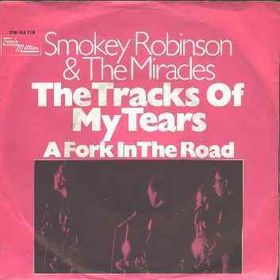
The Miracles – “The Tracks of My Tears”

smokey

The Miracles – “The Tracks of My Tears,” Pop #16, R&B #2

By Joel Francis

Smokey Robinson had little to prove in 1965. Since joining Motown four years ago, he had not only given the label its first million-selling single and its first No. 1, but written, produced or performed on scores of classic tracks. Robinson was rewarded for all his work when his name was pulled out of the Miracles and given top billing.

“The Tracks of My Tears” was one of the first singles credited to “Smokey Robinson and the Miracles,” but Robinson wasn’t resting on his laurels. His heart wrenching vocals may be topped only by Levi Stubbs’ performance on “Ask the Lonely” as the label’s most powerful performance to date. With a voice packed full of heartache and longing, Robinson pulls back the mask, revealing his naked heart to his former lover.

Exhausted after meticulously maintaining his façade for the evening, and the truth seeps out of Robinson’s character when he’s finally alone. Ah that the pain of love could be so melodic. The song starts as if out of dream, introduced by the subtle but spectacular guitar line of Marv Taplin. The Miracles’ harmony vocals are the reassurance and support that are always absent in these dead-of-night confessions. The orchestra, xylophone and drumming are all perfectly arranged and placed. Everything pauses for the syncopation of the line “My smile is my makeup I wear since my break-up with you.”

“The Tracks of My Tears” is frequently lauded as not only Robinson’s best number, but one of the greatest songs of all time. It is also the Miracles’ most-covered song. Less than two year’s after the Miracles’ hit, Johnny Rivers cut a version. Aretha Franklin’s reading from “Soul ’69” is just wonderful. Her celebrated voice is framed by a gorgeous finger picked guitar and a tough brass arrangement that accentuates without overpowering. Most recently, the song has been covered by Dolly Parton and Elvis Costello, who sometime performs it in concert as a medley with his like-minded hit “Alison.”

Although the song is nearly 45 years old, it hasn’t aged a minute.

The Contours – “First I Look at the Purse”

262-contours
The Contours – “First I Look at the Purse,” Pop #57, R&B #12

By Joel Francis

The name on the label says “The Contours,” but all four of the singers who found success with 1962’s chart-topping “Do You Love Me” were gone by the time this number came out three years later.

A novelty song penned in the vein of Jerry Lieber and Mike Stoller’s classic Coaster’s numbers, it’s hard to imagine songwriters Smokey Robinson and Bobby Rodgers presenting this number to their group, the Miracles. But since none of the Contour’s follow-up efforts had cracked the Top 40, they had a little leeway for fun.

The production combines the Motown Sound with a spirit similar to Jimmy Soul’s 1963 hit “If You Wanna Be Happy.” In Soul’s song, ugly women cause fewer problems that pretty ones. For the Contours, fiscal assets are more desirable than physical ones. Or as the lyrics so eloquently put it, “If the purse is fat/that’s where it’s at.”

It’s not surprising the number failed to catch on, although it did prevent the group from becoming a one-hit wonder. What is surprising is the longevity of the group. As the original lineup fell away, Berry Gordy kept replacing members. Billy Gordon, the man who sang lead on “Do You Love Me” was replaced by Joe Stubbs, brother of Four Tops vocalist Levi Stubbs. After Stubbs left, Dennis Edwards was recruited to front the group.

It seemed the end for the Contours when the Temptations plucked Edwards to be their frontman in 1968. Founding member Joe Billingslea had other plans. Nearly 10 years after he left the group, Billingslea, a founding member, resurrected the name and hired four other singers to play and record with him around Detroit.

The band found themselves in demand after the Motown 25 concert and the 1988 film “Dirty Dancing,” which prominently featured “Do You Love Me.” The subsequent Dirty Dancing Concert Tour found Billingslea reunited with his old bandmate Sylvester Potts and recording for Motor City Records. In the early ’90s, Potts split from Billingslea’s quintet and started his own four-piece lineup, also called The Contours. Today, both Joe Billingslea and the Contours and The Contours featuring Sylvester Potts can be found on the oldies and county fair circuit.