(Above: Blues legends Hubert Sumlin and James Cotton help Big Head Todd and the Monsters visit the “Killing Floor.”)
By Joel Francis The Kansas City Star
Rock and roll tributes to the blues are hardly a novel concept, but the glossy, contemporary rock of Big Head Todd and the Monsters makes them an unexpected outfit to try such a feat.
Saturday’s concert at the Uptown was billed as “Back at the Crossroads: The Robert Johnson Centennial Concerts.” The four-piece, Colorado rock band aimed to celebrate Johnson in the months leading up to his 100th birthday in May, but this wasn’t quite the case. Johnson figured prominently in the set, but there was also a heavy dose of Chicago blues. The night was more like an exposition of the genre’s most overt influences on rock. Put another way, the first set opened with Todd Park Mohr alone onstage playing the dobro and ended less than an hour later with dueling drum solos.
Taking the stage in a dark suit and black fedora, frontman Mohr quickly put any expectations for the Monsters’ back catalog to bed, telling the one-third capacity crowd the only thing they’d be hearing was “straight, natural blues.” He was right for the most part, but an audience clamoring for “Bittersweet” – one of the band’s biggest tunes – needn’t have worried. The songs in the last third of the set sounded like typical Big Head Todd material outfitted with familiar blues lyrics.
Mohr opened with three stellar, solo acoustic numbers before being joined by Missouri native Lightnin’ Malcolm and Monsters keyboardist Jeremy Lawton. That trio, along with bass player Rob Squires who entered later, formed the core band for the night, present on nearly every number. They were augmented by drummer Cedric Burnside, grandson of the Fat Possum bluesman R.L. Burnside and Malcolm’s longtime touring partner, and Monsters drummer Brian Nevin.
The real blues cred, however, came from 79-year-old guitarist Hubert Sumlin, and 75-year-old harp man James Cotton. Sumlin’s playing can be heard on most of Howlin’ Wolf’s classic material and Cotton played on many great Muddy Waters records. Half a century later, both men were in just as fine of form today as they were in their Chess Records heyday. Sumlin’s soling was nimble and his vocal turn on “Sittin’ On Top of the World” was strong. Cotton made his harmonica moan and wail like a woman in pleasure and had so much fun during one solo that he started laughing when it was done.
Big Head Todd and the Monsters are no strangers to working with blues legends. In 1997 they worked with John Lee Hooker on a cover of his “Boom Boom” that reached the Top 40. Opinions of that track will likely frame one’s appreciation for the evening: The band either misappropriated a hero to dumb down a song or paid honest homage using their familiar idiom.
The best moments were the spare opening numbers, particularly Lightnin’ Malcolm’s duets with Cotton on “Walkin’ Blues” and “Future Blues.” Mohr really pushed himself at the mic all night and did a great job approximating the Wolf’s moans and rasp on the Chicago numbers. Cotton or Sumlin were onstage for about half of the two-hour set’s 22 songs. Their contributions were always a treat.
After the first, mostly acoustic set, the band took a 20 minute break. They returned for another hour of electric music that blurred the lines between Chicago blues, traditional bar band fare and the typical Big Head sound. Not everything worked – covers of ZZ Top’s “Jesus Just Left Chicago” and a slick arrangement that removed any sense of doom from “Last Fair Deal Gone Down” were questionable. But there was no doubt everyone onstage was having fun.
Setlist: Love in Vain; Stones In My Passway; Dry Spell; Kind-Hearted Woman Blues; If I Had Possession Over Judgment Day; Walkin’ Blues; Future Blues; Viola Lee Blues; When You Got A Good Friend; Travelling Riverside Blues. Intermission. Ramblin’ On My Mind; Preachin’ Blues (Up Jumped the Devil); Wang Dang Doodle; Sittin’ On Top of the World; Killing Floor; I Love the Life I Live, I Live the Life I Love; Jesus Just Left Chicago; Come On In My Kitchen; Last Fair Deal Gone Down. Encore: Cross Road Blues; I Believe I’ll Dust My Broom > Sweet Home Chicago.
(Above: Ozzy performs “Mr. Crowley” at the Sprint Center on Jan. 22, 2010.)
By Joel Francis The Kansas City Star
The Prince of Darkness looked more like a soaked kitten.
Ozzy Osbourne stood center stage dripping wet, covered in foam. Thanks to the fire hose he used to liberally douse both himself and fans in the front half of the floor, Ozzy looked like he’d just fallen into a bathtub. The foam would dissolve, but Ozzy would never dry out.
Ostensibly in town to promote a new album, Ozzy performed just one new song. Most of the rest of the setlist could have been written months in advance by a causal fan. But while the songs didn’t hold any surprises, many of the performances were still vital.
Experiencing Ozzy perform “Crazy Train” is a classic rock ‘n’ roll moment up there with hearing the Stones do “Jumping Jack Flash” or seeing Pearl Jam perform “Alive.” Despite being more than 40 years old, “War Pigs” still packs a powerful punch.
Although some of his solo material hasn’t aged as well, the three-quarters full house still reveled in the night, pumping their fists during solos and singing along. During “The Road to Nowhere” and “Mama, I’m Coming Home” the room lit up with lighters.
“Mr. Crowley” was an early highlight. Keyboard player Adam Wakeman, son of Rick Wakeman, turned the room into a giant cathedral with his ominous organ. As he played, a sheet of sparks feel from the rafters behind Ozzy, creating a curtain of fireworks.
Although there was a large video screen behind the band for most of the set and plenty of pyrotechnics, Ozzy’s oversized persona was the best visual effect of the night. Waterworks aside, he was constantly in motion, urging the crowd to clap, hopping up and down like a frog or bowing to his audience. During “Fire in the Sky” he writhed his arms and body during the lengthy guitar solo as if performing some Satanic jujitsu.
The two-hour set lagged quite a bit toward the end. It would have been difficult to maintain the energy and momentum of the opening numbers, but back-to-back, cliché-ridden guitar and drum solos deflated the show. Everyone would have been better served had the band performed two 45-minute sets with an intermission.
Fortunately Ozzy still had plenty of goodies buried in his catalog. “Crazy Train” brought the crowd back to life, while “Mama” and “Paranoid” ensured most of them would show up next time for his inevitable return.
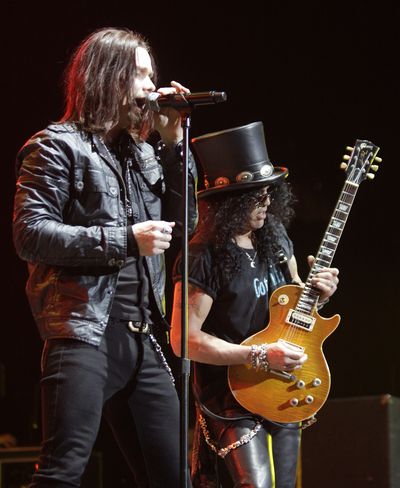
Slash: Axl Rose is notorious for making fans wait hours before appearing; Slash came onstage 10 minutes early. His one-hour set was basically a truncated version of the show he put on last fall at the Voodoo Lounge. It was heavy on Guns ‘N’ Roses, with most of the songs coming from “Appetite For Destruction.” The Velvet Revolver material held its own, but some of the newer songs lost the crowd, especially “By the Sword.”
For a band so reliant on its guitarist, the mix was atrocious. All the instruments were trapped in a mush under bellowing drums and vocals that sounded like they emanated from a tin-can telephone. Fans may have been better served sonically by asking their next-door neighbor to play “Appetite” at full volume, then retreating to their basement and listening to it from there. Although the sound got better at times, the closing solo during “Paradise City” was practically inaudible.
Ozzy setlist: Bark at the Moon; Let Me Hear You Scream; Mr. Crowley; I Don’t Know; Fairies Wear Boots; Suicide Solution; Road to Nowhere; War Pigs; Fire in the Sky; Shot in the Dark; guitar solo > Rat Salad > drum solo; Iron Man; I Don’t Want to Change the World; Crazy Train. Encore: Mama, I’m Coming Home; Paranoid.
Slash setlist: Ghost; Sucker Train Blues; Mr. Brownstone; Back From Cali; Civil War; Nothing to Say; By the Sword; Nightrain; Sweet Child O’ Mine; Slither; Paradise City.
(Above: It was impossible to go anywhere in 1997 without hearing “Iris,” the Goo Goo Dolls’ biggest hit.)
By Joel Francis
The Kansas City Star
During the mid- to late ‘90s, the Goo Goo Dolls racked up multiplatinum albums, Top 10 hits and Grammy nominations. That was a long time ago, but you wouldn’t know that walking into the Independence Events Center on Thursday night.
“We are small, but we are mighty,” lead singer John Rzeznik told the house, which was better than three-quarters full. As expected, the crowded demonstrated its approval by singing along to “Dizzy” the second of seven cuts from 1998’s “Dizzy Up the Girl” played that night.
By including 11 songs from their 2007 greatest hits album, the Dolls had a surefire set list. Most songs drew a cheer from the opening chords and were long-form exercises in audience participation. Even “Home,” one of five new songs the band bravely tested from their upcoming album, found several fans singing along.
The best numbers were the most obvious ones. “Black Balloon” found the area in front of the stage filled with, what else, black balloons. At times the reactions during “Name” and “Slide” threatened to overwhelm the very vocal-friendly mix.
Touring guitarist Brad Fernquist added some nice slide guitar to Rzeznik’s otherwise solo “Acoustic #3.” “All Eyes on Me” featured a great instrumental coda that provided one of the few times the band stretched out.
The biggest moment, of course, was “Iris.” Rzeznik prefaced it by telling the crowd “we gotta play this one” and everyone reacted to the introduction like they had just walked out of “City of Angels.” After a full performance of the song, the back kicked into it one more time to let the crowd have a solo run through the chorus. They probably could have done it once more and achieved the same result.
Hopping around barefoot on the massive stage, bass player Robby Takac took the mic for four numbers. His rawer songs showed off the influence the Replacements had on the Dolls’ sound. This was especially true on “Another Time Around,” the lone nod to their pre-fame days. Even though it was written more than 15 years later, “Now I Hear,” Takac’s contribution to the forthcoming “Something For the Rest of Us” album, sounded like it could have been cut at the same session.
After blowing their big bullets – “Name” and “Iris” – during the main set, the band returned with another new track and “Broadway,” another “Dizzy” single. The 90-minute set may have not offered many surprises, but everyone got exactly what they were looking for: a fun romp down memory lane.
Setlist: The Sweetest Lie (new song); Big Machine; Slide; Dizzy; Here Is Gone; Another Second Time Around; Smash; Can’t Let Go; Black Balloon; Home (new song); Better Days; Stay With You; Now I Hear (new song); Tucked Away; Name; Let Love In; As I Am (new song); All Eyes On Me; Acoustic #3; Iris. Encore: Not Broken (new song); Broadway.
(Above: The Old 97s road-test the new song “Every Night Is Friday Night Without You.”)
By Joel Francis
The Kansas City Star
The 16-year history of the Texas-born Old 97s follows a trajectory well worn by other bands: start out with plenty of youthful energy and fire in the belly and gradually grow more mellow and/or pop-oriented. For theirThursday night’s performance at Crossroads, the alto-country quartet shrugged off its pop trappings and attacked their material with vibrant intensity.
The first sign of the evening’s energy came on the second song, “Dance With Me.” Recorded as a pop song for their latest album, 2008’s “Blame It On Gravity,” guitarist Ken Bethea tore into the main riff like a buzz saw, pushing the tempo to nearly double its original speed. When bass player Murry Hammond was given the mic shortly thereafter for a cover of Merle Haggard’s “Mama Tried” the band pushed and prodded the laid-back vocalist.
Flanked by Bethea and Hammond in nearly matching red plaid shirts, photogenic singer/front man Rhett Millershook his hips like Elvis behind his Stratocaster. He yelped, yowled and screamed his way through the 90 minute set list that featured as many cuts from their first album – four- as their latest.
The band’s third album, “Too Far To Care,” is widely considered its best. They treated the crowd to six cuts, or nearly half the album and they consistently received the biggest responses of the night. “Big Brown Eyes” and “Barrier Reef” got everyone dancing and Miller took an audience request of “Niteclub” during the encore.
Miller seemed to enjoy playing the scorned lover and dumping extra venom into likes like “I hope you crash your momma’s car” and “Thought so much about suicide/parts of me have already died” on back-to-back trips down lonely street during “Lonely Holiday” and “Wish the Worst.” A couple songs later, on “Melt Show,” he emphatically kicked the air during the chorus.
Bethea spurred Miller’s energy, leaping into the air at the start of “The Fool,” dropping a Dick Dale-style guitar solo into “Smokers,” another Hammond vocal showcase,” and adding a nice countermelody to the most delicate and upbeat song in their catalog, “Question.” His solo leading into “Timebomb,” the traditional closer, turned the already fast number into something like a punk song.
Drummer Philip Peeples was the brick on the accelerator that never let up. His cadences consistently pushed the band harder and faster. His kit was at the center of “Every Friday Night Is Lonely Without You,” a staccato-riffed song from the band’s upcoming fall album. It was the only song the half-capacity crowd didn’t sing or air guitar along to all night, but embraced just the same. Peeples also took nice mini-solos during “Doreen” and “Early Morning.”
Lucero rock the Bottleneck in 2008.
The drum solo after “Early Morning” led into a reading of R.E.M.’s “Driver 8,” one of covers the band cut for its new “Mimeograph” EP. The arrangement hewed closely to the original, but it was interesting to hear the lyrics through Miller’s enunciation.
Normally the more rambunctious of the two bands, Lucero was more subdued that night. Singer Ben Nichols embraced the band’s mellow side with numbers like the gospel piano ballad “Goodbye Again,” “Kiss the Bottle” and the one-two of “Hey Darlin’ Do You Gamble?” and “Nobody’s Darlings.”
The five-piece band displayed its Memphis roots by adding a two-piece horn section for a set that featured several cuts from last year’s album “1372 Overton Park.” Early in the set the horns competed with the pedal steel in the mix, but they soon settled in adding extra punch and depth. The brass gave “That Much Further To Go” and “Sixes and Sevens” an E Street sound.
Lucero’s 65-minute set ended with nearly everyone taking a solo during the joyous “All Sewn Up.”
Old 97s setlist: Streets of Where I’m From; Dance With Me; Won’t Be Home; Mama Tried (Merle Haggard cover); Lonely Holiday; Wish the Worst; The Fool; Smokers; Melt Show; Question; Stoned; Up the Devil’s Pay; Barrier Reef; Driver 8 (REM cover); Early Morning; Can’t Get A Line; Big Brown Eyes; Doreen. Encore:Every Night Is Friday Night Without You; Niteclub; The Easy Way; Timebomb.
(Above: Sarah McLachlan and Emmylou Harris’ duet on “Angel” was the best musical moment of Lilith Fair 2010. The festival stopped in Kansas City on July 15.)
By Joel Francis The Kansas City Star
The sunglasses every artist wore onstage at Thursday’s Lilith Fair were more than a fashion accessory – they were as vital as the instruments.
For five of the festival’s eight hours of music, performers played directly into the sun. Singer/songwriter Ingrid Michaelson summed up the misery.
“It’s so hot out here I felt sweat dripping down my legs, and for a second there I thought I pulled a Fergie,” she said, referring to the pop star’s onstage pee incident.
The performers had it easy compared to the fans. After their 40-minute sets they could retreat to cooler confines. Fans had fewer options. Many ditched their seats and scrambled to whatever shade they could find. This made an already undersold Sandstone Amphitheater look even emptier.
All facilities past the second section of seating were closed. Drivers expecting to park in the main lot at the top of the hill were directed to the auxiliary lot. Fans with lawn tickets were upgraded to second-tier seats, while those with second-level seats could move down. As the sun shrank the crowd grew, filling most of the seating, but it was rough going for the early bands.
Vedera fared better than most acts. Sequestered to a tiny side stage, several hundred dedicated fans crowded into the awkward space to hear the local band deliver new gems like “Greater Than” and “Satisfy” in their half-hour set. Vedera was the last of three local acts, which also included singer/songwriters Julia Othmer and Sara Swenson.
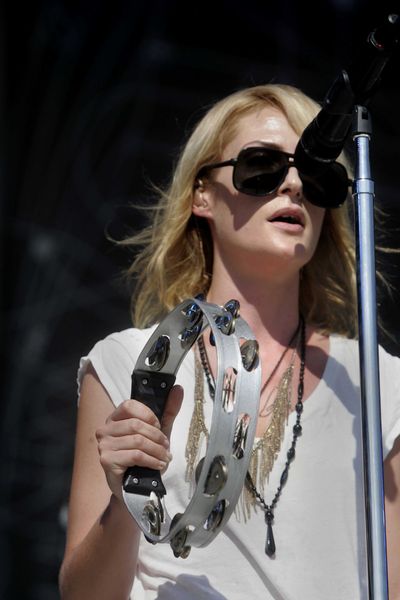
Emily Haines of Metric, looking hot and bothered.
Metric was the first band to appear on the main stage, and red flag the fact that holding an all-day event in a venue with little no cover was a poor idea. The relentless sun rendered moot any lighting or special effects. When it was finally dark enough for these tricks to emerge, the video screens captured a static image of the Lilith Fair logo, meaning fans in the back had no close-up view of events all day.
The four-piece indie band’s dark synth pop isn’t built for daylight. Sound problems plagued the first couple songs, but what the atmosphere didn’t kill the temperature did. When you’re sweating just standing still, it’s hard to be convinced to dance. Singer Emily Haines did a robotic dance to the Big Brother-esque lyrics of “Satellite Mind,” and prefaced “Gimme Sympathy” with a bit of Neil Young’s “Hey Hey, My My.” Their set was heavy on last year’s “Fantasies,” but surprisingly did not include their contribution to the latest Twilight film, “Eclipse (All Yours).”
Michaelson had better success connecting with the sparse crowd with her jangly pop. Backed by a five-piece band, Michelson bookended her set with ironic covers, incorporating Lady Gaga’s “Pokerface” into her own “Soldier” and closing with Britney Spears’ “Toxic,” which featured everyone onstage in a synchronized dance. Both moves drew big cheers. In between, she delivered her hit “The Way I Am,” which recalled Regina Spektor’s quirky vocal phrasing, the bouncy “Locked Up,” and new song “Parachute.”
Halfway through the Court Yard Hounds’ set, Emily Robison found herself in trouble.
“This is a quintessential chick song,” she said, intending to introduce Joni Mitchell’s “This Flight Tonight.” The chick the crowd knew, however, was Robison’s main gig with fellow Yard Hound and sister Martie Maguire, the Dixie Chicks. The unexpected burst of delight flummoxed Robison for a moment.
“No, no, not that chick,” she said, trying to recover. “I mean a hippie chick.”
Robison and Maguire released three Dixie Chicks albums before singer Natalie Maines arrived and turned the group into superstars. When Maines bowed out of making new music, the sisters soldiered on. Their sound hews closer to Americana and roots music than the Chicks’ pop country, but suffers without Maines’ feisty spirit. “It Didn’t Make A Sound” featured a nice honky tonk piano solo, and “The Coast” was a pleasant tribute to the sister’s native Texas beaches, but it was too gentle to engage the crowd.
Sisters Nancy (left) and Ann Wilson, the heart of Heart.
Conversation ceased, however, when the sisters unleashed a furious bluegrass instrumental that had fans on their feet, clapping and stomping along. The set ended with a moment out of “O Brother, Where Art Thou?” when Maguire’s 6-year-old twin daughters joined the ensemble, tentatively playing percussion alongside their mother.
Emmylou Harris is the Mother Maybelle Carter of her generation, collaborating with everyone from Bob Dylan and Neil Young to Ryan Adams and Lyle Lovett. The artists everyone else on the bill respect as legends, she calls contemporaries. Yet even her distinct, wonderful voice wasn’t enough to sway the crowd. As with most artists during the day, the audience was divided between hardcore fans, politely curious listeners and everyone else, waiting impatiently for their act to appear. The ambitious and diverse bill ended up leaving everyone out at some point during the day.
Harris and her four-piece Red Dirt Band leaned heavily on her 1999 album “Red Dirt Girl,” mixing in the good old country of “Wheels” and “Born to Run” (a Paul Kennerly song, not a Bruce Springsteen cover). The most riveting moments were the a cappella gospel arrangement of “Calling My Children Home” and Harris’ own hymn, “The Pearl.”
Harris also shared the day’s best musical moment when she joined Sarah McLachlan on “Angel.” These multi-artist bills should have more of this synergy. Witnessing Harris and the Hounds collaborate on a Bill Monroe bluegrass number, or Haines join McLachlan on “Possession” would have been special events fans would treasure long after they had forgotten the heat and the ticket price.
Lilith Fair found Sarah McLachland closed out the day.
It wasn’t until Heart took the stage at 8:45 that the fair had its first galvanizing musical moment. The raucous blast of “Barracuda” eradicated the gentle sway of the afternoon and invigorated a crowd that had traded the sun for the moon and was finally ready to move. Sisters Ann and Nancy Wilson delivered a heavy slab of ‘70s rock that had fists pumping and hips shaking. Guitarist Nancy Wilson concluded her acoustic intro to “Crazy On You” with a scissor kick, cueing the rest of the six-piece band. Singer Ann Wilson was in top form, belting the refrain from the Rolling Stones’ “Gimme Shelter” during their own “Even It Up” and easily finessing the dynamics of “Magic Man.”
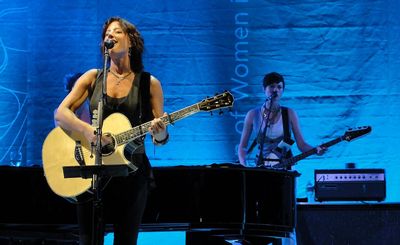
Lilith Fair founder Sarah McLachlan closed the day nearly eight hours after the first act appeared. The Vancouver native congratulated the crowd for braving the heat and rewarded them with many of her biggest hits, including “Building a Mystery,” “World On Fire” and “Adia.” She needlessly apologized before playing each of her three new songs, but the crowd responded well to those numbers as well.
Here’s a tip to established artists trying to introduce new songs: If you act proud of your new material, fans will be more likely to embrace it. Today’s new song is tomorrow’s sing-along.
The night ended with the gentle lilt of McLachlan’s “Ice Cream” before most of the day’s artists -– including Swenson, who shared a mic with the Court Yard Hounds -– joined together for a joyous romp through Patti Smith’s “Because the Night.”
Setlists:
Metric – “Twilight Galaxy,” “Satellite Minds,” “Help I’m Alive,” “Gold Guns Girls,” “Hey Hey, My My” > “Gimme Sympathy,” “Dead Disco.” Ingrid Michaelson – “Soldier” > “Pokerface,” “The Way I Am,” “Parachute,” “Maybe,” “Locked Up,” “The Way I Am,” “Toxic.”
Court Yard Hounds – “Delight (Something New Under the Sun,” “It Didn’t Make a Sound,” untitled new song, “Then Again,” “Fear of Wasted Time,” bluegrass instrumental, “The Coast,” “Ain’t No Son.”
Emmylou Harris – “Here I Am,” “Orphan Girl,” “Evangeline,” “Wheels,” “Born To Run,” “Calling My Children Home,” “Red Dirt Girl,” “Get Up John,” “Bang the Drum Slowly,” “Shores of White Sand,” “The Pearl.”
Heart – “Barracuda,” “Straight On” “Even It Up/Gimme Shelter,” “WTF,” “Hey You,” “Red Velvet Car,” “Alone,” “Magic Man,” “Crazy On You.” Encore: “What Is and What Should Never Be.”
Sarah McLachlan – “Angel” (with Emmylou Harris), “Building a Mystery,” “Loving You Is Easy,” “World On Fire,” “I Will Remember You,” “Forgiveness,” “Adia,” “Out Of Tune,” “Sweet Surrender,” “Possession.” Encore: “Ice Cream,” “Because the Night” (with most of the day’s perfomers).
(Above: Modest Mouse perform “Baby Blue Sedan” at a previous stop in Kansas City, Mo., at the Uptown Theater in March, 2009.)
By Joel Francis The Kansas City Star
Early in his first visit to Crossroads, Modest Mouse singer Isaac Brock was quick to point out the venue’s most distinctive feature. After the second song, he told the sold-out crowd the band had a “super awesome” gift for everyone: they each got to take home a wood chip.
The six members of the indie rock band were so excited about their present they flubbed the first verse of the next song “We’ve Got Everything.” After taking a brief moment to regroup they returned to the number with increased fervor. It was the only misstep of the two-hour set that found the band growing stronger with each number.
The set opened with slow, droning intro to “Gravity Rides Everything,” which gave way to a gentle wash of acoustic guitar. With three guitarists and two drummers, Modest Mouse’s songs were never lacking in texture. Frequently the band went one step further, substituting banjo, violin and keyboards. During “Gravity,” Brock held his acoustic guitar up to the speakers a la Pete Townshend for a nice burst of feedback. The combination of two trumpets and Brock’s banjo on “King Rat” and “Devil’s Workday” created a kind of demented Dixieland.
While two of the band’s biggest songs – “Float On” and “Florida” – were absent, they weren’t missed. The opening bars of nearly every number were greeted with huge cheers of recognition, regardless if it was a single like “Dashboard” or album cut like “Paper Thin Walls.” The 18-song setlist was democratically split between the band’s three most recent albums, with a few added nuggets. There was very little chatter during songs in the crowd or between them onstage; the music captured everyone’s attention.
“Whale Song” featured a lengthy opening and Brock’s signature guitar style. Brock has a way of bending notes while hitting them with the whammy bar that makes his guitar sound like a drunken Jew’s harp. Although touring guitarist Jim Fairchild, formerly of Granddaddy, shared the stage, Brock chose to do most of the heavy lifting. After “Whale,” each song seemed to build on the intensity of the previous performance. By “Devil’s Workday,” which featured another great stinging solo from Brock, and “Tiny Cities Made of Ashes” the band was cranking at 11.
That intensity made “Fire It Up” seem even more low-key, with the entire band riding Eric Judy’s loping bass line. “Blame it on the Tetons” had a gentle, folksy feel supported by Tom Peloso’s violin. New song “Here’s To Now” also featured Peloso’s fiddle, which had everyone clapping along to the two-step rhythm.
The biggest contrast of the night, however, may have been the response to “Parting of the Sensory.” Brock could never be mistaken for an optimist, but the audience danced and sang along to the nihilistic refrain of “someday you will die and somehow something’s going to steal your coffin” like it was the Jackson 5. It would have been the perfect ending, but the band had one more treat in “Black Cadillacs.” Even without the souvenir wood chip, it wasn’t a night anyone will soon forget.
Setlist: Gravity Rides Everything; The View; We’ve Got Everything; King Rat; Here It Comes; Fire It Up; Whale Song; Paper Thin Walls; Here’s to Now (new song); Baby Blue Sedan; Dashboard; Satin in a Coffin; Devil’s Workday; Tiny Cities Made of Ashes; Encore: Blame It On the Tetons; Third Planet; Parting of the Sensory; Black Cadillacs.
When Pieta Brown was in town almost two months ago, she played her songs before a sold-out Midland Theater. As the opening act on Mark Knopfler’s tour, she had a dream gig of full houses and open-minded audiences.
Opportunities like that can boost a career, but it doesn’t happen overnight. Which is why just seven weeks later, Brown was back. The material may have been the same, but without Knopfler’s boost, Brown had trouble drawing more than three dozen people to her early evening set Friday night at Crosstown Station.
These are the roller coaster realities of an emerging artist, all too familiar to Brown. The daughter of folk singer Greg Brown, she released her first solo album in 2002. Her latest release dropped in April. On those albums Brown has crafted a sound that will please fans of Kathleen Edwards, Carrie Rodriguez and the Cowboy Junkies.
As before, Brown arrived armed with guitarist Bo Ramsey, who not only produced several of her father’s albums, but has also worked with obvious influences Lucinda Williams, Ani DiFranco and Calexico. Brown’s songs provided ample space for his tasty, slow-as-molasses solos to drip out.
Above: Bo Ramsey, left, and Pieta Brown during a 2009 performance.
The duo’s 75-minute set included several stand-out numbers, including “In My Mind I Was Talking To Loretta,” an homage to the time Brown’s parents took her to see “Coal Miner’s Daughter” and she came home wanting to be “Roletta Lynn.” The song is also a tribute to the run-down Iowa shack she grew up in surrounded by “miles and miles of haystacks and miles and miles of gravel roads,” as she told the crowd.
Other high points included the new song “Prayer of Roses,” and “4th of July,” a poignant memory of a rural holiday. The country girl also mixed in several blues numbers, including an adaptation of “Rolling and Tumbling” and a cover of Memphis Minnie’s “Looking the World Over.”
The sparse crowd sat attentively, appreciative, but distant. It was the type of polite crowd that would wait until between songs to get up and head to the bathroom. No one thought, however, to stand up and move closer, which left a 15-foot chasm between the stage and the first row of tables.
Although Brown’s material was strong, the similar moods and arrangements caused them to blend together after a while. Some of the audience started to get bored, as the chatter from the bar picked up until it threatened to overwhelm the last quarter of the set.
For all of her considerable talents, Brown would be better off teaming up with similarly minded and situated artists. This would take the pressure off of having to sustain a full set, and broaden her reach. She would be a great addition to the July bill at Crossroads that includes Dar Williams and Rodriguez.
Brown was long gone by the time Truckstop Honeymoon took the stage an hour later. The quartet not only had the benefit of a later time slot, but also a local following. After Hurricane Katrina washed out bass player Katie Euliss and guitar/banjo player Mike West’s New Orleans home, the couple relocated to Lawrence, Kan.
Augmented by mandolin player Jake Wagner and drummer Colin Mahoney, the pair traded and harmonized on verses like Johnny Cash and June Carter, refusing to take anything seriously. When Euliss sang about the Christmas she got her mama high it was hard to tell how much was she made up. Later, West introduced the original “My Automobile” as a P-Funk cover.
The 90-minute set also included several new songs, like “Latch Key Kid Recipe Book,” an ode to absent parents and oven pizzas. “Kansas in the Spring” drew a parallel between tornadoes in the heartland and hurricanes on the coast.
The best moment was “Vacation Bible School,” another song that felt autobiographical. After coaxing the crowd into singing along on the ridiculously convoluted chorus about getting kicked out of bible school, West broke the audience into three parts and held a yodeling competition.
(Above: Maxwell performs “Fistful of Tears” in Dallas on the fall 2009 arena leg of the tour.)
By Joel Francis
The Kansas City Star
If the local birth notices are unusually high late next February, we’ll know why. Sunday night at Starlight, neo-soul stars Maxwell and Jill Scott set a romantic mood with three hours of slow jams designed to linger long after the last note expired.
Shortly after sunset, a silhouette appeared on the screen behind the band. As the 10-piece band vamped, Maxwell suavely strolled out in a three-piece suit and sunglasses. Women erupted in spontaneous shrieks of delight as he set the mood early with “Sumthin’ Sumthin’.”
It was hardly the only time Maxwell would play to the fairer sex. Over the course of his 90- minute set he praised (“Fortunate,” “Ascension”), chastised (“Cold”), apologized (“Pretty Wings”) and seduced (pretty much every other song) the women in the audience. The set comprised two-thirds of Maxwell’s 2009 comeback album “BLACKsummer’snight,” and another half dozen hits and favorites for good measure.
The band rolled through the first three numbers without stopping. The come-hither strut of “Sumthin’ Sumthin’” easily rolled into “Get To Know Ya” and an arrangement based on James Brown’s “The Big Payback.” After a New Orleans jazz breakdown and trumpet solo, the ensemble took a deft turn into the Kool and the Gang-inspired “Cold,” one of the most upbeat kiss-off songs of all time.
Nearly every musician backing Maxwell has a foot in the worlds of jazz and hip hop. Many members have collaborated with rappers Mos Def, Jay-Z or Diddy. Pianist Robert Glasper was received a Grammy nomination for his 2009 album “Double Booked.” This jazz pedigree was on display all night, in the way Glasper or organist Travis Sayles would respond to a vocal phrase, or feed off the rhythm section.
Although the size of venues, staging and setlists have changed, Maxwell and the band have been touring together for nearly two years now. They’ve had plenty of time to sand out the rough spots, and Sunday’s night was an effortlessly paced ride. The roughest element was likely the most surprising: Maxwell’s voice.
The rasp in Maxwell’s throat was obvious from the first number; by the fifth he ‘fessed up to overdoing it the previous night in St. Louis and asking for the audience to help him on the high notes he couldn’t hit. He then bravely launched into the falsetto-sung “This Woman’s Work,” holding the mic stand over the crowd on the chorus. It was a generous gesture, but Maxwell would have been better off letting back-up singer Latina Webb play a greater role. Their duet on “Reunion” was one of the better moments of the night.
This was a small hurdle to overcome. Maxwell’s voice grew stronger with each number, to the point that he was able to handle the high parts in a cover of the Isley Brothers’ “Don’t Say Goodnight” with ease. The set ended with two guaranteed crowd-pleasers, “Fortunate” and “Ascension.” On the latter, the very full (but not sold out) house delivered the entire first verse a capella, much to Maxwell’s delight.
Jill Scott had the misfortune of taking the stage with the sun blazing through most of her 80-minute set, rendering most of her lighting and effects moot. It wasn’t a big loss, though, because like Maxwell the focus was on her voice and her band.
The 10-piece group sizzled through the keyboard propelled “It’s Love” that got most of the crowd up and dancing. If that number bounced with the energy of a passionate night on the town, then the next song, “Not Like Crazy,” gently embraced the delicate pleasure of waking up next to that person the following morning.
The two new numbers were studies in contrast. “I Love You” rode a bubbly ‘80s synth line, but wasn’t a radical departure in sound or subject. “Hear My Call” was a desperate, dead-of-night cry for help in the aftermath of a relationship. Scott performed the song backed only by piano. When it was over, she walked to the opposite end of the stage where her other keyboard player started one of her most affirming songs, “He Loves Me.”
Soon the band and the crowd were both fired up, but Scott stopped the show with her near-operatic vocal display that brought a richly deserved standing ovation. Scott made sure everyone stayed on their feet with the girl-power anthem “Hate On Me,” early hit “A Long Walk” and carpe diem hymn “Golden.”
It would have been a delight to have Scott and Maxwell share the stage for a number, but even apart the pair was a perfect complement. Both realized their roles as facilitators as much as entertainers.
“I’m here to support, engage and enthuse,” Maxwell said suggestively.
Scott was more direct: “This is an effort to get y’all some tonight.”
Jill Scott setlist: Gimme, The Real Thing, Insomnia, It’s Love, Not Like Crazy > The Way, Come See Me, Crown Royal, I Love You (new song), Cross My Mind, Hear My Call (new song), He Loves Me, Hate on Me, A Long Walk, Golden.
Maxwell setlist: Sumthin’ Sumthin’ > Get to Know Ya > Cold, Lifetime, Bad Habits, This Woman’s Work, Help Somebody, Fistful of Tears, Stop the World, Reunion, Till the Cops Come Knockin’, Don’t Say Goodnight (Isley Brothers cover) > Fortunate, Ascension. Encore: Pretty Wings.
(Above: James Taylor and Carole King are accompanied by Leland Sklar (bass) and Russ Kunkel (drums) on “Ellen” in 2010.)
By Joel Francis The Kansas City Star
For more than 30 years, James Taylor and Carole King have been writing the type of songs that fans want to hold close and wrap around themselves like a blanket. When the pair announced their joint tour, the material and musicianship were beyond question. The biggest hurdle lay in translating that intimacy to large spaces.
Taylor and King had no problem transforming the spacious Sprint Center into a cozy club for their two-and-a-half-hour performance Friday night. The stage set the mood. The raised white platform was situated in the middle of the floor, and surrounded by three rows of nightclub tables, each outfitted with a warm, glowing lamp.
The ambience was cemented when the duo entered through the crowd to take the stage. Taylor’s chair was positioned in the curve of King’s grand piano so the two could have constant eye contact while they played. Even when Taylor eventually stood up and King stepped away from the piano, the chemistry and closeness was evident.
The atmosphere was such that when someone shouted a request, Taylor picked the oversized setlist off the floor, pointed to the number and told them they’d get to it eventually.
Both singers were chatty, but Taylor had the better banter, cracking wise about calling the onstage seating “raised seats” because “high chairs” wasn’t right and “stools” sounded dirty. His wry sense of humor was also on display when he tried to set up the common theme between “Beautiful” and “Shower the People.”
“Here’s another song,” Taylor started. “I know that’s a surprise. ‘Oh, they’re going to play another song.’ Well, here we have two in a row that … I guess they’re all in a row. We tried doing them all at once, but it didn’t work.”
The sold-out crowd (although both of the end sections up top were curtained off), devoured every syllable, musical or otherwise. Each song was greeted with thunderous applause that threatened to overwhelm the performance at times. When the band joyously performed the Motown classic and Taylor hit “How Sweet It Is (To Be Loved By You)” they seemed to be singing to the appreciative audience as much as themselves. The response definitely surprised the performers, particularly King, who took the stage for the encore looking at the crowd in wonder, mouth agape.
King’s reaction was genuine, but she shouldn’t have been so shocked. The setlist included all but three songs from King’s masterpiece “Tapestry” and nine of the 12 cuts on Taylor’s best-selling “Greatest Hits” collection. This night wasn’t about introducing new material, but to reunite with longtime musical friends.
“Fire and Rain,” “So Far Away,” “Country Road,” “Crying in the Rain.” Nearly every number could have been a defining moment. The biggest moments were the small ones, like Taylor’s exquisite harmony on “Will You Still Love Me Tomorrow” on the line “when the night/meets the morning sun.” Or the way Taylor and King traded verses on “You’ve Got a Friend.”
During “Smackwater Jack” and “I Feel the Earth Move” the 68-year old King bounced around stage like a teenager. Not to be outdone, the 62-year-old Taylor strapped on an electric guitar for the crackling “Steamroller.” After blowing a harmonica solo, he duck walked across the stage. The blues song was out of Taylor’s normal dynamic, but the audience response was so great Taylor should consider cutting an album on the Alligator label.
Before the third song, Taylor introduced the band so the audience could fully appreciate the accompanists. Bass player Leland Sklar, drummer Russ Kunkel and guitarist Danny Kortchmar are collective known as The Section.
The three defined the mellow, Los Angeles sound of the 1970s singer/songwriter movement, appearing not only on “Tapestry” and “Sweet Baby James,” but several records by Jackson Browne, Warren Zevon and Jimmy Buffett. Sklar and Kunkel’s playing was tasteful and understated, with every note or beat serving the song. Kortchmar relished the times he could cut loose with a solo, like on “Smackwater Jack” and “Jazzman.”
The Section was augmented by a trio of backing singers and keyboard player Robbie Kondor. Singer Arnold McCuller took the crowd to church with his Gospel delivery during “Shower the People” that was the first big moment of the set. It made for a hard song to follow, but King pulled out one she wrote that was made famous by the Queen of Soul, “(You Make Me Feel Like) A Natural Woman.” When the chorus hit, everyone in the arena became part of the ensemble.
The evening ended with the quiet “You Can Close Your Eyes.” Accompanied only by Taylor’s guitar, the two sat side by side, King staring into Taylor’s eyes as she harmonized. As the last note rang out, she briefly rested her head on his shoulder before the two rose and strolled off, hand in hand.
“This reunion has been waiting to happen since the early ‘70s,” Taylor had said earlier. But for the fans present the question isn’t “What took you so long?” Rather, it’s “When are you coming back?”
Setlist: Blossom, So Far Away, Honey Don’t Leave L.A., Carolina On My Mind, Way Over Yonder, Smackwater Jack, Country Road, Sweet Seasons, Mexico, Song of Long Ago > Long Ago and Far Away, Beautiful, Shower the People, (You Make Me Feel Like) A Natural Woman. Intermission. Copperline, Crying in the Rain, That Sweet Old Roll (Hi-De-Ho), Sweet Baby James, Jazzman, Will You Love Me Tomorrow, Steamroller, It’s Too Late, Fire and Rain, I Feel the Earth Move, You’ve Got A Friend. Encore: Up on the Roof, How Sweet It Is (To Be Loved By You), You Can Close Your Eyes.
(Above: John Lydon made his first post-Sex Pistols statement with “Public Image.” “Rise” is one of PiL’s most accessible tunes. Here the reunited band performs them at the 2010 Coachella music festival.)
By Joel Francis The Kansas City Star
There was nothing rotten about the performance John Lydon and Public Image Ltd. delivered Monday night at the Midland Theater. Faced with a miniscule crowd in a minor market on a weeknight, Lydon and the band could have phoned in their performance and few would have known. The four-piece band held nothing back during the high-energy, two hour show.
Public Image Ltd., or PiL, is the band Lydon formed after the Sex Pistols imploded. Although the band carried on for 15 years, its catalog can be broken down into two distinct eras. The first three albums were a conscious deconstruction of the Pistols mythology, filled with long, heavy, experimental pieces. Later work boiled down to Lydon solo projects under the PiL name produced with a rotating cast of musicians (including, incredibly, Steve Vai).
The reconstituted PiL, back together for the first time since disbanding in 1992, drew equally from both eras, and tossed in a couple numbers from Lydon’s 1997 solo release for good measure. Older numbers, like the magnificent “Poptones,” the epic “Albatross” or “Chant” were studies in texture and ambience. As the rhythm section of Bruce Smith on drums and new member Scott Firth on bass anchored the songs, guitarist Lu Edmonds welded huge blocks of sound which Lydon penetrated effortlessly with his shrill voice.
The backing trio clearly enjoyed having the space to stretch out and play with different sounds. Firth and Edmonds sparred on “Flowers of Romance” before Edmonds delivered his first solo of the night on an electric banjo. Firth switched to upright electric bass for several numbers which added extra punch to Smith’s cadences.
Although Lydon was about the same age as his gray-haired compatriots he appeared decades younger. His head was shaved, save long, blonde spikes on top that looked like a mischievous crown. After removing a red vest early in the night, Lydon was clad entirely in black. He kept a lyric book on a music stand near his mic and although he rarely looked at them during a number, he dutifully turned the page after each song. When Lydon was really feeling the music, he would hop up and down or do a robo-monster march, a manic expression plastered on his face.
While the older material was dark and amorphous, the newer songs were bright, poppy and quite danceable. The set opened with PiL’s biggest number, “This Is Not a Love Song.” Later, “Sun” was delivered via acoustic guitar and mouth organ. As Lydon led the crowd in sing-along, the arrangement almost had a klezmer feel. “Disappointed” got the biggest reaction during the main set and had everyone near the stage bouncing. Lydon later joked about the song’s message of forgiveness didn’t quite stand with the cynicism of his other tunes.
During his four decades in the spotlight, Lydon has cultivated a reputation for acerbically speaking his mind, and he didn’t disappoint onstage Monday. “Warrior” contained a political diatribe and a few not-so-kind words for Sarah Palin. Lydon introduced “Religion” as “a song that is 30 years old and as accurate as ever.” He then made a few comments about the Pope that won’t be earning him a Vatican invite any time soon.
The night ended with “Public Image,” the song that most resembles Lydon’s former band, and the upbeat “Rise,” which contains an interpretation of the Irish blessing “may the road rise to meet you.” “Open Up,” Lydon’s collaboration with the techno duo Leftfield, closed the night. As the crowd danced to the heavy bed of looped synthesizers, Lydon’s voice panned and swirled around the room.
As the band waved good night, the punk provocateur let his guard drop with a fleeting moment of sincerity when thanked everyone from the bottom of his heart for coming out. The tiny crowd comfortably filled the first two tiers on the floor, but the third was sparse and the fourth was empty.There were a few dozen people sitting on chairs in the back, but the entire audience could have probably crammed into the Beaumont Club. That venue may have been more size-appropriate, but it wouldn’t have been much fun. PiL had no problem filling the vast Midland, and Lydon’s outsized persona needed – and deserved – a bigger stage.
Setlist: This Is Not A Love Song, Poptones, Memories, Tie Me to the Length of That, Albatross, Death Disco, Flowers of Romance, Psychopath, Warrior, USLS 1, Disappointed, Sun, Bags, Chant, Rise, Religion. Encore: Public Image, Rise, Open Up.


 Taking the stage in a dark suit and black fedora, frontman Mohr quickly put any expectations for the Monsters’ back catalog to bed, telling the one-third capacity crowd the only thing they’d be hearing was “straight, natural blues.” He was right for the most part, but an audience clamoring for “Bittersweet” – one of the band’s biggest tunes – needn’t have worried. The songs in the last third of the set sounded like typical Big Head Todd material outfitted with familiar blues lyrics.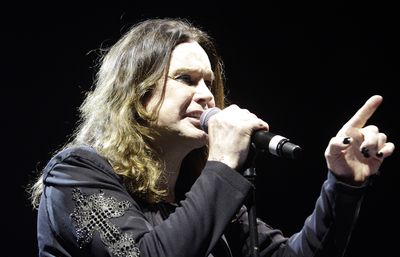





 Nearly every musician backing Maxwell has a foot in the worlds of jazz and hip hop. Many members have collaborated with rappers Mos Def, Jay-Z or Diddy. Pianist Robert Glasper was received a Grammy nomination for his 2009 album “Double Booked.” This jazz pedigree was on display all night, in the way Glasper or organist Travis Sayles would respond to a vocal phrase, or feed off the rhythm section.


 joelfrancis.com