The Four Tops – “Reach Out (I’ll Be There)”

Four-tops-reach-out-1966

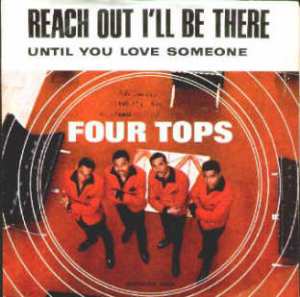
The Four Tops – “Reach Out (I’ll Be There),” Pop # 1, R&B # 1

By Joel Francis

The dramatic introduction to “Reach Out (I’ll Be There)” owes more than a little to Phil Spector’s Wall of Sound and was Motown’s most cinematic chart-topper to date. While the flute gets the signature melody, check out James Jamerson’s uber-melodic bassline bubbling underneath the bevy of instruments. Paul McCartney gets a lot of (deserved) credit for his inventive basslines, but Jamerson’s brilliant countermelody here rivals anything McCartney came up with the Beatles – OK, maybe not “I Feel Fine” – and should permanently insert Jamerson into the ‘60s bass legends conversation.

The song was written by the white-hot trio of Holland-Dozier-Holland – there were actually other Hitsville employees at the time, although one wouldn’t know it by looking at the Billboard charts – but Norman Whitfield supplied the galloping percussion. Propelled by HDH’s rich arrangement, “Reach Out” starts strong and continues to build through the verse, dropping off and resting slightly before the Tops casually fall into the chorus. Lyrics could almost become superfluous with a melody this strong, but lead singer Levi Stubbs’ words of commitment and devotion are equally compelling.

Although the song became the Tops signature number, Stubbs initially felt his voice was too rough for the song and tried to recuse himself. Fortunately, HDH prevailed on Stubbs to give it a try. Stubbs promptly delivered one of the great vocals in the Motown catalog. Critics who pick on “overproduced” songs like this as examples of the slick Motown sound need to pay more attention to Stubbs’ vocals. His signing is as gritty and soulful as anything in the Stax cannon. Marvin Gaye and Smokey Robinson may sound a little stilted in singing in front of Stax’ incredible house band Booker T and the MGs. It’s not hard to imagine Stubbs being more than up to the task. Unfortunately such cross-pollination never occurred, but with the advent of ProTools and continued merger of major record labels, maybe the Motown and Stax catalog will end up under the same corporate umbrella and someone will give us a recreated session.

Stubbs’ soulful signing on “Reach Out” inspired a lot of people – unfortunately it inspired a lot of the wrong people. While the ability to sing soul music is not racial, a whole lotta white dudes certainly tried to make the case. Elton John, Michael Bolton and Michael McDonald all failed on this number. More successful were Diana Ross, who took her cover into the Top 40 in 1971, and Gloria Gaynor, who did a disco version just four years later.
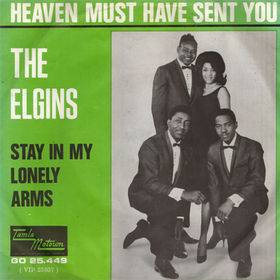
The Elgins – “Heaven Must Have Sent You”

elgins heaven

The Elgins – “Heaven Must Have Sent You,” Pop #50 , R&B #9

By Joel Francis

I suspect that if you took this single and replaced the word “Elgins” with “Supremes” and gave it to DJs with no other changes, it would have been a far bigger hit.

Not that Saundra Edwards’ voice sounds like Diana Ross’ – Edwards’ has more depth and fullness – but the Holland-Dozier-Holland team that cranked this number out sure cribbed it in the same production and arrangement that sent all the Supremes material to the top of the charts.

Unfortunately, Edwards wasn’t Ross and the Elgins weren’t the Supremes. Frustrated by her lack of success at Motown – Edwards recorded two songs for the label in 1962 as Saundra Mallett and the Vandellas – left the group shortly after the group recorded their only full-length platter. The Elgins briefly carried on with Yvonne Allen in Edwards’ place, but disbanded in 1968.

Although it had little impact at the time, “Heaven Must Have Sent You” finally became a Motown pop hit in 1979 – for disco singer Bonnie Pointer, the youngest of the Pointer Sisters. Spurred by this hit, though, the Elgins regrouped in the 1980s. Although there was only one original Elgin in this lineup, the group toured and re-recorded “Heaven Must Have Sent You.” Edwards also cut a solo album in the early ‘80s with the same producer the Elgins were using at the time.

Temptations – “Beauty Is Only Skin Deep”

tempt beauty

Temptations – “Beauty Is Only Skin Deep,” Pop #3, R&B #1

By Joel Francis

After teaming to give the Tempts a No. 1 R&B hit with “Ain’t Too Proud To Beg,” Norman Whitfield and Eddie Holland paired again to deliver “Beauty Is Only Skin Deep,” which fared even better. The song was the Temptations’ third hit of 1966 and fifth consecutive R&B No. 1, dating back to 1965’s “My Girl.”

After a sharp blast of horns and drum roll from “Pistol” Allen, the song drops to a tinkle of glockenspiel that would make Bruce Springsteen proud and slowly builds, with a crescendo at the chorus. There’s a whisper of guitar and the rumble of James Jamerson’s bass, but Paul Riser’s arrangement is essentially David Ruffin and the Tempts’ voices, horns – complete with trumpet solo! – and that magnificent snare. It was more than enough.

Contrast the prominence the other Temptations are given with their backing performance in this song to the anonymity Mary Wilson and Florence Ballard of the Supremes were often given. As part of the Holland-Dozier-Holland team, Eddie Holland certainly knew how to write and arrange interesting counter-vocals. It makes one wonder how much influence label owner Berry Gordy exerted to push Diana Ross to the front and minimize the contributions of her bandmates.

Although the title seems enlightened, few women would regard a lyric like “A pretty face you may not possess/ But what I like about it is your tenderness” as a compliment.

Whitfield actually recorded the song’s backing track two years before he added the Temptations’ vocals. In the interceding time he shopped it to several Motown artists, including David Ruffin’s brother, Jimmy, and the Miracles, who included their version on the “Away We Go-Go” album. (Never one to miss a trend, Gordy also released “The Supremes A Go-Go” album in that same summer of 1966.) The Ruffin and Miracles versions are the only substantial covers of the song on record to date.

The Supremes – “You Can’t Hurry Love”

Supremes_You_cant_hurry_love

The Supremes – “You Can’t Hurry Love,” Pop #1, R&B #1

By Joel Francis

The bouncing bassline that opens this song is courtesy of James Jamerson, the same man who delivered the delightful and legendary three-note thump that introduces “My Girl.”

The intro to Holland-Dozier-Holland’s masterpiece “You Can’t Hurry Love” is a lesson in how to build a Motown hit: Start with the bass and percussion, add some horns (or strings) and then have a pretty voice jump into a catchy verse.

Diana Ross may not have had the prettiest or best female vocal on the Hitsville roster, but by 1966 she had the most recognizable one. And for once her thin tone actually works in her favor. Ross’s voice perfectly conveys the naivety and innocence of a lovelorn girl trying to be patient – “remember mama said,” she sings – to little avail. Ross would seldom reveal so much of herself in song again, hiding behind “big” vocals a la “Ain’t No Mountain High Enough.”

When this song was recorded, Ross was little more than a year away from getting top billing and four years removed from going solo. Even still, Mary Wilson and Florence Ballard are little more than anonymous backing singers in the mix. Although the track is as perfect as a song can be, it’s a shame their talent wasn’t given greater prominence.

While this song may be held up as Exhibit A by haters who think Motown is too slick and soulless, it is also testament to how smoothly the Motown assembly line was working. The song was recorded in just two sessions. Presumably the Funk Brothers laid down everything but the vocals at the June 11, 1966 session and the Supremes added their vocals at the July 5 session. Little more than three weeks later, the single was on the radio. By September, only three months after initial recording, it sat at No. 1 and earned the trio a high-profile performance on the Ed Sullivan show.

“You Can’t Hurry Love” had a renaissance in the 1980s. Phil Collins took it to the Top 10 in 1982, the same year the Stray Cats put it on the flip side of “Rock This Town.” Whoopi Goldberg sang it in her 1986 film “Jumpin’ Jack Flash,” and former Jimi Hendrix/Electric Flag drummer Buddy Miles sang it as the voice of the California Raisins (which, sadly, was the first version The Daily Record heard and its non-oldies radio introduction to classic R&B).

Chris Clark – “Love’s Gone Bad”

cc

Chris Clark – “Love’s Gone Bad,” Pop #105, R&B #41

By Joel Francis

Producers had been looking for a “white singer with a black sound” long before Sam Phillips signed Elvis Presley. But Berry Gordy’s quest definitely added a layer of irony to the process.

Not that Gordy fared any better than the majority of his contemporaries. We can be fairly certain that the assets that drew Gordy to Chris Clark were not vocal.

Nonetheless, Gordy positioned Clark to be Motown – and America’s – answer to Dusty Springfield. He propped her up with songs by Holland-Dozier-Holland and even wrote and produced several numbers himself. Gordy’s favoritism didn’t go over so well at Hitsville. Other artists resented that Gordy spent so much time trying to make a star out of someone who refused to wear shoes, didn’t dress sharply and ate too much.

The public didn’t find much to like, either. Clark’s releases refused to dent the charts. “Love’s Gone Bad,” a HDH composition, was her greatest success, and somehow was enough to earn her the right to cut a full album the next year. 1967’s “Soul Sounds” dropped without a trace. So few copies were pressed that 40 years later it is a rare Motown collectible.

Despite all this, Clark managed to hang around Motown for quite a while. She co-wrote the Oscar-nominated screenplay to “Lady Sings the Blues,” Motown’s 1972 foray into film. That film, of course, starred Gordy’s ultimate protégée, Diana Ross.

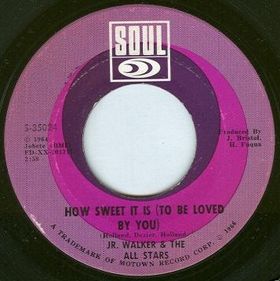
Jr. Walker and the All Stars – “How Sweet It Is (To Be Loved By You)”

sweet

Jr. Walker and the All Stars – “How Sweet It Is (To Be Loved By You),” Pop #18, R&B #3

By Joel Francis

Because he owned both the label and its publishing, it’s no surprise that Berry Gordy frequently had other label artists cut versions of earlier Motown hits. While there are several notable exceptions, for the most part these covers are either curiosities or album filler.

Jr. Walker, however, broke out of the mold with his reading of Marvin Gaye’s 1964, Top 5 hit “How Sweet It Is (To Be Loved By You).” After an extended saxophone intro, Walker puts down his horn. He has clearly overcome the microphone shyness that plagued him during the recording of his breakthrough hit “Shotgun.” Walking in Gaye’s shoes is no small feat, but Walker’s voice credibly handles the soulful, demanding melody.

While Gaye’s version was slick, joyous anthem, Walker’s is a little seedier – and all the better for it. Producer Harvey Fuqua, who signed Walker and changed his band name from the “Rhythm Rockers” to the “All Stars” in 1961, gave the song a faux-live feel that makes it sound like it was captured in a Southern roadhouse. The purposefully ragged backing vocals are more like enthusiastic audience intrusions. Close your eyes and you can smell alcohol and cigarette smoke while listening.

Others have covered this number since Gaye and Walker, of course, but a moratorium should have been placed after this interpretation. Finally, it should be noted that the year after he recorded “How Sweet It Is,” Walker memorably stole “Come See About Me” from the Supremes – no small feat – with his 1967 cover.

Jimmy Ruffin – “What Becomes of the Brokenhearted”

jruffin

Jimmy Ruffin – “What Becomes of the Brokenhearted,” Pop #7, R&B #6

By Joel Francis

Jimmy Ruffin isn’t as well-known as his brother, the late Temptations singer David Ruffin, but Jimmy didn’t land at Motown through nepotism. Raised in Mississippi, Jimmy sang with David in the family gospel group. When he was drafted, Jimmy entertained the troops with his doo-wop singing. After the military, he settled in Detroit. Jimmy auditioned for Motown and was signed before his brother, but success didn’t come as quickly.
Relegated to supplying handclaps and finger snaps, Jimmy was forced to earn a living on the automotive assembly line. After a few failed singles, Jimmy broke through with his third single, “As Long As there is Love,” written by Smokey Robinson, and finally hit big with “What Becomes of the Brokenhearted.”
Songwriters William Witherspoon, Paul Riser and James Dean originally intended this song to go to the Spinners, who would later give Motown a Top 20 hit with “It’s a Shame.” When Ruffin heard the number, it resonated so deeply within that he begged the trio to let him record it. The resulting single was the biggest and best-known of his career.
The song’s long introduction was the result of producer Mickey Stevenson’s decision to remove Jimmy’s spoken-word verse from the final mix. A restored version was later released on several Motown compilations. But the instrumental prelude does a great job of establishing the setting for Ruffin’s “land of broken dreams.” Songwriter Riser is best known as Motown’s in-house arranger. His string arrangements that appear on albums by Stevie Wonder, Marvin Gaye, the Temptations, Diana Ross and many more. One of the few Funk Brothers to emerge from the Snakepit – their nickname for Motown’s garage-cum-recording studio – with a writing credit, his influence may explain the song’s sweeping, theatrical feel.
Jimmy released another dozen singles and four albums – including one with David – for Motown. In the mid-’70s, he signed with Polydor, who released two of his albums. Jimmy’s final album, “Sunrise,” was produced by Bee Gee Robin Gibb and released in 1980. Shortly afterward, Ruffin moved to England where he had his own talk show and continues to tour.
The song was covered by Diana Ross and the Supremes in 1969, but ignored until Dave Stewart and Zombies singer Colin Blunstone cut a version in 1981. The duo may have been spurred by the success of “Sunrise” and Jimmy’s immigration to their native England. Ten years later, Paul Young’s cover hit No. 1 on the U.S. Adult Contemporary chart on the back of its appearance in the film “Fried Green Tomatoes.”

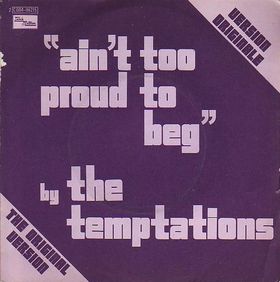
The Temptations – “Ain’t Too Proud To Beg”

680083

The Temptations – “Ain’t Too Proud To Beg,” Pop #13, R&B #1

By Joel Francis

If you’re not hooked in the first five seconds of this song, you haven’t been paying attention. All the elements attack immediately: the drum roll coupled with the insistent clanging cymbal, the knuckle-roll piano riff and, of course, David Ruffin’s raspy vocal. The stinging staccato guitar that shows up later in the initial verse is a direct homage to James Brown. Throw in the glorious backing vocals from the rest of the Temptations and a stellar horn line and you’ve got not only an incredible song, but a definitive snapshot of Motown in full glory.

“Ain’t Too Proud To Beg” would be no less a masterpiece if the story stopped there, but remarkably the song almost didn’t get made.

After a few of Smokey Robinson’s productions for the Temps failed to take hold on the charts, hotshot Norman Whitfield wanted the chance to sit behind the boards with the group. Whitfield was a long shot to topple Robinson’s incumbency, but Whitfield thought he had a number that could give him control. Enlisting songwriting help from Edward Holland, Jr. of the Holland-Dozier-Holland team, Whitfield had the Funk Brothers lay down the backing track to one of Motown’s funkiest numbers to date. The Temptations then added their vocals and Whitfield submitted the single to be auditioned at the Motown Quality Control meeting.

Quality Control meetings were the result of Berry Gordy’s days on the Detroit assembly line. Each week, the label’s top creative minds would meet, listen to music and decide what should be released. Surprisingly, “Ain’t To Proud To Beg” didn’t make the cut. It didn’t make the cut the second week, either. Politics could have been at play – Robinson and Gordy were so close that Robinson named his son Berry – but Gordy asserted that the number simply needed more work.

So Whitfield went back into the studio and moved the melody for the vocal line just out of Ruffin’s range. The straining singer’s vocals added the needed muscle and desperation to the song, and the number was once again submitted to Quality Control.

This time, however, the song had unexpected competition in the form of “Get Ready,” a Temptations number Robinson had written and produced for the band. Since Robinson was the Temps’ established producer “Get Ready” went out while “Ain’t Too Proud To Beg” stayed on the shelf. Whitfield was so upset that Gordy promised him “Beg” would be the next single if “Get Ready” failed to reach the pop Top 20.

Gordy kept his word and the song was finally released in May, 1966, eventually reaching No. 1 on the R&B charts. When Whitfield found success with the Temptations following two singles he was instated as the group’s main producer, a role he guarded fiercely until 1974.

Around the same time Whitfield was leaving Motown and the Temptations to form his own record label, the Rolling Stones found No. 17 pop hit with their cover. Through the years, the number has also yielded interpretations by Ben Harper, the Count Basie Orchestra and, even more strangely, Rick Astley, who also made it a Top 20 hit (albeit on the Adult Contemporary charts) in 1988.

Raphael Saadiq sends a love letter to soul makers and Motown

(Above: Raphael Saadiq runs the “100 Yard Dashfor Seattle’s excellent community radio station, KEXP.)

By Joel Francis
The Kansas City Star

Raphael Saadiq’s latest album, “The Way I See It,” is draped heavily in the sounds of Motown and Philly soul, but don’t call it a tribute album.

“Boyz II Men did a tribute; I wrote a bunch of songs,” Saadiq said about his all-originals album. “This was not intended to be a tribute album. It’s more like a secret love letter to the people I love.”

People like the Funk Brothers, Motown’s now-legendary stable of musicians, and the other unknown musicians who “took music to the level where it is today that I can come out and do this,” Saadiq said. “It’s not just about Smokey (Robinson) and Stevie Wonder, but a bunch of people we don’t even know about.”

He plays most of the instruments on the album himself, but Saadiq recruited two Funk Brothers to help him get that classic Motown sound. Jack Ashford’s tambourine has graced classics like “Nowhere to Run” and “You Can’t Hurry Love.” Paul Riser, who arranged the strings on Saadiq’s album, has worked with the Supremes, Marvin Gaye and Stevie Wonder.

“I brought Jack in because he added a sound I couldn’t have had without him,” said Saadiq, who performs Wednesday at the VooDoo Lounge. “With Paul Riser it was the same thing. You can feel the energy when they walk into a room.”

Having Stevie Wonder play harmonica on one song was ultimate validation. Saadiq even went so far as to introduce his guest like Wonder introduced Dizzy Gillespie on his 1982 hit “Do I Do.”

“Seeing Stevie walk into a room and play is something I’ve never gotten used to,” Saadiq said. “Having him play on this was a stamp of approval. I’ve worked hard for a long time to have him come play (on my album).”

The former Tony! Toni! Tone! singer, who named his first solo album “Instant Vintage,” is more worried about being called “neo soul” than being pigeonholed.

“Everybody knows I hate the term ‘neo-soul,’ ” Saadiq said. “If someone was playing the blues they’d want an old soul. I don’t want a new soul — then I’d sound like somebody on the radio today, which I hate.”

On an album with so much — ahem — old-school soul, Jay-Z’s guest spot on the final track, a bonus remix, probably surprised many listeners.

“That was Q-Tip’s idea,” said Saadiq, referring to the former MC of A Tribe Called Quest. “He was like, ‘You should put Jay-Z on this record’ and then went and got him, because I didn’t know Jay like that. Some people didn’t like it. They’re probably neo-soul fans. I did this for the other people.”

More on Raphael Saadiq from The Daily Record:
“The Way I See It” album review
“The Way I See It” caps the Top 10 albums of 2008

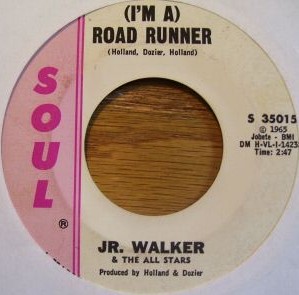
Jr. Walker and the All-Stars – “(I’m A) Roadrunner”

roadrunner

Jr. Walker and the All-Stars – “(I’m A) Roadrunner,” Pop #20, R&B# 4

Not to be confused with similarly titled hit by Bo Diddley, or the great pre-punk anthem by the Modern Lovers, this “Roadrunner” is a pure Holland-Dozier-Holland confection. Jr. Walker has clearly overcome his earlier trepidation with the microphone to confidently deliver this paean to the open road. Answering his vocals with stinging sax lines, Walker proves to be his own best all-star. The elastic guitar lines show Shorty Long’s blues influence on the label, while the organ buried in the mix is the subtle glue that keeps the performance together.

The song isn’t even in the Top 5 of Walker’s biggest hits, but it’s held up better than better-charting songs like “What Does It Take (To Win Your Love)” and “How Sweet It Is (To Be Loved By You).”

Walker’s ’60s sax rival King Curtis was the first to cover the song, but the enduring number was also covered by a post-Peter Green, pre-Lindsey Buckingham Fleetwood Mac, Jerry Garcia, Humble Pie, Peter Frampton and, most recently, James Taylor in 2008. – by Joel Francis