The Originals – “Baby I’m For Real,” Pop # 14, R&B # 1
By Joel Francis
The Originals had appeared on nearly a dozen Motown hits before they finally landed one with their name on the label. As backing vocalists, the Detroit quartet saw their performances on “Function at the Junction,” “Twenty-Five Miles,” “For Once In My Life” and “My Whole World Ended (The Moment You Left Me)” – to name but a few – rise to the top of the chart.
When Marvin Gaye had the group sing on his singles “You” and “Chained” he felt an immediate rapport and took it upon himself to give them the breakout single they deserved. Working with his wife Anna (label boss Berry Gordy’s sister), Gaye penned the lyrics for “Baby I’m For Real.”
With its soft arrangement and doo-wop influences, the song was an about-face from the psychedelic soul singles Motown was sending to the top of the charts. Gordy balked, insisting Gaye release the other song he wrote and produced for the Originals, “You’re the One.” When it flopped, Gaye convinced his brother-in-law to release “Real.”
With its quivering strings, silky saxophone and smooth vocals, the song fit more into the Philly soul mold than the Motown model. Even the drums on the track are gentle and the performance floats by like a cloud across a lazy summer afternoon sky.
Gaye’s intentions were not entirely altruistic. He wanted to spread his wings and used the song’s success to convince Gordy that he was capable of producing hit material. The triumph of “Baby I’m For Real” was quickly parlayed into the Originals’ follow-up hit, “The Bells” and helped paved the way for Gaye’s groundbreaking “What’s Going On” album.
Nearly a generation after its original release, After 7 refurbished this classic and, blending it with Bloodstone’s “Natural High,” took it to No. 5 on the R&B chart. In 1972, soul singer Esther Phillps put her spin on the number. Faux-soulster Michael McDonald included his take on the more recent “Motown Two” album.
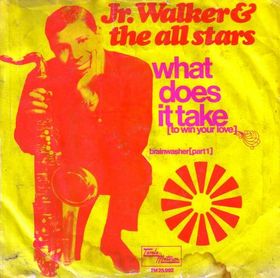
Jr. Walker and the All Stars – “What Does It Take (To Win Your Love),” Pop # 4, R&B # 1
By Joel Francis
“What Does It Take (To Win Your Love)” was Jr. Walker’s second chart-topper and first since 1965’s “Shotgun,” but the two songs couldn’t have been more different. While “Shotgun” was a raw roadhouse rumble with the horn dominating the vocals, “What Does It Take” was a smooth love song designed to drive traffic to the bedroom.
Although Walker penned many of the All Stars’ best numbers, like “Shake and Fingerpop,” “Hip City” and “Last Call,” he handed the reigns over to the songwriting and production duo of Harvey Fuqua and Johnny Bristol in a bid for greater pop success in the late ‘60s.
On paper it looked like a solid decision. Fuqua and Bristol were trusted entities. The latter discovered Walker, and the former gave Walker his first record deal. When Fuqua’s Harvey Records were purchased by Motown, Fuqua, Bristol and Walker became part of the Hitsville family.
While Fuqua and Bristol were successful in taking Walker back to the top of the charts, they did it by depriving Walker of his signature sound. The great saxophone that propelled so many All Stars singles was relegated to anonymous responses that could have been handled by any session player. Walker has overcome his initial microphone shyness to deliver a credible vocal, but his delivery his hardly distinct. All the right elements may be in place, but the product is competently forgettable.
Any thoughts that Walker strayed too far from the sound that made him great are reinforced by Kenny G’s 1986 cover featuring Bristol on lead vocals.
When the Temptations kicked David Ruffin out of the group in 1968, they cleaned house. Free of their troubled lead singer and his drug dependence and egocentric demands to rebill the quintet “David Ruffin and the Temptations,” founding member Otis Williams decided the psychedelic stylings of Sly and the Family Stone were the sound of the future. Although producer Norman Whitfield was reluctant to change the band’s sound with something “that ain’t nothing but a little passing fancy,” he eventually relented.
The wah guitar and flat cymbal sound that opens the song was completely unlike anything Motown had issued before. Instead of featuring one vocalist, the number finds all five Temptations passing the lead around. Williams and Whitfield’s early interest in Sly and the Family Stone is betrayed by the arrangement, which mirrors the San Francisco group’s No. 8 hit, “Dance to the Music.”
The lyrics also hit on what would become another touchstone of the post-Ruffin Temptations. The socially conscious themes of poverty, abuse and danger in the urban core would be repeated in the hits “Ball of Confusion,” “Run Away Child, Running Wild” and several other album tracks.
Williams has denied that the songs glorifies drugs as an escape to the world’s problems. For him, the key line is when Eddie Kendricks explains that cloud nine is “a world of love and harmony.”
“Cloud 9” brought Motown its first Grammy for Best Rhythm & Blues Group Performance, Vocal or Instrumental. The new category was just in its third year and had previously been awarded to Ramsey Lewis and Sam and Dave. The song paved the way for later psychedelic hits “Runaway Child, Running Wild,” “Psychedelic Shack.” These songs placed the Temptations on the vanguard of soul music and helped clear the way for Funkadelic, Earth Wind and Fire and the funk movement of the 1970s.
“Cloud 9” was run through the Motown stable and covered by Marvin Gaye, Gladys Knight and Edwin Starr. Meshell Ndgeocello performed the song live in the excellent Funk Brothers tribute/documentary “Standing in the Shadows of Motown.” The song has also been covered by reggae artist Carl Dawkins, Latin musician Mongo Santamaria and Rod Stewart.
Smokey Robinson and the Miracles – “I Second That Emotion,” Pop # 4, R&B # 1
By Joel Francis
Smokey Robinson was Christmas shopping with fellow Motown songwriter Al Cleveland when Cleveland let slip the malapropism “I second that emotion.” Intrigued, Robinson penned a lyric about a man disinterested in flirting, fishing for long-term love. In other words, it’s the complete opposite of every Kiss song ever.
The arrangement and delivery is relaxed and easy. Never a forceful singer, Robinson lets the horns punctuate his pleas. His vocals are soft and comforting as a pillow, while Miracle Marv Tarplin’s guitar pulls the song over the unusually subdued percussion. There’s no climax or resolution to the number – the horn breakdown in the final moment is as close as we get. It’s almost like Robinson is auditioning the idea.
The song fades before we learn the woman’s reaction, but audiences were delighted, sending “I Second That Emotion” into the Top 5 and earning the Miracles their sixth million-selling single.
Less than two years later, Diana Ross and the Supremes and the Temptations teamed up for a television special and album. “Diana Ross and the Supremes Join the Temptations” featured their interpretation of “I Second that Emotion,” which was a Top 20 UK hit (the single was not released in America). The album marked the debut of new Temp Dennis Edwards, who replaced the troubled David Ruffin. Miracle guitarist Tarplin reprised his role for the all-star revision. The song has a diverse cover life, with performances issued by Jerry Garcia, ‘80s synth band Japan, and “Stand By Your Man” country singer Tammy Wynette.
Marvin Gaye and Tammi Terrell – “Ain’t No Mountain High Enough,” Pop # 19, R&B # 3
By Joel Francis
Marvin Gaye found his greatest early success as a duet partner. The 1964 album “Together” was his first album to chart, and his duets placed in the Top 20 with a consistency that eluded him as a solo artist. Unfortunately, Gaye’s soul partners, Mary Wells and Kim Weston, both left Motown for (allegedly) greener pastures shortly after collaborating with Gaye. As established Motown solo artists, pairing of Gaye with Wells and Weston made sense. The teaming of Gaye with Hitsville newcomer Tammi Terrell, however, was inspired.
Terrell arrived at Motown in 1965 after bouncing from Scepter Records, where she recorded as Tammy Montgomery, James Brown’s Try Records and the Chess Records subsidiary Checker. Her initial Motown singles didn’t much fare better than her previous efforts, but “Ain’t No Mountain High Enough” took both her and Gaye’s careers to a new level.
Motown’s new singing pair was paired with the songwriting team Berry Gordy hired to replace the gradually exiting Holland-Dozier-Holland squad. Husband and wife Nickolas Ashford and Valerie Simpson came to Gordy’s attention in 1966 with their No. 1 hit “Let’s Go Get Stoned” for Ray Charles. (Ironically, “Stoned” was Charles’ first single after leaving rehab for his heroin addiction.)
“Mountain was a heck of a debut for both Ashford and Simpson and Gaye and Terrell. It’s obvious from the few seconds of spoken introduction that the signers have great rapport and their voices dance perfectly on the chorus. Although Gaye and Terrell sound like they’re giggling from the same care-free piano bench, their vocal parts were actually recorded separately. Terrell felt like she hadn’t rehearsed the lyrics enough to record with Gaye, so after some coaching with producers Harvey Fuqua and Johnny Bristol she cut her part alone.
Although Fuqua and Bristol had helmed dozens of Motown hits, “Mountain” doesn’t have the expected Hitsville sound. The most obvious explanation is that Ashford and Simpson were an “outside” songwriting team and that Holland-Dozier-Holland were on their way out. It also highlights that when people talk about the “Motown sound” they are often talking about Holland-Dozier-Holland’s signature production style. Holland-Dozier-Holland’s defection not only deprived Motown of its greatest songwriting team, but also Gordy’s vaunted “sound of young America.”
As one team of stars left, another was being born. The success of “Ain’t No Mountain High Enough” helped transform Gaye into one of Motown’s biggest and most enduring performers, whose brightest days were yet to come.
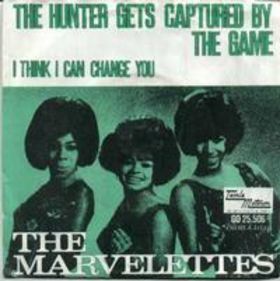
The Marvelettes – “The Hunter Gets Captured By the Game,” Pop # 13, R&B #2
By Joel Francis
The Marvelettes gave Motown its first No. 1 hit with “Please Mr. Postman,” but that was way back in 1961. But that was five years before “The Hunter Gets Captured by the Game” came out – a lifetime in pop music. The interceding years weren’t too kind. The group found some follow-up success with “Beechwood 4-5789,” but lost a founding member, and famously passed on “Where Did Our Love Go,” which became the Supremes’ first No. 1 hit.
By the mid-‘60s, the Marvelettes had lost another member. Only the success of greatest hits and live albums were keeping the band tethered to the Motown roster. Then Smokey Robinson entered the picture.
Robinson penned “Don’t Mess With Bill,” the comeback single for the now-trio. His pen also produced “The Hunter Gets Captured by the Game,” sung by Wanda Young, wife of Miracles’ guitarist Bobby Rodgers.
The lyrics are straightforward, but what makes the song is Young’s slinky singing and an equally elastic performance from the Funk Brothers. Check out the great guitar performance holding the whole song together and the great and rare Motown harmonica solo to appear outside of a Stevie Wonder or Shorty Long album.
The Marvelettes found a Top 10 hit with their next single – a remake of Ruby and the Romantics’ “When You’re In Love” – before losing another singer. They carried on with some success, but a full-scale comeback was quashed when the remaining members decided not to follow Berry Gordy to Los Angeles and Young’s pregnancy. After the Marvelettes dissolved, singer Ann Bogan joined New Birth, a soul outfit founded by former Motown staffer Harvey Fuqua.
“The Hunter Gets Captured by the Game” has been covered by Ella Fitzgerald, Raconteur Brendan Benson, Jerry Garcia, Blondie and Massive Attack. A reggae cover by Grace Jones reached No. 87 on the R&B charts in 1980.
The ultimate Stax tribute to the Beatles was Booker T and the MGs 1970 album “McLemore Avenue.” None of those tracks appear on the 2007 compilation “Stax Does the Beatles,” but strong contributions from Isaac Hayes, the Bar Kays, Carla Thomas and four other MG tracks make collection as strong as it appears on paper.
Otis Redding opens the album with arguably the greatest Beatles cover of all time. His version of “Day Tripper” (presented here in an unreleased alternate take) may even top the Beatles. Redding’s “Day Tripper” may be second only to Wilson Pickett and Duane Allman’s “Hey Jude” in the pantheon of Beatle covers. Pickett’s reading is sadly missing on this album, but David Porter’s “Help!” continues Redding’s frenetic horn lines and double-time delivery to add an urgency only hinted in John Lennon’s originals vocals.
“Stax Does the Beatles” contains two very different versions of “Yesterday,” a funky, sassy spin on “And I Love Her” and a slight cheat with John Gary Williams’ 1973 cover of George Harrison’s “My Sweet Lord.” Some readings work better than others, but all are stamped with the high quality that defined the Stax catalog.
The collection’s centerpiece is Isaac Hayes’ 12-minute cinematic, romantic rendition of “Something.” His arrangement features almost as many instruments as the Beatles “A Day in the Life,” including saxophone, wah guitar, full orchestra and a gorgeous piano line that holds the whole thing together. And that’s just the first 2 minutes.
Some might complain Hayes’ “Something” is overblown, over-produced and pretentious. They haven’t been paying attention to the deep longing in Hayes’ voice.
Although “Something” and “Day Tripper” come the closest, nothing on this collection will replace or make one forget the Beatles versions. The magic in their songs is that there are so many nooks and crannies it seems unlikely future generations will ever exhaust the possibilities of reinterpretation.
For Beatle fans that can play a song in their head by just thinking of the title or chorus, these R&B translations are for you. They are a fresh coat of paint on a favorite structure. For soul fans interested in the influence of soul in rock and vice versa, there is much to enjoy in “Stax Does the Beatles.” People who don’t like either Stax or the Beatles should find the nearest house of worship and repent. Then buy this on the way home.
When RZA needed a hook for “C.R.E.A.M.” he turned to the Charmels’ “As Long As I’ve Got You” and joined a large fraternity of rappers and producers who have leaned on the Stax catalog for their tracks. And though Stax has provided the samples for hits by Jay-Z, Public Enemy, Notorious B.I.G. and countless others, the source material has somehow remained in the secret province of crate-diggers.
Until now. “Stax: The Soul of Hip Hop” is 14 wonderfully selected, mostly obscure late-period Stax cuts released as part of Concord Record’s revitalization of the label. It’s unlikely that many Ghostface Killah fans listening to “Supreme Clientele” would have the urge to track down the source material for “The Grain.” But listening to Rufus Thomas’ “Do the Funky Penguin” on this compilation not only sheds light on the music that informed Ghostface – it’s fun enough to make the album more than a history lesson.
It’s great if De La Soul and Cypress Hill are the reasons these song sound familiar, but the collection succeeds because it dusts off great songs that are ignored on most retrospectives. 24-Carat Black’s lone album was ignored in 1973. That album’s title track “Ghetto: Misfortune’s Wealth” opens this compilation with a slab of socially conscious funk. The female trio the Emotions found their greatest success with Earth, Wind and Fire in the late ‘70s, but “Blind Alley” shows they were fully formed pop soul act long before Maurice White helmed their albums.
The Dramatics’ “Get Up and Get Down” foreshadows the disco movement, while Little Milton’s “Packed Up and Took My Mind” is the marriage of soul and blues that Robert Cray has been chasing for 20 years. The inclusion of Isaac Hayes and Booker T. and the MGs tosses a bone to casual fans, although two Hayes cuts may be one too many.
The only misstep is a song that dates from Stax’ early days with Atlantic Records. Wendy Rene’s 1964 track “After the Laughter (Come Tears)” is an unconvincing ballad whose best quality is a great calliope organ line. Complaining about this cut, the extra Hayes track and the wish that the producers would have packed the disc with more tracks, though, misses the point and spoils a great treasure.
This set not only proves that the hip hop samplers had immaculate taste, but that they weren’t just cherry picking. While they may have only mined 10 or 15 seconds from each track, the ore runs consistently deep through each performance.
If hip hop is the reason for this collection to exist and that marketing angle will draw those fans to this music, then so be it. But a celebration this fun doesn’t need an excuse.
The Temptations – “(I Know) I’m Losing You,” Pop # 8, R&B # 1
By Joel Francis
The list of Motown songs based around a guitar riff is a short one, but this masterpiece should be at the top of that one and several others. Producer Norman Whitfield wrote the song with Edward Holland of Holland-Dozier-Holland, but the Temps’ road manager Cornelius Grant supplied the signature guitar line. Grant’s contribution not only got him co-writing credit, but earned him the spot to play on the record – that’s him you hear on guitar in the song.
The Temptations’ classic line-up was in full effect for this number. David Ruffin nails the vocals. The rasp in his voice makes it sound like he’s been up all night drinking, smoking and thinking about where this relationship has gone. When the rest of the Temps chime in with “looosing you” it sounds like a desperate cry echoing out of the abyss.
The subtleties in Whitfield’s arrangement take center stage in the last minute of the song, as the playing of Eddie “Bongo” Brown and the Funk Brothers horn section take over. Check out that great trombone line and how the long low note underscores the desperate feel of the song. You can hear Ruffin’s world collapsing as the horns ramp up and dance with the voices as the song fades out. The gravity of the situation would be dire if it weren’t so easy to dance to.
Seizing on the rock elements of the song, Rare Earth cut a 10 minute cover for their 1970 “Ecology” album. Motown cut the track down to three minutes and released it as a single that summer where it peaked at No. 7 on the pop charts, one slot higher than the Temptations’ original. The greatest bar band of all time, the Faces, cut their version a year later. It was also released as a single and appeared on Rod Stewart’s blockbuster “Every Picture Tells A Story” album. In 1983, Texas pop group Uptown Girls released a dance version of the song.
(Above: Roy Ayers dedicates “Everybody Loves the Sunshine” to Miles Davis.)
By Joel Francis
The Kansas City Star
Before James Brown was black and proud and Marvin Gaye asked what’s going on, the Impressions were a winner who got people ready for the train a-comin’.
The Impressions message of racial harmony and black empowerment laid the roots for the black pride movement in soul and the native tongues/backpacker strain of hip hop today. The soul trio’s performance Saturday at the 40 Acres and a Mule Activity Campus in southeast Kansas City, Mo. capped the first day of the Juneteenth Family Festival, which celebrates the end of slavery in America.
Taking the stage in matching white suits, the Impressions quickly touched the sky with “Move On Up,” a song that established their leader and songwriter Curtis Mayfield as a solo artist. Although the set bounced between Impressions and Mayfield material, the songs were rooted in Mayfield’s late ‘60s/early ‘70s prime.
“Choice of Colors” felt like a hymn and was followed by the buoyant “We’re A Winner,” which got a healthy portion of the crowd of 300 clapping or on their feet. Impression Reggie Torian donned a black cape and white hat while the bass thumped the familiar melody to “Superfly.”
Torian had the unenviable job of taking Mayfield’s place. Although Mayfield, who died 10 years ago, will never be replaced, Torian did a good job capturing Mayfield’s rich falsetto on “I’m So Proud” and “I Loved and Lost.”
In an age of reunion bands and acts carrying on with only one original member, it would be easy to dismiss the Impressions as a Mayfield tribute act. Fortunately, the singers flanking Torian onstage are Fred Cash and Sam Gooden, the very people who sang, toured and recorded alongside Mayfield back in the day.
Backed by a seven-piece band that included a nearly obscured three-piece horn section, the Impressions were swinging through “Woman’s Got Soul” when a 40 Acres staff member came onstage. Confused, the band ended the song and announced that it was time for them to go. Ending with a rushed version of “It’s Alright,” they departed 40 minutes after taking the stage.
The Impressions’ set was likely cut short because Roy Ayers’ ran long. Ayers immediately preceded the Impressions, and while he made his name blurring the lines between jazz and funk in the early ‘70s, his 70 minute set concentrated on the slick R&B that made him a radio staple in the last half of the decade.
Backed by the local octet Ronnie Reed and the Millennium, Ayers took the stage halfway through a jam based on the JB’s “Pass the Peas” and quickly showed why he’s been the go-to guy for everyone from the Roots to Fela Kuti.
Ayers’ playing is at once funky and smooth. His approach to the vibraphone renders it a sonic mutant of drums, piano and guitar. His solos were so captivating that they rendered Millennium’s horn players irrelevant. As Ayers’ hammered away backed by the bare minimum of a groove, the suddenly extraneous horn section were relegated to synchronized dancing duty.
After an instrumental introduction, Ayers took over the mic and romped through four crowd pleasers. “Everybody Loves the Sun” drew many to their feet and Ayers got the rest involved by leading them through the lyrics. “Running Away” stayed in the same vein and featured a lengthy trumpet solo. Ayers was gracious in letting everyone in Millennium take long solos throughout the night.
Ayers ended his set walking through the crowd personally giving out free copies of his new live album. It seemed generous at the time, but ended up being an exchange of live music for recorded. Although the Impressions seemed ready to give more, no one was complaining either.
Setlists: The Impressions – Move On Up; Mighty Mighty (Spade and Whitey); Choice of Colors; We’re A Winner; Superfly; I Loved and Lost; Gypsy Woman; I’m So Proud; Woman’s Got Soul; It’s Alright
Roy Ayers – Pass the Peas; Everybody Loves the Sunshine; Running Away; Don’t Stop the Feeling; Searching






 joelfrancis.com