Review: Experience Hendrix

(Above: Jonny Lang and Aerosmith’s Brad Whitford blaze through “Fire.”)

By Joel Francis
The Kansas City Star

The lineup for Tuesday’s Experience Hendrix concert at the Uptown Theater seemed to set up a joke: How many guitarists does it take to pay tribute to the most celebrated axeman of all time? The answer: Fourteen, including half of Los Lobos, all of Living Colour, a pair of virtuosos, a handful of bluesmen and several contemporaries.

HENDRIX_FY_031610_CGO_002F
Bass player Billy Cox met Jimi Hendrix while the two were in the Army. He is the last living musician from any of the bands Hendrix lead.

Billy Cox, the Band of Gypsys bass player and Jimi Hendrix’ last living band mate, opened the night with a heartfelt thank you and romp through “Stone Free.” Backing him on drums was Chris Layton, better known for his time backing Stevie Ray Vaughan in Double Trouble, and Ernie Isley of the Isley Brothers. The star-power of the opening lineup may have had the loaded house drooling over their guitar magazines, but they didn’t have long to revel.

Every 20 minutes or so, another pairing of musicians emerged, each seeming to emphasize a different aspect of Hendrix’ music. His rhythm and blues roots came out in Living Colour’s set, while members of Los Lobos paid tribute to his roots and Kenny Wayne Shepherd emphasized the rock star angle.

Jonny Lang’s performance of “Fire” was the first explosive moment of the night. Backed by Brad Whitford of Aerosmith and a vivacious chorus of singers, Lang’s feverish vocals and impassioned playing drove the crowd to their feet. Whitford was finally able to emerge from the long shadow of his Aerosmith band mate Joe Perry as he and Lang traded solos.

Lang’s set was followed by Kenny Wayne Shepherd’s explosive interpretation of “Voodoo Child (Slight Return).” Knowing his boss was about to burn down the fret board, singer Noah Hunt, who also sings in the Kenny Wayne Shepherd Band, abandoned the stage after completing his verses. Alone onstage, save the rhythm section of Layton and Scott Nelson, Shepherd struck about every rock star pose imaginable as he soloed endlessly to the rapture of the crowd.

Susan Tedeschi was the lone intruder into this guy’s night out. Although she wasn’t given a set of her own, each of her frequent guest appearances was inspiring. Her singing on “One Rainy Wish” added an earthy sensuality and vulnerability to Hendrix’ lyrics, and her tasty guitar solos were a welcome relief from the pyrotechnics.

The night’s two dozen songs spotlighted classic rock staples “Purple Haze,” “Foxy Lady” and “The Wind Cries Mary,” and also unearthed some deeper treasures. Cox celebrated the guitarist he met in the Army with “Message of Love,” a song he a Hendrix recorded on the “Band of Gypsys” album. Eric Johnson embraced Hendrix’ love of unusual textures with the deep cut “House Burning Down.”

Robert Randolph and Sacred Steel brought new life into “Purple Haze.” The result wasn’t too different from what Randolph’s Family Band typically serves up, but the playing was much more elastic bouncing between the trio of steel guitars. Eric Johnson enlisted three drummers to help summon the heavy, drugged feel on “Are You Experienced.” Later, Joe Satriani had no trouble coaxing alien sounds from his guitar during “Third Stone From the Sun.”

Midway through the set, guitarist emeritus Hubert Sumlin emerged to represent the pre-Hendrix guitar world. Backed by Tedeschi, and Cesar Rosas and David Hildago of Los Lobos, Sumlin showed none of his 78 years powering through “Killing Floor,” a song he originally cut with Howlin’ Wolf for Chess Records in 1966.
HENDRIX_FY_031610_CGO_001F
While all the expected heavy hitters drew big responses, some of the evening’s best moments occurred during songs Hendrix didn’t write. Robert Randolph and Sacred Steel teamed with Cox and Living Colour singer Corey Glover for a jubilant gallop through Buddy Miles’ “Them Changes.” Cox tried to end the number, but Randolph wouldn’t let it stop, motivating Glover’s fervent yelps with his riffs. Early in the night, Isley’s unaccompanied incorporation of “Amazing Grace,” mostly played with his teeth, brought back shades of Woodstock.

After every trick and novelty had been exhausted, Cox returned to the stage and closed the night with the blues staple “Red House.” When all the performers were brought out for a final bow, they extended nearly all the way across the stage. Evidently it takes a lot of bodies to fill some very big shoes.

PROGRAM
Stone Free – Billy Cox, Ernie Isley
Message To Love – Billy Cox, Ernie Isley
Manic Depression > Amazing Grace – Ernie Isley
Power of Soul – Living Colour
Crosstown Traffic – Living Colour
House Burning Down – Eric Johnson
Bold As Love – Eric Johnson
One Rainy Wish – Eric Johnson, Susan Tedeschi
Are You Experienced – Eric Johnson, Will Calhoun
Fire – Jonny Lang, Brad Whitford
The Wind Cries Mary – Jonny Lang, Brad Whitford
Spanish Castle Magic – Jonny Lang, Brad Whitford, Susan Tedeschi
I Don’t Live Today – Kenny Wayne Shepherd, Noah Hunt
Come One – Kenny Wayne Shepherd, Noah Hunt
Voodoo Chile > Voodoo Child (Slight Return) – Kenny Wayne Shepherd, Noah Hunt
Can You See Me – David Hildago, Cesar Rosas
Little Wing – David Hildago, Cesar Rosas
Killing Floor – Hubert Sumlin, David Hildago, Cesar Rosas, Susan Tedeschi
Purple Haze – Robert Randolph and Sacred Steel
Them Changes – Robert Randolph and Sacred Steel, Billy Cox, Corey Glover
Third Stone from the Sun – Joe Satriani, Corey Glover, Doug Wimbish, Will Calhoun
Foxy Lady – Joe Satriani, Living Colour
All Along the Watchtower – Joe Satriani, Living Colour
Red House – Billy Cox, Joe Satriani, Brad Whitford, Robert Randolph, Will Calhoun

Note: Except when replaced by Living Colour or Billy Cox, Chris Layton and Scott Nelson played drums and bass. The Sacred Steel is Robert Randolph, Darick Campbell and Aubrey Ghent. Living Colour is Will Calhoun, Corey Glover, Vernon Reid and Doug Wimbish.

Keep reading:
Rock Hall celebrates the 40th anniversary of Woodstock

Review: Buddy Guy

Review: Los Lobos

Review: Chickenfoot

Review: Robert Randolph and the Family Band

Stuff your stocking with these live collections

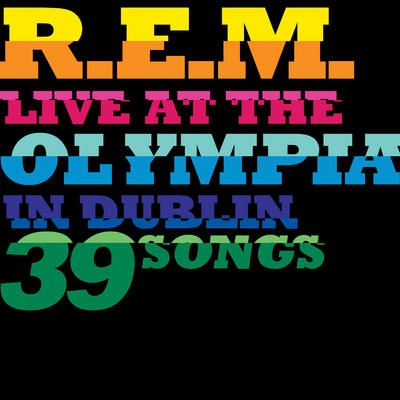
(Above: If you’ve been good, maybe Santa will bring the new R.E.M. album, “Live at the Olympia.”)

By Joel Francis

The holiday season is a notorious dumping ground for greatest hits, repackagings and other musical ephemera. Four established artists, however, transcend the fourth-quarter wasteland. New live albums by Paul McCartney, R.E.M., Tom Waits and Tom Petty are essential additions to any music fan’s library.

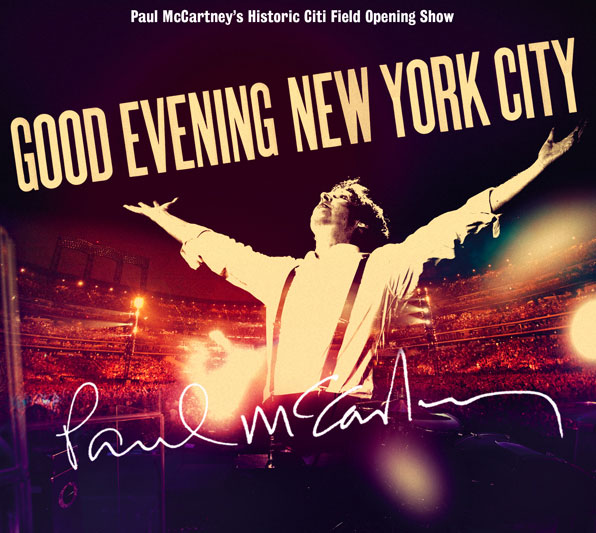
After dropping just one live album in the first half of his solo career, Paul McCartney opened the floodgates over the past two decades. Issuing six live albums since 1990, McCartney has faithfully documented nearly all of his tours and several special performances, but “Good Evening New York City” stands out. The two-CD, one-DVD set documents McCartney’s three-night inaugural performance at the Mets new home Citi Field last summer. Backed by his tight, longstanding quartet, Sir Paul unloads several surprises, like the forgotten “Mrs. Vandebilt,” a tribute to John Lennon with a medley of “A Day in the Life” and “Give Peace a Chance,” and the delightful segue way into Jimi Hendrix’ “Foxy Lady” at the end of “Let Me Roll It.”

Other delights are newer cuts “Only Mama Knows” and “See the Changes,” and the full-band arrangement of “Something” that echoes the performance at the Concert for George. Of course Beatle numbers are plentiful, but the obligatory “Hey Jude” and “Let It Be,” are countered with “Paperback Writer” and “Day Tripper.”

As with all McCartney live albums, the stage banter has been removed, giving the album a bit of a workman-like quality, as the band grinds through the songs with only brief pauses. This editing creates some curious results, such as Billy Joel’s unannounced duet on “I Saw Her Standing There,” or the accidentally buttressing of “Yesterday” and “Helter Skelter” (there was likely an encore break separating the two).

Although there are many places to hear Sir Paul shuffle through the world’s greatest jukebox, few are this energetic or diverse.

When R.E.M. released their last live album, “R.E.M. Live,” only two years ago the band seemed to be running on fumes. Following the disappointing “Beyond the Sun” album with a stop-gap, hits-in-concert set as generic as its title was a naked, holiday cash grab.

A lot has changed since then. Last year’s “Accelerate” brought the trio long-absent acclaim and reinvigorated both the band and its fans. Although “Live at the Olympia” was recorded only four months after “R.E.M. Live” the results couldn’t be more different. While “Live” hit all the obvious marks with little passion, “Olympia” digs deep into the catalog, offering early fan favorites “Driver 8” and obscurities like “Circus Envy.” “Olympia” boasts 17 more songs than “Live” and only two overlapping numbers, so both collections can coexist comfortably.

Fans excited by “Accelerate” will celebrate this 39-track collection. “Live at the Olympia” is the sound of a band being reborn.

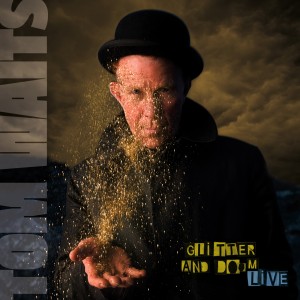
Unlike McCartney and R.E.M., it has been nearly a generation since Tom Waits last issued a live album. “Glitter and Doom Live” does a good job spotlighting Waits’ sonic shifts over the last several years, leaning heavily on tracks from his decade on the Anti- label. Drawn from stops along his 2008 tour of the same name, “Glitter and Doom Live” is more a sampler than a complete performance.

Most of the stage banter has been excised, hilariously, to the second disc. “Tom’s Tales” is a 36-minute montage of Waits’ musings about vultures, jokes about Nazi pasta and adventures on eBay that could stand on its own as one of the year’s best comedy albums.

The songs that made the cut, though, are invigorating. “Orphans” cuts “Lucinda” and “Fanin Street” are more raw while “The Part You Throw Away” is delicate and tender. “Get Behind the Mule” sounds like a voodoo chant at a deep South juke joint, and early cuts like “Singapore” and “I’ll Shoot the Moon” are completely reworked. While hardcore fans may have been happier with a set that recreated Waits’ concert experience, few will be disappointed with the 16 songs delivered.

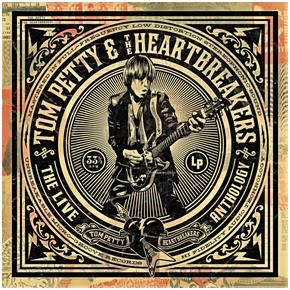
Tom Petty has issued more than a dozen albums during his hit-filled, three-decade career, but until now has only had one live album to his name. “Live Anthology” corrects that problem by offering 50 choice cuts spanning 30 years of gigs. The performances zig zag through the years, but the set flows, creating a dream concert spread across four discs (more if you buy the deluxe edition).

Although all the hits are here, the opening number, “Nightwatchman” shows how deep Petty is willing to delve. More than living up to its name, “Anthology” explores early performances of hits “Even the Losers” right up to full-band arrangements of “Square One” off Petty’s most recent solo album. A sing-along stroll through “A Thing About You” segues seamlessly into Bobby Womack’s soul ballad “I’m In Love.” Later, “Breakdown” slides into a few bars of “Hit the Road, Jack.”

There are no cuts from the Heartbreakers’ mid-‘80s stint as Bob Dylan’s backing band, but honestly, there are enough other incredible moments that they’re not missed. A sublime “Learning to Fly” with Stevie Nicks on backing vocals, an extended “Good to Be King” and unreleased originals like “Melinda” and “Driving Down to Georgia” and covers like “Good Good Loving” and “Goldfinger” (yes, that one) make the set an embarrassment of riches.

This collection not only cements the Heartbreakers’ legend as one of the tightest and most versatile bands of all time, but amplifies their love of rock and roll in all its forms. “Live Anthology” is both more consistent and comprehensive than Petty’s previous box set, the hits/album cuts/rarities collection “Playback.” It is the jewel of Petty’s catalog.

Marvin Gaye – “I Heard It Through the Grapevine”

256489
Marvin Gaye – “I Heard It Through the Grapevine,” Pop # 1, R&B # 1

By Joel Francis

Producer and songwriter Norman Whitfield had finally triumphed. His fourth attempt at recording “I Heard It Through the Grapevine” had finally made it past Berry Gordy’s Quality Control meetings and triumphed at the top of the charts. Now, just over a year later, he wanted to release an earlier version of the song recorded by Marvin Gaye. Label honcho Berry Gordy had denied Whitfield’s request to release Gaye’s “Grapevine” before Gladys Knight had a hit with the song. His stance would not change. Whitfield was successful, however, in getting the song inserted on Gaye’s “In the Groove” album. Just as he had hoped, listeners started requesting “Grapevine” and DJs clamored for Motown to release the song as a single. Finally released in late October, 1968, “Grapevine” shot to the top of both the pop and R&B charts, outselling Knight’s version and becoming the biggest-selling Motown single to date. The song was so popular, Gaye’s album “In the Groove” was renamed “I Heard It Through the Grapevine.”

The path to getting the song recorded wasn’t much smoother. Whitfield spent a month recording the backing track with the Funk Brothers, Detroit Symphony and backing vocal group the Andantes. During these sessions, Gaye and Whitfield started to argue over the vocal arrangement. Whitfield, who worked primarily with the Temptations, wanted Gaye to sing above his natural ranges, as David Ruffin did on the Tempt’s hit “Ain’t To Proud To Beg.” Gaye initially resisted, but finally gave in. The combination of Gaye’s rasp and the Andantes convinced Whitfield he had a hit. Now he had to persuade Gordy.

Gaye’s version of “I Heard it Through the Grapevine” bears little resemblance to the song Knight took to No. 1. The defining organ line in Gaye’s arrangement barely appears in Knight’s version. Her reading was all about funk and atmosphere; Gaye’s speaks directly to the lyrics. His strained voice is haunting and filled with pain. And while the emphasis is placed on the strings, check out the great interaction between the bass and drums and the great drum sound. It almost sounds tribal.

This reading of “Grapevine” has become the definitive version, but that hasn’t stopped dozens of other artists from trying their hand. Hoping to strike lightning thrice, Whitfield gave the song to the Temptations, who included it on their 1969 album “Puzzle People.” In 1970, Creedence Clearwater Revival released a blistering 11 minute version that featured lots of fretwork and jamming from the usually concise quartet. Talk-box titan and funkmaster Roger Troutman took the song back to No. 1 on the R&B charts with his 1982 cover. The song was also famously co-opted by the California Raisins (and sung by former Jimi Hendrix drummer Buddy Miles) in 1986.

Bobby Taylor – “Does Your Mama Know About Me”

mama know
Bobby Taylor – “Does Your Mama Know About Me,” Pop # 29, R&B # 5

By Joel Francis

North Carolina native Bobby Taylor was working with a trio of Canadian musicians performing Motown numbers in Vancouver when the group caught the attention of Supremes Mary Wilson and Florence Ballard. The pair excitedly contacted Berry Gordy after hearing Bobby Taylor and the Shades in concert, and Gordy signed the group to his Gordy Records subsidiary.

Unfortunately, the excitement over Taylor’s stage shows failed to translate over records to a wider audience, and the group broke up in 1969 after one album and a handful of lukewarm singles. “Does Your Mama Know About Me” was the group’s biggest hit, peaking at No. 29 on the Pop chart.

Although Taylor’s Motown footprint is shallow, he had a hand in scouting and nurturing several well-known performers. While he was never a member of the Shades – later rechristened the Vancouvers by Gordy – Taylor recalled that Seattle guitarist Jimi Hendrix played with the group on several occasions. Shades drummer Floyd Sneed went on to join Three Dog Night. After booking a local band to open for them in Chicago, Taylor recommended Gordy sign the Jackson 5. He went on to produce the majority of the band’s debut album.

The Vancouver to go onto greatest acclaim, though, was the band’s guitarist. The half-Chinese, Scots-Irish born Thomas Chong co-wrote “Does Your Mama Know About Me” and performed on two more Vancouvers singles before being fired for missing a gig – he was applying for a green card – and becoming a superstar as half of the comedy duo Cheech and Chong.

With its sweeping strings and lush orchestration, “Does Your Mama Know About Me” feels more like a Philly soul number than a Motown production. This type of arrangement was used to great effect by Kenny Gamble and Leon Huff on early ‘70s soul hits like “Me and Mrs. Jones” and “If You Don’t Know Me By Now.” Although Gamble and Huff developed their sound independently – though they were no doubt keeping an ear trained on Motown – “Mama” illustrates how Motown continued to be at the vanguard of soul music beyond the departure of Holland-Dozier-Holland and its production-line sound.

A forgotten footnote, the only noteworthy cover of “Does Your Mama Know About Me” was performed by Diana Ross and the Supremes and included on their 1968 album “Love Child.”

Rock Hall celebrates the 40th anniversary of Woodstock

Rock & Roll Hall Of Fame

(Above: Woodstock Festival organizer Michael Lang’s hand-drawn layout of the festival grounds. The drawing is part of a new exhibit celebrating the 40th anniversary of Woodstock at the Rock and Roll Hall of Fame and Museum. All photos courtesy of the Rock and Roll Hall of Fame and Museum.)

By Joel Francis

The enduring image of Woodstock is iconic: a fringed performer – Jimi Hendrix, Roger Daltrey, David Crosby or Sly Stone – onstage, in front of a staggering mass of people. But how did the performers get to the stage, and where do all the fans answer nature’s call?

“Woodstock: The 40th Anniversary,” a new exhibit at the Rock and Roll Hall of Fame, sheds light on the logistical side of America’s first and greatest rock festival.

“One of the things that interested me the most in putting this exhibit together was just seeing what went into planning of the festival,” said Jim Henke, chief curator at the Rock and Roll Hall of Fame. “There was a massive amount of planning involved, and a lot of it had to be done at the last minute because the city fathers of Wakill, N.Y. didn’t want that many people to descend on them and made the organizers move the site.”

Festival organizer Michael Lang didn’t get much rest in the weeks leading up to the Woodstock and as evidenced in the “Woodstock” film, Lang had his hands full throughout the event as well. Lang made quite the statement on film making several last-minute arrangements, deals and accommodations in a hand-designed leather vest, also fringed, of course. The vest is just one of several items Lang loaned to the hall for the exhibit.

“Lang’s vest is still in decent shape today,” Henke said. “I’m sure he didn’t get any sleep during that period, but it seems like for whatever reason he was able to keep it together.”

Other clothing in the exhibit includes the tie-dyed cape and jacket John Sebastian wore during his five-song set, and the spectacles Robbie Robertson wore during The Band’s performance.

Rock & Roll Hall Of FameSurrounding the garments is the contract Crosby, Stills, Nash and Young’s performance contract, drawings and layouts of the festival grounds, Lang’s handwritten management and operations plan, and an early press release stating the original location of Wallkill and that “Woodstock does not figure on gate crashers.”
“One of the more interesting items we have is a letter from Apple offering the services of James Taylor and Billy Preston for Woodstock,” Henke said. “It turned out Lang and the others didn’t get it in time, so no one appeared.

The letter offered the services of the Plastic Ono Band, which it described as “a series of plastic cylinders incorporated around a stereo sound system.”

“The letter didn’t say John Lennon and the Plastic Ono Band,” Henke said, “so I’m not sure if he would have been there or not. I do know Lennon played the Live Peace festival in Toronto a month later, so it could have been a possibility.”

“Woodstock: The 40th Anniversary” appears in the museum’s Ahmet M. Ertegun Main Exhibit Hall through November. The museum will be showing an edited version of the restored Woodstock film in the theater adjacent to the exhibit.

“In addition to having an amazing musical lineup, Woodstock was also the culmination of the anti-Vietnam war movement and the peace and love movement. It was a natural merger that pushed them of being underground movements,” Henke said. “For some of our visitors, this exhibit will bring back memories. The younger audience may not know as much going in, but hopefully they will learn how one of the seminal moments in rock and roll history came about.”

For museum hours and ticket and general information, visit the Rock and Roll Hall of Fame Website.

Keep Reading:

Rock Hall Celebrates 50 Years of Motown

George Kalinsky: Painting with Light (Rock Hall photo exhibit)

Bruce Springsteen Rocks the Hall (part one)

Bruce Springsteen Rocks the Hall (part two)

Contest: Win a pair of tickets to the Air Guitar Championship

(Above: This could be you – or one of your really drunken friends.)

Be it Jimi Hendrix with a broom stick or Eddie Van Halen and a tennis racket, every music fan has gone through an air guitar phase, whether he (or she) wants to admit it or not.

If you’ve kept practicing your air guitar moves or like to laugh at those who have, then make plans to be at the Record Bar, on Tuesday, June 9 for the Air Guitar Championships.

Tickets for the competition run $10 online (plus TicketBastard fees), but The Daily Record is giving a one of its loyal readers the chance to get in free.

Here’s how this will work: If you live in the Kansas City area and want to go, simply leave a comment for this entry describing your favorite air guitar song or greatest air guitar moment. Be sure to leave your e-mail address, because that’s how I’ll contact the winner to let them know they’ve won a two tickets to witness or participate in the Air Guitar Championships.

Originality counts, folks, so don’t inundate us with stories about “Eruption” and “Stairway to Heaven.”

The people throwing this competition are serious about finding the ultimate air guitar hero. Winners at the 23 regional showcases will have the chance to compete in the championship round this August in New York City. There they will be judged by reigning U.S. and World Air Guitar Champion “Hot Lixx” Hulahan (I know, but that’s what it says in the press release) and Daily Show correspondent Jason Jones.

For complete rules, videos and other information visit the Air Guitar Championships Web site.

Commence sending your stories … now!

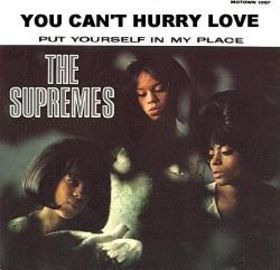
The Supremes – “You Can’t Hurry Love”

Supremes_You_cant_hurry_love

The Supremes – “You Can’t Hurry Love,” Pop #1, R&B #1

By Joel Francis

The bouncing bassline that opens this song is courtesy of James Jamerson, the same man who delivered the delightful and legendary three-note thump that introduces “My Girl.”

The intro to Holland-Dozier-Holland’s masterpiece “You Can’t Hurry Love” is a lesson in how to build a Motown hit: Start with the bass and percussion, add some horns (or strings) and then have a pretty voice jump into a catchy verse.

Diana Ross may not have had the prettiest or best female vocal on the Hitsville roster, but by 1966 she had the most recognizable one. And for once her thin tone actually works in her favor. Ross’s voice perfectly conveys the naivety and innocence of a lovelorn girl trying to be patient – “remember mama said,” she sings – to little avail. Ross would seldom reveal so much of herself in song again, hiding behind “big” vocals a la “Ain’t No Mountain High Enough.”

When this song was recorded, Ross was little more than a year away from getting top billing and four years removed from going solo. Even still, Mary Wilson and Florence Ballard are little more than anonymous backing singers in the mix. Although the track is as perfect as a song can be, it’s a shame their talent wasn’t given greater prominence.

While this song may be held up as Exhibit A by haters who think Motown is too slick and soulless, it is also testament to how smoothly the Motown assembly line was working. The song was recorded in just two sessions. Presumably the Funk Brothers laid down everything but the vocals at the June 11, 1966 session and the Supremes added their vocals at the July 5 session. Little more than three weeks later, the single was on the radio. By September, only three months after initial recording, it sat at No. 1 and earned the trio a high-profile performance on the Ed Sullivan show.

“You Can’t Hurry Love” had a renaissance in the 1980s. Phil Collins took it to the Top 10 in 1982, the same year the Stray Cats put it on the flip side of “Rock This Town.” Whoopi Goldberg sang it in her 1986 film “Jumpin’ Jack Flash,” and former Jimi Hendrix/Electric Flag drummer Buddy Miles sang it as the voice of the California Raisins (which, sadly, was the first version The Daily Record heard and its non-oldies radio introduction to classic R&B).

Review: Gov’t Mule

(Above: Mule, meet Radiohead. Radiohead, Mule.)

By Joel Francis
The Kansas City Star

One fan’s T-shirt asked: “Got Mule?” And for the second time in three months, the answer was “yes.”

Nearly 12 weeks after playing to a packed Voodoo Lounge, Gov’t Mule played for another full house Wednesday night at the Granada in Lawrence.

The classic rock jam quartet opened with the dirty blues stomp of “Brand New Angel” before segueing into the wah-driven “Perfect Shelter.” The show didn’t really start, though, until the surprise cover of Jimi Hendrix’ “If 6 Was 9.” It was the first of many cover treats.

A raucous “Helter Skelter” bumped against a medley of Temple of the Dog’s “Hunger Strike” and Traffic’s “Dear Mr. Fantasy.” Earlier in the night, Radiohead’s “Creep” was followed by Led Zeppelin’s “Trampled Underfoot.”

There was just as much diversity in band’s original material. Propelled by Danny Lewis’ organ, the intro to “Larger Than Life” recalled Medeski, Martin and Wood. “Streamline Woman,” meanwhile sounded like Led Zeppelin lost in the Florida swamps. And all bets were off for the progressive rocker “Silent Scream,” which encompassed 20 minutes and a drum solo.

The band played a one-hour opening set, before taking a 20-minute break and coming back for another 90 minutes. During that time, most sets of eyes were trained on singer and guitarist Warren Haynes. Haynes also plays in the Allman Bros. and was hailed by Rolling Stone as one of the greatest guitarists of all time. His playing is impressive, but not flashy. It’s like he knows exactly where to put his fingers again and again and again.

Although Haynes took many noteworthy solos, the instrumental “Birth of the Mule” was his tour de force. The 10-minute number opened with Haynes’ delicate, fingerpicked slide playing. Starting like a gentle rain and building into a full storm, the song culminated in a heavy riff reminiscent of Black Sabbath before gliding back to the ground, light as a feather.

The middle-aged, mostly male Mule heads who knew exactly what they were getting into. Although the floor was too packed to dance, everyone seemed content to nod and sway in place.

The night closed with a pair of slide blues rave-ups. Hayes did a great job of replicating Muddy Waters’ early playing style on “Champagne and Reefer.” The tune paired so nicely with Hound Dog Taylor’s “Gonna Send You Back To Georgia” that the two were stretched for 20 minutes.

Setlist: Brand New Angel, Perfect Shelter, Streamline Woman, Larger Than Life ->If 6 Was 9 ->Larger Than Life, Get Out Of My Life, Birth of the Mule, Temporary Saint, Creep, Trampled Underfoot/Intermission/Patchwork Quilt, Helter Skelter, Hunger Strike->Dear Mr. Fantasy->Hunger Strike, Silent Scream->Drum Solo, Like Flies->Mule->I’ve Been Working->Mule/Encore/Champagne and Reefer, Gonna Send You Back To Georgia

The Day the Music Survived

(Above: “True Love Ways” is The Daily Record’s favorite Buddy Holly song.)

By Joel Francis
The Daily Record

Fifty years ago this week, the plane carrying Buddy Holly, Ritchie Valens and the Big Bopper crashed in an Iowa cornfield, claiming its passengers and 22-year-old pilot Roger Peterson.

The event became known as “The Day the Music Died,” but the fact people were still talking about it 12 years later when Don McLean memorialized the moment with the song “American Pie” proves that music indeed survived.

The rock landscape had changed a lot between 1959 and 1971. The pioneers of the rock and roll were having hard time. Chuck Berry had bounced from Chess to Mercury and back and was seven years removed from his most recent Top 40 hit (although the No. 1 “My Ding-A-Ling” was right around the corner). Carl Perkins was performing as a sideman in Johnny Cash’s band and Little Richard, Bo Diddley, Fats Domino and Bill Haley dismissed as washed up. Only Elvis Presley and Jerry Lee Lewis retained a whiff of their ’50s fervor, but it took a televised “comeback” special and a genre hop to country and western for them to manage the trick.

That Holly was not only remembered, but celebrated in the aftermath of Woodstock and Altamont, in an era where rock’s excesses were just starting to steamroll, was not pure nostalgia.

Far from killing rock and roll, Holly planted the seeds that allowed it to flourish. Holly was one of the first artists to recognize the recording studio as creative environment, by experimenting with double-tracking and overdubs. He was the first songwriter to pilfer the Bo Diddley beat for “Not Fade Away.” He was the first rock and roll star to play a Fender Stratocaster, the guitar of choice for Eric Clapton, Jeff Beck, Jimi Hendrix, Stevie Ray Vaughan and countless others.

Although the Beatles often receive credit for being the first group to write their own material and put strings on a rock album, the truth is, Holly did both nearly a decade before them. It’s not a big leap from Holly’s “Raining In My Heart” to McCartney’s “Yesterday.”

But the most amazing of Holly’s feats is that he did it all by 22, an age at which Bob Dylan was just emerging from his Woody Guthrie fixation, Brian Wilson was begging out of tours because of stage fright and Neil Diamond was still trapped in the Brill Building.

Few mourn other ’50s rock casualties, like Eddie Cochran, who died a scant 14 months later, but Holly’s influence continues to be felt today. It’s  in Elvis Costello’s spectacles, Weezer’s Top 5 1994 hit, and the myriad of bands – ranging from the Rolling Stones to the White Stripes to the cover band in the bar around the corner – who regularly drop “Not Fade Away” into their sets.

The day the music died? Not even close.

Review: Buddy Guy


Above: Buddy Guy preaches the blues via Cream, Hooker and Hendrix.

By Joel Francis

The Kansas City Star

Buddy Guy isn’t mentioned in the film “Cadillac Records” but he made a strong case for his inclusion among the Chess label’s pantheon of greats Friday night at the Uptown Theater.

After a brief introduction by his four-piece band, Guy walked onto the stage and straight into a guitar solo. When he finally tired of pulling notes from his cream-colored Stratocaster, Guy walked to the mic and began to sing. Rattling off the names of his mentors and influences – Son House, Muddy Waters, Howlin’ Wolf, and Willie Dixon – he passionately cried “they’re the ones who made the blues, tell me who’s going to fill those shoes?” It was a reverent, but rhetorical question.

Guy has no trouble whipping a crowd into a frenzy, but he can silence them just as easily by placing a finger to his lips. He stayed in a quiet mode for most of the evening, dripping a spare, creeping version of “Hoochie Coochie Man.” The classic Waters number was propelled by Guy’s expressive singing and the familiar bass line while a sprinkling of piano and smattering of guitar solos were drizzled over the top. That number worked its way into two more Waters’ tunes, “Love Her With A Feeling” and “She’s Nineteen Years Old.”

While his playing was still fiery, Guy was content to smolder for an evening. With the drums gently clicking like metronome, band played so subtly they were easily overwhelmed by conversation when the audience grew restless. The steady flow of bodies to the beer stands said the crowd wasn’t expecting so much restraint.

Likewise, Guy probably wasn’t expecting such an empty house. The Uptown’s balcony was closed off and while the floor was basically full, there were still plenty of vacant seats.

Opening act Tom Hambridge, who also produced Guy’s latest album, hopped onstage to lend vocal support to “Skin Deep.” Guy’s journey as the child of Louisiana sharecroppers to witnessing his fellow Chicagoan Barack Obama claim the presidency gives his song for racial equality extra poignancy. The soul ballad ended with the audience singing along. Bolstered by a Hammond organ, the song wasn’t quite gospel, but it felt a lot like church.

A tribute to Albert King opened with one of the mellowest readings of “I’m Going Down” of all time. The song heated up, though, when Guy jumped offstage and slowly made his way through the assembly. Feeding off the crowd’s energy, Guy devastated “Drowning On Dry Land.” Walking into the foyer, Guy unleashed the most blistering solo of the night with few witnesses around. With his guitarist and bass player swaying to a synchronized two-step on stage, Guy sauntered back into the theater and plopped down in one of its seats without missing a note. Guy’s six-string field trip ended with a passionate performance of B.B. King’s “Rock Me Baby.”

The second half of the show was essentially a mega medley of Guy’s blues heroes. Rotating from John Lee Hooker to Little Walter to Cream to a dialed-down cover of Peggy Lee’s “Fever,” Guy switched songs so often it was almost like their was a penalty for playing a number all the way through. He found a wah wah peddle and the volume switch for “Voodoo Child” and channeled James Brown for a stellar snippet of “I Go Crazy.” After nearly 90 minutes onstage, Guy closed with a bit of “Kansas City.”