The Supremes – “You Can’t Hurry Love”

Supremes_You_cant_hurry_love

The Supremes – “You Can’t Hurry Love,” Pop #1, R&B #1

By Joel Francis

The bouncing bassline that opens this song is courtesy of James Jamerson, the same man who delivered the delightful and legendary three-note thump that introduces “My Girl.”

The intro to Holland-Dozier-Holland’s masterpiece “You Can’t Hurry Love” is a lesson in how to build a Motown hit: Start with the bass and percussion, add some horns (or strings) and then have a pretty voice jump into a catchy verse.

Diana Ross may not have had the prettiest or best female vocal on the Hitsville roster, but by 1966 she had the most recognizable one. And for once her thin tone actually works in her favor. Ross’s voice perfectly conveys the naivety and innocence of a lovelorn girl trying to be patient – “remember mama said,” she sings – to little avail. Ross would seldom reveal so much of herself in song again, hiding behind “big” vocals a la “Ain’t No Mountain High Enough.”

When this song was recorded, Ross was little more than a year away from getting top billing and four years removed from going solo. Even still, Mary Wilson and Florence Ballard are little more than anonymous backing singers in the mix. Although the track is as perfect as a song can be, it’s a shame their talent wasn’t given greater prominence.

While this song may be held up as Exhibit A by haters who think Motown is too slick and soulless, it is also testament to how smoothly the Motown assembly line was working. The song was recorded in just two sessions. Presumably the Funk Brothers laid down everything but the vocals at the June 11, 1966 session and the Supremes added their vocals at the July 5 session. Little more than three weeks later, the single was on the radio. By September, only three months after initial recording, it sat at No. 1 and earned the trio a high-profile performance on the Ed Sullivan show.

“You Can’t Hurry Love” had a renaissance in the 1980s. Phil Collins took it to the Top 10 in 1982, the same year the Stray Cats put it on the flip side of “Rock This Town.” Whoopi Goldberg sang it in her 1986 film “Jumpin’ Jack Flash,” and former Jimi Hendrix/Electric Flag drummer Buddy Miles sang it as the voice of the California Raisins (which, sadly, was the first version The Daily Record heard and its non-oldies radio introduction to classic R&B).

Chris Clark – “Love’s Gone Bad”

cc

Chris Clark – “Love’s Gone Bad,” Pop #105, R&B #41

By Joel Francis

Producers had been looking for a “white singer with a black sound” long before Sam Phillips signed Elvis Presley. But Berry Gordy’s quest definitely added a layer of irony to the process.

Not that Gordy fared any better than the majority of his contemporaries. We can be fairly certain that the assets that drew Gordy to Chris Clark were not vocal.

Nonetheless, Gordy positioned Clark to be Motown – and America’s – answer to Dusty Springfield. He propped her up with songs by Holland-Dozier-Holland and even wrote and produced several numbers himself. Gordy’s favoritism didn’t go over so well at Hitsville. Other artists resented that Gordy spent so much time trying to make a star out of someone who refused to wear shoes, didn’t dress sharply and ate too much.

The public didn’t find much to like, either. Clark’s releases refused to dent the charts. “Love’s Gone Bad,” a HDH composition, was her greatest success, and somehow was enough to earn her the right to cut a full album the next year. 1967’s “Soul Sounds” dropped without a trace. So few copies were pressed that 40 years later it is a rare Motown collectible.

Despite all this, Clark managed to hang around Motown for quite a while. She co-wrote the Oscar-nominated screenplay to “Lady Sings the Blues,” Motown’s 1972 foray into film. That film, of course, starred Gordy’s ultimate protégée, Diana Ross.

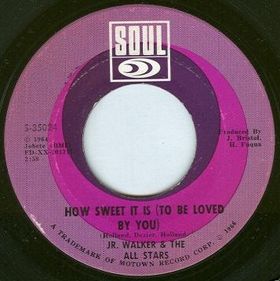
Jr. Walker and the All Stars – “How Sweet It Is (To Be Loved By You)”

sweet

Jr. Walker and the All Stars – “How Sweet It Is (To Be Loved By You),” Pop #18, R&B #3

By Joel Francis

Because he owned both the label and its publishing, it’s no surprise that Berry Gordy frequently had other label artists cut versions of earlier Motown hits. While there are several notable exceptions, for the most part these covers are either curiosities or album filler.

Jr. Walker, however, broke out of the mold with his reading of Marvin Gaye’s 1964, Top 5 hit “How Sweet It Is (To Be Loved By You).” After an extended saxophone intro, Walker puts down his horn. He has clearly overcome the microphone shyness that plagued him during the recording of his breakthrough hit “Shotgun.” Walking in Gaye’s shoes is no small feat, but Walker’s voice credibly handles the soulful, demanding melody.

While Gaye’s version was slick, joyous anthem, Walker’s is a little seedier – and all the better for it. Producer Harvey Fuqua, who signed Walker and changed his band name from the “Rhythm Rockers” to the “All Stars” in 1961, gave the song a faux-live feel that makes it sound like it was captured in a Southern roadhouse. The purposefully ragged backing vocals are more like enthusiastic audience intrusions. Close your eyes and you can smell alcohol and cigarette smoke while listening.

Others have covered this number since Gaye and Walker, of course, but a moratorium should have been placed after this interpretation. Finally, it should be noted that the year after he recorded “How Sweet It Is,” Walker memorably stole “Come See About Me” from the Supremes – no small feat – with his 1967 cover.

Jimmy Ruffin – “What Becomes of the Brokenhearted”

jruffin

Jimmy Ruffin – “What Becomes of the Brokenhearted,” Pop #7, R&B #6

By Joel Francis

Jimmy Ruffin isn’t as well-known as his brother, the late Temptations singer David Ruffin, but Jimmy didn’t land at Motown through nepotism. Raised in Mississippi, Jimmy sang with David in the family gospel group. When he was drafted, Jimmy entertained the troops with his doo-wop singing. After the military, he settled in Detroit. Jimmy auditioned for Motown and was signed before his brother, but success didn’t come as quickly.
Relegated to supplying handclaps and finger snaps, Jimmy was forced to earn a living on the automotive assembly line. After a few failed singles, Jimmy broke through with his third single, “As Long As there is Love,” written by Smokey Robinson, and finally hit big with “What Becomes of the Brokenhearted.”
Songwriters William Witherspoon, Paul Riser and James Dean originally intended this song to go to the Spinners, who would later give Motown a Top 20 hit with “It’s a Shame.” When Ruffin heard the number, it resonated so deeply within that he begged the trio to let him record it. The resulting single was the biggest and best-known of his career.
The song’s long introduction was the result of producer Mickey Stevenson’s decision to remove Jimmy’s spoken-word verse from the final mix. A restored version was later released on several Motown compilations. But the instrumental prelude does a great job of establishing the setting for Ruffin’s “land of broken dreams.” Songwriter Riser is best known as Motown’s in-house arranger. His string arrangements that appear on albums by Stevie Wonder, Marvin Gaye, the Temptations, Diana Ross and many more. One of the few Funk Brothers to emerge from the Snakepit – their nickname for Motown’s garage-cum-recording studio – with a writing credit, his influence may explain the song’s sweeping, theatrical feel.
Jimmy released another dozen singles and four albums – including one with David – for Motown. In the mid-’70s, he signed with Polydor, who released two of his albums. Jimmy’s final album, “Sunrise,” was produced by Bee Gee Robin Gibb and released in 1980. Shortly afterward, Ruffin moved to England where he had his own talk show and continues to tour.
The song was covered by Diana Ross and the Supremes in 1969, but ignored until Dave Stewart and Zombies singer Colin Blunstone cut a version in 1981. The duo may have been spurred by the success of “Sunrise” and Jimmy’s immigration to their native England. Ten years later, Paul Young’s cover hit No. 1 on the U.S. Adult Contemporary chart on the back of its appearance in the film “Fried Green Tomatoes.”

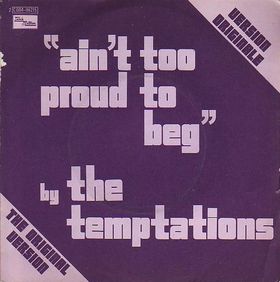
The Temptations – “Ain’t Too Proud To Beg”

680083

The Temptations – “Ain’t Too Proud To Beg,” Pop #13, R&B #1

By Joel Francis

If you’re not hooked in the first five seconds of this song, you haven’t been paying attention. All the elements attack immediately: the drum roll coupled with the insistent clanging cymbal, the knuckle-roll piano riff and, of course, David Ruffin’s raspy vocal. The stinging staccato guitar that shows up later in the initial verse is a direct homage to James Brown. Throw in the glorious backing vocals from the rest of the Temptations and a stellar horn line and you’ve got not only an incredible song, but a definitive snapshot of Motown in full glory.

“Ain’t Too Proud To Beg” would be no less a masterpiece if the story stopped there, but remarkably the song almost didn’t get made.

After a few of Smokey Robinson’s productions for the Temps failed to take hold on the charts, hotshot Norman Whitfield wanted the chance to sit behind the boards with the group. Whitfield was a long shot to topple Robinson’s incumbency, but Whitfield thought he had a number that could give him control. Enlisting songwriting help from Edward Holland, Jr. of the Holland-Dozier-Holland team, Whitfield had the Funk Brothers lay down the backing track to one of Motown’s funkiest numbers to date. The Temptations then added their vocals and Whitfield submitted the single to be auditioned at the Motown Quality Control meeting.

Quality Control meetings were the result of Berry Gordy’s days on the Detroit assembly line. Each week, the label’s top creative minds would meet, listen to music and decide what should be released. Surprisingly, “Ain’t To Proud To Beg” didn’t make the cut. It didn’t make the cut the second week, either. Politics could have been at play – Robinson and Gordy were so close that Robinson named his son Berry – but Gordy asserted that the number simply needed more work.

So Whitfield went back into the studio and moved the melody for the vocal line just out of Ruffin’s range. The straining singer’s vocals added the needed muscle and desperation to the song, and the number was once again submitted to Quality Control.

This time, however, the song had unexpected competition in the form of “Get Ready,” a Temptations number Robinson had written and produced for the band. Since Robinson was the Temps’ established producer “Get Ready” went out while “Ain’t Too Proud To Beg” stayed on the shelf. Whitfield was so upset that Gordy promised him “Beg” would be the next single if “Get Ready” failed to reach the pop Top 20.

Gordy kept his word and the song was finally released in May, 1966, eventually reaching No. 1 on the R&B charts. When Whitfield found success with the Temptations following two singles he was instated as the group’s main producer, a role he guarded fiercely until 1974.

Around the same time Whitfield was leaving Motown and the Temptations to form his own record label, the Rolling Stones found No. 17 pop hit with their cover. Through the years, the number has also yielded interpretations by Ben Harper, the Count Basie Orchestra and, even more strangely, Rick Astley, who also made it a Top 20 hit (albeit on the Adult Contemporary charts) in 1988.

Jr. Walker and the All-Stars – “(I’m A) Roadrunner”

roadrunner

Jr. Walker and the All-Stars – “(I’m A) Roadrunner,” Pop #20, R&B# 4

Not to be confused with similarly titled hit by Bo Diddley, or the great pre-punk anthem by the Modern Lovers, this “Roadrunner” is a pure Holland-Dozier-Holland confection. Jr. Walker has clearly overcome his earlier trepidation with the microphone to confidently deliver this paean to the open road. Answering his vocals with stinging sax lines, Walker proves to be his own best all-star. The elastic guitar lines show Shorty Long’s blues influence on the label, while the organ buried in the mix is the subtle glue that keeps the performance together.

The song isn’t even in the Top 5 of Walker’s biggest hits, but it’s held up better than better-charting songs like “What Does It Take (To Win Your Love)” and “How Sweet It Is (To Be Loved By You).”

Walker’s ’60s sax rival King Curtis was the first to cover the song, but the enduring number was also covered by a post-Peter Green, pre-Lindsey Buckingham Fleetwood Mac, Jerry Garcia, Humble Pie, Peter Frampton and, most recently, James Taylor in 2008. – by Joel Francis

Shorty Long – “Function at the Junction”

function

Shorty Long – “Function at the Junction,” Pop #97, R&B #42

Bluesman Shorty Long always sounded more like a Chess artist than someone on the Motown roster. His 1964 song “Devil With A Blue Dress” sounded like something coming out of a juke joint at midnight. “Function at the Junction,” released two years later, was no less conventional. While Long was one of the few Motown artists in the ’60s allowed to produce himself – Smokey Robinson was another –  he allowed the Holland-Dozier hit machine to apply their shiny production to this number. The result was something that sounded more like Little Richard’s Specialty output of the ’50s than any of the recent HDH hits, but there were a few Motown trademarks. The drums and tambourine are pushed to the front of the mix, but the piano riff propped up by a mean organ that drive the song.

Lyrically, Long’s number is similar to Willie Dixon’s “Wang Dang Doodle” which was a hit for Koko Taylor and Chess the previous year. While Taylor sings of Automatic Slim and Fast Talking Fanny, Long espouses “Ling Ting Tong from China” and 007, who is “bringin’ all the guys from ‘I Spy.'”

The debt “Function at the Junction” owes Little Richard wasn’t lost on the legend, who covered the number in 1971. Two years later jazzman Ramsey Lewis teased the song’s piano strains with his reading. Two decades later, Huey Lewis revived the tune for a greatest hits package. – by Joel Francis

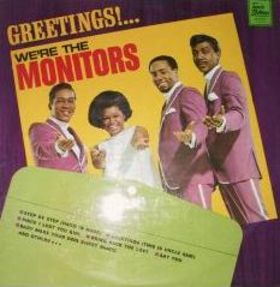
The Monitors – “Greetings (This Is Uncle Sam)”

monitors

The Monitors – “Greetings (This Is Uncle Sam),” Pop #100, R&B #21

The Monitors’ can thank the Valadiers, Motown’s first all-white group, for their only hit. Written in the early ’60s, the song took on new meaning just a few years later when the Vietnam war and military draft started building momentum.

Producer “Mickey” Stevenson does a great job dressing up this homage to a draft notice as a ’50s love ballad. Singer Richard Street playfully teases the phrase “I need you,” adding new meaning to the words, while the playful backing vocals recall “Gomer Pyle”‘s Sergeant Carter. Although the song is humorous now, it was probably a lot less funny at the time.

Although the Monitors released a handful of singles for Motown between 1964-68, this was their highest-topping effort. Several members of the group held other jobs within the company. Street was a member of Berry Gordy’s Quality Control team, and a stand-in for Temptation Paul Williams, who was struggling with alcoholism at the time. Street ultimately replaced Williams in the Temptations when he was fired in 1971.The rest of the Monitors faded into obscurity before briefly resurfacing with a reunion album in 1990. – by Joel Francis

Isley Brothers – “This Old Heart of Mine (Is Weak For You)”

isleys

Isley Brothers – “This Old Heart of Mine (Is Weak For You),” Pop #12, R&B #6

By Joel Francis

For the most part, Motown’s talent during its heyday was home-grown. Martha Reeves was a Hitsville secretary, Stevie Wonder was a kid pestering the Funk Brothers for lessons, Marvin Gaye and Smokey Robinson were part of Berry Gordy’s extended family and Diane Ross and her friends stopped by every day after school to pester staff for an audition.

In short, talent came to Motown, not the other way around.

Of course that mindset quickly changed when the Isley Brothers hit the free agent market in 1965. The brothers made their name with 1959’s “Shout!” (recorded for RCA) and 1962’s “Twist and Shout” (recorded for the Wand label and covered by the Beatles). But after bouncing between those two labels and the failure to establish their own imprint, the Isley Brothers were looking for a new home. Berry Gordy was all too happy to welcome them to his fold.

The Isley’s Motown debut, “This Old Heart of Mine (Is Weak For You) was their biggest success so far. Holland-Dozier-Holland definitely applied the Motown sound to their number. The drums lead the mix, and the string section sounds more like the Four Tops than the Isley Brothers’ gritty urban soul. The brothers had never sounded so slick before, but the results couldn’t be argued with. The song is infectious, fun and impossible to listen to without breaking into smiles or dance.

Unfortunately, the Isley-Motown marriage didn’t last long. Despite releasing two more albums, the group couldn’t find a follow-up hit and complained of being fed inferior, cast-off tracks. They had a point: “This Old Heart” was originally intended for the Supremes. The brothers left Motown in 1968 and signed with Buddha before finding long-term success with Epic.

The Elgins – “Darling Baby”

darling-baby

The Elgins – “Darling Baby,” Pop #72, R&B #4

The Elgins started as a trio in 1962 who called themselves The Downbeats. When they added frontwoman Sandra Edwards (nee Mallet) and another singer, they switched their name to the Elgins. That wouldn’t have been a problem, except copies of “Darling Baby” were already being pressed, so new labels had to be hastily printed. Copies of “Darling Baby” credited to the Downbeats carry a hefty price tag. (Original pressings of the Elgins’ “Darling Baby” run between $25 and $50.)

The group’s name choice is an interesting one. The Temptations went as the Elgins before Berry Gordy made them come up with a new handle. There was also a Los Angeles-based doo-wop group with the same name.

Unfortunately, all of this history is more interesting than the actual song. Penned by the usually spectacular Holland-Dozier-Holland team, “Darling Baby” is as generic as its title. Despite a fine vocal performance by Edwards, the backing vocals are laughably unconvincing, the rhythm plods and the arrangement is stagnant. Edwards pleads her departing lover to “talk it over one more time,” but it’s obvious there isn’t much being said.

Fortunately, the Elgins’ follow-up hit “Heaven Must Have Sent You,” atones for the misstep of “Darling Baby.” – by Joel Francis