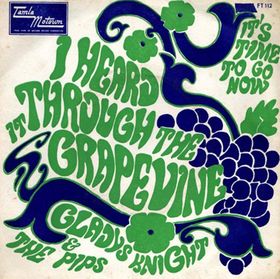
Gladys Knight and the Pips – “I Heard It Through the Grapevine”

grapevine
Gladys Knight and the Pips – “I Heard It Through the Grapevine,” Pop # 2, R&B # 1

By Joel Francis

Unlike nearly every other soul singer at the time, Gladys Knight didn’t want to go to Motown. She was (rightly) worried she and her group, the Pips, would end up playing second fiddle to Diana Ross and the Supremes. However, the Pips were a democracy. When the rest of the group voted to migrate to Hitsville, Knight reluctantly acquiesced.

“I Heard It Through the Grapevine” was a thrice-heated leftover when Norman Whitfield presented his song to the group in 1967. Smokey Robinson and the Miracles cut a version the previous year that didn’t make it out of Berry Gordy’s Quality Control meeting. A second Miracles recording of “Grapevine” was buried as an album cut on 1968’s “Special Occasion” LP.  The Isley Brothers were rumored to have recorded a version during their brief stint on the label, but no recording has surfaced to date. Several Motown scholars believe a recording session with the Isleys to cut “Grapevine” was scheduled, but then cancelled.

This is likely the case. In 2005, Motown released the two-disc clearinghouse “Motown Sings Motown Treasures.” This incredible and enlightening collection presented many recordings – Kim Weston performing “Stop! In the Name of Love,” the Supremes doing “Can IGet A Witness,” and the Miracles original, unissued version of “Grapevine,” among others – previously locked in the vaults. It seems unlikely that the Isley Bros. version of “Grapevine,” if it exists, would have been omitted from this collection.

Although it wouldn’t be released for another year, Marvin Gaye had also cut his reading of “Grapevine” by the time the Pips were hearing Whitfield’s pitch.

Whitfield’s latest “Grapevine” arrangement was inspired by Aretha Franklin’s “Respect” and Whitfield’s desire to “out-funk” Franklin. It’s clear from the great snare-and-cymbal intro that Whitfield was on to something new. Motown had been a lot of things until that point, but it had rarely been so overtly funky. In the coming years, Whitfield would help place Hitsville at the epicenter of psychedelic soul. This recording was one of the first steps down that path.

Whitfield’s attempt to out-do the Memphis soul sound Aretha was getting from Atlantic producer Jerry Wexler was buoyed by Knight’s singing. The gospel background isn’t as obvious in Knight’s delivery, and her voice is a little earthier than Franklin’s, but Knight’s vocals can soar just as high. In fact, the song is little more than drums, piano and Knight’s powerful voice until a scratch guitar enters during the first chorus.

Stealing a page from the Holland-Dozier-Holland production book, the tambourine is mixed front and center. The instrument serves as a tractor, dragging the entire song it its wake. The signature organ line that introduces Gaye’s chart-topping “Grapevine” makes a cameo on the piano about a minute into the song. The saxophone solo bisecting the song is a straight-up homage to King Curtis, the Memphis soul legend. Even the juiciest gossip is rarely this much fun.

The fourth time was the charm for Whitfield, as the Pips’ powerful “Grapevine” finally made it past Gordy’s Quality Control meeting. That didn’t guarantee label support, though, as Knight was forced to rely on her DJ connections to promote the song. When “Grapevine” finally caught on, it caught fire holding the top spot on the R&B chart for six weeks and stalling behind the Monkee’s “Daydream Believer” at No. 2 on the pop chart. Although it was Motown’s best-selling single to date, the “Grapevine” story was far from over.
Bob Dylan – “Workingman’s Blues No. 2”

(Above: Happy Labor Day! Bob Dylan’s tribute to Merle Haggard and the working man.)

Bob Dylan – “Workingman’s Blues No. 2”

By Joel Francis
The Daily Record

Merle Haggard was on a roll in 1969. In just three years he had racked up seven No. 1 hits and released eight albums. Haggard’s days digging ditches and toiling in prison were finally receding, but he refused to forget the unlucky people he labored beside for so long. “Working Man Blues” was Haggard’s tribute to his fans and his roots.

More than 35 years later, Bob Dylan turned Haggard’s tribute into a personal homage. Abandoning the Bakersfield sound that Haggard helped popularize, Dylan’s “Workingman’s Blues No. 2,” is a nostalgic ballad, introduced by a piano and accented with touches of violin.

Haggard’s “Working Man Blue” is a blazing portrait of a hard-workin’, hard-drinkin’ man with nine kids struggling to make ends meet. In the prime of his career, Haggard’s hero might “get a little tired on the weekend, but “Monday morning, I’m right back with the crew.”

Dylan catches up with a similar blue collar man thousands of shifts later. Worn by hard work and tight budgets, the place he loves best is a “sweet memory.” Too tired to get his boots and shoes, all the weary man can muster is to try “to keep the hunger from creeping its way into my gut.”

Dylan matches Haggard’s detail, but also pulls the camer back a bit, opening with a portrait of “an evenin’ haze settlin’ over the town/starlight by the edge of the creek.” Doubling the number of verses and tripling the song’s length also gives Dylan to explore the weary worker’s love life. The nine kids have moved out and the wife is gone, leaving the fatigued to wonder “am I wrong in thinking/That you have forgotten me?” and imagining his love returning to lead him off to dance in a new suit and a world where he doesn’t have to live on rice and beans.

“Workingman’s Blues No. 2” is less a celebration of the working man than a compliment to Haggard, who toured with Dylan shortly before the sequel was written. At the time it was rumored Haggard would return the favor by penning “Blowing in the Wind 2.” That song hasn’t come to light, but pair of “Working Man” songs provide a perfect Labor Day soundtrack. Play Haggard’s at the outdoor cookout while clutching a cold one; save Dylan’s for some midnight, pre-shift soul searching.

(Below: Merle Haggard’s original “Working Man Blues.” Kick up your heels before the whistle blows.)

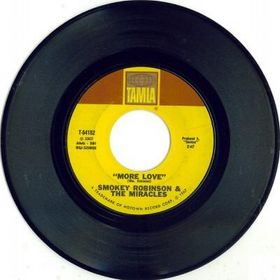
Smokey Robinson and the Miracles – “More Love”

422268
Smokey Robinson and the Miracles – “More Love,” Pop # 23, R&B # 5

By Joel Francis

Smokey Robinson has penned dozens of gorgeous love songs throughout his career, but few are affecting as “More Love.” The reassuring lyrics speak to the tragedies the couple suffered as a result of life on the road. Between 1957 and 1964, Claudette Robinson had eight miscarriages. This heartbreaking back story adds to the romance of the chorus:

“More love, more joy,
|Than age or time could ever destroy.
My love will be so sound,
It would take about a hundred lifetimes
To live it down, wear it down, tear it down.”

The song opens with some gospel chords on the piano before the gently insistent bassline enters. Robinson’s voice appears on a pillow of strings, as the arrangement slowly builds underneath. After Robinson delivers the chorus a second time, the performance pulls back to that great bassline before reaching a climax that sustains through the rest of the song.

Foreshadowing Motown’s cross-country relocation, the track was performed by Los Angeles session musicians before the Miracles – including Claudette – overdubbed their voices in Detroit. It’s unclear why Robinson, who also produced the cut,  bypassed the Funk Brothers, but the public didn’t seem to mind. The song was wedged near the top of both the pop and R&B charts in the spring of 1967.

Foreshadowing another Motown move, “More Love” was the second single credited to “Smokey Robinson and the Miracles.” Berry’s decision to give Robinson top billing started the avalanche that benefitted Diana Ross and Martha Reeves but doomed David Ruffin and the Temptations.

Smokey and Claudette eventually had two children, both named in tribute to Motown. Son Berry Robinson was the namesake of label founder Berry Gordy, and daughter Tamla Robinson was named after the Hitsville subsidiary.

Former New Christy Minstrels singer Kim Carnes had a No. 10 hit on the Adult Contemporary charts in 1980 with her reading of “More Love.” The song was her biggest hit until “Bette Davis Eyes” hit No. 1 the following year. “More Love” has also been covered by Paul Young, Barbara McNair and the 5th Dimension.

Marvin Gaye and Tammi Terrell – “Ain’t No Mountain High Enough”

mountain
Marvin Gaye and Tammi Terrell – “Ain’t No Mountain High Enough,” Pop # 19, R&B # 3

By Joel Francis

Marvin Gaye found his greatest early success as a duet partner. The 1964 album “Together” was his first album to chart, and his duets placed in the Top 20 with a consistency that eluded him as a solo artist. Unfortunately, Gaye’s soul partners, Mary Wells and Kim Weston, both left Motown for (allegedly) greener pastures shortly after collaborating with Gaye. As established Motown solo artists, pairing of Gaye with Wells and Weston made sense. The teaming of Gaye with Hitsville newcomer Tammi Terrell, however, was inspired.

Terrell arrived at Motown in 1965 after bouncing from Scepter Records, where she recorded as Tammy Montgomery, James Brown’s Try Records and the Chess Records subsidiary Checker. Her initial Motown singles didn’t much fare better than her previous efforts, but “Ain’t No Mountain High Enough” took both her and Gaye’s careers to a new level.

Motown’s new singing pair was paired with the songwriting team Berry Gordy hired to replace the gradually exiting Holland-Dozier-Holland squad. Husband and wife Nickolas Ashford and Valerie Simpson came to Gordy’s attention in 1966 with their No. 1 hit “Let’s Go Get Stoned” for Ray Charles. (Ironically, “Stoned” was Charles’ first single after leaving rehab for his heroin addiction.)

“Mountain was a heck of a debut for both Ashford and Simpson and Gaye and Terrell. It’s obvious from the few seconds of spoken introduction that the signers have great rapport and their voices dance perfectly on the chorus. Although Gaye and Terrell sound like they’re giggling from the same care-free piano bench, their vocal parts were actually recorded separately. Terrell felt like she hadn’t rehearsed the lyrics enough to record with Gaye, so after some coaching with producers Harvey Fuqua and Johnny Bristol she cut her part alone.

Although Fuqua and Bristol had helmed dozens of Motown hits, “Mountain” doesn’t have the expected Hitsville sound. The most obvious explanation is that Ashford and Simpson were an “outside” songwriting team and that Holland-Dozier-Holland were on their way out. It also highlights that when people talk about the “Motown sound” they are often talking about Holland-Dozier-Holland’s signature production style. Holland-Dozier-Holland’s defection not only deprived Motown of its greatest songwriting team, but also Gordy’s vaunted “sound of young America.”

As one team of stars left, another was being born. The success of “Ain’t No Mountain High Enough” helped transform Gaye into one of Motown’s biggest and most enduring performers, whose brightest days were yet to come.

Four Tops – “Bernadette”

Four-tops-bernadette
Four Tops – “Bernadette,” Pop # 4, R&B # 3

By Joel Francis

Levi Stubbs’ performance on “Bernadette” cements his status as Motown’s greatest male vocalist. The magnificent feats Stubbs laid down on the Four Tops previous pair of singles, “Reach Out” and “Standing in the Shadows of Love” reaches an impassioned crescendo on “Bernadette.” Stubbs joy, appreciation and devotion to Bernadette is still making women envy that name and that kind of partner.

The Holland-Dozier-Holland team that wrote and produced the previous two Tops singles once again employ the same lush orchestration, wrapping Stubbs’ urgent vocals in insistent strings, soaring background vocals and their signature propulsive snare drum.

“Bernadette” was the Tops last Top 10 hit until “Keeper of the Castle” took off in 1972. Perhaps coincidentally, “Bernadette” was also the Tops next-to-last collaboration with Holland-Dozier-Holland. The HDH-Four Tops swan song “7-Rooms of Gloom” hit No. 7 on the R&B charts in the summer of 1967.

Although Holland-Dozier-Holland had a handful of hits with Diana Ross and the Supremes before they left Motown in early 1968, “Bernadette” marks the last appearance by the incredible songwriting and production trio on the “Hitsville U.S.A.” set.

After Holland-Dozier-Holland departed, Berry Gordy placed all his best songwriters on Diana Ross and the Supremes and other pet artists like the Jackson 5. Groups that weren’t assigned to a producer – as the Temptations were to Norman Whitfield – floundered as the Hitsville transitioned. Many groups, including increasingly ignored girl groups like Martha and the Vandellas and the Marvelettes never regained their former glory.

As free agents, the Holland-Dozier-Holland team continued to turn out hits like Freda Payne’s “Band of Gold” and “The Day I Found Myself” by Honey Comb, but neither HDH nor Motown were ever as good again after they parted ways.

Les Paul with Bing Crosby – “It’s Been A Long, Long Time”

By Joel Francis
The Daily Record

“Kiss me once, then kiss me twice, then kiss me once again.”

Sammy Cahn’s lyrics spoke to millions of couples separated by … well the song doesn’t say, but everyone who sent it to No. 1 in two different versions at the end of 1945 knew all too well.

For six years the specter of World War II hung over America. A nation split by heated debates over participation until Pearl Harbor forced the nation’s hand became united through victory gardens and war bonds. The country was also united in its separation, as selective service split up thousands of couples when the men were called overseas.

But when Bing Crosby’s sweet voice sang “It’s Been A Long, Long Time,” the turmoil and anxiety of the war was finally fading. Effortlessly capturing the hope and sentimentality of the lyrics, Crosby couldn’t have needed more than a couple takes. What made the recording more interesting, though, was Les Paul’s guitar playing.

If Crosby’s voice was a bird chirping at the sunrise, Paul’s arrangement was the first rays of light piercing the horizon. His tone is just as mellow and natural as Crosby’s vocals. After opening with a few understated chords, Paul kicks into gentle jazz mode, strumming a countermelody that’s nearly as interesting as the one Jule Styne penned. The solo is understated, echoing the vocal line with a couple flourishes that show why Paul continues to influences the guitar gods of the 21st century.

That voice and that guitar was all the song needed to jump to No. 1. Sure, there’s a rhythm guitar in the background, but it’s only there to reassure the hapless listeners who couldn’t find the rhythm on their own.

Paul died last Thursday. He was 94. The legendary guitarist is best-known for “How High the Moon,” his signature Gibson guitar and recording innovations. Although his performance here predates those advances, it is no less inventive.

Crosby got most of the glory for “It’s Been A Long, Long Time,” which is probably right. The song and his singing resonate with the tenor of the times. (A competing version by Harry James with Kitty Kallen also hit No. 1 that winter.) Paul, however, visited the song repeatedly throughout his career. He cut a version with his wife Mary Ford in the 1950s and came back to it nearly 30 years later on the first “Chester and Lester” album with Chet Atkins. All readings are sublime, but none capture the wistful sentimentality and promise-filled romance of his pairing with Crosby.

There’s nothing harder than not knowing or being able to do anything about the well-being of a loved one. When I hear this song, I think about my grandparents. Both sets were separated by husbands who served in the war. I think about their joyful reunions and how they are now – temporarily – separated by the grave. But Les and Bing reassure us. And then we close our eyes and lean in for that kiss. Again.

Bruce Springsteen and Tom Morello – “The Ghost of Tom Joad”

By Joel Francis
The Daily Record

There is probably a good bromance film to be made about the relationship between male songwriters. They dynamics of a songwriting partnership mirror that of a romantic union – giddy joy at meeting a compatible soul, the steady rhythm of fruitful collaboration, independence and wanting to branch out and then either acceptance and adaptation or estrangement.

Some partnerships – like Morrissey and Johnny Marr – burn hot and bright, flaming out quickly. Others, like Mick Jagger and Keith Richards, settle into marriages of convenience. Jack White is quite promiscuous as a songwriter, flitting from the White Stripes to the Raconteurs, Loretta Lynn and Dead Weather. Some songwriting partnerships turn into real marriages, like Tom Waits and Kathleen Brennan or Barry Mann and Cynthia Weil.

Then there are the songwriters who have flown solo: Phil Ochs, Neil Young, But even the most ardent songwriting bachelors have had a subtle and unseen hands guiding their way and providing resistance to make the song better. Rivers Como had Matt Sharp, Jeff Tweedy had Jay Bennett, Stevie Wonder had Syreeta Wright. And Bruce Springsteen had Miami Steven Van Zandt.

Van Zandt made his presence in the E Street Band known immediately. He arranged the horn line in “Tenth Avenue Freeze-Out” and contributed to the signature guitar line on “Born To Run.” For the next eight years his guitar was the muscle behind Springsteen’s songs, constantly challenging the band and its leader to keep moving and top themselves.

When Van Zandt left the E Street band in 1984, he was replaced by Nils Lofgren. Lofgren had established an outstanding reputation on the basis of his solo work and his stints with Neil Young and Crazy Horse. As a musician he was a more-than-worthy replacement for Van Zandt, but was too easygoing to musically aggravate his new boss the way Van Zandt had.

In 1995 Van Zandt returned the E Street Band and Lofgren remained. The pair has now spent more time in the band together than they did apart. But during that time, Springsteen’s concerts have turned into carnivals rather than escapades. Musicians that used to labor over albums as a unit now record their parts separately. In short, the E Street Band is less a team than an all-star squad of longtime ringers.

Although Springsteen concerts remain incredible experiences and his albums are very good for the most part, Springsteen’s songwriting lacks the urgency, grit and desperation of his early work. Since Springsteen’s early ‘90s retreat from the E Street crew, he hasn’t had a foil, poking, prodding and disturbing him.

When Tom Morello joined the E Street Band onstage in April, 2008, the long absent counterpunch returned. Although his career was considerably shorter, the guitarist had been searching for his own artistic gadfly since the break-up of Rage Against the Machine and the disappointment of Audioslave.

Both performers were familiar with the material. Springsteen wrote “The Ghost of Tom Joad” as the title song for his 1995 solo album and Rage Against the Machine released a covered it two years later. There are several elements in the live collaboration missing on either incarnation. Morello emulates Woody Guthrie in his solo guise as the Nightwatchman, but here and Springsteen add an element of longing and loneliness Guthrie would have liked.

Five guitars are played, but only two of them matter. Springsteen rips off a blistering solo with more intensity than anything he’s recorded in years – he came closest in his appearances on Warren Zevon’s farewell album “The Wind” – and Morello soars with passionate extended solo that combines Public Enemy’s Terminator X and Eddie Van Halen to end the song.

Springsteen originally wrote “Tom Joad” for the E Street 1995 reunion project, but didn’t like the band’s arrangement and set the number aside. That it took an outsider to help the group get the song right 13 years later points the direction Springsteen’s music should head. Too comfortable with the E Streeters, he needs an album-length collaboration with obvious disciples like the Hold Steady or a partnership with more-obscure-but-still-simpatico Black Keys.

Springsteen doesn’t need anyone reverential or deferential. He needs someone like Morello kicking his ass, forcing him to be better. Hopefully these eight tantalizing minutes are the first draft of an upcoming screenplay.

Keep reading:

Review: Bruce Springsteen and the E Street Band (2008)

Review: Rage Against the Machine at Rock the Bells (2007)

Review: Springsteen’s “Dream” Needs More Work

Springsteen in the Waiting Room: Drop the Needle and Pray

Springsteen Rocks the Hall (part 1)

Springsteen Rocks the Hall (part 2)

Book Review: “Big Man” by Clarence Clemons

More Bruce Springsteen on The Daily Record

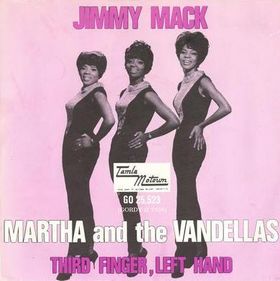
Martha and the Vandellas – “Jimmy Mack”

jimmy mack
Martha and the Vandellas – “Jimmy Mack,” Pop # 10, R&B # 1

By Joel Francis

“Jimmy Mack” capped a remarkable four-year run by the trio that started with “Come and Get These Memories” in 1963. Like most of the group’s hits during that time, “Jimmy Mack” was written and produced by the redoubtable Holland-Dozier-Holland team. Coincidentally, “Jimmy Mack” was not only the Vandellas final Top 10 hit, but the last time the trio worked with Holland-Dozier-Holland before the songwriting team departed Motown in early 1968 over a royalty dispute.

Although HDH had a half-dozen major hits with Motown before their work slowdown/standoff with Berry Gordy, “Jimmy Mack” was recorded in 1964 but shelved after it failed to pass the weekly Quality Control meetings. When it was rescued from the vaults three years later, the lyrics took on a whole new dimension.

President Lyndon Johnson’s escalation of troops in Vietnam brought new poignancy to Martha Reeves’ musings of when her man would return. Originally written as a tempted woman’s plea for her boyfriend to return, many separated young couples interpreted the song as an overseas missive to a lost loved one.

Not that the song’s arrangement could support such a weighty metaphor. “Jimmy Mack” is little more than handclaps, perky piano and vocals. Reeves’ sunny vocals are void of any heartache, but the melody is catchy enough to compensate. Listen to this once and you’ll be signing it for the rest of the day.

Nearly 20 years later, Sheena Easton revived “Jimmy Mack” and took it to No. 65 in 1986.

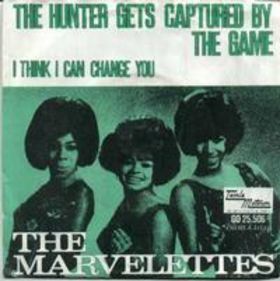
The Marvelettes – “The Hunter Gets Captured By the Game”

hunter

The Marvelettes – “The Hunter Gets Captured By the Game,” Pop # 13, R&B #2

By Joel Francis

The Marvelettes gave Motown its first No. 1 hit with “Please Mr. Postman,” but that was way back in 1961. But that was five years before “The Hunter Gets Captured by the Game” came out – a lifetime in pop music. The interceding years weren’t too kind. The group found some follow-up success with “Beechwood 4-5789,” but lost a founding member, and famously passed on “Where Did Our Love Go,” which became the Supremes’ first No. 1 hit.

By the mid-‘60s, the Marvelettes had lost another member. Only the success of greatest hits and live albums were keeping the band tethered to the Motown roster. Then Smokey Robinson entered the picture.

Robinson penned “Don’t Mess With Bill,” the comeback single for the now-trio. His pen also produced “The Hunter Gets Captured by the Game,” sung by Wanda Young, wife of Miracles’ guitarist Bobby Rodgers.

The lyrics are straightforward, but what makes the song is Young’s slinky singing and an equally elastic performance from the Funk Brothers. Check out the great guitar performance holding the whole song together and the great and rare Motown harmonica solo to appear outside of a Stevie Wonder or Shorty Long album.

The Marvelettes found a Top 10 hit with their next single – a remake of Ruby and the Romantics’ “When You’re In Love” – before losing another singer. They carried on with some success, but a full-scale comeback was quashed when the remaining members decided not to follow Berry Gordy to Los Angeles and Young’s pregnancy. After the Marvelettes dissolved, singer Ann Bogan joined New Birth, a soul outfit founded by former Motown staffer Harvey Fuqua.

“The Hunter Gets Captured by the Game” has been covered by Ella Fitzgerald, Raconteur Brendan Benson, Jerry Garcia, Blondie and Massive Attack. A reggae cover by Grace Jones reached No. 87 on the R&B charts in 1980.

Marvin Gaye and Kim Weston – “It Takes Two”

it takes two
Marvin Gaye and Kim Weston – “It Takes Two,” Pop # 14, R&B # 4

By Joel Francis

“It Takes Two” was one of the last songs Kim Weston recorded for Motown. Its success established Marvin Gaye as a capable duet partner. Gaye was already one of Motown’s bigger stars, but his brief pairing with Weston and subsequent success with Tammi Terrell helped earn Gaye the titles of “Prince of Motown” and “Prince of Soul.”

The coupling of Weston and Gaye was fairly obvious. Gaye had collaborated with Weston’s husband, William “Mickey” Stevenson on “Dancing in the Street,” “Stubborn Kind of Fellow” and “Pride and Joy.” As Stevenson’s romantic song came together, his two frequent collaborators came to mind.

On paper, this song should have been a miserable, schmaltzy failure. That it didn’t come off as corny and syrupy is a testament to the talents of Gaye, Weston and Stevenson (who also produced the cut).

His arrangement is responsible for removing most of the sappiness. The strings add a romantic touch without going too far and the horn line during the chorus keep the song swinging. Benny Benjamin’s drumming is the coup de grace, ensuring that the song will never be a slow dance number.

As great as Gaye and Weston are on this track, they are nearly upstaged by Otis Redding and Carla Thomas’ fabulous version released the same year on the essential “King and Queen” album. Lightning did not strike a third time, however, when Tina Turner and Rod Stewart trotted out their cover in 1990. The song went to No. 5 in the UK but mercifully did not chart in America. Bruce Springsteen frequently incorporates “It Takes Two” into his live versions of “Two Hearts.”