Woodstock, from a distance

(Above: Even thousands of miles and dozens of years removed from Woodstock, the message of Jimi Hendrix – musical or otherwise – still resonantes with those who did not attend.)

By Joel Francis
The Daily Record

Exactly 40 years ago this weekend, an estimated 450,000 music fans, druggies, hippies and people looking to get laid packed Max Yasgur’s farm in upstate New York. In retrospect, the Woodstock Music and Art Fair has become the de facto Boomer event, but for every person who attended – or claims to have attended – dozens of their peers were either ignorant or indifferent to the happening… and have no regrets about their absence.

“My impression at the time was very negative,” said Sanford Beckett, then 23, recently married and living in Kansas City, Mo. “It was all about drugs, sex and the anti-war movement.”

Although his brother’s time in the army changed Beckett’s perspective on the Vietnam War, the culture of sex and drugs kept many others away as well.

“I’m glad I didn’t attend,” Dave Glandon, then 18, said. “It just wasn’t my lifestyle.”

Geography and responsibility kept Tom Rambo, then 18, from attending. He liked the music, but was getting ready to start his second year of college at Pittsburg (Kan.) State University.

“I think I realized something a little bit bigger than a concert had occurred,” Rambo said. “But the reality was Woodstock was something that happened half a country away from me.”

Woodstock made icons of Jimi Hendrix, Janis Joplin, the Grateful Dead and others, and crystallized their status in the eternal playlist of existing fans. Those who didn’t appreciate the music then, though, remained indifferent.

“The whole thing just sounded fantastic,” said Mark Brasler, then 24 and living in Chicago. “I still listen to many of the artists who appeared.”

Many rank Woodstock as the greatest musical event of the decade – ahead of the 1967 Monteray Pop Festival and 1965 Newport Folk Festival where Bob Dylan created chaos by going electric – but the event didn’t have the resonance of John Kennedy’s assassination or the moon landing.

“I will always remember where I was – in junior high health class – when our class was interrupted with the news of President Kennedy’s assassination,” Glandon said. “Woodstock does not have a role in my memories of the ‘60s.”

Rambo remembers Woodstock and the moon landing as positive events in a sea of unrest and a time that can never be restored.

“Attempts to recreate Woodstock are a joke,” Rambo said. “We’re too cynical for that kind of ‘what the hell, it’s a free concert from now on’ way of thinking. People crashing the gates would be tasered today.”

But even from thousands of miles and nearly two generations away, Woodstock stands as the brief moment when the counterculture forced its way into the mainstream and inserted a younger voice into the national discussion.

“Looking back, I think Woodstock brought together the nation’s youth,” said Ward Francis, then a 21-year-old college student. “It solidified the thinking of a whole generation.”

Review: Chickenfoot

(Above: Chickenfoot live it up going “Down the Drain,” one of the highlights of their performance Tuesday night at the Uptown Theater.)

By Joel Francis
The Kansas City Star

On paper, there was a potential disaster: Chickenfoot, the hard-rock supergroup that includes members of Van Halen and the Red Hot Chili Peppers, ignored several of those groups’ Top 10 hits to concentrate solely on new material at their Tuesday night concert at the Uptown Theater.

However, what sometimes comes across as forced and stiff on album, was loose and fun as former Van Halen vocalist Sammy Hagar and bass player Michael Anthony, Chili Peppers drummer Chad Smith and guitar virtuoso Joe Satriani tore through their new songs like a set of old favorites for a nearly sold-out crowd.

For the two hours they were onstage, the Uptown felt like a rock club. Throughout the night, Smith perpetually tossed drumsticks into the audience as Hagar signed autographs and slapped hands. The curtain draped across the back half of the stage pushed the band so close that Smith was able to pick out a pretty blonde in the front row and convince her to administer a spanking.

The night opened like the album, with “Avienda Revolution.” The second number, “Soap on a Rope,” featured a big greasy guitar riff that wouldn’t have been out of place in Hagar and Anthony’s old band. As Satriani reeled off one of his gravity-defying solos, he stood shoulder-to-shoulder with Anthony, smiling and bopping like the two had played together since high school.

Anthony broke out the Jack Daniels bass for barn-burning “Down the Drain.” Hagar introduced the number saying it was born out of a studio jam, but the way the group changed textures and tempos while maintaining intensity proved that this band was more than a vanity project.

Satriani rarely works with vocalists, so it was interesting to watch how he interacted with Hagar. Typically, his fingers say so much it’s difficult to get a word in edgewise, but he served the songs well, tastefully stepping back during the verses instead of just spinning his wheels until the next solo.

“Bitten by the Wolf” was the lone number during the main set that didn’t come from Chickenfoot’s self-titled album. The bluesy acoustic number was well received, but the crowd tore the roof off singing along to the next song, “Oh Yeah,” which has generated some radio airplay.

After the obligatory Hagar car song “Turnin’ Left” -– an ode to NASCAR –- the Red Rocker finally strapped on an electric guitar for the closing ballad “Future in the Past.” He reached for the six-string again, playing lap slide to introduce “Bad Motor Scooter,” a number Hagar wrote with Montrose in the ‘70s. It was the lone nod to any back catalog.

The night ended with another car song, Deep Purple’s “Highway Star,” but the band lingered onstage long after the song was over. As Smith, Anthony and Hagar reveled in the fans, Satriani filmed the moment for posterity. The fun was so infectious, everyone was reluctant to leave and break up the party.

Admittedly, it would have been nice to hear “Dreams” or “By the Way,” but why look to the past when there’s so much promise in the future?

Setlist: Avienda Revolution, Sexy Little Thing, Soap on a Rope, My Kinda Girl, Down the Drain, Bitten by the Wolf, Oh Yeah, Learning to Fall, Get It Up, Turnin’ Left, Future in the Past/encore: Bad Motor Scooter, Highway Star

ckft

Review: Alice Cooper

(Above: One of the many deaths of Alice Cooper – and “School’s Out.”)

By Joel Francis
The Kansas City Star

Friday’s concert was barely 15 minutes old when Alice Cooper was forced under the guillotine. The crime was impaling a roadie and the sold out Ameristar Casino crowd was witnesses to his guilt.

As his head flopped into the basket, Cooper emerged unscathed and unamused, briefly holding up his severed head like a “Twilight Zone” Hamlet before signaling his band to start “Welcome to My Nightmare.”

From the guillotine to the hangman’s noose to the iron maiden, Cooper’s Theater of Death definitely lived up to its name. More than a rock concert, the 90-minute spectacle was a brutal slab of rock theater set to a heavy soundtrack.

Backed by a tight, thunderous four-piece band, Cooper both opened and closed the show with “School’s Out.” In between he hit on nearly every phase of his massive back catalog. Flipping from blues-based hard rock to industrial metal, Cooper and co. did a good job unearthing album tracks and delivering the hits.

Big numbers like “I’m Eighteen” and “Poison” got the expected responses but lesser-known numbers were just as good. Cooper belted the “Ballad of Dwight Fry” from a straightjacket. Later he performed “Nurse Rozetta” from a wheelchair, setting up her PG strip-tease during “Be My Lover.”

The only time the group dialed down from 11 were the back-to-back acoustic numbers “Only Women Bleed” and “I Never Cry.” Cooper delivered “Bleed” with a lifeless Rozetta across his lap and “Cry” hanging from the gallows. The setting rendered the ballads less tender but more powerful.

Cooper uses props in the same way as the Flaming Lips. The added spectacle definitely makes the evening more entertaining, but would be worthless without the great music supporting them. Cooper’s band drove this point the two times they were given the stage alone. Deprived of their leader and all his tricks, they rocked hard and kept the audience riveted.

After an instrumental number, Cooper returned with some of his biggest numbers. It was hilarious to watch the group of graying mid-life dudes in the crowd go nuts over the silver Mardi Gras beads he tossed out during “Dirty Diamonds.” For the next number – “Billion Dollar Babies” – he presented a saber loaded with fake money, which was sprinkled over the front rows.

The main set ended with the one-two punch of “No More Mr. Nice Guy” and “Under My Wheels.” Although they’d been played to death, the band was clearly having a blast, duckwalking backward across the stage and grinning from ear to ear. It was hard to tell who was having more fun, the band or the crowd. Ultimately it didn’t matter. It was clear both sides lived for this stuff.

Setlist: School’s Out, Department of Youth, I’m Eighteen, Wicked Young Man, Ballad of Dwight Fry, Go To Hell, Guilty, Welcome To My Nightmare, Cold Ethyl, Poison, The Awakening, From the Inside, Nurse Rozetta -> Is It My Body, Be My Lover, Only Women Bleed, I Never Cry, instrumental, Vengeance Is Mine , Devil’s Food -> Dirty Diamonds, Billion Dollar Babies, Killer, No More Mr. Nice Guy -> Under My Wheels / School’s Out (encore)

Bruce Springsteen and Tom Morello – “The Ghost of Tom Joad”

By Joel Francis
The Daily Record

There is probably a good bromance film to be made about the relationship between male songwriters. They dynamics of a songwriting partnership mirror that of a romantic union – giddy joy at meeting a compatible soul, the steady rhythm of fruitful collaboration, independence and wanting to branch out and then either acceptance and adaptation or estrangement.

Some partnerships – like Morrissey and Johnny Marr – burn hot and bright, flaming out quickly. Others, like Mick Jagger and Keith Richards, settle into marriages of convenience. Jack White is quite promiscuous as a songwriter, flitting from the White Stripes to the Raconteurs, Loretta Lynn and Dead Weather. Some songwriting partnerships turn into real marriages, like Tom Waits and Kathleen Brennan or Barry Mann and Cynthia Weil.

Then there are the songwriters who have flown solo: Phil Ochs, Neil Young, But even the most ardent songwriting bachelors have had a subtle and unseen hands guiding their way and providing resistance to make the song better. Rivers Como had Matt Sharp, Jeff Tweedy had Jay Bennett, Stevie Wonder had Syreeta Wright. And Bruce Springsteen had Miami Steven Van Zandt.

Van Zandt made his presence in the E Street Band known immediately. He arranged the horn line in “Tenth Avenue Freeze-Out” and contributed to the signature guitar line on “Born To Run.” For the next eight years his guitar was the muscle behind Springsteen’s songs, constantly challenging the band and its leader to keep moving and top themselves.

When Van Zandt left the E Street band in 1984, he was replaced by Nils Lofgren. Lofgren had established an outstanding reputation on the basis of his solo work and his stints with Neil Young and Crazy Horse. As a musician he was a more-than-worthy replacement for Van Zandt, but was too easygoing to musically aggravate his new boss the way Van Zandt had.

In 1995 Van Zandt returned the E Street Band and Lofgren remained. The pair has now spent more time in the band together than they did apart. But during that time, Springsteen’s concerts have turned into carnivals rather than escapades. Musicians that used to labor over albums as a unit now record their parts separately. In short, the E Street Band is less a team than an all-star squad of longtime ringers.

Although Springsteen concerts remain incredible experiences and his albums are very good for the most part, Springsteen’s songwriting lacks the urgency, grit and desperation of his early work. Since Springsteen’s early ‘90s retreat from the E Street crew, he hasn’t had a foil, poking, prodding and disturbing him.

When Tom Morello joined the E Street Band onstage in April, 2008, the long absent counterpunch returned. Although his career was considerably shorter, the guitarist had been searching for his own artistic gadfly since the break-up of Rage Against the Machine and the disappointment of Audioslave.

Both performers were familiar with the material. Springsteen wrote “The Ghost of Tom Joad” as the title song for his 1995 solo album and Rage Against the Machine released a covered it two years later. There are several elements in the live collaboration missing on either incarnation. Morello emulates Woody Guthrie in his solo guise as the Nightwatchman, but here and Springsteen add an element of longing and loneliness Guthrie would have liked.

Five guitars are played, but only two of them matter. Springsteen rips off a blistering solo with more intensity than anything he’s recorded in years – he came closest in his appearances on Warren Zevon’s farewell album “The Wind” – and Morello soars with passionate extended solo that combines Public Enemy’s Terminator X and Eddie Van Halen to end the song.

Springsteen originally wrote “Tom Joad” for the E Street 1995 reunion project, but didn’t like the band’s arrangement and set the number aside. That it took an outsider to help the group get the song right 13 years later points the direction Springsteen’s music should head. Too comfortable with the E Streeters, he needs an album-length collaboration with obvious disciples like the Hold Steady or a partnership with more-obscure-but-still-simpatico Black Keys.

Springsteen doesn’t need anyone reverential or deferential. He needs someone like Morello kicking his ass, forcing him to be better. Hopefully these eight tantalizing minutes are the first draft of an upcoming screenplay.

Keep reading:

Review: Bruce Springsteen and the E Street Band (2008)

Review: Rage Against the Machine at Rock the Bells (2007)

Review: Springsteen’s “Dream” Needs More Work

Springsteen in the Waiting Room: Drop the Needle and Pray

Springsteen Rocks the Hall (part 1)

Springsteen Rocks the Hall (part 2)

Book Review: “Big Man” by Clarence Clemons

More Bruce Springsteen on The Daily Record

Mariah Carey sells out, or All that Glitters…

(Above: Neil Young sets the record straight with a live performance of “This Note’s For You” from 1988. Thanks to Viacom, clips for Roca Pads and Redman’s Potty Fresh were unavailable.)

By Joel Francis
The Daily Record

Earlier this week, Billboard reported the booklet in the new Mariah Carey CD will contain “lifestyle ads.”

The 34-page “mini-magazine” will be co-produced by Elle magazine and house ads for Elizabeth Arden, Angel Champagne, Carmen Steffens, Le Métier de Beauté and the Bahamas Board of Tourism. The booklet will also contain Carey-centric articles with the enticing titles like “VIP Access to Her Sexy Love Life,” “Amazing Closet,” “Recording Rituals.”

Evidently the music wasn’t enough.

Annoying as the ad campaigns may have been, there have been no Chevy ads in Bob Seeger or John Mellencamp albums. Other artists have been less scrupulous about whoring their album space, but were never this brazen. Master P turned the booklets for all his No Limit artists into mini-catalogs, and Outkast frequently squeezed ads for their pit bulls alongside lyrics and musician credits. At least those performers had a stake in the products in question.

Carey’s move is more egregious on several levels. First, retailers have already found ways to cross-promote. According to the Billboard story, Walmart will display Carey’s album next to her Arden fragrance Forever, which has an ad on the back cover of the CD booklet. Even more disturbingly, Island-Def Jam, Carey’s label, has eyed Rihanna, Bon Jovi and Kanye West to follow suit if the initial venture is a success. Carey has never been a bastion of artistry, but if the major labels can turn a buck from this experiment, expect ads in CD booklets to become the norm.

“The idea was really simple thinking: ‘We sell millions of records, so you should advertise with us,’” Antonio “L.A.” Reid, chairman, Island Def Jam Music Group, a unit of Universal Music Group, told Billboard.

If an album is more valuable as an advertising vehicle, why not give the music away? In 2007, Prince gave away copies of his album “Planet Earth” in the Sunday edition of a London newspaper. Two years before that he included his album as a door prize at concerts. This year, fans who bought tickets for No Doubt’s summer concert tour were gifted with the band’s entire catalog.

Fans who buy the album digitally through iTunes or Amazon will also be subjected to the advertising. The ads will also be included in the electronic PDFs accompanying download sales. The only way to circumvent the booklet blights is the easiest and cheapest solution: ignore Carey or steal the music. Until the major labels start respecting the listeners, there is absolutely no reason to respect them.

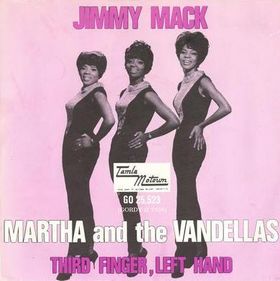
Martha and the Vandellas – “Jimmy Mack”

jimmy mack
Martha and the Vandellas – “Jimmy Mack,” Pop # 10, R&B # 1

By Joel Francis

“Jimmy Mack” capped a remarkable four-year run by the trio that started with “Come and Get These Memories” in 1963. Like most of the group’s hits during that time, “Jimmy Mack” was written and produced by the redoubtable Holland-Dozier-Holland team. Coincidentally, “Jimmy Mack” was not only the Vandellas final Top 10 hit, but the last time the trio worked with Holland-Dozier-Holland before the songwriting team departed Motown in early 1968 over a royalty dispute.

Although HDH had a half-dozen major hits with Motown before their work slowdown/standoff with Berry Gordy, “Jimmy Mack” was recorded in 1964 but shelved after it failed to pass the weekly Quality Control meetings. When it was rescued from the vaults three years later, the lyrics took on a whole new dimension.

President Lyndon Johnson’s escalation of troops in Vietnam brought new poignancy to Martha Reeves’ musings of when her man would return. Originally written as a tempted woman’s plea for her boyfriend to return, many separated young couples interpreted the song as an overseas missive to a lost loved one.

Not that the song’s arrangement could support such a weighty metaphor. “Jimmy Mack” is little more than handclaps, perky piano and vocals. Reeves’ sunny vocals are void of any heartache, but the melody is catchy enough to compensate. Listen to this once and you’ll be signing it for the rest of the day.

Nearly 20 years later, Sheena Easton revived “Jimmy Mack” and took it to No. 65 in 1986.

Dischord finds harmony in D.C. hardcore scene

dischord house


(Above: The Dischord house.)

By Joel Francis

In a town littered with monuments and markings, the historic two-story red home in Arlington, Vir., has nary a plaque or sign. The house is close enough to the Pentagon that armed guards patrol a nearby parking facility, but what’s gone on inside its four walls for the past 30 years has been just as combative.

The residence on South Washington Blvd. is known worldwide to punk fans as the Dischord House, ground zero for the straight-edge and Washington, D.C., hardcore movement in the 1980s and the residence of Ian McKaye.

Today McKaye is best known as the force behind legendary hardcore punk outfits Minor Threat and Fugazi, but in 1980 he was a disenfranchised teenager trying to get his band recorded.

“The history of Dischord Records is pretty simple. Ian and Jeff (Nelson) were in Teen Idles, but the band broke up before they could release anything,” said longtime Dischord employee and spokesperson Alec Bourgeois. “At the time, there was no commercial structure. If you wanted it out, you had to do it yourself. The idea was to have something to sell at shows and to friends.”

McKaye and Nelson were responsible for all aspects of the initial run of 1,000 copies, from getting the LPs pressed, designing the artwork and assembling the sleeves. The final product, “Minor Disturbance” was the first entry in the Dischord catalog.

The first records were so primitive,” Bourgeois said. “Ian literally pulled a 7-inch off the self, took it apart to see how it was made and took it to Kinkos, or whatever the equivalent was at the time and came back with a template to cut and paste around. They were literally handmade. Later he realized he could send the stuff off to someone familiar with the format.”

As Minor Threat started taking off, so – gradually – did Dischord. Other bands started coming to McKaye for help getting their music out.

The pair had two strikes against them – not only were they teenagers, but their band was kaput. By the time the Teen Idles 7-inch finally came out, McKaye was prospering in Minor Threat, and other bands were coming to for help getting records out.

“By the late ‘80s, early ‘90s there was a vibrant independent music scene (in D.C.),” Bourgeois said. “We felt connected with all the different labels, even though we all represented different communities. It’s one of the reason we carry all the local labels – because we feel connected to them. We don’t purport to represent DC by ourselves.”

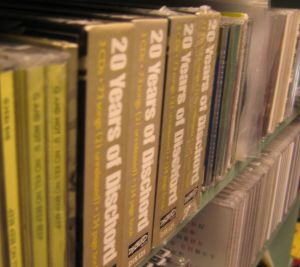
dischord albumsToday, Dischord has a worldwide relationship with distributors, pressing plants and the indie record industry, but the original DIY spirit is still intact. When the album from Fugazi drummer Brendon Canty’s first high school band was released in 2007, Dischord had the cardboard sleeve printed at a letter press, but assembled the rest of the packaging and inserted the CDs by hand.
“We just did an Edie Sedgwick record and got the bag, record and sleeves separately. We spent days putting them together because no one would do it how we wanted them to look (with orange LP placed on top of the sleeve),” Bourgeois said. “To do some of it, it feels good. Anytime you get your hands involved and feel directly involved with the manufacturing feels exciting”

Dischord’s approach hasn’t changed over the years but the rest of the music industry has. Major labels are in crisis and illegal downloading has killed many revenue streams.

“This is the first time the music listener has been put in charge,” Bourgeois said. “Many labels feel threatened. We don’t, because we have a decent relationship with our customers. They get to decide what format they want to listen in, we don’t – but that’s a good thing.”

According to Bourgeois, CD sales have fallen, but digital downloads and vinyl sales have increased. Most Dischord LPs come with a download code with access to a digital copy of the album, but Bourgeois said he doesn’t think physical product will ever completely disappear.

“We make records – we like having something to do,” Bourgeois said. “Digital sales feel impersonal. We find ways to keep involved. With digital you just push buttons. No one has to touch or move anything. It’s kind of a bummer. What we’ve done for 25-plus years is interact with people.”

Bourgeois keeps an eye out for interesting orders or orders containing a lot of one artist. When those pops up he generates a promo code for free songs that artist may have done with another band and sends a message to the customer.

“We want to keep the back-and-forth going,” Bourgeois said.” We’ve always had a nice exchange with our customers.”

Those conversations have kept Dischord steady while the rest of the industry struggles.

“We’re fairly immune to certain market trends,” Bourgeois said. “We were never involved directly with the market anyway.”

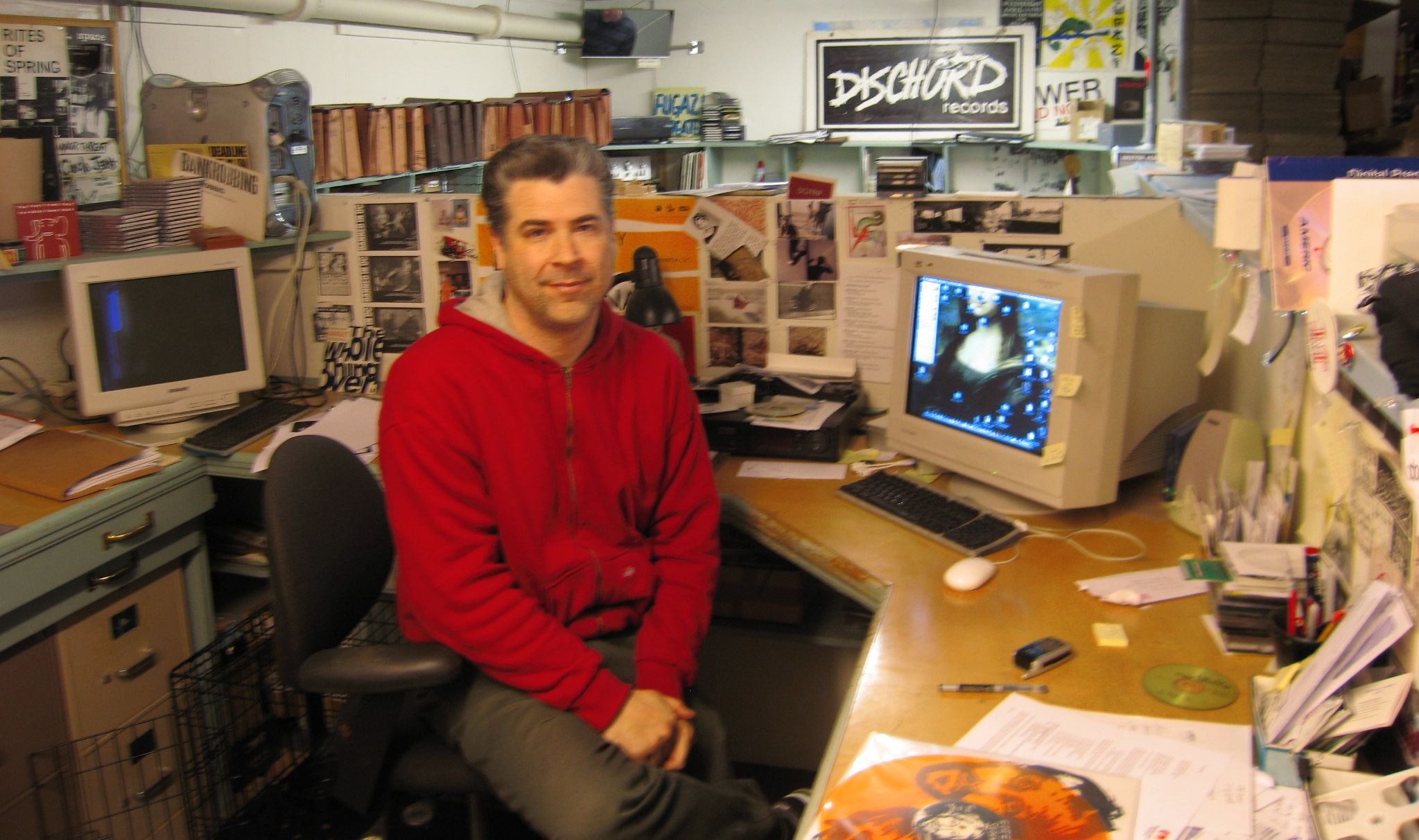
Although McKaye maintains an office at the Dischord House, Bourgeois and the other four full-time staff members do the lion’s share of the label’s work from a cluttered-but-cozy basement office stuffed below a dry cleaner across the street.

“This label has always represented a specific community within the D.C. scene,” Bourgeois said.” We don’t deal with contracts (on our artists). It’s a very personal group of friends.”

(Below: Bourgeois at his workspace in the Dischord office.)alec workspace

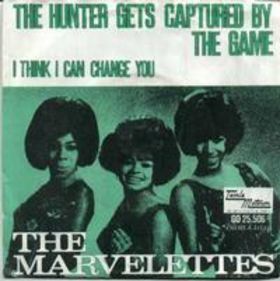
The Marvelettes – “The Hunter Gets Captured By the Game”

hunter

The Marvelettes – “The Hunter Gets Captured By the Game,” Pop # 13, R&B #2

By Joel Francis

The Marvelettes gave Motown its first No. 1 hit with “Please Mr. Postman,” but that was way back in 1961. But that was five years before “The Hunter Gets Captured by the Game” came out – a lifetime in pop music. The interceding years weren’t too kind. The group found some follow-up success with “Beechwood 4-5789,” but lost a founding member, and famously passed on “Where Did Our Love Go,” which became the Supremes’ first No. 1 hit.

By the mid-‘60s, the Marvelettes had lost another member. Only the success of greatest hits and live albums were keeping the band tethered to the Motown roster. Then Smokey Robinson entered the picture.

Robinson penned “Don’t Mess With Bill,” the comeback single for the now-trio. His pen also produced “The Hunter Gets Captured by the Game,” sung by Wanda Young, wife of Miracles’ guitarist Bobby Rodgers.

The lyrics are straightforward, but what makes the song is Young’s slinky singing and an equally elastic performance from the Funk Brothers. Check out the great guitar performance holding the whole song together and the great and rare Motown harmonica solo to appear outside of a Stevie Wonder or Shorty Long album.

The Marvelettes found a Top 10 hit with their next single – a remake of Ruby and the Romantics’ “When You’re In Love” – before losing another singer. They carried on with some success, but a full-scale comeback was quashed when the remaining members decided not to follow Berry Gordy to Los Angeles and Young’s pregnancy. After the Marvelettes dissolved, singer Ann Bogan joined New Birth, a soul outfit founded by former Motown staffer Harvey Fuqua.

“The Hunter Gets Captured by the Game” has been covered by Ella Fitzgerald, Raconteur Brendan Benson, Jerry Garcia, Blondie and Massive Attack. A reggae cover by Grace Jones reached No. 87 on the R&B charts in 1980.

Review: Toots and the Maytals, the Wailers

(Above: Toots and the Maytals deliver “54-46 Was My Number” to a massive French audience in 2009.)

By Joel Francis
The Kansas City Star

For four hours Sunday night, the back lot behind Grinder’s felt like a Jamaican resort.

The balmy summer weather was the perfect accompaniment to the music. Toots and the Maytals, the group that invented the word “reggae,” and the Wailers, the band that took it mainstream, celebrated both the roots and the future of the genre for a partially packed but fully appreciative audience.

While both groups feature only one founding member, it was more than enough for each ensemble. Led by bass player Aston “Family Man” Barrett, the Wailers blasted through an energetic hour of Bob Marley’s greatest hits.

The 10-piece band stuck closely to the original arrangements handed down from Mount Marley, but no one seemed to be looking for anything new. The Wailers played the hits for a crowd who had worn out their copies of “Legend” and needed no prompting to sing and dance along.

With a deck stacked so deeply, it was hard to go wrong, but a few songs stood out. “Jamming” took its title literally enough to feature some nice guitar work. “Wait In Vain” featured some nice harmony vocals from lead singer Elan Atias and the two female backing vocalists. The trio tossed the audience a curveball in the middle of that number when they worked “We Are the World” and a shout-out to Michael Jackson in the chorus.

The Wailers’ set ended with an epic medley of “Exodus” and “Punky Reggae Party.” Anchored by the wah guitar strumming and keyboard riff and garnished by horns, the 10-minute performance suggested a slithering, dancing convoy.

When “Exodus” was over, so was the set. It seemed a shame to shut down a band that felt like it was just getting start. The puzzlement was compounded by 45-minute wait before Toots and the Maytals came on.

Toots Hibbert made up for the wait between sets by opening with the song most people wanted to hear -– “Pressure Drop” -– and blasting through his best-known numbers. The music Hibbert made with the Maytals isn’t as famous as Marley’s, but it’s just as influential, mixing gospel, soul, funk and folk.

The earliest highlight wasn’t an original number, though. Hibbert and the seven-piece Maytals transformed “Louie Louie” to something that sounded like a Jamaican version of Booker T and the MGs that ended in double-time with Hibbert screaming like Ronald Isley at the end of “Shout” and verbally jousting with his two female backing singers. The trick worked so well it was reprised several times throughout the set.

A slowed-down reading of “Bam Bam” found Hibbert on acoustic guitar with an arrangement that betrayed the song’s sea shanty roots. Hibbert stayed on acoustic for a ferocious “Funky Kingston,” which more than lived up to its title. He blew a blues harp on “My Love Is So Strong” and dared the crowd to keep up with his fast dance moves several times.

The indefatigable Hibbert still has great pipes and he showed them off frequently. An improvised tribute to Kinston went from soul ballad to blues shuffle to reggae groove before getting a big gospel finish. The Maytals’ church collided with a great cover of “Take Me Home, Country Roads” that reclaimed the number from Dwight Schrute and Andy Bernard’s break room shenanigans.

The Maytals’ 95-minute set ended with romps through “Broadway Jungle” and “54-46 Was My Number” that culminated in another gospel blow-out and the band riffing on “Beat It.”

Public Property opened the evening with a 30-minute set played against the setting sun and an arriving audience. The six-piece band was definitely a disciple of the acts who followed. Their infectious set including the catchy “Choo-Choo Song.”

Setlists

The Wailers: Intro/horn instrumental, Lively Up Yourself, Rastaman Vibration, I Shot the Sheriff, Jamming, Wait In Vain ->We Are the World, Three Little Birds, One Love, Exodus/Punky Reggae Party

Toots and the Maytals: Pressure Drop, Pomp and Pride, Louie Louie, Reggae Got Soul, Time Tough, Bam Bam, Funky Kingston, unknown song, My Love is So Strong, Sweet and Dandy, Reggae Music All Right (improv), Take Me Home Country Roads, You Know, Light Your Light, Monkey Man/encore/Broadway Jungle, 54-46 Was My Number

Keep reading:

Review: Toots and the Maytals (2007)

Review: Sly and Robbie (2009)

Jamie Foxx brings it to Sprint Center on Saturday

(Above: Jamie Foxx celebrates society’s greatest scapegoat.)

By Joel Francis
The Kansas City Star

Three days after Michael Jackson’s death, Jamie Foxx appeared as host of the BET Awards clad in a red leather, Thriller-era jacket and sequined glove. After performing “Beat It” and telling a few jokes about Jackson’s ever-changing nose, Foxx paid tribute to the fallen icon by moonwalking across the stage.

And when Foxx performs a concert at the Sprint Center on Saturday, Jackson again will have his moment.

“We definitely do a Michael Jackson moment at our shows and let his music play,” Foxx said in a recent telephone interview. “A lot of the media’s Michael Jackson coverage has become a circus. We try to concentrate on what he gave us — his music.”

After walking the tightrope of poking fun at Jackson without offending, Foxx closed out the BET Awards with a duet of “I’ll Be There” with Ne-Yo. After the pair finished, Jackson’s sister Janet and father, Joe, came out and thanked everyone for their support.

“My job that night was to keep things light, keep things fun,” Foxx said. “Having the family there was tough, because I wanted to be respectful and I knew Janet was going to come out at the end. I have to commend BET, though. They had to do an awards show when the biggest entertainer in the world passes away. With very little money and very little time, they completely turned the show around.”

When Foxx last played Kansas City at the Music Hall in March, 2007, he was best known for his Oscar-winning performance as Ray Charles and parodying that character on the hit single “Gold Digger” with Kanye West. For this tour, Foxx has the success and chops under his belt to prove that he’s not just another actor living out a fantasy as a musician.

“The biggest thing I’ve learned since the last tour is that you should go out while your record is hot, not wait two years,” Foxx said, remembering his 2005 hit “Unpredictable,” which he didn’t promote until 2007. “Right now, this very moment, ‘Blame It’ is still rolling (on the charts). It’s sizzling.”

When Stevie Wonder played Starlight Theatre recently, he stopped the show for a few minutes to have the soundman pump his favorite song this year through the PA. Within moments, the crowd that had been grooving to “Signed, Sealed, Delivered” and “Living for the City” was grinding to Foxx’s “Blame It.”

Even without the endorsements, “Blame It” is one of the unofficial songs of the summer. It topped the Urban Contemporary charts for 12 consecutive weeks and as of mid-July it had been in the Top 40 for 26 weeks.

Like many of the previous summertime hits, “Blame It” gets a boost from the ubiquitous T-Pain. He won’t be at the Sprint Center, but Foxx said audiences won’t miss T-Pain or any of the other artists that appear on his albums.

“For those songs with features, I have guys who sing those parts, so we don’t miss a step,” Foxx said. “My back-up singer does a great job performing T-Pain’s part. It’s a lot of fun, but it also taught me another lesson: Don’t lean on your features too heavily when recording, so you can still do them alone on tour.”

Before Foxx was an Oscar-winning actor or a comedian on “In Living Color” and “Def Comedy Jam,” he was a musician. Foxx started taking piano lessons at age 5 and released his first album in 1994. It took 11 years and an appearance on Twista’s “Slow Jamz” — again with West — before Foxx released a follow-up album.

When he began performing as a musician on the big stage, Foxx drew on his experiences as an actor and comedian.

“Through playing live I learned how to pace myself,” Foxx said. “I learned I could take my time with a slow song. As a comedian, I am always looking for a reaction. But when you sing a slow song, you don’t need an immediate reaction. Sometimes people want to take it all in before they respond. I don’t need to go all over the stage to make sure they like it.”

Whatever the tempo, Foxx pulls on his acting background and treats each song as if he’s playing a character. Upbeat songs get a character who knows how to party and have fun, Foxx said.

“When it’s time for slower music, I change clothes and put on a suit,” he said. “For ‘Blame It,’ I wear a sparkly jacket, because that’s what I felt that character would wear. Everything’s always a character.”

Foxx appeared as a different kind of musician earlier this year. In the movie “The Soloist,” he portrayed a homeless, schizophrenic, classically trained cellist. Don’t look for that character to appear onstage.

“No more cello for me,” Foxx said. “I just play piano.”


the show
Jamie Foxx and his 50-city “Intuition Tour” come to Kansas City at 8 p.m. Saturday at the Sprint Center. Doors open at 7. Tickets are $59.75 and $69.75 at www.ticketmaster.com.