Review: “I Am Ozzy”

(Above: Ozzy Osbourne has done a lot of crazy stuff in his life. This might be the most surreal.)

By Joel Francis
The Daily Record

The trails and adventures of Ozzy Osbourne’s life have been repackaged and sold nearly as often as the metal god’s greatest hits.

Between an episode of “Behind the Music,” countless articles and three seasons of reality television on MTV, there’s little new ground for Ozzy’s new autobiography, “I Am Ozzy” to cover.

But just like “Crazy Train” and “No More Tears,” just because you’ve heard them before doesn’t mean you don’t want to hear them again. “I Am Ozzy” may hold few surprises, but it’s still a breezy and entertaining read.

Fans looking for insight into Ozzy’s musical process should look elsewhere. Animal activists are also advised to keep away. In the course of the book’s 391 pages, Ozzy not only (infamously) bites the head off of a dove and a bat, but decapitates his seven-foot stuffed bear and mows down his backyard flock of pet chickens during a drunken rampage.

That phrase, “during a drunken rampage,” is the preface to 99 percent of the book’s stories. It is amazing that Ozzy survived his rampages. Even more incredibly, the cumulative effect of so many successive episodes makes Ozzy’s unthinkable actions seem rational. After reading “I was drunk, so I figured ___” so many times, one starts to become numb to the consequences and may find himself frequently nodding in agreement.

The most entertaining and musically focused chapters detail Ozzy’s time in Black Sabbath. Before recording “Sabbath Bloody Sabbath,” the band holed up at Clearwell Castle in England. The time supposed to be used for rehearsal quickly devolved into a series of pranks designed to convince the others the castle was haunted. These stories show an innocent playfulness than reinforces the bond between band mates and makes them feel more human.

“I Am Ozzy” could also serve as an alternate screenplay for “This Is Spinal Tap.” Ozzy details his difficulties finding the perfect midget to hang onstage and how he placed blood capsules in a wig so it looks like he is suffering head trauma. He also recalls the difficulties of performing in a suit of armor – particularly when fans are flinging handfuls of raw meat onto the stage – and the night the pyrotechnic hand designed to lift him over the crowd malfunctioned.

Despite the hi-jinks, there is a serious side to the book. Ozzy somberly discusses the death of his guitarist and greatest foil, Randy Rhoades, a lawsuit filed by the family of a fan after he committed suicide and dealings with religious fanatics, both Satanists and Christians. Ozzy expresses his regrets, but doesn’t expound on the details (probably because he never had to deal with them).

For the past three decades, Ozzy’s long-suffering wife and manager Sharon has embraced the role of janitor. The Marge to Homer’s Ozzy, Sharon not only had to deal with the consequences of her husband’s addictions, but also had to repeatedly stand up to her father, Don Arden. As Ozzy and Sabbath’s former manager, he uses every dirty trick in the book to steal Ozzy back from his daughter. Sharon is frequently painted as an opportunist, but “I Am Ozzy” leaves little doubt that Sharon had to work very hard for her empire and may even deserve a smidgen of sympathy.

After spending two-thirds of his text on Sabbath and Rhodes, Ozzy breezes through the final 25 years of his life. Guitarists Jake E. Lee and Zakk Wylde (who played with Ozzy for 20 years) get only a passing mention. Ozzy slows down over the last 50 pages to discuss his resurrection on MTV, and health issues.

“I Am Ozzy” may not win any literary awards, but a special prize should be awarded to Chris Ayres for making the Ozz-man sound coherent and engaging. Although the conversational tone is loaded with profanity and British colloquialisms, they make the stories seem even more natural and personal.

If there’s one surprise in “I Am Ozzy” it is how much of Ozzy’s life feels like destiny. Despite the trappings of his fame and success, one gets the feeling Ozzy would have turned out pretty much same. Ozzy the Crazy Ex-Con or Ozzy the Slaughterhouse Worker (both were pre-fame occupations) just seem like lower-budget versions of Ozzy the Metal God.

After all, that’s who he is.

Mount Righteous invade KC

(Above: Mount Righteous play in the street back in 2008 when they had a guitarist in the lineup.)

By Joel Francis
The Daily Record

There must be something in the water down in Dallas/Fort Worth. After spawning the uber-upbeat indie rock choir the Polyphonic Spree and singer-songwriter St. Vincent the town presents yet another indie band from the fringes: Mount Righteous.

The exuberant nine-piece collective sounds like a cross between John Phillips Sousa and the Shins. The unique sound is intentional, said founder and drummer Joey Kendall.

“We knew since we were such a big band, we wanted to be able to play without a PA,” Kendall said. “Since we weren’t going to be using mics and amps, we got a hold of brass instruments.”

The normal lineup of bass/guitar/drum was thrown overboard for brass, woodwinds, accordion, melodica and bells. Adding further distinction to their sound, everyone in the band sings in unison.

“We do that so we don’t have to use mics, but everyone can still hear us,” Kendall said. “That said, we just wrapped up recording our second album and there are some solo vocals on there. In concert we’ll use megaphones for that part.”

Mount Righteous’ off-the-grid approach means the band can literally play at the drop of a hat. Since forming in 2007, they’ve crashed SXSW by parading in the street, played in a D/FW metroplex, and marched just outside of Mexico at Borderfest.

“We want to be prepared to rely only on ourselves,” Kendall said. “There’s a feeling of freedom that comes with knowing we can play whenever and wherever.”

On Saturday, Mount Righteous will bring their show to The Brick in Kansas City.

“This is our second visit to Kansa City,” Kendall said recalling the band’s May, 2008, performance. “There’s a good vibe to the Brick. Since we book our own tours, we look to places that have already booked us. We met some cool people there last time and are looking forward to seeing them again and hopefully make some more friends.”

When Kendall started corralling members for his new project several years ago everyone had standing obligations to their own bands. Eventually, though, Mount Righteous started taking priority.

“I’ve always viewed this as my main focus,” Kendall said. “But it took several years of work for the band to be worth doing full-time for everyone anyway. You need a lot of shows and a couple records under your belt before you know what you’ve got.”

Unlike the Polyphonic Spree, Mount Righteous is a true collective, with everyone in the band contributing lyric and song ideas. Although some musicians might feel constrained with such an unusual array of instruments, Kendall feels relieved.

“I think if we used the standard, traditional guitar lineup it would be overwhelming. There are so many ways you can write a song on guitar,” Kendall said. “Whereas there are hardly any pop songs written with these instruments.”

Kendall concedes that its unusual that so many unconventional bands have come from his neck of the woods, but doesn’t think Mount Righteous isn’t doing anything others aren’t.

“I’ve talked to a lot of people in community collective bands,” Kendall said. “There were bands like that in Grapevine (Texas, the band’s hometown) even before Polyphonic Spree. What we’re doing isn’t that new of an idea. We just might be better at getting things organized and going on tour.”

The show: Mount Righteous go onstage at 10 p.m. on Saturday, Feb. 21 at The Brick, 1727 McGee. Visit http://www.thebrickkcmo.com/ for ticket prices and further information.

Rare Earth – “Get Ready”

Rare Earth – “Get Ready,” Pop # 4, R&B # 20

By Joel Francis
The Daily Record

Motown’s signing of Rare Earth in 1968 was the sign of a label attempting to spread its wings. Although Rare Earth wasn’t the first all-white rock group signed by to Motown (that would be the Messengers in 1967), it was the most successful.

“Get Ready” was the Earth’s second and biggest single. The song was originally recorded by the Temptations in 1966 when it rose to No. 29. It was written by Smokey Robinson and Pete Moore and Bobby Rogers of the Miracles. When the Temptations version of “Get Ready” failed to chart high enough, Robinson passed production reigns of the group over to Norman Whitfield.

But that was four years ago, before the psychedelic movement and power trios started stretching songs to fill an entire album side. Which is exactly what Rare Earth did to “Get Ready.” Modeled after their show-closing performances, the song reached more than 21 minutes and packed the entire second side of their Motown debut.

The quintet lobbied label honcho Berry Gordy to release the song as a single, but given the song’s length he balked at the proposition. Finally, a three-minute edit was released in February, 1970 and the song shot up the chart.

Despite the genre transplant, “Get Ready” emerged relatively unaltered. The horn line was replaced with electric guitar, and faux crowd noise was added. The biggest change was Pete Rivera’s gritty white soul vocals replacing Eddie Kendricks’ tough falsetto. A saxophone solo by Gil Bridges closes the number.

The song became a staple not only for Rare Earth and the Tempts, but was a sort of label warhorse. It was included on albums by the Supremes, Miracles, Smokey Robinson on his own, and again by the Temptations in 1991.”Get Ready” was also covered by pop-punk band Ash, the Scottish folk band the Proclaimers and sampled by the Black Eyed Peas, who later turned it into a full-blown cover for their singer Fergie on her solo album.

Key King Artists

(Above: The groundbreaking “Working on a Building,” which the Swan Silvertones cut for King Records.)

By Joel Francis
The Daily Record

James Brown is certainly the best-known artist to record for Syd Nathan’s Cincinnati-based label, but King Records had forged a reputation long before Brown emerged. For a quarter century, from 1943 to 1968, King recorded some of the top performers in not only R&B, but gospel, jazz, bluegrass, rockabilly, blues and early rock and roll.

Here are some other King artists worth checking out.

Bill Doggett
Organist Bill Doggett was the biggest-selling instrumentalist on King. He joined the label after leaving Louis Jordan’s band in 1951, and recorded several sides with a trio. When the results weren’t what he’d hoped, Doggett added saxophone and guitar to the lineup and scored big hits with “Ding Dong, “Hammer Head” and “Shindig.” Doggett’s biggest success, though, was the 1956 smash “Honky Tonk.” The record sold 1.5 million copies that year, spent seven months on the chart and won several awards Doggett left King for Warner Bros. in 1960 when King owner Syd Nathan refused to increase Doggett’s royalty rate.

Swan Silvertones
Claude Jeter’s Swan Silvertone’s were the biggest gospel act to record for King. They were only with the label for five years, from 1946 to 1951. The 45 songs cut for King bridged the transition from the traditional barbershop-based style of gospel singing to a more spontaneous, emotional approach. Jeter’s duet with co-lead singer Solomon Womack on “Working on a Building” epitomized the potential of the new method and influenced future stars Al Green, Curtis Mayfield and Sam Cooke. The Slivertone’s later recordings on Specialty and Vee-Jay receive more attention, but the half-decade at King cemented the group’s sound and reputation.

Charlie Feathers
Rockabilly guitarist Charlie Feathers is one of those criminally forgotten musicians whose talent outshines his reputation. Feathers grew up in Mississippi listening to the Grand Ol Opry, but learned guitar from bluesman Junior Kimbrough. Feathers briefly recorded for Sun before coming to King in 1956. After cutting several raw, visceral rockabilly numbers that went nowhere, commercially speaking, Feathers decided to model himself after Elvis Presley. When the sanitized new records also refused to budge, a frustrated Feathers left King. He bounced around from label to label, continuing to perform until his death in 1998. In 2003, director Quentin Tarantino resurrected a couple Feathers songs for his “Kill Bill” films.

Stanley Brothers
Bluegrass legends Carter and Ralph Stanley were already stars when they signed to King in 1958. That fall, the duo released one of the genre’s landmark albums, an untitled recorded nicknamed after its catalog number, King 615. Along with old-timey mountain music, the Brothers recorded gospel and even R&B numbers, putting their stamp on Hank Ballard’s “Finger Poppin’ Time.” The Stanley Brothers reached new audiences during the folk revival of the early ‘60s, and cut their final album for King in 1965. Carter Stanley died the following year, but his Ralph kept the flame alive. In 2006, Ralph Stanley found improbable acclaim for his a cappella reading of “O Death” on the “O Brother, Where Art Thou?” soundtrack.

Little Willie John
Soul singer Little Willie John had one of the longer tenures at King, spending one third of his life on the label. Unfortunately, John only lived to 30 and all his success came early. The Detroit native was just 18 when he landed his first big hit, “All Around the World.” In the next few years, John racked up 10 more To 20 R&B hits, including his signature number, “Fever.” A has-been at 25, John struggled with alcohol and drug addiction. He was charged with manslaughter after stabbing a man to death following a concert in Seattle. In 1968, John died in prison.

(Below: “Can’t Hardly Stand It” was one of several great rockabilly songs Charlie Feathers cut for King in the 1950s.)

Keep Reading:

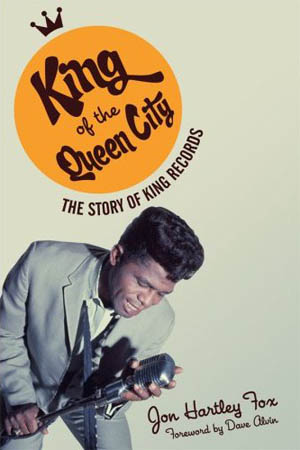
“King of the Queen City” book review

Police On My Back: Five Musicians Convicted of Murder

Review – “King of the Queen City”

(Above: The Delmore Brothers landed a hit with “Blues Stay Away From Me” in 1949 on King Records.)

By Joel Francis
The Daily Record

In a musical landscape that lionizes pioneering indie labels Chess, Motown and Atlantic, Cincinnati’s King Records is at best remembered as a footnote and the early home of James Brown.

Author Jon Hartley Fox aims to correct that perspective with his new book “King of the Queen City: The Story of King Records.” While Brown receives his due, Fox spends a great deal of time making the case that King was the most diverse and innovative label of its time.

King Records was founded in 1943 by Syd Nathan, a 40-year-old Cincinnati businessman with asthma and poor eyesight. Nathan’s got into the music business started by reselling old jukebox platters at the tail end of the depression. The venture proved so successful he opened Syd’s Record Shop on Cincinnati’s Central Avenue in 1940.

The first artists Nathan signed to King were Grandpa Jones and Merle Travis. Their success, coupled with the early hit “I’m Using My Bible for a Road Map,” led Nathan to advertise with the slogan, “If it’s a King, it’s a hillbilly.”

In 1945, Nathan dipped his toe in the waters of “race music” (the term “rhythm and blues” wouldn’t be coined for another three years), with Queen Records. The success of early artists like Bull Moose Johnson led the subsidiary to be moved onto the proper King label.

Nathan’s pursuit to make records for the “little man” took him into nearly every conceivable genre of music. Throughout his quarter century at the helm of King, the label produced hits on the country, blues, gospel, pop, R&B and jazz charts. A cross section of King’s staggeringly diverse roster includes Freddie King, Hank Ballard and the Midnighters, the Stanley Brothers, Homer and Jethro and, briefly, John Lee Hooker, Hot Lips Page and Johnny Otis.

The label’s biggest artist, however, nearly didn’t make it out of the studio. James Brown came to King through a demo of “Please, Please, Please.” Nathan hated the track with a passion, and released it only to humiliate the producer, who staked his career on its success. The Hardest Working Man in Show Business went on to have an unprecedented string of hits on King beginning with “Please, Please, Please” 1956 and continuing until 1971, when Brown and his back catalog moved to Polydor.

The label’s success went beyond its across-the-board chart triumphs. In the early 1940s it was the first independent label to have its own fully functioning recording studio. Nathan was also at the vanguard of race relations, hiring black producers to supervise sessions with white musicians. Eight years before the hometown Cincinnati Reds would let blacks and whites play on the same team, Nathan had integrated crews in nearly every facet of the label.

Clearly, Fox has a lot of ground to cover in his book, and he does a good job of presenting the material in easy-to-digest portions. Each chapter covers a different facet of the label, such as country, gospel, solo or group R&B acts, production and distribution. From one-hit wonders to major performers, Fox does a good job breaking down the biographies of all the key players. In one or two pages, Fox paints a tight picture of everything the subject did before, during and after King. In that regard, the book functions almost as well as an encyclopedia of mid-century, Midwestern performers.

That approach, however, can also suffer from losing sight of the forest from all the trees. Nathan’s persona could have provided an easy and useful narrative thread, but he disappears for pages at a time. We don’t learn about his failing health until Fox casually mentions Nathan had a heart attack during a treatise on Brown. We also don’t learn much about Nathan’s personality – when he showed up at the office, his lifestyle, where he lived or his personal life.

The book’s timing also puts Fox at a disadvantage. Nathan died in 1968 and Brown in 2006. Most of the other performers are also deceased, giving Fox few primary sources to work with. Despite these difficulties, Fox proves himself a good researcher who draws on previously published material and interviews to tell his story.

The concise book covers a lot of territory in just over 200 pages. “King of the Queen City” is a brief but compelling work that should be devoured by music historians, both professional and amateur.

The Originals – “The Bells”

The Originals – “The Bells,” Pop # 12, R&B # 4

By Joel Francis
The Daily Record

Once Marvin Gaye proved he could write and produce a hit song with “Baby I’m For Real,” he set out to show it wasn’t a fluke. Released less than a year later, “The Bells” replicated the success of its predecessor, for both Gaye and the Originals.

Like “Baby,” “The Bells” is a mid-tempo ballad that never picks up the pace past a pleasant trot. That said, whoever is playing the drums lays down some funky licks during the bridge (“I hear the bells/ringing in my ears”). The song closes with a spoken verse with smooth saxophone accompaniment, presaging the Quiet Storm movement.

Less than six months after “The Bells” ascended near the top of the charts, Gaye was again in the studio with the Originals, this time recording his landmark album “What’s Going On.”

Although “The Bells” earned the Originals a gold record, the group had a hard time finding their previous success sans Gaye. Their next four singles failed to chart. It wasn’t until five long years later, in 1975, that their disco effort “Good Lovin’ is Just a Dime Away,” nibbled at the bottom of the charts. Their 1976 single “Down to Love Town” fared better, hitting No. 1 on the dance chart.

The Originals broke up in 1981 after the death of singer Ty Hunter. Twenty-five years later, founding member Hank Dixon toured with a reformed version of the Originals. Ironically, he was the only original member in the lineup.

In 1971, Laura Nyro covered “The Bells” with Patti LaBelle contributing backing vocals. In 1994, New Jack Swing group Color Me Badd put the song back on the R&B charts.

Review: Yo La Tengo

(Above: Yo La Tengo tear into “Sugarcube.”)

By Joel Francis
The Kansas City Star

Almost an hour into Yo La Tengo’s show Tuesday night at the Granada Theater, a fan asked how long the band had been together. The choices presented were 12, 13 or 14 years or longer.

Singer/guitarist Ira Kaplan quickly set the record straight: “I’d like to take this opportunity to announce that this is our 26th year of rocking,” he said. “And I know a lot of you are similarly looking forward to your 26th birthday.”

The indie-rock trio from Hoboken, N.J., is not only a case study in longevity, but consistency. Its set exceeded two hours and touched on all facets of the band’s career, from a whisper-soft reading “Speeding Motorcycle,” one of the band’s earliest “hits,” to bright, up-tempo new song “Nothing To Hide.”

The opening number showcased the two facets of Yo La Tengo’s personality. “We’re an American Band,” was not a Grand Funk cover, but a 10-minute, laid-back drone. Kaplan’s sweet falsetto vocals were countered by his sudden guitar spasms, creating something like an abrasive lullaby.

The rest of the night swung between those two poles. A spacey reading of “Little Eyes” drew big cheers. Drummer Georgia Hubley (Kaplan’s wife) took over vocal duties. Kaplan’s guitar had a flat tone and was buried in the mix, making it feel like the song was floating out of a distant radio.
Other early highlights included the jaunty “Mr. Tough,” which had some people dancing. “I’m On My Way,” another new song, featured bass player James McNew on lead vocals and Hubley on acoustic guitar.

The mellow, dreamy soundscape was punctured by the ferocious drums and guitar that introduced a raucous “Sugarcube.” The energy from that number carried into “More Stars From Heaven,” that slowly built in intensity until reaching a blissful crescendo after nearly 10 minutes.

While Yo La Tengo knows how to nurse a mood, the instrumental “I Heard You Looking” was a tour de force. With Hubley and McNew holding down the groove, Kaplan battered and molested his guitar for nearly 20 minutes. Jumping in the air while strumming, and swinging the instrument by its neck, Kaplan did everything he could to coax out new sounds. When his guitar strap broke, Kaplan kept on playing, using the experience to add new texture to his strumming.

After surveying their catalog, the band turned to their influences during the encore sets. A fun garage rock cover of the Small Faces’ “What Cha Gonna Do” and a goofy duet of “It’s OK, I’m Alright” with opening band Times New Viking showed the trio’s sense of humor. While the crowd didn’t get the band’s oft-requested cover of Sun Ra’s “Nuclear War,” the night closed with another Ra cover.

Nearly two hours after taking the stage, Yo La Tengo surprised everyone by returning for a second encore. After playing a stripped down version of “Big Day Coming,” that found Hubley replacing Kaplan on lead vocals, the trio broke out some doo-wop on Sun Ra’s “Somebody’s In Love.” Although the house wasn’t sold out, it was comforting to know the band could, and would, come back and do this again anytime they wanted.

Setlist: We’re An American Band, All Your Secrets, Periodically Double or Triple, Avalon or Someone Very Similar, Little Eyes, Here To Fall, If It’s True, Mr. Tough, I’m On My Way, Don’t Say, Tom Courtenay, Sugarcube, More Stars Than There Are In Heaven, The Story of Jazz, Nothing To Hide, I Heard You Looking. Encore: It’s OK, I’m Alright (with Times New Viking), Stockholm Syndrome, What Cha Gonna Do (Small Faces cover), Speeding Motorcycle; Big Day Coming (acoustic), Somebody’s In Love (Sun Ra cover).

2010 Grammys: A Live Diary

By Joel Francis
The Daily Record

We at The Daily Record try to play clean in our tiny corner of the interweb. Once a year, on “music’s biggest night” the gloves come off and the snark comes out. This year, we present a live diary of the 62nd Annual Grammy Awards. We’ll be doing this live throughout the telecast, so keep checking back.

7:01 – Lady Gaga opens the show in a dress she bought at Bjork’s garage sale.

7:02 – She forgot to buy the pants, though.

7:04 – At last, Elton John has found someone with more flamboyant taste in eye wear. Wonder how that feels.

7:11 – Stephen Colbert may have already delivered the line of the night. Re: Susan Boyle selling the most records of ’09 and saving the bottom line –  “You may think you’re the coolest people in the world, but just remember that your industry was saved by a Scottish woman in sensible shoes.”

7:13 – Beyonce wins “Song of the Year” but can’t make it onstage to accept the award. Why not have it received by the Chippettes, stars of the year’s best film “Alvin and the Chipmunks: The Squeakquel”? Now that’s synergy!

7:15 – Who the hell thought it was a good idea to turn “American Idiot” into a musical? I can hear this one flopping faster than Twyla Tharpe’s tribute to Bob Dylan. Forget “Movin’ Out,” how about moving on?

7:16 – Nothing screams “punk rock” louder than a Broadway chorus. Even the Clash buried their choral version of “Career Opportunities” on the last side of “Sandinista.”

7:24 – I can’t figure out which interests me less Kirsten Bell’s insipid new movie “When In Rome” or what song Bon Jovi will play tonight. Let me guess: a really lame one from the ’80s.

7:26 – Does Taylor Swift have a clause in her contract that she must win every award for which she is nominated? Has she ever lost?

7:27 – I’m a little disappointed Kayne West didn’t jump onstage and start talking about how great Keith Urban is.

7:28 – Hey, Beyonce brought the S1W’s with her. Nice to see her kicking it old school.

7:29 – (The S1Ws were the black panther dancers who guard the stage during Public Enemy performances.)

7:32 – Nothing screams 2010 like Alanis Morrissette songs. On to the next one.

7:37 – Questlove just tweeted “must admit that watching twitter tweets are better than watching the actual event.”

7:41 – Pink is wearing the sexiest berka of all time.

7:44 – Nothing screams “class” like a chick in a g-string spraying water everywhere. Pink is so talented!

7:45 – Between Pink and GaGa that’s four butt-cheeks bared tonight. Just wait until Howard Stern and Prince come out.

7:47 – I’m not sure who the Zac Brown are, but respect the fact that they didn’t get all gussied up for the show.

7:48 – I’m also glad none of them were wearing a g-string.

7:55 – Will.I.Am looks like Mr. Roboto from that Styx album.

7:56 – Fergie looks like someone from either Buck Rogers or the original Battlestar Galatca. Does anyone else remember when Channel 62 used to show all those back-to-back on Saturday afternoons?

7:58 – I gotta admit that watching the Peas do “I Got A Feeling” in concert would probably be a lot of fun. That song got a lot more infectious energy than it deserved.

8:00 – OK, so we’re an hour into this thing and a couple ground rules have already been established. No. 1, no one can perform a song all the way through. Medleys only, please. No. 2, all performance must somehow make their way from the main stage to the satellite stage, and back.

8:01 – They keep advertising the 3-D Michael Jackson tribute with Celine Dion. That woman’s so skinny, I bet even in 3D she’s only 2D.

8:06 – Who the heck are Lady Antebellum?

8:07 – I knew it would happen. People are starting to compose songs for those episode-capping montages. This Lady Antebellum song would be perfect over the poignant closing moments of “Grey’s Anatomy.”

8:09 – The presenter just said there was a Grammy category for artists who don’t have musical talent. Wait, there’s a Grammy for people with musical talent? When are they going to give that one out. Oh yeah, it was done earlier in the day in the parking lot behind the Ross downtown.

8:11 – I bet Stephen Colbert’s daughter thinks her dad is cool now that he’s won a Grammy.

8:12 – Oh, just as I blogged the above Colbert asked his daughter if she thought he was cool now. I am so freaking prescient!! (She said yes, by the way.)

8:13 – The Target ad just showed a white dog with a red spot of his eye. Spuds McKenzie lives!

8:14 – OK, that’s three exclamation points in the past two entries. I’m calming down now.

8:18 – Wow, Taylor Swift was up for “Song of the Year” and she didn’t win. I bet she gets at least half an album’s worth of songs of out how she’s feeling right now.

8:20 – They just introduced Robert Downey, Jr. as the most “self-important” actor of his day. How out of control is your ego when you’re crowned most “self-important” in Hollywood?

8:21 – That operatic introduction to “Blame It” was brilliant. Every time I hear this song I remember that Stevie Wonder stopped his show at Starlight last summer to play it over the PA.

8:23 – If they hadn’t just shown George Clinton in the audience, I would have sworn he was the white-haired conductor onstage.

8:24 – I think “Blame It” is starting to suffer from auto-tune overload. It sounds like Kraftwerk.

8:25 – Now Slash is onstage playing the guitar solo from “November Rain.” He probably just heard someone talking about alcohol and bum rushed.

8:27 – Joe Posnanski just tweeted: “They really had people VOTE to determine what Jon Bon Jovi sings at the Grammys? Was there a ‘What’s the difference’ option?'”

8:33 – Hey, Green Day won “Best Rock Album” for their follow-up to “American Idiot.” Can’t wait until that gets turned into a Broadway musical.

8:34 – Chris O’Donnell looks like McSteamy on “Grey’s Anatomy.” I hate myself for knowing this.

8:36 – Wow, a “country” band singing a patriotic song. Way to think outside the box, guys.

8:37 – Answer: Leon Russell with the Zac Brown Band. Question: Who will be headlining Knucklehead’s Labor Day celebration in 2012?

8:38 – Are the red-staters happy that the Zac Brown Band is celebrating America by playing a patriotic number, or upset with them for supporting Obama? This is so confusing. I thought we established that one couldn’t love their country without blindly supporting its president.

8:46 – Has anyone noticed how Taylor Swift strums from her elbow and not her wrist? It’s like she just picked up a guitar for the first time.

8:47 – I hope the tattooed guy on banjo is getting paid well for this gig.

8:49 – Good Lord, Taylor, stay in key! She has pitch like Mariah Carey at a baseball game in Japan.

8:53 – Dang, I forgot to get my 3D glasses. Fortunately, I still have 7 minutes to make it to Target.

8:54 – All you chumps who forgot your 3D glasses will now be given a migraine.

8:56 – I think Smokey could have handled the whole MJ tribute on his own. I would have loved to hear him cover a less-maudlin ballad on his own. I’d even settle for “Ben.”

8:57 – I love how Beyonce is wearing her 3D specs while Jay-Z is sans glasses. Hey B, you’re at the event. It’s already in 3D.

9:01 – I bet MJ’s kids feel really out of place when they hang out at their Uncle Tito’s place. Those are some pale-faced children.

9:03 – Wow, they were just paying tribute to MJ on the Grammys and now there’s a a commercial for “This Is It” on DVD. What a weird coincidence. It’s almost like it was planned.

9:08 – All you have to do to win an icon award is write “Sweet Talkin’ Guy”? Seems to be setting the bar a bit low.

9:09 – So what you were really voting for was which part of a Bon Jovi song they’ll perform.

9:10 – I hope Roger McGuinn is getting a cut of “We Weren’t Born to Follow.” Methinks Bon Jovi should have paid more attention to the Byrds’ “Wasn’t Born to Follow” when they were ripping it off.

9:11 – Someone needs to say it: Bon Jove are looking old. How many chins does Sambora have, anyway? I count three.

9:12 – I’ll tell you who says you can’t go home: Thomas Wolfe. And if home sounds like this, I’ll be out with Dean Moriarty on the road.

9:14 – Jon Bon Jovi should be forced to sing “Living on a Prayer” over the PA at a Home Depot.

9:16 – What the? How did Mos Def get onstage? “True Magic” had more artistry than the entire careers of everyone else onstage tonight – combined (except for Smokey Robinson and Leon Russell).

9:18 – Next year at this time, I hope Mos Def and Talib Kweli are being presented with the Best Rap Song award for “History.” Black Star rules.

9:19 – So Kanye actually wins an award and he doesn’t show up to collect it? How classic would it have been for Taylor to crash his speech? Probably why he didn’t show up.

9:21 – Seriously, though, best of luck to you and whatever you’re going through, Kanye. Your albums are genius. I hope you get your magic back and exorcise those demons.

9:26 – So it’s OK to sing “Bridge Over Troubled Water” to show support for the Haitians even though the song was banned by Clear Channel in the wake of 9/11?

9:28 – I just want to get this off my chest: Mary J. Blige, magnificent voice, but she oversings and all her songs are vamps and choruses. She doesn’t know what to do with a verse. And the a-hole who thought it would be a good idea to run that voice through auto-tune for MJB’s latest single should be shot. That’s like tying Fred Astaire’s ankles together.

9:30 – Do Mary J and Andrea Bocelli know they’re both singing the same song? Their “duet” was like an otolaryngological cock fight.

9:37 – Who’d have thought the Latin Grammys would have lasted a decade?

9:38 – How come there isn’t a Jazz Grammys or Klezmer Grammys?

9:42 – How many support musicians does the Dave Matthews Band need for this song? Maybe the USC Marching Trojans will show up again.

9:44 – Dave Matthews dances worse than Elaine Benes from “Sienfeld.”

9:46 – Now Ricky Martin has stolen Chris O’Donnel’s close-cropped look. He should just be glad he’s not forced to pay is way in with the general public.

9:48 – I think Beyonce’s dress is made of all of Jay-Z’s discarded bling.

9:55 – When I saw Maxwell last fall at the Saavis/Keil/Whatever it’s now called Center in St. Louis I imagined the experience was similar to seeing Marvin Gaye back in the day. Maxwell is the real deal and he’s killing it right now. Best performance of the night so far.

9:58 – Maxwell + Roberta Flack. At last, a duet with two people who actually know how to sing with a partner.

10:00 – As the show rounds the three hour mark, just think: the whole night could have been as good as what we just heard.

10:05 – I wonder if this is the combo Jeff Beck will be bringing to Starlight in April.

10:06 – So what’s the thinking here, now that all the kiddies have gone to bed we can shelve the pop tarts and have some real music?

10:07 – Does Quentin Tarantino know that pretending to act like such a badass is making him look like a huge douchebag?

10:14 – Is there a song underneath all these edits? Why not change the lyrics for television? I wonder if the producers have a lyric sheet up in the booth so they know when to drop out. That would be classic to see.

10:17 – Jamie Foxx is singing along with every lyric, but I have to say I think Drake is horribly overrated.

10:18 – Drake’s blend of preppie (black leather jacket, black shirt) with ghetto (torn, sagging jeans) is cracking me up. He’s clearly trying to have it both ways.

10:26 – Taylor Swift wins Album of the Year. Yawn.

10:29 – That’s it for the night. Thanks for reading and for hanging out.

Keep reading:

2010 Grammys: A Running Diary

Professor Griff discusses the past – and future – of Public Enemy

(Above: The title says it all: “Professor Griff drops knowledge.”)

By Joel Francis
The Daily Record

Onstage, Professor Griff, minister of information for the veteran rap group Public Enemy, rarely smiles. Griff rarely takes center stage, but sets the tone of the show by marshalling the S1Ws, Public Enemy’s uniformed faux-security force, through their militant dance steps.

Offstage, Griff may not be mistaken for Flavor Flav, the group’s much-lampooned comedic foil-turned-reality TV star, but he is far from the grim-faced drill sergeant he appears. In fact, right now he is laughing.

“At first, I was DJ Griff,” the founding member says through a chuckle. “I laugh because people don’t see me like that. Then it morphed into minister of information, because I was always studious. I took it upon myself to be an avid reader and study. That’s how I got the name Professor.”

Griff, nee Richard Griffin, describes the early days of Public Enemy and discusses his political views and philosophies in his new book, “Analytixz.”

“Readers already know the media’s version of who Griff is. This lets me tell aspects of my story without writing an autobiography,” Griff says. “The ugly truth and the controversies are there. I don’t like it, but I can’t write it with a pink cover and make everything cute.”

The lengthy first chapter covers the most controversial part of Griff’s career, when he was kicked out of Public Enemy for being quoted making anti-Semitic statements in the Washington Times.

“The first chapter was the most difficult,” Griff says. “It was the only time I had to stop tape, because it brought back a time I didn’t want to re-experience.”

Although that rough experience is the lynchpin of the book, another hardship brought the manuscript to fruition.

“’Analytixz’ came together in 90 days because I lost the other three books I was working on when my house burnt to the ground,” Griff says. “It comes from a place of hurt and pain, but I wanted to fulfill my promise to put out a book.”

Griff laughs again remembering how Run-DMC’s DJ Jam Master Jay and Def Jam label co-founder Rick Rubin’s original plan for Public Enemy.

“When Jam Master Jay saw (Public Enemy MC) Chuck (D) at Adelphi University, he and Rick Rubin wanted to sign him as Chuckie D,” Griff says through a snicker. “Chuck and I are still laughing about that one. Basically, Chuck brought Flav along, and everyone else came from me.”

“Everyone else” is the groundbreaking production unit known as the Bomb Squad and the group’s DJ, Terminator X.

“Members of the Bomb Squad had a group called Spectrum City, which included me,” Griff says. “We brought Chuck on board to be part of our mobile DJ unit.”

Public Enemy is nearing its 25th anniversary, but Griff, Chuck and company are still intent on bringing the noise. After leaving Def Jam, the band is financing their new album through SellABand. By purchasing $25 shares, fans can help the band reach its goal of $250,000 and get everything from a mention in the liner notes, to profit sharing and input on the final product.

“It’s interesting to see how things are unfolding,” Griff says. “People say, Public Enemy, you guys were popular, it should be no problem to raise that money, but they’re on the outside of it.”

While many rap acts from the ‘80s are dismissed as old school, Public Enemy has worked hard to stay at the vanguard. The band pioneered the digital distribution model with their album “There’s A Poison Goin’ On” 10 years ago, and introduced a play-listed based album on 2002’s “Revolverution.”

“Me and Chuck are 49,” Griff says of his bandmate, who was born on the same day in the same hospital. “It’s not over. We still have to put our period at the end of the sentence.”

What’s on Griff’s iPod?

“If I lent you my iPod for one day, you’d probably say ‘What the hell?’ The first thing you’d notice is I have a large music collection – easy listening, rock, soulful stuff. When it comes to my hip hop playlist, you’ll see Rage Against the Machine, the Roots, Immortal Technique, Wize Intelligent, Dead Prez, KRS-One – because I’m still learning from him – and the new Can-I-Bus. There’s no Nelly, no Snoop Dogg and nothing produced by Jermaine Dupri.

“The most surprising thing on my iPod is (long pause) Asher Roth, which is on there probably because me and my son share a computer. I play that song when people come in the car with me and they say, Griff, what do you know about a white Jewish boy? I listen to everything, man.”

Keep Reading:

Review: Public Enemy, Rage, the Roots and more at Rock the Bells (2007)

Review: The Roots (2008)

More Hip Hop on The Daily Record

Jackson 5 – “I Want You Back”

Jackson 5 – “I Want You Back,” Pop #1, R&B #1

By Joel Francis
The Daily Record

“I Want You Back” not only introduced America to the biggest post-Elvis superstar in the world. It also kicked off the unprecedented success of a group having its first four singles top the chart, and returned the mojo Motown lost with the departure of Holland-Dozier-Holland.

The Jackson 5 – Michael, Tito, Jermaine, Marlon and Jackie – were famously raised in Gary, Ind. by their ambitious and abusive father Joe. When his sons started showing musical aptitude, Joe Jackson saw them as his ticket out of the Gary steel mills and, after music lessons, sent them out on the chitlin circuit. Their shows caught the eye of Sam and Dave and Gladys Knight, who recommended the group to Motown chief Berry Gordy. Because Gordy already had one child star with Stevie Wonder, he declined to sign them.

One year later, in 1968, the Jackson 5 were paired with Knight and Bobby Taylor and the Vancouvers, who were riding their lone Motown hit “Does Your Mama Know About Me.” Taylor and Knight were so impressed by the J5’s performance that they videotaped an audition and send the tape to Gordy to his new home in Los Angeles. Gordy was still reluctant to sign another child act, but relented after watching the tape.

Of course Knight and Taylor received little credit for bringing the Jackson 5 to Motown. The glory went to Diana Ross, who had nothing to do with the quintet or their signing, but received top billing on their debut album, “Diana Ross presents the Jackson 5.”

The arrival of the Jackson 5 draws a sharp line between the Detroit and Los Angeles eras of Motown. Gordy had recently relocated to Los Angeles to start a film career for both himself and Ross, his lover. Although some early J5 songs were recorded at the Hitsville studio in Detroit, Gordy moved the group out to California for grooming.

Gordy copied the songwriting template of the Supreme’s successful “Love Child” to craft “I Want You Back.” He called three of his best writers – Freddie Perren, Deke Richards and Alphonso Mizell – to help him retool a song originally intended for either Gladys Knight or Diana Ross as either “I Wanna Be Free” or “I Want You Back.” As on “Love Child,” Gordy billed the collective anonymously. After the defection of Holland-Dozier-Holland, Gordy did not want any more of his songwriters to become “back room superstars.” Known only as “The Corporation,” the team wrote many of the Jackson 5’s early hits.

One of the most infectiously joyous songs in the Motown catalog, “I Want You Back” has been covered several times. Nickel Creek recorded a bluegrass version in 2007, two pop girl groups – Cleopatra and the West End Girls – had international hits with their 1990s interpretations. It was recorded by indie rockers Discovery on their 2009 debut, and performed by British singer Mika, KT Tunstall and even Guns N Roses in concert.

“I Want You Back” was sampled by Kris Kross for their 1992 hit “Jump,” and Kanye West for Jay-Z’s 2001 smash “Izzo (H.O.V.A.).”