Steddy P takes care of his fans. Since Steddy’s debut album in 2008, fans have never had to wait more than a few months between new offerings. This month Steddy dropped the While You Were Sleeping EP/mixtape to keep fans happy until the emergence of his next full-length album. But While You Were Sleeping is more than a stopgap release. Six new cuts show Steddy’s recent activity in the studio. But more fun is the second part of the album: 13 tracks from the back catalog, remixed by DJ Mahf.
Mahf, who oversaw Steddy’s 2009 album, Style Like Mind, clearly had a blast marrying “Kenneth Arnold” to the “Super Mario Bros.” video game soundtrack. “Miss Your Coffee Table,” one of the few odes to the fairer sex on the mixtape, incorporates both Q-Tip of A Tribe Called Quest and LL Cool J’s “I Need Love.” Other tracks pay tribute to early Kanye West, Jay-Z, DJ Shadow and the Nappy Roots. That Steddy’s original verses stand up against such recognizable backgrounds is a testament to his clever wordplay and intricate delivery.
At times Steddy’s delivery recalls that of Blackalicious’ Gift of Gab. Steddy does a good job of changing textures when necessary, and recruits great guests such as Ces Cru, Mathias and Jbomb to further vary the vocal patterns. Steddy’s best performance across the 19 tracks comes early. “BARS (Loser’s Club Remix)” is Steddy’s answer to repeated invitations to freestyle battles. After calling out so-called Midwestern rappers who quickly vacate to the coasts he revs into double time. It’s not quite Twista-fast, but impressive nonetheless.
Although they appear first, the new tracks almost seem secondary. Steddy comes strong out of the chute on “Enough” and “Bars,” but the production falters on “Steddy Persistence Pt. II,” the third cut. Each song is handled by separate producers. The tracks don’t flow together well, and the quality fluctuates.
On “No Doz” Steddy uses a violent slasher/horror film metaphor to establish his lyrical dominance. His words are threatening, but try as it might, the chintzy synthesizer loop can’t be considered sinister. A similarly vanilla loop is featured in “And It’s Like That,” which manages to include a shout-out to Steddy’s former home turf of Mizzou, to KU and even to the UMKC Roos.
The final new song, “WindOverHead,” is the most successful. The production includes hints of the ambient and industrial, as well as snippets of saxophone and opera over an understated piano melody. Steddy shines across this landscape, calling out Tech N9ne and Mac Lethal and marking his IndyGround territory.
Despite a few minor missteps, While You Were Sleeping is a nice place for longtime fans to regroup and experience Steddy’s catalog in a different light. Newcomers will find the album a handy place to catch up. Best of all, it’s free.
(Above: Devo get “fresh” on the Jimmy Kimmel Show.)
By Joel Francis The Kansas City Star
Devo deserved better. Kudos to the local radio station for adding them to their Buzz Under the Stars lineup at City Market on Friday night, but the pioneering synth-pop band merited more than a 50-minute set shoehorned in with four other acts.
The five-piece band hasn’t played Kansas City in some time, and many in the crowd were seeing the band for the first time. They weren’t hard to spot. Many were sporting the group’s trademark blue energy dome hats that look like inverted Lego flower pots. Several more knew the precise moments to mimic singer Mark Mothersbaugh’s choreographed hand signals. At times they looked like a group of subversive air traffic controllers.
The five-piece band took the stage wearing matching gray suits with half-masks that looked like berets extending over the eyes. The kinetic keyboard riff to “Don’t Shoot (I’m A Man)” a track off the band’s first album in 20 years, showed they hadn’t lost any of their zany energy during the time off.
Music was only part of Devo’s multimedia message. A large LED screen behind the quintet showed clips from past music videos and footage designed to amplify the songs. The footage during “What We Do” commented on mass consumption and the arbitrary nature of elections as partying humans gradually regressed into simians. Another new song, “Fresh,” featured rapid-fire images of fruit and a bikini-clad derriere.
The diverse lineup prevented the crowd from completely gelling with the music for most of the night. The one exception came during “Whip It,” Devo’s Top 20 hit from 1980. For three minutes, everyone was a Devo fan, whipping the air and singing along.
The final third of the set was an about-face. Synthesizers were replaced with guitars as the band embraced the punk roots of its first two albums. Dressed in yellow radiation suits, the band delivered wonderfully sideways covers of “Satisfaction” and “Secret Agent Man.” Closing song “Jocko-Homo” found the crowd answering Mothersbaugh’s question “Are we not men?” with the hearty “We are Devo.” And then they were gone.
The transition from Devo to Silversun Pickups was jarring. The Los Angeles-based quartet opened with the dreamy wash of “Growing Old is Getting Old.” Their very vocal supporters made a lot of noise during a great performance of “There’s No SecretsThis Year” that somehow managed to find dynamics and texture in an abysmal sound mix.
Guitarist and singer Brian Aubert also gave a shout-out to all the fans that came out for the band’s free St. Patrick’s Day show at the Power and Light district last year. The 50-minute set ended with a run through three of the band’s biggest singles: “Substitution,” “Panic Switch” and “Lazy Eye.”
Ben Folds closed out the night. His one-hour set included favorites like “Kate” and “Annie Waits.” Accompanied only by his piano, the crowd was more than happy to pitch in. They sang all of Regina Spektor’s part on the duet “You Don’t Know Me,” provided three-part harmony to “Not the Same” and participated in a joyously profane call-and-response during “Rockin’ the Suburbs.” Folds also sang “Levi Johnston’s Blues” a track from his upcoming album, and rarities “Steven’s Last Night in Town” and “The Secret Life of Morgan Davis.”
Against Me! and Crash Kings completed the evening’s bill.
Devo setlist: Don’t Shoot (I’m a Man); Peek-A-Boo; What We Do; Going Under; Fresh; That’s Good; Girl U Want; Whip It; Planet Earth; Satisfaction; Secret Agent Man; Uncontrollable Urge; Jocko-Homo.
Few links remain to the golden age of Delta Blues. Most of the artists are dead, and the generation that followed grew up cities far away from sharecropping plantations. T-Model Ford’s appearance at Davey’s Uptown on Thursday night was a rare opportunity to witness firsthand the roots of the blues.
Ford drew a diverse group of about 60 fans, spanning several generations and including bikers, punk rockers, hipsters, musicologists and the curious. What they got was either an embarrassment of riches or way too much.
Fliers promised Ford would be performing with a band, but his only backing was Gravel Road drummer Marty Reinsel. Together the pair coaxed a sound that distilled nearly every traditional variety of the blues into one long shuffle. The guitar-and-drums duo played with a simplicity the White Stripes and Black Keys could only imagine.
There was no set list. For two and a half hours, including a 20-minute break, Ford flipped through the vast blues songbook in his mind and played whatever started coming out of his fingers. The results included well-known songs like “Hoochie Coochie Man” and “My Babe” and Ford originals such as “Chicken Head Man” and “Cut Me Loose.”
Seated on a cushioned chair, Ford looked completely relaxed. During the glacial pauses between verses he gazed across the room, a gentle smile on his face as if he had no cares in the world. Across Ford’s lap was Black Nanny, a Peavy electric guitar that looked like it had been stolen from a hair metal band. Ford twice called it the best guitar in the world.
Regardless of their origin, most songs were based on a two-chord shuffle that had nowhere to go and was in no particular hurry to get there. Most songs ambled along for about five minutes, several stretched to nearly twice that length. Ford’s smooth singing was almost stream-of-conscious, picking up verses halfway through, mixing stanzas and inventing new verses altogether.
Reinsel’s drumming was the element that held the set together. He held back on most songs, altering his emphasis ever so slightly to keep the endless boogies from becoming monotonous. The more aggressive rhythms on “Chicken Head Man” had a Keith Moon energy.
Between songs, Ford massaged the arthritis in his right hand. After one number, he declared it “Jack Daniels time” and downed the contents of the shot glass sitting on his amplifier. He told a story about getting married last week and told the women in the room that “If she flags my train, I’m going to let her ride.”
But what was hypnotic for some was tedious for others and near the end of the first set the chatter from the bar in the back of the room threatened to take over the space. After a 75-minute set, Ford took a break which eliminated many of the less-dedicated fans.
If the night had stopped there no one would have felt shortchanged. No one is sure of Ford’s age, least of all the man himself, but most peg his birth sometime during the Harding administration. Unlike many bluesmen, Ford didn’t start playing guitar late in life and didn’t record an album until 1997 when he was discovered by the Fat Possum label.
The hour-long second set reprised many of the favorites from the first set, including “Sallie Mae” and “That’s Alright.” By the third go-round of “Hoochie Coochie Man” what started as innocent started looking senile. It didn’t stop anyone from dancing, though. As a friend said at the end, when you’re 90 years old you can play the blues any way you want.
(Above: Rare footage from Devo’s first-ever concert in 1973.)
By Joel Francis
The Daily Record
On May 2, 1970, Bob Lewis thought he had it all figured out. In just a few weeks he would graduate from Kent State University. He would come back in the fall and start on his graduate degree in anthropology.
The National Guard arrived on campus the next day and everything changed. There had been rumblings of unrest before. The previous year there had been a skirmish over the administration allowing the Oakland police department to recruit on campus. When the students tried to protest at the disciplinary hearing of the student organizers they were locked in a building and surrounded by the police.
But that incident didn’t compare to what happened on May 4, 1970. The details of the day are well-known: four unarmed students were killed by National Guard troops trying to disperse an anti-war rally. In less than 24 hours an entire generation entered a new paradigm.
“Devo wouldn’t exist if it wasn’t for Kent,” said Lewis, one of the band’s founding members. “If it hadn’t been for May 4, I would have gotten my doctorate in anthropology and taught or gone out on digs. Jerry (Casale, Devo’s bass player) probably would have wound up as a graphic artist or art professor.”
Instead, Casale and Lewis decided to channel their outrage at the system by holding a mirror to it. Informed by professors who had become friends, visiting faculty and articles such as “Readers vs. Breeders and “Polymer Love,” the duo started creating their own agenda.
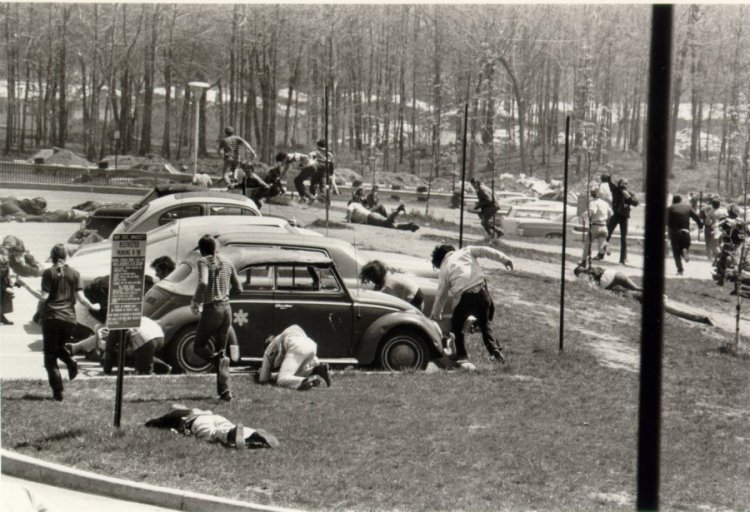
Kent State students run for cover as the National Guard open fire on May 4, 1970.
“Devo, at least partly, was a joke at first. It was a lens we turned on society,” Lewis said. “The plan wasn’t necessarily to be in a band in the beginning. There was always a multimedia, subversive element.”
In 1972, after working odd jobs in Kent, Ohio, the duo migrated to California to write for the underground newspaper the “Los Angeles Staff.” In exchange for writing legitimate articles, Lewis and Casale were allowed to insert pieces of Devo propaganda. The paper quickly folded and the two were back in Kent that fall.
“Jerry and I worked on Devo for two years before Mark (Mothersbaugh, Devo keyboardist) got involved,” Lewis said. “At the time he was in a group called Flossy Bobbit, playing Hammond B3 organ, mellotron, Moog (synthesizer) and Farfisa organ all at the same time. The first thing we told him when he joined was that everything had to be simple and stupid.”
Mothersbaugh not only brought a higher level of musicianship to the group, but several thousand dollars worth of equipment, including a PA. Like Casale and Lewis, Mothersbaugh was a Kent State alum and was also present at the protest on May 4.
“Mark was two or three years younger than us, so I didn’t really know him,” Lewis said. “I certainly recognized him from school. I think he and Jerry may have had an art class together.”
Mothersbaugh was recruited to perform at the university Creative Arts Festival in the spring of 1973. The trio of Mothersbaugh, Casale and Lewis – who played lead guitar – were joined by a drummer from town, Casale’s brother Bob on rhythm guitar and singer Fred Weber. Billed as Sextet Devo, the band promised “polyrhythmic tone exercises in de-evolution.”
In the book “We Are Devo,” authors Jade Dellinger and David Giffels described first show, also captured on amateur video. Bob Casale performed in scrubs, Jerry Casale wore a butcher’s coat, Bob Lewis was hidden under a monkey mask and Mothersbaugh sported a doctor’s robe and ape mask. The set opened with Mothersbaugh playing “Here Comes Peter Cottontail” and featured what the band called a “headache solo.” Unsurprisingly, it took the group a while to find the next gig and a stable lineup.
“At one point it was Jerry and three Mothersbaugh brothers. Jerry didn’t like that because he’d always be outvoted,” Lewis recalled. “Jerry finally tormented Jim Mothersbaugh into quitting as drummer, but it took another year before we found Alan (Meyers) to play for us.”
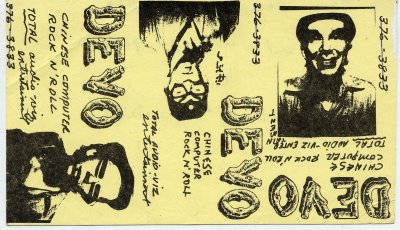
An early band flier.
When the group began to get more serious, Lewis knew the musicianship would have to improve. When Bob Mothersbaugh started playing lead guitar, Lewis transitioned from guitarist to manager.
“I became more of a manager than a player because we decided someone had to do it,” Lewis said. “I liked that other (managerial) stuff better anyway.”
The five-piece lineup of the Casale and Mothersbaugh brothers and Meyers toured Ohio with their confrontational stage show. In 1976 they were the subject of the short film “The Truth About De-Evolution.” The combination of touring and the film set the table for the band to cut their first single. “Mongoloid”/”Jocko Homo” was released in 1976 on the band’s Booji Boy label.
“We sold 17,000 copies of that single ourselves,” Lewis said proudly. “I was trying to get us in record stores in Denmark, Germany, the Netherlands and England, which meant I either had to get up really early or stay up really late to talk to these guys and convince them to stock us. Of course now you could just send an e-mail, but back then it was an adventure.”
The first sign of the band’s cult following appeared before a show at Max’s Kansas City when a flat-black oldsmobile 98 zoomed up the street bearing the face of Booji Boy, the group mascot. After the release of another independent single and an appearance on a Stiff Records EP, Devo caught the attention of David Bowie and Iggy Pop. David Bowie suggested a production deal through Warner Brothers that he would produce, and the band went to Germany to record. Bowie was unavailable, so his friend Brian Eno produced the first album.
“The band was in England recording while I was in the States trying to arrange for them to do some concerts in Europe on the way back home,” Lewis said. “Meanwhile, (Virgin Records president Richard) Branson takes them out on his boat on the Thames (River), gets them high and convinces them to sign with Virgin. Had I been able to, I would have told them they shouldn’t do that. Warner Bros. promptly sued them.”
Many recordings from Lewis' tenure have been released on the two "Hardcore Devo" collections.
Although Virgin and Warner Bros. amicably agreed to split distribution rights, it would not be the Devo’s final lawsuit. Lewis’ relationship with the band, and particularly Jerry Casale, had soured ever since Lewis told Casale that Devo would never be popular with him as the front man. It had to be Mark Mothersbaugh.
“From that point on I was on my way out,” Lewis said. “When Elliott Roberts, who managed Joni Mitchell and Neil Young, announced to Warner Bros. that he wanted to be manager, I knew I was gone, because then I was replaceable.”
Lewis received no credit or mention on Devo’s debut album “Q: Are We Not Men? A: We Are Devo!” The album came out in 1978 and Lewis promptly sued for theft of intellectual property. With the band now located to Los Angeles, Lewis was up against a high-powered, label-financed law firm. Help came in the unlikely form of a cassette tape from a former high school newspaper reporter.
“Word had gotten around that I was suing the band and this person called me up who had interviewed us after one of our first performances at the Akron Arts Festival,” Lewis said. “This tape contained an interview of the band where he asked who came up with the Devo concept and Mark said ‘This guy right here, Bob Lewis.’
“When I played that tape at the deposition their lawyers looked like they had been gut-shot,” Lewis continued with a smile. “Shortly thereafter we reached an equitable settlement.”
Just as Lewis discovered he liked managing better than performing, he learned he enjoyed legal work. After managing a few bands to near-success, Lewis became a paralegal.
“I have the best job in the world. Essentially, I’ve been practicing law without a license for the last 30 years,” Lewis said. “The catch is I always have to work with a lawyer.”
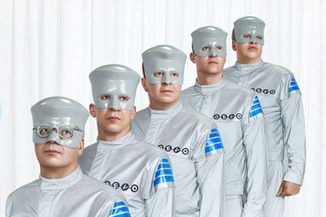
The band today. Devo plays tonight as part of the Buzz Under the Stars concert at the City Market with Ben Folds and Silversun Pickups. Tickets are $34.
Lewis left Ohio for Lawrence, Kan. in 1998 where his wife was working on her doctorate. Shortly thereafter the couple moved to Kansas City, Mo. Today, Lewis works as a paralegal for the Community of Christ Church in Independence, Mo. and lives in a house filled with antiques and art and a story behind each piece.
Last month Devo released “Something For Everybody,” their ninth album and first in 20 years. In the downtime, Mark Mothersbaugh has become a highly sought film composer. Mothersbaugh wrote the music for several of Wes Anderson’s movies, including “Rushmore” and “The Royal Tenenbaums.” His brother Bob wrote the music for the “Rugrats” cartoon series. Jerry Casale, who directed most of Devo’s music videos, has also directed videos for Rush, Foo Fighters, Soundgarden and Silverchair. Myers left Devo in 1987; the drum stool is currently held by Josh Freese.
More than a generation after their lawsuit, Lewis said he is on good terms with the band. If he attends tonight’s show, however, it will be as a fan with a ticket purchased at the box office.
“It all depends on the weather,” Lewis said. “I e-mailed the guys the other day to let them know what they were facing here. I told them with as hot as it’s been it may not be a good idea for a bunch of 60-year-old guys jumping around in rubber suits. I’m sure they’ll be OK.”
(Above: “Jefferson Jericho Blues” is one of several new songs Tom Petty and the Heartbreakers have been regularly playing on their tour this summer.)
By Joel Francis
The Daily Record
The sets Heart and Sarah McLachlan delivered back-to-back at last week’s Lilith Fair were studies in contrast. Sure their styles are wildly divergent, but each act presented three new songs during their one-hour sets.
Heart was proud of their songs, delivering them in succession. They may have gone one song too far, but the crowd responded positively. McLachlan, on the other hand, apologized for performing new songs. She sprinkled them throughout her hit-laden set and express regret before and after each one. She needn’t have bothered – the audience enjoyed them anyway.
Beloved songwriter James Taylor has only released one album of original material this decade.
Nostalgia is the single most lucrative element in the music industry today. Fans are wiling to shell out more than ever to see legendary artists in concert. Paradoxically, those fans are loathe to hear anything outside of the sacred catalog. This is a closed cannon. With a few exceptions, anything after two dozen hit singles or 10 successful albums is off limits. Some artists, like Billy Joel, are fine with this. Joel hasn’t written any new pop material in nearly two decades. Others, like Fleetwood Mac, shuttle most of their new music to individual projects (although the band did deliver a new album in 2003, their first in eight years).
Solo performers have fewer options. Paul McCartney and Elton John have bravely soldiered on, each releasing four albums in the past decade and highlighting his latest release in concert. James Taylor and Paul Simon have slowed their output to a trickle; both have only released one or two albums of original material in the new millennium, respectively.
Guitarist Junior Marvin and the Original Wailers have been playing material from their upcoming album alongside Bob Marley's classic material.
Then there are the rare established artists whose fans salivate over new material. In 2007, Bruce Springsteen’s “Magic” hit No. 1 on the album charts. Despite a Clear Channel missive not to play any of the new material on its stations, Springsteen performed the majority of the album on his sold-out tour. When “Working on a Dream” appeared just 18 months later, it featured heavily in setlists as well.
The Original Wailers face an even more daunting task. Their catalog is not only the most popular and indelible in reggae, but Bob Marley, their frontman and songwriter, has been dead for 30 years. When the band performed in Kansas City earlier this year they boldly mixed many original songs from their upcoming album in with Marley’s classics. Surprisingly, the new riddims didn’t stop the dancing for a moment.
Artists have three choices onstage: ignore performing new material, apologize and play a couple new songs, or deliver a block of new material. None of these are optimal. (Quick caveat: the songs in question should be worthwhile additions to the catalog, not a cheap excuse to trot out the same tired hits yet again.)
Overconfidence in new material may send fans fleeing for the bathroom and bar. I’m confused why any artist would ever apologize for the music they perform, especially if it is something they have written or hold dear. Ignoring new work reinforces the same message as apologizing: I’m not proud of this material. If they’re not proud of it, why should fans bother?
Despite their perceived authority and glamor, artists have little power over how their music will be marketed, sold and received. Going onstage is as close to complete control that they will ever have. Songwriters should own all of their material, especially the latest and least familiar. Don’t be afraid to surprise. Weaving new material in with the old not only freshens the setlist, but shakes some dust off the favorites by placing them in a new perspective and context. It tells the fan “if you liked this then, try this now.” Remember: Today’s new songs are tomorrow’s sing-alongs.
(Above: Sarah McLachlan and Emmylou Harris’ duet on “Angel” was the best musical moment of Lilith Fair 2010. The festival stopped in Kansas City on July 15.)
By Joel Francis The Kansas City Star
The sunglasses every artist wore onstage at Thursday’s Lilith Fair were more than a fashion accessory – they were as vital as the instruments.
For five of the festival’s eight hours of music, performers played directly into the sun. Singer/songwriter Ingrid Michaelson summed up the misery.
“It’s so hot out here I felt sweat dripping down my legs, and for a second there I thought I pulled a Fergie,” she said, referring to the pop star’s onstage pee incident.
The performers had it easy compared to the fans. After their 40-minute sets they could retreat to cooler confines. Fans had fewer options. Many ditched their seats and scrambled to whatever shade they could find. This made an already undersold Sandstone Amphitheater look even emptier.
All facilities past the second section of seating were closed. Drivers expecting to park in the main lot at the top of the hill were directed to the auxiliary lot. Fans with lawn tickets were upgraded to second-tier seats, while those with second-level seats could move down. As the sun shrank the crowd grew, filling most of the seating, but it was rough going for the early bands.
Vedera fared better than most acts. Sequestered to a tiny side stage, several hundred dedicated fans crowded into the awkward space to hear the local band deliver new gems like “Greater Than” and “Satisfy” in their half-hour set. Vedera was the last of three local acts, which also included singer/songwriters Julia Othmer and Sara Swenson.
Emily Haines of Metric, looking hot and bothered.
Metric was the first band to appear on the main stage, and red flag the fact that holding an all-day event in a venue with little no cover was a poor idea. The relentless sun rendered moot any lighting or special effects. When it was finally dark enough for these tricks to emerge, the video screens captured a static image of the Lilith Fair logo, meaning fans in the back had no close-up view of events all day.
The four-piece indie band’s dark synth pop isn’t built for daylight. Sound problems plagued the first couple songs, but what the atmosphere didn’t kill the temperature did. When you’re sweating just standing still, it’s hard to be convinced to dance. Singer Emily Haines did a robotic dance to the Big Brother-esque lyrics of “Satellite Mind,” and prefaced “Gimme Sympathy” with a bit of Neil Young’s “Hey Hey, My My.” Their set was heavy on last year’s “Fantasies,” but surprisingly did not include their contribution to the latest Twilight film, “Eclipse (All Yours).”
Michaelson had better success connecting with the sparse crowd with her jangly pop. Backed by a five-piece band, Michelson bookended her set with ironic covers, incorporating Lady Gaga’s “Pokerface” into her own “Soldier” and closing with Britney Spears’ “Toxic,” which featured everyone onstage in a synchronized dance. Both moves drew big cheers. In between, she delivered her hit “The Way I Am,” which recalled Regina Spektor’s quirky vocal phrasing, the bouncy “Locked Up,” and new song “Parachute.”
Halfway through the Court Yard Hounds’ set, Emily Robison found herself in trouble.
“This is a quintessential chick song,” she said, intending to introduce Joni Mitchell’s “This Flight Tonight.” The chick the crowd knew, however, was Robison’s main gig with fellow Yard Hound and sister Martie Maguire, the Dixie Chicks. The unexpected burst of delight flummoxed Robison for a moment.
“No, no, not that chick,” she said, trying to recover. “I mean a hippie chick.”
Robison and Maguire released three Dixie Chicks albums before singer Natalie Maines arrived and turned the group into superstars. When Maines bowed out of making new music, the sisters soldiered on. Their sound hews closer to Americana and roots music than the Chicks’ pop country, but suffers without Maines’ feisty spirit. “It Didn’t Make A Sound” featured a nice honky tonk piano solo, and “The Coast” was a pleasant tribute to the sister’s native Texas beaches, but it was too gentle to engage the crowd.
Sisters Nancy (left) and Ann Wilson, the heart of Heart.
Conversation ceased, however, when the sisters unleashed a furious bluegrass instrumental that had fans on their feet, clapping and stomping along. The set ended with a moment out of “O Brother, Where Art Thou?” when Maguire’s 6-year-old twin daughters joined the ensemble, tentatively playing percussion alongside their mother.
Emmylou Harris is the Mother Maybelle Carter of her generation, collaborating with everyone from Bob Dylan and Neil Young to Ryan Adams and Lyle Lovett. The artists everyone else on the bill respect as legends, she calls contemporaries. Yet even her distinct, wonderful voice wasn’t enough to sway the crowd. As with most artists during the day, the audience was divided between hardcore fans, politely curious listeners and everyone else, waiting impatiently for their act to appear. The ambitious and diverse bill ended up leaving everyone out at some point during the day.
Harris and her four-piece Red Dirt Band leaned heavily on her 1999 album “Red Dirt Girl,” mixing in the good old country of “Wheels” and “Born to Run” (a Paul Kennerly song, not a Bruce Springsteen cover). The most riveting moments were the a cappella gospel arrangement of “Calling My Children Home” and Harris’ own hymn, “The Pearl.”
Harris also shared the day’s best musical moment when she joined Sarah McLachlan on “Angel.” These multi-artist bills should have more of this synergy. Witnessing Harris and the Hounds collaborate on a Bill Monroe bluegrass number, or Haines join McLachlan on “Possession” would have been special events fans would treasure long after they had forgotten the heat and the ticket price.
Lilith Fair found Sarah McLachland closed out the day.
It wasn’t until Heart took the stage at 8:45 that the fair had its first galvanizing musical moment. The raucous blast of “Barracuda” eradicated the gentle sway of the afternoon and invigorated a crowd that had traded the sun for the moon and was finally ready to move. Sisters Ann and Nancy Wilson delivered a heavy slab of ‘70s rock that had fists pumping and hips shaking. Guitarist Nancy Wilson concluded her acoustic intro to “Crazy On You” with a scissor kick, cueing the rest of the six-piece band. Singer Ann Wilson was in top form, belting the refrain from the Rolling Stones’ “Gimme Shelter” during their own “Even It Up” and easily finessing the dynamics of “Magic Man.”
Lilith Fair founder Sarah McLachlan closed the day nearly eight hours after the first act appeared. The Vancouver native congratulated the crowd for braving the heat and rewarded them with many of her biggest hits, including “Building a Mystery,” “World On Fire” and “Adia.” She needlessly apologized before playing each of her three new songs, but the crowd responded well to those numbers as well.
Here’s a tip to established artists trying to introduce new songs: If you act proud of your new material, fans will be more likely to embrace it. Today’s new song is tomorrow’s sing-along.
The night ended with the gentle lilt of McLachlan’s “Ice Cream” before most of the day’s artists -– including Swenson, who shared a mic with the Court Yard Hounds -– joined together for a joyous romp through Patti Smith’s “Because the Night.”
Setlists:
Metric – “Twilight Galaxy,” “Satellite Minds,” “Help I’m Alive,” “Gold Guns Girls,” “Hey Hey, My My” > “Gimme Sympathy,” “Dead Disco.” Ingrid Michaelson – “Soldier” > “Pokerface,” “The Way I Am,” “Parachute,” “Maybe,” “Locked Up,” “The Way I Am,” “Toxic.”
Court Yard Hounds – “Delight (Something New Under the Sun,” “It Didn’t Make a Sound,” untitled new song, “Then Again,” “Fear of Wasted Time,” bluegrass instrumental, “The Coast,” “Ain’t No Son.”
Emmylou Harris – “Here I Am,” “Orphan Girl,” “Evangeline,” “Wheels,” “Born To Run,” “Calling My Children Home,” “Red Dirt Girl,” “Get Up John,” “Bang the Drum Slowly,” “Shores of White Sand,” “The Pearl.”
Heart – “Barracuda,” “Straight On” “Even It Up/Gimme Shelter,” “WTF,” “Hey You,” “Red Velvet Car,” “Alone,” “Magic Man,” “Crazy On You.” Encore: “What Is and What Should Never Be.”
Sarah McLachlan – “Angel” (with Emmylou Harris), “Building a Mystery,” “Loving You Is Easy,” “World On Fire,” “I Will Remember You,” “Forgiveness,” “Adia,” “Out Of Tune,” “Sweet Surrender,” “Possession.” Encore: “Ice Cream,” “Because the Night” (with most of the day’s perfomers).
(Above: Tommy James and the Shondells deliver the greatest psychedelic love song of all time.)
By Joel Francis The Daily Record
Even as it was unfolding, Tommy James knew he had a heck of a story to tell. The intimidating visitors, angry phone calls, mysterious disappearances. Little of it was directed at him, but James knew that could change in an instant if his hits dried up.
James knew the stories were too good to keep, but he realized he needed to stay quiet and let time pass before he shared them. Nearly 40 years later, when James could finally paint the picture, he grasped he wasn’t even the star of his own tale.
“As I was writing, I realized this story is more about Morris Levy than it is about me,” James said. “I could have called it ‘Crimson and Clover’ and talked about the music, but realized if I wasn’t telling the Roulette story I would be shortchanging everybody.”That’s OK, it’s as it should be. People called Morris the godfather of the record business and he was appropriately named.”
In his new memoir “Me, the Mob, and the Music: One Helluva Ride with Tommy James and the Shondells,” James recalls his tumultuous, dangerous relationship with Levy, a mafia associate who ran Roulette Records as a mob front.
“I recorded ‘Hanky Panky’ in 1962, but it didn’t become a hit until 1966, when out of nowhere it went to No. 1 in Pittsburgh,” James said. “After that I grabbed the first bar band I could find and took them to New York to sign with a label. We visited everyone, Atlantic, Columbia, and got a yes from them all. The only one we didn’t visit was Roulette. One by one, the labels started to call us back. They all turned us down. They had been told we were Roulette property and to back off.”
Morris had the business sense to know a sure thing, and the goons to make sure he got what he wanted. And at that moment he wanted James. Although he was intimidated by Morris, the two men eventually became good friends.
“Morris was more fun than any 10 guys, but doing business with him was a disaster,” James said. “On the other hand, people called Morris the godfather of the record business for good reason. I frequently found myself walking on eggshells around him.”
Levy withheld all royalties, and kept James in the dark about his finances. In fact, since the label was under Federal surveillance, Levy kept three sets of books. When songwriter Bo Gentry realized he wasn’t getting paid for the songs he co-wrote for James, including “Mony Mony,” he started giving his a-list songs to other performers. A call from Levy corrected the situation. When James’ account gave Levy an invoice for the estimated $30 million to $40 million James was owed in back royalties, Levy threatened to send him to the bottom of the river.”
“I was very afraid several times,” James said. “The Morris’ associates were flat-out psychopaths who devoted their lives to the dark side of everything.”
Afraid for his live, James started carrying a gun and staying away from the Roulette offices, fearing retribution from Levy’s partners or, worse yet, becoming a casualty in the mob wars. Yet at the same time, he never refused a weekend invitation to get away with Levy on his upstate New York farm.
“Every time I go to say something nasty about Morris or Roulette, I know there probably wouldn’t have been a Tommy James without them. I always keep that in the back of my mind.
“Morris was an important chapter in my life, no doubt about it,” James continued. “I learned a great deal from him and Roulette about nuts and bolts of the business. If I had been on a corporate label, I would have been handed to a producer and lost in the numbers. I ended up on Roulette with 23 gold singles and 9 gold and platinum albums.”
James left Roulette in 1974 and used what Levy taught him to set up his own label in the late ‘80s, about the same time the government finally caught up with Levy.
“They finally nabbed him on something that seemed pretty minor at the time,” James said. “He got involved in a scheme to rip off a Philadelphia record promoter named John LaMonte. When LaMonte realized what was going on, he refused to pay. When Levy threatened to beat him to a pulp, he went to the feds.”
Sentenced to 10 years for racketeering and extortion, Levy died from colon cancer before serving a day. In 2005, the last of the Roulette Regulars, as Levy’s partners were known, died, clearing the way for the book.
“I’ve been amazed by the response to the book,” James said. “There’s going to be a movie and a Broadway show. There will probably be a couple actors playing me because of all the time involved, but one of the actors we’ve looked at is Val Kilmer, who is a friend of mine.”
Once again, Levy has already beaten James to the punch. The “Sopranos” character Hersh Rabkin, played by Jerry Adler, was based on Levy. Although he has been dead for 20 years, Levy is still an inseparable part of James’ life.
“I miss Morris, strangely enough,” James said. “I have all these mixed feelings about him, and I guess part of me always will.”
(Above: Stefani Germanotta goes gaga for John Lennon.)
A few random thoughts for this mid-week blog entry.
By Joel Francis
The Daily Record
Lilith Fair
I’m looking forward to catching my first-ever Lilith Fair tomorrow night, but must admit I have several reservations. It’s never a good sign when Sarah McLachlan, the tour headliner and organizer, admits that ticket sales have been “soft.” Several dates were cancelled, and a quick glance at the temporarily unavailable TicketMaster instant seat locator showed that many of the remaining dates had vast sections of available seats. I don’t know how to fix the sour ticket industry (eliminating “convenience” fees and lowering prices spring to mind, but I’m sure it’s much more complicated), but I think Lilith hasn’t done itself any favors. Many of these problems could be fixed by paying more attention to the Lilith Fair Website.
Fans should be able to see where each artists performs without having to click on every date. Clicking an artist’s name brings up a highlighted list of her cities, but without dates. This is needlessly complex. Furthermore, the schedules for each city are missing. Eleven artists will play at Sandstone Amphitheater tomorrow night. Performances will start in the mid-afternoon. Approximate schedules should be posted weeks before each stop so fans will be able to make plans and adjust to be in place for their favorite performer. Each of these issues have easy solutions. Judging by the Website, it appears as if everyone threw in the towel long ago. These shows may be a loss, but fans still need to be cared for.
Lady Gaga and John Lennon
My little brother cracks me up. With very little coaching from me, he has become a huge Beatles fan. His Facebook posting the other day reminded me of something I would have written as his age. He was outraged that the “freak” Lady Gaga had covered “Imagine,” “the magnificent song by John Lennon.”
I can’t recall any Beatles covers drawing my ire, but for a brief period I grew very upset when rap producers (I’m looking at you, Diddy) were too reliant on the source material. “I’ll Be Missing You” and “Feel So Good” seemed like glorified karaoke to me. The kicker came when Jimmy Page and Tom Morello, two guitarists (read: “musicians”) I greatly respected helped Diddy rework Led Zeppelin’s “Kashmir” for “Come With Me.”
I have mellowed over time. Now when I hear Gaga’s cover of “Imagine” I’m glad she has good taste and that someone is keeping Lennon’s music alive, however the performance rates.
Going Deep
In another lifetime, in another era I would have been a great producer at Rhino Records. I love scouring the catalogs of artists, unearthing gems from dismissed albums or periods. Much of this ends up in multi-volume anthologies, but these treasures also work as nice garnishing in a playlist.
The other day I was working with a friend who took great delight in all the solo Pete Townshend material I had sprinkled into a Who playlist (there were Roger Daltrey and John Entwistle solo offerings as well). He thought it was hilarious that I would venture beyond “You Better You Bet,” the band’s final classic single. I think he’s missing out. “Slit Skirts” and “Give Blood” may not be the second coming of “Won’t Get Fooled Again” or “Substitute,” but they’re easily as good as anything that came after “Who By Numbers.”
This leads me to Ringo Starr. Obsessive that I am, I created anthologies for all the fallow periods in the solo Beatle catalogs – except Ringo. The Fab drummer’s 70th birthday last week caused me to reconsider this stance. So I dutifully investigated all of his albums. The critics weren’t wrong – there’s more bad than good. That said, there’s always at least one keeper on each album, and if I hadn’t been so dedicated I would have completely missed out on Ringo’s first two fantastic albums.
Ringo’s third solo album, 1973’s “Ringo” soaks up all the love but “Sentimental Journey” and “Beaucoups of Blues” are just as good, albeit for very different reasons. Both albums came out in 1970, and both clock in around 35 minutes. Both the brevity and timing work in Ringo’s favor. 1970 was both the best and worst year to be a Beatles fan. Sure the band broke up, but on the other hand fans got “Let It Be,” “McCartney,” “All Things Must Pass,” “Plastic Ono Band” and the aforementioned Ringo platters.
Although they hit shelves only six months apart, “Sentimental Journey” and “Beaucoups of Blues” couldn’t be more different. Both albums are genre exercises, but the big-band swing of “You Always Hurt the One You Love” is both geographically and generationally separated from the country twang of “Loser’s Lounge.” Yet Ringo’s enthusiasm and personality shines through both project, making them an infectious and irresistible listen.
Neither album will replace “Abbey Road” or “A Hard Day’s Night,” but they easily trump “Red Rose Speedway,” “Extra Texture” or “Some Time in New York City.” Better yet, they can be found easily and cheaply on vinyl. Do yourself a favor and grab ‘em next time you haunt the bins.
(Above: Modest Mouse perform “Baby Blue Sedan” at a previous stop in Kansas City, Mo., at the Uptown Theater in March, 2009.)
By Joel Francis The Kansas City Star
Early in his first visit to Crossroads, Modest Mouse singer Isaac Brock was quick to point out the venue’s most distinctive feature. After the second song, he told the sold-out crowd the band had a “super awesome” gift for everyone: they each got to take home a wood chip.
The six members of the indie rock band were so excited about their present they flubbed the first verse of the next song “We’ve Got Everything.” After taking a brief moment to regroup they returned to the number with increased fervor. It was the only misstep of the two-hour set that found the band growing stronger with each number.
The set opened with slow, droning intro to “Gravity Rides Everything,” which gave way to a gentle wash of acoustic guitar. With three guitarists and two drummers, Modest Mouse’s songs were never lacking in texture. Frequently the band went one step further, substituting banjo, violin and keyboards. During “Gravity,” Brock held his acoustic guitar up to the speakers a la Pete Townshend for a nice burst of feedback. The combination of two trumpets and Brock’s banjo on “King Rat” and “Devil’s Workday” created a kind of demented Dixieland.
While two of the band’s biggest songs – “Float On” and “Florida” – were absent, they weren’t missed. The opening bars of nearly every number were greeted with huge cheers of recognition, regardless if it was a single like “Dashboard” or album cut like “Paper Thin Walls.” The 18-song setlist was democratically split between the band’s three most recent albums, with a few added nuggets. There was very little chatter during songs in the crowd or between them onstage; the music captured everyone’s attention.
“Whale Song” featured a lengthy opening and Brock’s signature guitar style. Brock has a way of bending notes while hitting them with the whammy bar that makes his guitar sound like a drunken Jew’s harp. Although touring guitarist Jim Fairchild, formerly of Granddaddy, shared the stage, Brock chose to do most of the heavy lifting. After “Whale,” each song seemed to build on the intensity of the previous performance. By “Devil’s Workday,” which featured another great stinging solo from Brock, and “Tiny Cities Made of Ashes” the band was cranking at 11.
That intensity made “Fire It Up” seem even more low-key, with the entire band riding Eric Judy’s loping bass line. “Blame it on the Tetons” had a gentle, folksy feel supported by Tom Peloso’s violin. New song “Here’s To Now” also featured Peloso’s fiddle, which had everyone clapping along to the two-step rhythm.
The biggest contrast of the night, however, may have been the response to “Parting of the Sensory.” Brock could never be mistaken for an optimist, but the audience danced and sang along to the nihilistic refrain of “someday you will die and somehow something’s going to steal your coffin” like it was the Jackson 5. It would have been the perfect ending, but the band had one more treat in “Black Cadillacs.” Even without the souvenir wood chip, it wasn’t a night anyone will soon forget.
Setlist: Gravity Rides Everything; The View; We’ve Got Everything; King Rat; Here It Comes; Fire It Up; Whale Song; Paper Thin Walls; Here’s to Now (new song); Baby Blue Sedan; Dashboard; Satin in a Coffin; Devil’s Workday; Tiny Cities Made of Ashes; Encore: Blame It On the Tetons; Third Planet; Parting of the Sensory; Black Cadillacs.
(Above: Cracker perform “Take Me Down to the Infirmary” at Crossroads in Kansas City on July 6, 2007.)
By Joel Francis
The Daily Record
As the 1980s morphed into the 1990s, David Lowery was riding high. The underground band he started in 1983 had attained major label success, and his new band, Cracker, continued to ride that wave. His songs “Low” and “Teen Angst (What the World Needs Now)” were all over the radio and MTV.
This year, Lowery and guitarist Johnny Hickman celebrate the 20th anniversary of the band they founded together out of the ashes of Camper Van Beethoven. In that time, Cracker has come full circle, operating in a landscape that eerily mirrors the early days of Camper Van Beethoven.
“To me the real story isn’t that we had bit MTV and radio hits in the early ‘90s,” Lowery said, “but how the band kept going after that for 15 years. We’ve done it by cultivating a loyal following that exists away from the rest of the industry.”
Cracker’s model of relentless touring, taper- and fan-friendly policies and annual weekend destination festival should be instantly recognizable to any jam band fans.
“We all got it from the same place,” Lowery said. “I remember back in Camper (Van Beethoven) days telling people we had more in common with the (Grateful) Dead than the punk scene. Out of all the jam bands, I don’t know how many played with the Dead, but we did.”
David Lowery (second from left) and Cracker perform a free concert tonight on the KC Live! stage in the Power and Light District. Start time is listed as 8 p.m., but bands usually go on much later.
The Dead invited Cracker to open for them in 1994 at their annual stand at Autzen Stadium in Eugene, Ore. Lowery remembers well his meeting with Jerry Garcia.
“Apparently when I met Jerry he had just come out of a porta-potty. I went to shake his hand, but the only thing I could think was ‘there’s no sink in there,’” Lowery said. “Jerry told me he totally loved our song ‘Euro-Trash Girl’ and was trying to work up an arrangement so the Dead could play it. Sadly, he didn’t live long enough to get it done.”
Camper Van Beethoven emerged in the early ‘80s, in the Southern California underground rock scene, but didn’t fit comfortably. They definitely weren’t punk and too quirky to be mainstream. Over the course of five albums, Lowery and his band mates carved their own niche. Similarly, Cracker came up in an era where they were too poppy for grunge and too much of a country influence to rest beside other rock bands. In 2000, Lowery revived Camper and splits his time between bands.
“The music business has gone all the way back to where we started, where we had to do a lot of stuff independently, within our own organization,” Lowery said. “It wasn’t a challenge for me, because I learned how from the Camper Van Beethoven days. When the labels started coming apart, we always knew what to do.”
In a way, Lowery and his bands have always operated both on their own and on their own turns. The window of high-profile success was so brief they didn’t consider changing how they worked.
“The alt-rock bubble or financial bubble,” Lowery said, “where any band together for more than two weeks and three shows got signed was such a brief period in the 20 years of Cracker and my 27 years of recording that it almost seems like a fluke. There was hardly time to adjust.”
After seeing Internet entrepreneurs being praised for the books they wrote about their five-year-old businesses, Lowery decided he might have something to say about his 27 years in the music business and started working on a book that’s part memoir and business manual.
“People give record labels way too much importance in their minds,” Lowery said. “I learned some things doing research for my book. Like, very few labels last more than 10 or 15 years. Most collapse or are absorbed. The average lifespan of an A&R man (a talent scout who works as a liaison between the label and artist) is less than four years. The people who have been around a long time, that have all the experience, are the artists and the managers.”








 joelfrancis.com