The Budos Band breaks loose

(Above: It will sound a lot like this at the Record Bar tonight when the Budos Band make their Kansas City debut. The show starts at 10 p.m. and tickets are $10.)

By Joel Francis
The Daily Record

The covers of the three albums released by the ten-piece instrumental ensemble the Budos Band depict a volcano, scorpion and cobra. In other words, objects that are fascinating, even mesmerizing, from afar, but deadly serious up close. Like those totems, the Budos Band’s music can be appreciated, but rarely trifled with.

It is fitting, then, that the ensemble came together at the turn of the century during the Afro-beat revival lead by the New York-based combo Antibalas. Although inspired by – and sharing musicians with – Antibalas, the Budos Band developed a distinct voice.

“After a year or so of playing Afro-beat we refined our sound, brought in funk and soul influences and tightened things up,” said Jared Tankel, baritone saxophone player in the Budos Band. “That Afro-beat influence is still there, but our sound has progressed in different ways.”

While the band’s 2005 self-titled debut was a jumping off point from Afro-Beat to soul, Tankel said their second album – “Budos Band II,” released in 2007 – shows the emergence of Ethiopian jazz influences. That growth continues on this summer’s “Budos Band III.” The album’s darker and heavier undertones hint at the band’s rock and metal influences.

“It’s not explicit, but I think the undercurrent of that influence is there. It might influence our arrangements or approach,” Tankel said. “It’s still heavy funk and soul, but there is a darker influence.”
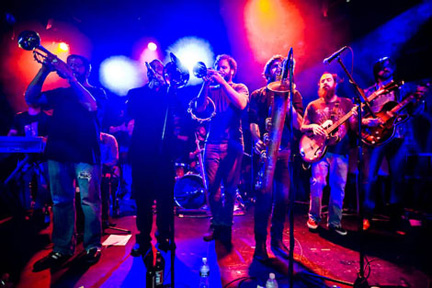
Although the textures and arrangements vary, Budos Band songs come together in a pretty straightforward process. Guitarist Tom Brenneck or bass player Dan Foder come in with a rhythm bed, or Tankel and trumpet player Andrew Greene develop a melodic horn line.

“Tom and Dan are in lockstep communication at a very high level,” Tankel said. “Whether they are coming up with something or building off it, a lot of ideas come from those guys.”

After the quartet refines the idea, it goes into rehearsal, where drummer Brian Profilio listens to the parts, suggests transitions and helps develop an arrangement. The song is then presented to the other half of the band – the percussion section.

“They really know how to keep in the pocket of the song,” Tankel said. “They’ve been playing together for so long they can really fall in together and give it the texture that makes it a Budos Band song.”

Just don’t expect that process to include a vocalist any time soon.

“That’s something a lot of people ask, but I feel we’re big enough with 10 guys (in the band),” Tankel said. “I feel this third album is our truest voice of what we have going on right now. I’m not sure a vocalist would fit. We’re having too much fun right now visiting all these exciting places musically on our own.”

Like every other album released on the Daptone label, all of the Budos Band’s output was recorded at the label’s House of Soul studio/headquarters in Brooklyn, N.Y. and produced by Gabriel Roth, aka Bosco Mann, leader of the Dap-Kings. As the band behind Amy Winehouse’s “Back to Black” and Daptone flagship artist Sharon Jones, the Dap-Kings have become a hot commodity.

“There is some competition between us and the Dap-Tones, but what we each do is different enough that the competition is somewhat limited,” Tankel said. “They’re on the path to stardom. We kind of enjoy being the scrappy little brother, still playing smaller size clubs and bars.”

The true competitive spirit lies in the band’s roots with Antibalas. The groups’ shared musicians over the years have lead to a healthy level of one-upmanship.

“At this point I don’t know if there are any shared musicians simply because both bands have become busy enough guys have had to decide,” Tankel said. “We’ll definitely hear something great Antibalas or the Dap-Kings come up with and want do it even better.”

Keep reading:

Bettye LaVette – “Interpretations: The British Rock Songbook”

Bring yo booty to the Bottleneck

Review Roundup – Rakim, Dodos, Naomi Shelton, Blakroc and Daptone Gold

Open wide for Mouth

Review: Jack Johnson

(Above: “Better Together,” the closing song, taken from Jack Johnson’s concert at Sandstone Amphitheater on August 16, 2010.)

By Joel Francis
The Kansas City Star

Kansas may be a landlocked state, but for two hours on Monday night there was prime beachfront property in Bonner Springs.

Surfer-cum-songwriter Jack Johnson brought a mellow vibe that matched the cooler weather and gentle breeze. There were some empty seats in the middle section, but the lawn in back and area up front were both comfortably crowded.

The crowd started singing along on the opening lines of “You and Your Heart” and with the exception of a few tracks Johnson recorded with Hawaiian singer Paula Fuga, didn’t let up until the closing refrain of “Better Together,” the final song. Many songs were greeted with spontaneous exclamations by the fans in the back. More fortunate fans closer to the stage shouted their feelings directly at Johnson, who engaged them a couple times.

Backed by a three-piece band, Johnson let his lyrics carry the conversation, intermittently interrupting himself to point out the half moon hanging over the lawn or to read a sign from a fan who had driven 700 miles without sleep to see the show.

Stacked together, the similar tempo and feel of his songs blended together like the gentle sway of the tide washing against the shore. The atmosphere was amplified by a large, curved screen behind the band that projected pictures of swirling water, palm trees, album covers and, occasionally, the action onstage.

Along the way, Johnson was joined by several guests. Alo guitarist Dan Lebowitz who added some nifty slide guitar to a cover of Steve Miller’s “The Joker,” and texture to a couple ukulele-driven numbers. Fuga duetted with Johnson on “Turn Your Love,” one of his songs, and “Country Roads,” one of hers. G. Love brought some blues harp and much-needed energy to “Rodeo Clowns” and “At or With Me.”

The best cameos, however, came from within Johnson’s band. Bass player Merlo Podlewski burst from his fixed spot at the back of the stage to drop a lively rap into “Staple It Together.” Keyboard player Zach Gill was the secret weapon. He splashed some honky tonk piano into “Red Wine, Mistakes and Mythology” and added an elegant introduction to “Go On.” Gill gave “Mudfootball” a zydeco feel with his accordion solo.

Detractors may argue that too many of Johnson’s songs mine the same tempo and sound alike. It would be hard to refute that argument. But Johnson’s songs are also dominated by the concept of philia. Watching several thousand fans sing and celebrate together it’s impossible to deny he didn’t realize his dream, if only for a few hours.

G. Love – One of two opening acts, G. Love told the large crowd about a previous gig at the Grand Emporium when he drank so many gin and tonics he passed out against the microphone. Armed only with a harmonica and acoustic guitar, his 45-minute set would have fit nicely at that or any of Kansas City’s current blues clubs.

New song “Milk and Sugar” echoed Mississippi Fred McDowell’s “Coffee Blues.” “Freight Train Blues” was offered in the same arrangement Bob Dylan used on his debut recording, while “Mystery Train” featured a long instrumental introduction that made the familiar song unique. In between, G. Love delivered crowd-pleasing originals “Cold Beverages” and “Booty Call.”

Jack Johnson setlist: You and Your Heart; If I Had Eyes; Taylor; Sitting, Waiting, Wishing; The Horizon Has Been Defeated; Inaudible Melodies; To the Sea; Go On; Upside Down; Red Wine, Mistakes, Mythology; Bubbletoes; Mellow Mood (Bob Marley cover); Wasting Time; Breakdown; My Little Girl; Turn Your Love (with Paula Fuga, Dan Lebowitz); Country Road (with Paula Fuga, Dan Lebowitz); Flake (with Dan Lebowitz); The Joker (Steve Miller cover) with Dan Lebowitz; Banana Pancakes; Mudfootball; Good People; Rodeo Clowns (with G. Love); Staple it Together (with G. Love); At or With Me (with G. Love); Encore (Jack Johnson solo): Do You Remember; Home; Times Like These; Gone; Angel; Better Together (with full band, G. Love, Paula Fuga, Alo).

Keep reading:

Review: Modest Mouse (2010)

Review: Michael Franti

Review: David Gray

Review: Wilco (2009)

Bring yo booty to the Bottleneck

(Above: Yo Mama’s Big Fat Booty Band bring the bounce to Ziggy’s in Wiston-Salem, N.C.)

By Joel Francis
The Daily Record

There are several different versions of the story how the six-piece, North Carolina funk outfit Yo Mama’s Big Fat Booty Band came up with their name.

Guitarist J.P. Miller’s favorite rendition involves a fortune telling machine in Las Vegas.

“You know those fortune telling machines where you put a couple quarters in and the guy tells you your fortune?” Miller asks. “Well we found one that wasn’t plugged in. After we got it hooked back up, we put our money in, only instead of giving us a fortune the little piece of paper it spit out just said ‘Yo Mama’s Big Fat Booty Band.’ So there you go.”

The Booty Band has seen several changes in the 11 years since, including numerous line-up changes, different front men and cross-state relocation to Asheville, N.C. Early shows were known to feature belly dancers and bring their own dancing pole.

“Back in the day we had a lot of crazy stuff,” Miller said. “I don’t want to say we were a gimmick band, but these days we put all our focus on the music.”

As a guitar player, Miller grew up emulating Jimi Hendrix and Funkadelic guitarist Eddie Hazel. He said each band member brings his own backgrounds and influences to the ensemble. This means at any moment the music could show flavors of reggae, hip hop, jazz or ‘80s pop.

“Funk is always the focus, but we’ll do whatever it takes to keep people having fun and dancing,” Miller said. “We go nonstop from the first song to the last. We don’t give people the chance to stop dancing.”

The band’s current quest to keep booties shaking started with a hometown show in late July. Doin’ It Hard tour stops include dates in Missoula, Mont., Haines, Alaska and New Orleans.

Veterans of two Wakarusa music festivals at Clinton Lake and this year’s festival in Arkansas, the Booty Band drop their infectious funk on the Bottleneck in Lawrence, Kan. next Wednesday.

“A lot of places we don’t know what to expect,” Miller said. “We’ll often go to a club we’ve never played before and the dance floor will be full because people saw us play a festival or city event or cruise or whatever.”

The tour’s final dates in Asheville and Key West, Fla. around Thanksgiving will celebrate the release of the Booty Band’s fourth album.

“Our last album was a live album recorded in 2008, ‘Greatest Hips Live, Vol. II,’” Miller said. “The idea is to alternate between studio and live albums, so this one we recorded in a Miami studio,”

Miller said the group wanted a warmer analog sound for the album so they recorded directly to tape. This process eliminated the possibility of overdubs and meant the band had to put in plenty of practice so they wouldn’t be wasting expensive tape and studio time.

“We’ll be doing these new cuts all summer on the road,” Miller said. “It’s tightened us up a lot as a band, and people can tell.”

Funk fell out of favor for a while, but Miller is glad to see the genre regaining popularity.

“If you look online, a lot of bands use ‘funk’ in their description. It’s become kind of a buzzword,” Miller said. “Funk also makes you feel good, so why not?”

Keep reading:

Open wide for Mouth

Wakarusa Music Festival: A Look Back

Feature: George Clinton is bringing the funk

Morris Day makes up for lost time

thePhantom – “Bohemian Seduction Grooves”

By Joel Francis
Ink Magazine

“Seduction” is the key word in the thesis-length title of thePhantom’s new EP, Bohemian Seductive Grooves for the Gay Soul. But thePhantom, aka Kansas City rapper/producer Kemet Coleman, would rather have you in his head than in his bed.

The five-track release is thePhantom’s attempt to translate the urban theory he’s been soaking up as a student at the University of Missouri-Kansas City into urban beats and rhymes. Dropouts needn’t worry. The vibe is more relaxed than the last day of school, with wordplay more effortless than a third-grade spelling test.

The low-key production on opening track “Midnight Seduction” sets the mood. ThePhantom’s words are set against a wash of synthesizers perfect for that late-night comedown when the energy starts to fade but sleep is still a long way off. “Downtown,” the second cut, bumps the tempo, but the rest of the album plays like lost tracks from a chill-out compilation.

ThePhantom says his master plan is to unite Kansas City’s diverse citizenry on the dance floor, a place where both blue-collar and artisans are equally comfortable. Of course if that effort creates a gathering of eligible women, thePhantom’s fine with that, too. On “Just Right” he makes the case for romance without stooping to the crass cliches common to the genre.

On December’s Destroy and Rebuild, thePhantom had an entire album to present his titular concept. Padded with a five-minute instrumental, the EP’s 22 minutes are ample time for thePhantom to gather his bohemians and gay souls, but not long enough to keep them on the dance floor. The result feels more like an outline than the conclusion. Sadly, that’s exactly what this is. ThePhantom has announced this EP will be his final project. Even so, he leaves behind a body of work worth further study.

Keep reading:

Steddy P and DJ Mahf – “While You Were Sleeping”

KC’s MCs throw down this weekend

Jazz, hip hop collide to celebrate landmark album

Remembering Alaadeen

(Above: Ahmad Alaadeen plays for Charlie Parker at a 2008 graveside memorial service.)

By Joel Francis
The Daily Record

I grew up in a musical household where classical was the genre of choice. Consequently, I was left to discover everything else on my own.

NPR was my gateway to jazz. The car my parents let me drive in high school didn’t have much that worked (including heat or air conditioning, which ensured I wouldn’t venture too far from home). The radio, however, was fine. On evening drives I switched between KCUR and KANU, both of which had long blocks of jazz into the night.

I couldn’t tell you who was playing at any given moment. If the song didn’t reach me, or the announcers started talking too much I’d hit the button for the other station. Although I didn’t know Mingus from Monk, I did know that this stuff was a heck of a lot better than hearing the same Pink Floyd, Led Zeppelin and Metallica songs for the millionth time on commercial rock stations.

The other jazz fact I knew all too well was that everyone I had heard of was no longer living. Like the classical music my parents enjoyed, the genre was confined to corpses, their legacies entombed with Beethoven and Armstrong.

Ahmad Alaadeen was my entry into jazz as a living art form. My sister told me a “guy who played with Billie Holliday” was having a concert in a church near Paseo and Linwood. I convinced a couple of friends to make the trek with me, and we were all blown away. I can’t remember what he played, but I know he played in a trio and the drummer had the tiniest kit I had ever seen. At most he had four pieces, but he did more with those than any of the rock drummers with mega-kits I had seen.

After that show I started paying more attention to jazz shows around town. School prevented me from attending most, but I made it a point to see who had played and check out their music from the library. I also started paying more attention to Kansas City’s role in jazz history. As I did, I realized many of the roads led back to Jay McShann (then still living) and the horn players whom he gave his first jobs: Charlie Parker and Alaadeen. (Both men also shared the same saxophone teacher, Leo Davis.)

It seems strange to say, but I had almost forgotten about that Alaadeen performance until I saw him receive the American Jazz Museum Lifetime Achievement Award last May at the Gem Theater. Clark Terry received the same award that night and, deservedly, most of the attention. Terry, however, only sang two songs and did not play. Alaadeen was right there on the front row of the orchestra, horn in his mouth, blowing several solos during the evening’s tribute to Duke Ellington.

A couple days later, Alaadeen’s neighborhood threw a celebration in his honor. I was able to convince one of my friends who saw Alaadeen with me over a decade before to join our party. As we congratulated Alaadeen on the award, I reminded my friend of that show.

Alaadeen didn’t play that night. He seemed content to sit in his lawn chair, greet fans and take in the neighborhood funk band. We had hoped he would play, but weren’t too disappointed – there would be other opportunities.

None of us could have predicted that in a little more than three months Alaadeen would be gone. Next to the frail Terry on the stage of the Gem, he seemed immortal. Shortly after that weekend he was hospitalized for nearly two weeks. News of his cancer only emerged a few weeks ago before his passing.

In hindsight, this award came at the right time. It was the final show of the 2009-2010 Jammin’ at the Gem series. Who knew he wouldn’t live to see the opening of the next season?

When Alaadeen received another award to honor his work as an educator at the neighborhood party he seemed overwhelmed by the weekend. He stood silently at the mic for a few moments, as if recording everything in his mind. Finally, he spoke.

“I’m at a loss for words,” he admitted. Then he paused. “I will never forget this.”

Me neither.

Keep reading:

Sho’ Nuff: Alaadeen’s blog

Clark Terry’s Last Stand

Remembering Rusty

A tour of KC’s Women in Jazz

The Supremes – “Stoned Love”

The Supremes – “Stoned Love,” Pop # 7, R&B #1

By Joel Francis
The Daily Record

“Stoned Love” was the Supremes’ biggest hit of the post-Diana Ross era, and with good reason – it sounds like a throwback to the golden Holland-Dozier-Holland age of Motown.

Motown producer Frank Wilson discovered the song when it was played over Detroit radio during a talent search contest. Amazed to find such a mature work had been penned by a local teenager, Wilson worked with Kenny Thomas, the young writer, and arranger David DePitte before presenting the number to Berry Gordy and the Supremes.

In a narrative repeated so frequently it has nearly become a cliché, Gordy hated the song. The reason for Gordy’s dislike is unclear, but there was concern over the title. Thomas and Wilson insisted the title referred to love with a solid foundation, not drug use. The original title, “Stone Love” supports this claim. Somehow the single was mislabeled “Stoned Love” at the pressing plant and the new title stuck.

Just as they had three years ago when the Doors sang “we couldn’t get much higher” on the Ed Sullivan Show, CBS freaked out over the potential reference and cut the song from the girls’ appearance on the Merv Griffin Show.

As usual, the censors paid more attention to the hysteria than the work itself. Wilson’s lyrics call for “a love for each other that will bring fighting to an end/forgiving one another” and challenge for the “young at heart” to “rise up and take your stand.”

The hope-filled lyrics brim with the optimism of youth and could easily turn into treacle. Thomas and DePitte turned them into a great showcase for Jean Terrell’s talents. All elements seem to feed off her emotion, particularly the inspired backing vocals of fellow Supremes Mary Wilson and Cindy Birdsong. Wilson and Birdsong had been banished from the final recording sessions with Ross and they seem extra happy to be operating as a group again.

From the propulsive snare driving the song, down to the swirling strings and display of voices, the arrangement recalls the Supreme’s finest moments with the Holland-Dozier-Holland team. Fans seemed to agree, sending the song to the top of the R&B chart an into the pop Top 10. Again, Gordy’s steadfast, initial instinct had been proven wrong.

The legacy of “Stoned Love” lies more with its title than its tune. Angie Stone incorporated it into the introduction on her “Stone Love” album in 2004, just one of many similar titles it inspired. These include “Stone in Love” by Journey and the smilar “Stoned in Love” by UK dance pop artist Chicane. In 2006 Justin Timberlake released the single “LoveStoned.” None of these songs hold a candle to “Stoned Love.”

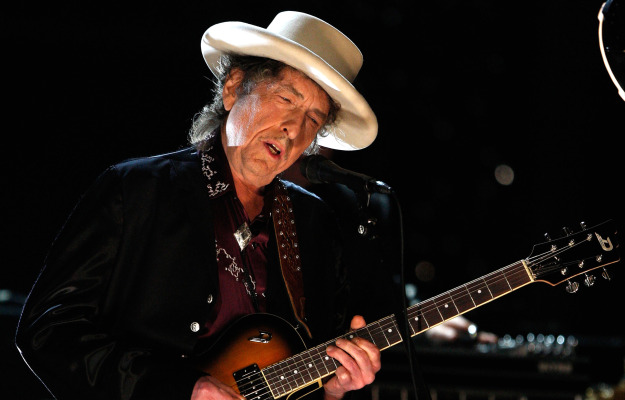
Review: Bob Dylan

(Above: Zimmy and band roll and tumble.)

By Joel Francis
The Daily Record

Two of the most iconic songwriters of the 1960s visited Kansas City just two weeks apart. But while patrons packed the Sprint Center and doled out big money to see Paul McCartney, acres of more reasonably priced empty seats could be found at Bob Dylan’s concert at Starlight Theater on Saturday night.

Part of this can be attributed to frequency. McCartney has only played Kansas City three times since the Beatles called it quits. Dylan rolls through town about every 15 months. But delivery also plays a big role. McCartney performs his beloved numbers exactly (or close to the ways) how everyone remembers them; Dylan plays nothing straight.

Saturday’s performance ran just shy of two hours and felt pretty much the same as Dylan’s many previous stops in town, including the show he played at Starlight just over three years ago. After opening with two tracks from the ‘70s – including a stunning “Senor (Tales of Yankee Power),”  Dylan and his four-piece band ping-ponged between his golden era in the ‘60s and material cut in the past decade.

The best moments were the ballads. The delicate “Just Like A Woman” opened with a lengthy instrumental section that highlighted the subtle interplay between acoustic, electric and pedal steel guitars, and Dylan’s organ, his preferred instrument of the night. The instruments danced deftly until the signature descending guitar riff entered, heralding the first verse. “Workingman’s Blues No. 2” had a similar feel later in the set, and featured Dylan’s best harmonica solo of the night.

Dylan gave a nice treat when he paired two of the best numbers from his protest era. Almost a half a century after their debut, “The Ballad of Hollis Brown” and “The Lonesome Death of Hattie Carroll” remain a potent commentary on poverty and race. Their impact was muted, however, by an arrangement of “Hattie Carroll” that rendered the number nearly unrecognizable.

The band mined the Chicago blues for two newer numbers, “My Wife’s Hometown” and “Rollin’ and Tumblin’.” The former was the only time Dylan strapped on an electric guitar. It should have been repeated. His prodding duel with lead guitarist Charlie Sexton seemed to invigorate the rest of the band.

A slump in the final third of the set ended with a spectacular “Ballad of a Thin Man.” The lone illumination from the footlights added an other-worldly atmosphere to the song as Dylan stepped away from his keyboard and sang into a microphone set just off center, in front of the drums.

Reliable encores “Like a Rolling Stone” and “All Along the Watchtower” still pack a punch and hold pleasant surprises. Dylan intentionally dropped his vocals after the second chorus on “Like a Rolling Stone” to give the band some space to play and let Sexton take an extra solo. “Watchtower” came in a staccato fashion that resembled the far-off gallop of the riders’ horses, before they suddenly stormed the gates.

The Dough Rollers: Dylan’s attraction to this duo isn’t hard to spot. Their 35-minute opening set included covers of John Lee Hooker, Mississippi Fred McDowell and early gospel numbers. The pair sounds like they have just been pulled off an old field recording cut by Alan Lomax. Malcolm Ford sounds like he learned to sing by studying antique cylinder recordings. Jack Byrne’s bottleneck slide on “Were You There When They Crucified My Lord” was especially tasty. The set also included an interpretation of “Goin’ to Kansas City.” They would be a great show at B.B.’s Lawnside BBQ or Knucklehead’s.

Dylan’s setlist: Watching the River Flow, Senor (Tales of Yankee Power), Most Likely You Go Your Way (And I’ll Go Mine), My Wife’s Home Town, Rollin’ and Tumblin’, Just Like A Woman, The Ballad of Hollis Brown, The Lonesome Death of Hattie Carroll, Cry A While, Workingman’s Blues No. 2, Highway 61 Revisited, I Feel A Change Comin’ On, Thunder on the Mountain, Ballad of a Thin Man. Encore: Like a Rolling Stone, Jolene, All Along the Watchtower.

Keep reading:

Bob Dylan: All Along the Watchtower (2004)

Bob Dylan – “Workingman’s Blues No. 2”

“Tell Tale Signs” Sheds Light on Legend

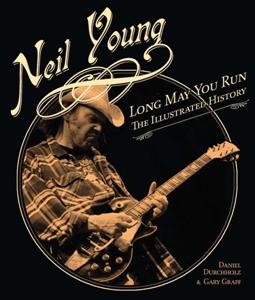
Review: “Neil Young – Long May You Run: The Illustrated History”

(Above: Neil Young, his wife Pegi and the late Ben Keith perform “Long May You Run.”)

By Joel Francis
The Daily Record

Pity the Kindle reader or Web surfer. The computer screen is still years away from capturing the depth and richness in the pages of “Long May You Rung,” Daniel Durchholz and Gary Graff’s new illustrated history of Neil Young.

Much of the book’s information will be familiar to longtime fans. What makes “Long May You Run” a treasure, however, is its presentation. Read about Young’s high school days at Kelvin Technical School in Winnipeg, and a photo of the school and two yearbook photos are right there alongside the text. Concert photos, tour programs and magazine covers all accompany entries on the myriad of Young’s tours. These and other similar visual clues that populate the book help put the events in context.

Also handy are the sidebars that detail Young’s sidemen, producers and female collaborators, his film career, favorite guitar, Motown stint, the Bridge School and nearly everything else that wouldn’t fit comfortably in the chronological narrative. The text is also punctuated with dozens of quotes from usual suspects Crosby, Stills and Nash and Eddie Vedder to Ben Folds and Toby Keith.

Authors Durchholz and Graff are clearly in their element. The St. Louis-based Durchholz boasts music bylines from the St. Louis Post-Dispatch, Washington Post and Rolling Stone. Graff has written for Billboard, the Cleveland Plain Dealer and New York Times and is the editor of “The Ties that Bind: Bruce Springsteen: A to E to Z” and the MusicHound Essential Album guides.

Their story opens with a photo of a two-year-old Young nestled by a full-page shot of his first band, the Squires. It closes with essays on his Linc/Volt hybrid car and the first volume of the Neil Young Archives. In between we see Young grow his hair long, cut it short, grow a beard, and dabble with folk, classic rock, electronica, country and grunge. Never comfortable with one look or style of music, the only constant in the narrative arc is Young himself.

Four appendices chronicle Young’s discography, providing the recording details, cover art and track listing for all of his albums, compilations and box sets. Further resources include the catalog number and a- and b-sides for all of his singles, his guest appearances on others’ albums and the tribute albums released in Young’s honor.

“Long May You Run” stops short of being a Young reference guide, but that was never the goal. It is a wonderful coffee table companion that is puts a trove of information, visual and otherwise at the reader’s fingertips. While there’s nothing in “Long May You Run” that can’t be found on a comprehensive Web site, it is a lot more fun to flip through and soak up.

Keep reading:

Review: “I Am Ozzy”

Review: “Big Man” by Clarence Clemons

Review – “Record Store Days”

Review: Old 97s, Lucero

(Above: The Old 97s road-test the new song “Every Night Is Friday Night Without You.”)

By Joel Francis
The Kansas City Star

The 16-year history of the Texas-born Old 97s follows a trajectory well worn by other bands: start out with plenty of youthful energy and fire in the belly and gradually grow more mellow and/or pop-oriented. For theirThursday night’s performance at Crossroads, the alto-country quartet shrugged off its pop trappings and attacked their material with vibrant intensity.

The first sign of the evening’s energy came on the second song, “Dance With Me.” Recorded as a pop song for their latest album, 2008’s “Blame It On Gravity,” guitarist Ken Bethea tore into the main riff like a buzz saw, pushing the tempo to nearly double its original speed. When bass player Murry Hammond was given the mic shortly thereafter for a cover of Merle Haggard’s “Mama Tried” the band pushed and prodded the laid-back vocalist.

Flanked by Bethea and Hammond in nearly matching red plaid shirts, photogenic singer/front man Rhett Millershook his hips like Elvis behind his Stratocaster. He yelped, yowled and screamed his way through the 90 minute set list that featured as many cuts from their first album – four- as their latest.

The band’s third album, “Too Far To Care,” is widely considered its best. They treated the crowd to six cuts, or nearly half the album and they consistently received the biggest responses of the night. “Big Brown Eyes” and “Barrier Reef” got everyone dancing and Miller took an audience request of “Niteclub” during the encore.

Miller seemed to enjoy playing the scorned lover and dumping extra venom into likes like “I hope you crash your momma’s car” and “Thought so much about suicide/parts of me have already died” on back-to-back trips down lonely street during “Lonely Holiday” and “Wish the Worst.” A couple songs later, on “Melt Show,” he emphatically kicked the air during the chorus.

Bethea spurred Miller’s energy, leaping into the air at the start of “The Fool,” dropping a Dick Dale-style guitar solo into “Smokers,” another Hammond vocal showcase,” and adding a nice countermelody to the most delicate and upbeat song in their catalog, “Question.” His solo leading into “Timebomb,” the traditional closer, turned the already fast number into something like a punk song.

Drummer Philip Peeples was the brick on the accelerator that never let up. His cadences consistently pushed the band harder and faster. His kit was at the center of “Every Friday Night Is Lonely Without You,” a staccato-riffed song from the band’s upcoming fall album. It was the only song the half-capacity crowd didn’t sing or air guitar along to all night, but embraced just the same. Peeples also took nice mini-solos during “Doreen” and “Early Morning.”

Lucero rock the Bottleneck in 2008.

The drum solo after “Early Morning” led into a reading of R.E.M.’s “Driver 8,” one of covers the band cut for its new “Mimeograph” EP. The arrangement hewed closely to the original, but it was interesting to hear the lyrics through Miller’s enunciation.

Normally the more rambunctious of the two bands, Lucero was more subdued that night. Singer Ben Nichols embraced the band’s mellow side with numbers like the gospel piano ballad “Goodbye Again,” “Kiss the Bottle” and the one-two of “Hey Darlin’ Do You Gamble?” and “Nobody’s Darlings.”

The five-piece band displayed its Memphis roots by adding a two-piece horn section for a set that featured several cuts from last year’s album “1372 Overton Park.” Early in the set the horns competed with the pedal steel in the mix, but they soon settled in adding extra punch and depth. The brass gave “That Much Further To Go” and “Sixes and Sevens” an E Street sound.

Lucero’s 65-minute set ended with nearly everyone taking a solo during the joyous “All Sewn Up.”

Old 97s setlist: Streets of Where I’m From; Dance With Me; Won’t Be Home; Mama Tried (Merle Haggard cover); Lonely Holiday; Wish the Worst; The Fool; Smokers; Melt Show; Question; Stoned; Up the Devil’s Pay; Barrier Reef; Driver 8 (REM cover); Early Morning; Can’t Get A Line; Big Brown Eyes; Doreen. Encore:Every Night Is Friday Night Without You; Niteclub; The Easy Way; Timebomb.

Keep reading:

Review: Old 97s (2008)

Review: Cross Canadian Ragweed (with Lucero)

Review: “The Oxford American: Book of Great Music Writing”

Chuck D looks forward in reverse

(Above: Chuck D pays tribute to Muhammad Ali.)

By Joel Francis
The Daily Record

Legendary hip hop ensemble Public Enemy is $20,000 away from fulfilling its efforts to raise enough money for its upcoming album. But PE front man Chuck D doesn’t want to spend much time talking about that project.

“I’m not spending long on this. That’s a 2011 project,” D said in a recent telephone interview. “I will say that it is a collaborative effort with Tom Morello, Boots (Riley, of the Coup and Street Sweeper Social Club) and Z-Trip.”

D quickly moves on to more immediate projects, like the three-CD, three-DVD retrospective of the band’s post-Def Jam era. Or Chuck’s second solo album. Or the other bands he’s trying to break through on his SlamJamz label.

The “Hits, Vids and Docs” box set is three discs of live cuts, remixes and album tracks covering the band’s history since 1999. Three additional DVDs contain interviews, documentaries, music videos and concert footage.

“This set covers the last 10 years since we left Def Jam,” D said. “Some of the video material has been repeated from other sets, but there is also new content. One thing I’ve learned is that if you are going to try to release anything in retail as an independent you’d better give the customer chock-full of their money’s worth. This certainly does.”

A dozen years after his solo debut, D is preparing to drop his second effort, “Don’t Rhyme for the Sake of Riddlin’.” Unlike the first, proper album, “Riddlin’” is a collection of D’s collaborations and one-off projects. The album will include “Tear Down the Wall,” his response to Arizona’s controversial immigration bill.

“The artists in SlamJamz are another big concern,” D said. “We just put out a song called ‘First Lady’ by a trio of female MCs called Crew Grrl Order. They also did a song called ‘Go Green’ which is a response to the BP disaster. My thing is just to try to encourage people in the genre to take action for themselves. Don’t look to me to do it for you. I will help you, but you have to be the one to do it.”

But while D is loaded with current projects and thinking of the future, Public Enemy has also taken some time this year to look back. D, Flava Flav, Professor Griff, DJ Lord and the SW1s have been celebrating the 20th anniversary of their landmark release “Fear of a Black Planet” by performing the entire album at special concerts and festivals.

“’Fear’ was the first album where people had expectations of us. We had broken through. It’s fun to think back to that year, because I just kind of put it out of my mind,” D said. “There are several cuts on there we either haven’t done before or haven’t done in a long time. It can be a challenge just to remember the words.”

Even the United States government got caught up in the celebration. The album was added to the National Recording Registry of the Library of Congress for being “culturally, historically or aesthetically significant.”

“The people in government are different from the government as an organization,” D said, clarifying Public Enemy’s legendary anti-establishment stance. “Washington, D.C. is the large sum of many parts. The day we were honored was a good day to be in D.C.”

Keep reading:

Professor Griff discusses the past – and future – of Public Enemy

Review: Gil Scott-Heron

Review: Public Enemy, Rage, the Roots and more at Rock the Bells (2007)