(Above: Los Lobos merge an original with a Neil Young classic on the steps of the Liberty Memorial in Kansas City, Mo. on September, 17, 2004.)
By Joel Francis The Kansas City Star
Los Lobos made one point abundantly clear during their opening number, a nearly 10-minute romp through “The Neighborhood”: these boys came to play. One of the most versatile, dynamic and enduring bands going outdid themselves Friday night in front of a sold-out crowd at Knuckleheads. The set was a potent mix of old favorites, new tracks, covers and a mini-set of classic Spanish material in the vein of the band’s “La Pisotla y el Corazon” EP.
Louie Perez, Cesar Rosas and David Hidalgo formed a triple-guitar threat across the front of the stage, but no one seemed to be having more fun than bass player Conrad Lozano, who performed with a perpetual grin throughout the night.Great weather contributed to the celebratory atmosphere. Slightly less than 1,000 fans packed Knucklehead’s patio and spilled into the road, which had been blocked off in front of the venue. “I Walk Alone,” “Main Street” and “Chuco’s Cumbia” were early high points of a set that stretched more than two hours – a half-hour longer than the 90-minute sets the group has typically delivered in previous Kansas City tour stops.
Hidalgo hopped behind the drums during “Don’t Worry Baby” but returned to his guitar for a rousing tribute to Buddy Holly. The Bo Diddley beat of “Not Fade Away” had nearly died when Hidlago resurrected the groove with a reading of “Bertha” that sounded more like the Allman Bros. Band than the Grateful Dead. The players finally shed their instruments, but quickly returned with two new musicians in tow – Juan-Carlos Chaurand and Enrique Chi from the local opening band Making Movies.
The headliners were more than hospitable during the 25-minute encore, giving both Chaurand and Chi several lengthy solos and letting them trade licks (and more than hold their own) with their heroes. The pair was ready to politely secede the stage after each number, only to have Hidalgo motion to stick around for a little more fun.
Everyone had nearly left the stage when Hidalgo kept stubbornly strumming, hinting at the opening lick of “La Bamba” and sending everyone scurrying back to their instruments. When Perez rolled into “Good Lovin’” a stream of female dancers filled the stage and the crowd carried the vocals, obscuring the boundaries between performers and audience. The medley reached a natural endpoint several times, but the band kept playing, trading solos and smiles.
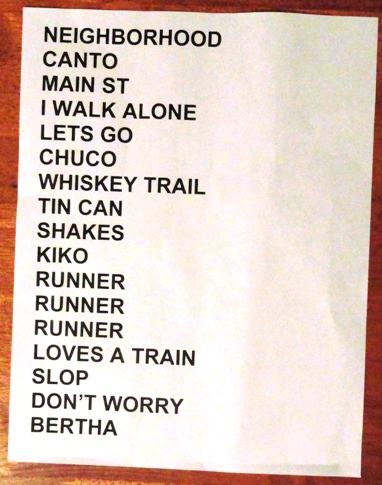
Setlist: The Neighborhood; Yo Canto; On Main Street; I Walk Alone; Emily; Come On, Let’s Go; Chuco’s Cumbia; Burn It Down; Tin Can Trust; Shakin’ Shakin’ Shakes; Chains Of Love; Let’s Say Goodnight; Ay Te Dejo enSan Antonio; Volver, Volver; She’s About a Mover (with David Hidalgo on drums); Don’t Worry Baby; Not Fade Away > Bertha. Encore (with Enrique Chi and Juan-Carlos Chaurand from Making Movies): Cumbia Raza; Mas y Mas; La Bamba > Good Lovin’ > La Bamba.
(Above: Frank Black visits “Manitoba” all by his lonesome.)
By Joel Francis The Kansas City Star
It’s hard to believe, but the Pixies have been around as a reunion act for almost as long as their original incarnation. When Frank Black (aka Black Francis) announced his new project shortly after the Pixies’ first triumphant reunion tour, few could have predicted where he would end up.
The self-taught, idiosyncratic king of indie rock was working in Nashville, Tenn., with seasoned session musicians. The impulse yielded two albums, 2005’s “Honeycomb” and 2006’s double album “Fast Man Raider Man.” Earlier this year Black announced a third Music City installment was on the horizon.
“If you’re into the pop music of the 20th century and you happen to be a post-punk record maker, chances are you’ll like Patsy Cline and Miles Davis,” Black said. “Most rock musicians aren’t going to put out a bebop album, so we go to blues, folk, roots music, whatever you want to call it. It’s not that much of a jump for me — it’s all part of the same grassy hillside.”
It’s also a road well traveled. In 1966, Bob Dylan left New York City to record at the CBS studios in Nashville with the day’s top session players. More recently, Robert Plant ventured to middle Tennessee to work with Allison Krauss and Buddy Miller.
“The reason why you see this happening again and again is because of the opportunity to play with some of the best musicians in the world,” Black said. “It’s not just country music, but R&B and the whole world of 1950s and ’60s pop recording.”
Black’s collaborators are a world removed from the Boston underground scene where the Pixies formed in the mid-’80s. His album credits today include Muscle Shoals legends Dan Penn and Spooner Oldham, Stax guitarist Steve Cropper and drummer Chester Thompson, pal of Genesis and Frank Zappa.
During sessions in Los Angeles, Black worked with Funk Brother Bob Babbitt, Al Kooper, Phil Spector veteran Carol Kaye and drummer Jim Keltner. Grab any of your favorite major-label albums from the late ’50s to the mid-1970s and at least one of these names will be found on the sleeve.
“I guess you could say the era peaked in the ’60s and got a bad rap in the ’70s, because by then there was just too much easy-listening and knockoff, quickie records,” Black said. “But the people who grew up under the punk badge were young 20-somethings who didn’t have a lot of money and shopped at used clothing stores and decorated their apartments with kitsch. All of a sudden, out come those old Dean Martin albums again. Ultimately, what you rebel against becomes hip again.”
When Black comes to town on Monday, he’ll be without any of his all-star assistants. In fact, Black’s only company onstage will be his acoustic guitar. But regardless of his surroundings, Black said, his goal is the same: to satisfy the customers.
“That’s where I’m at now and it’s no different from when I played my first gig,” Black said.
“It’s all part of the world of the musician. Sometimes you play huge festivals for tons of money in front of tons of people, other times you’re playing Knuckleheads in Kansas City. Both are equally valid.”
(Above: R.E.M. opened their 2003 concert in Kansas City with the rarely performed “Star 69. Here the band does it at Glastonbury ’99. )
By Joel Francis The Daily Record
“This next song,” Michael Stipe said, “is a request.”
The number wasn’t a surprise. Much like right now, the country was leading up to a big election year. It was startling the band would start playing requests just two songs in to the set. But what made “World Leader Pretend” seem so stunning was that I had requested it.
Oh, I’m sure I’m not the only person who logged on to R.E.M.’s Website, selected the upcoming concert at Starlight Theatre and plugged “World Leader Pretend” into one of the three request slots. In that moment, however, it felt like the band was playing for ME, way up near the top of the theater bowl.
That feeling was reinforced two songs later when Stipe announced another request. “Fall on Me” is my all-time favorite R.E.M. song, and occupied another of my limited request spots. Those two moments, coupled with that night being my first (and now only) time seeing R.E.M. in concert made the night an incredible experience that cemented my passion for the band.
Shortsightedness prevented me from seeing R.E.M. eight years earlier, when they sold out two nights at Sandstone Amphitheatre in 1995 with Sonic Youth. Despite promoting the critically derided (but personally beloved) “Monster” album, that was R.E.M.’s first tour since the gigantic success of “Losing My Religion” and “Everybody Hurts.”
Eight years later the band was in a very different place. Drummer and not-so-secret weapon Bill Berry had left and the remaining trio had released three increasingly experimental records with decreasing results. They had toured faithfully during that time, but always skipped Kansas City. In 2003 they were pumping a greatest hits collection and the generally lifeless “Around the Sun” was right around the corner. In that moment R.E.M. seemed like Johnny Unitas with the Chargers or Babe Ruth with the Braves. “Accelerate” and this year’s “Collapse Into Now” proved they were more like Bobby Hull with the Jets.
And now, nearly exactly eight years to the day1 after I saw them at Starlight, R.E.M. are done. Buck will probably continue to play sideman to Robyn Hitchcock and Scott McCaughey, Mills will make pleasant but unnecessary James Taylor-meets-Brian Wilson solo albums, and Stipe will direct films and make weird solo albums that sound nothing like R.E.M.
I’m happy that R.E.M. decided to call it a day instead of endlessly releasing uninspired product (I’m looking at you, Red Hot Chili Peppers). But I’m also sorry that I likely won’t hear the new sounds of three of my favorite musicians working together again.
R.E.M. have always been a part of my musical landscape. They were legends when I discovered music, and it makes me sad to think they now only exist in history. But I’ll always have the tape of “World Leader Pretend” and “Fall on Me” in my mind.2
(Above: Muse borrow a bit from Van Halen and then Queen with their performance of “Stockholm Syndrome” during their headlining set on the second day of Kanrocksas.)
The confessional California-based indie rock trio deserved better. Singer Beth Costentino’s intimate songs about frustrated crushes and missed chances wilted under the bright, blazing mid-day sun. Her lo-fi, straight-ahead songs are best suited for small, dark clubs, not 100-degree afternoons.
Costentino and her rhythm section of Bobb Bruno and Ali Koehler made the best of a bad time slot, though. The trio plays with considerably more power than is hinted at on their full-length debut LP and the sound was full despite the lack of bass guitar (Costentino and Bruno both played electric guitar while Koehler held down the beat on his drum kit).
The best moment’s of the 40-minute set were many of the same high points on the record: “Boyfriend,” which came out early, “Bratty B,” “Something In the Way” and the new song “When You Wake Up.” Colorful remnants of Friday’s Flaming Lips set still littered the ground as the band played.
OK GO
OK Go are better known for their videos than their music. Although the indie rock band’s 40-minute set showed they have depth beyond viral treadmill clips, their reputation is also fair.
The four musicians took the stage wearing bright, monotone Crayola suits, invited a fan onstage to play guitar and donned white gloves before performing “What To Do” on hand bells. Lead singer Damian Kulash left the stage to perform a couple songs acoustically, surrounded by the crowd. Upon returning to the stage, Kulash pulled out a digital camera and took a picture of the audience, promising to post it on Facebook so everyone could tag themselves. That, my friends, is marketing 2.0.
Behind the spectacle, the music was catchy and bouncy, filled with touches of New Wave and disco, a la Franz Ferdinand, and elements of the Cars, Cheap Trick and Roxy Music. High points included “White Knuckles,” “Do What You Want “ and “Here It Goes Again,” aka the treadmill song.
A Perfect Circle
The sun was just starting to set as A Perfect Circle took the stage. It was fitting, because this thinking-man’s metal band lives in the shadows and darkness. Each song was an exercise in subtly shifting textures and tempos, making each performance seem longer than it actually was.
One third of the quintet’s dozen songs were covers. “People Are People” opened with a slow, building solo that placed the Depeche Mode hit in a completely new context. Likewise, a minor-key reading of John Lennon’s “Imagine” may have resembled how Mark David Chapman heard the anthem for peace. Songs like “Counting Bodies Like Sheep to the Rhythm of the War Drums” and “The Outsider” offered one of the weekend’s few opportunities for head banging and get the metal out.
Each of the five band members stood on their own platforms, denying a single visual focus. Much of the pyrotechnics came from guitarist Billy Howerdel and beastly drummer Josh Freese, raised behind him. Singer Maynard James Keenan stood in the back left, out of the spotlight, back to the crowd. Former Smashing Pumpkins guitarist James Iha was elevated in the center.
Take-aways:
The layout provided easy access to several water stations, toilets and dedicated shade areas. The sound at all three stages and the DJ tent was surprisingly clear and aside from the large obligatory sound tents, all of the stages had decent sight lines.
My biggest complaint was the placement of the Ad Astra Stage. While the Stagesaurus Rex and Main Stage faced each other at either end of the main field, travelling to the Ad Astra Stage forced crowds through several gated bottlenecks. This made bouncing between the Ad Astra to the main area take longer than necessary, and forced fans to choose between forgoing the final songs of the current set or missing the opening numbers of the next one.
The Charity Village – a nice forum for local non-profits to introduce themselves to fans – was easily overlooked in the back of one of the vendor tents. It deserved more prominent placement.
All told, the foundation for what I hope will be a longstanding Kansas City summer tradition was in place.
The crowd assembled for this Welsh-trio likely would have been much larger if they weren’t going head-to-head with Fitz and the Tantrums. As it was, the crowd wasn’t much bigger than what would pack the Granada Theater in Lawrence, but judging by facial expressions as the audience dispersed most people left impressed.
Much of the band’s 40-minute set drew from “The Big Roar,” the critically praised album released earlier this year. Songs performed included “Cradle,” “The Greatest Light is the Greatest Shade” and the non-album single “Greyhounds in the Slips.”
Lead singer/guitarist Ritzy Bryan threw herself into the set-closing “Whirring,” hurling herself at the mic as she sang enthusiastically. Bryan later conjured images of Jimi Hendrix at Monteray when she threw her guitar on the ground and knelt over it to coax out some otherworldly sounds. Drummer Matt Thomas punctuated the noise with double-pedal rolls on the bass drum.
D12
Eminem’s Detroit cronies took the stage 20 minutes late – not bad by rap standards, but kind of a big deal when your allotted time is barely over half an hour.
Rapping over what sounded like their own commercial CDs – Eminem’s backing vocals were clearly audible despite his absence – the quartet employed what I like to call the “gang of yelling.” Technique: one rapper delivers most of the verse with the rest chiming in on the four count or the end of a phrase. The name is derived from the end result: an indiscernible cacophony of yelling.
Wearing a purple shower cap and red Angry Birds t-shirt, Bizarre led the group in rhymes about murder, family (“Loyalty”), women (“She Devil”) and weed, lots of weed. At one point the group parodied the Temptations attempting a synchronized dance routine and faux crooning about “my weed” over a sample of “My Girl.” Like the rest of their performance it was obvious, uninspired and unnecessary.
Kid Cudi
Kid Cudi writes pop/rock songs delivered as soul numbers draped in hip hop attitude. As his four-piece band vamped over a heavy prog-rock riff, Cudi skipped onstage wearing a Joan Jett t-shirt. Cudi’s hour-long set veered from rap (“Soundtrack to My Life”), ‘80s pop (“Mr. Rager”) to indie pop (“Pursuit of Happiness”). Several times he transformed the large lawn into a huge dance club.
The music tipped heavily toward Cudi’s sophomore album released this year, “Man on the Moon II: The Legend of Mr. Rager,” but included the singles from Cudi’s 2009 debut and an a capella medley of favorites from the 2008 mixtape “A Kid Named Cudi.” Regardless of the source, fans enthusiastically sang along to Cudi’s songs about isolation and escapism through marijuana.
Cudi’s previous stop at the Midland Theater last spring was by all accounts a disaster. The difference this time the presence of live instruments, which emphatically translating Cudi’s charismatic energy throughout the massive crowd. The triumph represented both the largest crowd and biggest response of the day, aside from headliner Eminem.
Major Lazer
The DJ duo of Dilpo and Switch – best known for their work with MIA and Beyonce’s “Girls (Who Run the World)” – were unfortunately slotted against California dj Bassnectar. With Bassnectar monopolizing the main stage, Major Lazer were unfortunately relegated to the Critical Mass Tent, an oversized carport with horrible air circulation stranded in the middle of port-a-potty land.
None of this stopped the dedicated from dancing as the pair blended standard techno tracks with touches of dancehall, Harry Belafonte, Lynryd Skynryd and their own “Keep It Goin’ Louder” from 2009’s full-length “Guns Don’t Kill People, Lazers Do.”
Surrounded by four frantic LED screens, the pair got an assist from an over-the-top hype-man with a deep Jamaican patois and a dancer whose primary job was to perform headstands on every accommodating surface onstage, including on top of both stacks of speakers.
(Above: Harry and the Potters rock a Wisconsin bookstore.)
By Joel Francis The Kansas City Star
It is doubtful that Irma Pince, mistress of the library at Hogwarts, would approve of Harry and the Potters.
The band is loud, noisy and proud of its subversive punk influences. For nearly a decade, it has also been the delight of librarians across the country.
The band makes a return appearance to the downtown branch of the Kansas City Public Library at 2 p.m. Sunday in a free performance and Monday at the Replay Lounge in Lawrence.
“Most libraries don’t see any bands;they see author readings and story time,” said guitarist Paul DeGeorge, who founded the group with his brother Joe in Boston in 2002 and now lives in Lawrence. “Sometimes we get librarians who think we’re too loud, but now that our reputation precedes us, I think they like that what we do is unique.”
Tying in to the most popular fiction series of the new millennium doesn’t hurt either. With songs such as “Gryffindor Rocks,” “Dumbledore’s Army” and “Saving Ginny Weasley from Dean Thomas,” the duo has plugged right into the zeitgeist.
The band is among the more successful of a long list of wizard rockers, including such Potter-inspired groups as Draco and the Malfoys, the Moaning Myrtles and the Whomping Willows. They even gather for festivals, such as the annual Hallows and Horcruxes Ball in Manhattan, Kan.
“It all started as sort of a whimsical idea after reading the Harry Potter book for the first time. We wanted to find a way to convince librarians to let us play loud punk rock music in their libraries,” DeGeorge said. “We didn’t realize how extensive and pervasive the Harry Potter fan world is. Once our website [Web site] was up, word spread really quickly, and that’s when we started touring nationally.”
Onstage, both brothers are dressed as Potter. Older brother Paul portrays the seventh-year wizard, while Joe represents Potter in his fourth year at Hogwarts. Although the family-friendly music attracts a young audience, Paul DeGeorge aims for a wide demographic.
“They Might Be Giants is a band I really related to in junior high, but as I grew up I realized there were a lot of smart things in those songs that I didn’t get when I was 12,” DeGeorge said. “We want to do the same thing. We want to keep the parents engaged as well, give them stuff to smile at that their kids won’t get and give the kids things to laugh at the parents will just think is cute.”
J.K. Rowling hasn’t weighed in on Harry and the Potters, but she is a big fan of the Harry Potter Alliance, a nonprofit group DeGeorge founded.
“The Harry Potter Alliance was inspired by the fact that Harry and his friends were just teenagers, but because they were dedicated to fighting evil they changed the world,” DeGeorge said. “We re-contextualize complex global issues through Harry Potter’s world. It’s a way to help young people understand the world and get involved using language they understand.”
Although the band is strong, DeGeorge confessed it isn’t as all-encompassing since he moved from his native Boston to Lawrence, Kan. a year ago. DeGeorge moved away from his brother to be with his girlfriend, who is earning her doctorate in art history at the University of Kansas.
“We used to do 120 shows a year, then record,” DeGeorge said. “Now we’re doing a two-month tour and will take some time off. In some ways, though, the distance makes us more focused, because we know we have to maximize our time together.”
(Above: Paul McCartney goes to Kansas City with a little help from his friends.)
By Joel Francis The Daily Record
The Big Apple has “New York, New York,” “Empire State of Mind” and dozens more. The Windy City has “Sweet Home Chicago” and “Jesus Just Left Chicago.” Tom Waits gifted the Twin Cities with not one but two songs (“Christmas Card from a Hooker in Minneapolis” and “9th and Hennipen”). Visitors to the Bay City are encouraged to “wear some flowers in (their) hair” while the City of Angels gets “California Love,” “Beverly Hills” and “Hollywood Swingin’.” Heck, the even the Gateway City has “St. Louis Blues.”
But there’s only one universally known song about my hometown: “Kansas City.” (Only obsessive music fans and listeners of a certain age will recall “Everything Is Up To Date in Kansas City” and “Train to Kansas City.”) When listening to Jay-Z, Frank Sinatra, Tom Waits and Louis Armstrong boast about other American cities I try to find comfort reminding myself that the Beatles only sang about one city during their career and they chose “Kansas City.”
“Kansas City” is the only song visiting performers feel obliged to work into their setlist. Willie Nelson played it at Farm Aid earlier this month and Paul McCartney used it to open his 1993 show at Arrowhead Stadium (the recording from that night also appears the album “Paul Is Live”). I’ve heard the song so many times in concert I feel like someone should tell all touring acts that no, really, they don’t have to play “Kansas City” on our behalf.
It’s not like the song is invisible around town. Twelfth Street and Vine may be gone (typical of my hometown – undermining its greatest assets), but the song is still very present. Go to a Royals game and if you stick around until the end you are guaranteed to hear “Kansas City.” If the boys in blue win, fans are treated to the Beatles version. If they lose then Wilbert Harrison is piped through the speakers.
“Kansas City” was seven years old by the time Harrison got his hands on it. Originally recorded by bluesman Little Willie Littlefield in 1952, the song was written by a couple of 19-year-old Jews inspired by a Big Joe Turner record. Littlefield’s performance featured a somewhat racier chorus, ending with the line “with my Kansas City baby and some Kansas City wine.” When Federal Records received Littlefield’s recording they promptly rechristened it “K.C. Lovin’.”
Wilbert Harrison
Harrison had been performing “K.C. Lovin’” for years before he decided to record it in 1959 under its original title and with the sanitized chorus we all know today. Released on Fury Records, the platter went straight to No. 1 and spawned an army of imitators. Within weeks, interpretations of “Kansas City” by Hank Ballard, Rockin’ Ronald, Little Richard, Rocky Olson and a reissue of Littlefield’s original recording could be found in record shops. Paired with his own “Hey Hey Hey,” Little Richard’s cover hit No. 27 in the UK and inspired the Beatles’ recording.
The men – boys, really – who penned “Kansas City” wouldn’t visit the town that inspired their song until the mid-‘80s, nearly 35 years after handing the tune to Littlefield. Despite this handicap, Jerry Leiber and Mike Stoller nailed their vision of “a melody that sounded like it could have come out of a little band in Kansas City,” as Stoller later explained on a UK television show.
Hot on the heels of “Hound Dog,” “Kansas City” cemented Leiber and Stoller’s reputation as rock and roll’s hottest songwriters. Before the decade was out they would write scores of hit songs for the biggest singers of the day – Elvis Presley, the Drifters, Phil Spector, Ben E. King and, especially, the Coasters – and shape the young days of rock and roll more than anyone else. A sampling of their songs from the time reads like an early rock and roll greatest hits collection: “Hound Dog,” “Jailhouse Rock,” “Smokey Joe’s Café,” “Riot in Cell Block Nine,” “On Broadway,” “Love Potion No. 9,” “Young Blood,” “Searchin’,” “Yakety Yak,” “Stand By Me” and on and on.
Jerry Leiber (left) and Mike Stoller show the King of Rock and Roll his next hit.
The duo’s use of strings on the Drifters’ “There Goes My Baby” predates (and foreshadows) the Motown sound that would dominate pop music in the coming decade. In fact many of their arrangements and innovations were so prescient that Leiber and Stoller found themselves on the sidelines for much of the 1960s. The Beatles and other British Invasion bands learned to write emulating Leiber and Stoller and other Brill Building songwriters, making third-party songwriters largely redundant. The expansive use of the recording studio rendered Leiber and Stoller’s pioneering arrangements sounding (for a while) like quaint relics of the past.
Despite these advancements, rock and roll and pop music will never outgrow the shadow of Leiber and Stoller. Grammy awards, hall of fame inductions and songwriting royalties stand as a testament to Leiber and Stoller’s perpetual influence. Even “American Idol” paused to pay tribute with an all Leiber-and-Stoller episode last spring.
Jerry Leiber, 78, died Monday. His survivors include Mike Stoller, his songwriting partner of 60 years, his family and everyone who ever picked up the guitar or sat down at the piano and tried to write a song or become a star.
(Above: Neil Young preaches and sings his only No. 1 hit at Farm Aid 26 in Kansas City, Kan.)
By Joel Francis The Daily Record
Several years ago and less than a quarter mile from the gigantic Farm Aid stage at Livestrong Sporting Park in Kansas City, Kan., Willie Nelson welcomed Bob Dylan onto the stage. It wasn’t that big of a surprise – the pair was playing minor league ballparks together for the first time that summer – but it was incredible to watch the two titans collaborate.
Despite Farm Aid’s star power, Saturday’s nearly 11-hour musical marathon/fundraiser didn’t feature any similar big-name collaborations but that’s about the biggest disappointment that could be leveled at the day.
The first of 16 artists went onstage at 1 p.m., but it wasn’t until Hearts of Darkness, Kansas City’s Afro-beat ensemble, came out a half hour later that the stadium started feeling less like a dress rehearsal and more like a concert.
The first half of the day was heavy on folkies and country music legends. Ray Price, 85, looked frail, but his deep baritone voice is immortal. His delivery on songs like “For the Good Times” and “City Lights” still pack the same emotional punch as it did when they were recorded nearly 40 years ago. Billy Joe Shaver proved to be spry at 71 as he hooted and scooted his way through “Wacko from Waco,” “Georgia on a Fast Train” and “Honky-Tonk Heroes.” It would have been great to witness either Shaver or Price duet with Nelson – Price and Nelson have recorded a handful of albums together – but with mid-afternoon sets, the two were likely well-settled in their hotel rooms by the time Nelson ended the day several hours later.
Robert Francis and British actress Rebecca Pigeon (the only female performer on the bill) each delivered 30-minute sets of fine folk music, but the only performance that stood out was Francis’ cover of Bruce Springsteen’s “I’m on Fire.”
The final acts before the headliners could have filed under nepotism, but provided some of the daytime’s strongest moments. With a singing voice eerily similar to his dad’s, Lukas Nelson and the Promise of the Real married Texas blues with the Allman Brothers Band’s Southern boogie. Backed by former Wallflowers pianist Rami Jaffee, Jakob Dylan delivered several of his old band’s biggest hits, including “Sixth Avenue Heartache,” “Sleepwalker” and “One Headlight.” At times, the pairing of Dylan and Jaffee recalled Tom Petty’s more delicate work with Heartbreakers ivoryman Benmont Tench.
The unfortunate dud in this stretch came unexpectedly from Jamey Johnson, who despite getting an assist from Lukas Nelson and a solid six-piece band filled his time with too many mid-tempo numbers that failed to ignite both onstage and in the crowd.
Taking the stage shortly before 7 p.m., Mraz faced the biggest crowd of the day so far and drew more applause than any of the preceding acts. Mraz got an assist delivering his bouncy acoustic folk/pop from longtime friend Toca Rivera on percussion and backing vocals. Their jazzy version of “Won’t You Be My Neighbor” (a.k.a. Mr. Roger’s theme song) drew a big reaction.
Several of his songs fit well with the day’s themes. Mraz said he wrote “Frank D. Fixer” for Farm Aid about the first farmer he knew, his grandpa. The second verse, ending with the line “what happened to the family farm?” was especially poignant.
Primed by Mraz, Dave Matthews fans were more than ready for their hero. Matthews – with help from guitarist Tim Reynolds – didn’t disappoint. His 45-minute set was packed with sing-alongs “Crush,” “Where Are You Going?” and the set-closing “Dancing Nancies.”
The crowd was ready for more singing when John Mellencamp emerged with his five-piece band, but Mellencamp played on his own terms. Detours through “Walk Tall,” “Death Letter Blues” and “If I Die Sudden” confused an assembly clamoring for the hits, but they were ultimately rewarded with a spectacular performance of “Check It Out” along with Farm Aid anthem “Rain on the Scarecrow,” “Small Town” and “Pink Houses.” A quiet reading of “Jackie Brown” performed only by Mellencamp and violinist Miriam Sturm was another highlight.
Neil Young needed only a harmonica and acoustic guitar to take the title of the day’s best set. He only played six songs, but the first three were a murder’s row of favorites: “Comes A Time,” “Sugar Mountain” and “Long May You Run.” Attention spans may have wandered during Young’s sermons against corporate farms and a pair of songs from last year’s excellent “Le Noise,” but he easily won the audience back with the opening chords of “Heart of Gold.” This was the fourth time I’ve seen Young but my first with him in coffeehouse mold. Experiencing these songs in such an intimate way was powerful and emotional, leaving me with goosebumps and a lump in my throat.
After Young’s transcendental set anything would be anti-climatic, and Willie Nelson drew the short straw for ending the day. While neither Mellencamp nor Young emerged beyond their appointed times, Nelson worked the stage all day, opening the concert, accepting checks and thanking people. Understandably fatigued, Nelson’s set was light on his biggest songs – “Whiskey River,” “Still is Still Moving” and “Mama Don’t Let Your Babies Grow Up To Be Cowboys” were the only chestnuts delivered.
He turned the mic over to his son for a blistering version of “Texas Flood” and the family tribute “Fathers and Mothers.” Blessed with a second wind, Willie Nelson serenaded the host city with “Kansas City.” Several backing musicians from the previous bands came back out to help with a trio of gospel numbers that wove through “Will the Circle Be Unbroken,” “I’ll Fly Away” and “I Saw the Light” before ending bizarrely on “Roll Me Up,” a brand new Nelson song with the refrain “roll me up and smoke me when I die.” The subject was incongruous, but the music stayed in the same jubilant spirit.
Nelson’s herb of choice may not be a crop farmers can plant, but it was fitting end to a day focused on agriculture.
(Above: Elvis Costello and the Imposters take the stage on a hot summer night at Crossroads KC.)
By Joel Francis The Kansas City Star
Elvis Costello solved the age-old problem of what to do when an artist has too many great songs for one show – he brought them all onstage with him.
Costello’s “Spectacular Spinning Songbook” tour touched down at a crowded Crossroads on Thursday night. Behind the acclaimed songwriter’s left shoulder loomed a huge multi-colored wheel adorned with three dozen of his favorite songs. One at a time, members of the audience were invited up to spin the wheel and pick the next number.
“(What’s So Funny ‘Bout) Peace, Love and Understanding,” usually an encore, came up early. So did “Earthworms,” a song Costello wrote for singer Wendy James in the early ‘90s but never recorded himself. When the wheel landed on Bob Dylan’s “This Wheel’s On Fire,” Costello let the crowd choose between that number and his own “Human Hands.” The headliner won out.
First employed in the late ‘80s, the spinning songbook is a novel way for the performer to experience his work in a new context. On that level it was a success. The quartet was tight and energetic, clearly feeding of the energy of the fans dancing along to their selections onstage. But the wheel also killed momentum and started to feel kind of gimmicky after a while.
That said there was indisputably some great music in between spins. A spooky “I Want You” and an extended reading of “Watching the Detectives” that played up the song’s dub roots were among the high points.
Many of the best moments came early. Costello and his Imposters took the stage in with many favorites in a potent 15-minute romp before introducing the wheel. The extended jam on “Uncomplicated” found Costello and bass player Davey Faragher trading lines from Jr. Walker’s “Shotgun.” The Motown connection returned during “Alison,” when Costello incorporated several of the verses from Smokey Robinson’s “Tracks of My Tears.”
Keyboard wizard Steve Nieve was the driving force on many songs, adding calliope runs to “Radio Radio,” a Theremin solo on “Peace, Love and Understanding” and sneaking some Stevie Wonder clavinet on “Shabby Doll.”
The night nearly ended with a brilliant three-song encore in which Costello and his band somehow took the jumpy “Pump It Up” straight into the reflective “Alison” before somehow ending up on a surprisingly strong version of Prince’s “Purple Rain.” Costello had other plans, however, returning with two thirds of the Lovell Sisters to play some bluegrass.
Setlist: I Hope You’re Happy Now; Heart of the City; Mystery Dance; Uncomplicated > Radio Radio; Talking in the Dark; Clubland; (What’s So Funny ‘Bout) Peace, Love and Understanding; Earthbound; Human Hands; Watching the Detectives; (I Don’t Want To Go To) Chelsea; Almost Blue; Shabby Doll; I Want You. Encore 1: Brilliant Mistake; Pump It Up; Alison > Purple Rain. Encore 2: Sulfur to Sugarcane; The Crooked Line; The Scarlet Tide.
(Above: The mini-movie for “Our Deal,” the latest song from Best Coast.)
By Joel Francis The Daily Record
The big names at the top of the bill will draw the most fans, but sometimes the best performances are from lesser-known acts early in the day. In the week leading up to the inaugural Kanrocksas music festival we’ll examine 10 overlooked acts. Earlier this week we looked at five acts from Friday’s lineup. Below are some great picks for Saturday.
Hearts of Darkness (Main Stage, 1:30 – 2 p.m.)
Kansas City’s worst-kept secret will kick off Saturday with deep Afro-beat grooves so hot the sun may be intimidated. With a five-piece horn section and multiple percussionists, the 18-member band has recently upstaged Snoop Dogg and made Huey Lewis and the News work a little harder. Hopefully it won’t be too long until Hearts of Darkness get the later stage time they deserve.
Making Movies (INK Unplugged Stage, 3:30 – 4 p.m.)
Making Movies took their name from the Dire Straits, but their sound is closer to Los Lobos. And just like Los Lobos, Making Moviesconcerts are likely to skip all over the place, with a salsa cover running into a Modest Mouse song. They will bring a much-needed world music presence to the lineup.
Best Coast (Stagesaurus Rex, 3:40 – 4:20 p.m.)
As their iTunes sessions EP proves, Best Coast have a lot more muscle onstage than their dreamy, lo-fi indie pop recordings imply. That’s good because they’ll have a massive space to fill Saturday afternoon. Singer/songwriter Bethany Cosentino has great songwriting chops. Now we’ll see how her song translate over several sunny acres.
Girl Talk (Main Stage, 8:30 – 9:35 p.m.)
Mash-up king Greg Gillis is the king of plucking a song’s apex and pairing it with another seemingly disparate crescendo to create a nonstop party. By stealing a few pages from the Flaming Lips play book and spraying the crowd with confetti and letting fans party onstage, Gillis is the rare DJ that is as fun to watch as he is to listen to.
The world of jam bands is an admittedly crowded and homogenous terrain, but STS9 manage to stand out by combining heavy electronic and psychedelic elements to the standard open-ended, improvisational fare. After withstanding two days and 24 hours of steady live music, zoning out and riding the STS9 wave may be the best way to end the festival.
Look for more Kanrocksas coverage next week on The Daily Record.


 The headliners were more than hospitable during the 25-minute encore, giving both Chaurand and Chi several lengthy solos and letting them trade licks (and more than hold their own) with their heroes. The pair was ready to politely secede the stage after each number, only to have Hidalgo motion to stick around for a little more fun.


 joelfrancis.com