Raphael Saadiq sends a love letter to soul makers and Motown

(Above: Raphael Saadiq runs the “100 Yard Dashfor Seattle’s excellent community radio station, KEXP.)

By Joel Francis
The Kansas City Star

Raphael Saadiq’s latest album, “The Way I See It,” is draped heavily in the sounds of Motown and Philly soul, but don’t call it a tribute album.

“Boyz II Men did a tribute; I wrote a bunch of songs,” Saadiq said about his all-originals album. “This was not intended to be a tribute album. It’s more like a secret love letter to the people I love.”

People like the Funk Brothers, Motown’s now-legendary stable of musicians, and the other unknown musicians who “took music to the level where it is today that I can come out and do this,” Saadiq said. “It’s not just about Smokey (Robinson) and Stevie Wonder, but a bunch of people we don’t even know about.”

He plays most of the instruments on the album himself, but Saadiq recruited two Funk Brothers to help him get that classic Motown sound. Jack Ashford’s tambourine has graced classics like “Nowhere to Run” and “You Can’t Hurry Love.” Paul Riser, who arranged the strings on Saadiq’s album, has worked with the Supremes, Marvin Gaye and Stevie Wonder.

“I brought Jack in because he added a sound I couldn’t have had without him,” said Saadiq, who performs Wednesday at the VooDoo Lounge. “With Paul Riser it was the same thing. You can feel the energy when they walk into a room.”

Having Stevie Wonder play harmonica on one song was ultimate validation. Saadiq even went so far as to introduce his guest like Wonder introduced Dizzy Gillespie on his 1982 hit “Do I Do.”

“Seeing Stevie walk into a room and play is something I’ve never gotten used to,” Saadiq said. “Having him play on this was a stamp of approval. I’ve worked hard for a long time to have him come play (on my album).”

The former Tony! Toni! Tone! singer, who named his first solo album “Instant Vintage,” is more worried about being called “neo soul” than being pigeonholed.

“Everybody knows I hate the term ‘neo-soul,’ ” Saadiq said. “If someone was playing the blues they’d want an old soul. I don’t want a new soul — then I’d sound like somebody on the radio today, which I hate.”

On an album with so much — ahem — old-school soul, Jay-Z’s guest spot on the final track, a bonus remix, probably surprised many listeners.

“That was Q-Tip’s idea,” said Saadiq, referring to the former MC of A Tribe Called Quest. “He was like, ‘You should put Jay-Z on this record’ and then went and got him, because I didn’t know Jay like that. Some people didn’t like it. They’re probably neo-soul fans. I did this for the other people.”

More on Raphael Saadiq from The Daily Record:
“The Way I See It” album review
“The Way I See It” caps the Top 10 albums of 2008
Review: Al Green


Above: The Rev. Al Green brings “Love and Happiness.”

By Joel Francis

After barely over an hour onstage, Al Green said goodnight, grabbed a small black duffle bag and exited. The gesture was symbolic of the evening: the bags were packed and he was ready to go.

Saturday’s concert at the Midland Theater was the final stop on Green’s eight-month tour that took him across America and around Europe; he was anxious to get home.

“Two month is a long time,” he said. “Even a preacher can’t go that long.”

That might explain the truncated set – 77 minutes, with no encore – and why it always felt like Green had one foot off the stage.

For the most part, Green let his 13-piece band and the audience do most of the heavy lifting. After introducing the first couple lines, Green was all too happy to let the audience take over his songs. Beaming from ear to ear, he was content to scat guide vocals over the crowd’s singing and hand roses to women in the front rows.

Green Hovered like a cloud over the numbers, dipping in just long enough to let out a scream or prove the health of his pipes. When he fully immersed himself in a song, the result was even better than his allusions. During “Tired of Being Alone” Green dropped to his knees and uncurled a falsetto that raised goose bumps. He poured his heart into “Amazing Grace” and came alive during a medley of Motown and Stax numbers that inspired him as a boy.

It would be easy to assume Green was simply bored with his repertoire if he wasn’t so perpetually joyous. After overcoming some early monitor problems, Green chatted effusively to the crowd, healing the Kansas/Missouri divide, telling stories from the tour and preaching a little gospel. Since Green had tossed “Let’s Stay Together” out a half-hour into the night, he closed with his next-biggest song, “Love and Happiness.” At end the band vamped over the groove, stretching the number out as Green thanked his crowd again and again, but the effect didn’t work – it was still too soon for him to leave.

With the premium seats going for $70, the evening cost about a dollar per minute after service fees. While there are worse ways to spend a night out, there wasn’t enough of the man whose name was printed on the ticket to justify the price.

Setlist: I Can’t Stop; Let’s Get Married; Lay It Down; Stay With Me (By the Sea); Everything’s Gonna Be Alright; Amazing Grace/Nearer My God To Thee; Let’s Stay Together; Medley: How Can You Mend a Broken Heart / Here I Am (Come and Take Me) / I Can’t Help Myself (Sugar Pie Honey Bunch) / My Girl / Bring It On Home to Me /(Sittin’ On) The Dock of the Bay / You Are Everything); Tired of Being Alone; I’m Still In Love With You; Simply Beautiful; Love and Happiness

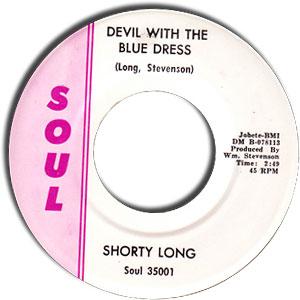
Shorty Long – “Devil with the Blue Dress”

Shorty Long – “Devil with the Blue Dress,” did not chart

Mitch Ryder and Bruce Springsteen fans will be taken aback by Shorty Long’s half-speed tempo on his original recording of “Devil with the Blue Dress.” Long’s bluesy shuffle is closer to Chicago blues than Detroit soul. It’s a far cry from the frenetic, late-set showstopper “Devil” has become.

Long’s co-writer Mickey Stevenson’s crisp production serves the song well – check the smacking echo in the handclaps and the dry wash Long’s guitar is given. All the elements are in place for a hit – why this didn’t stick is a mystery. Perhaps Long’s early demise in a boating accident just five years later, in 1969, and the success of Ryder’s 1966 cover, erased him from public consciousness.

When Ryder took transplanted the number from the roadhouse to the garage, he doubled the speed and paired it with Little Richards’s “Good Golly Miss Molly” and got a No. 4 hit. That’s the arrangement Springsteen is prone to trot out, but Long’s original vision is a Motown treasure waiting to be unearthed. — by Joel Francis

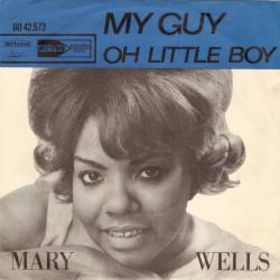
Mary Wells – “My Guy”

Mary Wells – “My Guy,” Pop #1

Before Gladys Knight, Martha Reeves and certainly Diana Ross, Mary Wells was Motown’s first female (super)star. Landing a No. 1 single in the heart of Beatlemania was no small feat. Arguably none of the Motown’s female stars have had bigger or more recognizable hits than “My Guy.” The Beatles themselves were so enraptured with Wells that they called her their favorite American singer.

Unfortunately, the Smokey Robinson-penned “My Guy,” was also Well’s swan song. Just a few months after “My Guy” was released, and while it was still very much ruling the charts, Wells exercised the termination clause in her Motown contract. Only 21 years old, she signed with 20th Century Fox with dreams of higher royalty rates and movie stardom. Leaving Motown also meant leaving Robinson, who penned and produced many of her greatest songs. Wells landed only one hit on the Top 40 pop charts after leaving Motown. She spent the rest of the decade bouncing to Atco, then Jubilee Records and finally Reprise Records.

Motown founder Berry Gordy was quick to groom a replacement for Wells – Diana Ross.

While the back story is interesting, none of it matters when listening to the actual song. The giddy, lightness in Wells’ delivery and the Funk Brothers bouncy accompaniment make “My Guy” stand up to the most narrow oldies playlists and misguided covers. Check the breathy semi-stutter Wells uses to sing “there’s not a man today who can take me away from my guy” in the outro. Pure delight. — by Joel Francis

Stax vs. Motown (part three)

The final installment of my conversation with soul music fan Brad S. includes how to build a solid, affordable soul music libarty. Here is part one and part two.

Brad S.: Okay, list time: What are your Top 10 Motown albums? You mentioned “What’s Going On,” “Songs in the Key of Life,” “Talking Book” and “Cloud Nine.” What other albums make the cut? I’m going to ask you to go for diversity here, especially if we’re fighting the perception of that “Motown hit song” stereotype.

Joel Francis: The thing to remember about albums is that prior to 1967 and “Sgt. Pepper’s,” pop albums were basically collections of singles. Going back a bit further, before Frank Sinatra’s concept albums for Capital in the late ’50s, LPs were for classical and jazz (i.e. longer performances) almost exclusively.

Berry Gordy had a hard time when Marvin Gaye and Stevie Wonder presented him with album-length concepts in the early ’70s. One could argue that “What’s Going On” and “Talking Book” were the first Motown albums that weren’t just glorified singles collections.

I know this contradicts what I said earlier, but I don’t think I can defy your stereotypes of mid-’60s Motown with any albums. That said, there are some great collections that show the depth and richness of the Motown performers of that era.

Universal, who now owns the Motown catalog, did a great job of anthologizing the great Motown groups on the “Ultimate Collection” CDs in the ’90s. These discs get the nod because they’re cheap (about $5 used on Amazon) and comprehensive. They all run in excess of two dozen tracks, which is more than enough to hit all the often-heard must-haves, but provide a deeper examination and context as well.

It’s hard to go wrong with a solid collection of Smokey Robinsons, The Temptations, early Marvin Gaye and Stevie Wonder, and the Supremes. These might not be as diverse as you were expecting, but songs like “Going to a Go-Go,” “Baby Don’t You Do It” and “Ball of Confusion” have fallen through the cracks and are worth revisiting. Divorcing oldies staples like “Uptight” and “Ain’t No Mountain High Enough” from a Top 40 context and placing them back in the artist’s cannon shines new light and perspective on the warhorses.

Because of its distribution deal with Warner Bros. the Stax side is a bit more complicated. Collections tended to fall on the pre- or post-Warner Bros. side and paint an incomplete picture. Fortunately, the consolidation of the major record labels has put all of Stax output in the hands of Concord Records. Concord has revived the Stax brand and started issuing comprehensive collections for the first time.

While there is no definitive Stax anthology series like Motown’s “Ultimate Collection,” quality single- and double-disc collections and box sets are available for nearly every Stax artist. I’d start with Otis Redding, Sam and Dave, the Staple Singers, Booker T and the MGs and Isaac Hayes and play around from there.

Two four-disc box sets provide a comprehensive overview of each label’s glory years. The Daily Record has been discussing each track on “Hitsville U.S.A.” A good follow-up project may be a walk through the “Stax Story” collection, though with more than 80 tracks to go with “Hitsville” I wouldn’t get too ancy.

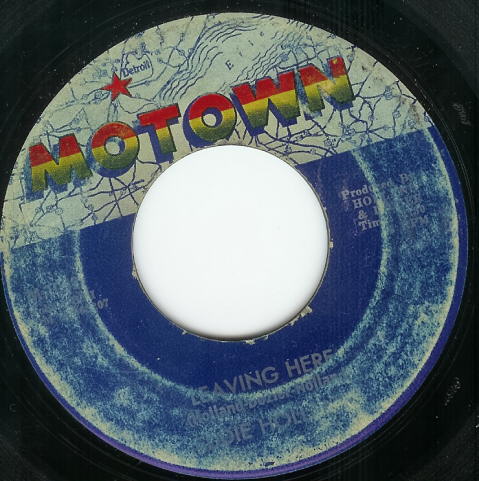
Eddie Holland – “Leaving Here”

Eddie Holland – “Leaving Here,” Pop #76

A lot changed for Eddie Holland in the two years between “Jamie” and “Leaving Here.” Holland went from reluctant (and struggling) Motown vocalist to key member of soul’s hottest songwriting team, Holland-Dozier-Holland.

After “Leaving Here” failed to find major chart success, Holland released just two more singles before permanently retreating behind his notepad. It’s just as well – the songs Holland helped write had far more success and impact than anything he performed.

Surprisingly, “Leaving Here” has had more influence as a garage rock song than a soul number. The Who recorded a smoking cover for the BBC in 1965, Motorhead released a version their debut single and Pearl Jam recorded it in the 1996 as a tribute to The Who. “Leaving Here” is one of the few songs that sounds good in the hands of almost anyone. If you find this title buried in on an obscure album, you’re guaranteed to have at least one good number. — by Joel Francis

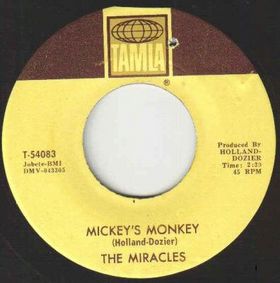
The Miracles – “Mickey’s Monkey”

The Miracles – “Mickey’s Monkey,” Pop #8, R&B #3

One of the most infectious and upbeat singles in the Motown catalog is unique in two ways. First, it was not written by main Miracle Smokey Robinson, but by the hot house songwriting team of Holland-Dozier-Holland. Second, it is one of few Motown songs to appropriate the Bo Diddley beat.

As Robinson’s voice joyously soars over the Funk Brothers groove, the Miracles, Martha and the Vandellas and members of the Supremes, Temptations and Marvellettes chip in on backing vocals.

The HDH production team did a great job of capturing a live sound that, like “Do You Love Me,” sounds like it was beamed directly from the greatest party in the world. Robinson’s multi-octave range is a marvel, but honestly anything over that groove would have been a hit.

“Mickey’s Monkey” was one of the Miracles biggest hits. Unsurprisingly, Berry Gordy tried to bottle lightning a second time by having Martha and the Vandellas cut a version, but neither their cover nor subsequent readings by The Rascals, The Hollies or John Cougar Mellencamp made an impact.

The “cat named Mickey from out of town” was based on Motown’s A&R director Mickey Stevenson. Stevenson wrote several Motown hits with Marvin Gaye, including “Beechwood 4-5789,” “Pride and Joy” and “Dancing in the Street.” — by Joel Francis

Stax vs. Motown (part two)

The second of three installments in my conversation about the golden era of Stax and Motown with soul music fan and Stax afficiando Brad. Don’t forget to check out part one.

Brad S.: I have to admit, when I think of Motown, I almost only associate it with the ‘64-‘65 period. Although I know, to cite one example, one of my old favorites, “Reflections” incorporates just enough psychedelica to distinguish it from what I consider Motown to sound like.

So what are some of those Motown songs that brought you back in?

Joel Francis: For a label so reliant upon singles, it was the albums that drew me back into Motown. “What’s Going On” made me realize there was more to Marvin Gaye than “It Takes Two.” Stevie Wonder’s “Talking Book” and “Songs in the Key of Life” and The Temptation’s “Cloud Nine.”
These albums showed more depth, emotion and creativity than the monotonous parade of mid-60s oldies radio staples would have you believe. Motown may have made its name with its assembly line parade of hits in the first half of the ’60s when it set the agenda, but its output gets more interesting to me in the second half of the decade as it responds to the Beatles, psychedelica, the civil rights movement, etc. That’s when the artists and songwriters really started to grow.

Getting back to Stax I don’t think it ever really recovered from the death of Otis Redding. The near-simultaneous loss of its biggest star in a plane crash and back catalog to Atlantic records was the beginning of the end. I know they regrouped and had massive success with Isaac Hayes, the Staple Singers and Wattstax, but the Stax I enjoy most – Otis, Sam and Dave, Rufus Thomas, Booker T and the MGs, sessions with Wilson Pickett, Solomon Burke, Aretha – was never entirely recaptured.

BS: I hear you with the post-Otis era of Stax, but that also begs this question: What were the true prime lifespans of these labels? I’m not talking about the point at which they continued only in name. The other question that comes to mind is how much of the label’s success is because of a fortunate luck of the draw with artists or is it because of the efforts of record owner or signature producer? Or to put it another way, is there an equivalent to (Motown founder and visionary) Berry Gordy on the Stax side?

JF: For me, Motown loses its luster when it relocated to Los Angeles. There are two reasons for this decline. The first factor is the rise of disco, which practically killed soul music until the neo-soul rebirth of the late-’80s. Second, Berry Gordy’s ambition to branch out into movies and television scattered the label’s focus and brought “mission creep” into his boardroom.

Stax golden years for me are its time with Atlantic when the late Jerry Wexler was helping run the studio. With the exception of Isaac Hayes and the Staple Singers (who were signed later), no one performed as well after the split as they did before. That said, it’s important to remember Stax two big ’70s non-soul successes bluesman Albert King and power pop rock combo Big Star. Many of today’s indie rock bands owe a huge debt to Alex Chilton and Chris Bell’s fantastic Big Star.

If there was a Berry Gordy figure at Stax, I would say it was Wexler in the early days and Al Bell in the later period. Not only was Wexler involved with much of Stax material, but he was also the person responsible for bringing other Atlantic artists, like Wilson Pickett, Aretha Franklin and Solomon Burke, to record at Stax.

After Wexler left, Bell assumed more production duties and became Stax co-owner. Bell patterned his business model off of Gordy. Bell was the person responsible for getting Stax into the soundtrack business (think “Shaft”) and movie business (think “Wattstax”). Ironically, after Stax bankruptcy and demise, Bell worked with Gordy at Motown in the ’80s.

To answer your question, though, I’d say both Motown and Stax’ success came because they were great at identifying talent – be it the songwriting teams of Holland-Dozier-Holland or Hayes-Porter or the raw talents of Mary Wells and Carla Thomas – and had a great business plan for delivering that talent out to the masses. Success breeds success and once those initial singles broke the charts, other artists wanted in.

Continue to part three.

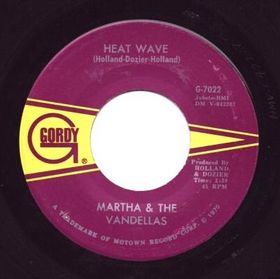
Martha and the Vandellas – “(Love is Like A) Heat Wave”

Martha and the Vandellas – “(Love is Like A) Heat Wave,” Pop #4, R&B #1

When the mercury starts pushing past the century mark my first inclinations are to shave my head and hibernate near the air conditioning. If actual heat waves were more like this song, I’d be dancing in the streets.

Holland-Dozier-Holland wrote it and Martha Reeves sang the heck out of it, but the real credit should go to the Funk Brothers, Motown’s stable of uber-talented, under-recognized musicians. The drums open the song with the buoyancy of an oceanic wave, while a swiftly strummed guitar tells your feet when to move. Add a spritely horn section and peppy piano and you’ve got a hit before Reeves nails the first note.
With so many upbeat elements it’s easy to miss the pain in the lyrics. “Whenever he calls my name/Sounds so soft sweet and plain/Right then, right there/I feel this burning pain/This high blood pressure’s got a hold on me/I said this ain’t the way love’s supposed to be/It’s like a heatwave burning in my heart/I can’t keep from crying/Tearing me apart.” Divorced from the melody and arrangement and the words have the same longing and pain as Bruce Springsteen’s “I’m On Fire.” But together bad love and frustration never felt so good.
Berry Gordy tried to replicate his success by lending the number to the Supremes in 1967. A year earlier The Who covered it a for their second album, but neither version measured up. How could it? Stick “Heat Wave” in your summer cookout playlist alongside Sly and the Family Stone’s “Hot Fun in the Summertime” and any number of Beach Boys tunes and you’ve got a recipe for success. — By Joel Francis