Marvin Gaye – “I Heard It Through the Grapevine”

256489
Marvin Gaye – “I Heard It Through the Grapevine,” Pop # 1, R&B # 1

By Joel Francis

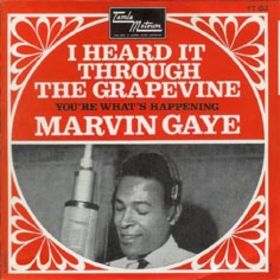
Producer and songwriter Norman Whitfield had finally triumphed. His fourth attempt at recording “I Heard It Through the Grapevine” had finally made it past Berry Gordy’s Quality Control meetings and triumphed at the top of the charts. Now, just over a year later, he wanted to release an earlier version of the song recorded by Marvin Gaye. Label honcho Berry Gordy had denied Whitfield’s request to release Gaye’s “Grapevine” before Gladys Knight had a hit with the song. His stance would not change. Whitfield was successful, however, in getting the song inserted on Gaye’s “In the Groove” album. Just as he had hoped, listeners started requesting “Grapevine” and DJs clamored for Motown to release the song as a single. Finally released in late October, 1968, “Grapevine” shot to the top of both the pop and R&B charts, outselling Knight’s version and becoming the biggest-selling Motown single to date. The song was so popular, Gaye’s album “In the Groove” was renamed “I Heard It Through the Grapevine.”

The path to getting the song recorded wasn’t much smoother. Whitfield spent a month recording the backing track with the Funk Brothers, Detroit Symphony and backing vocal group the Andantes. During these sessions, Gaye and Whitfield started to argue over the vocal arrangement. Whitfield, who worked primarily with the Temptations, wanted Gaye to sing above his natural ranges, as David Ruffin did on the Tempt’s hit “Ain’t To Proud To Beg.” Gaye initially resisted, but finally gave in. The combination of Gaye’s rasp and the Andantes convinced Whitfield he had a hit. Now he had to persuade Gordy.

Gaye’s version of “I Heard it Through the Grapevine” bears little resemblance to the song Knight took to No. 1. The defining organ line in Gaye’s arrangement barely appears in Knight’s version. Her reading was all about funk and atmosphere; Gaye’s speaks directly to the lyrics. His strained voice is haunting and filled with pain. And while the emphasis is placed on the strings, check out the great interaction between the bass and drums and the great drum sound. It almost sounds tribal.

This reading of “Grapevine” has become the definitive version, but that hasn’t stopped dozens of other artists from trying their hand. Hoping to strike lightning thrice, Whitfield gave the song to the Temptations, who included it on their 1969 album “Puzzle People.” In 1970, Creedence Clearwater Revival released a blistering 11 minute version that featured lots of fretwork and jamming from the usually concise quartet. Talk-box titan and funkmaster Roger Troutman took the song back to No. 1 on the R&B charts with his 1982 cover. The song was also famously co-opted by the California Raisins (and sung by former Jimi Hendrix drummer Buddy Miles) in 1986.

Temptations – “Cloud 9”

Cloud 9
Temptations – “Cloud 9,” Pop # 6, R&B # 2

By Joel Francis

When the Temptations kicked David Ruffin out of the group in 1968, they cleaned house. Free of their troubled lead singer and his drug dependence and egocentric demands to rebill the quintet “David Ruffin and the Temptations,” founding member Otis Williams decided the psychedelic stylings of Sly and the Family Stone were the sound of the future. Although producer Norman Whitfield was reluctant to change the band’s sound with something “that ain’t nothing but a little passing fancy,” he eventually relented.

The wah guitar and flat cymbal sound that opens the song was completely unlike anything Motown had issued before. Instead of featuring one vocalist, the number finds all five Temptations passing the lead around. Williams and Whitfield’s early interest in Sly and the Family Stone is betrayed by the arrangement, which mirrors the San Francisco group’s No. 8 hit, “Dance to the Music.”

The lyrics also hit on what would become another touchstone of the post-Ruffin Temptations. The socially conscious themes of poverty, abuse and danger in the urban core would be repeated in the hits “Ball of Confusion,” “Run Away Child, Running Wild” and several other album tracks.

Williams has denied that the songs glorifies drugs as an escape to the world’s problems. For him, the key line is when Eddie Kendricks explains that cloud nine is “a world of love and harmony.”

“Cloud 9” brought Motown its first Grammy for Best Rhythm & Blues Group Performance, Vocal or Instrumental. The new category was just in its third year and had previously been awarded to Ramsey Lewis and Sam and Dave. The song paved the way for later psychedelic hits “Runaway Child, Running Wild,” “Psychedelic Shack.” These songs placed the Temptations on the vanguard of soul music and helped clear the way for Funkadelic, Earth Wind and Fire and the funk movement of the 1970s.

“Cloud 9” was run through the Motown stable and covered by Marvin Gaye, Gladys Knight and Edwin Starr. Meshell Ndgeocello performed the song live in the excellent Funk Brothers tribute/documentary “Standing in the Shadows of Motown.” The song has also been covered by reggae artist Carl Dawkins, Latin musician Mongo Santamaria and Rod Stewart.

Stevie Wonder – “For Once in my Life”

for once
Stevie Wonder – “For Once in my Life,” Pop # 2, R&B # 2

By Joel Francis

“For Once in my Life” was less than two years old, but already practically a staple by the time Stevie Wonder’s cover was finally released in October, 1968.

Jean DuShon recorded the original version for the Chess Records subsidiary Cadet in 1966. Although the label failed to promote the single, it still managed to reach the ears of Berry Gordy. He was not pleased to learn that Motown composer Ron Miller had written the number for a performer outside of the Hitsville stable. Gordy demanded Miller let a Motown artist record the number and he promptly gave it to Barbara McNair for her 1966 album “Here I Am.” Best known as an actress who appeared on “Mission: Impossible,” “Hogan’s Heroes” and “Dr. Kildare,” McNair’s version sank without a trace.

Gordy wasn’t done with the song, though. In 1967 he gave it to the Temptations as a showcase for baritone Paul Williams. Their downbeat interpretation was one of the highlights of a 1968 television special with the Supremes.

Tony Bennett released his version of “For Once in My Life” the same time the Temptations were staking claim to the tune. Bennett’s reading was a crossover hit, lodging in the Top 10 of the Easy Listening chart and peaking at 91 on the pop chart. The title song of his 1967 album, it became one of the crooner’s signature numbers.

So the public was more than familiar with “For Once in My Life” by the time Wonder’s version hit the streets. Arriving a year after Bennett’s version peaked, Wonder’s interpretation became the most successful and definitive reading of the song. Like many great songs, however, this one almost didn’t get released.

Wonder recorded his vision of “For Once in My Life” the same summer the Temptations cut the song. Wonder’s upbeat arrangement stood in sharp contrast to the Temptations’ soulful balladry, and Gordy preferred the Tempts’ reading. After a year of pleading and cajoling, the head of Motown’s Quality Control department finally talked Gordy into allowing Wonder’s version to be released as a single. The result, of course, was a No. 2 single (held out of the top spot by Marvin Gaye’s “I Heard it Through the Grapevine”) that became the title track of Wonder’s tenth album.

Sonically, it’s hard to believe this song hails from 1968. The production and arrangement sounds like a throwback from the Holland-Dozier-Holland heydays of 1966. The big strings and Wonder’s vocals are front and center in the mix with the drums pushing the entire arrangement. The strings and horn tiptoe just shy of being bombastic, and a great piano line snakes along the bottom of the mix. Wonder’s harmonica makes the most of its verse-long solo, nimbly improvising on the melody like a jazz horn. The backing vocals are a little corny, but they are redeemed by Wonder’s best vocal performance to date. Wonder wasn’t yet 18 when he recorded this song, but there is a confidence in his delivery and phrasing that shows how much he’d grow since “Uptight” was released the summer before.

Wonder had far from the final word on the song. Gordy’s old boss Jackie Wilson released a cover that tried to split the difference between the Bennett and Wonder arrangements as a single to compete with Wonder. His version stalled at No. 70 on the cart. Ella Fitzgerald performed the song in concert throughout the summer of 1968 with an arrangement based on Bennett’s version. The following year, Frank Sinatra included his reading on the “My Way” album. In the twilight of his career, Sinatra revisited the song with Gladys Knight and Wonder for the 1994 “Duets II” album. Wonder returned to the song a dozen years later, sharing vocal duties with Bennett for Bennett’s “Duets: An American Classic” recording.

An enduring classic, “For Once in My Life” was covered by rocksteady singer Slim Smith in1969, recorded by James Brown in 1970 and translated into German by Stefan Gwildis in 2005. The song has also popped up on “Oprah,” “American Idol” and countless other television shows and films.

Diana Ross and the Supremes – “Love Child”

Lovechild-single-supremes
Diana Ross and the Supremes – “Love Child,” Pop # 1, R&B # 2

By Joel Francis

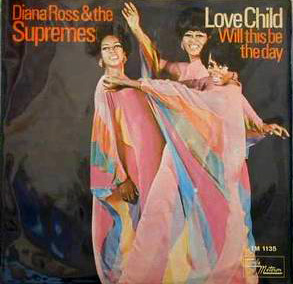
The departure of Holland-Dozier-Holland reverberated throughout Hitsville, but no one felt it as acutely as the Supremes. Between 1964’s “Where Did Our Love Go” and 1967’s “Reflections,” the powerhouse songwriting and production triumvirate landed 10 songs at No. 1 and a three more in the Top 10.

Berry Gordy spared little expense in turning the Supremes into the biggest group on his label, and he was loathe to see them slink back to their pre-HDH obscurity. Before the two trios met, the best the Supremes could muster was No. 23. Those numbers were no longer acceptable.

Desperate, Gordy sequestered a half dozen of his best writers in a Detroit hotel and demanded they come up with a new hit for Diana Ross and the Supremes. Credited anonymously to “The Clan,” the result was another No. 1 hit for Gordy’s favorite group. The Clan model worked so well, Gordy revived it the following year, this time as “The Corporation,” to write hits for the Jackson 5. Gordy gave both these teams generic names to prevent writers and producers from superseding the fame of the performer or the label.

It would have been fascinating to be a fly on the wall as the writers pitched this song to Gordy. Love songs were the Supremes bread and butter, but it’s doubtful Gordy envisioned his siren singing about abstinence. In “Love Child,” a woman, scarred by being born out of wedlock, the singer tries to convince her man to “hold on just a little bit longer” and understand that “no child of mine will be bearing/The name of shame I’ve been wearing.” “Love Child” wasn’t the first song to touch on unwanted pregnancy – Gordy himself and Smokey Robinson wrote the song  “Bad Girl” in the early days of the Miracles  – but it became the definitive song on the subject until “Billie Jean.”

Diana Ross is the only Supreme to appear on “Love Child,” and for once her voice does a song justice. This might be because the background of the woman in the song mirrors Ross’s childhood in the Brewster-Douglass housing project in Detroit. Unlike the song’s subject, Ross was born to married parents. The painfully shy Ross could no doubt to the lyrics like “So afraid that others knew I had no name” and “I started school/And a worn, torn dress that somebody threw out. Too poor to afford the stylish clothes she coveted, the aspiring fashion designer made her own clothes cobbled from scraps and hand-me-downs.

“Love Child” opens with a few bars of funk guitar before the sweep of strings relegate the guitar to the back of the mix. The arrangement – particularly the strings and backing vocals – foreshadows the disco trend that would serve Ross so well in the decade to come. For such a hard-driving song, the percussion is surprisingly soft. During Hitsville’s production-line heyday, the song would have been driven by snare and tambourine. Nearly a minute of “Love Child” passes before the snare a full drum kit completely engage. Instead, the propulsion rests with what sounds like ride cymbal, maracas and a glockenspiel.

Although they aren’t on the record, Mary Wilson and Cindy Birdsong performed the song with Ross on the Ed Sullivan Show in September, 1968. Despite the show’s conservative stance against the Rolling Stones “Let’s Spend the Night Together,” and the Doors “Light My Fire,” they lyrics to “Love Child” were performed as-is with no discussion. It was one of the group’s final performances on the popular Sunday night TV staple.

Despite its success, few performers have covered “Love Child.” It is unlikely the Supremes number will be confused with Deep Purple’s 1975 song of the same name.

Marvin Gaye and Tammi Terrell – “Ain’t Nothing Like the Real Thing”

ain't nothing
Marvin Gaye and Tammi Terrell – “Ain’t Nothing Like the Real Thing,” Pop # 8, R&B # 1

By Joel Francis

Marvin Gaye and Tammi Terrell’s first album together, “United,” was a smash that spawned three Top 5 R&B hits and turned Gaye into a soul superstar. A follow-up was inevitable. In March, 1968, less than three months after the release of their previous single, “Ain’t Nothing Like the Real Thing” announced the fruits of the duo’s new collaborations.

“Ain’t Nothing Like the Real Thing” is more of a Brill Building pop song than a soul number. Each singer gets two brief verses, but the heavy emphasis is on the chorus, which is usually repeated. There is a touch of Carol King’s phrasing in Terrell’s verses and the piano line – particularly the bit that introduces the first verse owes to King’s style. Although the structure is deceptively simple, the song works because the hook allows the complementary voices to dance. The clever bridge also surprises up the verse-chorus structure.

The song is definitely outside of the Motown paradigm, but Gaye’s voice , especially the soulful moans that appear after the drums and bass introduce the song, let the listener know we’re still deep in Motown territory.

Sadly, “Real Thing” was the next-to-last “real thing” Gaye and Terrell worked on together. In October, 14, 1967, following the completion of the No. 1 R&B hit “You’re All I Need To Get By,” Terrell collapsed in Gaye’s arms while performing at college homecoming in Virginia. Doctors diagnosed Terrell with a brain tumor and her days as a singer and performer were over.

Gaye completed the pair’s second album, “You’re All I Need,” by overdubbing his voice to Terrell solo recordings, a trick reprised on the duo’s third and final album, “Easy.” Largely present in name only, “Easy,” found Valerie Simpson standing in for Terrell on all but two albums. “Easy” spawned three Top 20 R&B hits, but nothing as influential or wonderful as “Real Thing.”

When Terrell died at age 24 on March 16, 1970, Motown released her final “duet” with Gaye in tribute.

“Ain’t Nothing Like the Real Thing” has been a go-to duet for 40 years. Diana Ross and the Supremes were the first to capitalize, recording a version with the Temptations in 1969. The following year the Ross-relieved Supremes cut another version with the Four Tops. The Jackson 5 included their cover on their 1972 album “Lookin’ Out the Windows.” Aretha Franklin recorded a rare solo version of the song in 1974.

Other performers to record “Real Thing” include Donny and Marie Osmond, Gladys Knight and Vince Gill, Elton John and Marcella Detroit, and Beyonce and Justin Timberlake. Michael McDonald and Boyz II Men also included interpretations of the number on their Motown tribute albums.

Johnny Cash – “Flesh and Blood”

june_carter_johnny_cash-wedding
Johnny Cash – “Flesh and Blood,” Pop #54, Country #1

By Joel Francis

Johnny and June had only been married for three years when Cash penned this love song for his wife. In that time, Cash had rejuvenated his career with two hugely successful live albums recorded in prisons and earned his own weekly television show.

Although these endeavors burnished under the name “Johnny Cash,” June Carter was no less responsible for their success. With a smoldering strength, she challenged and sustained as her man finally kicked the drug addiction that had plagued him for the better part of a decade and proudly supported him through his rejuvenation – personally, artistically, commercially and otherwise.

The list of adjectives used to describe the Man in Black is a million miles long, but “devoted” has to rank near the top. In “Flesh and Blood,” Cash celebrates his love for his wife and slips in some sideways admiration for his savior.

Bolstered by his omnipresent boom-chicka rhythm section, Cash rhapsodizes about afternoons spent outdoors and nature’s beauty. The majesty of Mother Nature is a feast for the mind and spirit, Cash sings, but “flesh and blood needs flesh and blood, and you’re the one I need.”

Cash grows philosophical on the bridge, for as great as the day had been, he knew it was all temporary. “Love is all that will remain,” Cash intones. In the New Testament, Jesus talks of three types of love: agape, eros and philia. For most of the song, Cash has been singing about eros, or romantic love. But in the bridge, he shifts to singing about agape, or godly love, and philia, love between friends. Eros will fade, he implies, but agape and philia will sustain. This clever turn not only subtly sows a bit of gospel, but universalizes Cash’s eros love for his wife into the broader forms, expanding the palate to a love everyone can understand.

In the 1969 documentary “The Man, His World, His Music,” there is a scene of Cash rehearsing the song at home for his wife. The song was sweetened with strings in the studio, but its soul was intact there on the sofa as Cash found a way to say what every woman wants to hear: All this other stuff is nice, but as long as I’ve got you, I’ll forever be happy.

Bobby Taylor – “Does Your Mama Know About Me”

mama know
Bobby Taylor – “Does Your Mama Know About Me,” Pop # 29, R&B # 5

By Joel Francis

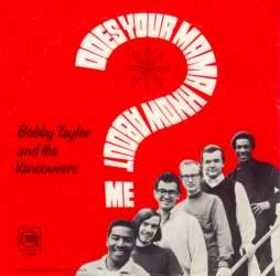
North Carolina native Bobby Taylor was working with a trio of Canadian musicians performing Motown numbers in Vancouver when the group caught the attention of Supremes Mary Wilson and Florence Ballard. The pair excitedly contacted Berry Gordy after hearing Bobby Taylor and the Shades in concert, and Gordy signed the group to his Gordy Records subsidiary.

Unfortunately, the excitement over Taylor’s stage shows failed to translate over records to a wider audience, and the group broke up in 1969 after one album and a handful of lukewarm singles. “Does Your Mama Know About Me” was the group’s biggest hit, peaking at No. 29 on the Pop chart.

Although Taylor’s Motown footprint is shallow, he had a hand in scouting and nurturing several well-known performers. While he was never a member of the Shades – later rechristened the Vancouvers by Gordy – Taylor recalled that Seattle guitarist Jimi Hendrix played with the group on several occasions. Shades drummer Floyd Sneed went on to join Three Dog Night. After booking a local band to open for them in Chicago, Taylor recommended Gordy sign the Jackson 5. He went on to produce the majority of the band’s debut album.

The Vancouver to go onto greatest acclaim, though, was the band’s guitarist. The half-Chinese, Scots-Irish born Thomas Chong co-wrote “Does Your Mama Know About Me” and performed on two more Vancouvers singles before being fired for missing a gig – he was applying for a green card – and becoming a superstar as half of the comedy duo Cheech and Chong.

With its sweeping strings and lush orchestration, “Does Your Mama Know About Me” feels more like a Philly soul number than a Motown production. This type of arrangement was used to great effect by Kenny Gamble and Leon Huff on early ‘70s soul hits like “Me and Mrs. Jones” and “If You Don’t Know Me By Now.” Although Gamble and Huff developed their sound independently – though they were no doubt keeping an ear trained on Motown – “Mama” illustrates how Motown continued to be at the vanguard of soul music beyond the departure of Holland-Dozier-Holland and its production-line sound.

A forgotten footnote, the only noteworthy cover of “Does Your Mama Know About Me” was performed by Diana Ross and the Supremes and included on their 1968 album “Love Child.”

Rita Wright – “I Can’t Give Back the Love I Feel For You”

syreeta
Rita Wright – “I Can’t Give Back the Love I Feel For You,” did not chart

By Joel Francis

Rita Wright is best known by her 1970s stage name, Syreeta. Before she collaborated with – and briefly married – Stevie Wonder, and scored a handful of Adult Contemporary hits with Billy Preston, Wright was a Pittsburgh transplant working as a secretary for Motown. Wright managed to catch the ear of Brian Holland, who signed her to the label. Holland collaborated with Ashford and Simpson – the songwriting team ironically brought in to replace the defected Holland, his brother Brian and their partner Lamont Dozier – on her 1968 debut, “I Can’t Give Back the Love I Feel For You.”

The song opens with a jarringly dissonant horn line before settling upon Wright’s soft voice. Although her performance is strong, the arrangement betrays the track’s origin as an abandoned Diana Ross and the Supremes cut. Although Ross eventually cut the song as a solo track for her 1971 album “Surrender,” Wright’s version could easily be confused for a lost Supremes track.

Although “I Can’t Give Back” didn’t chart, Wright had a successful recording career. She co-wrote “Signed, Sealed, Delivered” with Wonder and the Spinners’ hit “It’s A Shame.” Her first two LPs, 1972’s “Syreeta” and 1974’s “Stevie Wonder Presents: Syreeta” are hidden soul gems.

Ross’ version of “I Can’t Give Back” came in the middle of a sort of renaissance for the number. Dusty Springfield covered it in 1970 during the sessions to her follow up to “Dusty In Memphis,” the Philly soul masterpiece “A Brand New Me.” The final lineup of the Jeff Beck Group, featuring vocalist Bobby Tench, put their stamp on the song in 1972.

The Temptations – “I Wish It Would Rain”

rain
The Temptations – “I Wish It Would Rain,” Pop # 4, R&B # 1

By Joel Francis

“I Wish It Would Rain” had been out less than two weeks when songwriter Roger Penzaben took his life on New Year’s Eve, 1967. The heartache and melancholy Temptation David Ruffin poured into his singing was Penzaben’s story.

In the spring of 1967, Penzaben caught his wife in an affair. Unable to cope with the pain and betrayal, Penzaben dumped his feelings into the lyrics. Producer Norman Whitfield and Barrett Strong, who had previously teamed on Tempts’ classics EX.

The song opens with a few stately piano chords before Ruffin takes over. Backed only by a tambourine, it’s practically a cappella. Ruffin’s voice drips with so much sorrow that it’s hard to believe just three years prior he had “sunshine on a cloudy day.”

The understated strings and arrangement bear the hallmarks of Motown’s classic Holland-Dozier-Holland productions. It’s hard to believe that in less than a year, Whitfield and the Temps would be on the vanguard of the psychedelic soul movement.

It’s also hard to believe that “Rain” was Ruffin’s next-to-last single as a Temptation. Ruffin’s cocaine addiction and insistence that the group follow Smokey Robinson and Diana Ross’ leads and  be renamed “David Ruffin and the Temptations led to his firing in the summer of 1968. When the Temps again cracked the pop Top 10 with “Cloud Nine,” both Ruffin and Whitfield’s traditional arrangements were long gone.

Shortly before the Tempts debuted their psychedelic sound, Gladys Knight and the Pips took gave “Rain” an encore lap that reached Nos. 41 and 15 on the Pop and R&B charts, respectively. In 1973, Marvin Gaye recorded a funk version that was released as the b-side of his No. 1 hit “Let’s Get It On.” That same year, British slopsters The Faces had a U.K. hit with their interpretation. Aretha Franklin and hair metal band Little Caesar have also recorded versions of this miserable masterpiece.

Smokey Robinson and the Miracles – “I Second That Emotion”

Second Emotion

Smokey Robinson and the Miracles – “I Second That Emotion,” Pop # 4, R&B # 1

By Joel Francis

Smokey Robinson was Christmas shopping with fellow Motown songwriter Al Cleveland when Cleveland let slip the malapropism “I second that emotion.” Intrigued, Robinson penned a lyric about a man disinterested in flirting, fishing for long-term love. In other words, it’s the complete opposite of every Kiss song ever.

The arrangement and delivery is relaxed and easy. Never a forceful singer, Robinson lets the horns punctuate his pleas. His vocals are soft and comforting as a pillow, while Miracle Marv Tarplin’s guitar pulls the song over the unusually subdued percussion. There’s no climax or resolution to the number – the horn breakdown in the final moment is as close as we get. It’s almost like Robinson is auditioning the idea.

The song fades before we learn the woman’s reaction, but audiences were delighted, sending “I Second That Emotion” into the Top 5 and earning the Miracles their sixth million-selling single.

Less than two years later, Diana Ross and the Supremes and the Temptations teamed up for a television special and album. “Diana Ross and the Supremes Join the Temptations” featured their interpretation of “I Second that Emotion,” which was a Top 20 UK hit (the single was not released in America). The album marked the debut of new Temp Dennis Edwards, who replaced the troubled David Ruffin. Miracle guitarist Tarplin reprised his role for the all-star revision. The song has a diverse cover life, with performances issued by Jerry Garcia, ‘80s synth band Japan, and “Stand By Your Man” country singer Tammy Wynette.