Review: Pieta Brown, Truckstop Honeymoon

(Above: Pieta Brown sings to Loretta Lynn.)
By Joel Francis
The Kansas City Star
When Pieta Brown was in town almost two months ago, she played her songs before a sold-out Midland Theater. As the opening act on Mark Knopfler’s tour, she had a dream gig of full houses and open-minded audiences.

Opportunities like that can boost a career, but it doesn’t happen overnight. Which is why just seven weeks later, Brown was back. The material may have been the same, but without Knopfler’s boost, Brown had trouble drawing more than three dozen people to her early evening set Friday night at Crosstown Station.

These are the roller coaster realities of an emerging artist, all too familiar to Brown. The daughter of folk singer Greg Brown, she released her first solo album in 2002. Her latest release dropped in April. On those albums Brown has crafted a sound that will please fans of Kathleen Edwards, Carrie Rodriguez and the Cowboy Junkies.

As before, Brown arrived armed with guitarist Bo Ramsey, who not only produced several of her father’s albums, but has also worked with obvious influences Lucinda Williams, Ani DiFranco and Calexico. Brown’s songs provided ample space for his tasty, slow-as-molasses solos to drip out.

Above: Bo Ramsey, left, and Pieta Brown during a 2009 performance.

The duo’s 75-minute set included several stand-out numbers, including “In My Mind I Was Talking To Loretta,” an homage to the time Brown’s parents took her to see “Coal Miner’s Daughter” and she came home wanting to be “Roletta Lynn.” The song is also a tribute to the run-down Iowa shack she grew up in surrounded by “miles and miles of haystacks and miles and miles of gravel roads,” as she told the crowd.

Other high points included the new song “Prayer of Roses,” and “4th of July,” a poignant memory of a rural holiday. The country girl also mixed in several blues numbers, including an adaptation of “Rolling and Tumbling” and a cover of Memphis Minnie’s “Looking the World Over.”

The sparse crowd sat attentively, appreciative, but distant.  It was the type of polite crowd that would wait until between songs to get up and head to the bathroom. No one thought, however, to stand up and move closer, which left a 15-foot chasm between the stage and the first row of tables.

Although Brown’s material was strong, the similar moods and arrangements caused them to blend together after a while. Some of the audience started to get bored, as the chatter from the bar picked up until it threatened to overwhelm the last quarter of the set.

For all of her considerable talents, Brown would be better off teaming up with similarly minded and situated artists. This would take the pressure off of having to sustain a full set, and broaden her reach. She would be a great addition to the July bill at Crossroads that includes Dar Williams and Rodriguez.

Brown was long gone by the time Truckstop Honeymoon took the stage an hour later. The quartet not only had the benefit of a later time slot, but also a local following. After Hurricane Katrina washed out bass player Katie Euliss and guitar/banjo player Mike West’s New Orleans home, the couple relocated to Lawrence, Kan.

Augmented by mandolin player Jake Wagner and drummer Colin Mahoney, the pair traded and harmonized on verses like Johnny Cash and June Carter, refusing to take anything seriously. When Euliss sang about the Christmas she got her mama high it was hard to tell how much was she made up. Later, West introduced the original “My Automobile” as a P-Funk cover.

The 90-minute set also included several new songs, like “Latch Key Kid Recipe Book,” an ode to absent parents and oven pizzas. “Kansas in the Spring” drew a parallel between tornadoes in the heartland and hurricanes on the coast.

The best moment was “Vacation Bible School,” another song that felt autobiographical. After coaxing the crowd into singing along on the ridiculously convoluted chorus about getting kicked out of bible school, West broke the audience into three parts and held a yodeling competition.

Keep reading:

Carrie Rodriguez honors family, roots on new album

Review: Robert Plant and Allison Krauss

Elvis Costello – “Secret, Profane and Sugarcane”

(Below: You have to hear it at least once – Truckstop Honeymoon’s ode to vacation Bible school.)

Review – The Black Keys

(Above: Black Keys guitarist Dan Auerbach lays down some serious blues during “I Got Mine” at the band’s June 4, performance at Crossroads.)

By Joel Francis
The Daily Record

When the Black Keys last stopped in the area, they played a converted movie theater packed – but not quite full – with music geeks and underground music fans. Two albums and more than three years later, the Akron, Ohio drums-and-guitar duo returned to Kansas City Friday night before a sold-out throng of both hardcore and casual music lovers at Crossroads.

The crowds were different, but the set-up and arrangements for both shows were basically the same. With drummer Patrick Carney set up at mid-stage right, and guitarist Dan Auerbach at mid-stage left the pair delivered deep Delta blues filtered through several generations of garage rock. It’s Son House via the Stooges.

The pair kicked off with “Thickfreakness,” the title track to their second album, a thick slab of blues originally recorded in Carney’s basement back in 2002. The four songs that followed helped to explain the Keys’ boost in popularity. Although they’ve had no hit singles, several songs have been prominently placed in commercials, TV shows and movies. Ten years ago this was called selling out. Today it’s known as earning a living.

Whether or not fans recognized “10 A.M. Automatic” from “The OC,” saw “Set You Free” in “School of Rock” or learned “Strange Times” from playing “Grand Theft Auto” or watching “Gossip Girl,” nearly all of them sang along and weren’t timid with their whoops and hollers of approval. The band responded by egging them on, like when Auerbach teased a little bit of “Stairway to Heaven” in the intro to “Everywhere I Go.”

About 10 songs into the set, a bass player and keyboardist set up shop on a riser behind Auerbach. Although the number of musicians had doubled, the sound didn’t change too much. As expected, the songs were fuller, but the adding more players was really a testament to how much noise Carney and Auerbach make on their own.

Carney beats drums like they insulted him, but still coaxes subtlety from his kit. Auerbach can switch from bone-dry tone to sounding like an army of guitars with the simple stomp of a pedal. The auxiliary players were rarely able to penetrate this noise, but added nice nuances of texture when they did, like the keyboard part on “Too Afraid To Love You” that sounded like something from the Doors.

The sonic expansion also signaled the introduction of new material. Ostensibly in town to promote “Brothers,” the Keys’ sixth full-length album and best in some time, the quartet peel off nearly half of its tracks in succession. “Brothers” is less than a month old, but the crowd treated its songs with the same gusto they gave “I Got Mine,” a song played incessantly during last year’s baseball playoffs.

The Keys’ 2006 performance tapped out at 75 minutes, which felt like plenty. This time, though, they gave an hour and a half, and left the crowd wanting more. The expansion of their sonic palette delivered by Danger Mouse, who produced their previous album, and their foray into hip hop under the sobriquet Blakroc, tell part of the story. Auerbach told the rest in the lyrics of “Till I Get My Way,” the night’s final song: “don’t you know I will be calling on you every day/till I get my way.” The perseverance paid off.

Setist: Thickfreakness; Girl Is On My Mind; 10 A.M. Automatic; Set You Free; The Breaks; Stack Shot Billy; Busted; Everywhere I Go; Strange Times; Same Old Thing; Tighten Up; Howlin’ For You; Too Afraid To Love You; Next Girl; She’s Long Gone; Ten Cent Pistol; Your Touch; I’ll Be Your Man; No Trust; I Got Mine. Encore: Everlasting Light; Till I Get My Way.

Keep reading:

Review Roundup – Rakim, Dodos, Naomi Shelton, Blakroc and Daptone Gold

Review – Arctic Monkeys

Review: Modest Mouse

Review: Vampire Weekend

Review: Flaming Lips New Year’s Freakout

Review: Maxwell and Jill Scott

(Above: Maxwell performs “Fistful of Tears” in Dallas on the fall 2009 arena leg of the tour.)

By Joel Francis
The Kansas City Star

If the local birth notices are unusually high late next February, we’ll know why. Sunday night at Starlight, neo-soul stars Maxwell and Jill Scott set a romantic mood with three hours of slow jams designed to linger long after the last note expired.

Shortly after sunset, a silhouette appeared on the screen behind the band. As the 10-piece band vamped, Maxwell suavely strolled out in a three-piece suit and sunglasses. Women erupted in spontaneous shrieks of delight as he set the mood early with “Sumthin’ Sumthin’.”

It was hardly the only time Maxwell would play to the fairer sex. Over the course of his 90- minute set he praised (“Fortunate,” “Ascension”), chastised (“Cold”), apologized (“Pretty Wings”) and seduced (pretty much every other song) the women in the audience. The set comprised two-thirds of Maxwell’s 2009 comeback album “BLACKsummer’snight,” and another half dozen hits and favorites for good measure.

The band rolled through the first three numbers without stopping. The come-hither strut of “Sumthin’ Sumthin’” easily rolled into “Get To Know Ya” and an arrangement based on James Brown’s “The Big Payback.” After a New Orleans jazz breakdown and trumpet solo, the ensemble took a deft turn into the Kool and the Gang-inspired “Cold,” one of the most upbeat kiss-off songs of all time.

Nearly every musician backing Maxwell has a foot in the worlds of jazz and hip hop. Many members have collaborated with rappers Mos Def, Jay-Z or Diddy. Pianist Robert Glasper was received a Grammy nomination for his 2009 album “Double Booked.” This jazz pedigree was on display all night, in the way Glasper or organist Travis Sayles would respond to a vocal phrase, or feed off the rhythm section.
Although the size of venues, staging and setlists have changed, Maxwell and the band have been touring together for nearly two years now. They’ve had plenty of time to sand out the rough spots, and Sunday’s night was an effortlessly paced ride. The roughest element was likely the most surprising: Maxwell’s voice.

The rasp in Maxwell’s throat was obvious from the first number; by the fifth he ‘fessed up to overdoing it the previous night in St. Louis and asking for the audience to help him on the high notes he couldn’t hit. He then bravely launched into the falsetto-sung “This Woman’s Work,” holding the mic stand over the crowd on the chorus. It was a generous gesture, but Maxwell would have been better off letting back-up singer Latina Webb play a greater role. Their duet on “Reunion” was one of the better moments of the night.

This was a small hurdle to overcome. Maxwell’s voice grew stronger with each number, to the point that he was able to handle the high parts in a cover of the Isley Brothers’ “Don’t Say Goodnight” with ease. The set ended with two guaranteed crowd-pleasers, “Fortunate” and “Ascension.” On the latter, the very full (but not sold out) house delivered the entire first verse a capella, much to Maxwell’s delight.

Jill Scott had the misfortune of taking the stage with the sun blazing through most of her 80-minute set, rendering most of her lighting and effects moot. It wasn’t a big loss, though, because like Maxwell the focus was on her voice and her band.

The 10-piece group sizzled through the keyboard propelled “It’s Love” that got most of the crowd up and dancing. If that number bounced with the energy of a passionate night on the town, then the next song, “Not Like Crazy,” gently embraced the delicate pleasure of waking up next to that person the following morning.

The two new numbers were studies in contrast. “I Love You” rode a bubbly ‘80s synth line, but wasn’t a radical departure in sound or subject. “Hear My Call” was a desperate, dead-of-night cry for help in the aftermath of a relationship. Scott performed the song backed only by piano. When it was over, she walked to the opposite end of the stage where her other keyboard player started one of her most affirming songs, “He Loves Me.”

Soon the band and the crowd were both fired up, but Scott stopped the show with her near-operatic vocal display that brought a richly deserved standing ovation. Scott made sure everyone stayed on their feet with the girl-power anthem “Hate On Me,” early hit “A Long Walk” and carpe diem hymn “Golden.”

It would have been a delight to have Scott and Maxwell share the stage for a number, but even apart the pair was a perfect complement. Both realized their roles as facilitators as much as entertainers.

“I’m here to support, engage and enthuse,” Maxwell said suggestively.

Scott was more direct: “This is an effort to get y’all some tonight.”

Jill Scott setlist: Gimme, The Real Thing, Insomnia, It’s Love, Not Like Crazy > The Way, Come See Me, Crown Royal, I Love You (new song), Cross My Mind, Hear My Call (new song), He Loves Me, Hate on Me, A Long Walk, Golden.

Maxwell setlist: Sumthin’ Sumthin’ > Get to Know Ya > Cold, Lifetime, Bad Habits, This Woman’s Work, Help Somebody, Fistful of Tears, Stop the World, Reunion, Till the Cops Come Knockin’, Don’t Say Goodnight (Isley Brothers cover) > Fortunate, Ascension. Encore: Pretty Wings.

Keep reading:

Fans delay Maxwell’s next album

Review: Jill Scott at Starlight

Raphael Saadiq sends a love letter to soul makers and Motown

Jamie Foxx brings it to Sprint Center on Saturday

Review: James Taylor and Carole King

(Above: James Taylor and Carole King are accompanied by Leland Sklar (bass) and Russ Kunkel (drums) on “Ellen” in 2010.)

By Joel Francis
The Kansas City Star

For more than 30 years, James Taylor and Carole King have been writing the type of songs that fans want to hold close and wrap around themselves like a blanket. When the pair announced their joint tour, the material and musicianship were beyond question. The biggest hurdle lay in translating that intimacy to large spaces.

Taylor and King had no problem transforming the spacious Sprint Center into a cozy club for their two-and-a-half-hour performance Friday night. The stage set the mood. The raised white platform was situated in the middle of the floor, and surrounded by three rows of nightclub tables, each outfitted with a warm, glowing lamp.

The ambience was cemented when the duo entered through the crowd to take the stage. Taylor’s chair was positioned in the curve of King’s grand piano so the two could have constant eye contact while they played. Even when Taylor eventually stood up and King stepped away from the piano, the chemistry and closeness was evident.

The atmosphere was such that when someone shouted a request, Taylor picked the oversized setlist off the floor, pointed to the number and told them they’d get to it eventually.

Both singers were chatty, but Taylor had the better banter, cracking wise about calling the onstage seating “raised seats” because “high chairs” wasn’t right and “stools” sounded dirty. His wry sense of humor was also on display when he tried to set up the common theme between “Beautiful” and “Shower the People.”

“Here’s another song,” Taylor started. “I know that’s a surprise. ‘Oh, they’re going to play another song.’ Well, here we have two in a row that … I guess they’re all in a row. We tried doing them all at once, but it didn’t work.”

The sold-out crowd (although both of the end sections up top were curtained off), devoured every syllable, musical or otherwise. Each song was greeted with thunderous applause that threatened to overwhelm the performance at times. When the band joyously performed the Motown classic and Taylor hit “How Sweet It Is (To Be Loved By You)” they seemed to be singing to the appreciative audience as much as themselves. The response definitely surprised the performers, particularly King, who took the stage for the encore looking at the crowd in wonder, mouth agape.

King’s reaction was genuine, but she shouldn’t have been so shocked. The setlist included all but three songs from King’s masterpiece “Tapestry” and nine of the 12 cuts on Taylor’s best-selling “Greatest Hits” collection. This night wasn’t about introducing new material, but to reunite with longtime musical friends.

“Fire and Rain,” “So Far Away,” “Country Road,” “Crying in the Rain.” Nearly every number could have been a defining moment. The biggest moments were the small ones, like Taylor’s exquisite harmony on “Will You Still Love Me Tomorrow” on the line “when the night/meets the morning sun.” Or the way Taylor and King traded verses on “You’ve Got a Friend.”

During “Smackwater Jack” and “I Feel the Earth Move” the 68-year old King bounced around stage like a teenager. Not to be outdone, the 62-year-old Taylor strapped on an electric guitar for the crackling “Steamroller.” After blowing a harmonica solo, he duck walked across the stage. The blues song was out of Taylor’s normal dynamic, but the audience response was so great Taylor should consider cutting an album on the Alligator label.

Before the third song, Taylor introduced the band so the audience could fully appreciate the accompanists. Bass player Leland Sklar, drummer Russ Kunkel and guitarist Danny Kortchmar are collective known as The Section.

The three defined the mellow, Los Angeles sound of the 1970s singer/songwriter movement, appearing not only on “Tapestry” and “Sweet Baby James,” but several records by Jackson Browne, Warren Zevon and Jimmy Buffett. Sklar and Kunkel’s playing was tasteful and understated, with every note or beat serving the song. Kortchmar relished the times he could cut loose with a solo, like on “Smackwater Jack” and “Jazzman.”

The Section was augmented by a trio of backing singers and keyboard player Robbie Kondor. Singer Arnold McCuller took the crowd to church with his Gospel delivery during “Shower the People” that was the first big moment of the set. It made for a hard song to follow, but King pulled out one she wrote that was made famous by the Queen of Soul, “(You Make Me Feel Like) A Natural Woman.” When the chorus hit, everyone in the arena became part of the ensemble.

The evening ended with the quiet “You Can Close Your Eyes.” Accompanied only by Taylor’s guitar, the two sat side by side, King staring into Taylor’s eyes as she harmonized. As the last note rang out, she briefly rested her head on his shoulder before the two rose and strolled off, hand in hand.

“This reunion has been waiting to happen since the early ‘70s,” Taylor had said earlier. But for the fans present the question isn’t “What took you so long?” Rather, it’s “When are you coming back?”

Setlist: Blossom, So Far Away, Honey Don’t Leave L.A., Carolina On My Mind, Way Over Yonder, Smackwater Jack, Country Road, Sweet Seasons, Mexico, Song of Long Ago > Long Ago and Far Away, Beautiful, Shower the People, (You Make Me Feel Like) A Natural Woman. Intermission. Copperline, Crying in the Rain, That Sweet Old Roll (Hi-De-Ho), Sweet Baby James, Jazzman, Will You Love Me Tomorrow, Steamroller, It’s Too Late, Fire and Rain, I Feel the Earth Move, You’ve Got A Friend. Encore: Up on the Roof, How Sweet It Is (To Be Loved By You), You Can Close Your Eyes.

KC Recalls: Johnny Cash at Leavenworth prison

(Above: The Man in Black tells the story of “A Boy Named Sue” at San Quentin in 1969.)

By Joel Francis
The Daily Record

Leavenworth Federal Penitentiary has held some notorious figures during its storied history. Former heavyweight champion Jack Johnson, Kansas City political boss Tom Pendergast, disgraced quarterback Michael Vick and Robert Stroud, later known as the “Bird Man of Alcatraz.”

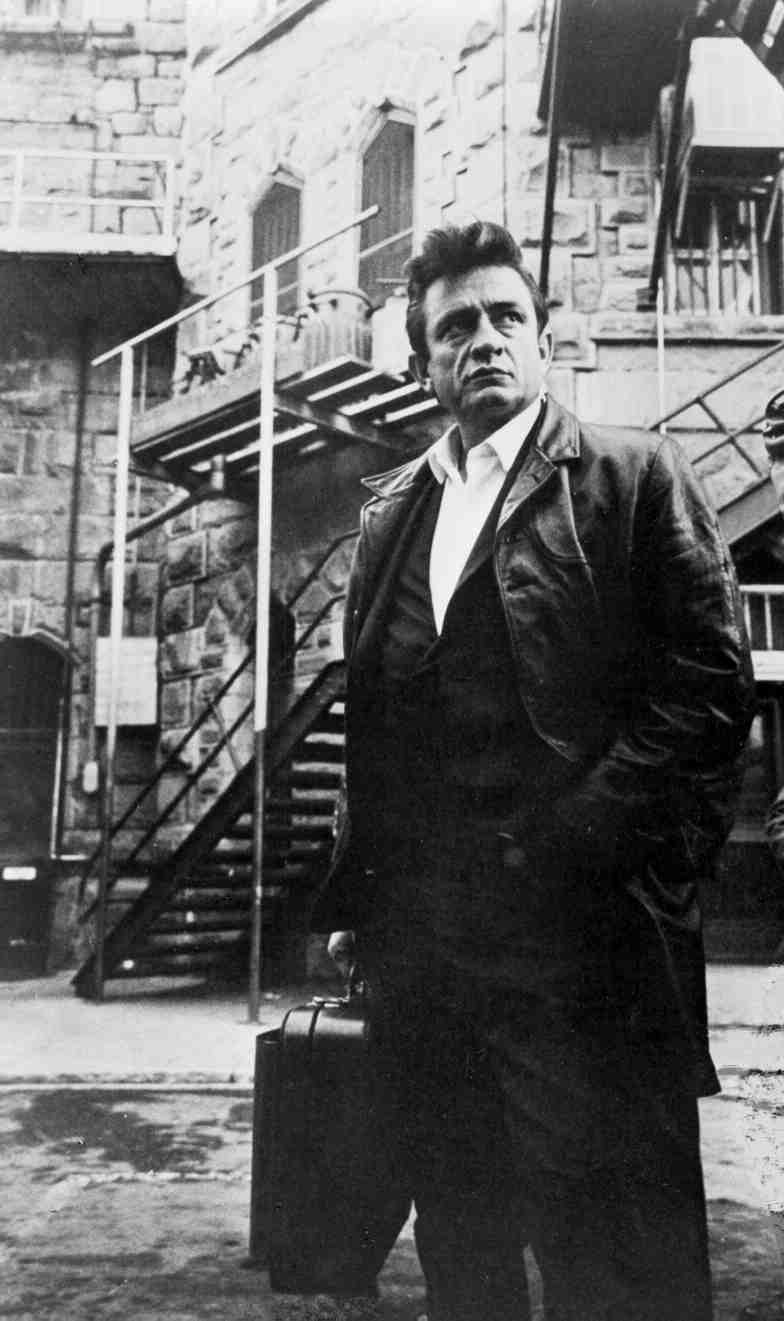
Forty years ago, one of the most famous men on the planet entered Leavenworth prison voluntarily: Johnny Cash. Cash was at the peak of his powers in 1970. Two earlier prison albums, recorded at San Quentin and Folsom, had not only re-established Cash’s reputation, but earned him a television show on ABC. The Man in Black was beamed into nearly four million homes each week and selling out big venues, such as Madison Square Garden.

Cash shuffled into Leavenworth between taping two episodes of his show, a month after playing the White House and 10 days before performing at a Billy Graham Crusade in Knoxville, Tenn. A series of thunderstorms and tornado warnings threatened to sabotage Cash’s penitentiary appearance, but the weather relented.

Inmate Albert Nussbaum recalled Cash’s visit in an essay included in the book “Ring of Fire: The Johnny Cash Reader.”

A pensive Cash in Folsom Prison, 1968.

“When the notice appeared on cell house bulletin boards – and even before, when rumors started to circulate – a tension began to build,” Nussbaum wrote. “Cash was going to arrive on a Friday afternoon. The prison factory was going to close. Anyone who wanted to see the show could.”

A makeshift stage was erected in the prison exercise yard; wooden bleachers for the prisoners were set up in the infield of the prison’s baseball diamond. The day’s schedule is unclear. Nussbaum reports the bleachers started filling up at 10 a.m. even though Cash wasn’t expected to arrive until 2 p.m. The Leavenworth Times reported he played in the morning.

Whatever the order, this much is clear: Cash’s entourage played three institutions that day. The troupe performed at Kansas State Penitentiary and Kansas Women’s Industrial Reformatory in Lansing either immediately before, or after playing Leavenworth. The night before, they performed at Municipal Auditorium in Kansas City, Mo.

The show opened with the standard brief opening sets from Carl Perkins, the Statler Brothers and the Carter Family. When Cash finally took the stage he told the 1,200-strong crowd “This is the same show we did for President Nixon, but we’re going to try a little harder here.”

The weather had backed off enough to allow the concert to be held outside, but it still wrecked havoc with Cash’s band, particularly the dresses worn by the backing singers. Strong gusts kept sending skirts skyward, so the Carter sisters banded closely around Robbie Harden, who was having the most trouble.

The prisoners, of course, delighted in any glimpse of female flesh they could gather. After a particularly strong stream of cheers and whistles Cash egged the prisoners on and goaded his singer. “They’re talking to you, Robbie,” he needled.

Cash also teased the audience.

“My mother told me when I was a little boy, be the best you can be at whatever you do,” Cash said. “If you’re going to be a baker, bake the best bread in town. If you’re going to pick cotton, pick more than any other man in the county … and if you’re going to rob banks, hit First National.”

During “Folsom Prison Blues” Nussbaum reported that Cash switched the song’s locale to Leavenworth.

“When he reached the words ‘I ain’t seen the sunshine since I don’t know when’ we who hadn’t seen the horizon in years were able to identify with the tone and mood of the song,” he wrote. “It captured our own feelings so exactly that our roar of approval completely drowned out the music.”

The cascade of hits and emotions – including “A Boy Named Sue,” “The Prison Song” and “Peace in the Valley” – combined with Cash’s physique and all-black attire made the legend seem larger than life to Nussbaum.

“It wasn’t his size or his costume that captured and held everyone’s attention – it was the look on his face and the sound in his voice,” Nussbaum wrote. “Cash is real. He has a bad cough and smokes too much. So did most of us who had come to see him. He has a look of suffering caused by a hard life and years of one-night stands in forgettable places. We all had pasts we didn’t like to think about either.”

After the show, Cash ambled over to the boundary near where the prisoners were corralled, shaking hands and signing autographs.

Cash was playing before a paying audience the previous night in Kansas City, but no less thrilling. Jerry Kohler covered the show for the Kansas City Star.

“A cross-section of Middle America … packed the auditorium to hear Johnny Cash tell it like it is,” Kohler wrote. “He didn’t disappoint.”

According to Kohler, high points included “Walk the Line,” “Jackson” and “Were You There When They Crucified My Lord.” Kohler also mentioned the Statler Brothers’ reading of “How Great Thou Art” and the two songs featuring Mother Maybelle Carter on lead vocals, “Wildwood Flower” and “Black Mountain Rag.”

The joyous evening ended with the best news of the night when Cash announced his TV show had been renewed for another season.

“We’ll try to keep it honest and down to earth,” Cash said of the upcoming season. Whether in prison, on tour or over the air there was no other way the Man in Black would do it.

Keep reading:

KC Recalls: Elvis Presley at Kemper Arena

Stuck in a Moment: 9/11 and U2

Lanois + Raffi = Eno

George Kalinsky: Painting with Light

Clark Terry’s Last Stand

(Above: A somewhat recent performance of Clark Terry’s signature song, “Mumbles.”)

By Joel Francis
The Daily Record

Perhaps only baseball reveres its heroes of the past as much as jazz. Each year, Stan Musial, Ted Williams or another bygone star is paraded around the field before the All-Star Game. Likewise, the songbooks passed down from Miles, Duke, Satchmo, Monk and others are considered sacrosanct.

Unlike baseball fans, however, jazz traditionalists are loathe to replace their legends with up-and-comers. This makes it frustratingly inconvenient when the links to that halcyon era keep dying.

Fortunately, Clark Terry was up to the task Friday night at the Gem Theater for the American Jazz Museum’s Duke Ellington celebration. The 89-year-old trumpet master played with Ellington for 10 years, led Johnny Carson’s Tonight Show band, and recorded with Oscar Peterson, J.J. Johnson, Thelonious Monk and scores of others throughout his eight-decade career.

Fellow Ellington orchestra alum Barrie Hall, Jr. introduced Terry by reminiscing when he was able to record with his hero on the soundtrack of the “Fabulous Baker Boys.” Stationed in a wheelchair, Terry appears from the backstage recesses of stage right, hidden in the wings.

As the applause built, Terry’s son, standing behind the chair, frantically waves his arms, as if to call the celebration off. The museum’s two-day tribute to Ellington has been building to this moment. Has something gone wrong? Will Terry not be able to appear after all? Killing time, Hall nervously sings a few stanzas of “Do Nothing ‘Till You Hear From Me.”


Clark Terry receives the American Jazz Museum lifetime achievement award from museum CEO Greg Carroll in Kansas City, Mo. on April 30, 2010.

Finally, Terry emerged, slumped in his chair, wearing a dark suit and white yachting cap reminiscent of Count Basie’s favorite headwear. A clear tube of oxygen runs beneath his nose, resting atop his albino moustache. A trumpet case is tantalizingly set next to Terry’s wheelchair, but it’s obvious he won’t be able to play even before the announcement is made.

As the band, led by Hall, kicks into “Full Moon at Midnight,” Terry rests his hands on the cane that stands between his knees. He takes in the saxophone solo by Ahmed Alaadeen. The esteemed Kansas City jazz fixture is another Ellington alumnus who received the museum’s lifetime achievement award earlier that evening.

When the song ended it was time for Terry to receive his own lifetime achievement award. His son pushes the wheelchair near the podium. As chief executive officer Greg Carroll reads a biography, Terry fiddles with his wristwatch, seemingly unsure of where he is. When the award is presented, he looks at the miniature bust of Charlie Parker in wonder as Carroll holds it up. Terry’s grip is too weak to clutch the statue.

While the camera flashes fade, Carroll looks at Terry and suggests a song. Terry looks so frail It seems an imposition to ask this much, but he graciously accepts the mic that has to be placed in his right hand. The band launches into “Squeeze Me,” one of Terry’s signature numbers with the Ellington orchestra. His warm voice starts out thin and strained, but grows stronger with each verse. The years fall away as he starts scatting the final verse, his left knee rocking up and down.

The applause is still strong when Hall looks at the band and blasts the intro to “Mumbles.” Terry joins right in and his nonsense spoof of blue singers brings laughter from the audience. He’s into it now, rocking back and forth and even backing his chair up so he can look Hall in the face as he supplies fills on his trumpet. Hall and Terry trade riffs back and forth from voice to horn and back like a jazz version of an Abbot and Costello routine.

The audience jumps to its feet with the final note, and a broad smile beams from Terry’s face. Wheelchair or not, it is obvious that when Terry is put onstage and given the mic he still knows exactly what to do. He has no difficulty conjuring smiles and making everyone happy. As his son wheels him offstage, Terry blows kisses and doffs his hat. A few songs later, Terry’s son and a nurse escort him quietly out of the building.

(Below: Clark Terry blows his horn on the Tonight Show in 1980.)

Keep reading:

Review: Sonny Rollins

Review: Oleta Adams

Review: Kind of Blue turns 50

Remembering Gennett Records

Releasing Jazz from Aspic

KC Recalls: The Coon-Sanders Night Hawk Orchestra

Buck O’Neil: Sweet times, sweet sounds at 18th and Vine

Piano Men: Dave Brubeck, Dr. John and the Jacksonville Jazz Festival

Review: Public Image Ltd.

(Above: John Lydon made his first post-Sex Pistols statement with “Public Image.” “Rise” is one of PiL’s most accessible tunes. Here the reunited band performs them at the 2010 Coachella music festival.)

By Joel Francis
The Kansas City Star

There was nothing rotten about the performance John Lydon and Public Image Ltd. delivered Monday night at the Midland Theater. Faced with a miniscule crowd in a minor market on a weeknight, Lydon and the band could have phoned in their performance and few would have known. The four-piece band held nothing back during the high-energy, two hour show.

Public Image Ltd., or PiL, is the band Lydon formed after the Sex Pistols imploded. Although the band carried on for 15 years, its catalog can be broken down into two distinct eras. The first three albums were a conscious deconstruction of the Pistols mythology, filled with long, heavy, experimental pieces. Later work boiled down to Lydon solo projects under the PiL name produced with a rotating cast of musicians (including, incredibly, Steve Vai).

The reconstituted PiL, back together for the first time since disbanding in 1992, drew equally from both eras, and tossed in a couple numbers from Lydon’s 1997 solo release for good measure. Older numbers, like the magnificent “Poptones,” the epic “Albatross” or “Chant” were studies in texture and ambience. As the rhythm section of Bruce Smith on drums and new member Scott Firth on bass anchored the songs, guitarist Lu Edmonds welded huge blocks of sound which Lydon penetrated effortlessly with his shrill voice.

The backing trio clearly enjoyed having the space to stretch out and play with different sounds. Firth and Edmonds sparred on “Flowers of Romance” before Edmonds delivered his first solo of the night on an electric banjo. Firth switched to upright electric bass for several numbers which added extra punch to Smith’s cadences.

Although Lydon was about the same age as his gray-haired compatriots he appeared decades younger. His head was shaved, save long, blonde spikes on top that looked like a mischievous crown. After removing a red vest early in the night, Lydon was clad entirely in black. He kept a lyric book on a music stand near his mic and although he rarely looked at them during a number, he dutifully turned the page after each song. When Lydon was really feeling the music, he would hop up and down or do a robo-monster march, a manic expression plastered on his face.

While the older material was dark and amorphous, the newer songs were bright, poppy and quite danceable. The set opened with PiL’s biggest number, “This Is Not a Love Song.” Later, “Sun” was delivered via acoustic guitar and mouth organ. As Lydon led the crowd in sing-along, the arrangement almost had a klezmer feel. “Disappointed” got the biggest reaction during the main set and had everyone near the stage bouncing. Lydon later joked about the song’s message of forgiveness didn’t quite stand with the cynicism of his other tunes.

During his four decades in the spotlight, Lydon has cultivated a reputation for acerbically speaking his mind, and he didn’t disappoint onstage Monday. “Warrior” contained a political diatribe and a few not-so-kind words for Sarah Palin. Lydon introduced “Religion” as “a song that is 30 years old and as accurate as ever.” He then made a few comments about the Pope that won’t be earning him a Vatican invite any time soon.

The night ended with “Public Image,” the song that most resembles Lydon’s former band, and the upbeat “Rise,” which contains an interpretation of the Irish blessing “may the road rise to meet you.” “Open Up,” Lydon’s collaboration with the techno duo Leftfield, closed the night. As the crowd danced to the heavy bed of looped synthesizers, Lydon’s voice panned and swirled around the room.

As the band waved good night, the punk provocateur let his guard drop with a fleeting moment of sincerity when thanked everyone from the bottom of his heart for coming out. The tiny crowd comfortably filled the first two tiers on the floor, but the third was sparse and the fourth was empty.There were a few dozen people sitting on chairs in the back, but the entire audience could have probably crammed into the Beaumont Club. That venue may have been more size-appropriate, but it wouldn’t have been much fun. PiL had no problem filling the vast Midland, and Lydon’s outsized persona needed – and deserved – a bigger stage.

Setlist: This Is Not A Love Song, Poptones, Memories, Tie Me to the Length of That, Albatross, Death Disco, Flowers of Romance, Psychopath, Warrior, USLS 1, Disappointed, Sun, Bags, Chant, Rise, Religion. Encore: Public Image, Rise, Open Up.

Keep reading:

Review: Carbon/Silicon at the Record Bar

Ever Fallen For The Buzzcocks?

Review – Greg Ginn and the Taylor Texas Corrugators

Go green with Stiff Little Fingers

Dischord finds harmony in D.C. hardcore scene

Review: Jonsi

(Above: This live version of “Grow Till Tall” doesn’t begin to capture the emotion of experiencing it in person.)

By Joel Francis
The Kansas City Star

When bands play Liberty Hall, they usually park their bus on Seventh Street, on the south side of the building. Prior to Jonsi’s show on Thursday night, that space was conspicuously empty except for two huge generators with power cords running inside the theater.

The generators only hinted at the energy Jonsi, lead singer for the atmospheric indie rock band Sigur Ros, would pour into his 80-minute set. The performance culminated with “Grow Till Tall” and the most powerful emotional moment I’ve experienced at a concert.

Before we get to that, however, a little context is appropriate. The Icelandic quartet Sigur Ros formed in the late ‘90s, but didn’t break through until their 2002 release. The album didn’t have a title – fans have named it “()” or parenthesis based on the symbols on the cover – or song titles. The lyrics are in Hopelandic, a nonsense language the band invented. It’s admittedly pretentious, but surprisingly accessible once one gets past the packaging and listens.

Sigur Ros songs are built on minimalist structures equally influenced by rock, classical and ambient elements. Imagine Radiohead singing in a foreign language spiked with a heavy dose of Brian Eno and you’re getting close. On his own, Jonsi still hews pretty closely that sound. Although he didn’t perform any Sigur Ros songs on Thursday, he likely could have slipped one in and only the audience response would have given it away.

Backed by a four-piece band that included his partner Alex Somers on guitar, Jonsi delivered all of “Go,” his debut solo album released this month, and four new songs that didn’t make it on the record. Jonsi and Somers, the masterminds behind “Go,” crept onstage together in the dark, the unmistakable falsetto of Jonsi’s voice marking their entrance. While Jonsi played acoustic guitar, Somers used a violin bow on vibraphone keys to create a gentle feedback. The rest of the band emerged on the next number, but this approach – Jonsi’s gorgeous, angelic voice placed within inventive settings – remained a hallmark of the night.

The music was bolstered by the theatrical staging. Four large, luminescent boxes framed the stage and an intricate glass and screen installation stood behind the band. As the projections on the boxes and screen changed, so did the mood of the room. All the images were developed by 59 Productions, and at times the combination of music and visuals threatened to overwhelm the senses. One could almost feel the heat from the fire projected around the band, smell the ozone after the simulated storm and taste the fat, wet raindrops dripping down the screens.

The band shifted textures by changing instruments after nearly every song. On a given number there might be three people playing keyboards, or two guitarists, or toy piano, percussion, vibraphone or digital manipulation. The consistent musician was drummer þorvaldur þorvaldsson. Þorvaldsson attacked his kit with the power of John Bonham or Dave Grohl, but had the finesse of a seasoned jazz drummer. More than any one player, he could change the mood of a song with a single cymbal crash and he was frequently the driving force behind the powerful crescendos.

The main set closed with Jonsi on piano, a single light shining over his shoulder. It felt like the house was privy to a late-night songwriting session. The number, appropriately titled “New Piano Song,” gave way to “Around Us.” As the melody entered, a golden glow of light settled on the crowd that felt like a sunrise. The song ended with Jonsi’s singing dissolving into a digitized barrage of vocals that ended suddenly, letting his live, pure sound ring out.

The sold-out crowd responded as it had throughout the night, waiting until the number was finished, then jumping to its feet with applause. Each number was held hushed reverence, punctuated by delighted bursts of applause between numbers. It seemed no one wanted to break the spell by talking. Pristine sound also helped perpetuate the atmosphere.

When Jonsi returned, he wore something on his head that resembled an American Indian headdress and matched the multi-colored fringes on his shirt. After “Animal Arithmetic,” the quintet moved into “Grow Till Tall.” With a forest scene projected around the band, it felt like the performance was coming from the home of “Where the Wild Things Are.”

As the song shifted, autumn settled on the forest and falling leaves swirled around the musicians. The leaves gave way to a gentle snow, which warmed into a hard rain. As the rain intensified so did the performance. Jonsi was bent over at the waist, singing into the floor and the rest of the band flailed as if caught in a terrific wind.

Like a roller coaster car inching its way to the top of a hill, the music kept ratcheting in intensity, building past any release point until it became a dense sheet of white noise, and even then it continued to swell. It seemed the only thing that kept the audience from being engulfed by the sound and the building from being torn apart was the fragile magnificence of Jonsi’s voice that penetrated the noise.

Three hours after that moment, the emotion remains strong. In a review posted on Jonsi’s Web site moments after the show, one fan stated that the performance had taken her through every emotion except anger and she knew she wouldn’t be able to sleep. That should have given her plenty of time to drive up to Minneapolis for the next concert. I know of at least one person ready to go with her.

Setlist: Hengilas; Icicle Sleeves; Kolinour; Tornado; Sinking Friendships; Saint Naïve; K12; Go Do; Boy Lilikoi; New Piano Song; Around Us. Encore: Animal Arithmetic; Grow Till Tall.

Keep reading:

Radiohead Rock St. Louis

Review: Mutemath

Review: Yo La Tengo

Review: Lupe Fiasco

(Above: “Shining Down” was one of several new songs Lupe Fiasco performed at his recent concert at the Midland Theater in Kansas City, Mo.)

By Joel Francis
The Kansas City Star

Chicago rapper Lupe Fiasco’s Kansas City debut promised to touch the sky, but left many fans hanging in midair. While Fiasco’s 65-minute set was strong, the lack of an encore left the brief evening seeking resolution.

As his guitar player noodle a riff reminiscent of “Sweet Child O’ Mine,” Fiasco launched into “Shining Down,” a song he released as a on-line single last year. A handful of similarly low-profile or unreleased cuts were sprinkled throughout the set. It has been three years since Fiasco’s last release, and the crowd happily embraced the new material.

Hip hop always sounds better when delivered through live instruments. Fiasco’s band included a drummer and a DJ, who rocked two Macs instead of two turntables, and it flexed its muscles several times. The setlist included a devastating reading of Radiohead’s “The National Anthem” as Fiasco spit some of his most articulate and angry rhymes of the night. The players also bridged one song to another with brief solos or instrumentals.
.
Although the new songs were appreciated, the evening didn’t officially seem to start until the fifth number, “Hip Hop Saved My Life.” The performance raised a sea of hands and kicked off a powerful run through most of Fiasco’s biggest songs. A surprise detour through N.E.R.D.’s “Everybody Nose” (“all the girls standing the line for the bathroom”) led straight into “Go Go Gadget Flow” and Fiasco’s pride for the Windy City. The run culminated with the skateboard anthem that took Fiasco into the mainstream, “Kick, Push.”

The favorites were exhausted, but Fiasco still had plenty of tricks up his sleeve. “Scream,” another new track, was a low-key mood piece set in a wash of keyboards and guitars over insistent drumming and magical delivery. From there Fiasco made his biggest statement of the night. The trio of “Little Weapon,” a song about child soldiers in Africa, “Streets of Fire,” a portrait of inner-city gang culture, and “Fighters” created a stirring case against violence and war. 

The cavernous Midland was more empty than full. The upper balcony was closed and the floor was only three-quarters populated. While the fans’ energy rarely flagged, the sound suffered, and one had to wonder if the performance wouldn’t have been better in a smaller venue. 

A lot of the band’s sound seemed lost in the room. The drums were thin and it seemed only the guitar or DJ could be heard in the mix at the same time. Only Fiasco’s ultra-enunciated, rapid-fire rhymes consistently penetrated the space.

The set ended with two of Fiasco’s biggest songs off “The Cool.” “Superstar” is a portrait of the fragility behind a celebrity’s public armor, and the hook-happy “Paris, Tokyo” is a hip hop love song about life on the road.

When the band departed after a little over an hour, an encore seemed inevitable. Too many good songs –including Lupe’s duets with Kanye West, “Touch the Sky,” “Us Placers” – had yet to be played. Chanting for their return, the crowd continued to stand in disbelief when the house lights came on. As the canned music grew louder, they gradually filed out.

Les Izmore: The local MC turned his 30-minute opening set into a taste of the city’s hip hop scene. Backed by a DJ, he performed one number alone, then brought out Dutch Newman for another. His set really took off when the four-piece horn section and rhythm section from Hearts of Darkness came out. “Middle of the Map” had a tight James Brown feel, and the Afro-beat number “America One” got the crowd involved. Izmore took the stage wearing a duck head and leading the crowd in “Row, Row, Row Your Boat,” but quickly proved he’s no joke.

Setlist: Shining Down, Solar Midnite, The Instrumental, The National Anthem, State-Run Radio, Hip-Hop Saved My Life, High Definition, Everyone Nose (N.E.R.D. cover); Go Go Gadget Flow; I Gotcha; Kick, Push; Scream;Little Weapon; The Cool; Streets on Fire; Fighters; I’m Beaming; Superstar; Paris, Tokyo.

Keep reading:

Les Izmore – Jazz, hip hop collide to celebrate landmark album
Review: Talib Kweli & Hi-Tek
Professor Griff discusses the past – and future – of Public Enemy
Review: For The Roots It’s All In The Music

Review – Arctic Monkeys

(Above: The Arctic Monkeys put their spin on Nick Cave’s “Red Right Hand.”)

By Joel Francis
The Kansas City Star

Five years ago, the Arctic Monkeys arrived on the music scene riding a wave of hype. The influential British music publication the NME ranked the Arctic Monkey’s debut album, “Whatever People Say I Am, That’s What I’m Not,” ahead of the Beatles, Radiohead and the Clash on its list of top 100 British albums.

Monday night the English quintet came to Liberty Hall in Lawrence in support of its third album, “Humbug.” The transitional album didn’t command the propaganda and isn’t as flashy as their first two efforts, but that didn’t stop a nearly full house from rabidly devouring everything the band played.

Over the course of their 80-minute set, the Monkeys delivered more than half of “Humbug,” including a couple B-sides, and half of their second release, 2007’s “Favourite Worst Nightmare.” The contrasting material revealed two very different sides of the band. “Humbug”’s songs, for the most part, are more downbeat, while the cuts from “Nightmare” border on metal.

Opening number “Dance Little Liar” foreshadowed the juxtaposition with a drum cadence lifted from Metallica’s “One.” As the number died down, a bank of strobe lights behind the band kicked on and the group thrashed their way through “Brainstorm” with a performance that wouldn’t have been out of place at Ozzfest.

The band’s approach seemed to be to combine the angular approach of the Talking Heads and Gang of Four with the speed and intensity of Slayer. Slanted guitar lines, surf riffs and plenty of tremolo framed most of the songs. Even at their heaviest, the Monkey’s songs were infused with enough pop hooks to keep the crowd moving, although it was hard to tell if they were dancing or moshing.

Although the newer material was well received, the biggest cheers came for the three numbers from the band’s debut. The opening chords of “Still Take You Home” prompted a big response, and the crowd went nuts during the one-two of “The View from the Afternoon” and “I Bet You Look Good on the Dance Floor.”

Surprisingly those numbers arrived in the middle of the set. After lifting the crowd so high, there was nowhere to go but down, so Alex Turner strapped on an acoustic guitar for the country-tinged “Cornerstone.” Later, a deconstructed reading of Nick Cave’s “Red Right Hand” rendered the already spooky song in a completely new light.

The Monkey’s performed on a minimalist stage, in front of a plain curtain and a bank of lights raised about 10 feet off the ground by a series of poles. When the lights were on, which was frequent, it created an artificial ceiling and made the mid-sized theater feel like a cramped, sweaty basement.

Bass player Nick O’Malley is the band’s secret weapon. Tucked in the back corner at stage right, he supplied the needed melody underpinning the abstract guitar lines. As Jamie Cook and Andy Nicholson strafed the songs from unprecedented angles on their guitars, Malley’s melodic bass lines and Matt Helders’ manic drumming held the performances together.

The set ended with the poppy “Fluorescent Adolescent,” which sounded like a mangled Mod single. The aggressive “Nettles” had the crowd clapping along and featured more false endings than a Beethoven symphony. When the number final ended, the instruments were abandoned buzzing, leaving feedback long after the band had departed.

On the way back to the car, I overheard two fans lamenting that more songs from the first album weren’t performed.

“I guess what we have to remember,” one fan said, trying to console himself, “is that what would be new to us, these guys have been carrying for five years.”

Sleepy Sun: While the Arctic Monkeys focus on delivering tightly crafted, manic singles, opening act Sleepy Sun was content to play spacey, long-form album tracks. The six-piece San Francisco band’s 45-minute set was filled with psychedelic, progressive rock that incorporated more than a hint of Black Sabbath and first-album-era Led Zeppelin. The co-ed lead singers brought a touch of folk to the arrangements, particularly when tambourine, harmonica or acoustic guitars were introduced. Fans of Death Star and the Seven Dwarfs, Black Moth Super Rainbow and the Flaming Lips might want to keep an eye open for their next trip through town.

Setlist: Dance Little Liar > Brainstorm; This House is a Circus; Still Take You Home; Potion Approaching; Joining the Dots; My Propeller; Crying Lightning; The View from the Afternoon; I Bet You Look Good on the Dance Floor; Cornerstone; Fire and the Thud; Do Me A Favour; Pretty Visitors; Red Right Hand (Nick Cave cover) > If You Were There, Beware; 505. Encore: Fluorescent Adolescent; Nettles.

Keep reading:

Review: Flaming Lips New Year’s Freakout
Review: The Decemberists
Review: Megadeth
Review: Get Up Kids
Review: Modest Mouse