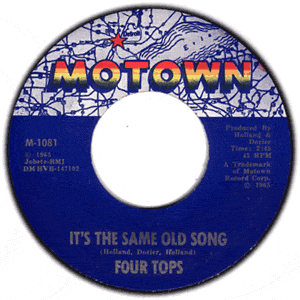
Four Tops – “It’s the Same Old Song”

341862
Four Tops – “It’s the Same Old Song,” Pop #5, R&B #2

By Joel Francis

There’s a good reason why “It’s the Same Old Song” sounds so much like the Four Tops’ previous hit, “I Can’t Help Myself:” both songs are built on the same chords, only in reverse order.

When “I Can’t Help Myself” hit No. 1 in June, 1965, the Tops’ old label, Columbia, tried to cash in by re-releasing a five-year-old Tops single. An upset Berry Gordy countered that Motown needed to quash that single with one of their own – in just 24 hours.

At 3 p.m. Holland-Dozier-Holland sat down to write. Just two hours later, the Tops had finished recording the number and the tune was ready to mix. By 3 p.m. the next day, 1,500 copies of “It’s the Same Old Song” had been pressed and sent to DJs across the country. The icing on this astounding feat of production came in the coming weeks, as the song eventually rose to No. 5 on the charts.

Like “I Can’t Help Myself,” the song is propelled by Funk Brother Jack Ashford’s vibe’s and Richard “Pistol” Allen’s drumming. The bubbly string arrangement also echoes “I Can’t Help Myself.” Unsurprisingly, the end result is a second helping of a joyous melody masking a melancholy lyric. If it ain’t broke….

In the late ’70s two groups proved it was anything but “The Same Old Song” with two very different covers. KC and the Sunshine Band turned in a disco version and Delroy Wilson gave a reggae reading. Neither translation made the charts.

The Miracles – “The Tracks of My Tears”

smokey

The Miracles – “The Tracks of My Tears,” Pop #16, R&B #2

By Joel Francis

Smokey Robinson had little to prove in 1965. Since joining Motown four years ago, he had not only given the label its first million-selling single and its first No. 1, but written, produced or performed on scores of classic tracks. Robinson was rewarded for all his work when his name was pulled out of the Miracles and given top billing.

“The Tracks of My Tears” was one of the first singles credited to “Smokey Robinson and the Miracles,” but Robinson wasn’t resting on his laurels. His heart wrenching vocals may be topped only by Levi Stubbs’ performance on “Ask the Lonely” as the label’s most powerful performance to date. With a voice packed full of heartache and longing, Robinson pulls back the mask, revealing his naked heart to his former lover.

Exhausted after meticulously maintaining his façade for the evening, and the truth seeps out of Robinson’s character when he’s finally alone. Ah that the pain of love could be so melodic. The song starts as if out of dream, introduced by the subtle but spectacular guitar line of Marv Taplin. The Miracles’ harmony vocals are the reassurance and support that are always absent in these dead-of-night confessions. The orchestra, xylophone and drumming are all perfectly arranged and placed. Everything pauses for the syncopation of the line “My smile is my makeup I wear since my break-up with you.”

“The Tracks of My Tears” is frequently lauded as not only Robinson’s best number, but one of the greatest songs of all time. It is also the Miracles’ most-covered song. Less than two year’s after the Miracles’ hit, Johnny Rivers cut a version. Aretha Franklin’s reading from “Soul ’69” is just wonderful. Her celebrated voice is framed by a gorgeous finger picked guitar and a tough brass arrangement that accentuates without overpowering. Most recently, the song has been covered by Dolly Parton and Elvis Costello, who sometime performs it in concert as a medley with his like-minded hit “Alison.”

Although the song is nearly 45 years old, it hasn’t aged a minute.

The Contours – “First I Look at the Purse”

262-contours
The Contours – “First I Look at the Purse,” Pop #57, R&B #12

By Joel Francis

The name on the label says “The Contours,” but all four of the singers who found success with 1962’s chart-topping “Do You Love Me” were gone by the time this number came out three years later.

A novelty song penned in the vein of Jerry Lieber and Mike Stoller’s classic Coaster’s numbers, it’s hard to imagine songwriters Smokey Robinson and Bobby Rodgers presenting this number to their group, the Miracles. But since none of the Contour’s follow-up efforts had cracked the Top 40, they had a little leeway for fun.

The production combines the Motown Sound with a spirit similar to Jimmy Soul’s 1963 hit “If You Wanna Be Happy.” In Soul’s song, ugly women cause fewer problems that pretty ones. For the Contours, fiscal assets are more desirable than physical ones. Or as the lyrics so eloquently put it, “If the purse is fat/that’s where it’s at.”

It’s not surprising the number failed to catch on, although it did prevent the group from becoming a one-hit wonder. What is surprising is the longevity of the group. As the original lineup fell away, Berry Gordy kept replacing members. Billy Gordon, the man who sang lead on “Do You Love Me” was replaced by Joe Stubbs, brother of Four Tops vocalist Levi Stubbs. After Stubbs left, Dennis Edwards was recruited to front the group.

It seemed the end for the Contours when the Temptations plucked Edwards to be their frontman in 1968. Founding member Joe Billingslea had other plans. Nearly 10 years after he left the group, Billingslea, a founding member, resurrected the name and hired four other singers to play and record with him around Detroit.

The band found themselves in demand after the Motown 25 concert and the 1988 film “Dirty Dancing,” which prominently featured “Do You Love Me.” The subsequent Dirty Dancing Concert Tour found Billingslea reunited with his old bandmate Sylvester Potts and recording for Motor City Records. In the early ’90s, Potts split from Billingslea’s quintet and started his own four-piece lineup, also called The Contours. Today, both Joe Billingslea and the Contours and The Contours featuring Sylvester Potts can be found on the oldies and county fair circuit.

Four Tops – “I Can’t Help Myself (Sugar Pie Honey Bunch)”

sugar-pie-honey-bunch
Four Tops – “I Can’t Help Myself (Sugar Pie Honey Bunch),” Pop #1, R&B #1

By Joel Francis

The piano riff that kicks off this tune is instantly and universally recognizable – and with good reason. Depsite the apologetic lyrics, Levi Stubbs’ magnificent vocals are a ray of sunshine. He might be singing that he’s “weaker than a man should be,” but Stubbs is clearly having more fun than he should for a man in his predicament.

The string arrangement echoes the upbeat, impulsive melody – pay attention to the delightful vibraphone line – while Funk Brother Richard “Pistol” Allen’s offbeat drumming keep the feet moving. Stubbs’ vocals sound like the direct descendent of Kansas City, Mo. jazzman Big Joe Turner’s “shout” singing style. If they couldn’t bring his lover back, then the saxophone interlude should have sealed the deal.

Holland-Dozier-Holland’s song capped five straight No. 1 hits with the Supremes. Although the trio penned the Tops’ early hits like “Baby I Need Your Loving,” Berry Gordy thought they had lost their touch and passed the Tops to Mickey Stevenson and Ivy Jo Hunter’s pen for “Ask the Lonely.” After the success of “I Can’t Help Myself,” Holland-Dozier-Holland were given nearly exclusive rights to the Tops’ singles for the next three years.

In the summer of 1965, this song fought for the No. 1 spot with The Byrd’s “Mr. Tambourine Man” and “I Can’t Get No (Satisfaction)” by the Rolling Stones. What a summer that must have been.

The Miracles – “Ooo Baby Baby”

ooo-baby-baby1
The Miracles – “Ooo Baby Baby,” Pop #16, R&B #4

“Ooo Baby Baby” didn’t hit the top of the chart, or even sell a million copies, but it was one of THE songs of the summer in 1965.

Despite a baby-talk title, the song starts melancholy and doesn’t waver. An unfaithful Smokey Robinson is heartbroken, miserable and penitent. Check out the way he sings the word “crying” at the end of each verse, echoing Roy Orbison’s heart-wrenching single of the same name. Robinson’s creamy vocals help the pain go down smoother, but the way the last note is left hanging, it’s clear there is no hope or delivery ahead.

And yet, Robinson and Pete Moore’s song was one of the most-played songs of the summer, and one of the Miracles’ most-covered tunes. Linda Ronstadt found a 1979 hit with the number, but not before Ella Fitzgerald, the Five Stairsteps and a slew of others tried their hands. – by Joel Francis

Brenda Holloway – “When I’m Gone”

bholloway
Brenda Holloway – “When I’m Gone,” Pop # 25, R&B #12

By Joel Francis

Brenda Holloway isn’t the biggest name in soul music, but she was on top of the world when this song hit 1965. She opened for the Beatles on their U.S. tour that year, and performed at the legendary Shea Stadium show.

The story behind “When I’m Gone” is more interesting than the song itself. Originally slated to be Mary Well’s follow-up to “My Guy,” the song was given to Holloway when Wells spurned Motown for 20th Century Fox Records. Despite being an alto to Well’s soprano, Berry Gordy thought Holloway was best-suited to put lead vocals to Well’s backing track.

“When I’m Gone” wasn’t as big a hit as “Every Little Bit Hurts,” but Holloway kept making singles for the next three years. Shortly after recording the original version of “You’ve Made Me So Very Happy” (later a huge hit for Blood Sweat and Tears), Holloway retired from the music business. Deeply religious, Holloway was disillusioned with Motown and conflicted about the lifestyle expected of a young star. Although she was just 22, Holloway had been making records for 6 years. After a 12-year absence, she returned with gospel album in 1980 and a pop album in 1999.

Martha and the Vandellas – “Nowhere To Run”

nowhere-to-run

Martha and the Vandellas – “Nowhere To Run,” Pop #8, R&B #5

Every element positively soars in this song. The brief, simple horn riff lifts off and Martha Reeves’ voice pushes the listener into the stratosphere. Funk Brother Benny Benjamin’s bouncing drums and ascending backing vocals from the Vandellas keep the track in the air well past the run-off groove.

Reeves’ vain search to shake a no-good lover from her mind is further propelled by a light tickle of piano and hard-driving percussion than included a pair of snow chains bolstering the tambourine placed front and center in the mix. Holland-Dolland-Holland clearly knew what they were doing with this number. Heartbreak has never sounded so jubilant. – by Joel Francis

Raphael Saadiq – “The Way I See It”

raphael_saadiq_-_the_way_i_see_it
By Joel Francis

It’s hard to listen to Raphael Saadiq’s new album, “The Way I See It,” without thinking it’s a lost Motown gem.

The record blasts off with “Sure Hope You Mean It,” a song that recalls the finer moments of Smokey Robinson and the Miracles. Later, Saadiq channels the Temptations on “Keep Marchin'” and “Staying In Love,” which features an effervescent call-and-response over a great rhythm.

The horns on “Big Easy,” courtesy of the Rebirth Brass Band, couple with an incessant guitar and snare drum to create a frantic atmosphere as Saadiq sings “somebody tell me what’s going on/I ain’t seen my baby in far too long.” Think Holland-Dozier-Holland lost in Mardi Gras and you’re almost there.

Saadiq strays from the Motor City to channel the Sound of Philadelphia for “Just One Kiss,” a duet with Joss Stone. Stone shows more restraint on this number than she did on the album Saadiq produced for her last year, “Introducing Joss Stone.” “Calling” starts with a Spanish introduction over flamenco guitar before sliding into a great doo-wop melody.

“Never Give You Up,” another Gamble-Huff-flavored moment, is the stand-out track. The arrangement pulls the listener in before Saadiq’s smooth voice kicks in, and the magnificent, swirling chorus seals the deal. That Stevie Wonder’s cameo after the third verse does not feel forced, speaks to the organic vibe Saadiq has not only created here, but sustained over most of the record.

The only misstep is the album-closing remix of “Oh Girl” featuring Jay-Z. While he offers some of his most soulful rapping to date – at points Jay-Z is nearly singing – the hip hop intrusion breaks the spell and rudely slams the album into the present.

Despite this, Saadiq’s third album is the best of his career. “The Way I See It” is more focused than his 2004 sophomore effort, “Ray Ray,” and tighter than his bloated (but otherwise excellent) debut “Instant Vintage.” From the sound of the guitar and the echo on drums to the mix and arrangement of the backing vocals, everything is spot-on. Even the timing is right – most songs are between two and three minutes.

Motown tributes are a dime a dozen. What elevates “The Way I See It” above the score of old school knock-offs is that it goes beyond the paint-by-numbers approach to inhabit and invigorate the true spirit of the music.

(Below: The video for “Love That Girl.”)

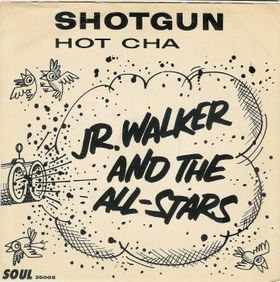
Junior Walker and the All-Stars – “Shotgun”

shot
Junior Walker and the All-Stars – “Shotgun,” Pop #4, R&B #1

Motown raided the juke joints for Junior Walker’s biggest hit. The song is propelled by Victor Thomas’s Hammond organ as much as Walker’s sax, and is closer to the Southern styling of Booker T. and the MGs and King Curtis than the Motown sound.

At the time, Walker was better-known for his playing than his singing. Initially, a studio singer was booked to sing Walker’s response to the fad dances of the time, like “The Jerk” and “The Watusi.” When the singer failed to arrive, Walker reluctantly stepped behind the mic to cut what he thought would be a guide vocal. Producer Berry Gordy prevailed on Walker to leave the track as-is. Gordy’s judgement was accurate, as the song shot to the top of the chart and inspired several similar singles, including Curtis’ “Memphis Soul Stew.”

Walker’s quartet is rounded out by the sharp guitar punctuation of Willie Woods and the solid backbeat from drummer Benny Benjamin. – by Joel Francis

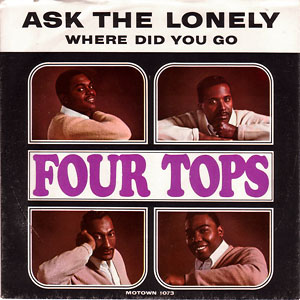
Four Tops – “Ask the Lonely”

4t
Four Tops – “Ask the Lonely,” Pop #24, R&B #9

The name on the label says “Four Tops” but this is really a Levi Stubbs record. Stubbs was never one of Motown’s marquee vocalists, and the injustice of that act is amplified by his three-minute tour-de-force singing here. Mickey Stevenson and Ivy Hunter’s song and production is more mature than the typical Motown single. Stubbs’ classic soul voice is imbedded with the “hurting pain” he’s imploring his friend to avoid. The female backing vocals sound silly when they introduce the song, but blend well with the arrangement. The other three Tops are all but absent, but they’re not missed thanks to Stubbs’ heart-wrenching performance.

“Ask the Lonely” is stuck in the Tops’ limbo land. It wasn’t a big hit, but it was too good to be a footnote. The song is still performed at Four Tops concerts today – sans Stubbs’ vocals, of course – but unlike other Motown hits, it never made an impact on the covers circuit. Which is probably just as good. — by Joel Francis