(Above: Yo Mama’s Big Fat Booty Band bring the bounce to Ziggy’s in Wiston-Salem, N.C.)
By Joel Francis
The Daily Record
There are several different versions of the story how the six-piece, North Carolina funk outfit Yo Mama’s Big Fat Booty Band came up with their name.
Guitarist J.P. Miller’s favorite rendition involves a fortune telling machine in Las Vegas.
“You know those fortune telling machines where you put a couple quarters in and the guy tells you your fortune?” Miller asks. “Well we found one that wasn’t plugged in. After we got it hooked back up, we put our money in, only instead of giving us a fortune the little piece of paper it spit out just said ‘Yo Mama’s Big Fat Booty Band.’ So there you go.”
The Booty Band has seen several changes in the 11 years since, including numerous line-up changes, different front men and cross-state relocation to Asheville, N.C. Early shows were known to feature belly dancers and bring their own dancing pole.
“Back in the day we had a lot of crazy stuff,” Miller said. “I don’t want to say we were a gimmick band, but these days we put all our focus on the music.”
As a guitar player, Miller grew up emulating Jimi Hendrix and Funkadelic guitarist Eddie Hazel. He said each band member brings his own backgrounds and influences to the ensemble. This means at any moment the music could show flavors of reggae, hip hop, jazz or ‘80s pop.
“Funk is always the focus, but we’ll do whatever it takes to keep people having fun and dancing,” Miller said. “We go nonstop from the first song to the last. We don’t give people the chance to stop dancing.”
The band’s current quest to keep booties shaking started with a hometown show in late July. Doin’ It Hard tour stops include dates in Missoula, Mont., Haines, Alaska and New Orleans.
Veterans of two Wakarusa music festivals at Clinton Lake and this year’s festival in Arkansas, the Booty Band drop their infectious funk on the Bottleneck in Lawrence, Kan. next Wednesday.
“A lot of places we don’t know what to expect,” Miller said. “We’ll often go to a club we’ve never played before and the dance floor will be full because people saw us play a festival or city event or cruise or whatever.”
The tour’s final dates in Asheville and Key West, Fla. around Thanksgiving will celebrate the release of the Booty Band’s fourth album.
“Our last album was a live album recorded in 2008, ‘Greatest Hips Live, Vol. II,’” Miller said. “The idea is to alternate between studio and live albums, so this one we recorded in a Miami studio,”
Miller said the group wanted a warmer analog sound for the album so they recorded directly to tape. This process eliminated the possibility of overdubs and meant the band had to put in plenty of practice so they wouldn’t be wasting expensive tape and studio time.
“We’ll be doing these new cuts all summer on the road,” Miller said. “It’s tightened us up a lot as a band, and people can tell.”
Funk fell out of favor for a while, but Miller is glad to see the genre regaining popularity.
“If you look online, a lot of bands use ‘funk’ in their description. It’s become kind of a buzzword,” Miller said. “Funk also makes you feel good, so why not?”
Legendary hip hop ensemble Public Enemy is $20,000 away from fulfilling its efforts to raise enough money for its upcoming album. But PE front man Chuck D doesn’t want to spend much time talking about that project.
“I’m not spending long on this. That’s a 2011 project,” D said in a recent telephone interview. “I will say that it is a collaborative effort with Tom Morello, Boots (Riley, of the Coup and Street Sweeper Social Club) and Z-Trip.”
D quickly moves on to more immediate projects, like the three-CD, three-DVD retrospective of the band’s post-Def Jam era. Or Chuck’s second solo album. Or the other bands he’s trying to break through on his SlamJamz label.
The “Hits, Vids and Docs” box set is three discs of live cuts, remixes and album tracks covering the band’s history since 1999. Three additional DVDs contain interviews, documentaries, music videos and concert footage.
“This set covers the last 10 years since we left Def Jam,” D said. “Some of the video material has been repeated from other sets, but there is also new content. One thing I’ve learned is that if you are going to try to release anything in retail as an independent you’d better give the customer chock-full of their money’s worth. This certainly does.”
A dozen years after his solo debut, D is preparing to drop his second effort, “Don’t Rhyme for the Sake of Riddlin’.” Unlike the first, proper album, “Riddlin’” is a collection of D’s collaborations and one-off projects. The album will include “Tear Down the Wall,” his response to Arizona’s controversial immigration bill.
“The artists in SlamJamz are another big concern,” D said. “We just put out a song called ‘First Lady’ by a trio of female MCs called Crew Grrl Order. They also did a song called ‘Go Green’ which is a response to the BP disaster. My thing is just to try to encourage people in the genre to take action for themselves. Don’t look to me to do it for you. I will help you, but you have to be the one to do it.”
But while D is loaded with current projects and thinking of the future, Public Enemy has also taken some time this year to look back. D, Flava Flav, Professor Griff, DJ Lord and the SW1s have been celebrating the 20th anniversary of their landmark release “Fear of a Black Planet” by performing the entire album at special concerts and festivals.
“’Fear’ was the first album where people had expectations of us. We had broken through. It’s fun to think back to that year, because I just kind of put it out of my mind,” D said. “There are several cuts on there we either haven’t done before or haven’t done in a long time. It can be a challenge just to remember the words.”
Even the United States government got caught up in the celebration. The album was added to the National Recording Registry of the Library of Congress for being “culturally, historically or aesthetically significant.”
“The people in government are different from the government as an organization,” D said, clarifying Public Enemy’s legendary anti-establishment stance. “Washington, D.C. is the large sum of many parts. The day we were honored was a good day to be in D.C.”
(Above: Rare footage from Devo’s first-ever concert in 1973.)
By Joel Francis
The Daily Record
On May 2, 1970, Bob Lewis thought he had it all figured out. In just a few weeks he would graduate from Kent State University. He would come back in the fall and start on his graduate degree in anthropology.
The National Guard arrived on campus the next day and everything changed. There had been rumblings of unrest before. The previous year there had been a skirmish over the administration allowing the Oakland police department to recruit on campus. When the students tried to protest at the disciplinary hearing of the student organizers they were locked in a building and surrounded by the police.
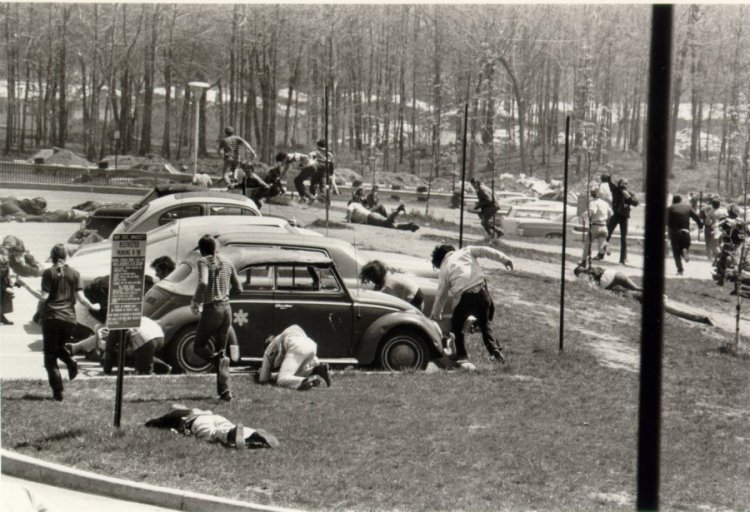
But that incident didn’t compare to what happened on May 4, 1970. The details of the day are well-known: four unarmed students were killed by National Guard troops trying to disperse an anti-war rally. In less than 24 hours an entire generation entered a new paradigm.
“Devo wouldn’t exist if it wasn’t for Kent,” said Lewis, one of the band’s founding members. “If it hadn’t been for May 4, I would have gotten my doctorate in anthropology and taught or gone out on digs. Jerry (Casale, Devo’s bass player) probably would have wound up as a graphic artist or art professor.”
Instead, Casale and Lewis decided to channel their outrage at the system by holding a mirror to it. Informed by professors who had become friends, visiting faculty and articles such as “Readers vs. Breeders and “Polymer Love,” the duo started creating their own agenda.
Kent State students run for cover as the National Guard open fire on May 4, 1970.
“Devo, at least partly, was a joke at first. It was a lens we turned on society,” Lewis said. “The plan wasn’t necessarily to be in a band in the beginning. There was always a multimedia, subversive element.”
In 1972, after working odd jobs in Kent, Ohio, the duo migrated to California to write for the underground newspaper the “Los Angeles Staff.” In exchange for writing legitimate articles, Lewis and Casale were allowed to insert pieces of Devo propaganda. The paper quickly folded and the two were back in Kent that fall.
“Jerry and I worked on Devo for two years before Mark (Mothersbaugh, Devo keyboardist) got involved,” Lewis said. “At the time he was in a group called Flossy Bobbit, playing Hammond B3 organ, mellotron, Moog (synthesizer) and Farfisa organ all at the same time. The first thing we told him when he joined was that everything had to be simple and stupid.”
Mothersbaugh not only brought a higher level of musicianship to the group, but several thousand dollars worth of equipment, including a PA. Like Casale and Lewis, Mothersbaugh was a Kent State alum and was also present at the protest on May 4.
“Mark was two or three years younger than us, so I didn’t really know him,” Lewis said. “I certainly recognized him from school. I think he and Jerry may have had an art class together.”
Mothersbaugh was recruited to perform at the university Creative Arts Festival in the spring of 1973. The trio of Mothersbaugh, Casale and Lewis – who played lead guitar – were joined by a drummer from town, Casale’s brother Bob on rhythm guitar and singer Fred Weber. Billed as Sextet Devo, the band promised “polyrhythmic tone exercises in de-evolution.”
In the book “We Are Devo,” authors Jade Dellinger and David Giffels described first show, also captured on amateur video. Bob Casale performed in scrubs, Jerry Casale wore a butcher’s coat, Bob Lewis was hidden under a monkey mask and Mothersbaugh sported a doctor’s robe and ape mask. The set opened with Mothersbaugh playing “Here Comes Peter Cottontail” and featured what the band called a “headache solo.” Unsurprisingly, it took the group a while to find the next gig and a stable lineup.
“At one point it was Jerry and three Mothersbaugh brothers. Jerry didn’t like that because he’d always be outvoted,” Lewis recalled. “Jerry finally tormented Jim Mothersbaugh into quitting as drummer, but it took another year before we found Alan (Meyers) to play for us.”
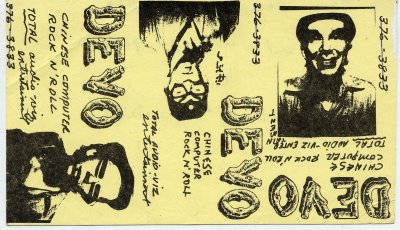
An early band flier.
When the group began to get more serious, Lewis knew the musicianship would have to improve. When Bob Mothersbaugh started playing lead guitar, Lewis transitioned from guitarist to manager.
“I became more of a manager than a player because we decided someone had to do it,” Lewis said. “I liked that other (managerial) stuff better anyway.”
The five-piece lineup of the Casale and Mothersbaugh brothers and Meyers toured Ohio with their confrontational stage show. In 1976 they were the subject of the short film “The Truth About De-Evolution.” The combination of touring and the film set the table for the band to cut their first single. “Mongoloid”/”Jocko Homo” was released in 1976 on the band’s Booji Boy label.
“We sold 17,000 copies of that single ourselves,” Lewis said proudly. “I was trying to get us in record stores in Denmark, Germany, the Netherlands and England, which meant I either had to get up really early or stay up really late to talk to these guys and convince them to stock us. Of course now you could just send an e-mail, but back then it was an adventure.”
The first sign of the band’s cult following appeared before a show at Max’s Kansas City when a flat-black oldsmobile 98 zoomed up the street bearing the face of Booji Boy, the group mascot. After the release of another independent single and an appearance on a Stiff Records EP, Devo caught the attention of David Bowie and Iggy Pop. David Bowie suggested a production deal through Warner Brothers that he would produce, and the band went to Germany to record. Bowie was unavailable, so his friend Brian Eno produced the first album.
“The band was in England recording while I was in the States trying to arrange for them to do some concerts in Europe on the way back home,” Lewis said. “Meanwhile, (Virgin Records president Richard) Branson takes them out on his boat on the Thames (River), gets them high and convinces them to sign with Virgin. Had I been able to, I would have told them they shouldn’t do that. Warner Bros. promptly sued them.”
Many recordings from Lewis' tenure have been released on the two "Hardcore Devo" collections.
Although Virgin and Warner Bros. amicably agreed to split distribution rights, it would not be the Devo’s final lawsuit. Lewis’ relationship with the band, and particularly Jerry Casale, had soured ever since Lewis told Casale that Devo would never be popular with him as the front man. It had to be Mark Mothersbaugh.
“From that point on I was on my way out,” Lewis said. “When Elliott Roberts, who managed Joni Mitchell and Neil Young, announced to Warner Bros. that he wanted to be manager, I knew I was gone, because then I was replaceable.”
Lewis received no credit or mention on Devo’s debut album “Q: Are We Not Men? A: We Are Devo!” The album came out in 1978 and Lewis promptly sued for theft of intellectual property. With the band now located to Los Angeles, Lewis was up against a high-powered, label-financed law firm. Help came in the unlikely form of a cassette tape from a former high school newspaper reporter.
“Word had gotten around that I was suing the band and this person called me up who had interviewed us after one of our first performances at the Akron Arts Festival,” Lewis said. “This tape contained an interview of the band where he asked who came up with the Devo concept and Mark said ‘This guy right here, Bob Lewis.’
“When I played that tape at the deposition their lawyers looked like they had been gut-shot,” Lewis continued with a smile. “Shortly thereafter we reached an equitable settlement.”
Just as Lewis discovered he liked managing better than performing, he learned he enjoyed legal work. After managing a few bands to near-success, Lewis became a paralegal.
“I have the best job in the world. Essentially, I’ve been practicing law without a license for the last 30 years,” Lewis said. “The catch is I always have to work with a lawyer.”
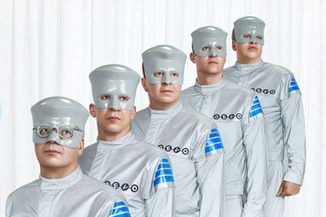
The band today. Devo plays tonight as part of the Buzz Under the Stars concert at the City Market with Ben Folds and Silversun Pickups. Tickets are $34.
Lewis left Ohio for Lawrence, Kan. in 1998 where his wife was working on her doctorate. Shortly thereafter the couple moved to Kansas City, Mo. Today, Lewis works as a paralegal for the Community of Christ Church in Independence, Mo. and lives in a house filled with antiques and art and a story behind each piece.
Last month Devo released “Something For Everybody,” their ninth album and first in 20 years. In the downtime, Mark Mothersbaugh has become a highly sought film composer. Mothersbaugh wrote the music for several of Wes Anderson’s movies, including “Rushmore” and “The Royal Tenenbaums.” His brother Bob wrote the music for the “Rugrats” cartoon series. Jerry Casale, who directed most of Devo’s music videos, has also directed videos for Rush, Foo Fighters, Soundgarden and Silverchair. Myers left Devo in 1987; the drum stool is currently held by Josh Freese.
More than a generation after their lawsuit, Lewis said he is on good terms with the band. If he attends tonight’s show, however, it will be as a fan with a ticket purchased at the box office.
“It all depends on the weather,” Lewis said. “I e-mailed the guys the other day to let them know what they were facing here. I told them with as hot as it’s been it may not be a good idea for a bunch of 60-year-old guys jumping around in rubber suits. I’m sure they’ll be OK.”
(Above: Cracker perform “Take Me Down to the Infirmary” at Crossroads in Kansas City on July 6, 2007.)
By Joel Francis
The Daily Record
As the 1980s morphed into the 1990s, David Lowery was riding high. The underground band he started in 1983 had attained major label success, and his new band, Cracker, continued to ride that wave. His songs “Low” and “Teen Angst (What the World Needs Now)” were all over the radio and MTV.
This year, Lowery and guitarist Johnny Hickman celebrate the 20th anniversary of the band they founded together out of the ashes of Camper Van Beethoven. In that time, Cracker has come full circle, operating in a landscape that eerily mirrors the early days of Camper Van Beethoven.
“To me the real story isn’t that we had bit MTV and radio hits in the early ‘90s,” Lowery said, “but how the band kept going after that for 15 years. We’ve done it by cultivating a loyal following that exists away from the rest of the industry.”
Cracker’s model of relentless touring, taper- and fan-friendly policies and annual weekend destination festival should be instantly recognizable to any jam band fans.
“We all got it from the same place,” Lowery said. “I remember back in Camper (Van Beethoven) days telling people we had more in common with the (Grateful) Dead than the punk scene. Out of all the jam bands, I don’t know how many played with the Dead, but we did.”
David Lowery (second from left) and Cracker perform a free concert tonight on the KC Live! stage in the Power and Light District. Start time is listed as 8 p.m., but bands usually go on much later.
The Dead invited Cracker to open for them in 1994 at their annual stand at Autzen Stadium in Eugene, Ore. Lowery remembers well his meeting with Jerry Garcia.
“Apparently when I met Jerry he had just come out of a porta-potty. I went to shake his hand, but the only thing I could think was ‘there’s no sink in there,’” Lowery said. “Jerry told me he totally loved our song ‘Euro-Trash Girl’ and was trying to work up an arrangement so the Dead could play it. Sadly, he didn’t live long enough to get it done.”
Camper Van Beethoven emerged in the early ‘80s, in the Southern California underground rock scene, but didn’t fit comfortably. They definitely weren’t punk and too quirky to be mainstream. Over the course of five albums, Lowery and his band mates carved their own niche. Similarly, Cracker came up in an era where they were too poppy for grunge and too much of a country influence to rest beside other rock bands. In 2000, Lowery revived Camper and splits his time between bands.
“The music business has gone all the way back to where we started, where we had to do a lot of stuff independently, within our own organization,” Lowery said. “It wasn’t a challenge for me, because I learned how from the Camper Van Beethoven days. When the labels started coming apart, we always knew what to do.”
In a way, Lowery and his bands have always operated both on their own and on their own turns. The window of high-profile success was so brief they didn’t consider changing how they worked.
“The alt-rock bubble or financial bubble,” Lowery said, “where any band together for more than two weeks and three shows got signed was such a brief period in the 20 years of Cracker and my 27 years of recording that it almost seems like a fluke. There was hardly time to adjust.”
After seeing Internet entrepreneurs being praised for the books they wrote about their five-year-old businesses, Lowery decided he might have something to say about his 27 years in the music business and started working on a book that’s part memoir and business manual.
“People give record labels way too much importance in their minds,” Lowery said. “I learned some things doing research for my book. Like, very few labels last more than 10 or 15 years. Most collapse or are absorbed. The average lifespan of an A&R man (a talent scout who works as a liaison between the label and artist) is less than four years. The people who have been around a long time, that have all the experience, are the artists and the managers.”
(Above: “Nobody’s getting any money for this one.” The Young Dubliners bring a little bit of Ireland to the CBS Early Show in 2007.)
By Joel Francis
The Daily Record
The first thing Chas Waltz does when he returns to Kansas City is check in with friends and family then head straight over to Gates BBQ for a slab of ribs. Waltz has been living in Los Angeles for nearly 20 years, but hasn’t forgotten the great tastes of his hometown.
As the violin player in Shooting Star, Waltz was part of one of the first major rock bands emerge of Kansas City. From 1977 to 1987, Shooting Star rubbed elbows with ZZ Top, Cheap Trick, REO Speedwagon, Jefferson Starship, Kansas and Journey. They helped put the local music scene on the radar of the powerful coastal labels.
“Whenever people learned we were from Kansas City they always kind of perked up, especially people on the coasts,” Waltz said. “People knew our town from the legendary reggae group the Blue Riddim Band, who were big at the time, but we were the first rock band. It made people take notice.”
After the demise of Shooting Star in the late ‘80s, Waltz relocated to Los Angeles. His violin skills inadvertently put him at the heart of the burgeoning Irish rock scene. The success of U2 and the Pogues had brought a new generation of Irish songwriters to America.
“Shortly after I moved to Los Angeles I hooked up with a friend of mine who was a producer out there, but grew up in Springfield, Mo.,” Waltz said. “He introduced me to that world, and particularly to Dave King, who would later form the group Flogging Molly. I joined his band, which got me into the whole scene. Through that I met the Dubliners.”
Above: The Young Dubliners play tonight at Davy's Uptown Rambler's Club. Show starts at 8 and tickets are $12. Visit http://www.daveysuptown.com/ for more information.
The Dubliners were informal group centered around Dublin natives Keith Roberts and Paul O’Toole who started tweaking and recording their favorite songs from back home. When Roberts and O’Toole lost their fiddle player In the mid-‘90s, they asked Waltz to join their band, now known as the Young Dubliners.
“I didn’t know any of this music when I started out. I was a rock and roll guy,” Waltz said. “But through the festivals we’ve been booked to play, I’ve gotten to learn from a lot of the best fiddle players from Scotland and Ireland.”
Waltz was present for the band’s first full-length album, 1995’s “Reach,” but was gone by the time the second record materialized.
“I was in the band for three years, left to front another band and was back in 2001,” Waltz said. “The timing was right. The band I was in wasn’t working out. Our bass player was also from Kansas City, and he wanted to go back and start a family. That was Norm Dahlor, who now plays with the Elders.”
When Waltz returned, the Dubliners’ lineup finally stabilized. O’Toole had left around the same time as Waltz, but the current crop of players has stayed together, more or less, until today.
“Touring is hard work and not everyone is cut out for it,” Young Dubliners founder Keith Roberts said. “It took a while to find the right mix of people, but the band we have today is the best group I’ve worked with.”
The past 10 years have taken the quintet around the world several times, performing at both Irish and rock festivals and opening for Jethro Tull and Jonny Lang. In 2006, Roberts hastily assembled the band to record a quick follow-up to their biggest record to date, “Real World.” The resulting album, “With All Due Respect,” a baker’s dozen of their favorite Irish songs, has surpassed everything else in their catalog.
“We did that in 17 days,” Roberts said. “The beauty of that album is that we didn’t have much time to over (mess) with it. It was like in our bar band days.
“No matter where we play, we’ll sell as many copies of that album as the new one,” Roberts continued. “It’s timeless. We might do it again.”
It might be a while before that happens, though. The band is feeling the itch to write some more original songs to complement “Saints and Sinners,” the all-new album that followed “Respect.”
“I’m looking forward to getting some new material going,” Waltz said. “I’m writing all the time and I have a lot of stuff wanting to be finished. I can’t wait to hear what the guys will do with it.”
(Above: The video for “Pretty Wings,” one of the biggest songs to come off Maxwell’s latest album.)
By Joel Francis
The Kansas City Star
When Maxwell released his first album in eight years last summer, he planned on making up for lost time by hitting his audience with three albums over a short period of time. The fans, however, had another plan. “BLACKsummer’snight” debuted at No. 1, spawned two singles that stayed on the charts for 46 and 47 weeks, respectively.
The assuring everyone “I’m back for good,” the follow up album is ready. Now Maxwell’s waiting for the excitement to die down.
“This (new album) will be the second in a trilogy,” Maxwell said. “They were going to come out in succession, but then the first one created this response. We’re waiting for the people to tell us when they’re ready.”
The soul man mapped his return cautiously, playing the Uptown on the first leg of his tour in the fall of 2008. By the time his show reached St. Louis a year later he was playing arenas and had two sold-out nights at Madison Square Garden under his belt.
“Honestly, I like the intimate settings better,” said Maxwell, who celebrated his 37th birthday on May 23. “People can hear us better and see us better. But because of the success of the record, I’d be in every town for two weeks if I did that.”
When Maxwell plays Starlight on Sunday, he will bring Jill Scott, one of the singers who blossomed during his time away.
“She is absolutely amazing,” Maxwell said of Scott. “Apart from the music, she not only has the most beautiful smile but the biggest spirit. She typifies soul right now.”
Maxwell said his set is “very different” from previous tour legs. The stage has been redesigned by Roy Bennett, who came to Maxwell’s attention through his work with Nine Inch Nails and Rammstein.
“His ability to design is stellar. We’ve got great video and lights,” Maxwell said. “More importantly is my band. These musicians could stand out in front of a cloth.”
The ten-piece outfit includes several artists who have made names for themselves in the jazz world, like pianist Robert Glasper and bass player Derrick Hodge. The pieces of the ensemble started falling into place when a friend introduced Maxwell to Chris Dave. Dave’s impressive resume includes collaborations with Mint Condition, Meshell Ndgeocello, Pat Metheny, Kenny Garrett.
“Chris is just an incredible drummer. He knew the person who introduced me to the horn section, and the band kind of evolved from there,” Maxwell said. “I won’t say it was happenstance, because I do believe in destiny, but it came together very organically.”
The musical landscape Maxwell re-entered is markedly different. Labels are failing and artists are selling fewer albums and, as a result, generating less money for both themselves and their label.
“It hasn’t been a problem for me, which is incredible,” Maxwell said. “We just added the fourth leg of the tour and I’m getting better album sales than I’ve ever had. I’ve been pretty – and I hate using this word, but – lucky. Blessed.”
For Maxwell the comeback is over. He’s returned and conquered, and now he’s ready to move on. Worn down by being asked why he voluntarily dropped out of sight so many times, Maxwell has a simple, smirking answer: “I like Seinfeld.”
(Above: Roy Orbison performs “(Oh) Pretty Woman” on “Austin City Limits.”)
By Joel Francis The Daily Record
The musical landscape of television was of a different world when “Austin City Limits” debuted on Public Television 35 years ago. Brief performances on late night talk shows or segments on “Don Kirshner’s Rock Concert” were the only options for fans hoping to catch a glimpse of their favorite act.
Baloons and the capital building, trademarks of the Flaming Lips and Austin City Limits.
The Rock and Roll Hall of Fame celebrates the show that put long-form performances on the air with the new exhibit “Great Music. No Limits. Celebrating 35 Years of Austin City Limits.”
“There were certainly music shows on television before, like Ed Sullivan, ‘Shindig’ or ‘Hullabaloo,’” said Jim Henke, vice president of exhibitions and curatorial affairs for the Rock Hall. “But ‘Austin City Limits’ was the first show where the performers didn’t lip synch and were provided with a platform that extended beyond just a song or two.”
The exhibit includes photographs, setlists, documents and video footage of the show’s greatest moments.
“A big part of the exhibit are the photos from the show. We have 30 or more pictures of artists ranging from B.B. King, Dolly Parton and Elvis Costello to Pearl Jam, R.E.M. and the Dave Matthews Band,” Henke said. “We also have a lot of different documents, including lots of early stuff like the proposal for underwriting the pilot episode and several handwritten memos.”
The memos show the evolution of the show’s title from “River City Country” to “Austin Space” before finally settling on the current title.
The Hag on ACL.
“We also have three setlists from Wilco’s performance where you can see which songs were added and changed before they went on,” Henke said.
“MTV Unplugged,” “Sessions at West 54th Street” and “Soundstage” are but a few of the shows Austin City Limits has inspired during its run. In 2002, the show spun off into the three-day Austin City Limits Music Festival.
“The show started out with Willie Nelson on the first episode then expanded,” Henke said. “If you look at who’s appeared since then it’s been a nice mix of artists.”
Henke pointed out recent episodes with Ben Harper sitting in with Pearl Jam and Mos Def with K’Naan as examples of the show’s continued innovation.
“The producers don’t just book established artists. They’re looking at younger artists as well,” Henke said. “Our video reel has everyone from Ralph Stanley and Bill Monroe to Damian Marley. It’s not just focused on one era or genre. I think this is not only what made the show so innovative, but has given it such longevity.”
Rusty Tucker pounds the skins with Alaadeen (saxophone) and Jay McShann (piano) at a 2005 Gem Theater performance.
Rusty Tucker was a fixture of the Kansas City jazz scene for more than 50 years. He could be found playing his trumpet with others or sitting behind a drum kit for the Scamps.
Tucker died almost four years ago, but I was priviledged to speak with him in his Independence, Mo. home in 2002 when I was a reporter for The Examiner. Here is Rusty’s story.
(Above: Carrie Rodriguez graces the KUTX airwaves in Austin, Texas.)
By Joel Francis The Daily Record
Over the years, Carrie Rodriguez closed her shows with “Punalda Trapera,” a Spanish-language number frequently performed by her great aunt, Eva Garza. Inevitably, fans asked which album it was on. The catch: it wasn’t – until now.
“Love and Circumstance,” Rodriguez third album, pays tributes to her family, inspirations and some contemporaries.
“Because of the response from fans, I decided to record these songs the way our band does them,” Rodriguez said.
Producer Lee Townsend helped Rodriguez pick the dozen covers, including well-known songs by Merle Haggard and Hank Williams, and surprising numbers by M. Ward and Little Village. Townsend was also able to convince Buddy Miller to take time from his tour with Robert Plant and Allison Krauss to contribute to the cover of his song “Wide River to Cross.”
“I’m a huge Buddy Miller fan. He’s one of the people I’ve always wanted to work with,” Rodriguez said. “Fortunately, he had a portable recording rig with him on the road, so he was able to record his vocal tracks from his hotel room on the road. It was very sweet of him.”
Carrie Rodriguez performs with Jim Lauderdale and Tim Easton on Sunday at Knuckleheads.
Rodriguez discovered “Punalda Trapera” while going through a stack of her grandmother’s records. The song was immediately added to her live act.
“Eva died in the late ‘40s, so I never got to meet her,” Rodriguez said. “She’s always been a family legend. When I was younger, my grandma would talk about her famous sister who was in films and made records and was on the radio. I always thought she was exaggerating until I got older.”
Even more personal is “When I Heard Gypsy Davy Sing,” a song by David Rodriguez that only existed as an e-mail file until his daughter recorded it. The elder Rodriguez came up in the Houston folk scene of the late ‘70s and moved to Holland when Carrie Rodriguez was 16.
“The song is about a singer in a bar looking back on what he’s done with his life and what he’s left behind,” Rodriguez said. “It was pretty heavy for me to sing as his daughter, but it was very therapeutic. Signing it made me feel closer to him.”
Longtime fans may remember the songs Rodriguez cut with Chip Taylor – writer of the song “Wild Thing” – as the violin player in his band. Her fiddle was largely absent on her last album, but has returned to prominence on “Love and Circumstance.”
“I let the song dictate what instrument I play,” Rodriguez said. “Part of why there wasn’t as much fiddle on the last record is that I couldn’t find a way to fit it in. The songs didn’t seem to need or want it.”
Writing songs on the guitar instead of the fiddle not only came more naturally to Rodriguez, but changed the dynamics of her songs.
“These days I end up writing on the guitar and can’t find a way to fit the fiddle in,” Rodriguez said. “There’s still plenty of fiddle in the live show, though.”
Two years ago, Rodriguez toured in Austin, Texas singer/songwriter Alejandro Escovedo’s band. Escovedo has been trying to convince Rodriguez to shift her alt-country roots and record a rock album.
“Al has good advice. I always have to consider his suggestions,” Rodriguez said. “Part of why I made this covers album was to take a step back and look at what kind of songs inspired me, and what kind of songs I want to write. Hopefully it’s given me some good inspiration for the next batch of songs I write.”
Janet Kuemmerlein has been interested in jazz even longer than she has been making art. Growing up in Detroit, she had to take two buses to reach her arts-focused high school downtown. While there, members of the Modern Jazz Quartet might stop by and ask to borrow instruments from the school. She also made sure to take in concerts by Ella Fitzgerald, Sarah Vaughn, Woody Herman, Count Basie, Cab Calloway, Stan Kenton … well, you get the picture.
After high school, Kuemmerlein was invited to study at the Cranbrook Academy of Art. Upon graduation she moved to Chicago, where she met her husband. Work assignments finally landed the couple and their four children in Kansas City, Mo. in 1960.
Kuemmerlien started in painting and sculpture. When she found the chemicals toxic around young children she moved to fabric. Her fabric works are on display across the country in government and office buildings, libraries and hotels, churches and synagogues.
Jazz and art didn’t intersect until Kuemmerlien was asked to contribute to the Johnson County Community College art auction in 2000. Her painting of Miles Davis was purchased by a local attorney and later given to the American Jazz Museum. Last month, Kuemmerlien unveiled her latest project, a series of 11 portraits commissioned by the AJM for their Women in Jazz celebration.
The paintings are on display in the gallery off the museum lobby from 9 a.m. to 6 p.m., Tuesday through Saturday, and noon to 6 p.m. on Sundays, until the end of May. There is no charge to view the exhibit.
Kuemmerlien was kind enough to take The Daily Record on a tour of the exhibit and speak about each piece.
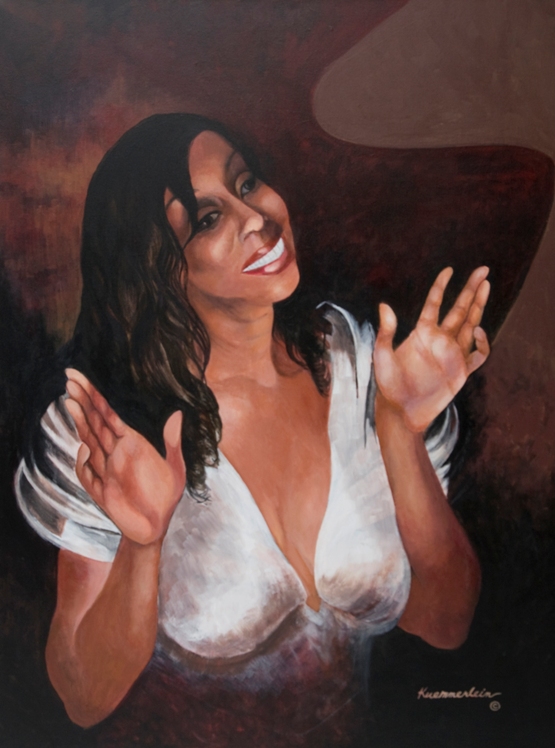
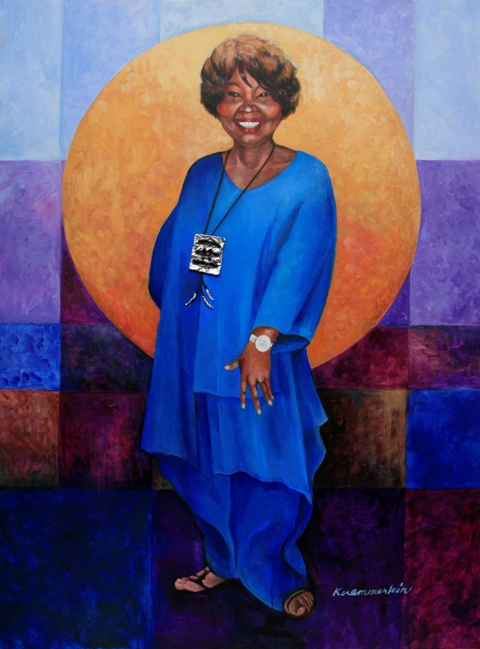
Oleta Adams
Oleta Adams – “We actually talked on the phone quite a bit beforehand because she was out of town so much. I wanted to showcase her hands because they’re such an expressive part of her performance. She and her husband are delightful people. God she is funny. She’s just adorable.”
Karrin Allyson
Karrin Allyson – “I made this from a concert photo. When I told her I was doing this she said ‘don’t paint any lines (on my face),’ but she doesn’t have any. She’s too young. She was in town recently, but I don’t know if she’s seen this or not.”
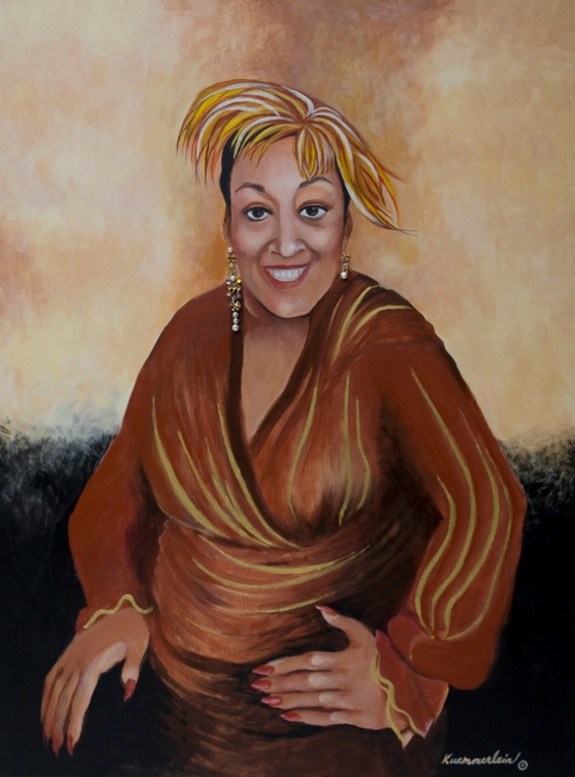
Queen Bey
Queen Bey – “Queen lives in California now, but when we were putting the exhibit together the museum told me she absolutely had to be in it. They supplied me with some photos and this is what I came up with. Although she isn’t in Kansas City any more, Queen Bey has been around for a long time and was an important figure to our jazz and blues scene.”
Deborah Brown
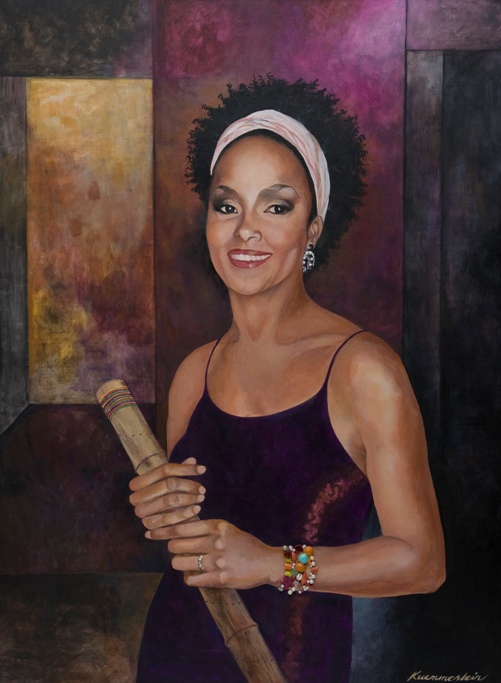
Deborah Brown – “Deborah spends a lot of time in Japan and Amsterdam. It was tricky to schedule the photo shoot, but we finally found a time and she came into my studio. She’s just a wonderful woman. I wanted the large circle in the background to reflect her career in Japan.”
Pearl Thurston Brown
Pearl Thurston Brown – “I did this partly from a photo she gave me, and partly from a photo session in her home. She’s as beautiful as she ever was. Although the painting portrays her at a younger age, she’d make a great portrait today as well.”
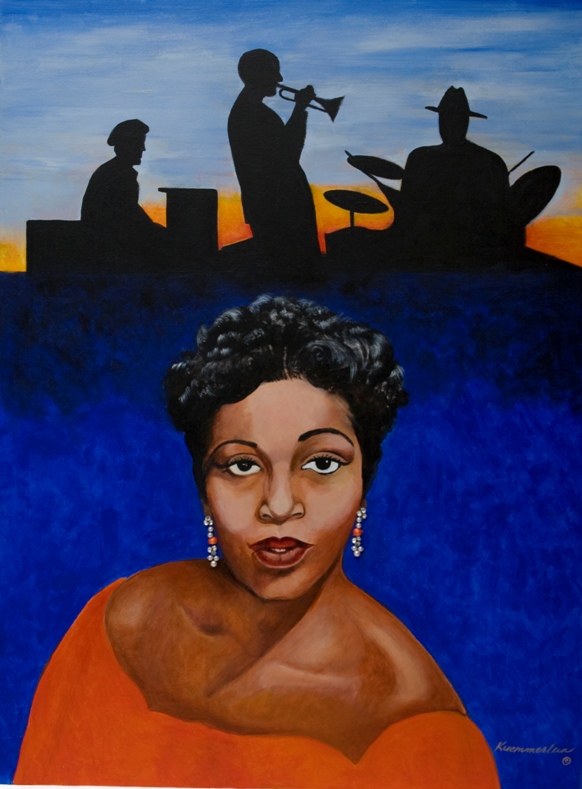
Carol Comer
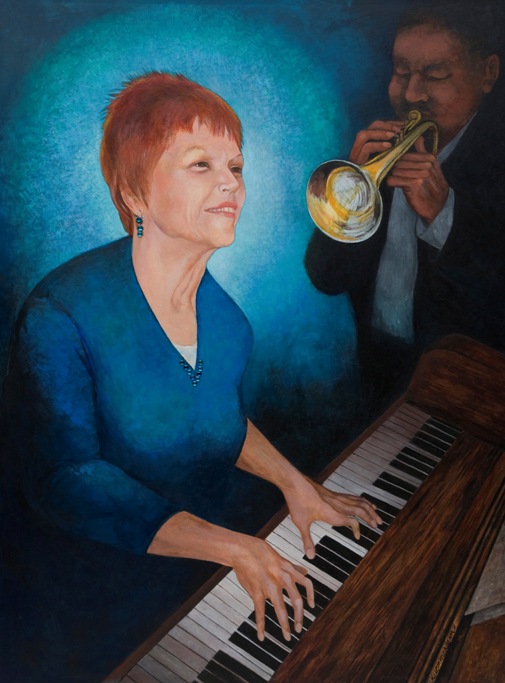
Carol Comer – “Carol is a personal friend of mine. I took her face from one photo, then went to her house and took a bunch of photos of her hands. I made up the trumpet player. Carol teaches many of the other vocalists in this series.”
Angela Hagenbach
Angela Hagenbach – “This is the first one I did. I got photos of her at Jardine’s one night before her set. I was so excited, because I got terrific pictures, except she’s so tall and I’m so short I would accidentally cut the top of her head off. She’s just a beautiful women – and great singer, too.”
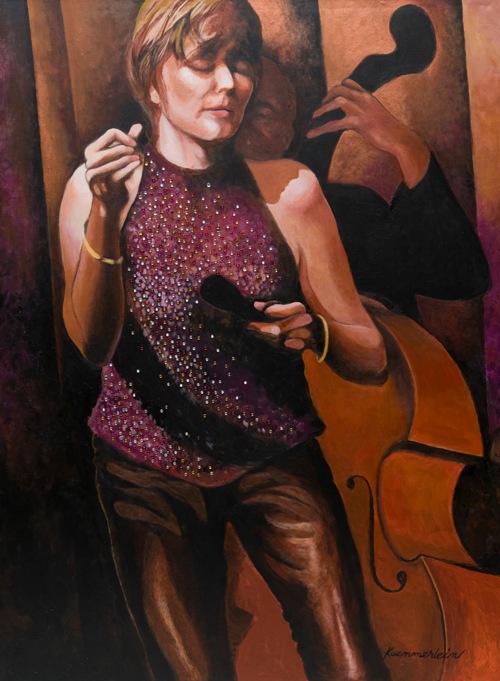
Lisa Henry
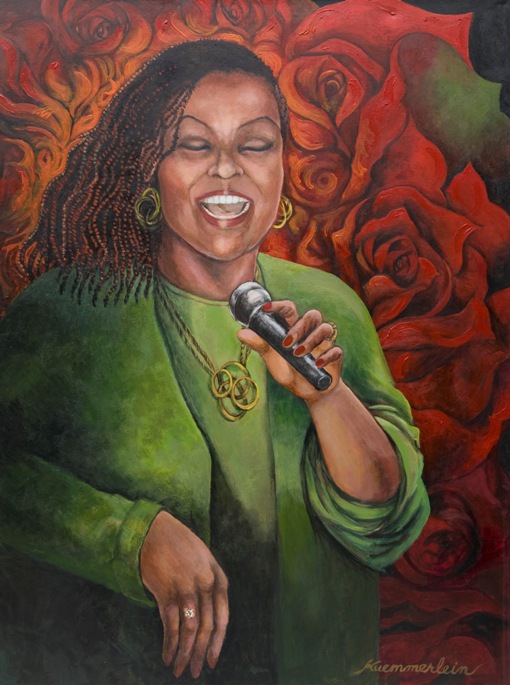
Lisa Henry – “This is one of the first ones I made. Again, I went to her house to take pictures. I knew she loved red roses, so I made those the background, then took photos of her at the Blue Room. She has such feel and phrasing. I think she’s a wonderful artist.”
Marilyn Maye
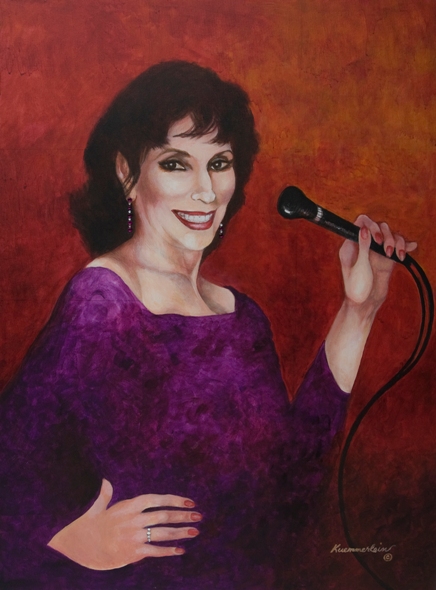
Marilyn Maye – “I painted this from photos Marilyn sent me and from album covers. Marilyn lives in New York, but she’s certainly a Kansas City legend. I tried to capture her longevity with the painting. She’s such a dynamo. Johnny Carson referred to her as a singer’s singer. She was his favorite singer.”
Julie Turner
Julie Turner – “I went to her house and photographed her. I used actual jewels to give textual interest to the painting and to have a little fun.”
The Wild Women of Kansas City
Wild Women of Kansas City – “I met with Geneva Price before I did any of the paintings, because she was working on an oral history of women jazz artists. For the painting, I used several group photos and then created a composite. I picked the best poses from each photo.”


 The band’s current quest to keep booties shaking started with a hometown show in late July. Doin’ It Hard tour stops include dates in Missoula, Mont., Haines, Alaska and New Orleans.





 joelfrancis.com