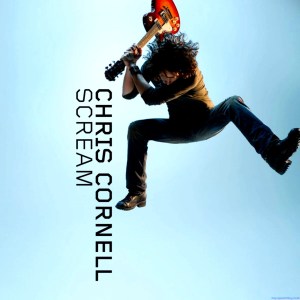
Chris Cornell – “Scream”

cover-front-chris-cornell-scream-2009

By Joel Francis

In the two months since Chris Cornell’s latest album, “Scream,” appeared on store shelves it has been mocked by Trent Reznor, bashed by critics and ignored by fans.

There’s only one problem with this: the album isn’t all bad.

This is not to say that “Scream” is a masterpiece that will make fans forget “Superunknown;” it is a flawed album. But the biggest problem lies not with the album, but Cornell’s fans. The hard rockers who grew up with Cornell in Soundgarden and backed by Rage Against the Machine in Audioslave are unwilling to give his collaboration with hip hop producer Timbaland a chance.

Timbaland made his name in the ‘90s working with Missy Elliott and Jay-Z. He cemented his radio-/club-friendly reputation this decade through collaborations with Justin Timberlake, Pussycat Dolls. None of these names are likely to impress Cornell’s hard rockin’ fan base.

The album bubbles, shakes and bounces with a consistency that surpasses Timbaland’s 2007 vanity project “Shock Value” and harkens back to his glory days with Elliott. Thanks to inventive interludes, the songs flow from one to the next, never letting the energy or mood flag.

And for a dance album, Cornell’s songwriting is strong. It’s hard to imagine many club bangers – “Hey Ya” aside – working well stripped to acoustic guitar and vocals, but it’s not difficult to envision Cornell performing “Ground Zero,” “Time” or “Long Gone” unplugged.

If this had been a Madonna album the public couldn’t buy (or download) enough copies. When Lil Wayne straps on a guitar and he’s praised for expanding his sound and showing artistic growth. Why can’t rockers do the same?

“Scream” is far from perfect. Lyrics have never been Cornell’s strong suit and he comes embarrassingly short several times on this album. Next to the rhythm, the chorus is the most important element of a dance song, and Cornell flunks badly on “Part of Me.” “That bitch ain’t a part of me” repeated eight time with multi-tracked and auto-tuned vocals is the most egregious crime, but hardly the only offender. At other times, you can imagine Cornell and Timbaland standing in awe over a track they’ve created only to realize they need to add a melody and lyrics.

The dirty little secret is that Chris Cornell is the Roger Daltrey of his generation. Like Daltrey, he is one of the most powerful, dynamic and expressive voices in rock. Unfortunately, also like Daltrey, he’s only as good as the guitarists backing him. Supported by Kim Thayil in Soundgarden or Tom Morello in Audioslave, Cornell was great. Timbaland is obviously not a full-time replacement for Thayil or Morello, but he was a bold and inventive choice for foil on this project.

Although “Scream” is a pop album, it is not a naked bid for crossover success. Judging by the studied calculation of Cornell’s previous two solo albums, he knew the risks he was taking. Although “Scream” will be too rocky for the clubbers and too clubby for the rockers, it is an interesting leap that deserves a better fate and a second listen.

Lanois + Raffi = Eno

(Above: Raffi was a staple of The Daily Record’s early childhood. The oft-spun LP remains in its archives.)

By Joel Francis
The Daily Record

Like many adolescent males in the mid-‘60s, Canadian Dan Lanois pined for a guitar. But he didn’t just want to make music, he wanted to record it, too.

Armed with an instrument and a cheap, tiny cassette recorder, Lanois and his brother Robert started recording anything they could find. They soon found manipulating the results was almost as fun as making and capturing the sounds. The siblings eventually invested in a four-track recorder and set up a small studio in the laundry room of their mother’s Ancaster, Ontario home.

The domestic facility was named MSR Studios, and the brothers advertised that for $60 they would not only record a band’s demo, but arrange, play on and compose the tracks as well. A short time after MSR Studios opened for business in the mid-‘70s, the Lanois brothers’ ad caught the eye of Egyptian immigrant Raffi Cavoukian.

Cavoukian was a veteran of Toronto’s folk circuit, but his 1975 album, “Good Luck Boy” generated little heat. Cavoukian’s mother-in-law encouraged him to write and record some songs for the children at her preschool. Aided by his wife, kindergarten teacher Debi Pike, Cavoukian recorded a tape that was so successful other schools started requesting copies.

MSR Studios was everything Cavoukian was looking for. Cheap, efficient and local it even came with its own musicians. In 1976, Cavoukian borrowed $4,000 from a bank recorded his first children’s album, “Singable Songs for the Very Young,” at the Lanois brother’s small home studio. Dan Lanois also played mandolin, recorded, mixed and engineered the album.

The easygoing, folk-flavored “Singable Songs for the Very Young” was a smash that ranked among top children’s album more than two decades after it was released.  Boosted by sessions with Cavoukian, by now going by simply Raffi, Doug McArthur, another Toronto folkie, and rock band Simply Saucer, the Lanois brothers soon had enough money to move their studio to better quarters. In 1978 they purchased a Hamilton, Ontario house on Grant Avenue, which became, naturally, Grant Avenue Studio.

Raffi was one of the first artists to use Grant Avenue Studio. By now he and Dan Lanois had collaborated on two albums and would go on to record two more together. Their body of work together comprised Raffi’s first four children’s albums. Grant Avenue also boasted sessions by singer/songwriter Ian Tyson and new wave band Martha and the Muffins.

The Muffins had just come off a commercially successful tour opening for Roxy Music, but they lost two members in the process. When the remaining quartet decided to carry on, one of the new musicians they recruited was bass player Jocelyne Lanois, sister of Dan and Robert. The Muffins got permission from Virgin to make an album with Dan Lanois with the stipulation that they operate on a miniscule budget. This was no obstacle for Lanois, and the resulting album “This is the Ice Age” generated a Top 40 Canadian single.

The band and album didn’t do much outside of the Great White North, however, and they were dropped by Virgin. The Muffin’s relationship with Lanois, however, flourished through two more albums. Their 1984 album, “Mystery Walk,” featured guest drummer Yogi Horton. Horton was a veteran of the 1981 experimental album “My Life in the Bush of Ghosts” and was recommended by his boss during those sessions, Brian Eno.

Eno, of course, had cemented his legendary reputation with his work in Roxy Music and the solo albums he released in the first half of the 1970s, and his production work with Devo, David Bowie, Talking Heads and the “No New York” No Wave compliation in the second half of the decade. By the mid-‘80s, Eno and Lanois were longtime associates.

Lanois’ tape and recording manipulations first caught Eno’s attention in the late ‘70s. Although embroiled in producing the final chapter in Bowie’s “Berlin Trilogy” and on albums with both the Talking Heads and their bandleader David Byrne, Eno and Lanois met at Grant Avenue to experiment with sound and recording. In 1979, Eno recorded “The Plateaux of Mirror,” the second installment in his ambient series, with Harold Budd at Grant Avenue. Although they did not produce the album, “Bob and Danny Lanois” are thanked in the album credits.

In 1982, Lanois co-produced and played some on the fourth installment of Eno’s ambient series, “On Land.” The following year, Lanois received cover billing for his musical and production contributions to the “Apollo: Atmospheres and Soundtracks.” One of the album’s tracks, “Silver Morning,” was essentially a Lanois solo performance.

When U2 asked Eno to produce their fourth album, “The Unforgettable Fire,” in 1984 Eno brought Lanois with him. The next year, Eno recommended Lanois to Peter Gabriel to help with the “Birdy” soundtrack.

Ten years after opening MSR Studios in his mother’s laundry room, Lanois was an A-list producer. He and Gabriel collaborated on several landmark albums, including “So” and “Us.” Eno and Lanois also repeatedly re-teamed with U2 for “The Joshua Tree,” portions of “Rattle and Hum,” “Achtung Baby,” “All that You Can’t Leave Behind” and the Irish quartet’s most recent album, “No Line on the Horizon.” Lanois has also worked with Emmylou Harris, the Neville Brothers, Bob Dylan, Robbie Robertson, Hothouse Flowers, Willie Nelson and released several solo albums.

The Supremes – “You Can’t Hurry Love”

Supremes_You_cant_hurry_love

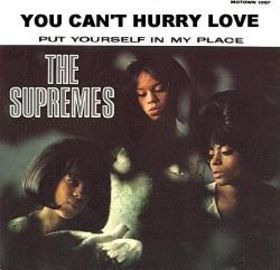
The Supremes – “You Can’t Hurry Love,” Pop #1, R&B #1

By Joel Francis

The bouncing bassline that opens this song is courtesy of James Jamerson, the same man who delivered the delightful and legendary three-note thump that introduces “My Girl.”

The intro to Holland-Dozier-Holland’s masterpiece “You Can’t Hurry Love” is a lesson in how to build a Motown hit: Start with the bass and percussion, add some horns (or strings) and then have a pretty voice jump into a catchy verse.

Diana Ross may not have had the prettiest or best female vocal on the Hitsville roster, but by 1966 she had the most recognizable one. And for once her thin tone actually works in her favor. Ross’s voice perfectly conveys the naivety and innocence of a lovelorn girl trying to be patient – “remember mama said,” she sings – to little avail. Ross would seldom reveal so much of herself in song again, hiding behind “big” vocals a la “Ain’t No Mountain High Enough.”

When this song was recorded, Ross was little more than a year away from getting top billing and four years removed from going solo. Even still, Mary Wilson and Florence Ballard are little more than anonymous backing singers in the mix. Although the track is as perfect as a song can be, it’s a shame their talent wasn’t given greater prominence.

While this song may be held up as Exhibit A by haters who think Motown is too slick and soulless, it is also testament to how smoothly the Motown assembly line was working. The song was recorded in just two sessions. Presumably the Funk Brothers laid down everything but the vocals at the June 11, 1966 session and the Supremes added their vocals at the July 5 session. Little more than three weeks later, the single was on the radio. By September, only three months after initial recording, it sat at No. 1 and earned the trio a high-profile performance on the Ed Sullivan show.

“You Can’t Hurry Love” had a renaissance in the 1980s. Phil Collins took it to the Top 10 in 1982, the same year the Stray Cats put it on the flip side of “Rock This Town.” Whoopi Goldberg sang it in her 1986 film “Jumpin’ Jack Flash,” and former Jimi Hendrix/Electric Flag drummer Buddy Miles sang it as the voice of the California Raisins (which, sadly, was the first version The Daily Record heard and its non-oldies radio introduction to classic R&B).

Review: George Clinton and the P-Funk All-Stars (2009)

(Above: Clinton. Letterman. Enough said.)

By Joel Francis
The Kansas City Star

For the third consecutive spring, George Clinton brought the Mothership Connection to Crossroads KC.

Unfortunately, Friday night’s two-and-a-half-hour set could never build momentum and was capsized by too many limp numbers. Although the repertoire hardly changed from previous years, the band’s setlist-free jams were a double-edged sword. Songs were either exciting or went nowhere.

Clinton’s P-Funk All-Stars are less a band than a troupe. At one point there were six guitarist stretched across the front of the stage. Everyone was in costume. There’s axeman with the rainbow-colored Afro, angels out of a Victoria’s Secrets ad, Diaper Man Gary Shider, another male guitarist in a wedding dress and veil, several backup singers in Mardi Gras masks and Sir Nose, the acrobatic agitator in a white fur coat.

In the middle of it all was Clinton himself, clad in a black jacket and pants, sporting his trademark Crayola-sponsored headpiece and a necklace that looked like it was borrowed from Flava Flav.

While the depth and diversity of the ensemble is a great strength –- musicians can cycle on and off stage leaving fresh fingers and never-ending jams -– it is also an Achilles heel. For a band so tight, the performances tend to sprawl. And while his democracy is to be commended, Clinton gives each of his performers often unnecessary time in the spotlight. I’d much rather have heard “Bop Gun” than watched Roller Girl dance and sing the next-to-closing number.

The night got off to a solid start with perennial opener “Funkentelechy” and the instrumental “Cosmic Slop.” The evening’s high point came early. The 15-minute version of “Flashlight” featured a pair of wicked horn solos and the band demonstrating why Clinton’s songs hold up so well over a generation later.

“Freak of the Week” initially seemed like a great follow-up, but despite incorporating parts of “Sentimental Journey” and a scat-vocal interlude, the song was stuck in a slow pace that never really got off the ground.

This set the pattern. The dynamic “Give Up The Funk (Tear The Roof Off The Sucker)” was part of an uber-medley with “Up For the Down Stroke” a sax solo and a tribute to James Brown. It was sandwiched by an unusually mellow “One Nation Under A Groove” and the turgid “Bounce 2 This,” which was little more than a bassline and repetition of its title.

At the start of the night, the two-thirds-full lawn was ready to dance and get down, but the crowd started thinning during “Maggot Brain,” the instrumental tour de force that appeared an hour into the set. By the end of “Bounce 2 This” the lawn was empty past the sound tent, save a few pockets of dedicated dancers.

The night ended on a high note with “Atomic Dog,” but by then it was too late. Too many stops and starts had killed the night’s groove. Fortunately, everyone will likely be back next spring to redeem themselves.

Keep Reading:

Feature: George Clinton is bringing the funk

Concert Review: George Clinton heats up cold night

Concert review: George Clinton (2007)

Concert Review: George Clinton, May 6, 2005 at the Beaumont Club

George Kalinsky: Painting with Light

ejjl1
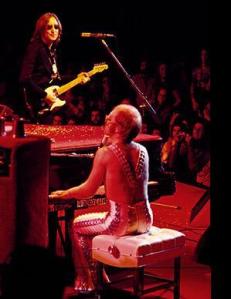
(Above: Elton John and John Lennon at Madison Square Garden, 1974.
All photos by George Kalinsky, courtesy of www.georgekalinsky.com.)

By Joel Francis

In his 34 years as Madison Square Garden’s official photographer, George Kalinsky has forgotten more games, concerts and events than many people could see in several lifetimes.

Kalinsky, who estimates he has shot more than 8,000 events, can be forgiven for having no memory of Bob Marley’s next-to-last performances in 1978, because what he remembers more than makes up for any lapses.

“November 28, 1974. Don’t ask me how I remember that, but I do,” Kalinsky said with a laugh. “Elton John was playing the Garden, and he surprised everyone by having John Lennon join him onstage. Those three songs they did together turned out to be the last time John Lennon performed before he was shot. The moment I captured won’t be there again.”

Several of Kalinsky’s favorite moments are on display for a current exhibit at the Rock and Roll Hall of Fame in Cleveland. “Live From Madison Square Garden: From the Lens of George Kalinsky” opened May 1 in the Ahmet M. Ertegun Main Exhibit Hall and will run through January 2010.

“I’ve always tried to paint with light,” Kolinsky said. “Shooting against a plain black background is not the most creative, but it’s what you usually see. These performers spend millions on lighting and effects. I always try to capture that as part of the atmosphere of the performance.”
fullscreen-capture-562009-34913-pmbmp1

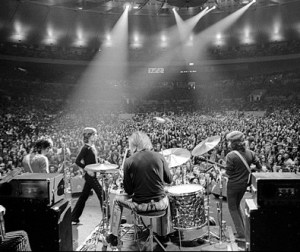
The atmosphere for the Rolling Stones’ Garden concert in 1969 was a frenzy. The show was one of the first arena rock concerts and the pandemonium was captured and released on the Stones’ great live album “Get Your Ya Ya’s Out.”

“That was the first time I saw a buzz, a reaction like that in the audience. Everyone wanted to be onstage and the crowd started gradually pushing forward,” Kalinsky said. “I went under the stage and went on in the back and got some amazing shots.”

Getting the audience’s reaction to the band was the key to recording the moment, Kalinsky said.

“I think a huge part of the story is the people and how they react,” he said. “There may not be too many pictures in this exhibit of the crowd, but I always try to include them. Every audience is different, just as a circus is different from a track meet and hockey is from basketball. The audience is a reflection of the performance.”

The crowd at a 1974 Bob Dylan performance played a key role in a shot Kalinsky called one of the top two or three photos he’s taken.

“Dylan is Dylan, the hair, the body language, all of it connecting and seeing the audience reach out to him is beautiful and telling,” Kalinsky said. “With him, the words are so important; when I look at Dylan I try to capture the aura of the man.

“I want to get a little closer to see what his face looks like,” Kalinsky continued, “and how it shows the years, not in terms of getting older, but the years of performing with the audience and how that bond grows stronger and stronger.”
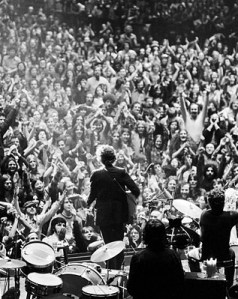
fullscreen-capture-562009-35709-pmbmpDylan played a key role in George Harrison’s 1971 Concert for Bangladesh at the Garden. Shooting both of those shows not only taught Kalinsky that music was the true universal language, but showed him how far the Garden’s stage extended.

“I was in a cab recently and the driver was from Bangladesh,” Kalinsky said. “He couldn’t have been more than 35 or 40 years old, but he said in the hearts of his family and friends in Bangladesh they would never forget Madison Square Garden. They weren’t there (at the Concert for Bangladesh), but they’d never forget because that’s where people learned to help his country and family.”

Events at the Garden, Kalinsky said, “become part of our culture and part of our world. It wasn’t long ago we had 9/11 and that concert. Even if you weren’t there, you were there because everybody in the world tuned in to the Concert for New York City.”

What stands out in Kalinsky’s mind from that show isn’t the defining performances from Paul McCartney, the Who and artists with ties to the Big Apple like Jay-Z and Bon Jovi, but a moment backstage with Billy Crystal before he was about to go on.

“I asked him how does he project his talent when the audience is in tears and police and firefighters are holding up pictures (of their missing loved ones)?” Kolinsky said. “He said the hardest thing to do was be funny in the face of an audience who had lost so much.”

Although Kalinsky’s relationships and reputation allowed him backstage that day, he acknowledged access has been almost completely shut down from the early days when he would take pictures of Elvis Presley in the dressing room before his first Garden concert or Sly Stone’s groomsmen getting ready before Stone’s onstage wedding in 1974.

And just as backstage has become more restrictive, the window for taking performance photos has been confined to the first three songs. That doesn’t bother Kalinsky, though, because digital technology and automatic lighting systems within the camera let him do as much with those three songs as he could in an entire show in the days of film.

“However, in terms of taking pictures it always comes down to the eye and the moment,” Kalinsky said. “You have to recognize the moment and snap the picture. This is the most important aspect, whether you are shooting a concert, sporting event or portrait setting. It’s what I’m always looking for.”

Kalinsky’s duties have also given him a window on the 1994 Stanley Cup Finals, Knicks games, scores of the world’s top athletes and personalities. This diverse shooting background has provided enough photos to fill eight books and exhibits from the Museum of Modern Art to the baseball and basketball halls of fame.

“The Garden stage, whether it’s Muhammad Ali, the Pope or LeBron James, brings out the best in every performer,” Kalinsky said. “Every day I walk into the Garden I say what a privilege it is to be part of this arena and the best stage in the whole world.”

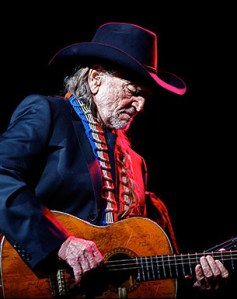
(Below: A recent portrait of the Red-Headed Stranger.)
fullscreen-capture-562009-40105-pmbmp

Keep Reading:

Rock Hall Celebrates 50 Years of Motown

Rock Hall Celebrates the 40th Anniversary of Woodstock

Bruce Springsteen Rocks the Hall (part one)

Bruce Springsteen Rocks the Hall (part two)

Chris Clark – “Love’s Gone Bad”

cc

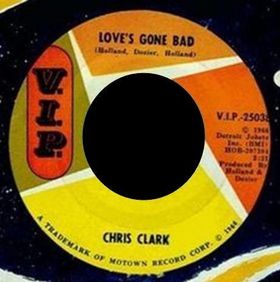
Chris Clark – “Love’s Gone Bad,” Pop #105, R&B #41

By Joel Francis

Producers had been looking for a “white singer with a black sound” long before Sam Phillips signed Elvis Presley. But Berry Gordy’s quest definitely added a layer of irony to the process.

Not that Gordy fared any better than the majority of his contemporaries. We can be fairly certain that the assets that drew Gordy to Chris Clark were not vocal.

Nonetheless, Gordy positioned Clark to be Motown – and America’s – answer to Dusty Springfield. He propped her up with songs by Holland-Dozier-Holland and even wrote and produced several numbers himself. Gordy’s favoritism didn’t go over so well at Hitsville. Other artists resented that Gordy spent so much time trying to make a star out of someone who refused to wear shoes, didn’t dress sharply and ate too much.

The public didn’t find much to like, either. Clark’s releases refused to dent the charts. “Love’s Gone Bad,” a HDH composition, was her greatest success, and somehow was enough to earn her the right to cut a full album the next year. 1967’s “Soul Sounds” dropped without a trace. So few copies were pressed that 40 years later it is a rare Motown collectible.

Despite all this, Clark managed to hang around Motown for quite a while. She co-wrote the Oscar-nominated screenplay to “Lady Sings the Blues,” Motown’s 1972 foray into film. That film, of course, starred Gordy’s ultimate protégée, Diana Ross.

Review: Cake

(Above: An early live performance of “Jolene” for San Francisco’s Fog Town Network in 1994.)

By Joel Francis
The Kansas City Star

Cake’s sold-out performance to open the third season of shows at Crossroads KC was less a concert than an extra-large backyard party.

The Sacramento-based college rock quintet so blurred the line between band and audience that a lot of fans must have felt like they were part of the performance, even if they weren’t all necessarily onstage.The night opened with “Short Skirt/Long Jacket,” an easy crowd-pleaser, though to be fair every number aired was greeted with an immediate and visceral response. It’s easy to see why. Every song is built on a surf, country or funk guitar line, bolstered by a serpentine bassline and steady drumming, accented with keyboards or trumpet — the band’s defining instrument — and secured by singer John McCrea’s mesmerizing monotone delivery.

“Frank Sinatra” employed one of the band’s best tricks. After the song’s natural crescendo, the band brought it back down, brought the audience in and built it up again. The move was just as effective when they repeated it later for the rarely played “Satan Is My Motor.”

After closing an hour-long opening set with a great version of “Jolene” (not the Dolly Parton song), the band took a 10-minute break and then returned for another hour of music. They kicked off that set with the instrumental “Arco Arena” and treated the multitude to an extended version of “Italian Leather Sofa.”

Although McCrea had no trouble coaxing the audience to sing, he still worked the crowd hard, prowling the front of the stage and encouraging singing or clapping in nearly every number. The results were frequently impressive. The crowd chimed in so loudly at their cue in “Rock N Roll Lifestyle” that the band repeated the verse, letting the audience carry it, a capella.

McCrea also took time to talk with the audience between every song. He cherished the band’s freedom from major labels, lamented the lack of3/4 time in modern pop music and even gave away the potted tree prominently placed near the front of the stage. Since the band operated sans setlist, they frequently huddled to figure out what to play next (and so they could hear each other over the barrage of requests shouted from the crowd).

The first encore was a bass-propelled cover of “War Pigs,” which the band thoroughly made their own. While Cake’s reading may have been less menacing that Black Sabbath’s, it was more fun, with a trumpet solo and sea of hands raised clapping along at the end.

The night ended as everyone wanted it to, with Cake’s biggest hit “The Distance.” There wasn’t much further anyone could go after all that anyhow.

Setlist: Short Skirt/Long Jacket, Comfort Eagle, Stickshifts and Safetybelts, Frank Sinatra, Wheels, Shadow Stabbing, It’s Been A Long Time (new song), Satan Is My Motor, Jolene. Intermission. Arco Arena, Pentagram, Italian Leather Sofa, Mexico, Opera Singer, Rock N Roll Lifestyle, Daria, Guitar, Never There. Encore: War Pigs (Black Sabbath cover), Sick of Me (unsure if this title is right), The Distance

iPod shuffles expectations

(The iPod has come a long way since its introduction in Oct., 2001. What has commercial radio done over that period?)

By Joel Francis

The Daily Record’s two-week experiment ended yesterday. For the past two weeks, I’ve been listening to my iPod on all-song shuffle, dedicated to penetrating 10 percent of my 12,226-tune pocket library. The journey was not only a blast, but it’s also been very revelatory. Songs sound different when they arrive unannounced and stripped of all context.

At first blush, the Futureheads sound a lot like the Jam, and “Mystery Title” from Robert Plant’s “Pictures At Eleven” doesn’t sound that different from what Zeppelin were going for on “In Through the Out Door.” To these ears, Mavis Staples’ 2008 album “Hope: Live at the Hideout” paled in comparison with its studio counterpart “Down In Mississippi,” and Staples’ energetic stop at the Folly Theater on that tour. But “The Hideout”‘s “Freedom Highway” blew me away when it popped up.

The Nine Inch Nails track “Zero-Sum” sounded like something Peter Gabriel would have placed on “Security.” The shuffle rescued the magnificient “I’m a Lady” from its burial deep in the second half of Santogold’s album. Heck, even a Ghostface Killah’s comedy sketch managed to evoke a chuckle when it popped up between Dinosaur Jr and Billie Holiday.

Not to sound too much like a fuddy-duddy, but there are a lot of aspects of the old music paradigm that I miss. Record Store Day is a great new tradition, but it can’t compete with the rush and anticipation of New Release Tuesdays. I also miss the days when radio would actually turn me on to good music and artists. None of my or my friends’ automobiles in high school and college had CD players, so we relied on the radio for entertainment. It wasn’t perfect – Kansas City still had way too much classic rock clogging the airways – but when you haven’t yet heard “Frankenstein” a million times, it didn’t seem so bad. We tried to sing the “woo-woos” all the way through “Sympathy for the Devil” (impossible) and memorize the lyrics to “American Pie” and “Like a Rolling Stone.” (Check and check. Also, sadly, “We Didn’t Start the Fire.”)

I didn’t need to know anything about the Telecommunications Act of 1996 to notice that radio started to suck that year. Eventually, though, we graduated and got better cars. I made sure mine had a CD player and turned my back completely on commercial radio. I have yet to find a compelling reason to go back. And while my iPod only reveals what I put into it, it’s nice to know there are still hundreds of treasures waiting to be revealed. Now if only I could figure out how to be the ninth caller and win that T-shirt.

Little Arkansas Rocks

(Above: Al Hibbler, who wrote “Unchained Melody,” attended school for the blind in Little Rock, Ark.)

By Joel Francis

At a recent concert in Fayetteville, Ark., jazz legend Sonny Rollins remarked at how happy he was to be playing Louis Jordan’s home state for the first time.

Arkansas has never been known as either cutting-edge or influential. Not even Bill Clinton could save Arkansas from being a backwoods punchline – it’s the West Virginia of the Midwest, for readers who are mystified by what lies west of Virginia – but it’s spawned an amazing number of influential musicians. There’s Johnny Cash, who was born in Kingsland and raised in Dyess, and his brother Tommy, of course. Legendary Band drummer Levon Helm, who hails from Marvell. Those are the ones everybody knows.

Incredibly, soul legend Al Green was born in Forrest City. One of Green’s influences, gospel/rock and roll pioneer Sister Rosetta Tharpe, was born in Cotton Plant. Contemporary gospel star Smokie Norfull was originally from Pine Bluff. Delight brought us Glen Campbell, Colt was Charlie Rich’s first home and Conway Twitty was born Harold Jenkins in Helena. John Hughes, a pedal steel player who worked Twitty and numerous others, came from Elaine.

Louis Jordan (Brinkley) aside, the Natural State has also produced jazzman Joe Bishop from Monticello, who wrote the staple “Woodchopper’s Ball” and free jazz saxophonist Pharoah Sanders (Little Rock).

The state’s greatest legacy might be the amount of blues it birthed, including Luther Allison (Widener), Willie “Big Eyes” Smith (Helena), Son Seals (Osceola), Jimmy Witherspoon (Gurdon), Roosevelt Sykes (Elmar) and Robert Jr. Lockwood (Helena). West Memphis was the first stop north for many blues players. Sonny Boy Williamson II, Howlin’ Wolf, Elmore James, Big Boy Crudup and B.B. King all stopped there for a while. Stax pillar Rufus Thomas was a longtime West Memphis radio host.

The name Jim Dickinson (Little Rock) may not be familiar, but his work with the Dixie Flyers, Aretha Franklin, the Rolling Stones, Big Star, the Flamin’ Groovies, the Replacements, Mudhoney and the North Mississippi Allstars – which features his sons Luther and Cody – has been heard the world over.

On the pop side, founding Evanescence duo Amy Lee and Ben Moody are also both Little Rock Natives; R&B slickster Ne-Yo was born in Camden and Perryville begat Shawn Camp, who has written songs for Garth Brooks, George Strait and Brooks and Dunn.

Arkansas may be a forgotten state that ranks in 32nd in population and 29th in area, but if you can’t experience its Ozark Mountains in person, it’s at least worth a musical road trip.

Review: Talib Kweli & Hi-Tek

(Above: “Back Again” from the forthcoming Talib Kweli/Hi-Tek album.)

By Joel Francis
The Kansas City Star

Ten years ago, rapper Talib Kweli and DJ Hi-Tek united to produce two of the genre’s landmark albums. Teaming with Mos Def they created “Black Star;” on their own they released “Train of Thought.”  The duo celebrated their past and future before a nearly full Granada Theater in Lawrence, Kan. on Sunday night.

The set started with a new song which showcased Kweli’s dense delivery and more-words-per-breath approach. From there the evening got more familiar with “Move Something” and “Eternalists,” two of several cuts to come off “Train of Thought.”

With barely a breather in between, the songs came in rapid-fire succession: “Too Late,” “Definition,” “Africa Dreams,” “Love Language,” “Down for the Count,” “Respiration,” “Memories Live.” Each number brought a big response -– a sea of hands and chorus of vocals.

Early in the set the pair switched spots, with Kweli on the turntables and Hi-Tek prowling the front of the stage in rhyme. The performances were passable, but neither as in his element. Kweli later ceded the mic again to DJ a 10-minute medley of songs Hi-Tek has produced for others. Most of the cuts were drawn from his trilogy of “Hi-Teknology” albums.

Hi-Tek was just as accommodating as DJ, working in ample Kweli hits produced by others like will.i.am’s “Hot Thing,” Just Blaze’s “Hostile Gospel,” Madlib’s “Over the Counter.” The room broke into pandemonium when Hi-Tek dropped into a loop of Kanye West’s “Get ‘Em High.” Instead of reprising the verse he cut for West’s album, though, Kweli freestyled, dropping references to the University of Kansas. It may have been pandering, but it was very effective.

For past tours, Kweli has brought backing vocalists and other onstage help. None of that was necessary this night. With Hi-Tek behind the turntables and on a riser, the MC had all the support and camaraderie he needed.

Live hip-hop is a deservedly suspicious beast. Many an MC has been cut to size by a performance that fails to replicate the studio magic and a DJ who cannot conjure the vibe. Hi-Tek’s varied samples, encompassing African rhythms, quiet storm, reggaeton and more, kept the music sonically interesting, while Kweli continually proved his microphone prowess.

The main set ended with two of the evening’s strongest songs. “Back Again” was another new song. Laced with African drums and R&B vocals it sounded like a “Train of Thought” outtake. The crowd wasn’t familiar enough to be singing along yet, but before Kweli’s next swing through town they will be. The audience had no problem, though, chiming in for “Get By,” Kweli’s biggest number and set closer.

After 70 minutes the concert morphed into an after-party. Audience members were invited onstage while Kweli and Hi-Tek played past and current hip-hop favorites. After a couple numbers, the stage was so crowded the headlining duo were barely visible.

Once the after-party started, the crowd split two ways: half took to the stage and the rest of us, faced with a drive back to Kansas City in a hard rainstorm, headed for the door.