Rock Hall commemorates 35 years of Austin City Limits

(Above: Roy Orbison performs “(Oh) Pretty Woman” on “Austin City Limits.”)

By Joel Francis
The Daily Record

The musical landscape of television was of a different world when “Austin City Limits” debuted on Public Television 35 years ago. Brief performances on late night talk shows or segments on “Don Kirshner’s Rock Concert” were the only options for fans hoping to catch a glimpse of their favorite act.

Baloons and the capital building, trademarks of the Flaming Lips and Austin City Limits.

The Rock and Roll Hall of Fame celebrates the show that put long-form performances on the air with the new exhibit “Great Music. No Limits. Celebrating 35 Years of Austin City Limits.”

“There were certainly music shows on television before, like Ed Sullivan, ‘Shindig’ or ‘Hullabaloo,’” said Jim Henke, vice president of exhibitions and curatorial affairs for the Rock Hall. “But ‘Austin City Limits’ was the first show where the performers didn’t lip synch and were provided with a platform that extended beyond just a song or two.”

The exhibit includes photographs, setlists, documents and video footage of the show’s greatest moments.

“A big part of the exhibit are the photos from the show. We have 30 or more pictures of artists ranging from B.B. King, Dolly Parton and Elvis Costello to Pearl Jam, R.E.M. and the Dave Matthews Band,” Henke said. “We also have a lot of different documents, including lots of early stuff like the proposal for underwriting the pilot episode and several handwritten memos.”

The memos show the evolution of the show’s title from “River City Country” to “Austin Space” before finally settling on the current title.

The Hag on ACL.

“We also have three setlists from Wilco’s performance where you can see which songs were added and changed before they went on,” Henke said.

“MTV Unplugged,” “Sessions at West 54th Street” and “Soundstage” are but a few of the shows Austin City Limits has inspired during its run. In 2002, the show spun off into the three-day Austin City Limits Music Festival.

“The show started out with Willie Nelson on the first episode then expanded,” Henke said. “If you look at who’s appeared since then it’s been a nice mix of artists.”

Henke pointed out recent episodes with Ben Harper sitting in with Pearl Jam and Mos Def with K’Naan as examples of the show’s continued innovation.

“The producers don’t just book established artists. They’re looking at younger artists as well,” Henke said. “Our video reel has everyone from Ralph Stanley and Bill Monroe to Damian Marley. It’s not just focused on one era or genre. I think this is not only what made the show so innovative, but has given it such longevity.”

For museum hours and ticket and general information, visit the Rock and Roll Hall of Fame Website.

Keep Reading:

Rock Hall Celebrates 50 Years of Motown

George Kalinsky: Painting with Light (Rock Hall photo exhibit)

Rock Hall celebrates the 40th anniversary of Woodstock

(Below: The Polyphonic Spree party on Austin City Limits in 2004.)

Remembering Rusty

Rusty Tucker pounds the skins with Alaadeen (saxophone) and Jay McShann (piano) at a 2005 Gem Theater performance.

Rusty Tucker was a fixture of the Kansas City jazz scene for more than 50 years. He could be found playing his trumpet with others or sitting behind a drum kit for the Scamps.

Tucker died almost four years ago, but I was priviledged to speak with him in his Independence, Mo. home in 2002 when I was a reporter for The Examiner. Here is Rusty’s story.

A Life Full Of Jazz

The Spinners – “It’s A Shame”

The Spinners – “It’s A Shame,” Pop #14, R&B #4

By Joel Francis
The Daily Record

The Spinners had been absent from the charts for five years when “It’s A Shame” came out in June, 1970. In fact, the Detroit quintet had only two hits in their 10-year history up till that point.

The group came to Motown when Berry Gordy hired Harvey Fuqua and bought his Tri-Phi label. Fuqua was an essential part of Motown’s artist development, nurturing a young Marvin Gaye and singing Tammi Terrell.

By 1970, the Spinners were considered collateral damage from the Tri-Phi takeover, serving mostly as road managers and chaperones for more successful groups. Their hunger for a hit was a natural match for another Motown artist’s desire to spread his wings.

When Gaye wanted to show his independence, he wrote and produced two hits for the Originals. Now Stevie Wonder looked at the Spinners and wanted to do the same.

“It’s a Shame” was written and produced by the same team responsible for Wonder’s most recent hit “Signed, Sealed and Delivered.” Wonder’s musical and romantic relationship with Syreeta Wright continued to blossom and Lee Garrett once again contributed to the composition.

The song opens with a hypnotic guitar hook, but it’s the Spinners’ harmony vocals that cement the number as a soul classic. The lyrics speak of heartbreak, but the delivery is effortless and graceful.

The performance was so stellar that few artists have attempted to cover “It’s a Shame.” The song instead lives on as a sample, appearing in songs by R. Kelly, Sounds of Blackness, Lethal Bizzile and Monie Love.

Carrie Rodriguez honors family, roots on new album

(Above: Carrie Rodriguez graces the KUTX airwaves in Austin, Texas.)

By Joel Francis
The Daily Record

Over the years, Carrie Rodriguez closed her shows with “Punalda Trapera,” a Spanish-language number frequently performed by her great aunt, Eva Garza. Inevitably, fans asked which album it was on. The catch: it wasn’t – until now.

“Love and Circumstance,” Rodriguez third album, pays tributes to her family, inspirations and some contemporaries.

“Because of the response from fans, I decided to record these songs the way our band does them,” Rodriguez said.

Producer Lee Townsend helped Rodriguez pick the dozen covers, including well-known songs by Merle Haggard and Hank Williams, and surprising numbers by M. Ward and Little Village. Townsend was also able to convince Buddy Miller to take time from his tour with Robert Plant and Allison Krauss to contribute to the cover of his song “Wide River to Cross.”

“I’m a huge Buddy Miller fan. He’s one of the people I’ve always wanted to work with,” Rodriguez said. “Fortunately, he had a portable recording rig with him on the road, so he was able to record his vocal tracks from his hotel room on the road. It was very sweet of him.”

Carrie Rodriguez performs with Jim Lauderdale and Tim Easton on Sunday at Knuckleheads.

Rodriguez discovered “Punalda Trapera” while going through a stack of her grandmother’s records. The song was immediately added to her live act.

“Eva died in the late ‘40s, so I never got to meet her,” Rodriguez said. “She’s always been a family legend. When I was younger, my grandma would talk about her famous sister who was in films and made records and was on the radio. I always thought she was exaggerating until I got older.”

Even more personal is “When I Heard Gypsy Davy Sing,” a song by David Rodriguez that only existed as an e-mail file until his daughter recorded it. The elder Rodriguez came up in the Houston folk scene of the late ‘70s and moved to Holland when Carrie Rodriguez was 16.

“The song is about a singer in a bar looking back on what he’s done with his life and what he’s left behind,” Rodriguez said. “It was pretty heavy for me to sing as his daughter, but it was very therapeutic. Signing it made me feel closer to him.”

Longtime fans may remember the songs Rodriguez cut with Chip Taylor – writer of the song “Wild Thing” – as the violin player in his band. Her fiddle was largely absent on her last album, but has returned to prominence on “Love and Circumstance.”

“I let the song dictate what instrument I play,” Rodriguez said. “Part of why there wasn’t as much fiddle on the last record is that I couldn’t find a way to fit it in. The songs didn’t seem to need or want it.”

Writing songs on the guitar instead of the fiddle not only came more naturally to Rodriguez, but changed the dynamics of her songs.

“These days I end up writing on the guitar and can’t find a way to fit the fiddle in,” Rodriguez said. “There’s still plenty of fiddle in the live show, though.”

Two years ago, Rodriguez toured in Austin, Texas singer/songwriter Alejandro Escovedo’s band. Escovedo has been trying to convince Rodriguez to shift her alt-country roots and record a rock album.

“Al has good advice. I always have to consider his suggestions,” Rodriguez said. “Part of why I made this covers album was to take a step back and look at what kind of songs inspired me, and what kind of songs I want to write. Hopefully it’s given me some good inspiration for the next batch of songs I write.”

Keep reading:

Review: Robert Plant and Allison Krauss

Catching up with the Hot Club of Cowtown

Elvis Costello – “Secret, Profane and Sugarcane”

KC Recalls: Johnny Cash at Leavenworth prison

(Above: The Man in Black tells the story of “A Boy Named Sue” at San Quentin in 1969.)

By Joel Francis
The Daily Record

Leavenworth Federal Penitentiary has held some notorious figures during its storied history. Former heavyweight champion Jack Johnson, Kansas City political boss Tom Pendergast, disgraced quarterback Michael Vick and Robert Stroud, later known as the “Bird Man of Alcatraz.”

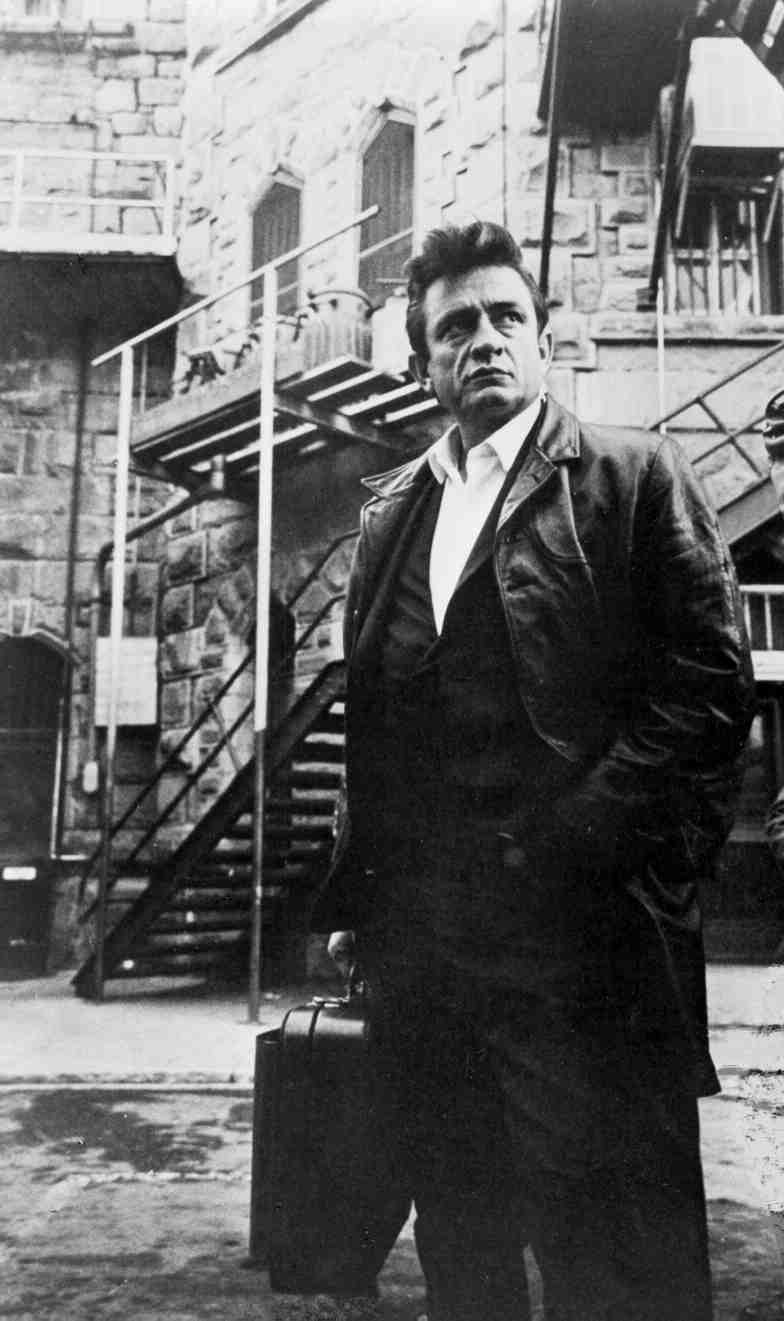
Forty years ago, one of the most famous men on the planet entered Leavenworth prison voluntarily: Johnny Cash. Cash was at the peak of his powers in 1970. Two earlier prison albums, recorded at San Quentin and Folsom, had not only re-established Cash’s reputation, but earned him a television show on ABC. The Man in Black was beamed into nearly four million homes each week and selling out big venues, such as Madison Square Garden.

Cash shuffled into Leavenworth between taping two episodes of his show, a month after playing the White House and 10 days before performing at a Billy Graham Crusade in Knoxville, Tenn. A series of thunderstorms and tornado warnings threatened to sabotage Cash’s penitentiary appearance, but the weather relented.

Inmate Albert Nussbaum recalled Cash’s visit in an essay included in the book “Ring of Fire: The Johnny Cash Reader.”

A pensive Cash in Folsom Prison, 1968.

“When the notice appeared on cell house bulletin boards – and even before, when rumors started to circulate – a tension began to build,” Nussbaum wrote. “Cash was going to arrive on a Friday afternoon. The prison factory was going to close. Anyone who wanted to see the show could.”

A makeshift stage was erected in the prison exercise yard; wooden bleachers for the prisoners were set up in the infield of the prison’s baseball diamond. The day’s schedule is unclear. Nussbaum reports the bleachers started filling up at 10 a.m. even though Cash wasn’t expected to arrive until 2 p.m. The Leavenworth Times reported he played in the morning.

Whatever the order, this much is clear: Cash’s entourage played three institutions that day. The troupe performed at Kansas State Penitentiary and Kansas Women’s Industrial Reformatory in Lansing either immediately before, or after playing Leavenworth. The night before, they performed at Municipal Auditorium in Kansas City, Mo.

The show opened with the standard brief opening sets from Carl Perkins, the Statler Brothers and the Carter Family. When Cash finally took the stage he told the 1,200-strong crowd “This is the same show we did for President Nixon, but we’re going to try a little harder here.”

The weather had backed off enough to allow the concert to be held outside, but it still wrecked havoc with Cash’s band, particularly the dresses worn by the backing singers. Strong gusts kept sending skirts skyward, so the Carter sisters banded closely around Robbie Harden, who was having the most trouble.

The prisoners, of course, delighted in any glimpse of female flesh they could gather. After a particularly strong stream of cheers and whistles Cash egged the prisoners on and goaded his singer. “They’re talking to you, Robbie,” he needled.

Cash also teased the audience.

“My mother told me when I was a little boy, be the best you can be at whatever you do,” Cash said. “If you’re going to be a baker, bake the best bread in town. If you’re going to pick cotton, pick more than any other man in the county … and if you’re going to rob banks, hit First National.”

During “Folsom Prison Blues” Nussbaum reported that Cash switched the song’s locale to Leavenworth.

“When he reached the words ‘I ain’t seen the sunshine since I don’t know when’ we who hadn’t seen the horizon in years were able to identify with the tone and mood of the song,” he wrote. “It captured our own feelings so exactly that our roar of approval completely drowned out the music.”

The cascade of hits and emotions – including “A Boy Named Sue,” “The Prison Song” and “Peace in the Valley” – combined with Cash’s physique and all-black attire made the legend seem larger than life to Nussbaum.

“It wasn’t his size or his costume that captured and held everyone’s attention – it was the look on his face and the sound in his voice,” Nussbaum wrote. “Cash is real. He has a bad cough and smokes too much. So did most of us who had come to see him. He has a look of suffering caused by a hard life and years of one-night stands in forgettable places. We all had pasts we didn’t like to think about either.”

After the show, Cash ambled over to the boundary near where the prisoners were corralled, shaking hands and signing autographs.

Cash was playing before a paying audience the previous night in Kansas City, but no less thrilling. Jerry Kohler covered the show for the Kansas City Star.

“A cross-section of Middle America … packed the auditorium to hear Johnny Cash tell it like it is,” Kohler wrote. “He didn’t disappoint.”

According to Kohler, high points included “Walk the Line,” “Jackson” and “Were You There When They Crucified My Lord.” Kohler also mentioned the Statler Brothers’ reading of “How Great Thou Art” and the two songs featuring Mother Maybelle Carter on lead vocals, “Wildwood Flower” and “Black Mountain Rag.”

The joyous evening ended with the best news of the night when Cash announced his TV show had been renewed for another season.

“We’ll try to keep it honest and down to earth,” Cash said of the upcoming season. Whether in prison, on tour or over the air there was no other way the Man in Black would do it.

Keep reading:

KC Recalls: Elvis Presley at Kemper Arena

Stuck in a Moment: 9/11 and U2

Lanois + Raffi = Eno

George Kalinsky: Painting with Light

Edwin Starr – “War”

Edwin Starr – “War,” Pop #1, R&B #1

By Joel Francis
The Daily Record

The Temptations had cut other political songs, such as “Message for a Black Man,” before they recorded the original version of “War” in 1969. Although the songs were generally well-received, they were closer to Norman Whitfield songs featuring the Temptations’ vocals than true Tempts cuts and rarely performed them in concert. Although Motown received several requests to release “War” as a single after it appeared on “Psychedelic Shack,” Berry Gordy feared ruining his group’s image with such a political number and resisted. Instead, he handed the number to another artist in Whitfield’s stable: Edwin Starr.

Prior to cutting “War,” Starr had been kept out of the studio for six months. His last big hit “25 Miles,” which reached No. 6, was 18 months old and long forgotten. Consequently, Starr was hungry when he was finally able to reach the mic. His pent-up energy added more charge to Whitfield’s already incendiary lyrics. Starr’s impassioned singing put Dennis Edwards and Paul Williams to shame on the now-placid Temptations reading.

Bolstering Starr’s vocals was a powerful horn riff, funky organ line and a smorgasboard of wah-wah guitars, fuzz bass, tambourines and nearly every other trick in Whitfield’s psychedelic bag of tricks. The production was Phil Spector’s Wall of Sound reimagined for the trippy, proto-metal flower child age.

Just over 15 years after its initial release, Bruce Springsteen took the song back into the Top 10 with his cover. Although no major U.S. conflict was brewing at the time, the song still packed a powerful punch. A little more than 15 year’s after the Boss’s version, “War” illustrated how far society had regressed when the song was placed on a list of “lyrically questionable songs” banned by the Clear Channel Communications corporation in the wake of the Sept. 11 attacks. The list also included “Imagine” by John Lennon and Louis Armstrong’s “What A Wonderful World.” Sadly, it is hard to picture as political statement as powerful as “War” penetrating the airwaves again.

A tour of KC’s Women in Jazz

By Joel Francis
The Daily Record

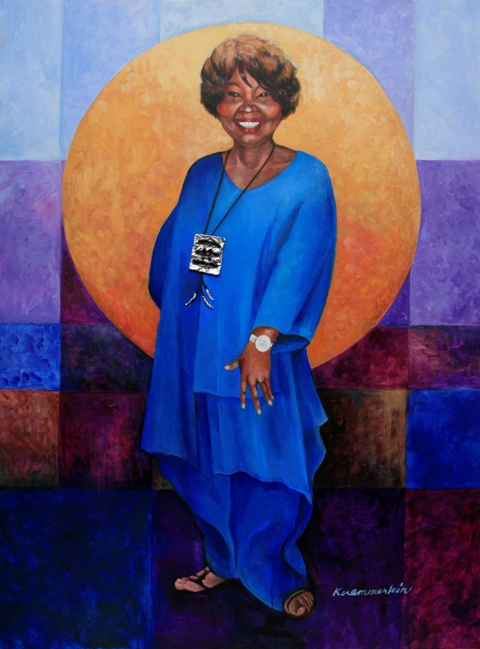
Janet Kuemmerlein has been interested in jazz even longer than she has been making art. Growing up in Detroit, she had to take two buses to reach her arts-focused high school downtown. While there, members of the Modern Jazz Quartet might stop by and ask to borrow instruments from the school. She also made sure to take in concerts by Ella Fitzgerald, Sarah Vaughn, Woody Herman, Count Basie, Cab Calloway, Stan Kenton … well, you get the picture.

After high school, Kuemmerlein was invited to study at the Cranbrook Academy of Art. Upon graduation she moved to Chicago, where she met her husband. Work assignments finally landed the couple and their four children in Kansas City, Mo. in 1960.

Kuemmerlien started in painting and sculpture. When she found the chemicals toxic around young children she moved to fabric. Her fabric works are on display across the country in government and office buildings, libraries and hotels, churches and synagogues.

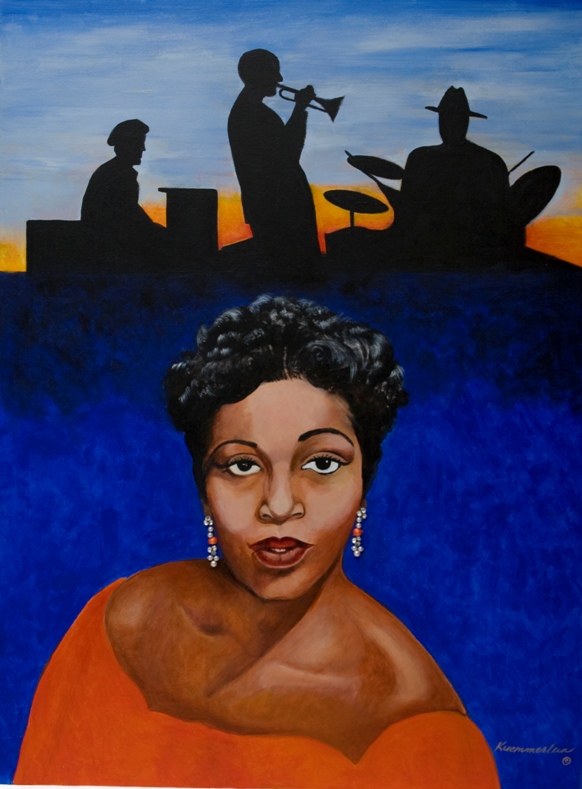
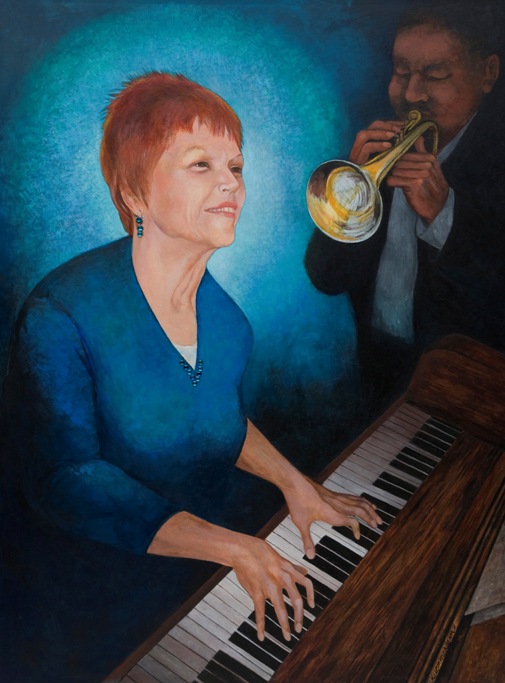
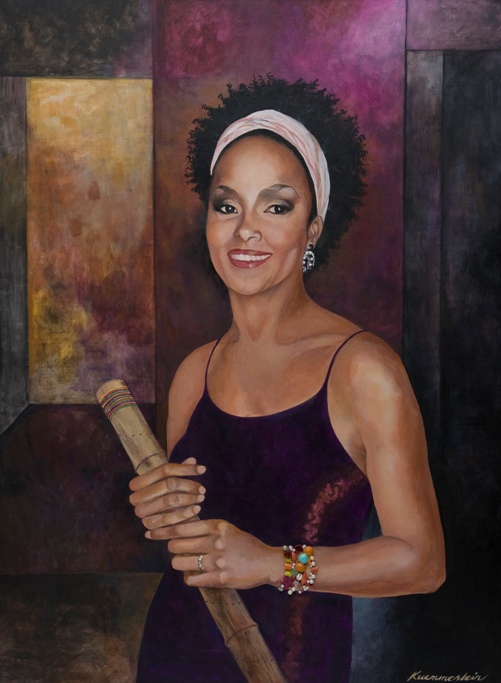
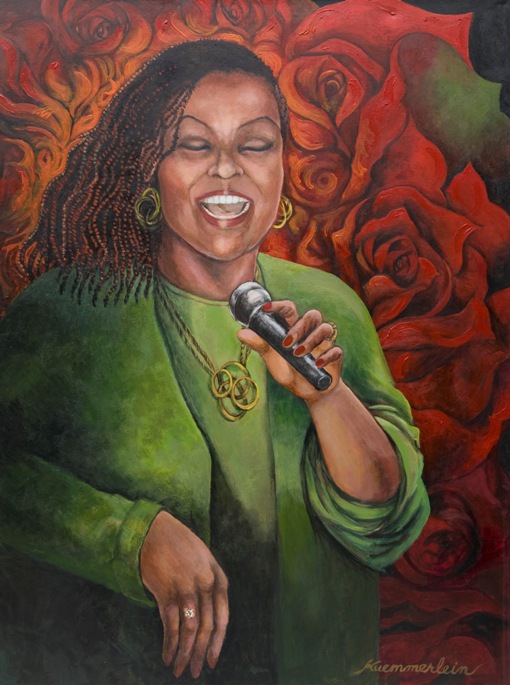
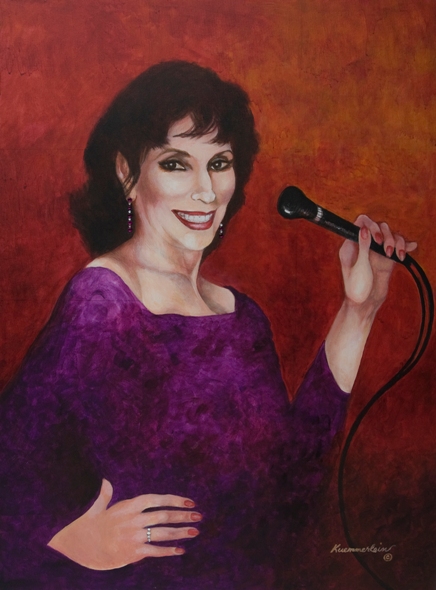
Jazz and art didn’t intersect until Kuemmerlien was asked to contribute to the Johnson County Community College art auction in 2000. Her painting of Miles Davis was purchased by a local attorney and later given to the American Jazz Museum. Last month, Kuemmerlien unveiled her latest project, a series of 11 portraits commissioned by the AJM for their Women in Jazz celebration.

The paintings are on display in the gallery off the museum lobby from 9 a.m. to 6 p.m., Tuesday through Saturday, and noon to 6 p.m. on Sundays, until the end of May. There is no charge to view the exhibit.

Kuemmerlien was kind enough to take The Daily Record on a tour of the exhibit and speak about each piece.

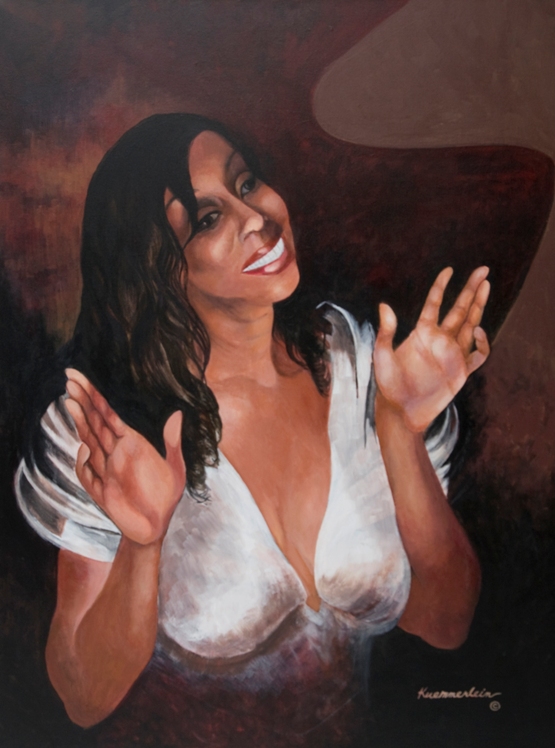
Oleta Adams

Oleta Adams – “We actually talked on the phone quite a bit beforehand because she was out of town so much. I wanted to showcase her hands because they’re such an expressive part of her performance. She and her husband are delightful people. God she is funny. She’s just adorable.”

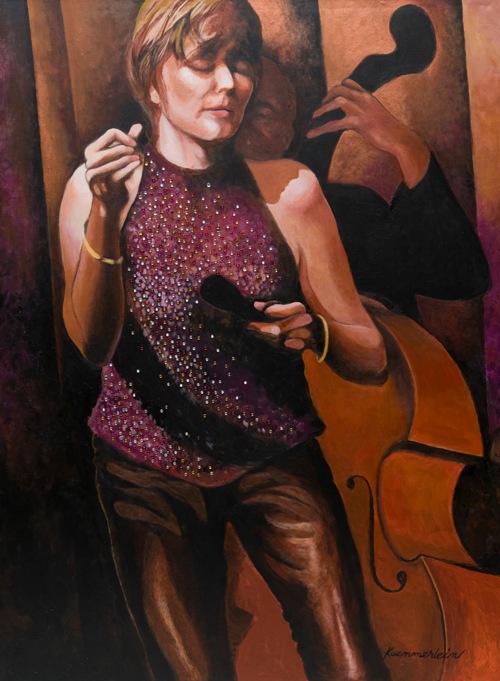
Karrin Allyson

Karrin Allyson – “I made this from a concert photo. When I told her I was doing this she said ‘don’t paint any lines (on my face),’ but she doesn’t have any. She’s too young. She was in town recently, but I don’t know if she’s seen this or not.”

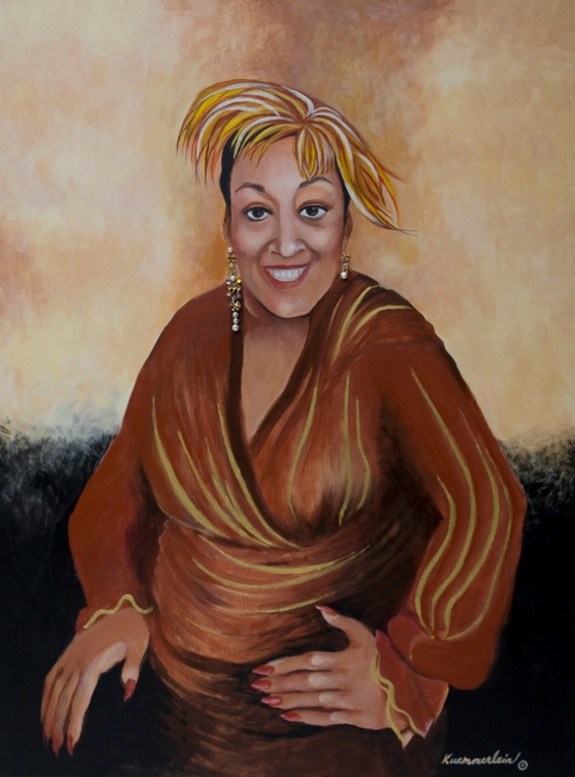
Queen Bey

Queen Bey – “Queen lives in California now, but when we were putting the exhibit together the museum told me she absolutely had to be in it. They supplied me with some photos and this is what I came up with. Although she isn’t in Kansas City any more, Queen Bey has been around for a long time and was an important figure to our jazz and blues scene.”

Deborah Brown

Deborah Brown – “Deborah spends a lot of time in Japan and Amsterdam. It was tricky to schedule the photo shoot, but we finally found a time and she came into my studio. She’s just a wonderful woman. I wanted the large circle in the background to reflect her career in Japan.”

Pearl Thurston Brown

Pearl Thurston Brown – “I did this partly from a photo she gave me, and partly from a photo session in her home. She’s as beautiful as she ever was. Although the painting portrays her at a younger age, she’d make a great portrait today as well.”

Carol Comer

Carol Comer – “Carol is a personal friend of mine. I took her face from one photo, then went to her house and took a bunch of photos of her hands. I made up the trumpet player. Carol teaches many of the other vocalists in this series.”

Angela Hagenbach

Angela Hagenbach – “This is the first one I did. I got photos of her at Jardine’s one night before her set. I was so excited, because I got terrific pictures, except she’s so tall and I’m so short I would accidentally cut the top of her head off. She’s just a beautiful women – and great singer, too.”

Lisa Henry

Lisa Henry – “This is one of the first ones I made. Again, I went to her house to take pictures. I knew she loved red roses, so I made those the background, then took photos of her at the Blue Room. She has such feel and phrasing. I think she’s a wonderful artist.”

Marilyn Maye

Marilyn Maye – “I painted this from photos Marilyn sent me and from album covers. Marilyn lives in New York, but she’s certainly a Kansas City legend. I tried to capture her longevity with the painting. She’s such a dynamo. Johnny Carson referred to her as a singer’s singer. She was his favorite singer.”

Julie Turner

Julie Turner – “I went to her house and photographed her. I used actual jewels to give textual interest to the painting and to have a little fun.”

The Wild Women of Kansas City

Wild Women of Kansas City – “I met with Geneva Price before I did any of the paintings, because she was working on an oral history of women jazz artists. For the painting, I used several group photos and then created a composite. I picked the best poses from each photo.”

Keep reading:

Review: Oleta Adams

CSNY – “Ohio”

 (Above: Neil Young leads Crosby, Still and Nash through “Ohio” during the CSNY2K tour stop in Toronto.)

By Joel Francis
The Daily Record

Several years ago, my dad and I drove out to Canton, Ohio to witness Hank Stram and Marcus Allen – two of our favorite Kansas City Chiefs – be inducted into the Pro Football Hall of Fame. Since the activities were spread out over several days, we frequently had time to kill each night. One evening we saw Quiet Riot at the local fairgrounds. Another night we decided to drive an hour or so north and walk around the Kent State University grounds.

As we strolled around the campus, the emotions of that day – 40 years ago yesterday, came flooding back to my dad. He remembered hearing the news and seeing the photos for the first time, his anguish at the senseless loss of life and anger at the government cover-up.

Although my dad hated the war in Vietnam, he easily could have been on either side of this conflict. As a college student, he had no problem seeing himself amongst the protesters. But he also joined the National Guard to avoid being drafted, and could just as easily been holding a rifle. Dad’s unit was given riot training, and he was frequently the designated heckler. He remembers a couple of his fellow soldiers nearly snapped during the simulations. That’s all it would have taken, he says.

Sadly, the shootings at Kent State were not an isolated incident. Ten days later, two more students were killed in a similar skirmish at Jackson State University.

Emotions were fresh in my dad, but I was trying to remember nearly forgotten history lessons as we walked the deserted campus at dusk. We tried to piece together where the events may have happened. We found the memorial, but it was frustratingly incomplete. The names of the fallen were absent, as was anything to place the memorial in historical perspective. Once again, good intentions had been killed in committee.

Four dead in Ohio. How many, how many more?

We were walking back to the car when we finally found the memorials. Frequently, university parking spaces are blocked off for loading, traffic flow or some other purpose. At first glance, we thought the low, lighted cement pylons scattered throughout the lot were standard parking barriers. As we approached the car, however, we noticed they outlined several low, pyramidal plaques set into the blacktop. These inconspicuous shrines marked the final steps of the fallen. And to think I almost dinged one when opening the car door.

To paraphrase Joni Mitchell, they paved a historical site, put up a parking lot. I know it was a parking lot on May 4, 1970. And, yes, I recognize the scarcity of public parking on college campuses. But the fallen deserved better and Kent State should be ashamed of trying to tiptoe around history. It’s hard to believe we’re still scared of what happened nearly two generations later.

At least back then you could get a song like “Ohio” on the radio. Neil Young penned his response to the killings after viewing photos of the incident in Life magazine. The song hit the airwaves in June, 1970, the same month Edwin Starr’s “War” topped the charts. Try to imagine either song cracking Entercom’s bland, corporate playlist today. Our corporate overlords have no problem challenging the listeners’ moral sensibilities with racy (hetro)sexual lyrics, but are petrified of offending them politically. One need only look at the list of songs banned by Clear Channel in the wake of the Sept. 11 attacks for proof.

Young cut the tune with his buddies David Crosby, Stephen Stills and Graham Nash. It took four years for the song to make it onto a proper album, CSNY’s stop-gap compilation “So Far.” I didn’t discover it until I picked up the two-disc Young anthology “Decade” in high school. I knew the song’s history, and respected its energy, but didn’t mean much to me beyond that until I heard it performed in concert.

The CSNY2K concert at Kemper Arena in 2000 was one of the worst shows I have attended. Our overpriced seats were a mile away. What little energy the performances had was lost long before the sound reached our little peanut gallery. Everyone seemed to be going through the motions. Stills was clearly burned out by having to play “Love the One You’re With” yet again, and Nash looked positively lost as the band tore into “Rockin’ in the Free World.”

Despite the overall malaise of the night, there were two bright spots. Young’s solo take on “After the Gold Rush” performed on a creaky pump organ while Crosby and Nash added harmony vocals was transcendent. Then there was “Ohio.” The lyrics took on new meaning as footage from the day flashed on the screens surrounding the band, but what got me was Crosby’s cries of “How many? How many more?” The pain was still fresh in his voice and his chilling refrain gave me goose bumps. Ten years later, I still can’t listen to the song without thinking of that moment.

Keep reading:

Bruce Springsteen and Tom Morello – “The Ghost of Tom Joad”

Clark Terry’s Last Stand

(Above: A somewhat recent performance of Clark Terry’s signature song, “Mumbles.”)

By Joel Francis
The Daily Record

Perhaps only baseball reveres its heroes of the past as much as jazz. Each year, Stan Musial, Ted Williams or another bygone star is paraded around the field before the All-Star Game. Likewise, the songbooks passed down from Miles, Duke, Satchmo, Monk and others are considered sacrosanct.

Unlike baseball fans, however, jazz traditionalists are loathe to replace their legends with up-and-comers. This makes it frustratingly inconvenient when the links to that halcyon era keep dying.

Fortunately, Clark Terry was up to the task Friday night at the Gem Theater for the American Jazz Museum’s Duke Ellington celebration. The 89-year-old trumpet master played with Ellington for 10 years, led Johnny Carson’s Tonight Show band, and recorded with Oscar Peterson, J.J. Johnson, Thelonious Monk and scores of others throughout his eight-decade career.

Fellow Ellington orchestra alum Barrie Hall, Jr. introduced Terry by reminiscing when he was able to record with his hero on the soundtrack of the “Fabulous Baker Boys.” Stationed in a wheelchair, Terry appears from the backstage recesses of stage right, hidden in the wings.

As the applause built, Terry’s son, standing behind the chair, frantically waves his arms, as if to call the celebration off. The museum’s two-day tribute to Ellington has been building to this moment. Has something gone wrong? Will Terry not be able to appear after all? Killing time, Hall nervously sings a few stanzas of “Do Nothing ‘Till You Hear From Me.”


Clark Terry receives the American Jazz Museum lifetime achievement award from museum CEO Greg Carroll in Kansas City, Mo. on April 30, 2010.

Finally, Terry emerged, slumped in his chair, wearing a dark suit and white yachting cap reminiscent of Count Basie’s favorite headwear. A clear tube of oxygen runs beneath his nose, resting atop his albino moustache. A trumpet case is tantalizingly set next to Terry’s wheelchair, but it’s obvious he won’t be able to play even before the announcement is made.

As the band, led by Hall, kicks into “Full Moon at Midnight,” Terry rests his hands on the cane that stands between his knees. He takes in the saxophone solo by Ahmed Alaadeen. The esteemed Kansas City jazz fixture is another Ellington alumnus who received the museum’s lifetime achievement award earlier that evening.

When the song ended it was time for Terry to receive his own lifetime achievement award. His son pushes the wheelchair near the podium. As chief executive officer Greg Carroll reads a biography, Terry fiddles with his wristwatch, seemingly unsure of where he is. When the award is presented, he looks at the miniature bust of Charlie Parker in wonder as Carroll holds it up. Terry’s grip is too weak to clutch the statue.

While the camera flashes fade, Carroll looks at Terry and suggests a song. Terry looks so frail It seems an imposition to ask this much, but he graciously accepts the mic that has to be placed in his right hand. The band launches into “Squeeze Me,” one of Terry’s signature numbers with the Ellington orchestra. His warm voice starts out thin and strained, but grows stronger with each verse. The years fall away as he starts scatting the final verse, his left knee rocking up and down.

The applause is still strong when Hall looks at the band and blasts the intro to “Mumbles.” Terry joins right in and his nonsense spoof of blue singers brings laughter from the audience. He’s into it now, rocking back and forth and even backing his chair up so he can look Hall in the face as he supplies fills on his trumpet. Hall and Terry trade riffs back and forth from voice to horn and back like a jazz version of an Abbot and Costello routine.

The audience jumps to its feet with the final note, and a broad smile beams from Terry’s face. Wheelchair or not, it is obvious that when Terry is put onstage and given the mic he still knows exactly what to do. He has no difficulty conjuring smiles and making everyone happy. As his son wheels him offstage, Terry blows kisses and doffs his hat. A few songs later, Terry’s son and a nurse escort him quietly out of the building.

(Below: Clark Terry blows his horn on the Tonight Show in 1980.)

Keep reading:

Review: Sonny Rollins

Review: Oleta Adams

Review: Kind of Blue turns 50

Remembering Gennett Records

Releasing Jazz from Aspic

KC Recalls: The Coon-Sanders Night Hawk Orchestra

Buck O’Neil: Sweet times, sweet sounds at 18th and Vine

Piano Men: Dave Brubeck, Dr. John and the Jacksonville Jazz Festival

Review: Public Image Ltd.

(Above: John Lydon made his first post-Sex Pistols statement with “Public Image.” “Rise” is one of PiL’s most accessible tunes. Here the reunited band performs them at the 2010 Coachella music festival.)

By Joel Francis
The Kansas City Star

There was nothing rotten about the performance John Lydon and Public Image Ltd. delivered Monday night at the Midland Theater. Faced with a miniscule crowd in a minor market on a weeknight, Lydon and the band could have phoned in their performance and few would have known. The four-piece band held nothing back during the high-energy, two hour show.

Public Image Ltd., or PiL, is the band Lydon formed after the Sex Pistols imploded. Although the band carried on for 15 years, its catalog can be broken down into two distinct eras. The first three albums were a conscious deconstruction of the Pistols mythology, filled with long, heavy, experimental pieces. Later work boiled down to Lydon solo projects under the PiL name produced with a rotating cast of musicians (including, incredibly, Steve Vai).

The reconstituted PiL, back together for the first time since disbanding in 1992, drew equally from both eras, and tossed in a couple numbers from Lydon’s 1997 solo release for good measure. Older numbers, like the magnificent “Poptones,” the epic “Albatross” or “Chant” were studies in texture and ambience. As the rhythm section of Bruce Smith on drums and new member Scott Firth on bass anchored the songs, guitarist Lu Edmonds welded huge blocks of sound which Lydon penetrated effortlessly with his shrill voice.

The backing trio clearly enjoyed having the space to stretch out and play with different sounds. Firth and Edmonds sparred on “Flowers of Romance” before Edmonds delivered his first solo of the night on an electric banjo. Firth switched to upright electric bass for several numbers which added extra punch to Smith’s cadences.

Although Lydon was about the same age as his gray-haired compatriots he appeared decades younger. His head was shaved, save long, blonde spikes on top that looked like a mischievous crown. After removing a red vest early in the night, Lydon was clad entirely in black. He kept a lyric book on a music stand near his mic and although he rarely looked at them during a number, he dutifully turned the page after each song. When Lydon was really feeling the music, he would hop up and down or do a robo-monster march, a manic expression plastered on his face.

While the older material was dark and amorphous, the newer songs were bright, poppy and quite danceable. The set opened with PiL’s biggest number, “This Is Not a Love Song.” Later, “Sun” was delivered via acoustic guitar and mouth organ. As Lydon led the crowd in sing-along, the arrangement almost had a klezmer feel. “Disappointed” got the biggest reaction during the main set and had everyone near the stage bouncing. Lydon later joked about the song’s message of forgiveness didn’t quite stand with the cynicism of his other tunes.

During his four decades in the spotlight, Lydon has cultivated a reputation for acerbically speaking his mind, and he didn’t disappoint onstage Monday. “Warrior” contained a political diatribe and a few not-so-kind words for Sarah Palin. Lydon introduced “Religion” as “a song that is 30 years old and as accurate as ever.” He then made a few comments about the Pope that won’t be earning him a Vatican invite any time soon.

The night ended with “Public Image,” the song that most resembles Lydon’s former band, and the upbeat “Rise,” which contains an interpretation of the Irish blessing “may the road rise to meet you.” “Open Up,” Lydon’s collaboration with the techno duo Leftfield, closed the night. As the crowd danced to the heavy bed of looped synthesizers, Lydon’s voice panned and swirled around the room.

As the band waved good night, the punk provocateur let his guard drop with a fleeting moment of sincerity when thanked everyone from the bottom of his heart for coming out. The tiny crowd comfortably filled the first two tiers on the floor, but the third was sparse and the fourth was empty.There were a few dozen people sitting on chairs in the back, but the entire audience could have probably crammed into the Beaumont Club. That venue may have been more size-appropriate, but it wouldn’t have been much fun. PiL had no problem filling the vast Midland, and Lydon’s outsized persona needed – and deserved – a bigger stage.

Setlist: This Is Not A Love Song, Poptones, Memories, Tie Me to the Length of That, Albatross, Death Disco, Flowers of Romance, Psychopath, Warrior, USLS 1, Disappointed, Sun, Bags, Chant, Rise, Religion. Encore: Public Image, Rise, Open Up.

Keep reading:

Review: Carbon/Silicon at the Record Bar

Ever Fallen For The Buzzcocks?

Review – Greg Ginn and the Taylor Texas Corrugators

Go green with Stiff Little Fingers

Dischord finds harmony in D.C. hardcore scene