Gladys Knight and the Pips – “If I Were Your Woman,” Pop #9, R&B #1
By Joel Francis The Daily Record
Relationship fantasies were nothing new at Motown – Mary Wells’ “The One Who Really Loves You” was one of the label’s earliest singles. But Gladys Knight and the Pips’ 1971 single “If I Were Your Woman” shows how much Hitsville had grown up during the ‘60s. The song removes the concept from the realm of schoolgirl crushes and infuses it with some serious grown-up desire.
When “If I Were Your Woman” came out the Pips were on a run of three consecutive Top 5 R&B hits, dating back to 1969’s No. 3 “The Nitty Gritty.” The group was determined to keep this streak intact and also bolster their album sales; none of their LPs had cracked the Top 10. They accomplished both. The single went all the way to the top of the R&B charts, and the album – given the same name – lodged at No. 4.
Knight’s smoky, smoldering voice played no small role in that achievement. Listeners who grew up with “Baby Love” no doubt enjoyed hearing love songs that matured with them. Knight sumptuously plays the role of a woman in love with a man trapped in a bad relationship. Knight knows she can make him the man he deserves to be, if only he could muster the strength to walk away … and she could find the courage to confront him face-to-face.
Knight sings with the passion of a woman pouring out her deepest desires to the darkness, a conviction rooted in the comfort of knowing these words will never face the harsh scrutiny of daylight. As the song fades, it is easy to imagine Knight drifting off to sleep as her would-be beau lies awake in bed next to his partner, wondering how he wound up in this predicament. The next time Knight and her man meet, their only exchanges will be furtive glances across the room and brief, awkward conversation punctuated by nervous laughter.
Written by Gloria Jones, Clay McMurray and Pam Sawyer and produced by McMurray, “If I Were Your Woman” inspired several covers. The Jean Terrell-fronted Supremes recorded a version the following year, in 1972. One year later, Jones – better known as the original singer of the song “Tainted Love,” later recorded by Soft Cell, and girlfriend of T. Rex glam rocker Marc Bolan – recorded her own version for her second solo album.
Bonnie Bramlett, formerly known as half of Delaney and Bonnie, followed suit in 1976. The unfairly ignored Bettye LaVette put her stamp on the song on her only Motown album, 1980s “Tell Me A Lie.” Eight years later Stephanie Mills put the song back on the charts, where it reached No. 19 on the Hot Black Singles chart (now known as the Hot R&B/Hip Hop chart). That same year found the only male interpretation of the number, when George Michael performed it at Nelson Mandella’s 70th birthday tribute. Somehow people were still shocked when he came out of the closet a decade later.
Most recently, Alicia Keys included the song as part of a medley on her sophomore album, and gave it the stand-alone treatment on her 2005 live album “MTV Unplugged.”
(Above: Branford Marsalis solos and shows off his new drummer, Justin Faulkner, at a 2009 concert.)
By Joel Francis The Daily Record
Saturday’s Branford Marsalis concert at the Gem Theater was a night of new beginnings.
The show kicked off the 2010-2011 season of Jammin’ at the Gem and featured new bass player Robert Hurst – this was only his second gig with the quartet in as many nights. It even opened with a new song.
That number, tentatively titled “Joey’s Tune” after its composer, pianist Joey Calderazzo, was a bit of an outlier. Admittedly a work in progress, the arrangement was busy to the point of claustrophobia. When Marsalis stepped back, Calderazzo and drummer Justin Faulkner flooded the room so completely one wondered if Marsalis would be able to wedge his way back in the song.
Fortunately, the rest of the two-hour set fared better. Alternating between soprano and tenor saxophones, Marsalis guided the band through breakneck changes and lumbering mood pieces. Some of his solos displayed the pop sensibilities that made him the go-to hornsmith for Sting and Bruce Hornsby, yet his playing was always challenging, never resting too lightly on the ears.
If the set had one blemish it was that Marsalis seemed too content to introduce a number with a solo, then step away for the rest of the number to let his trio play. Aside from being the best player onstage, Marsalis’ horn was the catalyst that helped the rest of the sounds to coalesce.
“The Blossom of Parting,” a track from Marsalis’ 2009 album “Metamorphosen” was the high point of night. The song opened softly with Marsalis on soprano sax, and Faulkner switching between brushes and mallets to build new textures. Calderazzo’s mesmerizing solo blurred the lines between jazz and classical music, and showed more than a hint of Brad Mehldau’s plaintive style. When the band re-entered, Marsalis gradually built the song’s intensity. Before the song could climax, however, an over-exuberant Faulkner accidentally knocked his ride cymbal to the floor. It wasn’t the ending Marsalis hoped for, but the audience took in stride and responded with a standing ovation.
Faulkner had no problem filling the drum stool occupied by Marsalis’ longtime beatman Jeff “Tain” Watts. On a cover of Thelonious Monk’s “Teo,” Faulkner traded bars with Marsalis with a maturity that outpaced his age of 19 and an energy that underlined it. His solo during a later song recalled another drummer of Marsalis’ acquaintance, Art Blakey.
Hurst also handled himself well, despite sight-reading all of the material. His lengthy solo would have worked better tied to a song than as a stand-alone piece. Aside from that moment, Hurst drew little attention to himself – a positive attribute for now in these new surroundings.
The evening ended with an encore of “St. Louis Blues” that found Marsalis showing off his New Orleans roots and reeling off some Satchmo-like trumpet licks on his saxophone.
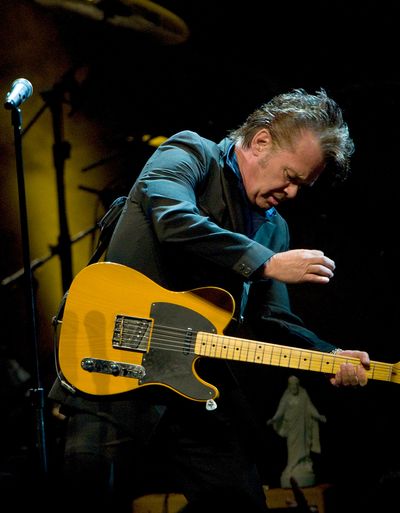
(Above: John Mellencamp tells the story of Jackie Brown at the Midland Theater in Kansas City.)
By Joel Francis The Kansas City Star
Friday night’s sold-out John Mellencamp show at the Midland Theater was the tale of two concerts. For the first 90 minutes, Mellencamp used his vast songbook to explore the nooks and crannies of American music. Opener “Authority Song” was stripped of its big country riff and rode bare bones on the spare bass and drum line. Later in the show, “Jack and Diane” was given the same treatment, with Miriam Strum’s violin shouldering the melody.
“No One Cares About Me” resembled prime-era Johnny Cash with a boom-chicka rhythm section and guitarist Andy York doing his best Carl Perkins impression. “Deep Blue Heart” sounded like an outtake from Bob Dylan’s “Time Out Of Mind.”
While there weren’t any jump-to-your-feet, hands-in-the-air climaxes during this part, there were a few goose bump-inducing moments. The smallest moments were the biggest, like Mellencamp’s poignant solo, acoustic delivery of “Jackie Brown,” where he was joined by Strum at the end.
A subdued “Check It Out” had the wistful air of someone watching their grandchildren play in the yard. Later, the entire theater clapped and sang along as Mellencamp sang “Cherry Bomb” without his band or his guitar.
It was clear, however, that the crowd wasn’t expecting a low-key evening. The chatter from the bar downstairs floated into the balcony during the quiet “Longest Days.” Story/songs “Right Behind Me” and “Easter Eve” lacked a traditional chorus and struggled to captivate the crowd.
After the beautiful violin/accordion duet of “New Hymn,” the full drum kit that had been tantalizing the crowd all night was finally put to use. Starting with the heartland hymn “Rain on the Scarecrow,” Mellencamp and his six-piece backing band cut loose and delivered 30 minutes of the expected energetic sing-alongs. With each song, the band raised the volume and dropped formality. Singles like “Pink Houses” drew the biggest responses, while the band seemed to relish trotting out album cuts “The Real Life” and “No Better Than This.”
In a way, Mellencamp served as his own opening act. As the audience found their seats an hour-long documentary played. The film showed Mellencamp on tour and as he recorded his latest album at Sun Studios in Memphis, the San Antonio hotel room where Robert Johnson once recorded, and First African Baptist Church in Savannah, Ga.
Mellencamp recorded the album using a single microphone to capture the entire band in one take. The approach may puzzle some fans, but it’s clear from the first half of the night that his songwriting chops are as strong as ever. The struggle will be to win fans over to new arrangements and sounds that don’t resemble the long-loved radio hits.
After a little more than two hours, the house lights were up, and Mellencamp was safely shuttled to his Airstream trailer parked behind the building. A large portion of the crowd lingered, whistling and clapping in vain as the stage was cleared. The evening wasn’t a complete success, but it was enough to leave them wanting more.
Setlist: Authority Song; No One Cares About Me; Deep Blue Heart; Death Letter; Walk Tall; The West End; Check It Out; Save Some Time To Dream (solo, acoustic); Cherry Bomb (a capella); Don’t Need This Body; Right Behind Me; Jackie Brown (solo, acoustic); Longest Days; Easter Eve; Jack and Diane; Small Town (solo, acoustic); New Hymn; Rain on the Scarecrow; Paper and Fire; The Real Life; Human Wheels; If I Die Sudden; No Better Than This; Pink Houses; R.O.C.K. in the U.S.A.
(Above: Vampire Weekend goes on “Holiday” with this track from their 2010 sophomore release, “Contra.”)
By Joel Francis The Kansas City Star
Success has come easily to Vampire Weekend. After starting in 2006, the indie-rock band generated major buzz the next year with its single “Cape Cod Kwassa Kwassa,” which appeared on Rolling Stone’s 100 Best Songs of the Year list.
With a mix of preppy ’80s rock and heavy debt to the African sounds of Paul Simon’s “Graceland” album, Vampire Weekend’s self-titled debut was seemingly everywhere. Songs popped up in movies, TV shows and video games, and the band performed to a capacity crowd at the high-profile Central Park SummerStage in New York.
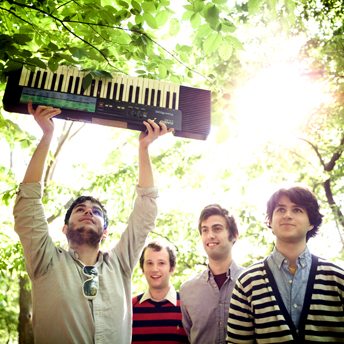
The Ivy League lads of Vampire Weekend worship both their Casio and the trees.
“When we signed with (record label) XL, if someone would have told me we would have sold 100,000 copies of our first record, I would have been elated,” said Chris Baio, the group’s bass player. “The fact that we sold 400,000 copies beyond that is just an extra bonus.”
Hot starts have derailed more than one promising band, but Baio said the group was talking about its follow-up effort just months after the first one dropped.
“We definitely felt some pressure as we started getting more and more success with the first record,” Baio said. “Very early on we were talking about the second album. I think we came up with the title ‘Contra’ within two months of the (first) album’s release.”
When it came time to record the follow-up, the band was able to push aside all the external pressure and make the album it wanted.
“If we were going for the easy commercial release it would have been five “A-Punks” and five “Oxford Commas,” Baio said, referring to two of Vampire Weekend’s biggest singles. “We didn’t think at all about the amount of records we had sold when we went in the studio to make ‘Contra.’ ”
Instead, they toyed with the formula, stretching some numbers beyond the four-minute limit imposed on “Vampire Weekend” and playing with arrangements.
“Some of the instrumentation on ‘Contra’ is a little bit weirder,” Baio said.
“There’s one song called ‘Diplomat’s Son’ that has abrupt changes that make it almost proggy in structure.”
When Vampire Weekend played Liberty Hall in Lawrence in September 2008, it emptied its repertoire in a 50-minute set. Standing in front of a static image of its only album’s cover, the band performed all of its songs, in addition to a couple of B-sides and new numbers.
“When we started, there was no light show, and we were using the house mixer,” Baio said. “Now we have our own sound and lighting guy. We have a background we’re proud of that changes at different points during the show and a good, new light show.”
Baio said both the production and set list will be improved when Vampire Weekend plays Starlight Theatre on Saturday with Beach House and the Very Best.
“I feel like we’re now putting on a full show at 85 minutes,” Baio said. “We may make some changes to the set, like if someone tweets a request, but for the most part we try not to change it. It has a nice ebb and flow we like, or rather just flow, no ebb.”
That makes the set similar to Vampire Weekend’s three-year history — one steady rush with few breaks, something the band isn’t interested in pushing any further.
“With the exception of when we went in and recorded ‘Contra,’ the past three years have been a steady grind,” Baio said. “We’re going to take some time between the second and third albums, and for now that’s still a ways off. We’re not going to be playing any songs off the third record this year.”
(Above: An excerpt from Sufjan Stevens’ 25-minute saga “Impossible Souls” performed at the Uptown Theater in Kansas City.)
By Joel Francis The Kansas City Star
It’s unlikely one will ever find a reissue of “Tales of Topographic Oceans” in the record bins at Urban Outfitters or see hipsters sporting Emerson, Lake and Palmer shirts with their skinny jeans. But on Sunday night at the Uptown Theater, indie singer/songwriter Sufjan Stevens delivered a chunk of progressive rock that would have made fans of Gentle Giant and Yes proud.
The earthy folk rock of Stevens’ breakthrough albums – “Seven Swans,” “Michigan” and “Illinois” – has been replaced by electronic, adventurous rock landscapes. About an hour into his two-hour set, Stevens explained the shift saying songwriting was “no longer loyal” to him so he started playing with rudimentary sounds.
Extended segments of noises and effects – particularly on the 25-minute journey “Impossible Soul” – made the set feel more like an art installation that a rock show at times. But whether channeling Genesis and the Flaming Lips or Paul Simon and Cat Stevens, the Uptown’s sold-out crowd hung on every note.
After tossing fans a bone with “Seven Swans,” Stevens and his 11-piece band focused exclusively on material from August’s hour-long “All Delighted People” EP and “The Age of Adz,” an album released this month. The poppy “Too Much” came with a boozy twin-trombone solo and could have been a dance hit in another dimension if not for the extended burps and warbles of guitars, organ and synthesizers in its second half.
As the band delivered its complex themes and arrangements, a large trapezoidal video screen reinforced the themes. Space opera “The Age of Adz” featured a film that looked like an animated Funkadelic album cover. Stevens later explained the number as an “explorative supernatural song about love and heartache” and added that a “broken heart doesn’t always bring the apocalypse, but it always feels like it.”Sure it’s pretentious, but it was also a lot of fun and more accessible than it sounds.
The songs felt intimate despite Steven’s everything-including-the-kitchen-sink approach. This was due in large part to his hushed, soft falsetto and intimate, yet inviting lyrics. Even the most bombastic material contained letters of encouragement, boasting self-affirming lyrics like “don’t be distracted” and “Sufjan, follow your heart.”
Several numbers were delivered with spare arrangements featuring little more than Steven’s voice and finger-picked guitar. “Heirloom” was just as delicate as its title, while “Futile Devices” was a soul-baring tribute to Stevens’ brother. When Stevens later forgot the lyrics during the quiet “Enchanting Ghost” it only enhanced the intimacy.
Stevens prepped his crowd for “Impossible Soul,” informing them they were about to embark on an “intense, emotional, psychotherapy experiment.” The result was nowhere near as ponderous the introduction or running time implied. “Soul” is less a song than an exploration of a song idea from every conceivable angle. Melodies and themes were tackled via prog-rock, ‘80s dance and autotune before concluding with Stevens gingerly plucking his acoustic guitar. It was enough fun that the band slipped in a bit of Salt and Peppa’s “Push It” and one of the supporting singers danced around the stage spraying silly string.
The crowd’s patience with the new material was rewarded with three songs from “Illinois.” “Chicago” ended the main set and drew the biggest cheers of the night. After saying goodnight, Stevens returned alone and delivered “Concerning the UFO” on piano and “John Wayne Gacy, Jr.” on acoustic guitar. It was a bit creepy to hear the audience sing along with Steven’s haunting portrait of the serial killer and an odd note to end the show on.
As with the rest of the evening’s detours, no one seemed to mind. After five long years, the hero had finally returned to his fans. The path may not have been expected, but the results were just as spectacular.DM Stith: The opening act only got 20 minutes, but he had no trouble silencing the crowd. Armed only with his acoustic guitar, the singer/songwriter delivered four songs very much in mold of Stevens’ most popular work. Using several pedals and a sampler, Stith was able to recreate a percussion section and choir by building then looping a series of claps, stomps and harmony vocals. The trick may not be new, but it was still impressive. Stith’s songwriting was even better. It would be interesting to see what he could do with a full set. Several of his songs may be downloaded for free on the Website for Asthmatic Kitty, the label Stevens founded.
Sufjan Stevens Setlist: Seven Swans; Too Much; Age of Adz; Heirloom; I Walked; Futile Devices; Vesuvius; Now That I’m Older; Get Real, Get Right; Enchanting Ghost; Impossible Soul; Chicago. Encore: Concerning the UFO Sighting Near Highland, Illinois; John Wayne Gacy, Jr.
(Above: The reconfigured Smashing Pumpkins incinerate the old country with “As Rome Burns,” a yet-unreleased track.)
By Joel Francis The Kansas City Star
Billy Corgan has learned to compromise. After frustrating and confounding fans with obscure songs and indulgent jams on the Smashing Pumpkins’ 20th anniversary tour just two years ago, he has struck a balance between the old (and beloved) and the new.
The unspoken agreement of Saturday’s show at Sandstone Amphitheater was one for you, one for me. Fans seemed thrilled to meet Corgan and his reconstituted Pumpkins halfway. Opening with the drum roll into “Cherub Rock,” the quartet alternated between favorites like “Zero” and “Drown” with newer numbers such as “Song for a Sun” and unreleased material like “As Rome Burns.”
“We’ve found the songs you know tend to get the biggest cheers,” Corgan told the audience before launching into “Tonight, Tonight” and he was right. “Today” provided the first big sing-along moment of the night, turned the chorus of “Bullet With Butterfly Wings” over to the very vocal throng. Even “Stand Inside Your Love,” an underrated single from the original configuration’s final retail album, drew a big response.
The 80-minute setlist ignored “Gish” but drew from every other album in the band’s catalog and a couple soundtrack contributions. Most of the songs sounded pretty much like they were recorded. The only exceptions were new arrangements of “Adore”-era material. The new version of “Adore” rode Nicole Fiorentino’s bass, and discarded the drum programming for a full band sound. “Eye” was given a trippy intro full of shimmering guitars and big, echoing drums.
Newer material dovetailed nicely with the familiar. “Tarantula,” from 2007’s forgotten “Zeitgeist,” emerged seamlessly from “Cherub Rock” just as “Drown” gave way to “As Rome Burns.” “Song for a Son” had a progressive feel and guitar lick similar to “Stairway to Heaven.” It was one of several of the night’s numbers to feature Corgan and Jeff Schroeder harmonizing on twin guitar solos.
Before breaking up at the dawn of the millennium, the Smashing Pumpkins were one of the most successful bands to come from the grunge era. Corgan and founding drummer Jimmy Chamberlain reconvened for “Zeitgeist,” recruiting supporting musicians for the subsequent tour, before Chamberlain left again last year.
Corgan may be the only founding member left in the band, but the new cast proved more than capable. Twenty-year-old Mike Byrne was a monster on the drums, having no trouble replicating the complex rolls and fills that are so much a part of the Pumpkin’s sound. The band was amazingly tight and precise, slithering across the changing dynamics and textures and following Corgan’s every move.
The stage set-up was basic, but impressive. The only effects were banks of lights set up above and behind the band, constantly strobing and changing. Two large metal fans were perched atop metal towers in the back at either side of the stage. The visual arrangement kept anyone from receiving the spotlight. The band was lit as a whole and the emphasis was placed on the music.
The band exited shortly before midnight against a wall of lights pointing into the audience. They were visible only as vague silhouettes, but had long established their identity.
Cake’s one-hour set preceding the Pumpkins couldn’t have been more different. Singer John McCrea chatted with the crowd between nearly every number, espousing his views on religion, American society and the gradual disappearance of three-four time. Along the way, the five-piece college rockers delivered audience favorites “Comfort Eagle” and “Frank Sinatra” and songs from their upcoming new album.
Although most of Cake’s songs ride a slow funk groove and McCrea’s tongue-in-cheek spoken/sung lyrics, two of evening’s best numbers veered from that formula. “Mexico” sounded like a lost Decemberists track, while new song “Bound Away” was a travelogue in the form of an Irish drinking song.
Smashing Pumpkins setlist: Cherub Rock, Tarantula, Adore, Song for a Son, Today, Drown, As Rome Burns, Freak, Tonight Tonight, Stand Inside Your Love, Eye, Bullet With Butterfly Wings, United States (including the Star-Spangled Banner and Moby Dick). Encore: Zero.
Cake setlist: Comfort Eagle, Rock and Roll Lifestyle, Sick of Me, War Pigs (Black Sabbath cover), Frank Sinatra, Wheels, Stickshfits and Safetybelts, Love You Madly, Guitar, Arco Arena, Mexico, Bound Away, Never There, The Distance.
(Above: “Go To Sleep” is one of many new songs rapper Lupe Fiasco has completed for his new album, “Lasers.” Despite submitting the album to his label two years ago, a release date of March, 2011, was just announced last week.)
By Joel Francis The Daily Record
Today hundreds of young music fans will protest outside the headquarters of Atlantic Records in New York City as part of Fiasco Friday. A similar rally will also take place in Chicago.
The gatherings started as an frustrated discussion on an internet forum over Atlantic’s two-year refusal to release an album by rapper Lupe Fiasco. Inspired by success stories of similar incidents with Wilco and Fiona Apple, this new generation of fans want major labels to respect their voices.
“Lupe is just one part of a larger issue,” said 17-year-old Matthew LaCorte, one of Fiasco Friday’s organizers. “I would like Atlantic to stop interfering in the creative process of its artists and to help get a more positive message – a message like Lupe’s – on commercial radio.”
Tall requests, to be sure. Artists complaints of label meddling can be found in ever era of the music industry, and are a major reason why artists from Trent Reznor of Nine Inch Nails to the Eagles have divorced themselves from major label. Complaints of commercial radio playlists have increased – while overall listenership has decreased – since the 1996 Telecommunications Act allowed single corporations to gobble up more and more of the national spectrum.
Rapper Lupe Fiasco.
“Our goals mirror Lupe’s L.A.S.E.R.S. manifesto, which he posted online,” LaCorte said. “We want to alert people and tell the message of Lupe Fiasco, who’s music has a drastically different message from what you hear on the radio.”
In part, the 14-point manifesto declares an end to glamorizing negativity in the media, promotes environmental responsibility, individualism and political accountability, elevates substance over popularity and calls for the end of war and a “processed culture of exploitation, over-consumption and waste.”
But it will take more than T-Pain’s ubiquitous and chart-topping auto-tune to make these lofty goals part of any mainstream discussion.
“I’m not exactly sure what to expect from the rally,” LaCorte said. “I know we’ll have lots of signs and so some picketing. I’m planning on giving a speech, and I know we’ll have lots of chants and rally calls based on Lupe’s music.”
Oh, and Fiasco will be personally participating in the New York rally. In late September, Fiasco tweeted “well if y’all there…I guess I gotta be there too!”
“This started because we all wanted ‘Lasers’ to come out,” LaCorte said. “Last week Atlantic finally gave us a release date of March 8, 2011, so in a way we’ve succeeded. Fiasco Friday will be both a celebration of our success and a chance to protest issues we feel still need to be addressed.”
Fiasco is hardly the only rapper facing label resistance right now. Last week Nas raged against Def Jam’s refusal to release the second volume in his “Lost Tapes” series as part of his contract.
“Beefing with record labels is so 15 years ago,” Nas wrote in his open letter. “I could go on twitter or hot 97 tomorrow and get 100,000 protesters @ your building but I choose to walk my own path my way because since day one I have been my own man.”
LaCorte said he was fine with Nas’ perspective. But when the original petition calling for ‘Lasers’” release was ignored by Atlantic, he knew it was time to make a bigger noise.
“Having fans protesting is not good for business,” LeCorte said. “But if we fans do this – petition, boycott, make phone calls, send letters and stand up for the musicians we admire – if we make our voices heard, there will be a change.”
(Above: Santana and Nas put their spin on AC/DC’s “Back In Black” on the “George Lopez Show.” Believe it or not, this is one of the better moment’s on Santana’s new album.)
By Joel Francis The Daily Record
It’s hard to believe it has been a ten years since “Supernatural.” Back then, Santana was just another fading Woodstock star. He has been living in the shadow of “Smooth” and “Maria Maria” ever since.
With a title like “Guitar Heaven: The Greatest Guitar Classics of All Time” one could be excused for thinking Santana’s latest album was a repackaging of “Oye Como Va,” “Soul Sacrifice” and the rest of the jams that made him a guitar icon. Instead we are gifted with an album much more panderous.
“Guitar Heaven” reunites Santana with label president/marketing guru Clive Davis for the first time since “Supernatural” and is the third consecutive album to follow its formula. The blueprint is simple: pair Santana’s guitar with some of the biggest pop voices of the moment in every genre. The twist this time is that every tune is a well-known cover, a great guitar classic, no less.
The result is a dozen pedestrian, uninspiring performances. None of the musicians associated with this project even pretend to muster the effort to add something new to these well-worn staples of classic rock radio stations. It’s hard to imagine anyone clamoring to hear Train’s Pat Monahan aping early Van Halen or anxiously waiting to see what Chris Daughtry could do with Def Leppeard’s “Photograph.”
Predictably, Davis invited Rob Thomas back into the fold, but this time the man who brought Santana his biggest hit is anything but smooth. The Matchbox 20 singer seems completely overwhelmed by “Sunshine of Your Love.” Joe Cocker fares better on the Jimi Hendrix staple “Little Wing,” but the performance still begs the question why anyone thought this project was necessary.
At best the outcome is merely redundant; at its worst it an embarrassment. The only inventive choices were including India.Arie and Yo-Yo Ma on “While My Guitar Gently Weeps” and rapper Nas trying to inject some hip hop into “Back In Black.”
Neil Young’s “Le Noise” is a true celebration of the guitar. For his 32nd album, Young worked with famed producer Daniel Lanois. Lanois’ productions are frequently criticized for their big echoy sound and stark separation of instruments. They can often sound like Lanois conformed the artists to his vision, rather than the other way around.
Although some of Lanois’ swampy trademark exists in “Le Noise,” his distinct fingerprints are absent for the most part. The reason is simple: there’s less for him to work with. All of the album’s eight tracks were cut live and feature only Young and his guitar. The result is a pastoral yet invigorating portrait of Young seated on his amp, volume cranked to 11, intimately and intently debuting his latest song cycle.
While the guitar makes all the noise, Young’s songwriting makes all the difference. Without a bed of strong material, “Le Noise” would be a curio, like “Arc,” the album-length experiment of feedback and noise Young released in 1991. These songs could just as easily been delivered acoustically. Fortunately, Young and Lanois muck them up with waves of feedback and distortion.
In the mid-‘90s, both Young and Santana were regularly releasing solid, if unremarkable albums that clearly came from the heart. Today their paths couldn’t be more different.
In movie terms, Young is the actor who with a questionable resume, but has remained unquestionably independent. Santana, on the other hand, resembles the washed-up actor willing to do anything to land one last big role.
But show-biz loves redemption stories. Let’s hope Santana has some Mickey Rourke in him.
(Above: Solomon Burke takes a mid-day festival crowd to church with “If You Need Me.”)
By Joel Francis The Daily Record
Soul legend Solomon Burke died Sunday at an airport in Amsterdam. The 70-year old singer was best known for 1960s soul classics such as “Got To Get You Off My Mind” and “Everybody Needs Somebody to Love,” which was covered by Wilson Pickett and the Blues Brothers.
Although he made his name in the ‘60s, Burke released several stunning albums in the last decade of his life. His 2002 comeback “Don’t Give Up On Me” featured songs written specifically for him by Van Morrison, Elvis Costello, Tom Waits, Bob Dylan, Brian Wilson and Nick Lowe. In 2006, Buddy Miller helmed “Nashville,” an Americana-themed album featuring support from Emmylou Harris and Gillian Welch. 2005’s “Make Do With What You Got” is another crucial piece of Burke’s renaissance.
I never got to see Burke perform. In fact, unless I missed him at the old Blues and Jazz Fest, I can’t recall him even stopping in Kansas City in the last 15 years. I always hoped Bill Shapiro would be able to book him for one of his excellent Cyprus Avenue Live at the Folly series. Sadly, it was not to be.
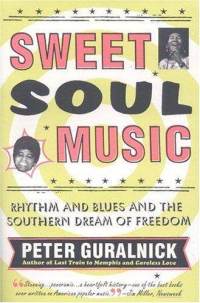
But while I missed out, thousands of fans around the world were able to enjoy the king of rock and soul up close. Writer Peter Guralnick devotes an entire chapter to Burke in his classic 1986 book “Sweet Soul Music.” Plenty has been written about Burke’s musical legacy; the following recollections from the book spotlight Burke’s colorful personality.
Burke during his glory days.
Burke was signed to Atlantic Records in 1961, in part to fill the hole that had been left when Ray Charles departed for ABC. Burke had, Guralnick wrote, “a combination of Sam Cooke at his mellifluous best and Ray Charles at his deep-down and funkiest, an improbable mix of sincerity, dramatic artifice, bubbling good humor, multitextured vocal artistry.”
Music was Burke’s love, but he always had a little something extra going on the side. Before signing to Atlantic, the Philadelphia-based singer struggled to bridge the gap between gospel and something bigger. When his first independent singles didn’t perform to expectation, he briefly left the music business to become a mortician, a skill he never completely abandoned. During an early Atlantic recording session, he begged out early to return to Philadelphia where he worked a snow-removal job for $3.50 an hour.
The ability – and willingness – to deliver a wide range of musical styles, from country to soul to gospel, not only made Burke a nationwide star, but disguised his race in a still very-segregated landscape. In “Sweet Soul Music” Burke described a Friday night gig in Mississippi that looked like a dream.
“They had those big flatbed trucks with the loudspeakers hooked up, and the black people was just bringing us fried chicken and ribs,” Burke recalled. “Oh, my God, they got corn on the cob, they making cakes and pies, they got hot bread, barbecued ribs …. Oh, man, I can’t begin to tell you – it looked like the festival of the year!”
Before the band went on, the sheriff instructed them when to take the stage and end their set, and promised protection and an escort back to the highway. When the band went onstage at the appointed time Burke noticed odd lights in the distance.
“All the way as far as your eye could see was lights, like people holding a blowtorch, coming, they was just coming slowly, they was coming toward the stage,” Burke said. “They got closer and closer. Man, they was 30,000 Ku Klux Klanners in their sheets – it was their annual rally. The whole time we played we played that show those people kept coming. With their sheets on. Little kids with little sheets, ladies, man, everybody just coming up, just moving under the lights, everyone dancing and having a good time.”
True his word, the sheriff made sure there was no trouble, and the band departed unscathed – not that they lingered any longer than necessary.
In 1964, radio station WEBB in Baltimore crowned Burke the King of Rock ‘n’ Soul. Burke took the title seriously and began performing from a thrown and wearing a crown. It was his royal cape, however, that caused the biggest problem.
If you haven’t read Peter Guralnick’s wonderful book, you are missing out.
The other reigning king of R&B had featured a cape in his shows for some time, and James Brown took offense to what he considered Burke’s stealing part of the act. The feud came to a head when Brown hired Burke to open in Chicago for $10,000. That was good money for a one-night stand in the early ‘60s, made even better when Burke was told he could use the James Brown Orchestra, saving his own band expenses.
Shortly before show time, Brown’s assistant met with Burke, ensuring Burke had his throne, red carpet, robe and crown all ready to go. Burke confirmed he was ready to go. When it was time to go on, Burke was standing in the wings in full regalia as the introduction started – only the emcee introduced Brown instead.
“James came on with his cape, dancing on the carpet. That was funny, man,” Burke said. “He says, ‘Your job, just watch me. Watch the real king.’”
At one point in the show, Brown asked Burke to come onstage and place his crown on Brown’s head. Even though he never performed, the crowd chanted Burke’s name all night.
“(Brown) says ‘Solomon Burke cannot perform because he’s been decrowned,’” Burke said. “I never did find out what ‘decrowned’ meant. But it was, as I say, very amusing.”
It was also an easy way to pick up ten grand. After the show Burke told Brown he’d be willing to do the whole thing over again the next night for a discounted price of $8,000. It was a generous gesture for Burke, who while not exactly cheap, recognized – like Brown – the value of making a buck.
For example, he frequently traveled with a mini convenience store of sandwiches, orange juice, tomato juice and ice water. As the odometer turned on the tour bus, so increased the price of Burke’s goods. Otis Redding’s brother Rodgers Redding remembers one tour with Burke.
“(Burke) always carried stuff like ice water, cookies, candy, gum; even though he didn’t drink at all, you’d go into his room at the hotel and see all this, Courvoisier, different kinds of wine, the whole room would be full of booze. He’d have a hot plate, frying pan, flowers, roses, everything, just for his guests, whoever would come by.
“I remember one tour,” Redding continued, “Solomon was selling his ice water for ten cents, sandwiches for a dollar – everybody just laughed at him. By the time they got halfway there, he was selling that water for a dollar, sandwiches for $7.50!”
Jim Crow laws in the South had given Burke a captive marketplace, but also provided a generous audience in each town. Burke taught his band never to eat out after a gig – the little old ladies would always provide a nicer meal for free in their home than they could imagine at a restaurant. Sometimes they offered more.
“Them old ladies would come out with their biscuits and fresh-baked pies, they’d say ‘Here’s some fresh milk for you, son, just be sure and bring back my thermos.’ Fried chicken, barbecued ribs, ham hocks, collard greens, man it was great,” Burke said. “Then them old ladies would say, ‘Son, would you drive my granddaughter out to the main highway? Don’t you worry none, she can find her own way back.’”
Every facet of Burke’s personality converged when he played the Apollo Theater at the height of his popularity in the mid-‘60s. Playing the famed theater was a dream for most performers, but Burke, as always, wanted a little something extra. He had language included in his contract that gave him control of the theater’s concessions that night. Known for strolling the aisles at intermission and hawking wares, this is what the theater owners thought they were agreeing to. Burke, however, had other plans.
The king of Rock and Soul on his throne.
Bobby Schiffman, brother of Apollo owner Frank Schiffman, picked up the story in his other brother Jack Schiffman’s book “Uptown: The Story of Harlem’s Apollo Theater.”
“Solomon arrived … with a cooker on which he fried pork chops to sell the gang backstage, and a carton of candy,” Schiffman said. “I decided to humor him – until the truck pulled up.”
It seems Burke had recently bought into a chain of drugstores and had an abundance of popcorn. He had taken to hauling a trailer of the stuff around to his shows and passing it out. So when the Apollo deal was struck, Burke thought he had the perfect means of ridding himself of the overstocked kernels.
“I had about 10,000 stickers printed up to go on the boxes of popcorn saying, ‘Thank you for coming to the Apollo Theater from Solomon Burke, Atlantic Records Recording Artist. Your Box of Soul Popcorn,’” Burke told Guralnick.
After nearly giving the Schiffman family a collective heart attack, the two parties hastily renegotiated. In Burke’s version of the story, he agreed to take a loss on the rest of his food and cede concessions back to the theater provided he could still distribute the popcorn. In Bobby Schiffman’s version the family bought the popcorn off Burke for $50,000 provided he not sell anything else in the theater that night.
“That’s been my problem my whole life in entertainment: I utilize my educational background and maybe that makes me a little too smart for my britches,” Burke said. “They assumed my intelligence was limited, that my ability to supply a demand was limited. I wasn’t even thinking about singing that week. My biggest shot was: get rid of that popcorn. But it was the greatest publicity thing that I ever did.”
(Above: First Stephen Foster, then Ray Charles. Now John Legend and the Roots have “Hard Times.”)
By Joel Francis The Daily Record
A little more than three months after releasing one of the best albums of their 17-year career, The Roots are back, this time with John Legend.
The pairing is inspired. The Roots have long have a reputation as the best band in hip hop. For the past couple years they’ve proved their mettle to the mainstream as the house band on “Late Night with Jimmy Fallon.” Legend is clearly a great talent, but often gets overwhelmed by slick production and light-weight songwriting. These 10 reinterpretations of classic soul protest songs offer the perfect platform for him to shine.
Legend lives up to the opportunity, singing with grit and emotion only hinted at on his solo albums, and feeding off the Roots’ vibe. Opening cut “Hard Times,” a lost Curtis Mayfield classic written for Baby Huey, feeds off a horn line ricocheting off of Ahmir “?uestlove” Thompson’s drums and Captain Kirk Douglas’ bright guitar. Black Thought’s rap in the middle reinforces the track’s message and feel. This is music to spark both revolution and revelry.
“Wake Up Everybody” features a guest rhyme from Common that feels like a verse from a lost hymn. Legend’s duet with Melanie Fiona here captures the same mood as a classic Marvin Gaye/Tammi Terrell number. “Little Ghetto Boy” – bolstered by another Black Thought cameo – and the buoyant gospel reading of Nina Simone’s “I Wish I Knew How It Would Feel to be Free” are other high points.
Unfortunately, the album can’t sustain these moments. Legend’s vocal shortcomings come to the foreground on “Wholy Holy.”Gaye’s voice soars effortlessly on the original, while Legend strains just to lift off. His over-singing on Bill Wither’s “I Can’t Write Left-Handed” is accidentally exposed by Douglas’ understated, tasteful soloing.
Not all of the blame lies at Legend’s feet. Normally an impeccable arranger, there are some surprising issues with Thompson’s choices. Les McCann’s “Compared to What” swings and skips like a rock skimming the top of a lake. Thompson’s slower arrangement is leaden in comparison. His treatment of Lincoln Thompson’s (no relation) reggae song “Humanity (Love the Way it Should Be)” hews closely to the original, but without the Jamaican patois it seems stiff and forced. The performance should have been reworked to emphasize what Legend could bring to the number.
“Wake Up” was inspired by Barack Obama’s 2008 presidential victory and Arcade Fire’s song “Wake Up.” The original plan was record an EP, and truthfully Legend and the Roots should have stayed with that concept. The handful of strong cuts present would have made for an outstanding mid-player. As is, this is a solid album with plenty of outstanding moments, but ample opportunity to skip to the next cut. Or, better yet, seek out the originals.


 Extended segments of noises and effects – particularly on the 25-minute journey “Impossible Soul” – made the set feel more like an art installation that a rock show at times. But whether channeling Genesis and the Flaming Lips or Paul Simon and Cat Stevens, the Uptown’s sold-out crowd hung on every note.




 joelfrancis.com