The Contours – “First I Look at the Purse”

262-contours
The Contours – “First I Look at the Purse,” Pop #57, R&B #12

By Joel Francis

The name on the label says “The Contours,” but all four of the singers who found success with 1962’s chart-topping “Do You Love Me” were gone by the time this number came out three years later.

A novelty song penned in the vein of Jerry Lieber and Mike Stoller’s classic Coaster’s numbers, it’s hard to imagine songwriters Smokey Robinson and Bobby Rodgers presenting this number to their group, the Miracles. But since none of the Contour’s follow-up efforts had cracked the Top 40, they had a little leeway for fun.

The production combines the Motown Sound with a spirit similar to Jimmy Soul’s 1963 hit “If You Wanna Be Happy.” In Soul’s song, ugly women cause fewer problems that pretty ones. For the Contours, fiscal assets are more desirable than physical ones. Or as the lyrics so eloquently put it, “If the purse is fat/that’s where it’s at.”

It’s not surprising the number failed to catch on, although it did prevent the group from becoming a one-hit wonder. What is surprising is the longevity of the group. As the original lineup fell away, Berry Gordy kept replacing members. Billy Gordon, the man who sang lead on “Do You Love Me” was replaced by Joe Stubbs, brother of Four Tops vocalist Levi Stubbs. After Stubbs left, Dennis Edwards was recruited to front the group.

It seemed the end for the Contours when the Temptations plucked Edwards to be their frontman in 1968. Founding member Joe Billingslea had other plans. Nearly 10 years after he left the group, Billingslea, a founding member, resurrected the name and hired four other singers to play and record with him around Detroit.

The band found themselves in demand after the Motown 25 concert and the 1988 film “Dirty Dancing,” which prominently featured “Do You Love Me.” The subsequent Dirty Dancing Concert Tour found Billingslea reunited with his old bandmate Sylvester Potts and recording for Motor City Records. In the early ’90s, Potts split from Billingslea’s quintet and started his own four-piece lineup, also called The Contours. Today, both Joe Billingslea and the Contours and The Contours featuring Sylvester Potts can be found on the oldies and county fair circuit.

The Miracles – “Ooo Baby Baby”

ooo-baby-baby1
The Miracles – “Ooo Baby Baby,” Pop #16, R&B #4

“Ooo Baby Baby” didn’t hit the top of the chart, or even sell a million copies, but it was one of THE songs of the summer in 1965.

Despite a baby-talk title, the song starts melancholy and doesn’t waver. An unfaithful Smokey Robinson is heartbroken, miserable and penitent. Check out the way he sings the word “crying” at the end of each verse, echoing Roy Orbison’s heart-wrenching single of the same name. Robinson’s creamy vocals help the pain go down smoother, but the way the last note is left hanging, it’s clear there is no hope or delivery ahead.

And yet, Robinson and Pete Moore’s song was one of the most-played songs of the summer, and one of the Miracles’ most-covered tunes. Linda Ronstadt found a 1979 hit with the number, but not before Ella Fitzgerald, the Five Stairsteps and a slew of others tried their hands. – by Joel Francis

The Temptations – “My Girl”


The Temptations – “My Girl,” Pop #1, R&B #1

By Joel Francis

Lightning definitely struck twice for Smokey Robinson and the Temptations. After struggling for years, Robinson gave the Temptations their breakthrough hit with “The Way You Do The Things You Do.” “My Girl,” their follow-up, is not only Motown’s biggest song, but one of the biggest soul numbers of all time.

Inspired by his wife Claudette, Robinson and fellow Miracle Ronald White wrote the one of the greatest Valentines of all time as an answer song to their previous hit “My Guy.” Bob Dylan may have been thinking of the lyric “I’ve got so much honey/the bees envy me” when he proclaimed Robinson “America’s greatest living poet” in 1965.

David Ruffin made his lead vocal debut delivering these deceptively simple lyrics. Though it seems a no-brainer in retrospect, the decision was controversial at the time. Eddie Kendricks and Paul Williams had shared the lead role prior to this song, and, to make matters worse, Ruffin was a ringer who replaced original Temptation Al Bryant. Ruffin got the nod after Robinson saw him singing “Under the Boardwalk” as part of their Motown Revue repertoire, and quickly became the group’s featured singer.

The Motown string section furthers Ruffin’s references to sunshine and fluttering birds, while Funk Brother James Jamerson’s signature two-note bass line anchors the entire performance.

It’s unclear why Robinson and White didn’t keep their song for The Miracles, but it didn’t take long for other acts to put their stamp on the number. Otis Redding added some blues for his 1965 reading; both the Rolling Stones and the Mamas and Papas cut it in 1967. Since then, everyone from Al Green to reggae artist Prince Buster to Dolly Parton to British shoegazers The Jesus and Mary Chain has reinterpreted this timeless classic.

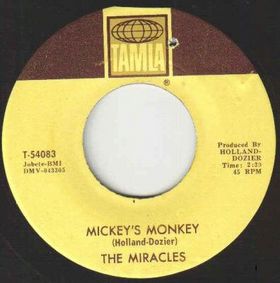
The Miracles – “Mickey’s Monkey”

The Miracles – “Mickey’s Monkey,” Pop #8, R&B #3

One of the most infectious and upbeat singles in the Motown catalog is unique in two ways. First, it was not written by main Miracle Smokey Robinson, but by the hot house songwriting team of Holland-Dozier-Holland. Second, it is one of few Motown songs to appropriate the Bo Diddley beat.

As Robinson’s voice joyously soars over the Funk Brothers groove, the Miracles, Martha and the Vandellas and members of the Supremes, Temptations and Marvellettes chip in on backing vocals.

The HDH production team did a great job of capturing a live sound that, like “Do You Love Me,” sounds like it was beamed directly from the greatest party in the world. Robinson’s multi-octave range is a marvel, but honestly anything over that groove would have been a hit.

“Mickey’s Monkey” was one of the Miracles biggest hits. Unsurprisingly, Berry Gordy tried to bottle lightning a second time by having Martha and the Vandellas cut a version, but neither their cover nor subsequent readings by The Rascals, The Hollies or John Cougar Mellencamp made an impact.

The “cat named Mickey from out of town” was based on Motown’s A&R director Mickey Stevenson. Stevenson wrote several Motown hits with Marvin Gaye, including “Beechwood 4-5789,” “Pride and Joy” and “Dancing in the Street.” — by Joel Francis

The Miracles – “You’ve Really Got A Hold On Me”

The Miracles – “You’ve Really Got A Hold On Me” Pop #8, R&B #1

Another stone classic from the pen of Smokey Robinson. Counting his songs for Mary Wells, this is Robinson’s fourth No. 1 hit (his first song with Wells stalled at No. 2 on the R&B charts). The song was famously covered by the Beatles It continues to be popular today. Cyndi Lauper covered it in 2003 and it popped up earlier this year on actress Zooey Deschanel’s delightful album with M. Ward, “She and Him.”

It’s no surprise so many artists have been drawn to this song. The melody and backing vocal lines are strong and supportive enough that the lead singer doesn’t need a great voice to pull it off (check out Cher’s version with then-husband Gregg Allman for proof). On the other hand, good vocalists have plenty to make their own. British invasion bands loved it for the snakey guitar line that could cover missing piano and horn parts.

The Miracles have the whole package, though: Robinson’s great singing, the full complement of Motown’s Funk Brothers musician’s stable and Barry Gordy’s impeccable production. The crescendo peaks with Robinson playing off the Miracles and pleading with his woman to “hold me (please)/hold me (squeeze)/hoooold me.” This certainly wasn’t the first time backing vocalists had been used so effectively, but it is a great demonstration of the subtle creativity Robinson employed in arranging the song. It’s no wonder the Beatles were so anxious to pay tribute to their idol when they finally reached American shores a little over a year after this song was released. — By Joel Francis

The Miracles – “Shop Around”

Shop Around

The Miracles – “Shop Around” Pop #2, R&B #1

Barry Gordy borrowed $800 from his family to launch the Tamla label. The first group Gordy signed to Tamla was The Matadors, who changed their name to The Miracles.

It’s impossible to underestimate how important main Miracle Smokey Robinson was to Barry Gordy’s success. He not only brought dozens of hit records to the charts with The Miracles, but wrote most of Mary Well’s early hits and “My Girl” for the Temptations. It is impossible to get to Hitsville U.S.A. without going through Robinson.

This song was Motown’s first No. 1 hit (on the R&B charts, at least), over 45 years ago. If you updated the production and handed this song to Mariah Carey under the altered title to “Sleep Around” it would probably be a hit again today. Not that this is necessarily a good thing. — by Joel Francis