Stevie Wonder celebrates Michael Jackson at Starlight

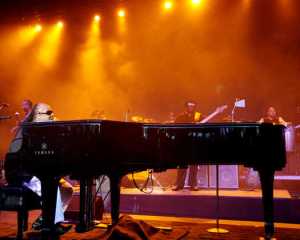
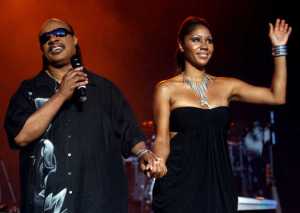
(Above: Stevie Wonder performs “Never Can Say Goodbye” the day after Michael Jackson’s death. Wonder dedicated his performance at Starlight Theater to Jackson.)

By Joel Francis
The Kansas City Star

Stevie Wonder walked on stage at Starlight Theatre on Friday night with zero fanfare and cut to the heart of the night before playing a single note.

“God blessed us with a talented man who brought us joy with his dancing, music, videos and all of that,” Wonder said as part of his five-minute monologue about his friend and former Motown labelmate Michael Jackson.
Finally settling behind his grand piano, Wonder delivered a powerful acapella performance of “Love’s In Need of Love Today” that gave me goosebumps. After two verses, the band joined in. When the song was over, Wonder led them into a spontaneous version of “Kansas City” that caught most of the musicians off-guard.It was that kind of night. The mood altered between moving tributes to Jackson, who died the day before, upbeat hits and random moments.

It took Wonder a half hour to get the nearly sold-out crowd on its feet. Once “Master Blaster (Jammin’)” finally did the trick, Wonder ensured they stayed up by playing the signature bassline to “Billie Jean.” With no vocal support from the stage, Wonder let the crowd sing the entire song.

The audience did a good job at impromptu karoke the first time around, but was less successful in carrying “I Can’t Help It.” Wonder has good reason to be proud of the song he wrote for Jackson that ended up on his “Off the Wall” album, but few in the audience were familiar with the number.

The crowd did better on Wonder’s classic material. “All I Do,” “Higher Ground” and “Living for the City” all drew big responses.

Later in the set, Wonder led the band through a jam with his vocoder. Safe behind the distortion of this electronic vocal altering device, Wonder was surprisingly honest.

“Last night and today I was in so much pain,” Wonder said, “but I knew if I played for you I would play a little better.”

Still employing the vocoder, Wonder segued into the Jackson 5’s “Never Can Say Goodbye.” The poignant moment was made even more mournful by the vocal alteration and Wonder’s decision to let a male backing singer take the final verse. Emotions built as Wonder led the crowd through the chorus again and again, turning the song into a remembrance and a celebration.

Wonder was backed by a 14-piece band that included four backing vocalists – including his daughter Aisha Morris – two percussionists, keyboard players and guitarist and a rhythm and horn section.

Given his orchestrations on record, it was no surprise the band arrangements were sublime. The ensemble knew the right moments to back off and give Wonder the spotlight and the right time to come in and kick the performance up a notch. As usual, the sound at Starlight was great.

After the South American syncopation of “Don’t You Worry ‘Bout a Thing,” Wonder paused for a moment behind the keyboard. Playing a gorgeous piece of music, he started humming and mumbling until the words congealed into stream-of-consciousness thoughts about Jackson being “in the arms of God.” The energy from this moving melody was poured into an amazing reading of “You and I” that found Wonder showing of his vocal range and its resilience to time and age.

Randomness struck again in the last 30 minutes of the night when Wonder had his sound man play Jamie Foxx and T-Pain’s “Blame It (On the Alcohol)” over the PA while he rested his throat and the band hydrated. That was followed by a jazz number performed by Wonder’s daughter. The song was pleasant, but not what folks came to hear.

Two other shortcomings also bear mention. The only time Wonder played harmonica was during a cover of Chick Corea’s “Spain.” His solo brief solo there was both a tease and a crime. Also, Wonder’s ‘60s catalog was completely ignored. “Signed, Sealed, Delivered” from 1970 was as far back as Wonder went for the night, which meant “Uptight,” “Hey Love,” “My Cherie Amor” and others were forgotten.

Wonder ended the night with the murderer’s row of “I Just Called To Say I Love You,” “Sir Duke,” “Superstition” and “As” that more than erased any minor missteps. As the final notes of “As” died out, the strains of “ABC” faded in. The Jackson 5 number kicked off a pre-recorded medley of Wonder’s favorite Jackson moments.

As the tape played, everyone remained onstage dancing, singing along and brushing away stray tears. Two hours and 20 minutes after taking the stage, Wonder and his band filed slowly offstage as “Man in the Mirror” played. There was no encore, but there was nothing left to say.

sw2

Setlist: Love’s In Need of Love Today, Going to Kansas City> Bird of Beauty> As If You Read My Mind> Master Blaster (Jammin’), Billie Jean, Did I Hear You Say You Love Me> All I Do, I Can’t Help It, Vocoder Jam> Never Can Say Goodbye > Higher Ground, Spain> Don’t You Worry ‘Bout a Thing, Improvised MJ tribute> You and I, Living For the City, Signed, Sealed, Delivered, Blame It (On the Alcohol) (Jamie Foxx and T-Pain song played over PA), I’m Going to Laugh You Right Out of My Life (Aisha Morris, lead vocals), Sir Duke> Superstition, As, Michael Jackson medley (played over PA)

Keep reading:
More Stevie Wonder articles from The Daily Record.

sw1

Raphael Saadiq sends a love letter to soul makers and Motown

(Above: Raphael Saadiq runs the “100 Yard Dashfor Seattle’s excellent community radio station, KEXP.)

By Joel Francis
The Kansas City Star

Raphael Saadiq’s latest album, “The Way I See It,” is draped heavily in the sounds of Motown and Philly soul, but don’t call it a tribute album.

“Boyz II Men did a tribute; I wrote a bunch of songs,” Saadiq said about his all-originals album. “This was not intended to be a tribute album. It’s more like a secret love letter to the people I love.”

People like the Funk Brothers, Motown’s now-legendary stable of musicians, and the other unknown musicians who “took music to the level where it is today that I can come out and do this,” Saadiq said. “It’s not just about Smokey (Robinson) and Stevie Wonder, but a bunch of people we don’t even know about.”

He plays most of the instruments on the album himself, but Saadiq recruited two Funk Brothers to help him get that classic Motown sound. Jack Ashford’s tambourine has graced classics like “Nowhere to Run” and “You Can’t Hurry Love.” Paul Riser, who arranged the strings on Saadiq’s album, has worked with the Supremes, Marvin Gaye and Stevie Wonder.

“I brought Jack in because he added a sound I couldn’t have had without him,” said Saadiq, who performs Wednesday at the VooDoo Lounge. “With Paul Riser it was the same thing. You can feel the energy when they walk into a room.”

Having Stevie Wonder play harmonica on one song was ultimate validation. Saadiq even went so far as to introduce his guest like Wonder introduced Dizzy Gillespie on his 1982 hit “Do I Do.”

“Seeing Stevie walk into a room and play is something I’ve never gotten used to,” Saadiq said. “Having him play on this was a stamp of approval. I’ve worked hard for a long time to have him come play (on my album).”

The former Tony! Toni! Tone! singer, who named his first solo album “Instant Vintage,” is more worried about being called “neo soul” than being pigeonholed.

“Everybody knows I hate the term ‘neo-soul,’ ” Saadiq said. “If someone was playing the blues they’d want an old soul. I don’t want a new soul — then I’d sound like somebody on the radio today, which I hate.”

On an album with so much — ahem — old-school soul, Jay-Z’s guest spot on the final track, a bonus remix, probably surprised many listeners.

“That was Q-Tip’s idea,” said Saadiq, referring to the former MC of A Tribe Called Quest. “He was like, ‘You should put Jay-Z on this record’ and then went and got him, because I didn’t know Jay like that. Some people didn’t like it. They’re probably neo-soul fans. I did this for the other people.”

More on Raphael Saadiq from The Daily Record:
“The Way I See It” album review
“The Way I See It” caps the Top 10 albums of 2008

2009 Grammys: A Running Diary

The last time The Daily Record watched a complete Grammy Awards show, “O Brother Where Art Thou?” won Album of the Year. This year, though, we got suckered in by the promise of seeing Radiohead. (Have they won a Grammy? Wikipedia says yes.) This presented the perfect opportunity to do one of those running diaries like Bill Simmons does for ESPN. We not may be as successful, but the official wife of The Daily Record was glad her husband’s snarky comments were bypassing her ears and going straight online, where she could ignore them more easily. Enjoy!

7:00 U2’s new song sounds like Bob Dylan’s “Subterranean Homesick Blues.”

7:02 The lyrics to their new song “Get On Your Boots” appear on a large video screen behind the band. I wonder if this is what all the presenters will see on their Teleprompters.

7:09 Whitney Houston comes out to present the award for “Best R&B Album.” Forget Botox – cocaine must be the secret to a younger looking face.

7:10 Seriously, Houston looks like she has been stored in the freezer next to Ted Williams for the last 10 years.

7:12 The Rock is as good a comedian as he is an actor.

7:17 Justin Timberlake and Keith Urban paying tribute to Al Green is like Henry Kissinger and Dick Cheney giving props to Barack Obama.

7:21 First commercial break. High-powered bloggers use this time to make snarky comments about commercials too. Unfortunately, The Daily Record has no corporate sponsorship. We’ll use this time to do glamorous things like take out the trash and recycling, pull stuff together for work tomorrow.

7:26 For a second, I thought Chris Martin was Paul McCartney sitting at his Magical Mystery Tour piano.

7:28 Let the haters hate; Jay-Z is still great.

7:29 How come Coldplay get to play two songs? I wonder if Joe Satriani will come out. Probably not.

7:30 Coldplay’s Beatles motif is reinforced with their Sgt. Pepper jackets.

7:33 Although representatives insist that all Grammy performers will not perform to a backing track like Bruce Springsteen did at last week’s Super Bowl, you have to be suspicious. It’s not like the music industry is a bastion of integrity.

7:34 Why does “country” singer Carrie Underwood rock harder than “rock stars” Coldplay?

7:35 I have no idea what Carrie is singing. I think it’s something about how long it took to get her legs waxed. Damn them’s some shiny gams!

7:36 Carrie’s guitar player looks like Lita Ford’s daughter.

7:38 Why does Sheryl Crow, 46, look younger than LeAnn Rimes, 26?

7:39 Congratulations, you’ve won a Grammy Lifetime Achievement Award. We will now honor you with a 15 second black and white video clip. Why not let the recipients perform?

7:48 Hey, Coldplay just acknowledged my Sgt. Pepper’s joke!

7:49 Man, Kid Rock really, really likes Bob Seger.

7:58 Taylor Swift and Miley Cyrus are performing together for the first time, but they won’t let the guys playing acoustic guitars and bass onstage with them.

7:59 It’s really bugging me that they won’t let the band perform onstage. What were they told? “OK, here’s the deal. You four will sing backing vocals, provide rhythm support, fine, you’ll carry the whole thing – but we don’t actually want anyone to see you do it.” Was there not enough crawlspace under the stage to stuff them in there?

8:02 A seated Tylor Swift just said “If you’re 19, or even older, it’s still a thrill to stand on the Grammy stage.” Man, she is going to have a long time to be depressed.

8:03 Robert Plant and Allison Krauss just won AWARD. But even better news is that they’re working on a new album together.

8:05 This is why we don’t need a Whitney Houston comeback. Jennifer Hudson is both more talented and a more substantive person.

8:15 What the? Stevie Wonder is jamming with the Jonas Brothers. Half the audience is wondering who the old dude is and everyone else is wondering what he’s doing playing with them. Thing is, it doesn’t sound half bad. Then again, I’m a sucker for Stevie’s vocoder trick.

8:16 Any excuse to hear “Superstition” is a good thing. I’ll never buy a Jonas Brothers album, but I thank them for this moment.

8:17 Seriously, you know your songs kick butt when Disney-sponsored tweener heart-throbs can’t screw them up. Not even Celine Dion could ruin this moment.

8:19 I hear Blink 182’s next album is going to be a tribute to Def Leppard.

8:20 Do Coldplay have to mention the Beatles every time they take the podium? Pretty soon Ringo will be onstage with them refusing to sign autographs.

8:27 Don’t forget, Craig Ferguson writes all his own material.

8:29 Am I the last person on Earth to be hearing “I Kissed A Girl” for the first time right now?

8:30 Why is Katy Perry dancing in Carmen Miranda’s headdress? This segment must be sponsored by Chiquita.

8:31 Am I the only person on Earth to feel like he hasn’t missed anything by not hearing “I Kissed A Girl” until now?

8:32 I don’t know the song Kanye West is doing with Estelle, but “808s and Heartbreaks” is really growing on me.

8:33 Kanye is taking this ’80s fixation a bit too far. Next year he’s going to come out wearing a Huxtable sweater.

8:41 I don’t care how long he keeps wearing it, that earring is never going to look natural on Morgan Freeman.

8:45 Sean “Puffy” Combs, Natalie Cole and Herbie Hancock are on hand to present “Record of the Year.” One of these things is not like the other (in a good way).

8:46 Natalie Cole’s dress looks like a last-minute compromise from the outfit Lil Kim wore on the MTV awards a few years back.

8:47 Plant and Krauss just won again. Robert Plant might have the most successful post-supergroup career of all time. OK, maybe Paul McCartney – but Plant’s taken more chances.

8:53 They just gave a Lifetime Achievement Award to Dean Martin. I guess we now know why they don’t have these winners perform, but why’d the take him so long for Martin to get this award? He’s been dead for awhile, but he certainly had the sales and popularity when he was alive. Maybe next year they’ll finally get around to honoring Bing Crosby.

8:54 I’m not sure why M.I.A. had to secede the stage so quickly. How cool would it have been if Mick Jones and Paul Simonon came out to do “Paper Planes” with her?

8:55 Kanye, Jay-Z, T.I. and Lil Wayne’s performance together is being called a “historic hip hop summit.” The tour kicks off next month in Yalta.

8:57 M.I.A.’s polka-dot pregnancy outfit is sponsored by Buddy Guy’s guitar.

9:00 I can’t believe I’ve sat through two hours of this show … and still have 90 minutes to go.

9:01 If I were going to have Dave Grohl drum with Paul McCartney I’d give him something a little meatier than “I Saw Her Standing There.” Maybe “Band on the Run” or “Helter Skelter.” I’m just saying.

9:10 Feed just went out as John Mayer was accepting an award. I guess my TV isn’t much of a fan either.

9:11 Jay Mohr and LL Cool J is one of the most awkward pairings of the night. Then again, Jay Morh and anyone is an awkward arrangement.

9:15 Sugarland and Adele aren’t really performing “together for the first time” as promised, but “one right after another.” Eh.

9:17 Oh, here’s Sugarland. She added that one essential line at the end of the song.

9:23 Gwyenth Paltrow is wearing a mirror ball. Dance party!

9:24 Radiohead is performing with the USC Marching Trojans. Man, first those guys get to play with Fleetwood Mac and now they’re backing up Radiohead. I wonder which was more rewarding.

9:25 Someday, future generations will worship Radiohead like we celebrate the Beatles.

9:27 Is it still Radiohead when it’s just Thom Yorke and Jonny Greenwood? Survey says, who cares? Radiohead in any form is better than anything else we’ve seen tonight.

9:28 OK, better than everything except Carrie Underwood’s legs – but I’m still not buying her album.

9:30 If you are still reading this, you are officially my new best friend. Please leave a comment to receive a special prize.

9:34 Justin Timberlake is performing in a coat and scarf. How did he know snow was in our forecast?

9:35 The stocking cap on T.I.’s head looks like a reservoir tip.

9:36 I don’t think switching back and forth between two distinct songs should count as collaboration. It’s more like a musical debate where the listener always loses.

9:38 Recording Academy president Neil Portnow rejected the traditional tirade against music piracy to talk about MusiCares and promote a Secretary of the Arts cabinet position.

9: 42 Portnow is done, but I’m kinda bummed he didn’t bring up piracy. I had a great line to use when he did: “Recording Academy president Neil Portnow is still talking about music piracy. This guy is slower than Rapidshare.”

9:44 Not even Smokey Robinsons sings the Four Tops as well as Levi Stubbs. Rest in peace, Levi.

9:45 It would be cool if the producers rounded up the remaining Funk Brothers as backing musicians for this Four Tops tribute.

9:52 Neil Diamond is singing “Sweet Caroline” and millions of Red Sox fans are crying because their season hasn’t started yet. Pitchers and catchers report in less than a week, boys.

9:54 Am I the only one that finds it kind of sad that Diamond’s expansive catalog has been reduced to just one song? And that “Sweet Caroline” is that song? It’s like if people only remembered Bob Dylan for “Quinn the Eskimo (The Mighty Quinn).”

9:59 Paying tribute to Bo Diddley are Buddy Guy, B.B. King, John Mayer and Keith Urban (because you know if any two performers have influenced Urban’s style and career its Al Green and Bo Diddley). Best rhythm in rock and roll.

10:00 I make that joke earlier about Buddy Guy’s guitar and he shows up here playing a gold top Les Paul. I’m not sure I’ve ever seen him rock a since his days on Vanguard.

10:08 Allen Toussaint is supposed to appear with Lil Wayne with Robin Thicke. I bet those two would be surprised to learn that Toussaint has written more hits than both of them combined.

10:10 I wonder why the producers haven’t rolled out one of those “for the first time ever” duets between Thicke and Timberlake? Probably because no one could tell them apart.

10:11 Allen Toussaint with the Dirty Dozen Brass Band and Terence Blanchard falls just short of topping Radiohead for best musical moment of the night – but it’s close. No American city makes more consistently fun music than New Orleans (although a case could be made for Memphis).

10:14 Will.I.Am just congratulated Obama. Who could have seen that coming? Next year, Will.I.Am will receive a record number of Grammy nominations for his album “Obamania: Songs About Barack Obama, Because I Love Barack Obama by Will.I.Am (for Barack Obama).”

10:24 Robert Plant and Allison Krauss are performing with T-Bone Burnett. Krauss’ hair keeps blowing back. Now I know why Justin Timberlake was wearing a coat and scar earlier.

10:25 I love “Raising Sand” as much as the next person, but that album came out in 2007. Why are the Grammys acting like it’s a new release?

10:26 The Grammys operate on such a loopy nomination calendar that a band’s previous and forthcoming albums can both be eligible at the same time.

10:27 The producers rightly made a big deal of T-Bone being on stage, but there was no mention of Buddy Miller holding down rhythm guitar. Therefore, I’d like to take this moment to give Buddy props for being a spectacular musician.

10:28 Album of the Year goes to “Raising Sand.” If it wasn’t going to be “In Rainbows” this is where it should have gone. (Seriously, does anyone else find it odd that both of these albums were released 16 months ago?)

10:30 Robert Plant started his career in 1968. You can fill a matchbook with a list of all tonight’s performers and honorees we’ll still be talking about 40 years from now.

10:32 Stevie Wonder is playing us home. See you in seven years, Grammys!

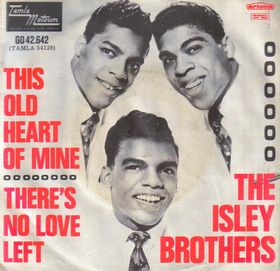
Isley Brothers – “This Old Heart of Mine (Is Weak For You)”

isleys

Isley Brothers – “This Old Heart of Mine (Is Weak For You),” Pop #12, R&B #6

By Joel Francis

For the most part, Motown’s talent during its heyday was home-grown. Martha Reeves was a Hitsville secretary, Stevie Wonder was a kid pestering the Funk Brothers for lessons, Marvin Gaye and Smokey Robinson were part of Berry Gordy’s extended family and Diane Ross and her friends stopped by every day after school to pester staff for an audition.

In short, talent came to Motown, not the other way around.

Of course that mindset quickly changed when the Isley Brothers hit the free agent market in 1965. The brothers made their name with 1959’s “Shout!” (recorded for RCA) and 1962’s “Twist and Shout” (recorded for the Wand label and covered by the Beatles). But after bouncing between those two labels and the failure to establish their own imprint, the Isley Brothers were looking for a new home. Berry Gordy was all too happy to welcome them to his fold.

The Isley’s Motown debut, “This Old Heart of Mine (Is Weak For You) was their biggest success so far. Holland-Dozier-Holland definitely applied the Motown sound to their number. The drums lead the mix, and the string section sounds more like the Four Tops than the Isley Brothers’ gritty urban soul. The brothers had never sounded so slick before, but the results couldn’t be argued with. The song is infectious, fun and impossible to listen to without breaking into smiles or dance.

Unfortunately, the Isley-Motown marriage didn’t last long. Despite releasing two more albums, the group couldn’t find a follow-up hit and complained of being fed inferior, cast-off tracks. They had a point: “This Old Heart” was originally intended for the Supremes. The brothers left Motown in 1968 and signed with Buddha before finding long-term success with Epic.

Stevie Wonder – “Happy Birthday”

(Above: Happy 80th, Dr. King.)

By Joel Francis
The Daily Record

Every few years, the calendar aligns so that my dad’s birthday lands on Martin Luther King Day. Most of the time, the extra day off works means we celebrate a bit longer. Stevie Wonder’s “Happy Birthday” is the perfect salute to these days, but it means even more this year, on the eve of Barack Obama’s inauguration.

King’s birthday was not a national holiday when Wonder penned this tribute. The song was a rallying point in the fight to establish King’s birthday as a holiday. Wonder performed the song at the Rally For Peace press conference in 1981, and wrote an essay about King that appeared on the album liner sleeve. Part of his words read:

“It is believed that for a man to lay down his life for the love of others is the supreme sacrifice. Jesus Christ by his own example showed us that there is no greater love. For nearly two thousand years now we have been striving to have the strength to follow that example. Martin Luther King was a man who had that strength. He showed us, non-violently, a better way of life, a way of mutual respect, helping us to avoid much bitter confrontation and inevitable bloodshed. We still have a long road to travel until we reach the world that was his dream. We in the United States must not forget either his supreme sacrifice or that dream.”

Wonder’s essay is accompanied by photos of King and the Civil Rights movement. The grim photos – which include depictions white police officers attacking black protesters – stand in contrast to the buoyant melody of the song. The synthesizers and drums may be dated, but the lyrics and sentiment capture the hope and love as well as U2’s more famous tribute. Wonder also understands that birthdays are about parties, so his homage to King is as much a celebration of life as a remembrance.

It was a touch disappointing to watch Wonder elect to perform “Higher Ground” at the “We Are One” concert that took place on the steps of the Lincoln Memorial in Washington, D.C. two days before Obama’s inauguration. In a day rife with symbolism and historic importance, the significance of performing “Happy Birthday” would have been amazing. Then again, more people are probably familiar with “Higher Ground.” And Stevie Wonder never met my dad.

Stevie Wonder – “Uptight (Everything Is Alright)”

uptight

Stevie Wonder – “Uptight (Everything Is Alright),” Pop #3, R&B #1

By Joel Francis

Nearly two years after success of “Fingertips,” Little Stevie finally found a follow-up hit – just in the nick of time. Motown had just about given up on him. Never mind that Wonder hadn’t been given much to work with: an album of Ray Charles covers, the “Fingertips” knock-off “Workout Stevie” and corny kids songs like “Happy Street” and “Hey Harmonica Man.” His dry spell was compounded by the fact that his voice was starting to change. Motown producers were wary of working with the onetime boy wonder, but Clarence Paul, who had acted as a mentor and father figure to the boy since his 1961 signing, liked his protégé’s newfound tenor.

The only thing uptight about this number is its title. The melody is fun, free and fresh. From the signature horn fanfare to the delight in Wonder’s voice, there are smiles all around. Every week Berry Gordy used to run each prospective single through a quality assurance committee who would vote on which numbers were released. The idea was a holdover from Gordy’s days on the assembly line. It’s hard to picture anyone not voting for this upbeat tune. I like to imagine that a spontaneous dance session broke out when it was played.

Once the song broke, everything was alright in Wonder’s world. Success may have been an early struggle, but it flowed effortlessly after this. With three exceptions, Wonder had at least one Top 10 hit per year from 1965 to 1985.

Rock Hall Celebrates 50 Years of Motown

motownnew

Above: Part of the new Rock and Roll Hall of Fame exhibit celebrating 50 years of Motown Records. The exhibit is open all year. (Photo courtesy of the Rock and Roll Hall of Fame.)

By Joel Francis

It may seem hard to believe, but “the sound of young America” is 50 years old.

To celebrate a half-century of Motown records, the Rock and Roll Hall of Fame in Cleveland is hosting a new exhibit, “Motown: The Sound of Young America Turns 50,” all year in the Ahmet M. Ertegun Main Exhibit Hall.

“It’s an obvious anniversary, one we should do something about,” said Howard Kramer, director of curatorial affairs for the museum. “Lots of labels have anniversaries, but Motown still rings wide and true.”

One of the largest items on display is the upright bass Funk Brother James Jamerson played on all his Motown sessions until 1963. It’s the instrument heard on “My Guy” and “Heat Wave.”

“A lot of people maintain the key to Motown was the rhythm section: The snap of the drums, the gorgeously intricate bass line and then the percussion laid over the top,” Kramer said. “Jamerson was the primary bass player. He carried the weight of those recordings.”

Of particular interest to Kramer are four posters promoting Motown concerts. Two of the posters advertise Motown Revue shows, which featured several of the labels artists on the same bill.

“For the 1963 revue, Stevie Wonder was the headliner.Usually the person with the biggest hit at the time was the headliner, and in this case he was riding ‘Fingertips, Part 2,'” Kramer said. “It’s interesting to see both who’s on top and the volume of artists (on the bill). It’s also interesting to note that for the 1968 Motown Revue shows at the Fox Theater in Detroit, they played 9 or 10 days in a theater that seats 5,000.”

Together, the posters span five years and a range of venues from a high school gym to a civic sports arena.

“These posters give you an idea of the breadth of places Motown performers were playing,” Kramer said. “They’d play arenas, high schools, theaters and also posh nightclubs like the Copacabana in New York,” Kramer said. “They played every possible circuit.”

Other items in the exhibit include the dress Supreme Mary Wilson wore for the group’s first appearance on the Ed Sullivan Show after the departure of Diana Ross, the outfit and glasses Stevie Wonder wore for his halftime performance at the 1999 Super Bowl and a stage costume worn by Miracle Bobby Rogers in the 1970s.

“Rogers’ suit is an example of the over-the-top clothing vocal groups wore at the time,” Kramer said. “There’s no reason for this to have been made except for a performer. This is not street wear.”

Thanks to a loan from the Universal Music Group, which owns the Motown label, many of the artifacts have never been displayed before.

“A lot of Motown stuff didn’t make it past the original era,” Kramer said. “The only item we’ve shown before is Rick James’ bass.”

For many of the Motown session musicians, playing for Hitsville was just another gig. But 50 years later, the notes they laid down still resonate.

After 50 years and several generations Motown is still a staple of radio, music, movies, television, commercials,” Kramer said. “That’s part of (label founder Berry) Gordy’s vision to make the music palatable to all ages.”

To learn more about museum hours and ticket information, visit the Rock and Roll Hall of Fame Website.

Keep Reading:

Rock Hall Celebrates the 40th Anniversary of Woodstock

George Kalinsky: Painting with Light (Rock Hall photo exhibit)

Bruce Springsteen Rocks the Hall (part one)

Bruce Springsteen Rocks the Hall (part two)

Review: Robert Randolph and the Family Band

Above: Robert Randolph persuades the ladies of Albany to shake their hips.

By Joel Francis

The Kansas City Star

A casino is as unlikely a setting for church as beer employees are a congregation. Yet on Friday night, Robert Randolph and the Family Band snuck 90 minutes of gospel on an unsuspecting crowd that loved every minute of it.

The quintet opened with a jam that sounded like the Allman Brothers dropped into an AME church, and found Randolph grinning from ear to ear, smacking his gum while working the horizontal fretboard of his pedal steel guitar.

The next song up, “I Need More Love,” was propelled by a funky six-string bassline and sounded like a lost Sly and the Family Stone track. Swaying in his seat, Randolph segued perfectly into an instrumental cover of Michael Jackson’s “Wanna Be Starting Something” that kept everyone on the dance floor moving.

After the MJ workout, Randolph stood up and strapped on Telecaster for a country-flavored jam led by some call-and-response vocals by his sister Lenesha Randolph. He was quickly back behind the pedal steel, though, for a John Lee Hooker boogie that packed three dozen women from the crowd onstage and invited them to shake their hips. Everyone obliged.

There was no setlist; songs grew spontaneously out of what the group was feeling. Each note was kinetic. They band may not know their destination, but they made sure everyone had fun getting there.

A tribute to Bo Diddley gradually grew out of a groove based on –- what else? -– the Bo Diddley beat. With Randolph playing one of Diddley’s trademark square guitars, the band launched into a thunderous version of the song “Bo Diddley” that worked its way into “Who Do You Love?” Randolph was so enamored with the square axe he played it for the rest of the main set.

A surprisingly subdued journey through the Doobie Brother’s “Black Water” played up the “funky Dixieland” aspect and kept the audience involved.

Randolph has torn apart the pedal steel stereotype of making only lonesome country twang. His playing is equal parts Stevie Ray Vaughan and Stevie Wonder and his music is so infectious one could forgive audience for missing the message peppered throughout songs like “Deliver Me.” In that one Randolph sang “Should I get on my knees and pray?/I know I, I just can’t make it through another day/I got to, I got to, I got to get away/Deliver me.”

The free show was a thank you to Bud Light employees and boosters. While the Voodoo Lounge was only two-thirds full, it didn’t feel empty. The extra elbow room allowed plenty of space for dancing and the crowd used every inch.

The band left after 75 minutes, but the music didn’t stop. An offstage bass solo slowly built into a jam that found the band back in front of the crowd. The closing song of the night sounded like Led Zeppelin and echoed a thought likely ringing through most minds: “Ain’t Nothing Wrong with That.”

Keep Reading:
Robert Randolph and the Family Band at Crossroads, 2009

Stax vs. Motown (part two)

The second of three installments in my conversation about the golden era of Stax and Motown with soul music fan and Stax afficiando Brad. Don’t forget to check out part one.

Brad S.: I have to admit, when I think of Motown, I almost only associate it with the ‘64-‘65 period. Although I know, to cite one example, one of my old favorites, “Reflections” incorporates just enough psychedelica to distinguish it from what I consider Motown to sound like.

So what are some of those Motown songs that brought you back in?

Joel Francis: For a label so reliant upon singles, it was the albums that drew me back into Motown. “What’s Going On” made me realize there was more to Marvin Gaye than “It Takes Two.” Stevie Wonder’s “Talking Book” and “Songs in the Key of Life” and The Temptation’s “Cloud Nine.”
These albums showed more depth, emotion and creativity than the monotonous parade of mid-60s oldies radio staples would have you believe. Motown may have made its name with its assembly line parade of hits in the first half of the ’60s when it set the agenda, but its output gets more interesting to me in the second half of the decade as it responds to the Beatles, psychedelica, the civil rights movement, etc. That’s when the artists and songwriters really started to grow.

Getting back to Stax I don’t think it ever really recovered from the death of Otis Redding. The near-simultaneous loss of its biggest star in a plane crash and back catalog to Atlantic records was the beginning of the end. I know they regrouped and had massive success with Isaac Hayes, the Staple Singers and Wattstax, but the Stax I enjoy most – Otis, Sam and Dave, Rufus Thomas, Booker T and the MGs, sessions with Wilson Pickett, Solomon Burke, Aretha – was never entirely recaptured.

BS: I hear you with the post-Otis era of Stax, but that also begs this question: What were the true prime lifespans of these labels? I’m not talking about the point at which they continued only in name. The other question that comes to mind is how much of the label’s success is because of a fortunate luck of the draw with artists or is it because of the efforts of record owner or signature producer? Or to put it another way, is there an equivalent to (Motown founder and visionary) Berry Gordy on the Stax side?

JF: For me, Motown loses its luster when it relocated to Los Angeles. There are two reasons for this decline. The first factor is the rise of disco, which practically killed soul music until the neo-soul rebirth of the late-’80s. Second, Berry Gordy’s ambition to branch out into movies and television scattered the label’s focus and brought “mission creep” into his boardroom.

Stax golden years for me are its time with Atlantic when the late Jerry Wexler was helping run the studio. With the exception of Isaac Hayes and the Staple Singers (who were signed later), no one performed as well after the split as they did before. That said, it’s important to remember Stax two big ’70s non-soul successes bluesman Albert King and power pop rock combo Big Star. Many of today’s indie rock bands owe a huge debt to Alex Chilton and Chris Bell’s fantastic Big Star.

If there was a Berry Gordy figure at Stax, I would say it was Wexler in the early days and Al Bell in the later period. Not only was Wexler involved with much of Stax material, but he was also the person responsible for bringing other Atlantic artists, like Wilson Pickett, Aretha Franklin and Solomon Burke, to record at Stax.

After Wexler left, Bell assumed more production duties and became Stax co-owner. Bell patterned his business model off of Gordy. Bell was the person responsible for getting Stax into the soundtrack business (think “Shaft”) and movie business (think “Wattstax”). Ironically, after Stax bankruptcy and demise, Bell worked with Gordy at Motown in the ’80s.

To answer your question, though, I’d say both Motown and Stax’ success came because they were great at identifying talent – be it the songwriting teams of Holland-Dozier-Holland or Hayes-Porter or the raw talents of Mary Wells and Carla Thomas – and had a great business plan for delivering that talent out to the masses. Success breeds success and once those initial singles broke the charts, other artists wanted in.

Continue to part three.

Stevie Wonder – “Fingertips (Part Two)”

Stevie Wonder – “Fingertips (Part Two),” Pop #1, R&B #1

Little Stevie Wonder’s first single joins Pink Floyd’s “Another Brick in the Wall (Part Two)” as the only “part twos” to hit No. 1 on the U.S. chart. Another notable “part two” is Gary Glitter’s “Rock and Roll (Part Two),” which was a No. 7 U.S. hit.

Not only did Wonder not write this song, he didn’t even need the whole number to sell his charisma and talent. “Fingertips (Part Two)” is less a song than a vamp that Wonder builds up with his harmonica playing and joyous singing. Even if there aren’t any real lyrics, it’s impossible not to smile and sing along.

It took Wonder nearly two years to land on the charts with this song and nearly as long to find a follow-up hit, 1965’s “Uptight (Everything Is Alright).” The complete 6-minute performance of “Fingertips” opens Wonder’s 1963 live album, “Recorded Live, The 12 Year Old Genuis.” — By Joel Francis