George Harrison – “Ding Dong, Ding Dong”

(Above: The original 1974 promotional film for “Ding Dong, Ding Dong.”)

By Joel Francis

It seems hard to believe in wake of the deification of St. John and the myth building of Sir Paul, but George Harrison was far and away the most successful of the solo Beatles after the implosion of the group.

The “Silent Beatle” racked up three No. 1 hits, a blockbuster triple-album, lured the reclusive Bob Dylan to appear at his all-star charity concert alongside Eric Clapton and fellow Beatle Ringo Starr, scored big with the subsequent Concert for Bangladesh soundtrack album.

Harrison rang in 1975 with “Ding Dong, Ding Dong,” the second single from his third solo album and the opening cut on its second side. A gentle kiss-off to his former band and bright look ahead, Harrison’s laid-back, hopeful approach – “ring out the old, ring in the new; ring out the false, ring in the true” – supported his optimistic spirituality.

The catchy number is pretty simple, essentially four choruses and a bridge bolstered by a short, two-stanza verse. The arrangement hangs on Harrison’s slide guitar riff and is punctuated by a horn section. The galloping drums recall Phil Spector’s production on the previous two Harrison albums.

The presence of keyboard player Gary Wright, bassist Klaus Voorman and Starr suggest the basic track may have been laid down during 1973’s “Living in the Material World” sessions. The three musicians aren’t credited anywhere else on the “Dark Horse” album. Guitarists Ronnie Woods, Mick Jones, in pre-Foreigner guise, and Albert Lee also appear in Harrison’s Wall of Sound.

While the song’s roots stretch back, the vocals are unmistakably new. Harrison developed laryngitis while recording the album, and because of a pending U.S. tour – the first-ever American tour by a Beatle since the group’s final show in 1966 – he could not wait for his throat to heal. The resulting vocals were raspy and strained and Harrison’s voice was completely shot when the tour kicked off.

“Ding Dong, Ding Dong” was Harrison’s lowest-charting single to date, but it still cracked the Top 40. For some reason, Harrison didn’t perform it during the North American tour. The trek was one of the first major arena tours, and performers will still figuring out how to translate the nuances of their songwriting to large sports domes. Critics savaged Harrison’s hoarse voice and bombastic band arrangements and silenced Harrison’s ambition as a live act.

The failure of Harrison’s 1974 U.S. Tour ended his reign as Top Beatle. The following year McCartney launched a massively successful tour immortalized on the “Wings Over America” LP and Lennon grabbed headlines with his Lost Weekend escapades.

Harrison returned to his familiar post, turning out reliable, if largely unchallenging, albums and guesting on songs with friends. Once again, he was the most celebrated second fiddle in pop music. “Ring out the old, ring in the new” indeed.

Stuff your stocking with these live collections

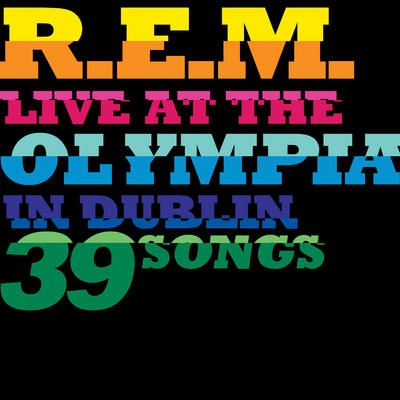
(Above: If you’ve been good, maybe Santa will bring the new R.E.M. album, “Live at the Olympia.”)

By Joel Francis

The holiday season is a notorious dumping ground for greatest hits, repackagings and other musical ephemera. Four established artists, however, transcend the fourth-quarter wasteland. New live albums by Paul McCartney, R.E.M., Tom Waits and Tom Petty are essential additions to any music fan’s library.

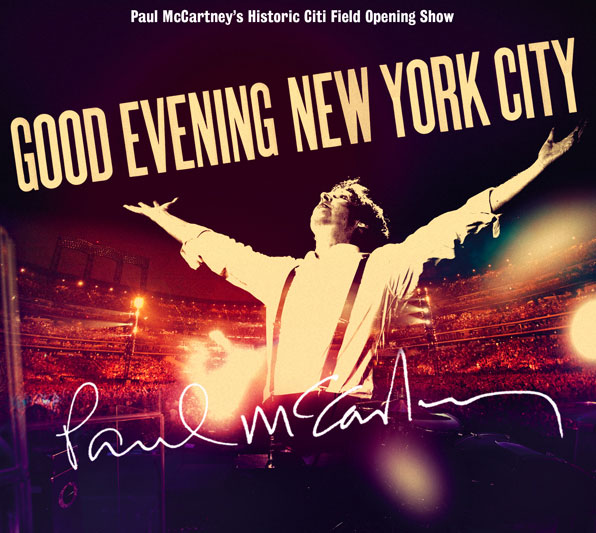
After dropping just one live album in the first half of his solo career, Paul McCartney opened the floodgates over the past two decades. Issuing six live albums since 1990, McCartney has faithfully documented nearly all of his tours and several special performances, but “Good Evening New York City” stands out. The two-CD, one-DVD set documents McCartney’s three-night inaugural performance at the Mets new home Citi Field last summer. Backed by his tight, longstanding quartet, Sir Paul unloads several surprises, like the forgotten “Mrs. Vandebilt,” a tribute to John Lennon with a medley of “A Day in the Life” and “Give Peace a Chance,” and the delightful segue way into Jimi Hendrix’ “Foxy Lady” at the end of “Let Me Roll It.”

Other delights are newer cuts “Only Mama Knows” and “See the Changes,” and the full-band arrangement of “Something” that echoes the performance at the Concert for George. Of course Beatle numbers are plentiful, but the obligatory “Hey Jude” and “Let It Be,” are countered with “Paperback Writer” and “Day Tripper.”

As with all McCartney live albums, the stage banter has been removed, giving the album a bit of a workman-like quality, as the band grinds through the songs with only brief pauses. This editing creates some curious results, such as Billy Joel’s unannounced duet on “I Saw Her Standing There,” or the accidentally buttressing of “Yesterday” and “Helter Skelter” (there was likely an encore break separating the two).

Although there are many places to hear Sir Paul shuffle through the world’s greatest jukebox, few are this energetic or diverse.

When R.E.M. released their last live album, “R.E.M. Live,” only two years ago the band seemed to be running on fumes. Following the disappointing “Beyond the Sun” album with a stop-gap, hits-in-concert set as generic as its title was a naked, holiday cash grab.

A lot has changed since then. Last year’s “Accelerate” brought the trio long-absent acclaim and reinvigorated both the band and its fans. Although “Live at the Olympia” was recorded only four months after “R.E.M. Live” the results couldn’t be more different. While “Live” hit all the obvious marks with little passion, “Olympia” digs deep into the catalog, offering early fan favorites “Driver 8” and obscurities like “Circus Envy.” “Olympia” boasts 17 more songs than “Live” and only two overlapping numbers, so both collections can coexist comfortably.

Fans excited by “Accelerate” will celebrate this 39-track collection. “Live at the Olympia” is the sound of a band being reborn.

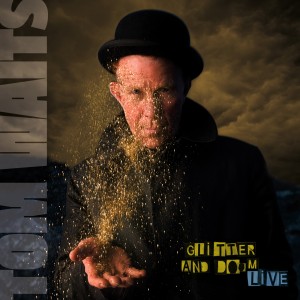
Unlike McCartney and R.E.M., it has been nearly a generation since Tom Waits last issued a live album. “Glitter and Doom Live” does a good job spotlighting Waits’ sonic shifts over the last several years, leaning heavily on tracks from his decade on the Anti- label. Drawn from stops along his 2008 tour of the same name, “Glitter and Doom Live” is more a sampler than a complete performance.

Most of the stage banter has been excised, hilariously, to the second disc. “Tom’s Tales” is a 36-minute montage of Waits’ musings about vultures, jokes about Nazi pasta and adventures on eBay that could stand on its own as one of the year’s best comedy albums.

The songs that made the cut, though, are invigorating. “Orphans” cuts “Lucinda” and “Fanin Street” are more raw while “The Part You Throw Away” is delicate and tender. “Get Behind the Mule” sounds like a voodoo chant at a deep South juke joint, and early cuts like “Singapore” and “I’ll Shoot the Moon” are completely reworked. While hardcore fans may have been happier with a set that recreated Waits’ concert experience, few will be disappointed with the 16 songs delivered.

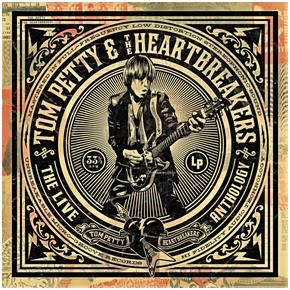
Tom Petty has issued more than a dozen albums during his hit-filled, three-decade career, but until now has only had one live album to his name. “Live Anthology” corrects that problem by offering 50 choice cuts spanning 30 years of gigs. The performances zig zag through the years, but the set flows, creating a dream concert spread across four discs (more if you buy the deluxe edition).

Although all the hits are here, the opening number, “Nightwatchman” shows how deep Petty is willing to delve. More than living up to its name, “Anthology” explores early performances of hits “Even the Losers” right up to full-band arrangements of “Square One” off Petty’s most recent solo album. A sing-along stroll through “A Thing About You” segues seamlessly into Bobby Womack’s soul ballad “I’m In Love.” Later, “Breakdown” slides into a few bars of “Hit the Road, Jack.”

There are no cuts from the Heartbreakers’ mid-‘80s stint as Bob Dylan’s backing band, but honestly, there are enough other incredible moments that they’re not missed. A sublime “Learning to Fly” with Stevie Nicks on backing vocals, an extended “Good to Be King” and unreleased originals like “Melinda” and “Driving Down to Georgia” and covers like “Good Good Loving” and “Goldfinger” (yes, that one) make the set an embarrassment of riches.

This collection not only cements the Heartbreakers’ legend as one of the tightest and most versatile bands of all time, but amplifies their love of rock and roll in all its forms. “Live Anthology” is both more consistent and comprehensive than Petty’s previous box set, the hits/album cuts/rarities collection “Playback.” It is the jewel of Petty’s catalog.

Beatles’ cash grab redefines “Money for Nothing”

(Above: Generations later, Paul’s message still rings out: “You Never Give Me Your Money.”)

By Joel Francis
The Daily Record

Hold tight to your pocketbooks; 9/9/9, the inverted day of the Beast draws neigh.

As any Beatle fan will tell you, Aug. 9 is not only the day Beatles edition of Rock Band lands in stores, but when the remastered Beatles albums will finally be released. On CD, that is, not to iTunes.

That information has been second only to anything related to Michael Jackson or Jack White in the online news hemisphere. The buried story, however, is that the Beatles trail only KISS in their devotion to part fans from their money.

Earlier this week, Paul and Ringo teased the public with their “Box of Vision,” an LP-sized storage container-cum-book for the upcoming remasters. The $90 artifact contains full-size replicas of all the original LP artwork, spiffy new sleeves to house the disc and a “Catalography” guidebook. Inventing new words doesn’t make this a better value.

Basically what you get with this set is a guidebook of discography information readily accessed online, blow-ups of all the artwork that will accompany the CDs and a mega-expensive flip-book. To top off the insult, the flip-book contains slots not only for the traditional catalog (i.e. “Please Please Me” through “Let It Be”) but posthumous releases like “Live at the BBC,” “Love,” and the “Anthology” series. That’s fine, but why are there spaces designated for the red and blue albums and “1” collection? That material is already presented throughout the rest of the catalog.

It’s easy to be cynical and say this move is designed to rankle completes and make them buy redundant collections. It’s easy because even a quick glance at the Beatles online store will jade the most intensely optimistic fans.

When the 40th anniversary of the White Album hit last summer, the Beatles did not release the long hoped-for remastered edition. They offered a $530 white pen. Last year also marked the 40th anniversary of the “Yellow Submarine” film, which one could commemorate with a $200 9-inch figurine or a $65 Yellow Submarine “musical globe with Nowhere Man base.” (I wonder who decided they could get more for a Nowhere Man base over a Blue Meanie base.) Oh, and don’t forget to get a jump start on the 45th anniversary of “Help” buy grabbing the $121 deluxe edition DVD with a reproduction of the script and 60-page book with rarely seen photos.

Official band stores are rarely a bargain, but asking $33 for “Live at the BBC,” $30 for the red and blue albums and $35 for the “Anthology” entries is insulting, especially since all these items may be found on Amazon for about $10 (some are significantly cheaper). You can find a used version of the “Help” deluxe edition for $25 there, too.

The Beatles have a big and diverse enough fan base that more than a few of their admirers can afford to spend extravagantly. But shouldn’t they be getting more bang for their buck than $1,000 album cover lithograph collection?  (I wonder if there’s a connection between these prints and what appears in the Box of Vision.) Is a Beatles edition of Monopoly or Trivial Pursuit really worth double the price ($40)?

Instead of wasting fans’ time and money with worthless trinkets, the band giving the fans what they want. The remastered CDs would have meant something if they appeared six or seven years ago when the upgraded Bob Dylan and Rolling Stones catalogs were introduced. And instead of hoarding the non-album and alternate cuts until the Past Masters and Anthology releases, they could have been sprinkled on the intended albums, creating a sense of context.

Ironically, by trying to dictate the conversation and sell overpriced novelties, Paul and Ringo have inadvertently left piles of cash on the table. Unable to find legitimate remasters, the “purple chick” bootlegs appeared. Unable to legally download the catalog, torrents and illegal MP3s proliferated the Web.

If Paul and Ringo really wanted to create a stir and control the game, they would mine the Apple vaults and create something as innovative, comprehensive and entertaining as Neil Young’s “Archives” box set. Instead, the pair end up looking as backwards and out-of-touch as all the bands that tried to keep up them back in the ‘60s.

“Stax Does the Beatles”

zzstaxdoesthebeatles~_101b

By Joel Francis

The ultimate Stax tribute to the Beatles was Booker T and the MGs 1970 album “McLemore Avenue.”  None of those tracks appear on the 2007 compilation “Stax Does the Beatles,” but strong contributions from Isaac Hayes, the Bar Kays, Carla Thomas and four other MG tracks make collection as strong as it appears on paper.

Otis Redding opens the album with arguably the greatest Beatles cover of all time. His version of “Day Tripper” (presented here in an unreleased alternate take) may even top the Beatles. Redding’s “Day Tripper” may be second only to Wilson Pickett and Duane Allman’s “Hey Jude” in the pantheon of Beatle covers. Pickett’s reading is sadly missing on this album, but David Porter’s “Help!” continues Redding’s frenetic horn lines and double-time delivery to add an urgency only hinted in John Lennon’s originals vocals.

“Stax Does the Beatles” contains two very different versions of “Yesterday,” a funky, sassy spin on “And I Love Her” and a slight cheat with John Gary Williams’ 1973 cover of George Harrison’s “My Sweet Lord.” Some readings work better than others, but all are stamped with the high quality that defined the Stax catalog.

The collection’s centerpiece is Isaac Hayes’ 12-minute cinematic, romantic rendition of “Something.” His arrangement features almost as many instruments as the Beatles “A Day in the Life,” including saxophone, wah guitar, full orchestra and a gorgeous piano line that holds the whole thing together. And that’s just the first 2 minutes.

Some might complain Hayes’ “Something” is overblown, over-produced and pretentious. They haven’t been paying attention to the deep longing in Hayes’ voice.

Although “Something” and “Day Tripper” come the closest, nothing on this collection will replace or make one forget the Beatles versions. The magic in their songs is that there are so many nooks and crannies it seems unlikely future generations will ever exhaust the possibilities of reinterpretation.

For Beatle fans that can play a song in their head by just thinking of the title or chorus, these R&B translations are for you. They are a fresh coat of paint on a favorite structure. For soul fans interested in the influence of soul in rock and vice versa, there is much to enjoy in “Stax Does the Beatles.” People who don’t like either Stax or the Beatles should find the nearest house of worship and repent. Then buy this on the way home.

The Four Tops – “Reach Out (I’ll Be There)”

Four-tops-reach-out-1966

The Four Tops – “Reach Out (I’ll Be There),” Pop # 1, R&B # 1

By Joel Francis

The dramatic introduction to “Reach Out (I’ll Be There)” owes more than a little to Phil Spector’s Wall of Sound and was Motown’s most cinematic chart-topper to date. While the flute gets the signature melody, check out James Jamerson’s uber-melodic bassline bubbling underneath the bevy of instruments. Paul McCartney gets a lot of (deserved) credit for his inventive basslines, but Jamerson’s brilliant countermelody here rivals anything McCartney came up with the Beatles – OK, maybe not “I Feel Fine” – and should permanently insert Jamerson into the ‘60s bass legends conversation.

The song was written by the white-hot trio of Holland-Dozier-Holland – there were actually other Hitsville employees at the time, although one wouldn’t know it by looking at the Billboard charts – but Norman Whitfield supplied the galloping percussion. Propelled by HDH’s rich arrangement, “Reach Out” starts strong and continues to build through the verse, dropping off and resting slightly before the Tops casually fall into the chorus. Lyrics could almost become superfluous with a melody this strong, but lead singer Levi Stubbs’ words of commitment and devotion are equally compelling.

Although the song became the Tops signature number, Stubbs initially felt his voice was too rough for the song and tried to recuse himself. Fortunately, HDH prevailed on Stubbs to give it a try. Stubbs promptly delivered one of the great vocals in the Motown catalog. Critics who pick on “overproduced” songs like this as examples of the slick Motown sound need to pay more attention to Stubbs’ vocals. His signing is as gritty and soulful as anything in the Stax cannon. Marvin Gaye and Smokey Robinson may sound a little stilted in singing in front of Stax’ incredible house band Booker T and the MGs. It’s not hard to imagine Stubbs being more than up to the task. Unfortunately such cross-pollination never occurred, but with the advent of ProTools and continued merger of major record labels, maybe the Motown and Stax catalog will end up under the same corporate umbrella and someone will give us a recreated session.

Stubbs’ soulful signing on “Reach Out” inspired a lot of people – unfortunately it inspired a lot of the wrong people. While the ability to sing soul music is not racial, a whole lotta white dudes certainly tried to make the case. Elton John, Michael Bolton and Michael McDonald all failed on this number. More successful were Diana Ross, who took her cover into the Top 40 in 1971, and Gloria Gaynor, who did a disco version just four years later.

George Kalinsky: Painting with Light

ejjl1
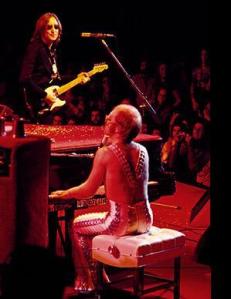
(Above: Elton John and John Lennon at Madison Square Garden, 1974.
All photos by George Kalinsky, courtesy of www.georgekalinsky.com.)

By Joel Francis

In his 34 years as Madison Square Garden’s official photographer, George Kalinsky has forgotten more games, concerts and events than many people could see in several lifetimes.

Kalinsky, who estimates he has shot more than 8,000 events, can be forgiven for having no memory of Bob Marley’s next-to-last performances in 1978, because what he remembers more than makes up for any lapses.

“November 28, 1974. Don’t ask me how I remember that, but I do,” Kalinsky said with a laugh. “Elton John was playing the Garden, and he surprised everyone by having John Lennon join him onstage. Those three songs they did together turned out to be the last time John Lennon performed before he was shot. The moment I captured won’t be there again.”

Several of Kalinsky’s favorite moments are on display for a current exhibit at the Rock and Roll Hall of Fame in Cleveland. “Live From Madison Square Garden: From the Lens of George Kalinsky” opened May 1 in the Ahmet M. Ertegun Main Exhibit Hall and will run through January 2010.

“I’ve always tried to paint with light,” Kolinsky said. “Shooting against a plain black background is not the most creative, but it’s what you usually see. These performers spend millions on lighting and effects. I always try to capture that as part of the atmosphere of the performance.”

fullscreen-capture-562009-34913-pmbmp1

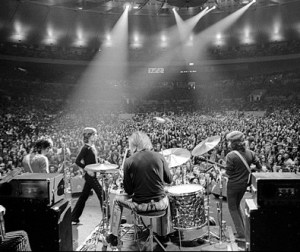
The atmosphere for the Rolling Stones’ Garden concert in 1969 was a frenzy. The show was one of the first arena rock concerts and the pandemonium was captured and released on the Stones’ great live album “Get Your Ya Ya’s Out.”

“That was the first time I saw a buzz, a reaction like that in the audience. Everyone wanted to be onstage and the crowd started gradually pushing forward,” Kalinsky said. “I went under the stage and went on in the back and got some amazing shots.”

Getting the audience’s reaction to the band was the key to recording the moment, Kalinsky said.

“I think a huge part of the story is the people and how they react,” he said. “There may not be too many pictures in this exhibit of the crowd, but I always try to include them. Every audience is different, just as a circus is different from a track meet and hockey is from basketball. The audience is a reflection of the performance.”

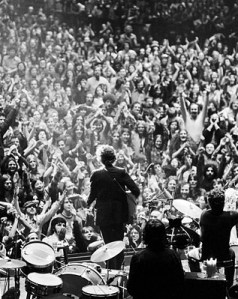
The crowd at a 1974 Bob Dylan performance played a key role in a shot Kalinsky called one of the top two or three photos he’s taken.

“Dylan is Dylan, the hair, the body language, all of it connecting and seeing the audience reach out to him is beautiful and telling,” Kalinsky said. “With him, the words are so important; when I look at Dylan I try to capture the aura of the man.

“I want to get a little closer to see what his face looks like,” Kalinsky continued, “and how it shows the years, not in terms of getting older, but the years of performing with the audience and how that bond grows stronger and stronger.”

fullscreen-capture-562009-35709-pmbmpDylan played a key role in George Harrison’s 1971 Concert for Bangladesh at the Garden. Shooting both of those shows not only taught Kalinsky that music was the true universal language, but showed him how far the Garden’s stage extended.

“I was in a cab recently and the driver was from Bangladesh,” Kalinsky said. “He couldn’t have been more than 35 or 40 years old, but he said in the hearts of his family and friends in Bangladesh they would never forget Madison Square Garden. They weren’t there (at the Concert for Bangladesh), but they’d never forget because that’s where people learned to help his country and family.”

Events at the Garden, Kalinsky said, “become part of our culture and part of our world. It wasn’t long ago we had 9/11 and that concert. Even if you weren’t there, you were there because everybody in the world tuned in to the Concert for New York City.”

What stands out in Kalinsky’s mind from that show isn’t the defining performances from Paul McCartney, the Who and artists with ties to the Big Apple like Jay-Z and Bon Jovi, but a moment backstage with Billy Crystal before he was about to go on.

“I asked him how does he project his talent when the audience is in tears and police and firefighters are holding up pictures (of their missing loved ones)?” Kolinsky said. “He said the hardest thing to do was be funny in the face of an audience who had lost so much.”

Although Kalinsky’s relationships and reputation allowed him backstage that day, he acknowledged access has been almost completely shut down from the early days when he would take pictures of Elvis Presley in the dressing room before his first Garden concert or Sly Stone’s groomsmen getting ready before Stone’s onstage wedding in 1974.

And just as backstage has become more restrictive, the window for taking performance photos has been confined to the first three songs. That doesn’t bother Kalinsky, though, because digital technology and automatic lighting systems within the camera let him do as much with those three songs as he could in an entire show in the days of film.

“However, in terms of taking pictures it always comes down to the eye and the moment,” Kalinsky said. “You have to recognize the moment and snap the picture. This is the most important aspect, whether you are shooting a concert, sporting event or portrait setting. It’s what I’m always looking for.”

Kalinsky’s duties have also given him a window on the 1994 Stanley Cup Finals, Knicks games, scores of the world’s top athletes and personalities. This diverse shooting background has provided enough photos to fill eight books and exhibits from the Museum of Modern Art to the baseball and basketball halls of fame.

“The Garden stage, whether it’s Muhammad Ali, the Pope or LeBron James, brings out the best in every performer,” Kalinsky said. “Every day I walk into the Garden I say what a privilege it is to be part of this arena and the best stage in the whole world.”

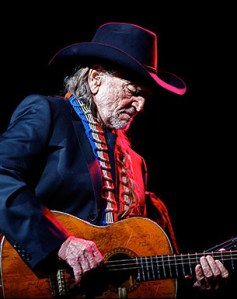
(Below: A recent portrait of the Red-Headed Stranger.)

fullscreen-capture-562009-40105-pmbmp

Keep Reading:

Rock Hall Celebrates 50 Years of Motown

Rock Hall Celebrates the 40th Anniversary of Woodstock

Bruce Springsteen Rocks the Hall (part one)

Bruce Springsteen Rocks the Hall (part two)

2009 Grammys: A Running Diary

The last time The Daily Record watched a complete Grammy Awards show, “O Brother Where Art Thou?” won Album of the Year. This year, though, we got suckered in by the promise of seeing Radiohead. (Have they won a Grammy? Wikipedia says yes.) This presented the perfect opportunity to do one of those running diaries like Bill Simmons does for ESPN. We not may be as successful, but the official wife of The Daily Record was glad her husband’s snarky comments were bypassing her ears and going straight online, where she could ignore them more easily. Enjoy!

7:00 U2’s new song sounds like Bob Dylan’s “Subterranean Homesick Blues.”

7:02 The lyrics to their new song “Get On Your Boots” appear on a large video screen behind the band. I wonder if this is what all the presenters will see on their Teleprompters.

7:09 Whitney Houston comes out to present the award for “Best R&B Album.” Forget Botox – cocaine must be the secret to a younger looking face.

7:10 Seriously, Houston looks like she has been stored in the freezer next to Ted Williams for the last 10 years.

7:12 The Rock is as good a comedian as he is an actor.

7:17 Justin Timberlake and Keith Urban paying tribute to Al Green is like Henry Kissinger and Dick Cheney giving props to Barack Obama.

7:21 First commercial break. High-powered bloggers use this time to make snarky comments about commercials too. Unfortunately, The Daily Record has no corporate sponsorship. We’ll use this time to do glamorous things like take out the trash and recycling, pull stuff together for work tomorrow.

7:26 For a second, I thought Chris Martin was Paul McCartney sitting at his Magical Mystery Tour piano.

7:28 Let the haters hate; Jay-Z is still great.

7:29 How come Coldplay get to play two songs? I wonder if Joe Satriani will come out. Probably not.

7:30 Coldplay’s Beatles motif is reinforced with their Sgt. Pepper jackets.

7:33 Although representatives insist that all Grammy performers will not perform to a backing track like Bruce Springsteen did at last week’s Super Bowl, you have to be suspicious. It’s not like the music industry is a bastion of integrity.

7:34 Why does “country” singer Carrie Underwood rock harder than “rock stars” Coldplay?

7:35 I have no idea what Carrie is singing. I think it’s something about how long it took to get her legs waxed. Damn them’s some shiny gams!

7:36 Carrie’s guitar player looks like Lita Ford’s daughter.

7:38 Why does Sheryl Crow, 46, look younger than LeAnn Rimes, 26?

7:39 Congratulations, you’ve won a Grammy Lifetime Achievement Award. We will now honor you with a 15 second black and white video clip. Why not let the recipients perform?

7:48 Hey, Coldplay just acknowledged my Sgt. Pepper’s joke!

7:49 Man, Kid Rock really, really likes Bob Seger.

7:58 Taylor Swift and Miley Cyrus are performing together for the first time, but they won’t let the guys playing acoustic guitars and bass onstage with them.

7:59 It’s really bugging me that they won’t let the band perform onstage. What were they told? “OK, here’s the deal. You four will sing backing vocals, provide rhythm support, fine, you’ll carry the whole thing – but we don’t actually want anyone to see you do it.” Was there not enough crawlspace under the stage to stuff them in there?

8:02 A seated Tylor Swift just said “If you’re 19, or even older, it’s still a thrill to stand on the Grammy stage.” Man, she is going to have a long time to be depressed.

8:03 Robert Plant and Allison Krauss just won AWARD. But even better news is that they’re working on a new album together.

8:05 This is why we don’t need a Whitney Houston comeback. Jennifer Hudson is both more talented and a more substantive person.

8:15 What the? Stevie Wonder is jamming with the Jonas Brothers. Half the audience is wondering who the old dude is and everyone else is wondering what he’s doing playing with them. Thing is, it doesn’t sound half bad. Then again, I’m a sucker for Stevie’s vocoder trick.

8:16 Any excuse to hear “Superstition” is a good thing. I’ll never buy a Jonas Brothers album, but I thank them for this moment.

8:17 Seriously, you know your songs kick butt when Disney-sponsored tweener heart-throbs can’t screw them up. Not even Celine Dion could ruin this moment.

8:19 I hear Blink 182’s next album is going to be a tribute to Def Leppard.

8:20 Do Coldplay have to mention the Beatles every time they take the podium? Pretty soon Ringo will be onstage with them refusing to sign autographs.

8:27 Don’t forget, Craig Ferguson writes all his own material.

8:29 Am I the last person on Earth to be hearing “I Kissed A Girl” for the first time right now?

8:30 Why is Katy Perry dancing in Carmen Miranda’s headdress? This segment must be sponsored by Chiquita.

8:31 Am I the only person on Earth to feel like he hasn’t missed anything by not hearing “I Kissed A Girl” until now?

8:32 I don’t know the song Kanye West is doing with Estelle, but “808s and Heartbreaks” is really growing on me.

8:33 Kanye is taking this ’80s fixation a bit too far. Next year he’s going to come out wearing a Huxtable sweater.

8:41 I don’t care how long he keeps wearing it, that earring is never going to look natural on Morgan Freeman.

8:45 Sean “Puffy” Combs, Natalie Cole and Herbie Hancock are on hand to present “Record of the Year.” One of these things is not like the other (in a good way).

8:46 Natalie Cole’s dress looks like a last-minute compromise from the outfit Lil Kim wore on the MTV awards a few years back.

8:47 Plant and Krauss just won again. Robert Plant might have the most successful post-supergroup career of all time. OK, maybe Paul McCartney – but Plant’s taken more chances.

8:53 They just gave a Lifetime Achievement Award to Dean Martin. I guess we now know why they don’t have these winners perform, but why’d the take him so long for Martin to get this award? He’s been dead for awhile, but he certainly had the sales and popularity when he was alive. Maybe next year they’ll finally get around to honoring Bing Crosby.

8:54 I’m not sure why M.I.A. had to secede the stage so quickly. How cool would it have been if Mick Jones and Paul Simonon came out to do “Paper Planes” with her?

8:55 Kanye, Jay-Z, T.I. and Lil Wayne’s performance together is being called a “historic hip hop summit.” The tour kicks off next month in Yalta.

8:57 M.I.A.’s polka-dot pregnancy outfit is sponsored by Buddy Guy’s guitar.

9:00 I can’t believe I’ve sat through two hours of this show … and still have 90 minutes to go.

9:01 If I were going to have Dave Grohl drum with Paul McCartney I’d give him something a little meatier than “I Saw Her Standing There.” Maybe “Band on the Run” or “Helter Skelter.” I’m just saying.

9:10 Feed just went out as John Mayer was accepting an award. I guess my TV isn’t much of a fan either.

9:11 Jay Mohr and LL Cool J is one of the most awkward pairings of the night. Then again, Jay Morh and anyone is an awkward arrangement.

9:15 Sugarland and Adele aren’t really performing “together for the first time” as promised, but “one right after another.” Eh.

9:17 Oh, here’s Sugarland. She added that one essential line at the end of the song.

9:23 Gwyenth Paltrow is wearing a mirror ball. Dance party!

9:24 Radiohead is performing with the USC Marching Trojans. Man, first those guys get to play with Fleetwood Mac and now they’re backing up Radiohead. I wonder which was more rewarding.

9:25 Someday, future generations will worship Radiohead like we celebrate the Beatles.

9:27 Is it still Radiohead when it’s just Thom Yorke and Jonny Greenwood? Survey says, who cares? Radiohead in any form is better than anything else we’ve seen tonight.

9:28 OK, better than everything except Carrie Underwood’s legs – but I’m still not buying her album.

9:30 If you are still reading this, you are officially my new best friend. Please leave a comment to receive a special prize.

9:34 Justin Timberlake is performing in a coat and scarf. How did he know snow was in our forecast?

9:35 The stocking cap on T.I.’s head looks like a reservoir tip.

9:36 I don’t think switching back and forth between two distinct songs should count as collaboration. It’s more like a musical debate where the listener always loses.

9:38 Recording Academy president Neil Portnow rejected the traditional tirade against music piracy to talk about MusiCares and promote a Secretary of the Arts cabinet position.

9: 42 Portnow is done, but I’m kinda bummed he didn’t bring up piracy. I had a great line to use when he did: “Recording Academy president Neil Portnow is still talking about music piracy. This guy is slower than Rapidshare.”

9:44 Not even Smokey Robinsons sings the Four Tops as well as Levi Stubbs. Rest in peace, Levi.

9:45 It would be cool if the producers rounded up the remaining Funk Brothers as backing musicians for this Four Tops tribute.

9:52 Neil Diamond is singing “Sweet Caroline” and millions of Red Sox fans are crying because their season hasn’t started yet. Pitchers and catchers report in less than a week, boys.

9:54 Am I the only one that finds it kind of sad that Diamond’s expansive catalog has been reduced to just one song? And that “Sweet Caroline” is that song? It’s like if people only remembered Bob Dylan for “Quinn the Eskimo (The Mighty Quinn).”

9:59 Paying tribute to Bo Diddley are Buddy Guy, B.B. King, John Mayer and Keith Urban (because you know if any two performers have influenced Urban’s style and career its Al Green and Bo Diddley). Best rhythm in rock and roll.

10:00 I make that joke earlier about Buddy Guy’s guitar and he shows up here playing a gold top Les Paul. I’m not sure I’ve ever seen him rock a since his days on Vanguard.

10:08 Allen Toussaint is supposed to appear with Lil Wayne with Robin Thicke. I bet those two would be surprised to learn that Toussaint has written more hits than both of them combined.

10:10 I wonder why the producers haven’t rolled out one of those “for the first time ever” duets between Thicke and Timberlake? Probably because no one could tell them apart.

10:11 Allen Toussaint with the Dirty Dozen Brass Band and Terence Blanchard falls just short of topping Radiohead for best musical moment of the night – but it’s close. No American city makes more consistently fun music than New Orleans (although a case could be made for Memphis).

10:14 Will.I.Am just congratulated Obama. Who could have seen that coming? Next year, Will.I.Am will receive a record number of Grammy nominations for his album “Obamania: Songs About Barack Obama, Because I Love Barack Obama by Will.I.Am (for Barack Obama).”

10:24 Robert Plant and Allison Krauss are performing with T-Bone Burnett. Krauss’ hair keeps blowing back. Now I know why Justin Timberlake was wearing a coat and scar earlier.

10:25 I love “Raising Sand” as much as the next person, but that album came out in 2007. Why are the Grammys acting like it’s a new release?

10:26 The Grammys operate on such a loopy nomination calendar that a band’s previous and forthcoming albums can both be eligible at the same time.

10:27 The producers rightly made a big deal of T-Bone being on stage, but there was no mention of Buddy Miller holding down rhythm guitar. Therefore, I’d like to take this moment to give Buddy props for being a spectacular musician.

10:28 Album of the Year goes to “Raising Sand.” If it wasn’t going to be “In Rainbows” this is where it should have gone. (Seriously, does anyone else find it odd that both of these albums were released 16 months ago?)

10:30 Robert Plant started his career in 1968. You can fill a matchbook with a list of all tonight’s performers and honorees we’ll still be talking about 40 years from now.

10:32 Stevie Wonder is playing us home. See you in seven years, Grammys!

Flaming Lips deserve Super Bowl halftime show

(Above: Picture this on the 50-yard line: the Flaming Lips, “Race for the Prize.”)

By Joel Francis

The five years since Janet Jackson’s Super Bowl halftime “wardrobe malfunction” two things are clear: Nipple shields have not become the must-have fashion accessory everyone predicted; and halftime shows have never been better.

It would be easy to get tired of all the blue-chip baby boomer performers if they didn’t put on such compelling shows. The Rolling Stones abysmal 2006 act aside, it doesn’t get much better than hearing “Drive My Car” and “Runnin’ Down A Dream” at halftime. Yeah, they’ve been done to death, but they’re a lot better than whatever song Janet and Justin Timberlake were singing and Aerosmith’s pairing with Britney Spears. Does anyone remember those songs today?

Even fans tired of the oldies can’t argue with the energy that propelled Prince’s set in 2006 and Bruce Springsteen’s show last night into the top echelon of pop music performances.

Which is exactly why it’s time to change things up. The canary is choking; there’s not much more ore in the vein the NFL has mined these past five years. Let’s stop now, before Fleetwood Mac and the Eagles are serenading us with mid-game naps. It’s time to take the halftime show in a new direction. A direction hinted at in 2002 when U2 were brought in to play: dynamic bands that can connect with a huge audience, playing high-energy hits written within 20 years of their performance.

The Flaming Lips are the perfect band to open this new era. Imagine frontman Wayne Coyne rolling over the crowd in his giant hamster ball as “Race For the Prize” blasts through the stadium. Lasers penetrate the clouds of smoke as confetti, streamers and balloons rain on the crowd. Did we mention the Lips also come with their own space aliens and super heroes? Oh, and a flying saucer?

In their 25-year history, the Lips have twice rocked the massive crowds at Bonnarro and will have no problem connecting to the fans in the upper deck or on the couch. Their songs may not be as universally known as “American Girl,” but “She Don’t Use Jelly” was an MTV staple big enough to land the band on “Beverly Hills 90210.” And the “Yeah Yeah Yeah Song” will have as many people signing along as the outro of “Hey Jude.” The biggest obstacle will be cleaning up all the joyous debris on the field (lay down a tarp) and getting everyone to settle down enough to concentrate on the resumed game.

It wasn’t that long ago that the Blues Brothers (minus John Belushi) and Miami Sound Machine were given center-stage at the world’s biggest intermission. But there is a midway point between dinosaur bands and Top 40 vapidity. Once the Flaming Lips remind the audience of this territory, bands like the Foo Fighters, Arcade Fire and Robert Randolph and the Family Band are perfect future candidates.

Inoffensive doesn’t have to be the antonym of adventure. The Flaming Lips are the embodiment of the party atmosphere the NFL wants the Super Bowl to inhabit. It’s time to let them take the stage. Book them for 2010.

Read The Daily Record’s coverage of the Flaming Lips at Wakarusa in 2006 and 2008.

The Music of James Bond: Part Three – The ’80s and Beyond

Above: Jack White and Alicia Keys do the latest James Bond song, “Another Way To Die.”

By Joel Francis

Duran Duran bass player John Taylor probably had the previous two James Bond themes in mind when he drunkenly approached producer Cubby Broccoli at a party and asked when they were going to get someone “decent” to do a Bond song.

It didn’t take long to learn the answer. Duran Duran’s “A View To A Kill” was a No. 1 hit, re-establishing Paul McCartney’s precedent of letting successful pop acts write and perform title songs hit. While the big synthesizers and processed drums haven’t aged well – few pop songs from the ’80s have – the chorus of “dance into the fire” remains as catchy as ever. The song also marked the last time original Duran Duran’s lineup recorded together for 16 years.

Encouraged by Duran Duran’s success, the Bonds producers handed the reigns to another pop act for 1987’s “The Living Daylights.” After being rejected by the Pet Shop Boys, who wanted to score the entire film, a-ha, the band best known for its 1985 No. 1 hit “Take On Me,” agreed to take on Bond. Sporting similar dated production as Duran Duran’s hit, but weaker songwriting and overly sensitive singing, “The Living Daylights” became another Bond footnote.

The lush orchestration associated with early Bond numbers was back for Gladys Knight’s “License to Kill” in 1989. Composer Michael Kamen did a good job incorporating the “Goldfinger” horn line into the main melody, but the lyrics and melody are bland. It’s a shame that Knight, who has one of the strongest soul voices of all time, wasn’t given stronger material. Bond’s further musical malaise is marked by the presence of Patti LaBelle’s end credits theme, “If You Asked Me To,” which was later covered by Celine Dion. Dion’s appearance marks the nadir of any expedition.

After a six-year hiatus and casting change, Bond returned in 1995’s “Golden Eye.” Written by U2’s Bono and The Edge, “Golden Eye” found the duo continuing in the same vein as their summer hit “Hold Me, Thrill Me, Kiss Me, Kill Me.” The arrangement wraps the duo’s discotheque infatuation around a haunting melody build on a horn line. Tina Turner masterfully teases Bono’s voyeuristic lyrics and was rewarded with a Top 10 hit in Europe. “Goldfinger” was the best Bond song in a generation and helped successfully jumpstart the franchise.

After the powerful, soulful voices of Knight and Tuner, Bond’s producers turned to another American female in 1997 for “Tomorrow Never Dies.” Sheryl Crow brought strong songwriting chops and chart-topping cache, but she lacked the voice to carry her melody. Her vocals fare well during the verses, but the chorus is too high for Crow’s register where her throat lacks the energy to carry the words and emotion. k.d. lang’s “Surrender,” written by the film’s composer David Arnold, fits firmly in the Bond mold of big strings and brassy horns and would have been a better opening number. Unfortunately, it was retitled and pushed to the closing credits once Crow signed on. Finally, pop-techno musician Moby was enlisted to remix Monty Norman’s “James Bond Theme.” The result was a rare update that successfully enhanced and modernized the original.

Arnold successfully married his large orchestration with light techno elements for “The World Is Not Enough.” Garbage singer Shirley Manson slithers through the lyrics with authority and the rest of the band maintains a tasteful balance between rock and orchestral while adding their stamp to the song.

Madonna was easily Bond’s biggest star pull since Paul McCartney when she signed up for “Die Another Day” in 2002. While the film may have been Bond-by-numbers, Madonna blew up the formula for her electronic theme song. Her manipulated vocals hide behind banks of synthesizers and strings and spout the memorable line “Sigmund Freud/analyze this.” Although the song spent 11 weeks at the top spot of the U.S. charts, it is unlike any other theme in the Bond cannon and, as a result, not without controversy. The Material Girl wouldn’t have it any other way.

Bond was rebooted once again in 2006 for “Casino Royale.” As the character became grittier, so did the music. Chris Cornell’s “You Know My Name” is easily the hardest number in the Bond cannon, cut from the same stone as Alice Cooper’s rejected “Man with the Golden Gun” that repulsed producers 30 years ago.

Confirming they were no longer afraid to rock out, White Stripes mastermind Jack White was enlisted to perform “Another Way To Die” for 2008’s “The Quantum of Solace.” Unsurprisingly, White’s song sounds like a heavily orchestrated White Stripes number given an urban twist courtesy of the piano and vocals of Alicia Keys. Stripped of the overproduction that plagues her solo releases, Keys shines under White’s watch. Her call and response with White’s dirty guitar licks halfway through the song channel “What I’d Say” through Jimmy Page’s amplifier. The number is the first Bond theme performed as a duet, but based on the openness Bond’s producers have shown in the past decade, it will likely not be the last.

Keep reading:

The Music of James Bond: Part 1 – The Classic Years

The Music of James Bond: Part 2 – The Seventies

The Music of James Bond: Part Two – The Seventies

(Above: Blondie’s superior, unused version of “For Your Eyes Only.”)

By Joel Francis

When Roger Moore replaced Sean Connery as James Bond, the producers retooled the series to include the grittiness of the recent Dirty Harry movies and “The French Connection.” In “Live and Let Die” Bond chases a corrupt Caribbean politician who deals heroin and happens to be black. They also snagged one of the biggest stars on the planet to write and perform the latest Bond theme – ex-Beatle Paul McCartney.

McCartney’s theme song reunited him with Beatles producer George Martin, who scored the film. Martin was the first person other than John Barry to score a Bond film.

Not only was McCartney’s song the first rock Bond theme, but it was the first one to be written and performed by the same person. The film’s producers had wanted a soul singer, but Martin prevailed and McCartney was allowed to sing. The song starts with a soft melody and understanding lyrics, before bursting into a whirlwind of strings and horns. The change in tempo and texture underscores the protagonist’s philosophical change, from “live and let live” to “live and let die.” The song is a staple of McCartney’s live shows and was performed at his Super Bowl halftime concert in 2005. The less said about Guns N’ Roses 1991 cover, the better.

Barry was back in the scoring saddle for “The Man With the Golden Gun.” He teamed with lyricist Don Black on the title song and the results were predictable. British singer Lulu made her name with the No. 1 hit “To Sir With Love,” the title song to Sidney Poitier’s 1967 film, but she’s given little to distinguish herself with here. Deep in the mix, a guitar spews crazy licks underneath a battalion of churning trombones, but Lulu’s vocals stay safely in the Bassey mold.

Proto-shock rocker Alice Cooper claimed his song “The Man With the Golden Gun” was written for the film but rejected by its producers. The song is an aggressive slab of hard rock completely out of step with anything the producers had used before, so its unsurprising Cooper’s version didn’t appear until it was included on the tastefully titled “Muscle of Love” album.

In 1977, Carly Simon became the second American (after Nancy Sinatra) to sing a Bond theme. “Nobody Does It Better” was the first Bond theme without the same name as its movie, in this case “The Spy Who Loved Me,” although songwriters Carole Bayer Sager and Marvin Hamlisch did work the title into the lyrics.

The song revitalized Simon’s career which had been in a five-year gradual decline since her 1972 hit “You’re So Vain.” It was No. 1 on the adult contemporary charts for seven consecutive weeks and was nominated for two Grammys.

Despite its soft rock arrangement, “Nobody Does It Better” works well as a Bond theme. Writing about the character instead of the film is a refreshing change. Simon’s vocals are nearly devoid of the sex most female Bond singers infused in their delivery. Simon’s approach is more of devotion than lust, which not only supports the arrangement, but makes the song more honest.

Moonraker” paired Bassey and Barry for the final time. Bassey’s third turn on a Bond theme happened after Johnny Mathis declined the song at the last moment. Her delivery is much smoother than on “Diamonds Are Forever” and “Goldfinger,” but it compliments Barry’s lush orchestration. For the first time, Barry’s horns are pushed far to the background. His strings are suspended, weightless in space, and the arrangement is accentuated with a light touch of disco.

The formula of pairing the score composer with a lyricist and giving the song to a pop singer was very much intact as the Bond film franchise entered the ’80s (and its third decade) with “For Your Eyes Only.” Unfortunately, the results were not as memorable. Sheena Easton set a precedent when she became the first singer to perform the title song onscreen. The gauze of synthesizers and strings and forced melody have rightfully relegated the song to footnote status. The producers would have been better served accepting Blondie’s title submission, which appeared on their 1982 album, “The Hunter.”

For his 13th Bond film, Barry turned to Tim Rice, Andrew Lloyd Weber’s lyricist, for help. The result, “All Time High,” was sung by Rita Coolidge. Like Carly Simon’s “Nobody Does It Better,” “All Time High” spent multiple weeks at No. 1 on the Adult Contemporary chart and does not share the its film’s title (in this case “Octopussy“). Unlike Simon’s song, though, “All Time High” hit the all-time low in Bond songs.

Keep reading:

The Music of James Bond: Part Three – The ’80s and Beyond

The Music of James Bond: Part One – The Classic Years

Below: Alice Cooper’s alternate “The Man With the Golden Gun.”