The Temptations – “I Wish It Would Rain”

rain
The Temptations – “I Wish It Would Rain,” Pop # 4, R&B # 1

By Joel Francis

“I Wish It Would Rain” had been out less than two weeks when songwriter Roger Penzaben took his life on New Year’s Eve, 1967. The heartache and melancholy Temptation David Ruffin poured into his singing was Penzaben’s story.

In the spring of 1967, Penzaben caught his wife in an affair. Unable to cope with the pain and betrayal, Penzaben dumped his feelings into the lyrics. Producer Norman Whitfield and Barrett Strong, who had previously teamed on Tempts’ classics EX.

The song opens with a few stately piano chords before Ruffin takes over. Backed only by a tambourine, it’s practically a cappella. Ruffin’s voice drips with so much sorrow that it’s hard to believe just three years prior he had “sunshine on a cloudy day.”

The understated strings and arrangement bear the hallmarks of Motown’s classic Holland-Dozier-Holland productions. It’s hard to believe that in less than a year, Whitfield and the Temps would be on the vanguard of the psychedelic soul movement.

It’s also hard to believe that “Rain” was Ruffin’s next-to-last single as a Temptation. Ruffin’s cocaine addiction and insistence that the group follow Smokey Robinson and Diana Ross’ leads and  be renamed “David Ruffin and the Temptations led to his firing in the summer of 1968. When the Temps again cracked the pop Top 10 with “Cloud Nine,” both Ruffin and Whitfield’s traditional arrangements were long gone.

Shortly before the Tempts debuted their psychedelic sound, Gladys Knight and the Pips took gave “Rain” an encore lap that reached Nos. 41 and 15 on the Pop and R&B charts, respectively. In 1973, Marvin Gaye recorded a funk version that was released as the b-side of his No. 1 hit “Let’s Get It On.” That same year, British slopsters The Faces had a U.K. hit with their interpretation. Aretha Franklin and hair metal band Little Caesar have also recorded versions of this miserable masterpiece.
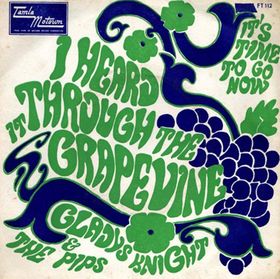
Gladys Knight and the Pips – “I Heard It Through the Grapevine”

grapevine
Gladys Knight and the Pips – “I Heard It Through the Grapevine,” Pop # 2, R&B # 1

By Joel Francis

Unlike nearly every other soul singer at the time, Gladys Knight didn’t want to go to Motown. She was (rightly) worried she and her group, the Pips, would end up playing second fiddle to Diana Ross and the Supremes. However, the Pips were a democracy. When the rest of the group voted to migrate to Hitsville, Knight reluctantly acquiesced.

“I Heard It Through the Grapevine” was a thrice-heated leftover when Norman Whitfield presented his song to the group in 1967. Smokey Robinson and the Miracles cut a version the previous year that didn’t make it out of Berry Gordy’s Quality Control meeting. A second Miracles recording of “Grapevine” was buried as an album cut on 1968’s “Special Occasion” LP.  The Isley Brothers were rumored to have recorded a version during their brief stint on the label, but no recording has surfaced to date. Several Motown scholars believe a recording session with the Isleys to cut “Grapevine” was scheduled, but then cancelled.

This is likely the case. In 2005, Motown released the two-disc clearinghouse “Motown Sings Motown Treasures.” This incredible and enlightening collection presented many recordings – Kim Weston performing “Stop! In the Name of Love,” the Supremes doing “Can IGet A Witness,” and the Miracles original, unissued version of “Grapevine,” among others – previously locked in the vaults. It seems unlikely that the Isley Bros. version of “Grapevine,” if it exists, would have been omitted from this collection.

Although it wouldn’t be released for another year, Marvin Gaye had also cut his reading of “Grapevine” by the time the Pips were hearing Whitfield’s pitch.

Whitfield’s latest “Grapevine” arrangement was inspired by Aretha Franklin’s “Respect” and Whitfield’s desire to “out-funk” Franklin. It’s clear from the great snare-and-cymbal intro that Whitfield was on to something new. Motown had been a lot of things until that point, but it had rarely been so overtly funky. In the coming years, Whitfield would help place Hitsville at the epicenter of psychedelic soul. This recording was one of the first steps down that path.

Whitfield’s attempt to out-do the Memphis soul sound Aretha was getting from Atlantic producer Jerry Wexler was buoyed by Knight’s singing. The gospel background isn’t as obvious in Knight’s delivery, and her voice is a little earthier than Franklin’s, but Knight’s vocals can soar just as high. In fact, the song is little more than drums, piano and Knight’s powerful voice until a scratch guitar enters during the first chorus.

Stealing a page from the Holland-Dozier-Holland production book, the tambourine is mixed front and center. The instrument serves as a tractor, dragging the entire song it its wake. The signature organ line that introduces Gaye’s chart-topping “Grapevine” makes a cameo on the piano about a minute into the song. The saxophone solo bisecting the song is a straight-up homage to King Curtis, the Memphis soul legend. Even the juiciest gossip is rarely this much fun.

The fourth time was the charm for Whitfield, as the Pips’ powerful “Grapevine” finally made it past Gordy’s Quality Control meeting. That didn’t guarantee label support, though, as Knight was forced to rely on her DJ connections to promote the song. When “Grapevine” finally caught on, it caught fire holding the top spot on the R&B chart for six weeks and stalling behind the Monkee’s “Daydream Believer” at No. 2 on the pop chart. Although it was Motown’s best-selling single to date, the “Grapevine” story was far from over.

Four Tops – “Bernadette”

Four-tops-bernadette
Four Tops – “Bernadette,” Pop # 4, R&B # 3

By Joel Francis

Levi Stubbs’ performance on “Bernadette” cements his status as Motown’s greatest male vocalist. The magnificent feats Stubbs laid down on the Four Tops previous pair of singles, “Reach Out” and “Standing in the Shadows of Love” reaches an impassioned crescendo on “Bernadette.” Stubbs joy, appreciation and devotion to Bernadette is still making women envy that name and that kind of partner.

The Holland-Dozier-Holland team that wrote and produced the previous two Tops singles once again employ the same lush orchestration, wrapping Stubbs’ urgent vocals in insistent strings, soaring background vocals and their signature propulsive snare drum.

“Bernadette” was the Tops last Top 10 hit until “Keeper of the Castle” took off in 1972. Perhaps coincidentally, “Bernadette” was also the Tops next-to-last collaboration with Holland-Dozier-Holland. The HDH-Four Tops swan song “7-Rooms of Gloom” hit No. 7 on the R&B charts in the summer of 1967.

Although Holland-Dozier-Holland had a handful of hits with Diana Ross and the Supremes before they left Motown in early 1968, “Bernadette” marks the last appearance by the incredible songwriting and production trio on the “Hitsville U.S.A.” set.

After Holland-Dozier-Holland departed, Berry Gordy placed all his best songwriters on Diana Ross and the Supremes and other pet artists like the Jackson 5. Groups that weren’t assigned to a producer – as the Temptations were to Norman Whitfield – floundered as the Hitsville transitioned. Many groups, including increasingly ignored girl groups like Martha and the Vandellas and the Marvelettes never regained their former glory.

As free agents, the Holland-Dozier-Holland team continued to turn out hits like Freda Payne’s “Band of Gold” and “The Day I Found Myself” by Honey Comb, but neither HDH nor Motown were ever as good again after they parted ways.

The Temptations – “(I Know) I’m Losing You”

362411
The Temptations – “(I Know) I’m Losing You,” Pop # 8, R&B # 1

By Joel Francis

The list of Motown songs based around a guitar riff is a short one, but this masterpiece should be at the top of that one and several others. Producer Norman Whitfield wrote the song with Edward Holland of Holland-Dozier-Holland, but the Temps’ road manager Cornelius Grant supplied the signature guitar line. Grant’s contribution not only got him co-writing credit, but earned him the spot to play on the record – that’s him you hear on guitar in the song.

The Temptations’ classic line-up was in full effect for this number. David Ruffin nails the vocals. The rasp in his voice makes it sound like he’s been up all night drinking, smoking and thinking about where this relationship has gone. When the rest of the Temps chime in with “looosing you” it sounds like a desperate cry echoing out of the abyss.

The subtleties in Whitfield’s arrangement take center stage in the last minute of the song, as the playing of Eddie “Bongo” Brown and the Funk Brothers horn section take over. Check out that great trombone line and how the long low note underscores the desperate feel of the song. You can hear Ruffin’s world collapsing as the horns ramp up and dance with the voices as the song fades out. The gravity of the situation would be dire if it weren’t so easy to dance to.

Seizing on the rock elements of the song, Rare Earth cut a 10 minute cover for their 1970 “Ecology” album. Motown cut the track down to three minutes and released it as a single that summer where it peaked at No. 7 on the pop charts, one slot higher than the Temptations’ original. The greatest bar band of all time, the Faces, cut their version a year later. It was also released as a single and appeared on Rod Stewart’s blockbuster “Every Picture Tells A Story” album. In 1983, Texas pop group Uptown Girls released a dance version of the song.

Temptations – “Beauty Is Only Skin Deep”

tempt beauty

Temptations – “Beauty Is Only Skin Deep,” Pop #3, R&B #1

By Joel Francis

After teaming to give the Tempts a No. 1 R&B hit with “Ain’t Too Proud To Beg,” Norman Whitfield and Eddie Holland paired again to deliver “Beauty Is Only Skin Deep,” which fared even better. The song was the Temptations’ third hit of 1966 and fifth consecutive R&B No. 1, dating back to 1965’s “My Girl.”

After a sharp blast of horns and drum roll from “Pistol” Allen, the song drops to a tinkle of glockenspiel that would make Bruce Springsteen proud and slowly builds, with a crescendo at the chorus. There’s a whisper of guitar and the rumble of James Jamerson’s bass, but Paul Riser’s arrangement is essentially David Ruffin and the Tempts’ voices, horns – complete with trumpet solo! – and that magnificent snare. It was more than enough.

Contrast the prominence the other Temptations are given with their backing performance in this song to the anonymity Mary Wilson and Florence Ballard of the Supremes were often given. As part of the Holland-Dozier-Holland team, Eddie Holland certainly knew how to write and arrange interesting counter-vocals. It makes one wonder how much influence label owner Berry Gordy exerted to push Diana Ross to the front and minimize the contributions of her bandmates.

Although the title seems enlightened, few women would regard a lyric like “A pretty face you may not possess/ But what I like about it is your tenderness” as a compliment.

Whitfield actually recorded the song’s backing track two years before he added the Temptations’ vocals. In the interceding time he shopped it to several Motown artists, including David Ruffin’s brother, Jimmy, and the Miracles, who included their version on the “Away We Go-Go” album. (Never one to miss a trend, Gordy also released “The Supremes A Go-Go” album in that same summer of 1966.) The Ruffin and Miracles versions are the only substantial covers of the song on record to date.

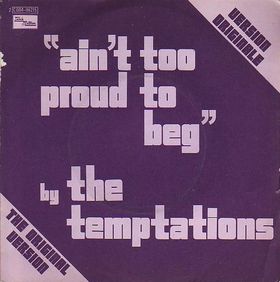
The Temptations – “Ain’t Too Proud To Beg”

680083

The Temptations – “Ain’t Too Proud To Beg,” Pop #13, R&B #1

By Joel Francis

If you’re not hooked in the first five seconds of this song, you haven’t been paying attention. All the elements attack immediately: the drum roll coupled with the insistent clanging cymbal, the knuckle-roll piano riff and, of course, David Ruffin’s raspy vocal. The stinging staccato guitar that shows up later in the initial verse is a direct homage to James Brown. Throw in the glorious backing vocals from the rest of the Temptations and a stellar horn line and you’ve got not only an incredible song, but a definitive snapshot of Motown in full glory.

“Ain’t Too Proud To Beg” would be no less a masterpiece if the story stopped there, but remarkably the song almost didn’t get made.

After a few of Smokey Robinson’s productions for the Temps failed to take hold on the charts, hotshot Norman Whitfield wanted the chance to sit behind the boards with the group. Whitfield was a long shot to topple Robinson’s incumbency, but Whitfield thought he had a number that could give him control. Enlisting songwriting help from Edward Holland, Jr. of the Holland-Dozier-Holland team, Whitfield had the Funk Brothers lay down the backing track to one of Motown’s funkiest numbers to date. The Temptations then added their vocals and Whitfield submitted the single to be auditioned at the Motown Quality Control meeting.

Quality Control meetings were the result of Berry Gordy’s days on the Detroit assembly line. Each week, the label’s top creative minds would meet, listen to music and decide what should be released. Surprisingly, “Ain’t To Proud To Beg” didn’t make the cut. It didn’t make the cut the second week, either. Politics could have been at play – Robinson and Gordy were so close that Robinson named his son Berry – but Gordy asserted that the number simply needed more work.

So Whitfield went back into the studio and moved the melody for the vocal line just out of Ruffin’s range. The straining singer’s vocals added the needed muscle and desperation to the song, and the number was once again submitted to Quality Control.

This time, however, the song had unexpected competition in the form of “Get Ready,” a Temptations number Robinson had written and produced for the band. Since Robinson was the Temps’ established producer “Get Ready” went out while “Ain’t Too Proud To Beg” stayed on the shelf. Whitfield was so upset that Gordy promised him “Beg” would be the next single if “Get Ready” failed to reach the pop Top 20.

Gordy kept his word and the song was finally released in May, 1966, eventually reaching No. 1 on the R&B charts. When Whitfield found success with the Temptations following two singles he was instated as the group’s main producer, a role he guarded fiercely until 1974.

Around the same time Whitfield was leaving Motown and the Temptations to form his own record label, the Rolling Stones found No. 17 pop hit with their cover. Through the years, the number has also yielded interpretations by Ben Harper, the Count Basie Orchestra and, even more strangely, Rick Astley, who also made it a Top 20 hit (albeit on the Adult Contemporary charts) in 1988.

Velvelettes – “He Was Really Sayin’ Somethin'”


Velvelettes  – “He Was Really Sayin’ Somethin’,” Pop #64, R&B #21

By Joel Francis

The Velvelettes’ final single for Motown was their most successful effort. Like their previous hit, “Needle In A Haystack,” this is another Norman Whitfield production. Unlike the house “assembly line” production on Whitfield’s earlier effort, this song bears more of his fingerprints. Listen to the punch of the brass, especially the deep notes from the trombones. That sound would define songs like “Get Ready” and Whitfield’s early collaborations with the Temptations.

 “He Was Really Sayin’ Something” is a step up on the writing side as well. Whitfield and Mickey Stevenson are joined by Eddie Holland of the famous Holland-Dozier-Holland team.

It took the Velvelettes two attempts to cut this single. An earlier performance cut in the fall of 1964 was discarded for this take, which was released two days after Christmas. Despite the questionable launch time, this was the group’s highest-charting single and the band was given an opening slot on an all-Motown tour. Life on the road was not sweet, however. The members disagreed about their musical direction and drifted apart. Lone founding member Carolyn Gill recruited two new members and attempted to press on, but Motown was wary of the group’s potential. Two follow-up singles failed to chart, while their final effort scraped No. 43 on the R&B charts in 1966. By then the Supremes had established themselves as Motown’s premier female group and the Velvelettes were cut loose.

In 1982, Bananarama revived the song and had a Top 5 U.K. hit.

Velvelettes – “Needle in a Haystack”

Velvelettes – “Needle in a Haystack,” Pop #45

The real action in “Needle in a Haystack” is happening away from the microphones and behind the glass. This song was the first single the late Norman Whitfield’s produced for Motown. Whitfield got his start at the label as a songwriter, co-writing Marvin Gaye’s hit “Pride and Joy,” but he made his name as a pioneering producer on the edge of the psychedelic soul movement.

In keeping with Berry Gordy’s assembly line mentality, the song sounds very much like the other Motown productions of the time. None of the experimental flourishes that mark Whitfield’s groundbreaking time with The Temptations are present. The promise of sounds to come, however, makes the song historically worth hearing.

History aside, there’s little that makes “Needle in a Haystack” stand out. The single was the Velvelettes’ second single for Motown and first charting effort. Although they had a follow-up hit, the Velvelettes, like Carolyn Crawford, are a footnote in Motown’s great history. – by Joel Francis

Review: The Temptations and Four Tops

(Above: Are they still tempting? “Papa Was A Rolling Stone” in 2008.)

By Joel Francis
The Kansas City Star

Halfway into his band’s set Saturday night at Starlight, Otis Williams, the last living original member of the Temptations, dedicated the evening’s performance to the late Motown producer Norman Whitfield.

It was fitting. Whitfield wrote several of the hits showcased during the night, like “Cloud Nine,” “Papa Was A Rolling Stone” and “Ain’t Too Proud To Beg.” It also matched the unofficial theme of the night: honoring the contributions of the departed.

The absence of late Temptations frontmen Eddie Kendricks and David Ruffin was obvious from the opening notes of “The Way You Do The Things You Do.” The group sounded good and the performance was strong, but something was missing.

Your verdict on the success of the show depends on how well you thought lead singer Bruce Williamson did filling some impossibly large shoes. It would be easy to cynically dismiss the night as nothing more than overblown karaoke, but it’s very hard to ignore the energy and delight they delivered to the crowd. The truth is these songs are so strong they sound good no matter who is singing them.

After opening with a cover of Marvin Gaye’s “How Sweet It Is (To Be Loved By You),” the Temps plowed through their classic catalog for nearly 30 minutes without taking a break. Every song had everyone on their feet, singing along.

Backed by a 10-piece horn section and four-piece band, the vocal quintet nimbly hopped from the propulsive “Ball of Confusion” to the tenderness of “I Wish it Would Rain” and the frustration of “Can’t Get Next To You.”

The only time the band veered from their prime years was to deliver a couple ballads. They also spiced up the set by performing a couple lesser-known numbers from their early Motown years. By the time they rolled into “My Girl” near the end of their 90-minute set it felt like the perfect conclusion. Unfortunately the song was followed by “Can I Get A Witness,” another Marvin Gaye cover. Despite its gospel flavor, the anti-climactic number trigged an exodus for the parking lot.

The Four Tops kicked off the night with a one-hour set. Although they sported as many original members – one – as the Temptations, they did not fare as well. The retirement of longtime lead singer Levi Stubbs was accentuated by slick production that was more Branson than Motown. Save for a pair of medleys that bookended the set, the band’s 1960s heyday was bypassed for ballads that bogged the momentum.

A tour-de-force cover of Heat Wave’s “Always and Forever” that included a long spoken introduction and tender, affecting vocals from Stubbs’ replacement Theo Peoples, drew the quartet’s biggest applause.

Although Starlight was far from sold out – partitions blocked off the back seating section and plenty of other empty chairs remained – few fans seemed concerned by the new faces singing the old songs. The consensus seemed to be, if these guys weren’t keeping the music and memories alive, would would? It’s a good question that doesn’t have an easy answer.

Setlists: Four Tops – Baby I Need Your Loving/Bernadette/It’s the Same Old Song/Just Walk Away/Still Water/Something About You/Ask the Lonely/Ain’t No Woman (Like the One I Got)/Always and Forever/Reach Out I’ll Be There/Standing in the Shadow of Love/I Can’t Help Myself (Sugar Pie Honey Bunch)

Temptations: How Sweet It Is (To Be Loved By You)/The Way You Do The Things You Do/Ain’t Too Proud To Beg/Ball of Confusion/I Wish It Would Rain/Just My Imagination/Papa Was A Rolling Stone/Can’t Get Next To You/You Are So Necessary In My Life/Get Ready/Treat Her Like A Lady/You’re My Everything/The Girl’s Alright With Me/Cloud Nine/Psychedelic Shack/My Girl/Can I Get A Witness