Bob Dylan: All Along the Watchtower

By Joel Francis

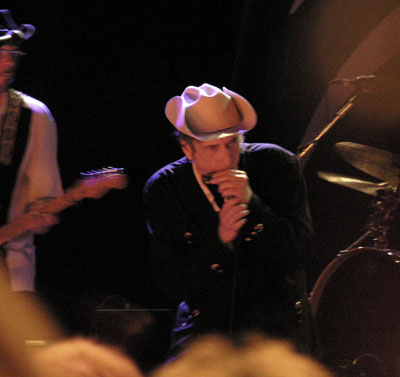
Twenty-plus years after eschewing his “Christian phase,” Bob Dylan assumed the mantle of Old Testament prophet at his joint concert with Willie Nelson at the T-Bones minor league baseball park in Kansas City, Kan.

Dylan cried out warnings of the apocalypse with a voice burdened by so much wisdom and sorrow it frequently broke and scraped under its own weight. There was no alternative but to drench it in echo: This is the way Moses’ voice must have sounded booming down from the mountains, falling like a harsh rain on the sinners’ ears. Then again, if Moses were accompanied by Larry Campbell on steel pedal the way Dylan was, the idolaters likely would have started casting a new statue. Like Isaiah foretelling the destruction of the temple, Dylan’s echo-laden, sparse and mournful arrangement of “All Along the Watchtower,” driven by Campbell’s pedal steel, warns that the future isn’t as bright as many concert-goers would like to believe.

In this new arrangement, the joker and the thief watch in relative safety. From their vantage-point, the riders are no longer approaching, but inside the city walls, raping, ransacking and causing unimaginable destruction. Campbell’s playing suggests that the wind has been howling for some time now._“Look at it,” the thief says in dismay, not wanting to believe his eyes. “We tried to warn them, but no one wanted to listen. Now they’re paying the price.”

A tear trickles down the joker’s cheek as he sees more riders on the horizon. He has lied to the thief, and he knows it: There is no kind of way outta here. The only exit from this horrific scenario is to end the song and turn on the house lights, which is exactly what Dylan does, but only after another of Campbell’s solos. The crowd cheers rapturously, never knowing how close they came to oblivion._But then again, seldom are the prophets’ words heeded in time.

Too Close To Ground at Willie Nelson Concert

By Joel Francis

I’d love to discuss tonight’s Willie Nelson concert, but what I really want to tell you about is the crowd at the Willie Nelson show. You see, the good folks in Marshall, Mo. decided to host Willie and throw a concert in their city park. Now normally when a park contains a large hill, as the Indian Foothills Park does, one would place the stage at the bottom of the hill. Not the folks in Marshall, no sir. They put that stage right in the middle of the hill and made all of us watch it at a 15 degree angle.
Knowing what I do about angles and intoxication, I knew I would be in for some laughs, but I had no idea how big. The fun started before the show when the two white trash couples decided to punctuate their beers with some weed. The foursome passed a very small roach around for about 20 minutes before a Gatorade bottle was produced, which contained, I am very sure, not Gatorade. After a few swigs of whatever magic potion this bottle contained everyone seemed to be feeling a lot better. Coincidentally this is when Willie took the stage. So as the man in the Alan Jackson t-shirt put down the not-Gatorade and proceeded to line dance to the opening strains of “Whiskey River” he drew the ire of the crowd behind him. They needn’t of worried; it was the only time he was on his feet for the rest of the night.
You see, there was something in this wonderful concoction of weed and magic juice that when combined with the aforementioned 15 degree slope made it impossible to maintain a center of gravity. Not that our inebriated, high friend didn’t try. After tumbling too the ground he’d gingerly right himself by clinging to the lighting scaffolding. He’d tepidly place himself in his camping chair, but damn if that slope didn’t get him every time. Why if he could stay in that chair for more than 30 seconds without tumbling out and hitting his head on his scaffolding his wife was impressed.
The recumbent wife was not only not impressed – she was a little upset, too. Once, after her husband managed to place himself in his chair – and this was not an easy process for him – she started yelling at him. Expecting praise for completing such a difficult task, he started yelling back. Eventually the yelling got so intense that her chair toppled onto his, knocking both of them clean onto the ground. The Three Stooges would have been proud. Charlie Chaplain would have sued.
After much of the falling-down-bracing-on-the-scaffolding-sitting-in-the-chair-falling-down shenanigans (and they didn’t always happen in this order), the man decided all might be better if he just laid down for the remainder of the evening. This is pretty much what he did, except when the pesky police got involved. It seemed they didn’t believe a man could just lie unconscious of his own volution at a Willie Nelson concert. After shining a light in his eyes and lightly slapping his face, the boys in blue decided the best course of action would be to place him safely in his chair. I was silently praying they would, because I knew he would inevitably topple out and likely hit his head. Willie was churning through the hits – “Crazy,” “Night Life,” “Always on My Mind,” “All of Me” – but there was no way he could compete with this.
Of course as we all expected, the man in the Alan Jackson t-shirt promptly tumbled to the ground, nearly taking an officer with him. I would have felt guilty at laughing at all this had I not witnessed these people gleefully bringing themselves to this state. Using his classic deductive police logic, one of the officers inquired of the other white trash couple if they may have any idea what could have happened to this stupefied stranger. Despite supplying the marijuana and not-Gatorade, they had no ideas. Unfortunately they also had no balance. As the shirtless, white trash supplier leaned in to spill his guts to the officer (the guilty are very willing to be helpful, up until the point they know they have implicated themselves), he started to fall, nearly taking yet another officer with him. Luckily our public servant remained upright, but the man did not fare so well, falling not only down, but over the milk crate that was doubling as his seat. Our topless sage wisely decided this was the safest position for him and remained doubled over the crate for the duration of the evening. Meanwhile, the unconscious blot was left upright in his chair by the police, who decided since he couldn’t hurt anyone, let alone move, they would leave him be. On cue, once their backs were turned, the man rolled out of the chair and sprawled on the ground leaving passers-by to fend for themselves to maneuver around his carcass.
You might think this would be the end. You might think that, but you would be wrong. You see, there were a couple thousand people at this concert, hundreds of gallons of alcohol consumed and still that pesky 15 degree incline.
A few yards past all this excitement, a woman in her late 50s was gleefully imbibing and dancing to the strains of “Seven Spanish Angels,” and “Angel Flying Too Close to the Ground” that were now filling the air. To say this woman was of generous girth would be an understatement, but this did not prevent her from flailing around like Greta Garbo. Fortunately this also did not prevent gravity from taking her on several sideways caterwauls. After several near-falls, the plump peasant managed to rapidly meet the earth, taking her husband with her. I only wish I could have seen it with both eyes, for my gaze was fixed up Sir Willie performing “Always on My Mind,” “On the Road Again” or some obscure number, and I only caught the tumble peripherally. My concert compatriot, Alan, though, saw the whole thing, the lucky so-and-so.
After that, my fantasy became that some poor bastard would stumble over the unconscious guy and be clumsily propelled into the fat woman, whereupon the two of them would topple over and take down a whole crowd. Think of it as human bowling.
It never happened, though. Last I saw them, the woman had – with the help of many friends – tepidly placed herself in a camping chair (it appeared to be more sturdy and did not spill its contents, unfortunately). The wife of the senseless man suddenly reappeared (she was gone for quite a while and I didn’t think to ask her what had taken so long), and loving place his head in her lap and gently ran her fingers through his hair as she spoke to him softly. I couldn’t make out what she was saying, but she was probably reminisce about the times they had growing up together and what bears mom and dad could be.
Prior to this, the most fun I had experienced with a concert crowd was when we went to the Foo Fighters/Red Hot Chili Peppers show at Blandstone. It was just a couple days after Ozzfest had been through town and the turf back on the lawn was pretty torn up so to save the ground, the crew laid down mesh tarps. Unfortunately they got kicked up, revealing the slick underside, wet with the ground’s moisture. Understandably, no one wanted to stand on this slippery surface so it created what appeared to be a path in the swarm of people on the lawn. Many a sap unwittingly charged onto this lubricated runway, only to have their feet and head exchange places. I nearly fell down myself laughing at these poor souls.
That night had nothing on this, though. Why for the modest price of $25, I not only got two hours of Willie’s serenades, but so much slapstick tomfoolery that Buster Keaton would have blushed. Oh there was a lot more that happened that night – like the music itself, or the time I and a host of others were tricked into believe that we had met Willie himself – but that is another story altogether.

Warren Zevon Remembered

By Joel Francis

Warren Zevon died today, but like most things in his life, he did it on his terms.
Over a year ago, doctors gave Zevon three months to live. Of course he proved them wrong and stuck around not only to witness his grandsons births, but to write and record his final album and watch it debut in the Top 40 (a feat he hadn’t accomplished in 25 years). Death has a funny way of propelling forgotten careers.
If Mark Twain were a songwriter, he’d have been Warren Zevon. I’d like to think that right now Zevon and Twain are sitting around backstage in heaven smoking huge cigars, drinking brandy and arguing about who has to open for whom.
“When you get Dylan, Neil Young and REM to appear on your albums as sidemen, you come talk to me about headlining,” Zevon says.
“Yeah, well when you write a satire about racism that is still being banned and burned 150 years after publication, you come talk to me about acerbic wit,” Twain retorts.
The two end up laughing and embracing and a little brandy spills on Twain’s immaculate white suit.
“Crap, now I’ve got to go change before I go on. How do you think I’ll look in orange?” Twain jokes.
“Don’t worry, I’ll cover for you,” Zevon says, grabbing a guitar and heading for the curtain. Ninety minutes later Twain appears onstage with Mae West and Jack Lemmon to sing the backing vocals on “Excitable Boy.”
“Who says life’ll kill ya, anyway?” Zevon says, winking at the audience as the curtain falls.

Local Doctor Claims He’s Treating Elvis

By Joel Francis
The Examiner

The King of Rock and Roll is alive and well, according to local psychiatrist Don Hinton.

Hinton, who works at Independence Regional Health Center, says he has been treating Elvis Presley for the past five years.

“What I’ve seen him mostly for is chronic pain,” said Hinton, who says he travels ‘somewhere in the South’ to treat Elvis. “He has severe arthritis, but I’ve also been there as a friend.”

Hinton is earnest but recognizes there will be skeptics and critics.

“There are people who wouldn’t accept it no matter what I would say or do unless he were here eye-to-eye, and then they would want a blood test or DNA test,” Hinton said.

“I’m a young doctor. This is my family, my career. I would not be doing this if it weren’t the truth.”

Becoming Elvis’ physician is no easy task. Hinton was a member of group of people who knew of Elvis’ existence for more than five years before he was finally able to speak to the King over the telephone.

“By the time I was in his presence it had been proven to me beyond the shadow of a doubt,” Hinton said. “I was allowed to meet him because I was a physician and trusted. Friends had known me for 10 years.”

Hinton said he and Elvis became such good friends that the King asked him to help with his book, “The Truth About Elvis Aron Presley, In His Own Words.”

“When I first started there was no talk of a book, and I had to promise not to tell a soul,” Hinton said. “In early ’98 he started talking about wanting to do a book.”

Shrewd Elvis fans may recognize that Elvis’ middle name is spelled “Aaron” on his gravestone at Graceland. However, in a letter on the book’s official Web site, http://www.thetruthaboutelvisjesse.com, Elvis himself explains that “I was the one who allowed the ‘A’ on my stone. … The extra ‘A’ was the first letter of the word ‘alive.’ ”

According to the book, Elvis staged his death in 1977 and assumed the identity of his twin brother Jesse who was born dead.

“This plan began back in 1976 and it was down to the last detail,” Hinton said. “In his mind what happened in 1977 was not a lie because it was necessary.”

Elvis, who became famous for songs like “Love Me Tender” and “Hound Dog,” and movies like “Jailhouse Rock” and “Viva Las Vegas,” died on Aug. 16, 1977, from an drug overdose. But now, Hinton says, Jesse, nee Elvis, is ready to reclaim the limelight.

“There is part of him that wants his fans to know the truth,” Hinton said. “He has to start talking about his life as Jesse and letting the fans know.”

And the book is just the beginning.

“This is just the tip of the iceberg of what’s coming,” Hinton said. “Beginning next month after his birthday there will be a TV special where celebrities who are his friends who know this is true will come forward. All of this will roll into the 25th anniversary in August.”

But Hinton is certainly not alone. Also among the inner circle of Elvis confidants is Linda Johnson, a neighbor and former co-worker of Hinton’s.

“My uncle was at one time his (Elvis’) dentist,” Johnson said. “That got me in through my relationship and honesty, just like Don. Really Don and I are the only ones in the same state.”

The Elvis book was not released by a major publishing house, Johnson said, because the King wanted to keep his book affordable for fans.

“We shopped around,” Johnson said. “We did our work.”

Larger publishers wouldn’t have accepted the work unless they saw the author typing it.

“He didn’t want to make it sensational or trashy,” Johnson said. “It wanted it to be inexpensive for fans. Most big publishers wanted him sitting in front of them writing.”

Today, Hinton and Johnson said, Elvis is a changed man.

“He’s a very spiritual man. I wouldn’t say he’s a monk, but it’s a completely different world for him,” Hinton said. “He’s turned off by money and show business.”

One thing important to Elvis, er Jesse, these days is privacy.

“He’s more protected than the president but still cannot trust people around him,” Hinton said. “This whole thing was his wish. If he didn’t want it to come out, I would have taken it to my grave.”

Hinton even kept it a secret from his wife, Heather, when they were dating.

“The phone would ring and he would just go into another room and shut the door and come out later,” Heather Hinton said. “He finally told me so I wouldn’t be frustrated or upset.”

Heather Hinton admitted she was skeptical at first.

“When he started explaining what was going on and when I saw things I believed,” Heather Hinton said. “He (Don Hinton) showed me pictures and different things that had been sent to him.”

Color Heather Hinton among the believers.

“I just went with whatever he said as long as it didn’t hurt the family,” Heather Hinton said. “I just thought he wouldn’t do something unless he was pretty sure.”

Don Hinton broke the news to his co-workers shortly before the book came out. He said the news hasn’t hurt his practice. Hinton’s co-workers at Independence Regional Health Center declined to be interviewed.

“It’s affected my practice just because of all the stress,” Don Hinton said. “I hear from people all over the world and 98 or 99 percent of it is positive.”

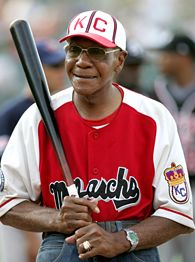
Buck O’Neil: Sweet times, sweet sounds at 18th and Vine

Buck O'Neil

Sweet times, sweet sounds at 18th and Vine
An Interview With Buck O’Neil

By Joel Francis

(Note: This 1998 interview was published in 2001 by The Independence Examiner newspaper.)

Q: I’d like to talk about the jazz scene in Kansas City, be cause you talked a little bit about that in your book, and I think that’s an exciting aspect of our town that people may not hear about as much, especially when they think of you. What was Kansas City like in the 1930s and ’40s?

A: Outstanding. See, Kansas City was a wide-open town and all the restaurants would have live music hotels would have live music, bars live music, and so it became easy to get a gig here. So musicians flocked here and played. Kansas City was a town that closed up at 1 o’clock (a.m.), at least the legitimate places. And so the musicians would flock to this area (18th and Vine) and we had a place called the Subway.

All the musicians would come after they got through working and, oh, they would jam all night, have jam sessions, yeah. You wouldn’t be surprised to see Basie there, or Joe Taylor, Georgia Thomas and musicians from all over the country. You would see them down there at this thing jammin’, just having a good time they were having a good time. Or Charlie Parker would drop in, or a blues singer maybe Big Joe Turner, somebody would drop in. All of these things were happening here, just a couple blocks from here; (it was) very alive.

Q: You were obviously a big part of the baseball scene. Why were baseball and jazz so closely linked together?

A: We played the same circuit, man. We’d go to Chicago to play. We’d be playin’ on the South Side and they would visit our ball games and we would go to the jazz joints. It was the same thing, not only there, also in New York City. We would play ball in the afternoon, say Sunday afternoon in New York City, Sunday night go down to Sugar Ray’s, the Apollo we were catchin’ all the acts there or the Baby Grand. All of this live music, it was just jazz. They were playin’ jazz all over. We did this at all of the places we would play. At matinee shows all of the theaters had bands. In Harlem, like I said, we would go to the matinee and maybe we would catch Cab Calloway, see? And we would go from there to Washington, D.C., and the Howard Theater. Maybe Ma Mabley was there and we would catch her, or Duke Ellington, or Fletcher Henderson. Everyplace that we went to play, the jazz people went, too. This was during the days of segregation, so we probably stayed at the same places, and we got to know them and they knew us.

Q: How would you describe the Kansas City style of jazz?

A: Exciting. Different. It was different that New Orleans. And right out of Kansas City, we come up with Charlie Parker, blowin’ notes nobody’d heard before. This is a brand new thing! These were the kind of things you could hear at that Subway. Here come a new dude, come in blowin’ something you hadn’t heard before a different note. Where did this come from? Where did this sound come from? It was a brand new sound.

And the good thing about it was that the musician was telling a story and it was his story to tell. They were playing the same song, but when it was his turn to come up and blow, it was different. And you could see the other musicians listening and coming in, you know. This drummer’s going to change the beat now. He’s got to change that. You could hear it if you’re listening; you could hear the change. This guy’s playin’ “Ain’t Misbehavin'” a little different than the other guy did. He’s puttin’ a little something of him in there. You could listen to a new story. The guy would blow notes, you knew who it was without seeing him, you know what I mean? You knew it was Armstrong. You didn’t have to be in there. You knew it was Ben Webster. You knew all these things. A little jazz. So many things were happening all over the country.

Q: Like what?

A: The music was live and the whole country (was) changing. A top musician would go to, maybe, Paris and when he came back from Paris, this was his style, but he had picked up something else. Or he might go to Egypt Cairo, or something like that. And here was a guy doing something on the bongos that was just different than they were doing in Harlem. You added a little something to what you were doing. You would take a little of this, a little of that.

And the jazz singers (did this with their) different phrasing styles. Like, nobody phrased like Billie Holiday. She could just open her mouth and hey, that’s Billie. You knew because nobody did it like Billie. You could hear the different phrasing and all of it was so clean, so clear.

This is the only thing I have against a lot of the things they play now. It’s hard to understand, because a lot of the words, the way they’re sayin’ them, I don’t get. But they were so clear. Like the tones they were playin’. The tones were so clear, you could hear it, you knew it; you weren’t confused. I like rap. I like to hear rap if the guy is distinct and I can understand what he’s saying. But if he jumbles it all together where I can’t understand it, it ain’t good. This is why music then, anyone who sang it, (sang) a clear note. You could understand it. You like to know what they’re doing and where they’re going from there. They will lead you around through this thing if you listen. Music is a great medium.

Q: What role did Tom Pendergast and his political machine play in the development of jazz in Kansas City?

A: It provided a place for them to play it was a job. It was in that era they had the speakeasy they had everything goin’ on and you had to provide entertainment with it.

Q: So did Pendergast turn a blind eye to it?

A: No. If there was a blind eye, it may have been the government turning a blind eye to Pendergast. There wasn’t anything illegal about jazz, but the things Pendergast was doing could have been illegal.

Q: Did any of Pendergast’s illegal activities help the jazz scene grow?

A: It just may have, because you know you’ve got to entertain the people you’re selling whiskey to, or the people going to gamble. Right now, we’ve got the boats, and gambling is legal. Whereas it wasn’t legal during that day and you had to entertain people. This was good entertainment.

Q: If speakeasies were illegal, how did people know where to go to hear the music?

A: Pendergast was running the city. When you say illegal, if I am the boss of the city and I am running the city this way, it wouldn’t be illegal. What would have been against the law was this: If you were running a club and instead of closing at 1 o’clock, you stayed open ’till 3 o’clock. If you stayed open at 3, you were doing the same things at 3 you were doing at 10, but the law was you had to close at this time. And the places would close, the musicians would come down here and go into that Subway and play and jam. And somebody down there would be doing something illegal, because somebody would be selling some whiskey. A lot of these things were happening before prohibition.

Q: So did Prohibition help the jazz scene?

A: Yeah, sure. Actually it opened it up all over the country. Wherein you had to go just to certain spots before, now you’re (playing) in Manhattan, you’re playing in Times Square. You’re playing now all over the country, even going to universities to play. Before you were playing in speakeasies, but now you’re playing in clubs.

Q: What were some of the hot jazz clubs in Kansas City at that time?

A: The Milton was strictly jazz. They had so many different clubs in Kansas City and … music was everywhere. During that time, just like a band comes to the Starlight and plays now, every weekend it was some band at the Municipal Audi torium. That doesn’t just mean Count Basie or something like that, but Benny Goodman would play; everybody would come. I’ve seen so many wonderful bands down there.

Q: What are some of your favorite bands you’ve seen play there?

A: I like Duke. To really jump I like Lionel Hampton. I was a very good friend of Count Basie; I like Basie. I like Goodman. The Jazz Philharmonic that was the top musicians put together and they traveled all over the country. Oh man, you talk about some music! You’d hear these great artists play. I like Armstrong. They had a girl band called the Sweethearts of Rhythm; they could play. First of all you were going because it was a girl band and you wanted to see them, but they could play.

There was another one called Tiny Davis. She blew that trumpet Louis Armstrong-style; she could play. Bob Burnside played the sax he could play the bell off of that horn! It was the era of the Mills Brothers. They were one of the first singing groups, the Platters and a whole lot of others came behind them.

Q: I couldn’t go too far in this interview without mentioning Satchel Paige.

A: He was an outstanding athlete.

Q: What did Satchel think of the jazz scene?

A: He loved it. He used to play the ukulele. He would play on the bus and we would sing along. Satchel Paige, yeah, we had a lot of fun.

Q: Did Satchel go with you to all the concerts at Municipal?

A: Yes, yes he would go. We all would go as a team. They (jazz musicians) would come out to the ball game in the afternoon and at night we would go down to the jazz concert. That was a couple of musts. If you lived in Kansas City, it was a must on Sunday afternoon to go to the Monarchs and see baseball, and it was a must after that to go to the Municipal Auditorium and hear these bands.

Q: Did they ever bring any of the Monarchs onstage and introduce them as celebrities?

A: Actually they would introduce the teams, because if we were playing the Chicago American Giants here, they would be going too. All of us would be there.

Q: Did both teams sit together?

A: Sometimes.

Q: What did your managers think about the jazz scene?

A: They were there. What do you mean “what did they think,” they were with us! (Laughs).

Q: Did they impose any rules about drinking and things like that?

A: You knew that yourself. You knew you couldn’t drink too much. We were there, but we didn’t drink that much. Everybody drank a little maybe, but you didn’t drink that much because you knew you had to play ball the next day.

Q: I’d like to name off some jazz performers and have you tell me some memories about them. A lot of these we have mentioned already. Let’s start with Bennie Moten.

A: Bennie Moten, that was early. That’s when I first met Count. Count was playin’ with Bennie Moten. A good musician.

Q: Lionel Hampton.

A: I made him first base coach for the Monarchs. It was just for a show. They were playing here that night and I put him in a uniform. His wife said that he kept that uniform and had it on an easel he kept in one room. He would tell everybody about that uniform.

Q: Count Basie.

A: Basie was a Yankee fan, and I’m a Dodger fan, see. And we would bet every year on the Yankees and Dodgers. You know he beat me most of the time, but we had a lot of fun.

Q: Duke Ellington.

A: Duke was sophisticated and clean. Clean music. Like with Lio nel, you wanted to dance, Duke you wanted to listen.

Q: Charlie Parker.

A: Oh, now you got a new step. You could start dancin’ a different way because you got a different beat. Charlie, he used to blow here at that Subway. He’d drop in as a kid, blowin’ that horn, making those new sounds.

Q: How did his death at such a young age affect you?

A: It wasn’t too much of a shock because of the way he was going. You knew the things happening to him, so it wasn’t a shock.

Q: Louis Armstrong.

A: That was music you could listen to, and you could laugh with Louie because Louie had a kind of a laughing horn, you know. When he blew that horn you’d laugh about the different notes he’d play. The thing about it is, you know that handkerchief he had to cover up so nobody was coppin’ those things. Quite a fella. Baseball nut too; he liked baseball.

Q: What was Satchmo’s favorite team?

A: It would be, more or less, the Black Yankees.

Q: What do you think caused the decline in the jazz scene in Kansas City?

A: It’s coming back now, and that’s all over the country. Different listeners are coming and they’re looking for new sounds. This is our last progress in anything and it’s something new, something different.

Q: What does jazz mean to you?

A: It has afforded me a lot of pleasure. I listen to it now and I like all music. There’s something about music. With television, I have to look, but I can do anything I want to do and listen to music. Every once and awhile somebody’s going to hit a note or something and I’m going to stop and listen to what they’re playing. Music can put me to sleep at night or it can wake me up. It’s a soothing thing, but it can be very exciting too.

Indigo Girls Bring Passion, Activism To Leid Center


By Joel Francis
Kaw Valley Independent (Lawrence, Kan.)

It is impossible for the Indigo Girls to separate their music from their activism. Their 90-minute set at the Lied Center last week not only brought out the fans, but the plight of Leonard Peltier, the American Buffalo and environmental issues.
The Girls opened their set with a moving version of Bob Marley’s “Redemption Song” that featured Emily Saliers on piano and Amy Ray on guitar. After the song the duo yielded the stage to Winona LaDuke, Honor the Earth project director. They returned aided only by accordion and piano player Carol Issacs for an all-acoustic set that included “Get Out the Map,” “Power of Two” and a reworking of “Go” that did not lose any of its electricity despite being unplugged.
The Girls also premiered two new tracks, “Devotion” and “Leaving,” that were released on the new best-of “Retrospective.” The crowd responded enthusiastically and sang along like they were old standards.
“We put two brand new songs on (the collection) because we wanted the fans to have something new,” Saliers said in telephone interview the day before the concert. “Picking the songs for the new album wasn’t nearly as difficult as putting together 1,200 Curfews, our live album. We just picked songs that we liked and we both agreed on it together.”
The set climaxed with “Kid Fears” when supporting act Shawn Mullins and reprised the vocals originally recorded by Michael Stipe. The trio’s voices blended and danced around the room leaving the audience awestruck. Later, on “Galileo,” Ray and Saliers yielded the mic to the crowd, who didn’t miss a beat or a lyric.
The Girls closed a jubilant night on the Honor the Earth Tour on a bill shared with Mullins and the all-Native American blues band Indigenous, each of whom received standing ovations at the end of their sets.
“The Honor the Earth tour is something Amy and I have been doing for almost seven years now,” Saliers said. “It has very specific social, political focuses that have to do with environmental issues on Native lands.”
This year’s issues included the slaughter of buffalos in Yellowstone Park and nuclear waste dumping on Native American land.
“It’s impossible to be an environmentalist and not consider indigenous issues,” Saliers said. “I think Americans need to see what kind of environmental racism is going on in impoverished communities and the responsibility for the nuclear industry to take care of its waste.”
To show their willingness to put their money where their mouths (or hearts) are, the Indigo Girls have released another new track, “Pt. Hope.” The song was recorded live in Atlanta and is available only by download at Indigogirls.com for $3.60.
“Three dollars of that money goes to Honor the Earth,” Saliers said. “It’s a beautiful, beautiful song that Amy wrote that deals with a lot of the issues that we’re covering on the tour.”
The Indigo Girls are not slowing down once the Honor the Earth tour wraps up. Ray will release her first solo record in February. Both Girls will return to the studio in May to record their ninth album. Saliers said the new album would have an intimate sound and return to their acoustic roots.
“We don’t want to belabor over this record,” Saliers said. “We just want to write strong songs and get in there and do it in a way that’s pure and catch the emotion of the songs.”
That emotion was undeniable on Saturday night.
“We’re passionate about these issues. If you’re going to write a song, you have to write about something you’re really thinking about or feeling,” Saliers said. “We’re activists and we come from the question of what can be done to help rectify a bad situation”