Review: Stevie Wonder

By Joel Francis
The Daily Record

It took 34 on-stage musicians to turn Stevie Wonder’s inner visions into reality on Thursday night at the Fiserv Forum in Milwaukee.

Wonder’s band encompassed a 12-piece string section, six backing vocalists, a five-piece horn ensemble, two percussionists, two guitarists, two keyboard players and one drummer, bass player, guest singer, conductor and, of course, the man himself. Oh, and two of his grandchildren.

Performing in the same space that just three months ago was home to the Republican National Convention, Wonder and his expansive entourage spread a message of love, hope and joy to all people, regardless of background or political affiliation. With only 11 dates, Wonder’s Sing Your Song! As We Fix Our Nation’s Broken Heart tour is aimed primarily at swing states in the weeks leading up to the presidential election.

Flanked by his son and daughter – both of whom were in the band – Wonder took the stage and proclaimed he was “here to speak to you from the heart and spread some love.” That message shined in the opening number, “Can We Fix Our Nations Broken Heart.” Released late this summer, the song was a call for unity and understanding.

For the next two and a half hours, Wonder played most of his biggest numbers, many of which happened to reinforce his message of dropping defenses and building bridges. As polarized as the nation is right now, Wonder’s dream felt a lot less naïve when delivered via “Higher Ground” or “As.”

Wonder let the crowd take over for several songs in the first set, leading the nearly sold-out arena through “You Are My Sunshine,” which segued into “You Are the Sunshine of My Life.” The crowd also handled lead vocals for a trio of Wonder’s early hits: “For Once In My Life,” “Signed, Sealed, Delivered I’m Yours,” and “My Cherie Amour.”

Other high points in the first set include the early one-two punch of “If You Really Love Me” and “Master Blaster (Jammin’).” One of Wonder’s most beautiful ballads, “Overjoyed” closed the opening portion.

After a dozen songs, Wonder introduced his latest protégé, Shelea, and took a short break. Seated behind Wonder’s grand piano, Shelea delivered a medley of Aretha Franklin, Roberta Flack and Carole King songs that were well-received. A full-band performance of her original song “Something’s Coming” was better suited for the Broadway stage than the Apollo Theater. Fortunately, a dynamite version of the instrumental “Contusion” – the first of many songs from Wonder’s acclaimed album Songs in the Key of Life – brought Wonder back out and the night back on track.

The rest of the night was a powerhouse, each song building on each other, taking the audience higher and higher. The buoyant, horn-driven “Sir Duke” led right into the joyous reminiscing of “I Wish.” Wonder wrote “Isn’t She Lovely” for his newborn daughter Aisha Morris, now a grown woman who performed with the backing vocalists and brought her own children to the show. This gave way to another singalong, the worldwide smash “I Just Called to Say I Love You.” Whatever treacly sentimentality that song held in the hearts of the cynical was quickly wiped away by “Superstition.”

A few songs earlier, Wonder briefly tabled his dream of hope with a hard dose of reality, putting the plea “Love’s in Need of Love Today” against “Village Ghetto Land,” a beautiful baroque hymn of injustice and poverty. Wonder pushed even more focus on inequality and oppression with “Living for the City.” Performed consecutively, these songs were a poignant reminder of how society can’t advance until every person is able to move forward.

An extended medley of three epic numbers ended the night. First up was “Do I Do,” a horn-infected disco number that made sure everyone stayed on their feet. That gave way to the rapturous “As,” one of Wonder’s most beloved songs. Just when “As” started to fade away, Wonder kicked the band into the bossa nova groove of “Another Star” and took the energy to another level. By the time Wonder said good night he had achieved his dream of bringing people together. Everyone rejoiced as Wonder’s music cascaded over their souls. Of course, the tougher job is achieving this feeling of togetherness away from the concert. But Wonder clearly believes we are up to the task. I do, too.

Set list: First set: Can We Fix Our Nation’s Broken Heart, As If You Read My Mind, If You Really Love Me, Master Blaster (Jammin’), Higher Ground, You Are My Sunshine > You Are the Sunshine of My Life, For Once in My Life, Signed, Sealed, Delivered I’m Yours, Send One Your Love, My Cherie Amour, Overjoyed.
Shelea set: Medley: Until You Come Back to Me (That’s What I’m Gonna Do)/Feel Like Makin’ Love/ You’ve Got a Friend, Something’s Coming, Contusion.
Second set: Don’t You Worry ‘Bout a Thing, Love’s in Need of Love Today, Village Ghetto Land, Living for the City, Sir Duke, I Wish, Isn’t She Lovely, I Just Called to Say I Love You, Superstition, Do I Do > As > Another Star.

Keep reading:

A survey of post-‘70s Stevie Wonder (Part One: The ‘80s)

Stevie Wonder – “Signed, Sealed, Delivered I’m Yours”

Stevie Wonder celebrates Michael Jackson at Starlight

A survey of post-‘70s Stevie Wonder (Part One: The ‘80s)

By Joel Francis
The Daily Record

Billed as a 12-year-old genius on his third LP (released in 1963), Stevie Wonder made good on that promise less than a decade later, releasing six masterworks in as many years between 1971 and 1976. Wonder’s critical acclaim was matched by popular appeal, as he won Grammys for Album of the Year three times in four years and sent seemingly everything he touched to the top of the charts.

Yet Wonder’s output after the 1970s has been derided nearly as much as his long pinnacle has been celebrated. The release of a new digital single, “Can We Fix Our Nation’s Broken Heart,” made me realize how much I missed Wonder’s voice and sent me scurrying back to his forgotten era to see what I had overlooked.

The 1980s opened strong for Wonder. Just nine months into the new decade, Wonder released Hotter Than July, an album that continued his 1970s hot streak. From the infectious reggae groove of lead single “Master Blaster (Jammin’)” to the tender ballad “Lately,” the release touches on many of Wonder’s strengths. Hotter Than July is rightly regarded as a classic, so I won’t spend much time on it here, but I’d be remiss not to point out the beautiful “Rocket Love.” The album closes with “Happy Birthday,” a tribute to Martin Luther King, Jr. and a plea to turn King’s birthday into a national holiday. It worked.

Two years later, Wonder gifted fans with Original Musiquarium I, an unconventional double-LP collection that paired a dozen tracks from the ‘70s with one new song on each side. Of the new material, the 10-minute “Do I Do” is easily the best. “Do I Do” has an effervescent groove that could be the cousin of “Another Star.” The expansive track has room for both a Dizzy Gillespie guest spot and an exploration of the still-young world of rap. It took nearly a decade before exploring the nexus of jazz and hip hop was considered edgy. Once again, Wonder was on the vanguard. The ballad “Ribbon in the Sky” is another key new song on this collection.

Less than a month before Original Musiquarium I dropped, a single with Wonder raced to the top of the charts, a harbinger of some musical misadventures that lie ahead. Written by Paul McCartney, the simplistic ode to racial harmony “Ebony and Ivory” sat atop the U.S. pop charts for seven weeks in 1982. “Ebony and Ivory” earns all the mockery it has received. That said, I must confess the song works better in the context of McCartney’s excellent Tug of War album, where it closes the song cycle than it does as a stand-alone single. “What’s That You’re Doing?” the pair’s other collaboration on Tug of War, is better, but still feels like less than the sum of its parts.

Wonder’s reputation really started to take a hit with his 1984 soundtrack to The Woman in Red. At eight songs and 40 minutes, The Woman in Red feels slight in comparison to Wonder’s previous albums. Two duets with Dionne Warwick, a Warwick solo track and an instrumental written by someone else comprise half the album, making it feel even lighter.

Used copies of The Woman in Red are ubiquitous at flea markets, antique malls, garage sales and record stores thanks to the single “I Just Called to Say I Love You,” which topped the charts around the world and sold millions of copies. In the 40 years since its release, “I Just Called” has been the punchline for scores of jokes and memes and served as Exhibit A for proving Wonder’s muse had departed. The saccharine ballad deserves every bit of scorn lobbed its way, but Wonder’s well was far from dry, as we shall soon see.

The album ends “Don’t Drive Drunk,” a public service announcement masquerading as a musical number. This continues the trend of Wonder ending albums with a bold social declaration. Unfortunately, Wonder isn’t able to thread the needle as deftly as he did on “Happy Birthday.” Wonder’s heart is in the right place, but “Don’t Drive Drunk” is ham-fisted. The production is interesting, but there’s not much of a song. The Woman in Red’s lone redeeming spot is “Love Light in Flight,” the only time Wonder’s innovative production lines up with lyrics that are more substantial than a greeting card.

A little more than a year after The Woman in Red soundtrack, Wonder dropped his 20th studio album, In Square Circle. The world was still very much enthralled/nauseated by “I Just Called” when In Square Circle came out and the association mars the album’s reputation. While Wonder’s peak releases have a timeless feel, his later work is very much tethered to its time. In Square Circle is a very ‘80s album, which may have hurt the release for a while, but it’s been long enough that we can now embrace the once-awkward signifiers of the era.

The platter opens with lead single “Part-Time Lover,” a fine if unambitious pop song. I’m divided over the next cut, “Love You Too Much,” which somehow feels both fun and annoying at the same time. Fortunately, the strong ballad “Whereabouts” picks up the slack. “Stranger on the Shore of Love” combines a peak-era arrangement with modern production. Wonder’s production takes another step forward on the brilliant “Never in Your Sun.”

If nothing else, this exercise has been worthwhile for bringing “Never in Your Sun” to my attention. I guess I should pay more attention to Tyler the Creator, because he shouted out this song a few years ago. You can also tell the Neptunes were paying attention.

Side two isn’t as strong, but contains “Overjoyed,” one of Wonder’s all-time best ballads and another big-statement closing song: “It’s Wrong (Apartheid).” Recorded at the peak of the Artists United Against Apartheid and the “Sun City” movement, “It’s Wrong (Apartheid)” is not subtle. Wonder compares the racist institution to slavery and the holocaust, which might be accurate, but is so heavy-handed even Billy Bragg would blanch. The production saves the song. An electronic polyrhythm propels the number and an African choir reinforces Wonder’s sentiment and injects joy into the performance.

Arriving between the half-baked (and overblown) Woman in Red soundtrack and disappointing Characters (more on this in a in the next installment), In Square Circle has been unfairly maligned as a mediocre Wonder release. In Square Circle belongs in every fan’s collection and demonstrates that Wonder was still pushing boundaries as a producer and writing strong songs in the decade of decadence.

Keep reading:

Stevie Wonder celebrates Michael Jackson at Starlight
Stevie Wonder – “Happy Birthday”

Concert Review: Diana Ross

Review: Sonny Rollins

(Above: At 79 Sonny Rollins still has plenty to say with his horn.)

By Joel Francis

Sonny Rollins’ saxophone has the power to bend time. For nearly two hours Thursday night, the jazz legend and his five-piece band melted minutes like hot butter in front of a near-capacity crowd at the Walton Arts Center in Fayetteville, Ark.

The first number, “Sonny, Please,” set the mood for the night. The song started slowly, with Rollins repeating the melody, like a cook tasting the broth before serving it for dinner. Once Rollins’ palette was whet, he cued the band and the song was twisted, flipped and cavorted into as many different ways as possible. The format was almost like a congenial roundtable discussion: If a musician had something to say, they jumped in and said it for as long as it took.

Rollins opened “Park Palace Parade” with an a capella solo before the band dropped into a reggae beat behind him. At five minutes it was one of the shortest songs of the night. For another song he strolled to the front of the stage and delivered a solo on the precipice, leaning over the audience.

Although several songs reached over 20 minutes, there were never any filibusters. In fact, time seemed to accelerate with each solo. The opening three-song, 40-minute set seemed fleeting.

After a 25-minute intermission, the band wordlessly dropped into a reading of “In A Sentimental Mood” that somehow disposed of 50 years of schlock and clichés. Rollins’ longtime bassman Bob Cranshaw was given a lengthy solo and the ensemble performance wound down after 20 minutes with another extended, a capella sax solo.

Rollins was gracious in ceding the stage to his band. Trombonist Clifton Anderson and guitar player Bobby Broom took the majority of the solos. Anderson’s mellow horn and Broom’s tasty licks provided a nice counter-texture to Rollins’ saxophone. When he was really feeling their solo, Rollins would snap his fingers and bob his head in rhythm. Drummer Kobe Watkins made the most of the three-bar fills Rollins repeatedly gave him on Noel Coward’s “Someday I’ll Find You.”

This was Rollins’ first performance in Arkansas and he announced how proud he was to be playing his idol Louis Jordan’s home state. Later in the set, he interrupted himself during the intro to “Nishi” to reminisce about a radio host he used to listen to as a child, Bob Burns, better known as the Arkansas Traveler.

For a man who could compress time so pleasurably and succinctly, introducing Burns, who died more than 50 years ago, to the present was no big deal.

The Temptations – “My Girl”


The Temptations – “My Girl,” Pop #1, R&B #1

By Joel Francis

Lightning definitely struck twice for Smokey Robinson and the Temptations. After struggling for years, Robinson gave the Temptations their breakthrough hit with “The Way You Do The Things You Do.” “My Girl,” their follow-up, is not only Motown’s biggest song, but one of the biggest soul numbers of all time.

Inspired by his wife Claudette, Robinson and fellow Miracle Ronald White wrote the one of the greatest Valentines of all time as an answer song to their previous hit “My Guy.” Bob Dylan may have been thinking of the lyric “I’ve got so much honey/the bees envy me” when he proclaimed Robinson “America’s greatest living poet” in 1965.

David Ruffin made his lead vocal debut delivering these deceptively simple lyrics. Though it seems a no-brainer in retrospect, the decision was controversial at the time. Eddie Kendricks and Paul Williams had shared the lead role prior to this song, and, to make matters worse, Ruffin was a ringer who replaced original Temptation Al Bryant. Ruffin got the nod after Robinson saw him singing “Under the Boardwalk” as part of their Motown Revue repertoire, and quickly became the group’s featured singer.

The Motown string section furthers Ruffin’s references to sunshine and fluttering birds, while Funk Brother James Jamerson’s signature two-note bass line anchors the entire performance.

It’s unclear why Robinson and White didn’t keep their song for The Miracles, but it didn’t take long for other acts to put their stamp on the number. Otis Redding added some blues for his 1965 reading; both the Rolling Stones and the Mamas and Papas cut it in 1967. Since then, everyone from Al Green to reggae artist Prince Buster to Dolly Parton to British shoegazers The Jesus and Mary Chain has reinterpreted this timeless classic.

Review: Los Lobos

Above: “Chuco’s Cumbia” at Austin City Limits 2006

By Joel Francis

The Kansas City Star

For a band as accomplished as Los Lobos, the reach from Jimi Hendrix and Willie Dixon to Richard Thompson and Ritchie Valens is a small one. The gulf between the lip of the stage and the front row, however, can be trickier to navigate.

The sextet’s 16-song, two-hour set was a celebration of all forms of music from New Orleans soul to Spanish mariachi. However, bottom-heavy sound and fixed seating proved nearly insurmountable for the band during the latest entry in the “Cyprus Avenue Live at the Folly Theater” on Sunday night.

The show never completely got off the ground, but it had its share of inspired moments. “Chuco’s Cumbia” featured a dirty Latin groove, while a medley of “The Neighborhood” and “Wang Dang Doodle” bridged the South Side of Chicago to East Los Angeles. The first set ended with a cover of Richard Thompson’s “Shoot Out the Lights” anchored by a thunderous backbeat.

After a 25-minute break, the band returned with a second set guaranteed to knock the yawn out of any weary political supporters (there were plenty of T-shirts from Saturday’s rally throughout the crowd). The one-two of “Come On Let’s Go” and “Don’t Worry Baby” got people involved, if not on their feet. The band traded 88 piano keys for 22 guitar strings on their cover of Fats Domino’s “The Fat Man,” which included a shuffling solo from drummer Cougar Estrada.

The high point of the night was a surprise cover of Jimi Hendrix’ “Little Wing.” Between David Hildago’s lead guitar and Cesar Rosas’ vocals, they not only nailed the song, but stretched it out and made it their own.

There were plenty of covers, but the band also touched on all phases of its career. While lesser bands make a career out of mining the same niche, Los Lobos were able to transition from the early rockabilly of “Shakin’ Shakin’ Shakes” to the more experimental “Kiko and the Lavender Moon,” and from the Spanish festivity of “Maria Christina” to the quiet introversion of “The Valley.”

The sound was muddy for most of the night and Steve Berlin suffered the brunt of it. His keyboards and woodwinds were often barely audible in the mix. The Folly is a wonderful venue for intimate shows -– recent performances by the Dave Brubeck Quartet and Randy Newman were sonically incredible -– but it is ill-suited for six amplified musicians.

The rigid seating and formal environment also inhibited the dancing and shaking Los Lobos’ music cries for. Toots and the Maytals, an earlier “Cyprus Avenue”/Folly booking, faced the same problem at its reggae concert last year. The younger crowd that turned out that night was less inhibited about dancing in the aisles.

Hildago finally coaxed people to their feet before “I Got Loaded,” and the band followed up with the one number guaranteed to keep everyone on their feet: “La Bamba.” After a brief encore break, the band picked up where they left off with a blistering “Good Morning Aztlan” and a frantic “Cumbia Raza” that featured another drum solo from Estrada and guitar solos from Louie Perez and Hildago. Just as the band and audience were hitting the mark, the band closed the set. It was a shame they had to stop. It felt like they were just getting started.

Setlist: Short Side of Nothing, Chuco’s Cumbia, The Valley, Luz d Mi Vida, The Neighborhood/Wang Dang Doodle, Shakin’ Shakin’ Shakes, Shoot Out the Light (intermission) Maria Christina, Kiko and the Lavender Moon, Come On Let’s Go, Don’t Worry Baby, Little Wing, The Fat Man, I Got Loaded, La Bamba/Good Lovin'(encores) Good Morning Aztlan, Cumbia Raza

Review: Old 97s


Above: Of course they played “Roller Skate Skinny.”

By Joel Francis

There is something to be said for a band who can play an entire set without changing instruments.

The Old 97s are not quite that band – lead singer/songwriter/heartthrob Rhett Miller swapped his electric axe for an acoustic one a few times – but they are as close as we’re going to get. For almost two hours they entertained a nearly full Granada Theater in Lawrence, Kan. with little more than the instruments and songs on their backs.

The setlist encompassed more than two dozen songs, from radio favorites like “New Kid” to fan favorites like “Jagged” and new songs like “No Baby I.” When the band played “Question,” a recount of Miller’s wedding proposal, all the women pulled their men close and sang softly in their ears. “Barrier Reef” erupted into a raucous sing-along.

In a rare moment of between-song banter, Miller recalled the band’s first show in Lawrence at the Replay Lounge where they performed for a night of unlimited, free video games. A few songs later, those days were celebrated in “Niteclub.”

Miller may have the easiest job in showbiz. Offstage, all he has to do is write songs that combine the alt-country terrain plowed by Uncle Tupelo with the pop sensibility of Paul McCartney. Onstage, he just makes love with his eyes to all the doe-eyed women pressed against the stage and occasionally shake his ass while Ken Bethea takes a guitar solo.

Bethea plays lead guitar via chainsaw. Standing on the edge of the stage with his headstock hanging over the crowd, he rips through songs with a Chet Atkins-meets-Dick Dale style. On the other extreme of the stage, modest Murry Hammond cradles his bass like a baby and tosses out the harmony (and intermittent lead) vocals that push the songs from good to great.

Late-tour shows can be a mixed bag. When Wilco played the Uptown Theater in 2006 at the end of the Kicking Television tour they were tired of both the road and their material. But with only a couple dates left on their current tour the Old 97s played with the perfect mix of familiarity and abandon. “Doreen,” one of their hardest-rocking numbers, positively smoked.

The evening ended with the encore haymaker punches of “Murder (Or a Heart Attack),” “Big Brown Eyes,” “Dance with Me” and, of course, “Timebomb.” When it was over, everyone left a little drunker and a lot happier.

Review: Randy Newman

(Above: We’ve got a friend in Randy.)

By Joel Francis

The setup couldn’t have been simpler – a grand piano, bench, monitor, couple of microphones, a small rug. But add Randy Newman to that list and the payoff couldn’t have been greater Saturday night.

Strolling casually onstage at 8 p.m. sharp, Newman rolled into “It’s the Money That I Love.” Throughout the next two and a half hours (counting a 20 minute intermission), he walked through nearly three dozen album tracks and hits like “You’ve Got A Friend In Me,” “I Love L.A.” and “Short People” for a nearly sold-out Folly Theater crowd.

He may have been alone onstage, but Newman had a theater of fervent supporters. The audience of NPR-listening baby boomers was pin-drop quiet on the moodier numbers and clapping and laughing on the upbeat songs. When Newman finally enlisted their help on the chorus of “I’m Dead (But I Don’t Know It)” the enthusiastic response was startling. “You sound like a Queen record,” he joked.

Newman is as good at directing a crowd as he is an orchestra. He shifted effortlessly from the laugh-out-loud satire of “Korean Parents” to the melancholy “I Miss You” – a love song “for my first wife while I was married to my second one,” Newman said – to the upbeat children’s song “Simon Smith.”

Some of the evening’s best lines came between songs. “The World Isn’t Fair” was prefaced by a story about his son’s progressive pre-school where they would “sit around on cushions and come home with lice every couple weeks” He led into “I’m Dead (But I Don’t Know It),” a screed about rock stars who don’t know when to retire, by explaining “no one is applauding at home” and “no one is going to tell Paul his best work was with Wings.”

Every song was a highlight, but several numbers stood apart. “Dixie Flyer,” a song about Newman’s emigration from the Bayou State to Los Angeles, segued into “Louisiana 1927,” a historical recount of the great Mississippi flood. Two songs named after cities, “Birmingham” and “Baltimore,” were powerful paeans to the working class in decaying towns.

Although the generous setlist encompassed Newman’s entire catalog, it tipped toward his last two releases. All but one song from this year’s wonderful “Harps and Angels” was performed. That album provided one of the better political songs in recent memory, “A Few Words in Defense of Our Country.”

Newman let his songs do his stumping for him. Several of the numbers he wrote more than 30 years ago, like the bomb-happy “Political Science” and the plea “Mr. President (Have Pity on the Working Man)” sadly have a contemporary relevance.

Today, Newman is better known for his sweeping film scores and Pixar songs than stinging lyrics and clever songwriting. He did OK with only 88 keys to replicate his orchestrations. His more complicated songs, like “A Piece of the Pie” and “Harps and Angels” survived the transition more or less intact. “Love Song (You and Me)” actually sounded better stripped down.

Like many of his generation’s best songwriters – Bob Dylan, Neil Young and Tom Waits come to mind – Newman’s froggy voice is an acquired taste that is easily parodied. Saturday’s magical immersion in Newman’s world of five centuries of European history in three minutes (“The Great Nations of Europe”), senior forgetfulness (“Potholes”) and erotic humor (“You Can Leave Your Hat On”) was more than enough to convert the few who carried any reservations into the theater and leave the devoted a performance to cherish.

Setlist: It’s the Money That I Love/My Life Is Good/Marie/Short People/Birmingham/Bad News From Home/The World Isn’t Fair/Korean Parents/I Miss You/Simon Smith and the Amazing Dancing Bear/A Few Words in Defense of Our Country/Laugh and Be Happy/Losing You/You Can Leave Your Hat On/I’m Dead (But I Don’t Know It)/Political Science/<intermission>/Mr. President (Have Pity on the Working Man)/The Great Nations of Europe/Potholes/In Germany Before the War/Baltimore/Only A Girl/Love Story (You and Me)/Real Emotional Girl/You’ve Got a Friend in Me/Harps and Angels/Dixie Flyer/Louisiana 1927/Guilty/I Love L.A./God’s Song (That’s Why I Love Mankind)/A Piece of the Pie/I Think It’s Going to Rain Today/<encores>/It’s Lonely at the Top/Feels Like Home

Below: Because you were going to Google it anyway….

Velvelettes – “Needle in a Haystack”

Velvelettes – “Needle in a Haystack,” Pop #45

The real action in “Needle in a Haystack” is happening away from the microphones and behind the glass. This song was the first single the late Norman Whitfield’s produced for Motown. Whitfield got his start at the label as a songwriter, co-writing Marvin Gaye’s hit “Pride and Joy,” but he made his name as a pioneering producer on the edge of the psychedelic soul movement.

In keeping with Berry Gordy’s assembly line mentality, the song sounds very much like the other Motown productions of the time. None of the experimental flourishes that mark Whitfield’s groundbreaking time with The Temptations are present. The promise of sounds to come, however, makes the song historically worth hearing.

History aside, there’s little that makes “Needle in a Haystack” stand out. The single was the Velvelettes’ second single for Motown and first charting effort. Although they had a follow-up hit, the Velvelettes, like Carolyn Crawford, are a footnote in Motown’s great history. – by Joel Francis

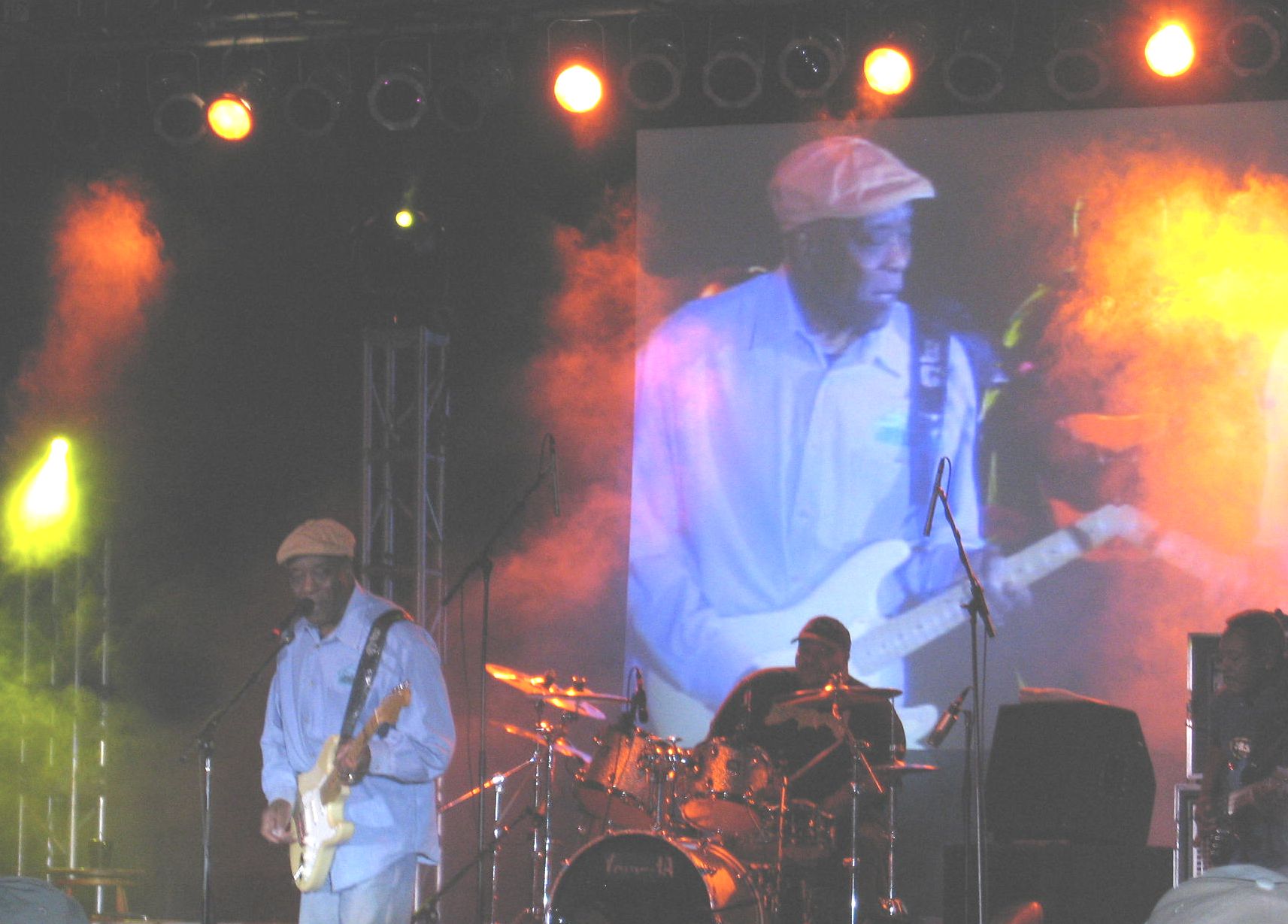
Review: Buddy and Bettye at Roots N Blues N BBQ Fest 2008

By Joel Francis

Buddy Guy

Buddy Guy is to the electric guitar what a match is to kerosene.

The 68-year-old blues legend lit into opening number “Best Damn Fool” like a house afire and closed out the Roots ‘n Blues ‘n BBQ Festival Saturday night in Columbia, Mo. with 90 minutes of barn-burning blues that skimmed through the encyclopedia of the genre.

After starting with a cut from his new album, “Skin Deep,” Guy tore through his classic “Hoodoo Man.” The song culminated with a guitar duel between Guy and his backing guitarist, who was more than capable of holding his own. After whipping the song into a frenzy, Guy put a finger to his lips and hushed both the crowd and his band. In whisper silence he noodled into “Love Her With a Feeling,” which merged with “She’s Nineteen Years Old.”

Guy’s mind is as frenetic as his fingers. He rarely plays a song all the way through, opting to mine the most joyous parts, then skip along to the next number that races through is brain. He treated the audience to a nearly two full minutes of his signature number “Damn Right I’ve Got the Blues,” before remembering he played Peggy Lee’s “Fever” at his last gig in Columbia 15 years ago and gave them all of that instead. No one seemed to mind.

“Boom Boom,” a tribute to John Lee Hooker, suddenly inspired “Strange Brew” and a shout-out to Eric Clapton and Cream. Guy hopped offstage and wandered through a shoulder-to-shoulder crowd a block deep and half a block wide to deliver “Drowning on Dry Land” and B.B. King’s “Rock Me Baby.”

Like a woman plied with one drink too many, Guy was able to coax things from his guitar beyond its natural limits. Armed with a cream-colored Fender Stratocaster instead of his trademark polka dot model, Guy hopped on a wah wah peddle to riff over the intro of Jimi Hendrix’ “Voodoo Child” before launching into Muddy Water’s “I Just Want To Make Love To You.”

The night ended with “Out in the Woods,” a boast about taming wild beasts. It was a great closing number, but also slightly redundant – at this point, Guy no longer had to prove how bad he was.

Bettye LaVette

In a perfect world, Bettye LaVette would be enjoying the same kind of success Tina Turner receives today.

After 47 years in the business and five years into her renaissance, LaVette’s raspy voice – no doubt enhanced by years of working smoky dives – is informed and enhanced by the pain and frustration of her wilderness years.

Her performance of early songs like “My Man – He’s A Lovin’ Man,” “Let Me Down Easy” and “Right in the Middle (Of Falling in Love)” hint at the career that could have been. But Lavette is not bitter. She can deliver a line like “I’ve been bruised, hurt and cheated on/ but still they couldn’t break me” (from “Close As I’ll Get to Heaven”) with both honesty and a smile.

Clad in a sleeveless black shirt and tight black pants, LaVette swayed and strutted across the stage channeling every note from her band, completely invested in every lyric. She added a swagger to her reading of “Joy” that songwriter Lucinda Williams could only dream of. Likewise, she added a level of sensuality to Leonard Cohen’s “You Don’t Know Me At All” unheard in the original. The sashay of her hips to a sizzling guitar solo said more than any of the verses.

Two years ago, LaVette put on a breathtaking performance at the Folly Theater in Kansas City. She was even better in the open air in Columbia and her band was the difference. For the earlier date, LaVette was backed by musicians who, like her, had been catapulted from juke joints to concert halls. Unlike her, they were not ready for the spotlight. Her new, four-piece band was tighter, funkier and able to keep up. They added a wash of psychedelic soul to “Sleep to Dream” and a superb gospel feel to “Choices.”

LaVette closed her 75-minute set with a riveting a cappella performance of a Sinead O’Connor song that summed up her life today: “I have all that I requested/And I do not want what I haven’t got.”

Doyle Bramhall

Drummer Doyle Bramhall grew up playing with the Vaughan brothers, so it makes sense that his Texas blues oscillate between the smooth strut of Jimmie and the rough and rocky bluster of  Stevie Ray. Unfortunately, there’s not much in between.

His five-piece band could turn it up when needed, like on a spirited cover of “Keep A Knockin’,” but for the most part they were content to keep the meat in the smoker instead of taking it out and slathering on the sauce.

Bramhall’s hour-plus set ran through songs from his solo catalog like “Top Rank Boxing” and “Cryin'” and a couple numbers he wrote with Stevie Ray. Predictably, “Change It” and “The House Is A Rockin’,” which closed the set, drew the greatest cheers.

Review: Robert Plant and Allison Krauss


Above: Plant and Krauss get “In the Mood.”

By Joel Francis

Robert Plant may never outlive the shadow of his onetime partner Jimmy Page, but Tuesday night at Starlight he showed unimaginable growth with his unlikely new muse, bluegrass legend Allison Krauss.

The pair’s 23 song, two-hour set explored nearly every facet of American music with a subtly, nuance and beauty Plant’s former four-piece could only dream of. From a rockabilly cover of Ray Charles’ “Leave My Woman Alone” to Leadbelly’s “In the Pines” the pair’s voices waltzed in perfect, egoless harmony.

Clad in all black, Plant slinked around the stage like a cat burglar before spontaneously hopping into a spry dance step. Krauss stood in contrast in a bright floral dress, sporting a wide smile and, frequently, a violin on her shoulder.

“Black Dog” was reworked with a banjo delivering the main riff as Plant and Krauss’s voices circled each other on the call-and-response chorus. A spellbinding reading of “Killing the Blues” in the encore set may have been the ultimate demonstration of their musical synergy.

The hammer of the gods may have been missing, but classics like “When the Levee Breaks” (to which Plant snuck a snippet of Bob Dylan’s “Girl of the North Country”) and “Black Country Woman” had plenty of thunder. A cover of Townes Van Zandt’s “Nothin'” outrocked ‘em all, though. A harrowing tale of addiction much in the same vein as John Lennon’s “Cold Turkey,” one could feel the symptoms of withdrawal dripping from the stage as Plant unleashed a couple of his trademark primal wails.

It would be easy for a rocker of Plant’s status to command the stage and bring a captivating performance, but he was very much a team player. He turned the stage over to Krauss for a stunning a cappella reading of “Down to the River to Pray” (boosted by the stellar backing vocals of guitarist Buddy Miller and fiddle/banjo/mandolin player Stuart Duncan) and a haunting version of Tom Waits’ “Trampled Rose.” Even bandleader T-Bone Burnett, producer of Krauss and Plant’s “Raising Sand” album, the “O Brother Where Art There Soundtrack” got the spotlight for a song.

Other highlights included a chipper “Gone Gone Gone” performed in front of a shimmering gold curtain that helped the song feel like an autumn road trip. Plant’s solo hit “In the Mood” was married to the Irish melody of “Matty Groves” and was a welcome surprise. “The Battle of Evermore” was the rare Zeppelin number that wasn’t radically reworked.

The assembly of Miller, Duncan, Burnett, acoustic bass player Dennis Crouch and drummer Jay Bellerose defy the term “backing band.” Their collective resumes include work with Waits, Elvis Costello, Beck, Emmylou Harris and Steve Earle, to name a few. Amazing songwriters and musicians in their own right, each of these guys are more than capable of mesmerizing solo performances. Together, they might be the greatest band of ringers ever assembled.

The wealth of material worked up for this tour begs for proper release on an encore collaboration or concert release. The entire evening was a treat that deserves to be relived as many times as possible. Hopefully the tour of a lifetime will be preserved for even longer.