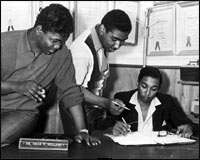
Velvelettes – “He Was Really Sayin’ Somethin'”


Velvelettes  – “He Was Really Sayin’ Somethin’,” Pop #64, R&B #21

By Joel Francis

The Velvelettes’ final single for Motown was their most successful effort. Like their previous hit, “Needle In A Haystack,” this is another Norman Whitfield production. Unlike the house “assembly line” production on Whitfield’s earlier effort, this song bears more of his fingerprints. Listen to the punch of the brass, especially the deep notes from the trombones. That sound would define songs like “Get Ready” and Whitfield’s early collaborations with the Temptations.

 “He Was Really Sayin’ Something” is a step up on the writing side as well. Whitfield and Mickey Stevenson are joined by Eddie Holland of the famous Holland-Dozier-Holland team.

It took the Velvelettes two attempts to cut this single. An earlier performance cut in the fall of 1964 was discarded for this take, which was released two days after Christmas. Despite the questionable launch time, this was the group’s highest-charting single and the band was given an opening slot on an all-Motown tour. Life on the road was not sweet, however. The members disagreed about their musical direction and drifted apart. Lone founding member Carolyn Gill recruited two new members and attempted to press on, but Motown was wary of the group’s potential. Two follow-up singles failed to chart, while their final effort scraped No. 43 on the R&B charts in 1966. By then the Supremes had established themselves as Motown’s premier female group and the Velvelettes were cut loose.

In 1982, Bananarama revived the song and had a Top 5 U.K. hit.

Marvin Gaye – “How Sweet It Is (To Be Loved By You)”


Marvin Gaye – “How Sweet It Is (To Be Loved By You),” Pop #6, R&B #4

Marvin Gaye scored his second Top 10 hit with this song penned and produced by the Holland-Dozier-Holland team. Gaye’s love songs were rarely this straightforward. The vocal melody is so strong the background singers and percussion are basically window dressing. And who says Motown doesn’t do jazz – check out the boogie-woogie piano playing under Gaye’s buoyant singing.

Gaye’s career has been infamously bipolar. In the ‘60s, he was essentially two performers: a nightclub singer turned pop star and coveted duet partner. “How Sweet It Is” was released after Gaye’s lone album with Mary Wells, and a couple years before he connected with Tammi Terrell. For most casual listeners, Gaye’s first decade is summarized by “I Heard It Through the Grapevine,” a couple Terrell duets and this song.

Jr. Walker comes close to stealing Gaye’s song with his celebratory 1966 cover. Walker’s voice isn’t a smooth as Gaye’s, but his sax is. James Taylor took the song one spot higher – to No. 5 – in 1975. Listeners who enjoy a brief, deep nap can program Taylor’s cover against Michael Buble’s 1996 version. – by Joel Francis

[Note: This concludes the first disc on our road trip through the four-disc “Hitsville U.S.A.” box set.]

The Supremes – “Baby Love,” “Come See About Me”


The Supremes – “Baby Love,” Pop #1, R&B #1
The Supremes – “Come See About Me,” Pop #1, R&B #3

By Joel Francis

(Note: Since the producers of the “Hitsville U.S.A.” box set programmed these tracks back-to-back, we’ll tackle them in one entry.)

For most people, the Supremes are Motown. Label founder Berry Gordy certainly didn’t hesitate to promote and encourage their singles, seemingly above all other releases. Gordy had been looking high and low to find a female face for his label. Early contender Mary Wells defected, and for some reason Martha Reeves and the Vandellas and Gladys Knight and the Pips didn’t fit his image. The answer was right under his nose the whole time.

Supreme Florence Ballard grew up in Detroit with future Temptations Paul Williams and Eddie Hendricks, who were performing as the Primes. Their management wanted a female group, so Ballard formed the Primettes with best friend Mary Wilson, who recruited schoolmate Diana Ross.

In 1960, Ross pestered her old neighbor Smokey Robinson for an audition at Motown. He thought the girls were too green, but snagged their guitarist to join the Miracles. Undaunted, the trio stopped by the Hitsville studio every day after school and bugged Gordy for a spot on his label. The persistence paid off and in 1961 The Supremes released their first Motown single.

The Supremes were hardly the overnight success history has made them out to be. Their first eight singles, released over three years) did absolutely nothing on the charts. In 1964 they were turned over to the Holland-Dozier-Holland machine and their fortunes improved.

“Baby Love” was the Supreme’s second No. 1 hit with HDH. Any listeners that Ross’ opening coo didn’t seduce were captured by the catchy chorus that opens the song. The Funk Brothers shuffle underneath the lyrics imitates the footsteps, but are they walking away or coming back? The sexy saxophone accompaniment seems imply a lover’s return, but Ross is so insistent throughout it’s impossible to be sure.

“Come See About Me” continued the Supreme’s No. 1 success. Yet another HDH song and production, the repeated musical and lyrical theme – a spurned Ross singing over a shuffling Funk Brothers track – the assembly-line criticism holds up in this case. Why did such lovely ladies do to be treated so badly and ignored by the men in their lives?

Both songs have risen to the top of the oldies pantheon, and performed by dozens of artists. As with most of his major hits, Gordy passed both numbers around his stable of singers. For my money, the definitive version of “Come See About Me” is Jr. Walker’s 1967 cover.

Four Tops – “Baby I Need Your Loving”

Four Tops – “Baby I Need Your Loving,” Pop #11

Few had heard of the Four Tops before this song was released in the summer of 1964, but the public quickly became acquainted. The quartet’s debut single sold over a million copies – a feat equally impressive in today’s iTunes era – and landed just outside the Top 10.

Songwriters and producers Holland-Dozier-Holland went the Phil Spector route in the studio, hauling in a 40-piece string section and supplementing the Four Tops’ voices with backing vocals from the Andantes, a female trio also signed to Motown. Spector’s Wall of Sound productions were simultaneously big and small. For all the attention lavished on the strings and vocals, check out the echo on those finger snaps. That’s ultimate flattery for Spector.

Levi Stubbs’ lead vocals capture the ache and longing of a lover hoping to be forgiven. The way he sings the line “lately I’ve been losing sleep” perfectly captures a midnight soul search in a bed too big.

While the competition between the Four Tops and Temptations raged within Berry Gordy’s Hitsville U.S.A. studio, on the carts and among fans, the Four Tops introductory offering more than equaled the Temptations breakthrough “The Way You Do the Things You Do.”

An incredibly durable number, the song charted in various arrangements (and punctuations, appearing as both “Baby I Need Your Lovin'” and “Baby, I Need Your Loving,”) for nearly 20 years after it was released. Folk singer Johnny Rivers had the first cover hit in 1967, but it has also been a hit for lounge singer O.C. Smith, soul singer Geraldine Hunt, pop idol Eric Carmen and, finally, funk singer Carl Carlton in 1982. — by Joel Francis

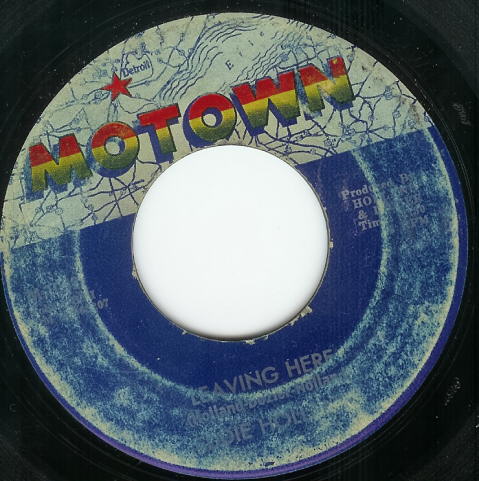
Eddie Holland – “Leaving Here”

Eddie Holland – “Leaving Here,” Pop #76

A lot changed for Eddie Holland in the two years between “Jamie” and “Leaving Here.” Holland went from reluctant (and struggling) Motown vocalist to key member of soul’s hottest songwriting team, Holland-Dozier-Holland.

After “Leaving Here” failed to find major chart success, Holland released just two more singles before permanently retreating behind his notepad. It’s just as well – the songs Holland helped write had far more success and impact than anything he performed.

Surprisingly, “Leaving Here” has had more influence as a garage rock song than a soul number. The Who recorded a smoking cover for the BBC in 1965, Motorhead released a version their debut single and Pearl Jam recorded it in the 1996 as a tribute to The Who. “Leaving Here” is one of the few songs that sounds good in the hands of almost anyone. If you find this title buried in on an obscure album, you’re guaranteed to have at least one good number. — by Joel Francis

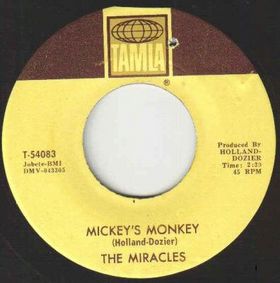
The Miracles – “Mickey’s Monkey”

The Miracles – “Mickey’s Monkey,” Pop #8, R&B #3

One of the most infectious and upbeat singles in the Motown catalog is unique in two ways. First, it was not written by main Miracle Smokey Robinson, but by the hot house songwriting team of Holland-Dozier-Holland. Second, it is one of few Motown songs to appropriate the Bo Diddley beat.

As Robinson’s voice joyously soars over the Funk Brothers groove, the Miracles, Martha and the Vandellas and members of the Supremes, Temptations and Marvellettes chip in on backing vocals.

The HDH production team did a great job of capturing a live sound that, like “Do You Love Me,” sounds like it was beamed directly from the greatest party in the world. Robinson’s multi-octave range is a marvel, but honestly anything over that groove would have been a hit.

“Mickey’s Monkey” was one of the Miracles biggest hits. Unsurprisingly, Berry Gordy tried to bottle lightning a second time by having Martha and the Vandellas cut a version, but neither their cover nor subsequent readings by The Rascals, The Hollies or John Cougar Mellencamp made an impact.

The “cat named Mickey from out of town” was based on Motown’s A&R director Mickey Stevenson. Stevenson wrote several Motown hits with Marvin Gaye, including “Beechwood 4-5789,” “Pride and Joy” and “Dancing in the Street.” — by Joel Francis

Stax vs. Motown (part two)

The second of three installments in my conversation about the golden era of Stax and Motown with soul music fan and Stax afficiando Brad. Don’t forget to check out part one.

Brad S.: I have to admit, when I think of Motown, I almost only associate it with the ‘64-‘65 period. Although I know, to cite one example, one of my old favorites, “Reflections” incorporates just enough psychedelica to distinguish it from what I consider Motown to sound like.

So what are some of those Motown songs that brought you back in?

Joel Francis: For a label so reliant upon singles, it was the albums that drew me back into Motown. “What’s Going On” made me realize there was more to Marvin Gaye than “It Takes Two.” Stevie Wonder’s “Talking Book” and “Songs in the Key of Life” and The Temptation’s “Cloud Nine.”
These albums showed more depth, emotion and creativity than the monotonous parade of mid-60s oldies radio staples would have you believe. Motown may have made its name with its assembly line parade of hits in the first half of the ’60s when it set the agenda, but its output gets more interesting to me in the second half of the decade as it responds to the Beatles, psychedelica, the civil rights movement, etc. That’s when the artists and songwriters really started to grow.

Getting back to Stax I don’t think it ever really recovered from the death of Otis Redding. The near-simultaneous loss of its biggest star in a plane crash and back catalog to Atlantic records was the beginning of the end. I know they regrouped and had massive success with Isaac Hayes, the Staple Singers and Wattstax, but the Stax I enjoy most – Otis, Sam and Dave, Rufus Thomas, Booker T and the MGs, sessions with Wilson Pickett, Solomon Burke, Aretha – was never entirely recaptured.

BS: I hear you with the post-Otis era of Stax, but that also begs this question: What were the true prime lifespans of these labels? I’m not talking about the point at which they continued only in name. The other question that comes to mind is how much of the label’s success is because of a fortunate luck of the draw with artists or is it because of the efforts of record owner or signature producer? Or to put it another way, is there an equivalent to (Motown founder and visionary) Berry Gordy on the Stax side?

JF: For me, Motown loses its luster when it relocated to Los Angeles. There are two reasons for this decline. The first factor is the rise of disco, which practically killed soul music until the neo-soul rebirth of the late-’80s. Second, Berry Gordy’s ambition to branch out into movies and television scattered the label’s focus and brought “mission creep” into his boardroom.

Stax golden years for me are its time with Atlantic when the late Jerry Wexler was helping run the studio. With the exception of Isaac Hayes and the Staple Singers (who were signed later), no one performed as well after the split as they did before. That said, it’s important to remember Stax two big ’70s non-soul successes bluesman Albert King and power pop rock combo Big Star. Many of today’s indie rock bands owe a huge debt to Alex Chilton and Chris Bell’s fantastic Big Star.

If there was a Berry Gordy figure at Stax, I would say it was Wexler in the early days and Al Bell in the later period. Not only was Wexler involved with much of Stax material, but he was also the person responsible for bringing other Atlantic artists, like Wilson Pickett, Aretha Franklin and Solomon Burke, to record at Stax.

After Wexler left, Bell assumed more production duties and became Stax co-owner. Bell patterned his business model off of Gordy. Bell was the person responsible for getting Stax into the soundtrack business (think “Shaft”) and movie business (think “Wattstax”). Ironically, after Stax bankruptcy and demise, Bell worked with Gordy at Motown in the ’80s.

To answer your question, though, I’d say both Motown and Stax’ success came because they were great at identifying talent – be it the songwriting teams of Holland-Dozier-Holland or Hayes-Porter or the raw talents of Mary Wells and Carla Thomas – and had a great business plan for delivering that talent out to the masses. Success breeds success and once those initial singles broke the charts, other artists wanted in.

Continue to part three.

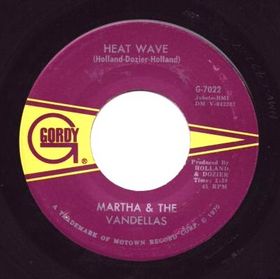
Martha and the Vandellas – “(Love is Like A) Heat Wave”

Martha and the Vandellas – “(Love is Like A) Heat Wave,” Pop #4, R&B #1

When the mercury starts pushing past the century mark my first inclinations are to shave my head and hibernate near the air conditioning. If actual heat waves were more like this song, I’d be dancing in the streets.

Holland-Dozier-Holland wrote it and Martha Reeves sang the heck out of it, but the real credit should go to the Funk Brothers, Motown’s stable of uber-talented, under-recognized musicians. The drums open the song with the buoyancy of an oceanic wave, while a swiftly strummed guitar tells your feet when to move. Add a spritely horn section and peppy piano and you’ve got a hit before Reeves nails the first note.
With so many upbeat elements it’s easy to miss the pain in the lyrics. “Whenever he calls my name/Sounds so soft sweet and plain/Right then, right there/I feel this burning pain/This high blood pressure’s got a hold on me/I said this ain’t the way love’s supposed to be/It’s like a heatwave burning in my heart/I can’t keep from crying/Tearing me apart.” Divorced from the melody and arrangement and the words have the same longing and pain as Bruce Springsteen’s “I’m On Fire.” But together bad love and frustration never felt so good.
Berry Gordy tried to replicate his success by lending the number to the Supremes in 1967. A year earlier The Who covered it a for their second album, but neither version measured up. How could it? Stick “Heat Wave” in your summer cookout playlist alongside Sly and the Family Stone’s “Hot Fun in the Summertime” and any number of Beach Boys tunes and you’ve got a recipe for success. — By Joel Francis

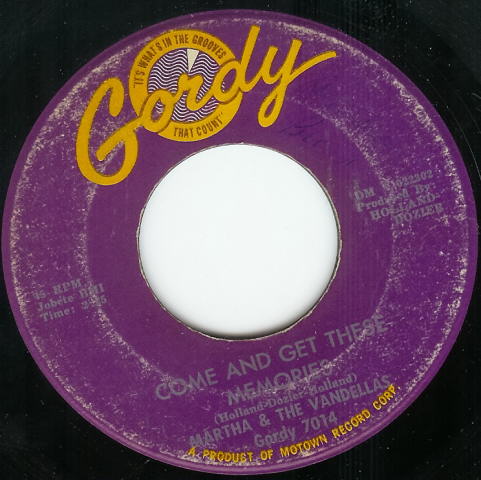
Martha and the Vandellas – “Come and Get These Memories”

Martha and the Vandellas – “Come and Get These Memories,” Pop #29, R&B #6

“Come and Get These Memories” would be less memorable were it not the Motown debut of both singer Martha Reeves and the songwriting team of Brain Holland, Lamont Dozier and Eddie Holland.

Though Holland-Dozier-Holland would dominate both the charts and the Motown landscape during the mid-‘60s, they got off to an inauspicious start here. Reeves is confident in her delivery, but the songwriting and arrangement is tepid. Before the first minute is over we’ve heard the chorus three times and two verses. The piece sounds more like a jingle than a song at this point. The horns bop back and forth without swinging and the backing vocals of “come and get ‘em” are too peppy to convey any sense of heartbreak.

The song fares better in its second half. The horn break at the halfway mark is like flipping a light switch. The brass arrangement grows more aggressive and supportive and Martha, the Vandellas and the Motown musicians really swing through the bridge (“because of these memories/I never think of anybody but you”) that fades into the outro. It’s as if the cast has finally been given direction.

According to legend, Tom Petty and the Heartbreakers were in the studio working out the arrangement to “Breakdown,” when someone walking by in the hall recommended they move the guitar lick from the outro to the beginning. It’s a shame that no one offered similar advice here. Instead the public would have to wait five months for Martha and Holland-Dozier-Holland’s follow-up effort, “Heatwave.” They had mastered the learning curve by then. — by Joel Francis

Eddie Holland – “Jamie”

index-hdh1.jpg

Eddie Holland – “Jamie,” Pop #30, R&B #6

Like Barrett Strong, who co-wrote this song, Eddie Holland was more comfortable composing than performing. He only had two hits in front of the mic, but teamed with Lamont Dozier and brother Brian Holland to pen a staggering 25 No. 1 pop hits in six years. You could call Holland-Dozier-Holland the Neptunes of their time, but the reverse is probably more accurate.

“Jamie” was a big enough hit that Motown built an self-titled album around it and dropped it in stores in late 1962. The album didn’t sell well, but Holland continued to turn out singles for the next couple years. None of them replicated enough of “Jamie”‘s chart success to warrant release of a second album. Today, all of Holland’s Motown solo material has been rounded up on the “Complete Eddie Holland” import collection. — by Joel Francis