Brenda Holloway – “When I’m Gone”

bholloway
Brenda Holloway – “When I’m Gone,” Pop # 25, R&B #12

By Joel Francis

Brenda Holloway isn’t the biggest name in soul music, but she was on top of the world when this song hit 1965. She opened for the Beatles on their U.S. tour that year, and performed at the legendary Shea Stadium show.

The story behind “When I’m Gone” is more interesting than the song itself. Originally slated to be Mary Well’s follow-up to “My Guy,” the song was given to Holloway when Wells spurned Motown for 20th Century Fox Records. Despite being an alto to Well’s soprano, Berry Gordy thought Holloway was best-suited to put lead vocals to Well’s backing track.

“When I’m Gone” wasn’t as big a hit as “Every Little Bit Hurts,” but Holloway kept making singles for the next three years. Shortly after recording the original version of “You’ve Made Me So Very Happy” (later a huge hit for Blood Sweat and Tears), Holloway retired from the music business. Deeply religious, Holloway was disillusioned with Motown and conflicted about the lifestyle expected of a young star. Although she was just 22, Holloway had been making records for 6 years. After a 12-year absence, she returned with gospel album in 1980 and a pop album in 1999.

Martha and the Vandellas – “Nowhere To Run”

nowhere-to-run

Martha and the Vandellas – “Nowhere To Run,” Pop #8, R&B #5

Every element positively soars in this song. The brief, simple horn riff lifts off and Martha Reeves’ voice pushes the listener into the stratosphere. Funk Brother Benny Benjamin’s bouncing drums and ascending backing vocals from the Vandellas keep the track in the air well past the run-off groove.

Reeves’ vain search to shake a no-good lover from her mind is further propelled by a light tickle of piano and hard-driving percussion than included a pair of snow chains bolstering the tambourine placed front and center in the mix. Holland-Dolland-Holland clearly knew what they were doing with this number. Heartbreak has never sounded so jubilant. – by Joel Francis

Raphael Saadiq – “The Way I See It”

raphael_saadiq_-_the_way_i_see_it
By Joel Francis

It’s hard to listen to Raphael Saadiq’s new album, “The Way I See It,” without thinking it’s a lost Motown gem.

The record blasts off with “Sure Hope You Mean It,” a song that recalls the finer moments of Smokey Robinson and the Miracles. Later, Saadiq channels the Temptations on “Keep Marchin'” and “Staying In Love,” which features an effervescent call-and-response over a great rhythm.

The horns on “Big Easy,” courtesy of the Rebirth Brass Band, couple with an incessant guitar and snare drum to create a frantic atmosphere as Saadiq sings “somebody tell me what’s going on/I ain’t seen my baby in far too long.” Think Holland-Dozier-Holland lost in Mardi Gras and you’re almost there.

Saadiq strays from the Motor City to channel the Sound of Philadelphia for “Just One Kiss,” a duet with Joss Stone. Stone shows more restraint on this number than she did on the album Saadiq produced for her last year, “Introducing Joss Stone.” “Calling” starts with a Spanish introduction over flamenco guitar before sliding into a great doo-wop melody.

“Never Give You Up,” another Gamble-Huff-flavored moment, is the stand-out track. The arrangement pulls the listener in before Saadiq’s smooth voice kicks in, and the magnificent, swirling chorus seals the deal. That Stevie Wonder’s cameo after the third verse does not feel forced, speaks to the organic vibe Saadiq has not only created here, but sustained over most of the record.

The only misstep is the album-closing remix of “Oh Girl” featuring Jay-Z. While he offers some of his most soulful rapping to date – at points Jay-Z is nearly singing – the hip hop intrusion breaks the spell and rudely slams the album into the present.

Despite this, Saadiq’s third album is the best of his career. “The Way I See It” is more focused than his 2004 sophomore effort, “Ray Ray,” and tighter than his bloated (but otherwise excellent) debut “Instant Vintage.” From the sound of the guitar and the echo on drums to the mix and arrangement of the backing vocals, everything is spot-on. Even the timing is right – most songs are between two and three minutes.

Motown tributes are a dime a dozen. What elevates “The Way I See It” above the score of old school knock-offs is that it goes beyond the paint-by-numbers approach to inhabit and invigorate the true spirit of the music.

(Below: The video for “Love That Girl.”)

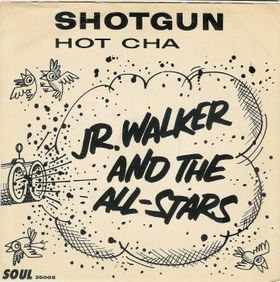
Junior Walker and the All-Stars – “Shotgun”

shot
Junior Walker and the All-Stars – “Shotgun,” Pop #4, R&B #1

Motown raided the juke joints for Junior Walker’s biggest hit. The song is propelled by Victor Thomas’s Hammond organ as much as Walker’s sax, and is closer to the Southern styling of Booker T. and the MGs and King Curtis than the Motown sound.

At the time, Walker was better-known for his playing than his singing. Initially, a studio singer was booked to sing Walker’s response to the fad dances of the time, like “The Jerk” and “The Watusi.” When the singer failed to arrive, Walker reluctantly stepped behind the mic to cut what he thought would be a guide vocal. Producer Berry Gordy prevailed on Walker to leave the track as-is. Gordy’s judgement was accurate, as the song shot to the top of the chart and inspired several similar singles, including Curtis’ “Memphis Soul Stew.”

Walker’s quartet is rounded out by the sharp guitar punctuation of Willie Woods and the solid backbeat from drummer Benny Benjamin. – by Joel Francis

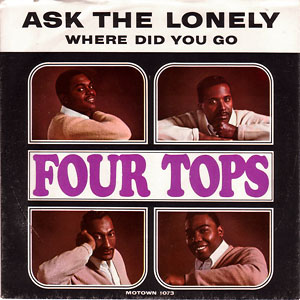
Four Tops – “Ask the Lonely”

4t
Four Tops – “Ask the Lonely,” Pop #24, R&B #9

The name on the label says “Four Tops” but this is really a Levi Stubbs record. Stubbs was never one of Motown’s marquee vocalists, and the injustice of that act is amplified by his three-minute tour-de-force singing here. Mickey Stevenson and Ivy Hunter’s song and production is more mature than the typical Motown single. Stubbs’ classic soul voice is imbedded with the “hurting pain” he’s imploring his friend to avoid. The female backing vocals sound silly when they introduce the song, but blend well with the arrangement. The other three Tops are all but absent, but they’re not missed thanks to Stubbs’ heart-wrenching performance.

“Ask the Lonely” is stuck in the Tops’ limbo land. It wasn’t a big hit, but it was too good to be a footnote. The song is still performed at Four Tops concerts today – sans Stubbs’ vocals, of course – but unlike other Motown hits, it never made an impact on the covers circuit. Which is probably just as good. — by Joel Francis

Velvelettes – “He Was Really Sayin’ Somethin'”


Velvelettes  – “He Was Really Sayin’ Somethin’,” Pop #64, R&B #21

By Joel Francis

The Velvelettes’ final single for Motown was their most successful effort. Like their previous hit, “Needle In A Haystack,” this is another Norman Whitfield production. Unlike the house “assembly line” production on Whitfield’s earlier effort, this song bears more of his fingerprints. Listen to the punch of the brass, especially the deep notes from the trombones. That sound would define songs like “Get Ready” and Whitfield’s early collaborations with the Temptations.

 “He Was Really Sayin’ Something” is a step up on the writing side as well. Whitfield and Mickey Stevenson are joined by Eddie Holland of the famous Holland-Dozier-Holland team.

It took the Velvelettes two attempts to cut this single. An earlier performance cut in the fall of 1964 was discarded for this take, which was released two days after Christmas. Despite the questionable launch time, this was the group’s highest-charting single and the band was given an opening slot on an all-Motown tour. Life on the road was not sweet, however. The members disagreed about their musical direction and drifted apart. Lone founding member Carolyn Gill recruited two new members and attempted to press on, but Motown was wary of the group’s potential. Two follow-up singles failed to chart, while their final effort scraped No. 43 on the R&B charts in 1966. By then the Supremes had established themselves as Motown’s premier female group and the Velvelettes were cut loose.

In 1982, Bananarama revived the song and had a Top 5 U.K. hit.

The Temptations – “My Girl”


The Temptations – “My Girl,” Pop #1, R&B #1

By Joel Francis

Lightning definitely struck twice for Smokey Robinson and the Temptations. After struggling for years, Robinson gave the Temptations their breakthrough hit with “The Way You Do The Things You Do.” “My Girl,” their follow-up, is not only Motown’s biggest song, but one of the biggest soul numbers of all time.

Inspired by his wife Claudette, Robinson and fellow Miracle Ronald White wrote the one of the greatest Valentines of all time as an answer song to their previous hit “My Guy.” Bob Dylan may have been thinking of the lyric “I’ve got so much honey/the bees envy me” when he proclaimed Robinson “America’s greatest living poet” in 1965.

David Ruffin made his lead vocal debut delivering these deceptively simple lyrics. Though it seems a no-brainer in retrospect, the decision was controversial at the time. Eddie Kendricks and Paul Williams had shared the lead role prior to this song, and, to make matters worse, Ruffin was a ringer who replaced original Temptation Al Bryant. Ruffin got the nod after Robinson saw him singing “Under the Boardwalk” as part of their Motown Revue repertoire, and quickly became the group’s featured singer.

The Motown string section furthers Ruffin’s references to sunshine and fluttering birds, while Funk Brother James Jamerson’s signature two-note bass line anchors the entire performance.

It’s unclear why Robinson and White didn’t keep their song for The Miracles, but it didn’t take long for other acts to put their stamp on the number. Otis Redding added some blues for his 1965 reading; both the Rolling Stones and the Mamas and Papas cut it in 1967. Since then, everyone from Al Green to reggae artist Prince Buster to Dolly Parton to British shoegazers The Jesus and Mary Chain has reinterpreted this timeless classic.

Marvin Gaye – “How Sweet It Is (To Be Loved By You)”


Marvin Gaye – “How Sweet It Is (To Be Loved By You),” Pop #6, R&B #4

Marvin Gaye scored his second Top 10 hit with this song penned and produced by the Holland-Dozier-Holland team. Gaye’s love songs were rarely this straightforward. The vocal melody is so strong the background singers and percussion are basically window dressing. And who says Motown doesn’t do jazz – check out the boogie-woogie piano playing under Gaye’s buoyant singing.

Gaye’s career has been infamously bipolar. In the ‘60s, he was essentially two performers: a nightclub singer turned pop star and coveted duet partner. “How Sweet It Is” was released after Gaye’s lone album with Mary Wells, and a couple years before he connected with Tammi Terrell. For most casual listeners, Gaye’s first decade is summarized by “I Heard It Through the Grapevine,” a couple Terrell duets and this song.

Jr. Walker comes close to stealing Gaye’s song with his celebratory 1966 cover. Walker’s voice isn’t a smooth as Gaye’s, but his sax is. James Taylor took the song one spot higher – to No. 5 – in 1975. Listeners who enjoy a brief, deep nap can program Taylor’s cover against Michael Buble’s 1996 version. – by Joel Francis

[Note: This concludes the first disc on our road trip through the four-disc “Hitsville U.S.A.” box set.]

The Supremes – “Baby Love,” “Come See About Me”


The Supremes – “Baby Love,” Pop #1, R&B #1
The Supremes – “Come See About Me,” Pop #1, R&B #3

By Joel Francis

(Note: Since the producers of the “Hitsville U.S.A.” box set programmed these tracks back-to-back, we’ll tackle them in one entry.)

For most people, the Supremes are Motown. Label founder Berry Gordy certainly didn’t hesitate to promote and encourage their singles, seemingly above all other releases. Gordy had been looking high and low to find a female face for his label. Early contender Mary Wells defected, and for some reason Martha Reeves and the Vandellas and Gladys Knight and the Pips didn’t fit his image. The answer was right under his nose the whole time.

Supreme Florence Ballard grew up in Detroit with future Temptations Paul Williams and Eddie Hendricks, who were performing as the Primes. Their management wanted a female group, so Ballard formed the Primettes with best friend Mary Wilson, who recruited schoolmate Diana Ross.

In 1960, Ross pestered her old neighbor Smokey Robinson for an audition at Motown. He thought the girls were too green, but snagged their guitarist to join the Miracles. Undaunted, the trio stopped by the Hitsville studio every day after school and bugged Gordy for a spot on his label. The persistence paid off and in 1961 The Supremes released their first Motown single.

The Supremes were hardly the overnight success history has made them out to be. Their first eight singles, released over three years) did absolutely nothing on the charts. In 1964 they were turned over to the Holland-Dozier-Holland machine and their fortunes improved.

“Baby Love” was the Supreme’s second No. 1 hit with HDH. Any listeners that Ross’ opening coo didn’t seduce were captured by the catchy chorus that opens the song. The Funk Brothers shuffle underneath the lyrics imitates the footsteps, but are they walking away or coming back? The sexy saxophone accompaniment seems imply a lover’s return, but Ross is so insistent throughout it’s impossible to be sure.

“Come See About Me” continued the Supreme’s No. 1 success. Yet another HDH song and production, the repeated musical and lyrical theme – a spurned Ross singing over a shuffling Funk Brothers track – the assembly-line criticism holds up in this case. Why did such lovely ladies do to be treated so badly and ignored by the men in their lives?

Both songs have risen to the top of the oldies pantheon, and performed by dozens of artists. As with most of his major hits, Gordy passed both numbers around his stable of singers. For my money, the definitive version of “Come See About Me” is Jr. Walker’s 1967 cover.

Velvelettes – “Needle in a Haystack”

Velvelettes – “Needle in a Haystack,” Pop #45

The real action in “Needle in a Haystack” is happening away from the microphones and behind the glass. This song was the first single the late Norman Whitfield’s produced for Motown. Whitfield got his start at the label as a songwriter, co-writing Marvin Gaye’s hit “Pride and Joy,” but he made his name as a pioneering producer on the edge of the psychedelic soul movement.

In keeping with Berry Gordy’s assembly line mentality, the song sounds very much like the other Motown productions of the time. None of the experimental flourishes that mark Whitfield’s groundbreaking time with The Temptations are present. The promise of sounds to come, however, makes the song historically worth hearing.

History aside, there’s little that makes “Needle in a Haystack” stand out. The single was the Velvelettes’ second single for Motown and first charting effort. Although they had a follow-up hit, the Velvelettes, like Carolyn Crawford, are a footnote in Motown’s great history. – by Joel Francis