Marvin Gaye and Tammi Terrell – “Ain’t Nothing Like the Real Thing”

ain't nothing
Marvin Gaye and Tammi Terrell – “Ain’t Nothing Like the Real Thing,” Pop # 8, R&B # 1

By Joel Francis

Marvin Gaye and Tammi Terrell’s first album together, “United,” was a smash that spawned three Top 5 R&B hits and turned Gaye into a soul superstar. A follow-up was inevitable. In March, 1968, less than three months after the release of their previous single, “Ain’t Nothing Like the Real Thing” announced the fruits of the duo’s new collaborations.

“Ain’t Nothing Like the Real Thing” is more of a Brill Building pop song than a soul number. Each singer gets two brief verses, but the heavy emphasis is on the chorus, which is usually repeated. There is a touch of Carol King’s phrasing in Terrell’s verses and the piano line – particularly the bit that introduces the first verse owes to King’s style. Although the structure is deceptively simple, the song works because the hook allows the complementary voices to dance. The clever bridge also surprises up the verse-chorus structure.

The song is definitely outside of the Motown paradigm, but Gaye’s voice , especially the soulful moans that appear after the drums and bass introduce the song, let the listener know we’re still deep in Motown territory.

Sadly, “Real Thing” was the next-to-last “real thing” Gaye and Terrell worked on together. In October, 14, 1967, following the completion of the No. 1 R&B hit “You’re All I Need To Get By,” Terrell collapsed in Gaye’s arms while performing at college homecoming in Virginia. Doctors diagnosed Terrell with a brain tumor and her days as a singer and performer were over.

Gaye completed the pair’s second album, “You’re All I Need,” by overdubbing his voice to Terrell solo recordings, a trick reprised on the duo’s third and final album, “Easy.” Largely present in name only, “Easy,” found Valerie Simpson standing in for Terrell on all but two albums. “Easy” spawned three Top 20 R&B hits, but nothing as influential or wonderful as “Real Thing.”

When Terrell died at age 24 on March 16, 1970, Motown released her final “duet” with Gaye in tribute.

“Ain’t Nothing Like the Real Thing” has been a go-to duet for 40 years. Diana Ross and the Supremes were the first to capitalize, recording a version with the Temptations in 1969. The following year the Ross-relieved Supremes cut another version with the Four Tops. The Jackson 5 included their cover on their 1972 album “Lookin’ Out the Windows.” Aretha Franklin recorded a rare solo version of the song in 1974.

Other performers to record “Real Thing” include Donny and Marie Osmond, Gladys Knight and Vince Gill, Elton John and Marcella Detroit, and Beyonce and Justin Timberlake. Michael McDonald and Boyz II Men also included interpretations of the number on their Motown tribute albums.
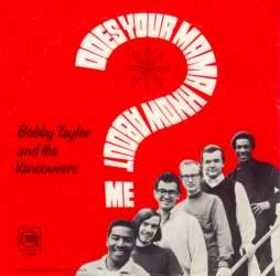
Bobby Taylor – “Does Your Mama Know About Me”

mama know
Bobby Taylor – “Does Your Mama Know About Me,” Pop # 29, R&B # 5

By Joel Francis

North Carolina native Bobby Taylor was working with a trio of Canadian musicians performing Motown numbers in Vancouver when the group caught the attention of Supremes Mary Wilson and Florence Ballard. The pair excitedly contacted Berry Gordy after hearing Bobby Taylor and the Shades in concert, and Gordy signed the group to his Gordy Records subsidiary.

Unfortunately, the excitement over Taylor’s stage shows failed to translate over records to a wider audience, and the group broke up in 1969 after one album and a handful of lukewarm singles. “Does Your Mama Know About Me” was the group’s biggest hit, peaking at No. 29 on the Pop chart.

Although Taylor’s Motown footprint is shallow, he had a hand in scouting and nurturing several well-known performers. While he was never a member of the Shades – later rechristened the Vancouvers by Gordy – Taylor recalled that Seattle guitarist Jimi Hendrix played with the group on several occasions. Shades drummer Floyd Sneed went on to join Three Dog Night. After booking a local band to open for them in Chicago, Taylor recommended Gordy sign the Jackson 5. He went on to produce the majority of the band’s debut album.

The Vancouver to go onto greatest acclaim, though, was the band’s guitarist. The half-Chinese, Scots-Irish born Thomas Chong co-wrote “Does Your Mama Know About Me” and performed on two more Vancouvers singles before being fired for missing a gig – he was applying for a green card – and becoming a superstar as half of the comedy duo Cheech and Chong.

With its sweeping strings and lush orchestration, “Does Your Mama Know About Me” feels more like a Philly soul number than a Motown production. This type of arrangement was used to great effect by Kenny Gamble and Leon Huff on early ‘70s soul hits like “Me and Mrs. Jones” and “If You Don’t Know Me By Now.” Although Gamble and Huff developed their sound independently – though they were no doubt keeping an ear trained on Motown – “Mama” illustrates how Motown continued to be at the vanguard of soul music beyond the departure of Holland-Dozier-Holland and its production-line sound.

A forgotten footnote, the only noteworthy cover of “Does Your Mama Know About Me” was performed by Diana Ross and the Supremes and included on their 1968 album “Love Child.”

Rita Wright – “I Can’t Give Back the Love I Feel For You”

syreeta
Rita Wright – “I Can’t Give Back the Love I Feel For You,” did not chart

By Joel Francis

Rita Wright is best known by her 1970s stage name, Syreeta. Before she collaborated with – and briefly married – Stevie Wonder, and scored a handful of Adult Contemporary hits with Billy Preston, Wright was a Pittsburgh transplant working as a secretary for Motown. Wright managed to catch the ear of Brian Holland, who signed her to the label. Holland collaborated with Ashford and Simpson – the songwriting team ironically brought in to replace the defected Holland, his brother Brian and their partner Lamont Dozier – on her 1968 debut, “I Can’t Give Back the Love I Feel For You.”

The song opens with a jarringly dissonant horn line before settling upon Wright’s soft voice. Although her performance is strong, the arrangement betrays the track’s origin as an abandoned Diana Ross and the Supremes cut. Although Ross eventually cut the song as a solo track for her 1971 album “Surrender,” Wright’s version could easily be confused for a lost Supremes track.

Although “I Can’t Give Back” didn’t chart, Wright had a successful recording career. She co-wrote “Signed, Sealed, Delivered” with Wonder and the Spinners’ hit “It’s A Shame.” Her first two LPs, 1972’s “Syreeta” and 1974’s “Stevie Wonder Presents: Syreeta” are hidden soul gems.

Ross’ version of “I Can’t Give Back” came in the middle of a sort of renaissance for the number. Dusty Springfield covered it in 1970 during the sessions to her follow up to “Dusty In Memphis,” the Philly soul masterpiece “A Brand New Me.” The final lineup of the Jeff Beck Group, featuring vocalist Bobby Tench, put their stamp on the song in 1972.

The Temptations – “I Wish It Would Rain”

rain
The Temptations – “I Wish It Would Rain,” Pop # 4, R&B # 1

By Joel Francis

“I Wish It Would Rain” had been out less than two weeks when songwriter Roger Penzaben took his life on New Year’s Eve, 1967. The heartache and melancholy Temptation David Ruffin poured into his singing was Penzaben’s story.

In the spring of 1967, Penzaben caught his wife in an affair. Unable to cope with the pain and betrayal, Penzaben dumped his feelings into the lyrics. Producer Norman Whitfield and Barrett Strong, who had previously teamed on Tempts’ classics EX.

The song opens with a few stately piano chords before Ruffin takes over. Backed only by a tambourine, it’s practically a cappella. Ruffin’s voice drips with so much sorrow that it’s hard to believe just three years prior he had “sunshine on a cloudy day.”

The understated strings and arrangement bear the hallmarks of Motown’s classic Holland-Dozier-Holland productions. It’s hard to believe that in less than a year, Whitfield and the Temps would be on the vanguard of the psychedelic soul movement.

It’s also hard to believe that “Rain” was Ruffin’s next-to-last single as a Temptation. Ruffin’s cocaine addiction and insistence that the group follow Smokey Robinson and Diana Ross’ leads and  be renamed “David Ruffin and the Temptations led to his firing in the summer of 1968. When the Temps again cracked the pop Top 10 with “Cloud Nine,” both Ruffin and Whitfield’s traditional arrangements were long gone.

Shortly before the Tempts debuted their psychedelic sound, Gladys Knight and the Pips took gave “Rain” an encore lap that reached Nos. 41 and 15 on the Pop and R&B charts, respectively. In 1973, Marvin Gaye recorded a funk version that was released as the b-side of his No. 1 hit “Let’s Get It On.” That same year, British slopsters The Faces had a U.K. hit with their interpretation. Aretha Franklin and hair metal band Little Caesar have also recorded versions of this miserable masterpiece.

Smokey Robinson and the Miracles – “I Second That Emotion”

Second Emotion

Smokey Robinson and the Miracles – “I Second That Emotion,” Pop # 4, R&B # 1

By Joel Francis

Smokey Robinson was Christmas shopping with fellow Motown songwriter Al Cleveland when Cleveland let slip the malapropism “I second that emotion.” Intrigued, Robinson penned a lyric about a man disinterested in flirting, fishing for long-term love. In other words, it’s the complete opposite of every Kiss song ever.

The arrangement and delivery is relaxed and easy. Never a forceful singer, Robinson lets the horns punctuate his pleas. His vocals are soft and comforting as a pillow, while Miracle Marv Tarplin’s guitar pulls the song over the unusually subdued percussion. There’s no climax or resolution to the number – the horn breakdown in the final moment is as close as we get. It’s almost like Robinson is auditioning the idea.

The song fades before we learn the woman’s reaction, but audiences were delighted, sending “I Second That Emotion” into the Top 5 and earning the Miracles their sixth million-selling single.

Less than two years later, Diana Ross and the Supremes and the Temptations teamed up for a television special and album. “Diana Ross and the Supremes Join the Temptations” featured their interpretation of “I Second that Emotion,” which was a Top 20 UK hit (the single was not released in America). The album marked the debut of new Temp Dennis Edwards, who replaced the troubled David Ruffin. Miracle guitarist Tarplin reprised his role for the all-star revision. The song has a diverse cover life, with performances issued by Jerry Garcia, ‘80s synth band Japan, and “Stand By Your Man” country singer Tammy Wynette.

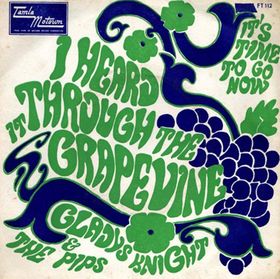
Gladys Knight and the Pips – “I Heard It Through the Grapevine”

grapevine
Gladys Knight and the Pips – “I Heard It Through the Grapevine,” Pop # 2, R&B # 1

By Joel Francis

Unlike nearly every other soul singer at the time, Gladys Knight didn’t want to go to Motown. She was (rightly) worried she and her group, the Pips, would end up playing second fiddle to Diana Ross and the Supremes. However, the Pips were a democracy. When the rest of the group voted to migrate to Hitsville, Knight reluctantly acquiesced.

“I Heard It Through the Grapevine” was a thrice-heated leftover when Norman Whitfield presented his song to the group in 1967. Smokey Robinson and the Miracles cut a version the previous year that didn’t make it out of Berry Gordy’s Quality Control meeting. A second Miracles recording of “Grapevine” was buried as an album cut on 1968’s “Special Occasion” LP.  The Isley Brothers were rumored to have recorded a version during their brief stint on the label, but no recording has surfaced to date. Several Motown scholars believe a recording session with the Isleys to cut “Grapevine” was scheduled, but then cancelled.

This is likely the case. In 2005, Motown released the two-disc clearinghouse “Motown Sings Motown Treasures.” This incredible and enlightening collection presented many recordings – Kim Weston performing “Stop! In the Name of Love,” the Supremes doing “Can IGet A Witness,” and the Miracles original, unissued version of “Grapevine,” among others – previously locked in the vaults. It seems unlikely that the Isley Bros. version of “Grapevine,” if it exists, would have been omitted from this collection.

Although it wouldn’t be released for another year, Marvin Gaye had also cut his reading of “Grapevine” by the time the Pips were hearing Whitfield’s pitch.

Whitfield’s latest “Grapevine” arrangement was inspired by Aretha Franklin’s “Respect” and Whitfield’s desire to “out-funk” Franklin. It’s clear from the great snare-and-cymbal intro that Whitfield was on to something new. Motown had been a lot of things until that point, but it had rarely been so overtly funky. In the coming years, Whitfield would help place Hitsville at the epicenter of psychedelic soul. This recording was one of the first steps down that path.

Whitfield’s attempt to out-do the Memphis soul sound Aretha was getting from Atlantic producer Jerry Wexler was buoyed by Knight’s singing. The gospel background isn’t as obvious in Knight’s delivery, and her voice is a little earthier than Franklin’s, but Knight’s vocals can soar just as high. In fact, the song is little more than drums, piano and Knight’s powerful voice until a scratch guitar enters during the first chorus.

Stealing a page from the Holland-Dozier-Holland production book, the tambourine is mixed front and center. The instrument serves as a tractor, dragging the entire song it its wake. The signature organ line that introduces Gaye’s chart-topping “Grapevine” makes a cameo on the piano about a minute into the song. The saxophone solo bisecting the song is a straight-up homage to King Curtis, the Memphis soul legend. Even the juiciest gossip is rarely this much fun.

The fourth time was the charm for Whitfield, as the Pips’ powerful “Grapevine” finally made it past Gordy’s Quality Control meeting. That didn’t guarantee label support, though, as Knight was forced to rely on her DJ connections to promote the song. When “Grapevine” finally caught on, it caught fire holding the top spot on the R&B chart for six weeks and stalling behind the Monkee’s “Daydream Believer” at No. 2 on the pop chart. Although it was Motown’s best-selling single to date, the “Grapevine” story was far from over.

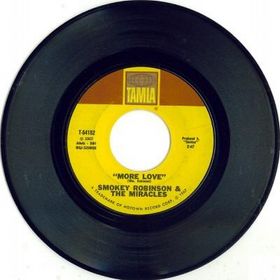
Smokey Robinson and the Miracles – “More Love”

422268
Smokey Robinson and the Miracles – “More Love,” Pop # 23, R&B # 5

By Joel Francis

Smokey Robinson has penned dozens of gorgeous love songs throughout his career, but few are affecting as “More Love.” The reassuring lyrics speak to the tragedies the couple suffered as a result of life on the road. Between 1957 and 1964, Claudette Robinson had eight miscarriages. This heartbreaking back story adds to the romance of the chorus:

“More love, more joy,
|Than age or time could ever destroy.
My love will be so sound,
It would take about a hundred lifetimes
To live it down, wear it down, tear it down.”

The song opens with some gospel chords on the piano before the gently insistent bassline enters. Robinson’s voice appears on a pillow of strings, as the arrangement slowly builds underneath. After Robinson delivers the chorus a second time, the performance pulls back to that great bassline before reaching a climax that sustains through the rest of the song.

Foreshadowing Motown’s cross-country relocation, the track was performed by Los Angeles session musicians before the Miracles – including Claudette – overdubbed their voices in Detroit. It’s unclear why Robinson, who also produced the cut,  bypassed the Funk Brothers, but the public didn’t seem to mind. The song was wedged near the top of both the pop and R&B charts in the spring of 1967.

Foreshadowing another Motown move, “More Love” was the second single credited to “Smokey Robinson and the Miracles.” Berry’s decision to give Robinson top billing started the avalanche that benefitted Diana Ross and Martha Reeves but doomed David Ruffin and the Temptations.

Smokey and Claudette eventually had two children, both named in tribute to Motown. Son Berry Robinson was the namesake of label founder Berry Gordy, and daughter Tamla Robinson was named after the Hitsville subsidiary.

Former New Christy Minstrels singer Kim Carnes had a No. 10 hit on the Adult Contemporary charts in 1980 with her reading of “More Love.” The song was her biggest hit until “Bette Davis Eyes” hit No. 1 the following year. “More Love” has also been covered by Paul Young, Barbara McNair and the 5th Dimension.

Marvin Gaye and Tammi Terrell – “Ain’t No Mountain High Enough”

mountain
Marvin Gaye and Tammi Terrell – “Ain’t No Mountain High Enough,” Pop # 19, R&B # 3

By Joel Francis

Marvin Gaye found his greatest early success as a duet partner. The 1964 album “Together” was his first album to chart, and his duets placed in the Top 20 with a consistency that eluded him as a solo artist. Unfortunately, Gaye’s soul partners, Mary Wells and Kim Weston, both left Motown for (allegedly) greener pastures shortly after collaborating with Gaye. As established Motown solo artists, pairing of Gaye with Wells and Weston made sense. The teaming of Gaye with Hitsville newcomer Tammi Terrell, however, was inspired.

Terrell arrived at Motown in 1965 after bouncing from Scepter Records, where she recorded as Tammy Montgomery, James Brown’s Try Records and the Chess Records subsidiary Checker. Her initial Motown singles didn’t much fare better than her previous efforts, but “Ain’t No Mountain High Enough” took both her and Gaye’s careers to a new level.

Motown’s new singing pair was paired with the songwriting team Berry Gordy hired to replace the gradually exiting Holland-Dozier-Holland squad. Husband and wife Nickolas Ashford and Valerie Simpson came to Gordy’s attention in 1966 with their No. 1 hit “Let’s Go Get Stoned” for Ray Charles. (Ironically, “Stoned” was Charles’ first single after leaving rehab for his heroin addiction.)

“Mountain was a heck of a debut for both Ashford and Simpson and Gaye and Terrell. It’s obvious from the few seconds of spoken introduction that the signers have great rapport and their voices dance perfectly on the chorus. Although Gaye and Terrell sound like they’re giggling from the same care-free piano bench, their vocal parts were actually recorded separately. Terrell felt like she hadn’t rehearsed the lyrics enough to record with Gaye, so after some coaching with producers Harvey Fuqua and Johnny Bristol she cut her part alone.

Although Fuqua and Bristol had helmed dozens of Motown hits, “Mountain” doesn’t have the expected Hitsville sound. The most obvious explanation is that Ashford and Simpson were an “outside” songwriting team and that Holland-Dozier-Holland were on their way out. It also highlights that when people talk about the “Motown sound” they are often talking about Holland-Dozier-Holland’s signature production style. Holland-Dozier-Holland’s defection not only deprived Motown of its greatest songwriting team, but also Gordy’s vaunted “sound of young America.”

As one team of stars left, another was being born. The success of “Ain’t No Mountain High Enough” helped transform Gaye into one of Motown’s biggest and most enduring performers, whose brightest days were yet to come.

Four Tops – “Bernadette”

Four-tops-bernadette
Four Tops – “Bernadette,” Pop # 4, R&B # 3

By Joel Francis

Levi Stubbs’ performance on “Bernadette” cements his status as Motown’s greatest male vocalist. The magnificent feats Stubbs laid down on the Four Tops previous pair of singles, “Reach Out” and “Standing in the Shadows of Love” reaches an impassioned crescendo on “Bernadette.” Stubbs joy, appreciation and devotion to Bernadette is still making women envy that name and that kind of partner.

The Holland-Dozier-Holland team that wrote and produced the previous two Tops singles once again employ the same lush orchestration, wrapping Stubbs’ urgent vocals in insistent strings, soaring background vocals and their signature propulsive snare drum.

“Bernadette” was the Tops last Top 10 hit until “Keeper of the Castle” took off in 1972. Perhaps coincidentally, “Bernadette” was also the Tops next-to-last collaboration with Holland-Dozier-Holland. The HDH-Four Tops swan song “7-Rooms of Gloom” hit No. 7 on the R&B charts in the summer of 1967.

Although Holland-Dozier-Holland had a handful of hits with Diana Ross and the Supremes before they left Motown in early 1968, “Bernadette” marks the last appearance by the incredible songwriting and production trio on the “Hitsville U.S.A.” set.

After Holland-Dozier-Holland departed, Berry Gordy placed all his best songwriters on Diana Ross and the Supremes and other pet artists like the Jackson 5. Groups that weren’t assigned to a producer – as the Temptations were to Norman Whitfield – floundered as the Hitsville transitioned. Many groups, including increasingly ignored girl groups like Martha and the Vandellas and the Marvelettes never regained their former glory.

As free agents, the Holland-Dozier-Holland team continued to turn out hits like Freda Payne’s “Band of Gold” and “The Day I Found Myself” by Honey Comb, but neither HDH nor Motown were ever as good again after they parted ways.

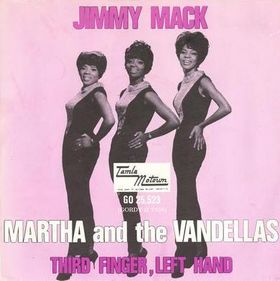
Martha and the Vandellas – “Jimmy Mack”

jimmy mack
Martha and the Vandellas – “Jimmy Mack,” Pop # 10, R&B # 1

By Joel Francis

“Jimmy Mack” capped a remarkable four-year run by the trio that started with “Come and Get These Memories” in 1963. Like most of the group’s hits during that time, “Jimmy Mack” was written and produced by the redoubtable Holland-Dozier-Holland team. Coincidentally, “Jimmy Mack” was not only the Vandellas final Top 10 hit, but the last time the trio worked with Holland-Dozier-Holland before the songwriting team departed Motown in early 1968 over a royalty dispute.

Although HDH had a half-dozen major hits with Motown before their work slowdown/standoff with Berry Gordy, “Jimmy Mack” was recorded in 1964 but shelved after it failed to pass the weekly Quality Control meetings. When it was rescued from the vaults three years later, the lyrics took on a whole new dimension.

President Lyndon Johnson’s escalation of troops in Vietnam brought new poignancy to Martha Reeves’ musings of when her man would return. Originally written as a tempted woman’s plea for her boyfriend to return, many separated young couples interpreted the song as an overseas missive to a lost loved one.

Not that the song’s arrangement could support such a weighty metaphor. “Jimmy Mack” is little more than handclaps, perky piano and vocals. Reeves’ sunny vocals are void of any heartache, but the melody is catchy enough to compensate. Listen to this once and you’ll be signing it for the rest of the day.

Nearly 20 years later, Sheena Easton revived “Jimmy Mack” and took it to No. 65 in 1986.