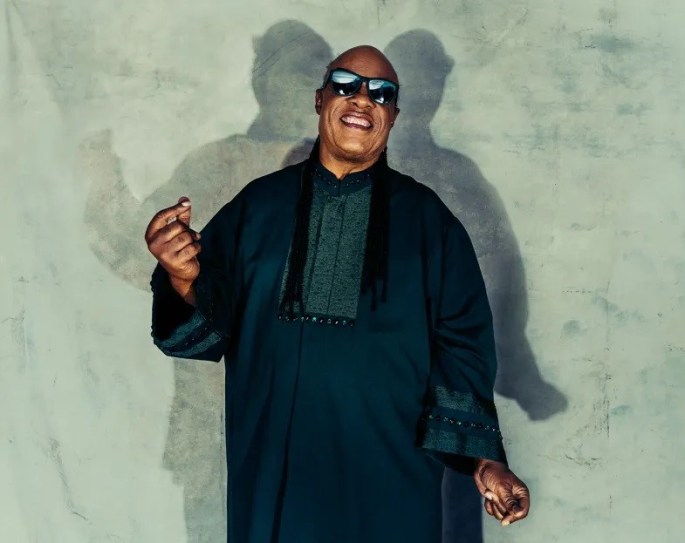
Review: Stevie Wonder

By Joel Francis
The Daily Record

It took 34 on-stage musicians to turn Stevie Wonder’s inner visions into reality on Thursday night at the Fiserv Forum in Milwaukee.

Wonder’s band encompassed a 12-piece string section, six backing vocalists, a five-piece horn ensemble, two percussionists, two guitarists, two keyboard players and one drummer, bass player, guest singer, conductor and, of course, the man himself. Oh, and two of his grandchildren.

Performing in the same space that just three months ago was home to the Republican National Convention, Wonder and his expansive entourage spread a message of love, hope and joy to all people, regardless of background or political affiliation. With only 11 dates, Wonder’s Sing Your Song! As We Fix Our Nation’s Broken Heart tour is aimed primarily at swing states in the weeks leading up to the presidential election.

Flanked by his son and daughter – both of whom were in the band – Wonder took the stage and proclaimed he was “here to speak to you from the heart and spread some love.” That message shined in the opening number, “Can We Fix Our Nations Broken Heart.” Released late this summer, the song was a call for unity and understanding.

For the next two and a half hours, Wonder played most of his biggest numbers, many of which happened to reinforce his message of dropping defenses and building bridges. As polarized as the nation is right now, Wonder’s dream felt a lot less naïve when delivered via “Higher Ground” or “As.”

Wonder let the crowd take over for several songs in the first set, leading the nearly sold-out arena through “You Are My Sunshine,” which segued into “You Are the Sunshine of My Life.” The crowd also handled lead vocals for a trio of Wonder’s early hits: “For Once In My Life,” “Signed, Sealed, Delivered I’m Yours,” and “My Cherie Amour.”

Other high points in the first set include the early one-two punch of “If You Really Love Me” and “Master Blaster (Jammin’).” One of Wonder’s most beautiful ballads, “Overjoyed” closed the opening portion.

After a dozen songs, Wonder introduced his latest protégé, Shelea, and took a short break. Seated behind Wonder’s grand piano, Shelea delivered a medley of Aretha Franklin, Roberta Flack and Carole King songs that were well-received. A full-band performance of her original song “Something’s Coming” was better suited for the Broadway stage than the Apollo Theater. Fortunately, a dynamite version of the instrumental “Contusion” – the first of many songs from Wonder’s acclaimed album Songs in the Key of Life – brought Wonder back out and the night back on track.

The rest of the night was a powerhouse, each song building on each other, taking the audience higher and higher. The buoyant, horn-driven “Sir Duke” led right into the joyous reminiscing of “I Wish.” Wonder wrote “Isn’t She Lovely” for his newborn daughter Aisha Morris, now a grown woman who performed with the backing vocalists and brought her own children to the show. This gave way to another singalong, the worldwide smash “I Just Called to Say I Love You.” Whatever treacly sentimentality that song held in the hearts of the cynical was quickly wiped away by “Superstition.”

A few songs earlier, Wonder briefly tabled his dream of hope with a hard dose of reality, putting the plea “Love’s in Need of Love Today” against “Village Ghetto Land,” a beautiful baroque hymn of injustice and poverty. Wonder pushed even more focus on inequality and oppression with “Living for the City.” Performed consecutively, these songs were a poignant reminder of how society can’t advance until every person is able to move forward.

An extended medley of three epic numbers ended the night. First up was “Do I Do,” a horn-infected disco number that made sure everyone stayed on their feet. That gave way to the rapturous “As,” one of Wonder’s most beloved songs. Just when “As” started to fade away, Wonder kicked the band into the bossa nova groove of “Another Star” and took the energy to another level. By the time Wonder said good night he had achieved his dream of bringing people together. Everyone rejoiced as Wonder’s music cascaded over their souls. Of course, the tougher job is achieving this feeling of togetherness away from the concert. But Wonder clearly believes we are up to the task. I do, too.

Set list: First set: Can We Fix Our Nation’s Broken Heart, As If You Read My Mind, If You Really Love Me, Master Blaster (Jammin’), Higher Ground, You Are My Sunshine > You Are the Sunshine of My Life, For Once in My Life, Signed, Sealed, Delivered I’m Yours, Send One Your Love, My Cherie Amour, Overjoyed.
Shelea set: Medley: Until You Come Back to Me (That’s What I’m Gonna Do)/Feel Like Makin’ Love/ You’ve Got a Friend, Something’s Coming, Contusion.
Second set: Don’t You Worry ‘Bout a Thing, Love’s in Need of Love Today, Village Ghetto Land, Living for the City, Sir Duke, I Wish, Isn’t She Lovely, I Just Called to Say I Love You, Superstition, Do I Do > As > Another Star.

Keep reading:

A survey of post-‘70s Stevie Wonder (Part One: The ‘80s)

Stevie Wonder – “Signed, Sealed, Delivered I’m Yours”

Stevie Wonder celebrates Michael Jackson at Starlight

A survey of post-‘70s Stevie Wonder (Part Three: The ‘90s and ‘00s)

By Joel Francis
The Daily Record

After averaging nearly an album a year for the first quarter-century of his career, Stevie Wonder slowed down his output considerably in the late ‘80s, releasing only three albums in eight years.

Wonder surprised and delighted fans by dropping Natural Wonder, a double-live album, just eight months after his previous offering, Conversation Peace. With a set list that includes many big hits, deep cuts and new songs, Natural Wonder seems to have something for everyone. The concept of Stevie Wonder performing with a symphony orchestra is intriguing but the result is something less than vital. While the performances captured on Natural Wonder are strong, many of them simply aren’t that different from their studio counterparts.

The stirring new song “Dancing to the Rhythm” makes full use of the lush musical backdrop, combining a drum corps with horn section and sweeping string section. Wonder’s skills as an arranger shine on this dynamic opening number. A few songs later, the appropriately bluesy instrumental “Stevie Ray Blues” sets up an energetic romp through “Higher Ground.” The final new number is “Ms. & Mr. Little Ones,” an undistinguished Conversation Peace outtake.

The performance of “Tomorrow Robins Will Sing” shows how a little tightening could have improved the songs on Conversation Peace. Natural Wonder’s live version trims nearly a minute off its studio counterpart and is much better for it. Overall, Natural Wonder is a fun souvenir of a magical night for those who were there, but not something fans will turn to often.

Ten years after the one-two of Conversation Peace and Natural Wonder, Wonder gifted fans with A Time to Love, his last album to date. The album’s two singles set the template for much of the release: funk numbers and ballads.

“From the Bottom of My Heart” is a drippy love song that offers no surprises, including the fact that it won another Grammy. A third of the album runs in this vein. There are two more songs just as bland, plus a tribute to Wonder’s late wife and collaborator Syreeta Wright and a jazzy duet with his daughter, Aisha Morris.

The best of these songs is “Moon Blue,” a jazz number with some of Wonder’s best singing. In a better world, this would be a standard. It’s easy to imagine Robert Glasper or Erykah Badu digging into the song. The other stand-out ballad is “Passionate Raindrops,” which harkens back to Talking Book. A Time to Love would be a much better album if Wonder had kept these two ballads and excised the rest.

The upbeat numbers are an equally mixed bag. Lead single “So What the Fuss” doesn’t quite work, but Prince’s funky guitar lines almost make up for it. “Sweetest Somebody I Know” mines Wonder’s classic clavinet sound, while “Please Don’t Hurt My Baby” heads further down the path plowed by “Superstition.” On “Positivity,” Wonder’s second duet with Morris, his daughter’s sunny soprano is a nice counterpoint to Wonder’s talk box. It’s hard to believe this number was never used in an animated kid’s film. “Tell Your Heart I Love You” features Wonder’s signature harmonica, an under-utilized instrument on his later albums. Its arrival pushes the bluesy number to another level.

A Time to Love ends with the title number. Across nine minutes, Wonder, with help from India.Arie on vocals and Paul McCartney on guitars, ponders why we have time for so many other activities, but not for love. It’s not the most groundbreaking thought, but the percussion and choir sweep in and save the day. A couple minutes could easily be trimmed from the performance without missing anything. This advice applies to A Time to Love as a whole. At 15 songs and 78 minutes (only 7 minutes shorter than Songs in the Key of Life), A Time to Love would be a much better album if Wonder culled most of the ballads and brought the run time to under an hour.

Almost 20 years later, A Time to Love still stands as Wonder’s most recent album. While Wonder hasn’t been prolific in the decades since he has kept busy. In the final installment, we’ll look at 15 excellent, late-period, non-album Stevie Wonder songs.

Keep reading:

A survey of post-‘70s Stevie Wonder (Part One: The ‘80s)

A survey of post-’70s Stevie Wonder (Part Two: The ’80s and ’90s)

Social Distancing Spins – Days 15-17 (including Stevie Wonder’s Music of My Mind)

A survey of post-‘70s Stevie Wonder (Part Two: The ‘80s and ‘90s)

By Joel Francis
The Daily Record

More than halfway through the 1980s, Stevie Wonder’s output was mixed. Hotter Than July and In Square Circle were both strong releases, but the ubiquity of successful sappy singles “Ebony and Ivory” and “I Just Called to Say I Love You” cast a pall over his triumphs.

At 12 songs and more than an hour, no one could accuse Wonder of being lethargic on his 1987 release Characters. Sadly, not much works. “You Will Know” is fine, but opening the album with this ballad makes it feel like we’ve joined something already in progress. “Skeletons,” a look at political corruption, feels like an update of something we’ve heard before – and done much better – on “Superstition” and “You Haven’t Done Nothing.”

Wonder and Michael Jackson traded album appearances in 1987. After Wonder guested the Bad album cut “Just Good Friends,” Jackson repaid the favor with the single “Get It.” Like Wonder’s earlier efforts with Paul McCartney, these meetings of the Motown child stars are somehow less than the sum of their parts. Neither is bad, per se, but they don’t linger in my ears past their runtimes.

“My Eyes Don’t Cry No More” combines autobiographic verses with a resolute chorus over a swinging electronic production. Another tear-themed song, “Cryin’ Through the Night” (shouldn’t these two titles cancel each other out?) is a surprisingly up-tempo tale of heartbreak. Finally, “Free,” the closing song on the vinyl edition, stands as the album’s final moment, a rousing call for freedom. Wonder really liked ending albums with proclamations.

These five songs – less than half the album – comprise Characters’ high points. The other songs are either too maudlin or half-baked to discuss. “Come Let Me Make Your Love Come Down” earns special derision for not only its awkward title, but for squandering a rare guitar summit between B.B. King and Stevie Ray Vaughan. When critics trumpet Wonder’s lost muse, most of that reputation rests on The Woman in Red and Characters. And for those two albums, it is deserved.

For the better part of two decades, Stevie Wonder’s production defined and redefined the boundaries of music. By the time Wonder rolled into the 1990s, his fourth decade as an artist, he was now following the sound of the times rather than creating it. No one stays on the bleeding edge forever and how Wonder adapted his songwriting and arrangements to the culture reveals other facets of his creativity.

Wonder took another break after Characters, releasing his next album four years later, in 1991. The soundtrack to Spike Lee’s Jungle Fever featured programmed drums and lots of synthesizers across it’s 11 tracks. The overall aesthetic tiptoes up to the au courant sound of new jack swing, but rarely feels that urban.

Lead song “Fun Day” is an exception to this rule, featuring a lively hip hop drum track. The song soars, living up to its title and erasing any lingering doubts caused by Wonder’s previous underbaked release. Obligatory ballad single “These Three Words” is heartfelt and has a timeless feel. It is easily Wonder’s best ballad since “Overjoyed.”

The soundtrack’s final single, “Gotta Have You” combines a programmed drum track with a typically funky groove. Although it wasn’t released as a single, the title song featured prominently in the film. While it won’t win any songwriting awards it is infectiously catchy and fun. The best song is buried near the end. “Chemical Love” is an anti-drug number that dodges cliches and generalizations by looking at the spiritual and emotional cravings people try to fill with poisonous substances.

Jungle Fever doesn’t quite rise to classic status – the rest of the material is fine but not particularly noteworthy – but it is worth a second look.

Wonder went further into new jack swing on Conversation Peace, released in 1995. At 13 songs and 74 minutes, there is a good album buried among all the bloat. Excising some of the songs and trimming down the performances – most cuts hover around six minutes – would have helped immensely. For every banger like “My Love is With You,” the apex of Wonder’s new jack swing infatuation, there’s a track like “Cold Chill” that goes nowhere and takes too long to get there.

“Edge of Eternity” is an upbeat love song with a tight horn line, while “Take the Time Out” is an empathetic look at homelessness and poverty with Ladysmith Black Mambazo. Deeper in the album, “For Your Love” is the requisite love ballad single. Despite winning a Grammy, the track feels pretty generic. The propulsive “Sorry” is much better, but its production sounds more like the mid-‘80s than the mid-‘90s. “Sorry” sets up the closing number and title song to end the album on a strong note.

Keep Reading:

A survey of post-‘70s Stevie Wonder (Part One: The ‘80s)

Stevie Wonder – “For Once in my Life”

The Spinners – “It’s A Shame”

Gladys Knight and the Pips – “If I Were Your Woman”

Gladys Knight and the Pips – “If I Were Your Woman,” Pop #9, R&B #1

By Joel Francis
The Daily Record

Relationship fantasies were nothing new at Motown – Mary Wells’ “The One Who Really Loves You” was one of the label’s earliest singles. But Gladys Knight and the Pips’ 1971 single “If I Were Your Woman” shows how much Hitsville had grown up during the ‘60s. The song removes the concept from the realm of schoolgirl crushes and infuses it with some serious grown-up desire.

When “If I Were Your Woman” came out the Pips were on a run of three consecutive Top 5 R&B hits, dating back to 1969’s No. 3 “The Nitty Gritty.” The group was determined to keep this streak intact and also bolster their album sales; none of their LPs had cracked the Top 10. They accomplished both. The single went all the way to the top of the R&B charts, and the album – given the same name – lodged at No. 4.

Knight’s smoky, smoldering voice played no small role in that achievement. Listeners who grew up with “Baby Love” no doubt enjoyed hearing love songs that matured with them. Knight sumptuously plays the role of a woman in love with a man trapped in a bad relationship. Knight knows she can make him the man he deserves to be, if only he could muster the strength to walk away … and she could find the courage to confront him face-to-face.

Knight sings with the passion of a woman pouring out her deepest desires to the darkness, a conviction rooted in the comfort of knowing these words will never face the harsh scrutiny of daylight. As the song fades, it is easy to imagine Knight drifting off to sleep as her would-be beau lies awake in bed next to his partner, wondering how he wound up in this predicament. The next time Knight and her man meet, their only exchanges will be furtive glances across the room and brief, awkward conversation punctuated by nervous laughter.

Written by Gloria Jones, Clay McMurray and Pam Sawyer and produced by McMurray, “If I Were Your Woman” inspired several covers. The Jean Terrell-fronted Supremes recorded a version the following year, in 1972. One year later, Jones – better known as the original singer of the song “Tainted Love,” later recorded by Soft Cell, and girlfriend of T. Rex glam rocker Marc Bolan – recorded her own version for her second solo album.

Bonnie Bramlett, formerly known as half of Delaney and Bonnie, followed suit in 1976. The unfairly ignored Bettye LaVette put her stamp on the song on her only Motown album, 1980s “Tell Me A Lie.” Eight years later Stephanie Mills put the song back on the charts, where it reached No. 19 on the Hot Black Singles chart (now known as the Hot R&B/Hip Hop chart). That same year found the only male interpretation of the number, when George Michael performed it at Nelson Mandella’s 70th birthday tribute. Somehow people were still shocked when he came out of the closet a decade later.

Most recently, Alicia Keys included the song as part of a medley on her sophomore album, and gave it the stand-alone treatment on her 2005 live album “MTV Unplugged.”

The Supremes – “Stoned Love”

The Supremes – “Stoned Love,” Pop # 7, R&B #1

By Joel Francis
The Daily Record

“Stoned Love” was the Supremes’ biggest hit of the post-Diana Ross era, and with good reason – it sounds like a throwback to the golden Holland-Dozier-Holland age of Motown.

Motown producer Frank Wilson discovered the song when it was played over Detroit radio during a talent search contest. Amazed to find such a mature work had been penned by a local teenager, Wilson worked with Kenny Thomas, the young writer, and arranger David DePitte before presenting the number to Berry Gordy and the Supremes.

In a narrative repeated so frequently it has nearly become a cliché, Gordy hated the song. The reason for Gordy’s dislike is unclear, but there was concern over the title. Thomas and Wilson insisted the title referred to love with a solid foundation, not drug use. The original title, “Stone Love” supports this claim. Somehow the single was mislabeled “Stoned Love” at the pressing plant and the new title stuck.

Just as they had three years ago when the Doors sang “we couldn’t get much higher” on the Ed Sullivan Show, CBS freaked out over the potential reference and cut the song from the girls’ appearance on the Merv Griffin Show.

As usual, the censors paid more attention to the hysteria than the work itself. Wilson’s lyrics call for “a love for each other that will bring fighting to an end/forgiving one another” and challenge for the “young at heart” to “rise up and take your stand.”

The hope-filled lyrics brim with the optimism of youth and could easily turn into treacle. Thomas and DePitte turned them into a great showcase for Jean Terrell’s talents. All elements seem to feed off her emotion, particularly the inspired backing vocals of fellow Supremes Mary Wilson and Cindy Birdsong. Wilson and Birdsong had been banished from the final recording sessions with Ross and they seem extra happy to be operating as a group again.

From the propulsive snare driving the song, down to the swirling strings and display of voices, the arrangement recalls the Supreme’s finest moments with the Holland-Dozier-Holland team. Fans seemed to agree, sending the song to the top of the R&B chart an into the pop Top 10. Again, Gordy’s steadfast, initial instinct had been proven wrong.

The legacy of “Stoned Love” lies more with its title than its tune. Angie Stone incorporated it into the introduction on her “Stone Love” album in 2004, just one of many similar titles it inspired. These include “Stone in Love” by Journey and the smilar “Stoned in Love” by UK dance pop artist Chicane. In 2006 Justin Timberlake released the single “LoveStoned.” None of these songs hold a candle to “Stoned Love.”

A Capitol Fourth

(Above: The primitive beauty of unaccompanied fireworks over the national Mall on July 4, 2010.)

By Joel Francis
The Daily Record

WASHINGTON, DC – Soul legend Gladys Knight took the stage staring into a sea of empty seats. It was three hours before show time, and the VIPs with reserved seats wisely avoided the blistering afternoon sun.

Knight, however, was undeterred. “This is a thing we used to call audience participation,” she hollered to the groundlings on the Capitol lawn who arrived hours before to stake a prime spot. Knight drew out each syllable of “par-tic-i-pat-ion” and drew cheers of delight from the exhausted but excited assembly of hundreds.

When Knight launched into a call and response, her words were thrown back with force and a smile crossed her face. After a few volleys, the band pumped the final vamp as she threw up her arms and walked from the stage. The 30-minute mini-set, which included a few instrumental runs through made the risk of heat stroke seem reasonable.

The blazing sun had been replaced with bright stage lights and television cameras when Knight re-emerged shortly after 8 p.m. After a brief welcome by MC Jimmy Smits, American Idol David Archuleta opened the show with the “Star-Spangled Banner.” Then it was time to get down to business.

The Empress of Soul emerged in a golden gown, flying into “Midnight Train to Georgia.” Knight’s voice was strong in the afternoon, but now she sang with even more soul and emotion. The words are the same, but the phrasing was different and they were delivered with a power has been honed over Knight’s half-century career.

Her voice rises in sharp contrast to Darius Rucker’s, who also sound checked in the afternoon. I realize his laid-back, what-you-see-is-what-you-get charm is a large part of his appeal, but there was very little difference between the run-through and televised performances. Rucker has a fine voice, but I hope he was paying attention.

Barely pausing after “Georgia,” the band hic-cupped into Knight’s 1969 hit “The Nitty Gritty.” Knight used the upbeat number to pay tribute to two of her departed Motown label mates, dropping in a healthy portion of the Jacksons’ “Shake Your Body (Down to the Ground)” and a sample of a Rick James number. Then it was time to finish business with her biggest hit, “I Heard It Through the Grapevine,” which showed no signs of age.

And that was it. Ten minutes, three songs, and she was walking offstage. Afterward people started asking me if it was worth it to trek to the Mall so early and broil for so long. Absolutely. Knight’s presence cemented my attendance, but I likely would have gone anyway. As far back as I can remember, my family always gathered around the television on the Fourth of July to watch the PBS broadcast from the capital. And now, with my parents rooting me on from their air-conditioned living room, I was there.

The performances I remember from growing up were classical and marching band pieces, so the National Symphony Orchestra’s patriotic overture from “George M.” and classical pianist Lang Lang’s solo adaptation of “Stars and Stripes Forever” resonated the most deeply. Once the shock of hearing Sousa’s most famous number without horns wore off, Lang’s performance was quite profound. The lines typically dominated by trombones and tubas was intricate and dissonant, while the familiar piccolo refrain had a ragtime feel.

Although the Capitol lawn is vast, it was easy to forget about the thousands of people standing behind me and the hundreds of thousands gathered behind the stage, on the Mall. In a way, the “Capitol Fourth” broadcast felt like any concert in the park, albeit one with TV cameras and A-list talent. As John Schneider (aka Bo Duke) led a recap celebrating the 30th anniversary of the broadcast, I abandoned the concert grounds and headliner Reba McEntire and to be part of the teeming masses camping around the Washington Monument.

The high-profile event disappeared with every step. The lawns on the Mall were filled with tents, displays and crowds oblivious to the concert behind them. Walking through one block I encountered an expanse of grass filled with multi-colored tents bearing signs like “Yoga and Meditation” and “Free Feast.” The tent most intriguing to me featured live traditional Indian music. The artists onstage were nearly obscured by smoke, and the crowd was sparse, but there were more people dancing than watching.

A block further, I spotted what I thought to be a poetry slam backed by a live drummer. Upon closer inspection it was a different sort of poet, a fevered evangelist in the middle of a passionate altar call. I briefly raised my hand in solidarity and pressed on.

An orange band hovered on the horizon above the Lincoln Memorial when the fireworks started shortly after 9 p.m. Unlike all previous July 4th celebrations I have attended, the carnival of explosions around the Washington Monument burst without accompaniment. The muffled pops and sizzles from each multi-color detonation was met by the collective oohs and ahs of thousands. In place of orchestration, my ears were treated to a kaleidoscope of accents, dialects and languages, punctuated by the occasional far-off siren or barking vendor. It was one of the rare moments in my life when music was rendered completely redundant.

For 20 minutes we stood united by a common gaze in the sky, a diverse collection of tourists from all parts of the map. Although the horde easily exceeded the audience created by the simultaneous emptying of Kauffman and Arrowhead stadiums, the Kansas Speedway and Sprint Center, there was no whiff of anger or danger. Small children danced in front of their strollers as teen-agers texted their friends and old-timers remembered when. It would be poetic to say that when the display ended we all went back to our respective lives, but in reality we all just swarmed to a different location – the subway stations.

Keep reading:

Stuck in a Moment: 9/11 and U2

“Tippecanoe and Tyler Too:” Original Campaign Music

Folkways gets trampled underfoot at renovated Smithsonian

Smokey Robinson and the Miracles – “The Tears of a Clown”

Smokey Robinson and the Miracles – “The Tears of a Clown,” Pop #1, R&B #1

By Joel Francis
The Daily Record

One of pop music’s most unique and amazing properties is its ability to wrap the most heartbreaking lyrics in a bubbly, effervescent melody.

Think about it for a moment. While there are shades and degrees to consider, and this is obviously a simplification, because other types of art usually inhabit only one medium, i.e. words or images, a sad poem or a sad painting typically going to be predominately sad. I’m not saying music is the only art form to convey multiple emotions at once; that’s a ludicrous assumption. But it seems pop music does this a lot easier than most.

Few songs handle the light/dark juxtaposition as effortlessly as Smokey Robinson and the Miracles’ 1970 smash “The Tears of a Clown.” The song started out as an instrumental Stevie Wonder wrote with his producer Hank Crosby. Unsure what to do with what Wonder knew was a great track, he brought it to the Motown Christmas party in 1966 to see if Robinson had any ideas. Robinson said hear head a circus in the melody and wrote the lyrics. The finished track appeared as the final song on the Miracles 1967 release “Make It Happen.”

For three years the song lay hidden as a deep cut, ignored by both the label and the band. In 1969, Robinson announced he was tired of touring and being separated from his family. By leaving the Miracles, Robinson reasoned, he could spend more time in Detroit with his family and focus on his role as Motown’s vice president. From Robinson’s perspective, it was a sound plan. The trouble was, the Miracles were one of Motown’s biggest act in Europe and the band had delivered only one Top 10 hit over the last two years. Desperate for new material, Hitsville UK scoured the vaults and back releases and stumbled upon the long-forgotten “The Tears of a Clown.” After giving the song a new mix it was released as a single in February, 1970. The song shot to No. 1 on both sides of the Atlantic.

Fortunately for music fans everywhere, the song’s success made Robinson reconsider his decision to leave the Miracles. Motown re-released “Make It Happen” with a modified tracklisting as “Tears of a Clown” – even the cover art stayed the same – and Robinson stayed in the Miracles until 1973.

Thematically, “The Tears of a Clown” mirrors the Miracles’ 1965 hit “The Tracks of My Tears.” Both songs deal with a heartbroken lover masking his/her pain in public. The subject of both songs craves the estranged, but it too proud to share those feelings in all but the darkest, quietest places. Not happy stuff. But while it was impossible to escape the anguish of “The Tracks of My Tears,” listeners could be possibly forgiven for thinking “The Tears of Clown” was little more than a happy romp on the calliope. Wonder and Cosby’s upbeat melody is a perfect antonym for Robinson’s lyrics. One moment poignantly cuts at the heart of the song, however. The arrangement briefly pauses while Robinson confesses “when there’s no one around.” In those tender seconds, his soul is laid bare.

“The Tears of a Clown” was the Miracles biggest hit while Robinson was in the group. Unsurprisingly, several other bands wanted a taste of this success. “Clown” has been widely covered over the past 40 years. The English Beat delivered one of the best interpretations with their 1979 ska adaptation of the song. At the other end of the spectrum are the version cut by LaToya Jackson for her 1995 Motown covers album, and Enuff Z’Nuff’s hair metal reading. Somewhere in the middle lie Phil Collin’s version, included on his “Testify” album, and Petula Clark’s 2000 reading. Early ‘90s Swedish pop duo Roxette also worked the “Clown” melody into their hit “Spending My Time.”

Jackson Five – “I’ll Be There”

Jackson Five – “I’ll Be There,” Pop #1, R&B #1

By Joel Francis
The Daily Record

To say that the Jackson 5’s formula was successful would be a terrific understatement. Three upbeat, bubblegum hits, all penned and produced by Berry Gordy and his faceless Corporation, all No. 1 pop and R&B smashes.

Gordy’s decision to break from the formula for the group’s fourth hit was shocking. Not known as one to mess with a sure thing, Gordy dumped the Corporation and partnered with Hal Davis, Willie Hutch and Bob Wests to craft a ballad that placed Michael Jackson directly the spotlight, and relegated his brothers to a support role.

The result was the J5’s most successful single ever, selling 4 million copies in the United States and cementing the band’s career beyond bubblegum. “I’ll Be There” was also the group’s last No. 1 hit; three more singles ceilinged at No. 2.

Only 12 years old at the time, Jackson dumps more emotion into his delivery than many singers twice his age possess. His clarion call to give love another chance is graceful and penetrating. Gordy positioned Diana Ross as the J5’s mentor – her influence shines in Jackson’s delivery, both in phrasing and tone.

“I’ll Be There” was covered by Mariah Carey and Trey Lorenz as a duet in 1992. The single was her sixth No. 1 hit, but the less said about her treacly reading the better. More interestingly, it appeared on the fourth album by Southern California punk rockers Me First and the Gimme Gimmes in 2003, who frequently recorded ironic covers. “I’ll Be There” graced two other Motown releases. The Temptations recorded a version for their 2006 album “Reflections” and sister La Toya Jackson cut it for her 1995 covers album. Many artists, including Carey, the New Kids on the Block, Jaime Foxx and Ne-Yo and Green Day performed “I’ll Be There” in tribute to Jackson after his death on June 25, 2009.

Michael Jackson performed “I’ll Be There” on all of his solo tours, frequently getting emotional and breaking down mid-song.

Four Tops – “Still Water (Love)”

Four Tops – “Still Water (Love),” Pop # 11, R&B #4

By Joel Francis
The Daily Record

The Four Tops needed this.

The departure of Holland-Dozier-Holland was a devastating blow to all of Motown, but the Tops felt it especially hard. “Bernadette” made them the top Motown act in U.K., second only to the Temptations at home. But just when they made it to the top, their songwriters and producers left.

After the HDH exodus, the Tops dabbled on the fringes of psychedelic soul (“It’s All in the Game”), the folk revival (“If I Were A Carpenter”) and covered the Left Banke’s “Walk Away Renee” to solid, but not spectacular results.

Finally, after being passed around to Ashford and Simpson, Ivy Jo Hunter and Norman Whitfield, the tops were paired with Smokey Robinson, who, with Frank Wilson, wrote and produced “Still Water (Love).”

Singer Levi Stubbs opens the track drenched in echo, inviting the listener “Walk with me/Take my hand.” The arrangement has a distinctive Motown touch, filled with a great guitar hook, clavinet and an ornate percussion figure pushed to the front of the mix. As always, the Tops’ vocals are great, and while Stubbs isn’t given much room to cut loose, he still belts a couple notes before the chorus.

“Still Water (Love)” opened the Tops’ 1970 concept album “Still Waters Run Deep,” which inspired Marvin Gaye to compose “What’s Going On.” “Still Water (Love)” was covered by the Jean Terrell lineup of the Supremes in the early ‘70s, and soul singer O’Bryan.

Four Tops – “Still Water (Love),” Pop # 11, R&B #4.

The Four Tops needed this.

The departure of Holland-Dozier-Holland was a devastating blow to all of Motown, but the Tops felt it especially hard. “Bernadette” made them the top Motown act in U.K., second only to the Temptations at home. But just when they made it to the top, their songwriters and producers left.

After the HDH exodus, the Tops dabbled on the fringes of psychedelic soul (“It’s All in the Game”), the folk revival (“If I Were A Carpenter”) and covered the Left Banke’s “Walk Away Renee” to solid, but not spectacular results.

Finally, after being passed around to Ashford and Simpson, Ivy Jo Hunter and Norman Whitfield, the tops were paired with Smokey Robinson, who, with Frank Wilson, wrote and produced “Still Water (Love).”

Singer Levi Stubbs opens the track drenched in echo, inviting the listener “Walk with me/Take my hand.” The arrangement has a distinctive Motown touch, filled with a great guitar hook, clavinet and an ornate percussion figure pushed to the front of the mix. As always, the Tops’ vocals are great, and while Stubbs isn’t given much room to cut loose, he still belts a couple notes before the chorus.

“Still Water (Love)” opened the Tops’ 1970 concept album “Still Waters Run Deep,” which inspired Marvin Gaye to compose “What’s Going On.” “Still Water (Love)” was covered by the Jean Terrell lineup of the Supremes in the early ‘70s, and soul singer O’Bryan.

Diana Ross – “Ain’t No Mountain High Enough”

Diana Ross – “Ain’t No Mountain High Enough,” Pop #1, R&B #1

By Joel Francis
The Daily Record

This was the moment. For years, Berry Gordy had been grooming Diana Ross to become a star. First he pushed the hesitant child to the forefront of the Supremes, then elevated her to top billing. Now she was on her own.

Ross’ first single, “Reach Out and Touch (Somebody’s Hand)” was a respectable Top 20 hit. For anyone else, it would have been a brilliant success. But at Motown, and especially for Ross, Top 20 was not good enough. She had to top the charts.

For her follow-up effort, Gordy turned to Nick Ashford and Valerie Simpson, who also penned “Reach Out.” Instead of writing a new number, however, the pair reached back to a song that had been a Top 20 hit for Marvin Gaye and Tammi Terrell three years earlier. Their choice wasn’t well received. Ross was hesitant to cut a song that had already been a hit with someone else. Besides, she had also performed the song when the Supremes paired with the Temptations for a television special and album in 1968.

Eventually, Ross was persuaded to record a re-imagined version of the song. While Gaye and Terrell’s arrangement build upon the synergy of their voices, the new vision opens with Ross’ affirmation of love, like a lonely, long-distance telephone call. The backing chorus of Ashford and Simpson, the Andantes and several other Motown studio singers builds slowly in the background underneath Ross’ promises of devotion. By waiting so long to grow into the refrain, the familiar strain is even more powerful.

When the finished track was submitted to Gordy he was not pleased. He thought the song should open with the chorus (an arrangement Ross later used in her live shows). In a story that mirrors Gaye’s recording of “I Heard It Through the Grapevine,” it wasn’t until DJs started cutting down the six-minute album track and playing it on the radio that Gordy finally acquiesced. Just as before, “Mountain” made a major star out of its singer.

“Ain’t No Mountain High Enough” has been played, performed and sampled so often it sometimes feels like a cliché. It seems every time a director wants a feel-good moment when the underdog triumphs they reach for this song (which must make Gordy, Ashford, Simpson and their bankers very happy). When the song reaches ears voluntarily, however, it is still a delight.