Review: Sly and Robbie

(Above: Sly and Robbie drop heavy riddim at Red Rocks in 2008.)

By Joel Francis
The Kansas City Star

If Robbie Shakespeare’s job as a musician fizzles, he could probably make a living bringing down buildings. Alongside rhythm partner Sly Dunbar, Shakespeare’s bass rattled the foundations of the Folly Theater for nearly two hours Saturday night.

Backed by the four-piece Taxi Gang, Sly and Robbie delivered their signature reggae sound, which has appeared on literally tens of thousands of records, encompassing everyone from Bob Dylan to Peter Tosh.

The night started with an instrumental that exceeded 20 minutes in which the musicians passed solos like a jazz combo. As the trombone and saxophone bridged the gap between Afro-beat and ska, the keyboards and guitar subliminally sparkled underneath. When the guitarist popped to the forefront he delivered solos that recalled Carlos Santana, displayed Eddie Van Halen’s two-finger tapping and went Jacques Cousteau on his wah peddle for a solo that sounded like it was played underwater.

Though they politely shared the spotlight, Sly and Robbie were never far from the forefront. Robbie’s bass was so loud it drowned out most of the vocals and probably registered on the Richter scale. Sly’s drums sat neatly on top, crisp, precise and articulate. Their playing wasn’t flashy, but their grooves spoke volumes.

The Folly was half-full at best, but the band worked the room like it was packed. Putting down his horn, the trombone player paced the stage leading the crowd in call and response. He delivered a great cover of LeRoy Smart’s “Ballistic Affair,” which featured Sly and Robbie on the original 1976 recording, and drew the biggest applause of the night with a reading of Bob Marley’s “Rastaman Chant.” The sextet slowed that number ever so slightly, accentuating the song’s gospel elements.

Though their playing was engaging, the music did get a little samey after about an hour. The echo-laden drums and behind-the-beat accompaniment typical of deep dub only hold so much room for exploration. Fortunately, a surprise appearance from singer Peter Gayle rescued the set.

Acting as if there were a secret ordinance against standing still, Gayle was constantly kicking his feet along with the beat, twirling his long dreadlocks or suggestively swinging his hips. His G-rated cover of Webbie’s “I Miss You” excited the crowd and the energy stayed high after he was gone.

The concert was part of the “Cyprus Avenue Live at the Folly” series, and came just one night after the ensemble’s performance at the Wakarusa Music Festival in its new home at Ozark, Ark.

The band opened their encore set with a cover of Tex Ritter’s Oscar winning ““High Noon (Do Not Forsake Me).” Robbie said this was their first time performing the number and the arrangement was little more than his vocals and Sly pounding out the Bo Diddley beat on his bass drum. They closed with “Welcome to Jamrock,” which after several minutes somehow morphed into a gentle jazz saxophone solo. After saying good night, half the ensemble left the stage. Seemingly oblivious, the saxophone and keyboard players and guitarist played on, lost in the rhythm.

Traveling Wilburys – “Inside Out”

(Above: The Traveling Wilburys turn “Inside Out.”)

By Joel Francis
The Daily Record

Their meeting was almost too serendipitous. Fresh off the success of “Cloud 9,” George Harrison and producer Jeff Lynne decided to record a b-side with Roy Orbison. When the entourage reached Tom Petty’s house to retrieve Harrison’s guitar, Petty insisted on accompanying the trio to their destination: Bob Dylan’s studio. Dylan was home, of course, and the quintet became the greatest supergroup ever: the Traveling Wilburys.

When the group reconvened two years later in 1990, a lot of the magic was gone. Orbison had died and the remaining members no longer had the element of surprise on their side. Indeed, expectations were set so high not even the century’s greatest songwriter, a former Beatle and a pair of hit-making disciples of both could live up to the standard.

Much of the Wilburys’ sequel, “Volume 3,” sounds forced and lacks the laidback organic vibe that made the first album such a delight. But they got it right in a couple places and “Inside Out” is a lost gem of the era.

Both the second song on “Volume 3” and second single released from the album, “Inside Out” is a transparent look at the Wilburys’ songwriting process and joy that manages to be greater than the sum of its considerable parts.

After opening with a chord progression that sounds like something off Petty’s then-recent “Full Moon Fever” album, Dylan delivers a verse that almost makes “Wiggle Wiggle” look like “Desolation Row.” But the lyrics aren’t that important. The song’s charm lies in the way Dylan’s verse slides into Lynne’s slick multi-tracked bridge that prefaces Petty’s catchy chorus. Oh, and just for good measure Harrison contributes a middle eight that rivals anything his ex-Beatle bandmates ever wrote.  All the ingredients are wrapped in Lynne’s signature production and over in three and a half minutes.

Like a jewelry store exhibit, everything is on open display yet just out of reach. “She’s My Baby” may have been the biggest single and “Wilbury Twist” the most memorable song, but nearly 20 years later, “Inside Out” still sparkles the brightest.

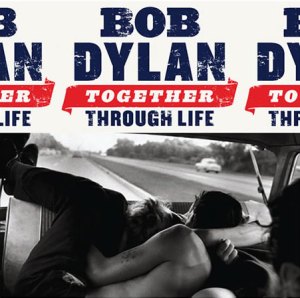
“Together Through Life” is a minor masterpiece

ttl

By Joel Francis

After delivering three “important” albums in the past dozen years, it’s nice to know Bob Dylan can make an album without making a statement.

“Together Through Life” feels like an afternoon drive through a dusty Texas border town with the windows rolled down. Much of that feel comes from the ubiquitous accordion played by David Hildago of Los Lobos. Lyricist Robert Hunter – who co-wrote all but one of “Life”’s tunes with Dylan and is best known  for writing “Casey Jones” and other songs with the Grateful Dead – deserves some credit for the record’s lack of ponderousness.

But lack of weight doesn’t equal a lightweight record in this case. The album is a cousin to “New Morning,” a solid, offering that is overshadowed by the albums surrounding it and filled with songs Dylan recorded because he wanted to, not because he had something to say.

Sonically, the album is cut from the same cloth that has defined Dylan’s previous ‘00’s offerings. It is a pastiche of Chess blues, Sun Records country and rock and pre-war pop. While there’s nothing as sunny as “Silvio,” a track Dylan and Hunter collaborated on 20 years ago, there’s also nothing as forgettable as “Ugliest Girl in the World,” the other fruit borne of that union.

Guitarist Mike Campbell from Tom Petty’s Heartbreakers adds light acoustic guitars and mandolin to most tracks, but drops a murky electric guitar reminiscent of Neil Young on “Forgetful Heart.”  Lyrically the song resembles the material for “Time Out Of Mind,” right down to the dark lyrics: “The door has closed, if indeed there ever was a door.”

While Dylan albums are rarely sunny endeavors, the gloom of “Forgetful Heart,” and the sarcasm of “It’s All Good” are broken by upbeat numbers like “Jolene” and “Shake Mama Shake” – both of which sound like they came from the Chess Studios at 2120 S. Michigan Avenue circa 1958. The tongue-in-cheek “My Wife’s Hometown” might be Dylan’s funniest number since his knock-knock joke in “Po’ Boy “ while “I Feel A Change Coming On” has a twilight optimism.

Fans have grown accustomed to waiting nearly five years between new offerings. “Together Through Life” is surprise arrival little more than two years after “Modern Life.” “Life”’s runtime of 10 tracks and 45 minutes and lack of “statement song” like “Highlands” or “Ain’t Talkin’” make a tempting case to write the album off as a lesser work. Although it will never measure among the first-tier cannon, those who dismiss it do so at their own folly.

Lanois + Raffi = Eno

(Above: Raffi was a staple of The Daily Record’s early childhood. The oft-spun LP remains in its archives.)

By Joel Francis
The Daily Record

Like many adolescent males in the mid-‘60s, Canadian Dan Lanois pined for a guitar. But he didn’t just want to make music, he wanted to record it, too.

Armed with an instrument and a cheap, tiny cassette recorder, Lanois and his brother Robert started recording anything they could find. They soon found manipulating the results was almost as fun as making and capturing the sounds. The siblings eventually invested in a four-track recorder and set up a small studio in the laundry room of their mother’s Ancaster, Ontario home.

The domestic facility was named MSR Studios, and the brothers advertised that for $60 they would not only record a band’s demo, but arrange, play on and compose the tracks as well. A short time after MSR Studios opened for business in the mid-‘70s, the Lanois brothers’ ad caught the eye of Egyptian immigrant Raffi Cavoukian.

Cavoukian was a veteran of Toronto’s folk circuit, but his 1975 album, “Good Luck Boy” generated little heat. Cavoukian’s mother-in-law encouraged him to write and record some songs for the children at her preschool. Aided by his wife, kindergarten teacher Debi Pike, Cavoukian recorded a tape that was so successful other schools started requesting copies.

MSR Studios was everything Cavoukian was looking for. Cheap, efficient and local it even came with its own musicians. In 1976, Cavoukian borrowed $4,000 from a bank recorded his first children’s album, “Singable Songs for the Very Young,” at the Lanois brother’s small home studio. Dan Lanois also played mandolin, recorded, mixed and engineered the album.

The easygoing, folk-flavored “Singable Songs for the Very Young” was a smash that ranked among top children’s album more than two decades after it was released.  Boosted by sessions with Cavoukian, by now going by simply Raffi, Doug McArthur, another Toronto folkie, and rock band Simply Saucer, the Lanois brothers soon had enough money to move their studio to better quarters. In 1978 they purchased a Hamilton, Ontario house on Grant Avenue, which became, naturally, Grant Avenue Studio.

Raffi was one of the first artists to use Grant Avenue Studio. By now he and Dan Lanois had collaborated on two albums and would go on to record two more together. Their body of work together comprised Raffi’s first four children’s albums. Grant Avenue also boasted sessions by singer/songwriter Ian Tyson and new wave band Martha and the Muffins.

The Muffins had just come off a commercially successful tour opening for Roxy Music, but they lost two members in the process. When the remaining quartet decided to carry on, one of the new musicians they recruited was bass player Jocelyne Lanois, sister of Dan and Robert. The Muffins got permission from Virgin to make an album with Dan Lanois with the stipulation that they operate on a miniscule budget. This was no obstacle for Lanois, and the resulting album “This is the Ice Age” generated a Top 40 Canadian single.

The band and album didn’t do much outside of the Great White North, however, and they were dropped by Virgin. The Muffin’s relationship with Lanois, however, flourished through two more albums. Their 1984 album, “Mystery Walk,” featured guest drummer Yogi Horton. Horton was a veteran of the 1981 experimental album “My Life in the Bush of Ghosts” and was recommended by his boss during those sessions, Brian Eno.

Eno, of course, had cemented his legendary reputation with his work in Roxy Music and the solo albums he released in the first half of the 1970s, and his production work with Devo, David Bowie, Talking Heads and the “No New York” No Wave compliation in the second half of the decade. By the mid-‘80s, Eno and Lanois were longtime associates.

Lanois’ tape and recording manipulations first caught Eno’s attention in the late ‘70s. Although embroiled in producing the final chapter in Bowie’s “Berlin Trilogy” and on albums with both the Talking Heads and their bandleader David Byrne, Eno and Lanois met at Grant Avenue to experiment with sound and recording. In 1979, Eno recorded “The Plateaux of Mirror,” the second installment in his ambient series, with Harold Budd at Grant Avenue. Although they did not produce the album, “Bob and Danny Lanois” are thanked in the album credits.

In 1982, Lanois co-produced and played some on the fourth installment of Eno’s ambient series, “On Land.” The following year, Lanois received cover billing for his musical and production contributions to the “Apollo: Atmospheres and Soundtracks.” One of the album’s tracks, “Silver Morning,” was essentially a Lanois solo performance.

When U2 asked Eno to produce their fourth album, “The Unforgettable Fire,” in 1984 Eno brought Lanois with him. The next year, Eno recommended Lanois to Peter Gabriel to help with the “Birdy” soundtrack.

Ten years after opening MSR Studios in his mother’s laundry room, Lanois was an A-list producer. He and Gabriel collaborated on several landmark albums, including “So” and “Us.” Eno and Lanois also repeatedly re-teamed with U2 for “The Joshua Tree,” portions of “Rattle and Hum,” “Achtung Baby,” “All that You Can’t Leave Behind” and the Irish quartet’s most recent album, “No Line on the Horizon.” Lanois has also worked with Emmylou Harris, the Neville Brothers, Bob Dylan, Robbie Robertson, Hothouse Flowers, Willie Nelson and released several solo albums.

George Kalinsky: Painting with Light

ejjl1
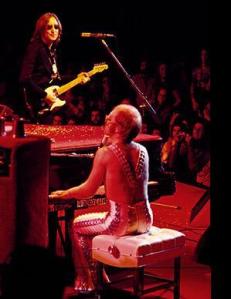
(Above: Elton John and John Lennon at Madison Square Garden, 1974.
All photos by George Kalinsky, courtesy of www.georgekalinsky.com.)

By Joel Francis

In his 34 years as Madison Square Garden’s official photographer, George Kalinsky has forgotten more games, concerts and events than many people could see in several lifetimes.

Kalinsky, who estimates he has shot more than 8,000 events, can be forgiven for having no memory of Bob Marley’s next-to-last performances in 1978, because what he remembers more than makes up for any lapses.

“November 28, 1974. Don’t ask me how I remember that, but I do,” Kalinsky said with a laugh. “Elton John was playing the Garden, and he surprised everyone by having John Lennon join him onstage. Those three songs they did together turned out to be the last time John Lennon performed before he was shot. The moment I captured won’t be there again.”

Several of Kalinsky’s favorite moments are on display for a current exhibit at the Rock and Roll Hall of Fame in Cleveland. “Live From Madison Square Garden: From the Lens of George Kalinsky” opened May 1 in the Ahmet M. Ertegun Main Exhibit Hall and will run through January 2010.

“I’ve always tried to paint with light,” Kolinsky said. “Shooting against a plain black background is not the most creative, but it’s what you usually see. These performers spend millions on lighting and effects. I always try to capture that as part of the atmosphere of the performance.”

fullscreen-capture-562009-34913-pmbmp1

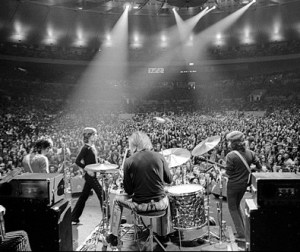
The atmosphere for the Rolling Stones’ Garden concert in 1969 was a frenzy. The show was one of the first arena rock concerts and the pandemonium was captured and released on the Stones’ great live album “Get Your Ya Ya’s Out.”

“That was the first time I saw a buzz, a reaction like that in the audience. Everyone wanted to be onstage and the crowd started gradually pushing forward,” Kalinsky said. “I went under the stage and went on in the back and got some amazing shots.”

Getting the audience’s reaction to the band was the key to recording the moment, Kalinsky said.

“I think a huge part of the story is the people and how they react,” he said. “There may not be too many pictures in this exhibit of the crowd, but I always try to include them. Every audience is different, just as a circus is different from a track meet and hockey is from basketball. The audience is a reflection of the performance.”

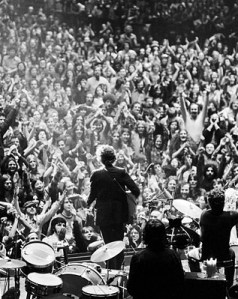
The crowd at a 1974 Bob Dylan performance played a key role in a shot Kalinsky called one of the top two or three photos he’s taken.

“Dylan is Dylan, the hair, the body language, all of it connecting and seeing the audience reach out to him is beautiful and telling,” Kalinsky said. “With him, the words are so important; when I look at Dylan I try to capture the aura of the man.

“I want to get a little closer to see what his face looks like,” Kalinsky continued, “and how it shows the years, not in terms of getting older, but the years of performing with the audience and how that bond grows stronger and stronger.”

fullscreen-capture-562009-35709-pmbmpDylan played a key role in George Harrison’s 1971 Concert for Bangladesh at the Garden. Shooting both of those shows not only taught Kalinsky that music was the true universal language, but showed him how far the Garden’s stage extended.
“I was in a cab recently and the driver was from Bangladesh,” Kalinsky said. “He couldn’t have been more than 35 or 40 years old, but he said in the hearts of his family and friends in Bangladesh they would never forget Madison Square Garden. They weren’t there (at the Concert for Bangladesh), but they’d never forget because that’s where people learned to help his country and family.”

Events at the Garden, Kalinsky said, “become part of our culture and part of our world. It wasn’t long ago we had 9/11 and that concert. Even if you weren’t there, you were there because everybody in the world tuned in to the Concert for New York City.”

What stands out in Kalinsky’s mind from that show isn’t the defining performances from Paul McCartney, the Who and artists with ties to the Big Apple like Jay-Z and Bon Jovi, but a moment backstage with Billy Crystal before he was about to go on.

“I asked him how does he project his talent when the audience is in tears and police and firefighters are holding up pictures (of their missing loved ones)?” Kolinsky said. “He said the hardest thing to do was be funny in the face of an audience who had lost so much.”

Although Kalinsky’s relationships and reputation allowed him backstage that day, he acknowledged access has been almost completely shut down from the early days when he would take pictures of Elvis Presley in the dressing room before his first Garden concert or Sly Stone’s groomsmen getting ready before Stone’s onstage wedding in 1974.

And just as backstage has become more restrictive, the window for taking performance photos has been confined to the first three songs. That doesn’t bother Kalinsky, though, because digital technology and automatic lighting systems within the camera let him do as much with those three songs as he could in an entire show in the days of film.

“However, in terms of taking pictures it always comes down to the eye and the moment,” Kalinsky said. “You have to recognize the moment and snap the picture. This is the most important aspect, whether you are shooting a concert, sporting event or portrait setting. It’s what I’m always looking for.”

Kalinsky’s duties have also given him a window on the 1994 Stanley Cup Finals, Knicks games, scores of the world’s top athletes and personalities. This diverse shooting background has provided enough photos to fill eight books and exhibits from the Museum of Modern Art to the baseball and basketball halls of fame.

“The Garden stage, whether it’s Muhammad Ali, the Pope or LeBron James, brings out the best in every performer,” Kalinsky said. “Every day I walk into the Garden I say what a privilege it is to be part of this arena and the best stage in the whole world.”

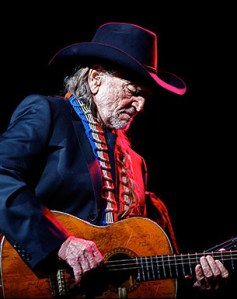
(Below: A recent portrait of the Red-Headed Stranger.)

fullscreen-capture-562009-40105-pmbmp

Keep Reading:

Rock Hall Celebrates 50 Years of Motown

Rock Hall Celebrates the 40th Anniversary of Woodstock

Bruce Springsteen Rocks the Hall (part one)

Bruce Springsteen Rocks the Hall (part two)

Police On My Back: Five Musicians Convicted of Murder

(Above: Honorable mention R.L. Burnside, who was convicted of murder 1959 and sentenced to Parchman Farm. Burnside later said, “I didn’t mean to kill nobody. I just meant to shoot the sonofabitch in the head. Him dying was between him and the Lord.”)

By Joel Francis

Phil Spector is hardly the first musician to be convicted of murder. He’s not even the most famous or influential one. But he is the latest. In honor of Spector’s recent sentencing, The Daily Record recognizes five other musicians convicted of murder.

Cool C and Steady B

Cool C and Steady B both came of age in the 1980s Philadelphia rap scene. Steady, nee Warren McGlone, was one of the first Philly rappers to taste the mainstream, while Cool, born Christopher Roney, was a member of the Hilltop Hustlers. The two teamed up in the early ’90s to form C.E.B., which was short for Countin’ Endless Bank. Taking their moniker a little two seriously, the duo decided to rob an actual bank.

On Jan. 2, 1996 – perhaps fulfilling a New Year’s resolution – C, B and Mark Canty, another Philadelphia rapper, attempted to rob a PNC bank in the City of Brotherly Love. Needless to say, the heist didn’t go as planned. When officer Lauretha Vaird responded to the silent alarm, she was shot and killed by Cool C. Steady B exchanged shots with another officer as the trio hopped into a stolen minivan and made their escape.

Steady was arrested at his apartment shortly after the crime. When two handguns left at the bank were traced back to him, he confessed to the crime.

In October, 1996, Cool was convicted of first degree murder and sentenced to death by lethal injection. Steady got off with a second degree murder conviction and life in prison. Cool was granted a stay of execution in 2006, by Pennsylvania Governor Ed Rendell (probably a closet C.E.B. fan), but remains on death row. Steady also remains incarcerated.

Little Willie John

In the late 1950s, Little Willie John traveled in the same soul circles as his contemporaries Sam Cooke, Jackie Wilson and Hank Ballard. His parade of hits started in 1955 with “All Around the World” and included “Need Your Love So Bad” (later covered by Peter Green’s Fleetwood Mac) and “Fever,” which Peggy Lee made famous and took to the U.S. Top 10.

John had a golden voice, but he also had a bad temper and a taste of alcohol. Those three traits collided backstage at a concert in 1964 when John stabbed a man to death. He was convicted of manslaughter and sentenced to Washington State Prison. John was appealing his conviction and aiming for a comeback when he died of pneumonia in 1968.

Don Drummond

In the fall of 1964, trombone player Don Drummond was living the good life. The band he helped form, the Skatalites, were finally breaking through, thanks to a song he wrote. “Man in the Street” was a Top 10 U.K. hit and for many their first taste of reggae. One year later, Drummond’s arrangement of the Guns of Navarone also hit the U.K. Top 10. But 1965 was not as kind to Drummond.

Drummond earned the nickname “Don Cosmic” for the erratic behavior brought on by his manic depression. When the body of Drummond’s girlfriend exotic dancer Marguerita Mahfood was found in Drummond’s home with several knife wounds, the police quickly arrested Drummond and charged him with murder. Drummond was judged legally insane at his trial and committed to Bellevue Hospital in New York City. Drummond died in Bellevue in 1967 at the age of 39. His death was ruled suicide, but because no autopsy was performed conspiracy theories persist to this day.

Drummond left behind a catalog of more than 300 songs and pivotal role backing Lee “Scratch” Perry, the Wailers, Delroy Wilson at their earliest sessions.

Jim Gordon

Drummer Jim Gordon started his career backing the Everly Brothers in 1963. By the end of the decade he’d performed on “Pet Sounds,” “The Notorious Byrd Brothers” and numerous other albums. When Jim Keltner pulled out of a tour with Delaney and Bonnie, Gordon was brought in as the replacement. Gordon got on so well with the rest of the band, which included Eric Clapton, bass player Carl Radle and keyboardist Bobby Whitlock, that the quartet played on Clapton’s first solo album, the first post-Beatles album by Clapton’s friend George Harrison (“All Things Must Pass”) and even a session with Ringo.

The group is most memorable, however, for the album it produced with Duane Allman. As Derek and the Dominoes, Clapton was able to pour out his unrequited love for Harrison’s wife Patti Boyd and Allman was able to lay down some of his best licks. Gordon gained notoriety for writing the piano coda to “Layla.” He composed the piece independently and had to be persuaded to let Clapton incorporate into what became one of the biggest rock singles of all time.

After Derek and the Dominoes broke up in 1971, Gordon played in Joe Cocker’s Mad Dogs and Englishmen tour. He also toured with Traffic and Frank Zappa. Gordon’s session work also flourished. He played drums on Carly Simon’s “You’re So Vain,” and the Incredible Bongo Band’s “Bongo Rock” album. Gordon’s drum solo on “Apache” is one of the most sampled licks in hip hop.

In the late ’70s Gordon complained of hearing voices. Treated for alcohol abuse instead of schizophrenia, the voices had pushed Gordon out of music entirely by 1981. They pushed him even further in 1983 when Gordon killed his mother with a hammer. Gordon was properly diagnosed in his 1984 trial and sentenced to sixteen years to life with the possibility of parole. Gordon remains in prison.

Lead Belly

Most musicians wait until after they’re famous to start killing people. Not the man born Huddie Ledbetter. Before he recorded a note for Alan Lomax, the towering legend of folk and blues had escaped from a chain gang in Texas, served seven years for killing a relative in a fight over a woman. Lead Belly learned new songs and honed his craft while in prison, eventually earning a pardon from Texas Governor Pat Neff, who enjoyed the religious songs Lead Belly had played for him. Five years later, Lead Belly was back in prison, this time for attempted homicide. After serving three years for knifing a white man in a fight, he was discovered by John and Alan Lomax, who fell under his spell and petitioned to have him released.

After taking Louisiana Governor O.K. Allen a recording of “Goodnight Irene,” Lead Belly was released (the official reason was time off for good behavior). He recorded several albums for the Library of Congress based on his book “Negro Folk Songs as Sung by Lead Belly.” Unfortunately, Lead Belly could not shake his criminal past, and was back in jail again in 1939 for stabbing a man in a fight in New York City. Again, Alan Lomax jumped to Lead Belly’s defense, dropping out of graduate school and helping Lead Belly record an album of songs to pay for his legal expense.

Lead Belly became a fixture of the New York City folk scene in the 1940s. He appeared on the radio, performed with Brownie McGhee, Sonny Terry, Woody Guthrie, and others and recorded a wide range of music. Acolyte Bob Dylan once said Lead Belly was “One of the few ex-cons who recorded a popular children’s album.”

“Goodnight Irene” became Lead Belly’s most popular song. Unfortunately, he did not live long enough to see Pete Seeger’s group the Weavers make it a No. 1 hit.

Lead Belly died in 1949, leaving behind a treasure of songs that includes “Midnight Special,” “Cotton Fields” and “Rock Island Line.”

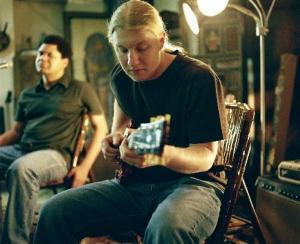
The Derek Trucks Band makes old-school rock new

derek_trucks_band

By Joel Francis
The Kansas City Star

Guitarist Derek Trucks was 12 years old when Bob Dylan asked him onstage during a show to play “Highway 61 Revisited.”

For Trucks, it was just another gig. The look on his dad’s face, however, told a different story.

“I knew who Dylan was because my dad was a massive fan, but it didn’t hit me then like it would have now or even 10 years ago,” Trucks said. “But even though I didn’t realize the significance, I could see it in my dad’s eyes that this was life-changing.”

Trucks and his father were both right. Playing with Dylan was just another encounter for the prodigy who would go on to play with Buddy Guy, Carlos Santana, Eric Clapton and numerous others. But it also opened the door to other possibilities.

Trucks, who turns 30 in June, now helms his own eponymous group (performing Friday at Harrah’s Voodoo Lounge) and also plays in the Allman Brothers Band. He returned Dylan’s favor with his supercharged blues cover of Dylan’s “Down in the Flood,” which opens his sixth and newest studio album, “Already Free.”

“I try to pick covers with some connection to the band,” Trucks said. “Part of that is Dylan is such a good songwriter with a great amount of tunes, but on top of that I figured after Katrina and the flooding in Iowa, the title and the lyrics were just a great metaphor for all that.”

Trucks didn’t go into the studio planning on cutting a record. Finding himself with downtime at his Jacksonville, Fla., home – atypical for a man who averages 300 shows a year – and a recently completed home studio called Swamp Raga Studio, Trucks and his band decided to lay down some tracks just to see how the room felt.

“The first day we wrote and ” Trucks said. “The next thing we recorded (the song) ‘Already Free,’ knew there were a dozen, then two dozen songs. We started calling people from (wife and blues guitarist) Susan (Tedeschi)’s band, Doyle (Bramhall II), Warren Haynes, Oteil Burbridge, to come in.”

The resulting release has a laid-back yet focused organic vibe that inhabits the best of the Allman Brothers’ Capricorn albums.

“It’s the most natural record I’ve done,” Trucks said. “It was very comfortable recording, and I think you can feel it. We captured tunes hours after they were written. There’s a freshness that comes across when songs are captured so quickly.”

Unsurprisingly, Trucks wanted to translate that urgency to the road as quickly as possible. The Derek Trucks Band tour kicked off last week.

For someone who has seemingly played with everyone, Trucks had the opportunity to encounter another legend and influence last year.

When you record two John Coltrane numbers on your debut album, and the opportunity to play with Coltrane’s longtime pianist McCoy Tyner arises, you don’t say no.

Still, Trucks was intimidated. Especially when he walked into the studio and saw bass player Ron Carter and drummer Jack DeJohnette.

“Those guys are legends in their own right, but McCoy is on his own level,” Trucks said. “He was such a sweet guy. He really made it feel comfortable.”

Trucks entered the studio with a list of four songs he hoped to play with the trio, but as the last guitarist on the session, some of his choices had already been recorded.

“My first choice of song was ‘Contemplations,’ but (jazz guitarist Bill) Frisell had already recorded it,” Trucks said.

The two-day session yielded collaborations with Trucks, Frisell, Bela Fleck, Marc Ribot and John Scofield. Trucks was the only “rock” guitarist invited, but he works well on his two featured cuts, “Slapback Blues” and “Greensleeves.” Trucks’ presence in the company of such eclectic legends is unsurprising given the range of covers his band performs – everything from Pakistani qawwali singer Nusrat Fateh Ali Khan to Delta bluesman Son House – and the diversity of the band playing them, which contains a four-decade age span.

Trucks said his innate musical curiosity has not only expanded his palate but has also given him a level of comfort playing with nearly anyone.

“It started at such a young age. I was always around musicians, so I’d try to pick their brains and see what influenced their music,” Trucks said. “A huge part of being able to stay on the road and on top of the game is to keep finding inspiration. You keep finding different things that turn you on, things that tweak different parts of the brain. In the long run you’re a better musician for it.”

Trucks hopes that same level of comfort and curiosity extends to his home Swamp Raga Studio.

“I’ve spent a lot of time with Willie (Nelson) in Maui, and anywhere he is has a clubhouse vibe. I can see that communal feeling. Wherever you are with him – on his bus, in his home – he makes sure everybody is absolutely comfortable,” Trucks said. “That’s kind of what it’s (Swamp Raga) starting to turn into in the month and a half we’ve gotten into it.”

Swamp Raga is not only musician-friendly but environmentally friendly as well.

“The beauty of building from scratch is that you can think about stuff ahead of time,” Trucks said. “When I figured the electric bill would be double, not only was that a financial hit, but psychologically I started feeling guilty because of all the energy we’d be using. We went out of our way to be conscious of that. We made it a point to do everything as efficiently as possible.”

To that end, Trucks and Tedeschi installed 26 solar panels on the studio and their home. And in the months when the family is out on tour, the local utility company pays them for the energy their panels generate.

“Sometimes our bill comes in right around zero,” Trucks said. “By doing the right thing it actually works out better in the end.”

Despite such 21st century enterprises, Trucks believes his band and his music are a throwback to a time where wooden instruments were hand-crafted and stepping onstage meant being ready to cut some heads.

“When you get on stage, you have to bring it,” Trucks said. “I get a sense from new music that the idea is to outsmart your audience or be so ultra-hip you can pull one over on them.

“With a band like ours, we try to represent a more honest music. We’re musicians representing our craft first and then trying to connect with people.”

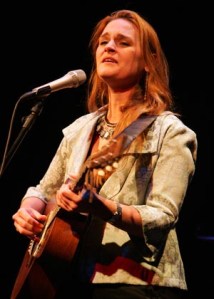
Review: Madeleine Peyroux

music_phases-38090
By Joel Francis

The Kansas City Star

Before playing the final song of the night, Madeline Peyroux told how “Somethin’ Grand” was written around 4 in the morning, when the trucks on the nearby highway finally stopped buzzing past her Brooklyn apartment.

Most of the music Peyroux played for a sold-out edition of Cyprus Avenue Live at the Folly Theater on Friday night fit that contemplative, midnight mood.The atmosphere was struck with the first song, “Dance Me to the End of Love.” Darren Beckett’s gently brushed drums and Barak Mori’s subtle and sometimes sweeping bass lines created a bed for music that blurred the lines between jazz, folk and pop.

“Don’t Wait Too Long,” the third number up, was a showcase for the other two members of Peyroux’s band. Jon Herrington’s guitar had a warm, fluid tone. Larry Goldings spent the night switching between piano, organ and keyboards. His earthy, gospel organ was the backbone of several numbers. Peyroux’s smoky voice and phrasing, which often recalled Billie Holiday, was the evening’s stand-out instrument, though.

Peyroux established her career by covering the masters and she got a couple heavyweights out early. Leonard Cohen’s “River of Tears” was followed by Bob Dylan’s “You’re Gonna Make Me Lonesome When You Go.” On that song, Peyroux crawled inside the lyric “I could stay with you forever/and never realize the time” and delivered a spectacular performance as comfortable as a Sunday afternoon nap with a lover.

Halfway through the set, Peyroux recreated her days busking on the streets of Paris as her band huddled around her playing on a box, upright bass, mandolin and blow-organ. For the only time that night, Peyroux’s acoustic guitar lead the band as she sang “La Javanaise” and “Don’t Cry Baby.” If she performed half as good on the streets as she did in the Folly, Peyroux likely found her cap filled with coins in no time.

Between songs, Peyroux chatted with the audience, playfully pointing out the lyric in Dylan’s song refers to the French poet Arthur “Rimbaud” and not Sylvester Stallone’s “Rambo,” discussing the inspiration behind her character song “Our Lady of Pigalle” and introducing her hit “I’m All Right” as a “happy break-up song.”

Peyroux performed all but two songs from her new album, “Bare Bones,” during the course of her 90-minute set. She completely ignored her 1996 debut album “Dreamland,” which may have frustrated some long-time fans. Instead the evening’s remaining songs were split between the two other albums she released this decade.

Opening act Steve Poltz was a welcome addition to the bill. Accompanied only by his acoustic guitar, the singer/songwriter quickly won over the crowed with his frequently funny songs. A rapid-fire talking blues somehow touched on everything from the winter holidays, fruit cake, Barack Obama and YouTube, while “Brief History of My Life” somehow combined Poltz’s love of baseball with stories of his first communion. Poltz is best known for helping Jewel write “You Were Made For Me.” He closed his 35-minute set with “Everything About You,” a song that appeared on the “Notting Hill” soundtrack.

With a night filled with so many stand-out moments – from Peyroux’s sly reading of “You Can’t Do Me,” which she wrote with Walter Becker, to the bouncy optimism of “Instead” – Peyroux left no doubt that her songbook had more legs than a glass of good wine.

Setlist: Dance Me To the End of Love, Bare Bones, Don’t Wait Too Long, River of Tears, You’re Gonna Make Me Lonesome When You Go, Damn the Circumstances, I’m All Right, A Little Bit, La Javanaise, Don’t Cry Baby, Love and Treachery, You Can’t Do Me, Our Lady of Pigalle, I Must Be Saved, Instead, Somethin’ Grand.

15 jazz greats to emerge in the last 20 years (part one)

(Above: Brad Mehldau performs an arrangement based on Radiohead’s “Exit Music (For A Film).”

By Joel Francis

Continuing The Daily Record’s look at the state of jazz today, here is the first of three installments shedding light on 15 jazz greats to emerge in the last 20 years. Note that these musicians are not necessarily the 15 greatest jazz artists to arrive since 1990. A brief listen to any of them, though, should more than persuade the most ardent purist that jazz is alive and well.

Roy Hargrove

Over the past 20 years, Roy Hargrove’s trumpet has proven to be one of the most versatile instruments ever. He’s equally at home conjuring Cuba on his own or summoning the spirit of African rebellion with rapper Common. Although Hargrove has yet found a way to reconcile his split personalities, he has built a strong catalog. In the Roy Hargrove Quintet, Hargrove works the more traditional mold forged by Freddie Hubbard and Clifford Brown. The RH Factor is the less-focused urban playground where Hargrove’s funky side comes out. Albums to start with: Habana, Earfood.

Brad Mehldau

Pianist Brad Mehldau cut his teeth working with saxophonists Joshua Redman and Wayne Shorter before striking out on his own. His lengthy concert arrangements often leave no stone unturned. Although his classical approach to playing is influenced by Bill Evans, Mehldau has no problem converting songs by Radiohead, the Beatles and Nick Drake into extended jazz workouts and placing them on footing equal to George Gershwin and Cole Porter standards. Mehldau made albums with opera singer Renee Fleming, guitarist Pat Metheny and pop producer Jon Brion without pandering on any project. Albums to start with: Back at the Vanguard, Day is Done.

Madeleine Peyroux

Singer Madeleine Peyroux’s voice sounds more than a little like Billie Holiday, but her style is closer to Joni Mitchell’s. Born in the South, raised in New York and California and seasoned in Paris, Peyroux splits the distance between jazz, folk and pop. Her interpretations of Leonard Cohen, Bob Dylan and Hank Williams numbers made her a star on Lilith Fair stages a decade ago and earned her acclaim as the “Best International Jazz Artist” by the BBC in 2007. Albums to start with: Dreamland, Half the Perfect World.

Miguel Zenón

Puerto Rican saxophonist Miguel Zenon recalls the tasteful, silky tone of Paul Desmond. In little more than five years, he’s released four albums, worked as a founding member of the SF Jazz Collective, won the Best New Artist award from JazzTimes in 2006 and named Rising Star-Alto Saxophone for three consecutive years in the Down Beat Critic’s Poll. While Zenon’s horn rests easily on the ears, his arrangements capture the spirit of his native island through insistent originals and unlikely hymns like “Great is Thy Faithfulness.” Albums to start with: Jibaro, Awake.

Maria Schneider

Maria Schneider’s compositions for her jazz orchestra have been some of the most ambitious works in the jazz canon since the heyday of the Duke Ellington Orchestra or Dave Brubeck’s late-’60s expositions. At once sweeping and evocative, Schnieder’s near-classical pieces reveal the deep influence of Gil Evans. The cinematic expanse of her work takes the listener on a journey where everyone from George Gershwin to Gustav Mahler is likely to appear. Albums to start with: Evanescence, Sky Blue.

Keep Reading: 15 Jazz Greats to Emerge in the Last 20 Years

Part Two

Part Three

Five Legends Still Adding to Their Legacies

2009 Grammys: A Running Diary

The last time The Daily Record watched a complete Grammy Awards show, “O Brother Where Art Thou?” won Album of the Year. This year, though, we got suckered in by the promise of seeing Radiohead. (Have they won a Grammy? Wikipedia says yes.) This presented the perfect opportunity to do one of those running diaries like Bill Simmons does for ESPN. We not may be as successful, but the official wife of The Daily Record was glad her husband’s snarky comments were bypassing her ears and going straight online, where she could ignore them more easily. Enjoy!

7:00 U2’s new song sounds like Bob Dylan’s “Subterranean Homesick Blues.”

7:02 The lyrics to their new song “Get On Your Boots” appear on a large video screen behind the band. I wonder if this is what all the presenters will see on their Teleprompters.

7:09 Whitney Houston comes out to present the award for “Best R&B Album.” Forget Botox – cocaine must be the secret to a younger looking face.

7:10 Seriously, Houston looks like she has been stored in the freezer next to Ted Williams for the last 10 years.

7:12 The Rock is as good a comedian as he is an actor.

7:17 Justin Timberlake and Keith Urban paying tribute to Al Green is like Henry Kissinger and Dick Cheney giving props to Barack Obama.

7:21 First commercial break. High-powered bloggers use this time to make snarky comments about commercials too. Unfortunately, The Daily Record has no corporate sponsorship. We’ll use this time to do glamorous things like take out the trash and recycling, pull stuff together for work tomorrow.

7:26 For a second, I thought Chris Martin was Paul McCartney sitting at his Magical Mystery Tour piano.

7:28 Let the haters hate; Jay-Z is still great.

7:29 How come Coldplay get to play two songs? I wonder if Joe Satriani will come out. Probably not.

7:30 Coldplay’s Beatles motif is reinforced with their Sgt. Pepper jackets.

7:33 Although representatives insist that all Grammy performers will not perform to a backing track like Bruce Springsteen did at last week’s Super Bowl, you have to be suspicious. It’s not like the music industry is a bastion of integrity.

7:34 Why does “country” singer Carrie Underwood rock harder than “rock stars” Coldplay?

7:35 I have no idea what Carrie is singing. I think it’s something about how long it took to get her legs waxed. Damn them’s some shiny gams!

7:36 Carrie’s guitar player looks like Lita Ford’s daughter.

7:38 Why does Sheryl Crow, 46, look younger than LeAnn Rimes, 26?

7:39 Congratulations, you’ve won a Grammy Lifetime Achievement Award. We will now honor you with a 15 second black and white video clip. Why not let the recipients perform?

7:48 Hey, Coldplay just acknowledged my Sgt. Pepper’s joke!

7:49 Man, Kid Rock really, really likes Bob Seger.

7:58 Taylor Swift and Miley Cyrus are performing together for the first time, but they won’t let the guys playing acoustic guitars and bass onstage with them.

7:59 It’s really bugging me that they won’t let the band perform onstage. What were they told? “OK, here’s the deal. You four will sing backing vocals, provide rhythm support, fine, you’ll carry the whole thing – but we don’t actually want anyone to see you do it.” Was there not enough crawlspace under the stage to stuff them in there?

8:02 A seated Tylor Swift just said “If you’re 19, or even older, it’s still a thrill to stand on the Grammy stage.” Man, she is going to have a long time to be depressed.

8:03 Robert Plant and Allison Krauss just won AWARD. But even better news is that they’re working on a new album together.

8:05 This is why we don’t need a Whitney Houston comeback. Jennifer Hudson is both more talented and a more substantive person.

8:15 What the? Stevie Wonder is jamming with the Jonas Brothers. Half the audience is wondering who the old dude is and everyone else is wondering what he’s doing playing with them. Thing is, it doesn’t sound half bad. Then again, I’m a sucker for Stevie’s vocoder trick.

8:16 Any excuse to hear “Superstition” is a good thing. I’ll never buy a Jonas Brothers album, but I thank them for this moment.

8:17 Seriously, you know your songs kick butt when Disney-sponsored tweener heart-throbs can’t screw them up. Not even Celine Dion could ruin this moment.

8:19 I hear Blink 182’s next album is going to be a tribute to Def Leppard.

8:20 Do Coldplay have to mention the Beatles every time they take the podium? Pretty soon Ringo will be onstage with them refusing to sign autographs.

8:27 Don’t forget, Craig Ferguson writes all his own material.

8:29 Am I the last person on Earth to be hearing “I Kissed A Girl” for the first time right now?

8:30 Why is Katy Perry dancing in Carmen Miranda’s headdress? This segment must be sponsored by Chiquita.

8:31 Am I the only person on Earth to feel like he hasn’t missed anything by not hearing “I Kissed A Girl” until now?

8:32 I don’t know the song Kanye West is doing with Estelle, but “808s and Heartbreaks” is really growing on me.

8:33 Kanye is taking this ’80s fixation a bit too far. Next year he’s going to come out wearing a Huxtable sweater.

8:41 I don’t care how long he keeps wearing it, that earring is never going to look natural on Morgan Freeman.

8:45 Sean “Puffy” Combs, Natalie Cole and Herbie Hancock are on hand to present “Record of the Year.” One of these things is not like the other (in a good way).

8:46 Natalie Cole’s dress looks like a last-minute compromise from the outfit Lil Kim wore on the MTV awards a few years back.

8:47 Plant and Krauss just won again. Robert Plant might have the most successful post-supergroup career of all time. OK, maybe Paul McCartney – but Plant’s taken more chances.

8:53 They just gave a Lifetime Achievement Award to Dean Martin. I guess we now know why they don’t have these winners perform, but why’d the take him so long for Martin to get this award? He’s been dead for awhile, but he certainly had the sales and popularity when he was alive. Maybe next year they’ll finally get around to honoring Bing Crosby.

8:54 I’m not sure why M.I.A. had to secede the stage so quickly. How cool would it have been if Mick Jones and Paul Simonon came out to do “Paper Planes” with her?

8:55 Kanye, Jay-Z, T.I. and Lil Wayne’s performance together is being called a “historic hip hop summit.” The tour kicks off next month in Yalta.

8:57 M.I.A.’s polka-dot pregnancy outfit is sponsored by Buddy Guy’s guitar.

9:00 I can’t believe I’ve sat through two hours of this show … and still have 90 minutes to go.

9:01 If I were going to have Dave Grohl drum with Paul McCartney I’d give him something a little meatier than “I Saw Her Standing There.” Maybe “Band on the Run” or “Helter Skelter.” I’m just saying.

9:10 Feed just went out as John Mayer was accepting an award. I guess my TV isn’t much of a fan either.

9:11 Jay Mohr and LL Cool J is one of the most awkward pairings of the night. Then again, Jay Morh and anyone is an awkward arrangement.

9:15 Sugarland and Adele aren’t really performing “together for the first time” as promised, but “one right after another.” Eh.

9:17 Oh, here’s Sugarland. She added that one essential line at the end of the song.

9:23 Gwyenth Paltrow is wearing a mirror ball. Dance party!

9:24 Radiohead is performing with the USC Marching Trojans. Man, first those guys get to play with Fleetwood Mac and now they’re backing up Radiohead. I wonder which was more rewarding.

9:25 Someday, future generations will worship Radiohead like we celebrate the Beatles.

9:27 Is it still Radiohead when it’s just Thom Yorke and Jonny Greenwood? Survey says, who cares? Radiohead in any form is better than anything else we’ve seen tonight.

9:28 OK, better than everything except Carrie Underwood’s legs – but I’m still not buying her album.

9:30 If you are still reading this, you are officially my new best friend. Please leave a comment to receive a special prize.

9:34 Justin Timberlake is performing in a coat and scarf. How did he know snow was in our forecast?

9:35 The stocking cap on T.I.’s head looks like a reservoir tip.

9:36 I don’t think switching back and forth between two distinct songs should count as collaboration. It’s more like a musical debate where the listener always loses.

9:38 Recording Academy president Neil Portnow rejected the traditional tirade against music piracy to talk about MusiCares and promote a Secretary of the Arts cabinet position.

9: 42 Portnow is done, but I’m kinda bummed he didn’t bring up piracy. I had a great line to use when he did: “Recording Academy president Neil Portnow is still talking about music piracy. This guy is slower than Rapidshare.”

9:44 Not even Smokey Robinsons sings the Four Tops as well as Levi Stubbs. Rest in peace, Levi.

9:45 It would be cool if the producers rounded up the remaining Funk Brothers as backing musicians for this Four Tops tribute.

9:52 Neil Diamond is singing “Sweet Caroline” and millions of Red Sox fans are crying because their season hasn’t started yet. Pitchers and catchers report in less than a week, boys.

9:54 Am I the only one that finds it kind of sad that Diamond’s expansive catalog has been reduced to just one song? And that “Sweet Caroline” is that song? It’s like if people only remembered Bob Dylan for “Quinn the Eskimo (The Mighty Quinn).”

9:59 Paying tribute to Bo Diddley are Buddy Guy, B.B. King, John Mayer and Keith Urban (because you know if any two performers have influenced Urban’s style and career its Al Green and Bo Diddley). Best rhythm in rock and roll.

10:00 I make that joke earlier about Buddy Guy’s guitar and he shows up here playing a gold top Les Paul. I’m not sure I’ve ever seen him rock a since his days on Vanguard.

10:08 Allen Toussaint is supposed to appear with Lil Wayne with Robin Thicke. I bet those two would be surprised to learn that Toussaint has written more hits than both of them combined.

10:10 I wonder why the producers haven’t rolled out one of those “for the first time ever” duets between Thicke and Timberlake? Probably because no one could tell them apart.

10:11 Allen Toussaint with the Dirty Dozen Brass Band and Terence Blanchard falls just short of topping Radiohead for best musical moment of the night – but it’s close. No American city makes more consistently fun music than New Orleans (although a case could be made for Memphis).

10:14 Will.I.Am just congratulated Obama. Who could have seen that coming? Next year, Will.I.Am will receive a record number of Grammy nominations for his album “Obamania: Songs About Barack Obama, Because I Love Barack Obama by Will.I.Am (for Barack Obama).”

10:24 Robert Plant and Allison Krauss are performing with T-Bone Burnett. Krauss’ hair keeps blowing back. Now I know why Justin Timberlake was wearing a coat and scar earlier.

10:25 I love “Raising Sand” as much as the next person, but that album came out in 2007. Why are the Grammys acting like it’s a new release?

10:26 The Grammys operate on such a loopy nomination calendar that a band’s previous and forthcoming albums can both be eligible at the same time.

10:27 The producers rightly made a big deal of T-Bone being on stage, but there was no mention of Buddy Miller holding down rhythm guitar. Therefore, I’d like to take this moment to give Buddy props for being a spectacular musician.

10:28 Album of the Year goes to “Raising Sand.” If it wasn’t going to be “In Rainbows” this is where it should have gone. (Seriously, does anyone else find it odd that both of these albums were released 16 months ago?)

10:30 Robert Plant started his career in 1968. You can fill a matchbook with a list of all tonight’s performers and honorees we’ll still be talking about 40 years from now.

10:32 Stevie Wonder is playing us home. See you in seven years, Grammys!