15 jazz greats to emerge in the last 20 years (part one)

(Above: Brad Mehldau performs an arrangement based on Radiohead’s “Exit Music (For A Film).”

By Joel Francis

Continuing The Daily Record’s look at the state of jazz today, here is the first of three installments shedding light on 15 jazz greats to emerge in the last 20 years. Note that these musicians are not necessarily the 15 greatest jazz artists to arrive since 1990. A brief listen to any of them, though, should more than persuade the most ardent purist that jazz is alive and well.

Roy Hargrove

Over the past 20 years, Roy Hargrove’s trumpet has proven to be one of the most versatile instruments ever. He’s equally at home conjuring Cuba on his own or summoning the spirit of African rebellion with rapper Common. Although Hargrove has yet found a way to reconcile his split personalities, he has built a strong catalog. In the Roy Hargrove Quintet, Hargrove works the more traditional mold forged by Freddie Hubbard and Clifford Brown. The RH Factor is the less-focused urban playground where Hargrove’s funky side comes out. Albums to start with: Habana, Earfood.

Brad Mehldau

Pianist Brad Mehldau cut his teeth working with saxophonists Joshua Redman and Wayne Shorter before striking out on his own. His lengthy concert arrangements often leave no stone unturned. Although his classical approach to playing is influenced by Bill Evans, Mehldau has no problem converting songs by Radiohead, the Beatles and Nick Drake into extended jazz workouts and placing them on footing equal to George Gershwin and Cole Porter standards. Mehldau made albums with opera singer Renee Fleming, guitarist Pat Metheny and pop producer Jon Brion without pandering on any project. Albums to start with: Back at the Vanguard, Day is Done.

Madeleine Peyroux

Singer Madeleine Peyroux’s voice sounds more than a little like Billie Holiday, but her style is closer to Joni Mitchell’s. Born in the South, raised in New York and California and seasoned in Paris, Peyroux splits the distance between jazz, folk and pop. Her interpretations of Leonard Cohen, Bob Dylan and Hank Williams numbers made her a star on Lilith Fair stages a decade ago and earned her acclaim as the “Best International Jazz Artist” by the BBC in 2007. Albums to start with: Dreamland, Half the Perfect World.

Miguel Zenón

Puerto Rican saxophonist Miguel Zenon recalls the tasteful, silky tone of Paul Desmond. In little more than five years, he’s released four albums, worked as a founding member of the SF Jazz Collective, won the Best New Artist award from JazzTimes in 2006 and named Rising Star-Alto Saxophone for three consecutive years in the Down Beat Critic’s Poll. While Zenon’s horn rests easily on the ears, his arrangements capture the spirit of his native island through insistent originals and unlikely hymns like “Great is Thy Faithfulness.” Albums to start with: Jibaro, Awake.

Maria Schneider

Maria Schneider’s compositions for her jazz orchestra have been some of the most ambitious works in the jazz canon since the heyday of the Duke Ellington Orchestra or Dave Brubeck’s late-’60s expositions. At once sweeping and evocative, Schnieder’s near-classical pieces reveal the deep influence of Gil Evans. The cinematic expanse of her work takes the listener on a journey where everyone from George Gershwin to Gustav Mahler is likely to appear. Albums to start with: Evanescence, Sky Blue.

Keep Reading: 15 Jazz Greats to Emerge in the Last 20 Years
Part Two

Part Three

Five Legends Still Adding to Their Legacies

Review: Gov’t Mule

(Above: Mule, meet Radiohead. Radiohead, Mule.)

By Joel Francis
The Kansas City Star

One fan’s T-shirt asked: “Got Mule?” And for the second time in three months, the answer was “yes.”

Nearly 12 weeks after playing to a packed Voodoo Lounge, Gov’t Mule played for another full house Wednesday night at the Granada in Lawrence.

The classic rock jam quartet opened with the dirty blues stomp of “Brand New Angel” before segueing into the wah-driven “Perfect Shelter.” The show didn’t really start, though, until the surprise cover of Jimi Hendrix’ “If 6 Was 9.” It was the first of many cover treats.

A raucous “Helter Skelter” bumped against a medley of Temple of the Dog’s “Hunger Strike” and Traffic’s “Dear Mr. Fantasy.” Earlier in the night, Radiohead’s “Creep” was followed by Led Zeppelin’s “Trampled Underfoot.”

There was just as much diversity in band’s original material. Propelled by Danny Lewis’ organ, the intro to “Larger Than Life” recalled Medeski, Martin and Wood. “Streamline Woman,” meanwhile sounded like Led Zeppelin lost in the Florida swamps. And all bets were off for the progressive rocker “Silent Scream,” which encompassed 20 minutes and a drum solo.

The band played a one-hour opening set, before taking a 20-minute break and coming back for another 90 minutes. During that time, most sets of eyes were trained on singer and guitarist Warren Haynes. Haynes also plays in the Allman Bros. and was hailed by Rolling Stone as one of the greatest guitarists of all time. His playing is impressive, but not flashy. It’s like he knows exactly where to put his fingers again and again and again.

Although Haynes took many noteworthy solos, the instrumental “Birth of the Mule” was his tour de force. The 10-minute number opened with Haynes’ delicate, fingerpicked slide playing. Starting like a gentle rain and building into a full storm, the song culminated in a heavy riff reminiscent of Black Sabbath before gliding back to the ground, light as a feather.

The middle-aged, mostly male Mule heads who knew exactly what they were getting into. Although the floor was too packed to dance, everyone seemed content to nod and sway in place.

The night closed with a pair of slide blues rave-ups. Hayes did a great job of replicating Muddy Waters’ early playing style on “Champagne and Reefer.” The tune paired so nicely with Hound Dog Taylor’s “Gonna Send You Back To Georgia” that the two were stretched for 20 minutes.

Setlist: Brand New Angel, Perfect Shelter, Streamline Woman, Larger Than Life ->If 6 Was 9 ->Larger Than Life, Get Out Of My Life, Birth of the Mule, Temporary Saint, Creep, Trampled Underfoot/Intermission/Patchwork Quilt, Helter Skelter, Hunger Strike->Dear Mr. Fantasy->Hunger Strike, Silent Scream->Drum Solo, Like Flies->Mule->I’ve Been Working->Mule/Encore/Champagne and Reefer, Gonna Send You Back To Georgia

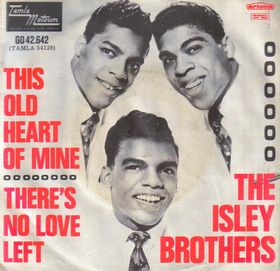
Isley Brothers – “This Old Heart of Mine (Is Weak For You)”

isleys

Isley Brothers – “This Old Heart of Mine (Is Weak For You),” Pop #12, R&B #6

By Joel Francis

For the most part, Motown’s talent during its heyday was home-grown. Martha Reeves was a Hitsville secretary, Stevie Wonder was a kid pestering the Funk Brothers for lessons, Marvin Gaye and Smokey Robinson were part of Berry Gordy’s extended family and Diane Ross and her friends stopped by every day after school to pester staff for an audition.

In short, talent came to Motown, not the other way around.

Of course that mindset quickly changed when the Isley Brothers hit the free agent market in 1965. The brothers made their name with 1959’s “Shout!” (recorded for RCA) and 1962’s “Twist and Shout” (recorded for the Wand label and covered by the Beatles). But after bouncing between those two labels and the failure to establish their own imprint, the Isley Brothers were looking for a new home. Berry Gordy was all too happy to welcome them to his fold.

The Isley’s Motown debut, “This Old Heart of Mine (Is Weak For You) was their biggest success so far. Holland-Dozier-Holland definitely applied the Motown sound to their number. The drums lead the mix, and the string section sounds more like the Four Tops than the Isley Brothers’ gritty urban soul. The brothers had never sounded so slick before, but the results couldn’t be argued with. The song is infectious, fun and impossible to listen to without breaking into smiles or dance.

Unfortunately, the Isley-Motown marriage didn’t last long. Despite releasing two more albums, the group couldn’t find a follow-up hit and complained of being fed inferior, cast-off tracks. They had a point: “This Old Heart” was originally intended for the Supremes. The brothers left Motown in 1968 and signed with Buddha before finding long-term success with Epic.

The Music of James Bond: Part Two – The Seventies

(Above: Blondie’s superior, unused version of “For Your Eyes Only.”)

By Joel Francis

When Roger Moore replaced Sean Connery as James Bond, the producers retooled the series to include the grittiness of the recent Dirty Harry movies and “The French Connection.” In “Live and Let Die” Bond chases a corrupt Caribbean politician who deals heroin and happens to be black. They also snagged one of the biggest stars on the planet to write and perform the latest Bond theme – ex-Beatle Paul McCartney.

McCartney’s theme song reunited him with Beatles producer George Martin, who scored the film. Martin was the first person other than John Barry to score a Bond film.

Not only was McCartney’s song the first rock Bond theme, but it was the first one to be written and performed by the same person. The film’s producers had wanted a soul singer, but Martin prevailed and McCartney was allowed to sing. The song starts with a soft melody and understanding lyrics, before bursting into a whirlwind of strings and horns. The change in tempo and texture underscores the protagonist’s philosophical change, from “live and let live” to “live and let die.” The song is a staple of McCartney’s live shows and was performed at his Super Bowl halftime concert in 2005. The less said about Guns N’ Roses 1991 cover, the better.

Barry was back in the scoring saddle for “The Man With the Golden Gun.” He teamed with lyricist Don Black on the title song and the results were predictable. British singer Lulu made her name with the No. 1 hit “To Sir With Love,” the title song to Sidney Poitier’s 1967 film, but she’s given little to distinguish herself with here. Deep in the mix, a guitar spews crazy licks underneath a battalion of churning trombones, but Lulu’s vocals stay safely in the Bassey mold.

Proto-shock rocker Alice Cooper claimed his song “The Man With the Golden Gun” was written for the film but rejected by its producers. The song is an aggressive slab of hard rock completely out of step with anything the producers had used before, so its unsurprising Cooper’s version didn’t appear until it was included on the tastefully titled “Muscle of Love” album.

In 1977, Carly Simon became the second American (after Nancy Sinatra) to sing a Bond theme. “Nobody Does It Better” was the first Bond theme without the same name as its movie, in this case “The Spy Who Loved Me,” although songwriters Carole Bayer Sager and Marvin Hamlisch did work the title into the lyrics.

The song revitalized Simon’s career which had been in a five-year gradual decline since her 1972 hit “You’re So Vain.” It was No. 1 on the adult contemporary charts for seven consecutive weeks and was nominated for two Grammys.

Despite its soft rock arrangement, “Nobody Does It Better” works well as a Bond theme. Writing about the character instead of the film is a refreshing change. Simon’s vocals are nearly devoid of the sex most female Bond singers infused in their delivery. Simon’s approach is more of devotion than lust, which not only supports the arrangement, but makes the song more honest.

Moonraker” paired Bassey and Barry for the final time. Bassey’s third turn on a Bond theme happened after Johnny Mathis declined the song at the last moment. Her delivery is much smoother than on “Diamonds Are Forever” and “Goldfinger,” but it compliments Barry’s lush orchestration. For the first time, Barry’s horns are pushed far to the background. His strings are suspended, weightless in space, and the arrangement is accentuated with a light touch of disco.

The formula of pairing the score composer with a lyricist and giving the song to a pop singer was very much intact as the Bond film franchise entered the ’80s (and its third decade) with “For Your Eyes Only.” Unfortunately, the results were not as memorable. Sheena Easton set a precedent when she became the first singer to perform the title song onscreen. The gauze of synthesizers and strings and forced melody have rightfully relegated the song to footnote status. The producers would have been better served accepting Blondie’s title submission, which appeared on their 1982 album, “The Hunter.”

For his 13th Bond film, Barry turned to Tim Rice, Andrew Lloyd Weber’s lyricist, for help. The result, “All Time High,” was sung by Rita Coolidge. Like Carly Simon’s “Nobody Does It Better,” “All Time High” spent multiple weeks at No. 1 on the Adult Contemporary chart and does not share the its film’s title (in this case “Octopussy“). Unlike Simon’s song, though, “All Time High” hit the all-time low in Bond songs.

Keep reading:

The Music of James Bond: Part Three – The ’80s and Beyond

The Music of James Bond: Part One – The Classic Years

Below: Alice Cooper’s alternate “The Man With the Golden Gun.”

Reunion bands: Ain’t nothing like the real thing

(Above: The two original members of Lynyrd Skynyrd and five other guys play “Free Bird.”)

By Joel Francis

When the Temptations and Four Tops took the stage Saturday night with only one original member in each ensemble, it raised questions of truth in advertising. Can a band be billed by its legendary name if only one of its musicians is an original legend?

Few bands are as fortunate as Los Lobos and U2 to have retained the same personnel since their debut. Some bands, like Wilco, have a different lineup on nearly every album.  But the reunion craze has accelerated hiring ringers to fill in for dead or uncooperative musicians.

When Journey played the Midland a few weeks ago, longtime singer Steve Perry had been replaced with Filipino Arnel Pineda, who was 8 years old when the band’s first album came out. No one complained, but Pineda’s job is essentially to sound like Perry while founding guitarist Neal Schon and the rest of the band deliver their signature sound.

Similarly, Yes were primed for a 40th anniversary tour when lead singer Jon Anderson fell ill. Rather than cancel the tour, the remaining members, who include Oliver Wakeman, son of original keyboardist Rick Wakeman, recruited a new singer off YouTube.

The majority of fans will tolerate a minor substitution. There were no grumbles when bass player Eric Avery sat out Jane’s Addiction’s second go-round. Most fans will recognize that age and time will prevent everyone from taking part. But when the skeleton of the original crew drag new faces out under the old name, it starts to take advantage of the people who kept the hunger for a reunion alive.

There’s also a slight double-standard in play. Few Beatles fans would be satisfied with a Beatles “reunion” featuring Paul, Ringo, Julian Lennon and Dhani Harrison, but The Who have completed not one but two successful (read: lucrative) tours minus the late John Entwistle and Keith Moon. Of course a true Fab Four reunion never happened, while The Who have launched a handful of “farewell” tours, but the rhythm section of Moon and Entwistle defined The Who’s sound just as much as John and George did for the Beatles.

Swapping drummers and bass players is one thing, but the road to finding a new frontman is fraught with peril. INXS failed miserably in their reality TV quest to carry on after the premature death of Michael Hutchinson. However, 14 years after Freddy Mercury died, Queen – minus drummer John Taylor – reconvened with former Free and Bad Company vocalist Paul Rogers. Many of the band’s East Coast concert date sold out quickly.

When Ray Manzarek and Robby Krieger hired Cult singer Ian Astbury to hit the road as The Doors they were faced with a lawsuit from drummer John Densmore and forced to tour as Riders on the Storm. The moniker didn’t alter any setlists, but it at least let the fans know they weren’t getting the same guys that worked together in the ‘60s.

Then there are the jazz orchestras that continue to tour despite the death of their bandleader. The Count Basie and Glenn Miller orchestras draw decent crowds when they visit the area, despite Miller’s disappearance during World War II and Bill Basie’s death a mere 25 years ago. The Gem Theater will host a Jazz Messengers reunion concert on October even though bandleader Art Blakey died in 1990.

The reason why a musician will resurrect his old band with ringers is obvious: Billy Corgan will sell a lot more tickets and albums as the Smashing Pumpkins than he would alone. And while there’s no clear-cut solution, I think this is a rare example of capitalism and artistry joining forces to provide the ultimate answer.

If a band’s catalog is strong enough, fans won’t mind shelling out $30 to $50 as they did Saturday night at Starlight to hear someone else sing “My Girl” and “Baby I Need Your Loving.” On the other hand, if bands plug on minus crucial components, they might be confined to the state fair/town festival circuit Three Dog Night and the Guess Who have been riding for years.