Social Distancing Spins – Day 25

By Joel Francis

I’m still lost in the catacombs, down in the groove.

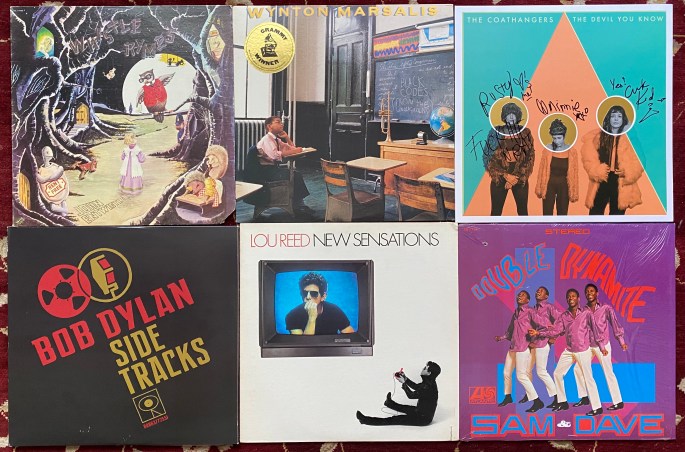
Lou Reed – New Sensations (1984) Lou Reed released several endeavors that sound more intriguing in concept than execution, but New Sensations stands out in a deep catalog full of non-sequiturs: It is relentless optimistic both lyrically and musically. I have no idea what put Reed in such a good mood, but it is a delight to hear praise impulsive behavior on “Doing the Things that We Want To,” turning the Detours’ “Do You Love Me” sideways for “I Love You, Suzanne” and celebrating a compatriot on “My Friend George.” If this sounds slight, fear not. There’s nothing here as lightweight as “The Original Wrapper,” which appears on his next album, Mistrial. New Sensations it a strong conclusion to an incredible – and diverse – trilogy of albums that appeared in consecutive years and represent Reed’s strongest run of material outside of the Velvet Underground.

Coathangers – The Devil You Know (2019) When first playing this sixth release from the all-female Atlanta trio one might think there was a mix-up at the pressing plant. Opening cut “Bimbo” opens with a light, bouncy guitar and piano line and airy vocals. Then the distortion kicks in at the chorus and we realize how the sonic dichotomy supports the song’s lyrics about making assumptions about women. Very clever. “Stranger Danger” employs a similar trick as coquette-ish repetition of the song title plays against more defiant vocals in the verses before all hell breaks loose on the chorus. The song does a great job of capturing #metoo-era menace in under three minutes. “Stranger Danger” sets the table nicely for “Fuck the NRA,” a song as brash and straightforward as its title and the album’s best moment. Clocking in at just over half an hour, The Devil You Know makes it point and quickly departs.

Sam and Dave – Double Dynamite (1966) Soul music abounds with upbeat songs and combos, but I don’t know of any as relentlessly happy as Sam and Dave. You can even hear them smiling during serious ballads like “When Something is Wrong with My Baby (Something is Wrong with Me).” Double Dynamite is Memphis soul at its finest, with Booker T. and the MGs serving as the backing band and Isaac Hayes and David Porter providing songs. The first side of this album has several of the duo’s hits, including “Soothe Me,” “Said I Wasn’t Going to Tell Nobody,” and “You’ve Got Me Hummin’.” The second side is less-known but still great and features a version of Dan Penn and Spooner Oldham’s “I’m Your Puppet.”

Bob Dylan – Sidetracks (compilation) – This collection gathers all the non-album tracks released on box sets and hits collections over the years. The majority of the cuts come from the Biograph box set and are quite good, but I am partial to the songs from Greatest Hits, Volume II, which was a staple in my college dorm room. Dylanologists can rejoice than they no longer need skip through a half-dozen other anthologies for these hard-to-find tracks. Casual fans looking for the hits won’t find them here, but they will encounter a lot of great songs to send them scurrying deeper into the catalog. Non-albums singles like “Positively Fourth Street” and 1999’s Oscar-winning “Things Have Changed” which will satisfy both audiences.

John Entwistle – Whistle Rymes (1972) – John Entwistle solo albums can be a dicey proposition. The majority of them are more miss than hit, I’m afraid. Thankfully, Whistle Rymes (sic), The Ox’s second solo album is a safe endeavor. That’s not to say it’s not for the faint-hearted. The liner notes, penned by Entwistle, is the beginning of a fairy tale about a girl named Boobity. So, yeah. (If this tale was ever completed elsewhere, I don’t want to know about it.) The closing song, “Nightmare (Please Wake Me Up)” is a glorious cacophony of horns, piano, violin and drums. The rest of the album is quite good. Anyone who heard The Who songs “Boris the Spider,” “Silas Stingy” or “Heaven and Hell” and thought they needed some more will be pleased with Whistle Rymes.

Wynton Marsalis – Black Codes from the Underground (1985) The jazz world lost a tremendous gift when Ellis Marsalias, patriarch of the great jazz family passed last week. I saw Marsalis at a small theater in Kansas City about a decade ago with a combo that included his son Jason on drums. Somehow, after the show, a neighbor who played saxophone and went with me had talked our way into joining the band – minus Jason – for drinks at the hotel across the street. I soaked in the conversation and experiences until Ellis arrived. He started telling stories about when Charlie Parker was in Jay McShann’s band. McShann, Ellis said, tried to get everyone to take his young horn player because he was so undependable. “You found him, you keep him!” Ellis remembered the other bandleaders telling McShann as we all laughed.

I mention all this here because I don’t have an Ellis Marsalis album and because there will be other opportunities to discuss the rest of the Marsalis family. I have no doubt somewhere in heaven the newly arrived pianist is sitting in on a heck of a jam session.

Social Distancing Spins – Days 22-24

By Joel Francis

Saturdays and Sundays are for family time. I think the trend of fewer weekend spins and a combined entry spanning Friday through Sunday will continue going forward.

The Dirtbombs – Ultraglide in Black (2001) Musically speaking, the Motor City is best known for two groundbreaking styles of music: Motown, of course, and the raw rock and roll that would become punk, pioneered by the MC5 and Stooges. The Dirtbombs combine both of these genres masterfully on this tribute to their hometown. Hearing Stevie Wonder and Marvin Gaye get a layer of scuzzy guitars and blown-out drums not only casts the songs in a new light but is a pure delight. If you like Detroit music, heck if you’ve ever driven a Ford, you’ll find something to like here.

I saw the Dirtbombs touring in support of another album, several years after Ultraglide came out. The show started after midnight and there were about a dozen people in the audience. It was fantastic.

The Temptations – All Directions (1972) Before taking the compass to All Directions, let’s pause for a moment and marvel at the industriousness of the Motown machine. All Directions was the first of two Temptations releases in 1972. Overall, it was their 16th studio album (counting two full-length collaborations with the Supremes) in only eight years. Think about that for a moment. In less than a decade, they went from “The Way You Do the Things You Do” to “Papa Was a Rollin’ Stone.” Wow!

“Papa” is the standout track here, a No. 1 hit on the U.S pop charts, but the rest of the album isn’t a bunch of cast-offs. “Funky Music Sho Nuff Turns Me On” starts the album with a faux-concert intro before the five Tempts trade lead vocals a la “Ball of Confusion.” Album closer “Do Your Thing” is a rare example of Motown covering Stax. The version of “The First Time Ever I Saw Your Face” won’t make anyone forget Roberta Flack, but newcomer Richard Street handles it well. After this album, the Temptations took a whole seven months off (during which they were no doubt touring) before releasing their next album.

Tom Petty – Let Me Up (I’ve Had Enough) (1987)

Tom Petty – The Last DJ (2002) Last autumn, I was on a business trip with the better part of a day to burn in Gainesville, Fla. Knowing that was Tom Petty’s home town, I did some online sleuthing and found several Petty-related points of interest to visit. The night I got in, I was walking around a nice little square of shops near my hotel when a sign caught my eye: Lillian’s Music Store. I had to go in. As I ordered my drink the bartender who gave me the scoop: Lillian’s hadn’t been a music store for some time (it claims to be the oldest bar in Gainesville) but kept the former occupant’s business name. Which is why on the song “Dreamville,” the third track on The Last DJ, Petty sings “Goin’ down to Lillian’s music store/To buy a black diamond string/Gonna wind it up on my guitar/Gonna make that silver sing.”

Now, the larger question is this: If I am going to buy a drink at Lillian’s Music Store chiefly because it appears in a Tom Petty lyric, as a Clash fan am I likewise obliged to get inked at the Death Or Glory tattoo parlor? The answer of course, is yes. And yet it didn’t happen. My apologies, Mick and Joe.

One more quick note about Lillian’s. They had these weird heavy, glass dishes that I hadn’t seen for several years scattered around inside. Ashtrays. Because indoor smoking is still cool in Florida, I guess. All my clothes smelled afterward and I had to double-bag them so they wouldn’t reek into the rest of my luggage.

A couple quick thoughts about the music on these albums before moving on, because this is already running long. Let Me Up (I’ve Had Enough) contains one of my favorite Petty deep tracks, “Runaway Trains.” It has very ‘80s production and feels almost more like an adult contemporary tune closer to something Sting or Steve Winwood would come up with than anything in the Heartbreakers catalog. I love it because it is so unusual and has those great Petty lyrics and singing. This album also has “It Will All Work Out,” one of my all-time favorite Petty songs. The Last DJ is excellent, except for the song “Joe,” which is my least favorite Petty song. It sounds like a demo that should have been scrapped in the studio. You should still own both albums.

David Bowie – Station to Station (1976) One of many favorite moments from catching David Bowie’s concert on the Reality tour during its stop in Kansas City, Mo. was watching him hang out on the side of the stage, arms holding on to the scaffolding, grooving along to as his band churned through the long instrumental introduction to “Station to Station.” It was the first song in the encore set and for those minutes, Bowie was just another music fan, like all of us in the crowd.

Bowie claimed to have no memories of making this album, but Station to Station’s detached, synthesized paranoia paved a direct path to Joy Division.  Single “TVC15” was durable enough to find a spot in Bowie’s Live Aid set nearly a decade later and his cover of “Wild is the Wind” is an touching showcase of Bowie’s vocal talent. An essential addition to any rock fan’s music collection.

Elvis Costello – Imperial Bedroom (1982) Elvis Costello’s seventh album concludes an incredible opening run with the country tribute Almost Blue as the only misstep. (Almost Blue doesn’t miss because of the genre – the songs and performances just aren’t as strong as on the surrounding albums.) Former Beatles engineer pulls several tricks out of George Martin’s playbook with his gorgeous production arrangements. I love the orchestral countermelody on “And in Every Home” and what sounds like a sitar on “Human Hands.” Not every song is dressed up. “Tears Before Bedtime” and “Man Out of Town” have a pared-down Attractions sound that could have come from Trust, Costello’s previous album. It’s not hard to imagine bands like the Decemberists obsessing over Imperial Bedroom and coming away with dozens of ideas. Costello wouldn’t stay in this baroque mood for long, however. By the next album (and year) he had moved on to a more modern sheen and added the TKO Horns for Punch the Clock.

Lana Del Rey – Norman Fucking Rockwell (2019) Lana Del Rey got a lot of buzz when her album Born to Die came out nearly a decade ago. I watched her on Saturday Night Live, eager to hear what the fuss was about and sampled her debut album before dismissing her as a joke trying too hard to be ironic (and iconic). NFR is the album that finally won me over. Del Rey has built her catalog almost exclusively on torch songs, but here she does them really, really well. Early in the album, the sweeping guitars at the end of “Mariners Apartment Complex” lead right into “Venice Bitch,” which slowly builds into a psychedelic meltdown. Later, Del Rey delivers one of the sexiest music nerd songs ever on “The Next Best American Record.” Don’t ever say she doesn’t know her demographic. The super-profane opening couplet that opens the album belongs in the poetry hall of fame as a stand-alone lyric. I don’t know how long LDR will be able to hold me, but she definitely got me with NFR.

Slobberbone – Bees and Seas: The Best of Slobberbone (compilation) Alt-country fans lamenting the end of Uncle Tupelo need look no further than Slobberbone. The questionably named quartet from Texas perform with the same reckless abandoned that fueled UT classics “Screen Door” and “Gun.” This two record set devotes roughly one side to each of the band’s four albums. The band remains remarkably consistent in sound a quality throughout. There are no detours into horn sections or bagpipes and Brent Best’s songwriting via scenes of everyday life never fail to suck me in. Sadly, like Uncle Tupelo, Slobberbone is no longer releasing new material. Unlike their forebearers, though, Best and company frequently reunite and tour.

The Kinks – Face to Face (1966) As the Fab Four started to migrate toward more intricate, artistic material, the Kinks stepped right into the void, albeit with a more garage-y sound. Straightforward rockers “Party Line” and “Rosie Won’t You Please Come Home” set the album off strong, but Ray Davies takes a couple surprising turns with the Indian instruments on “Fancy” and faux-Hawaiian guitars on “Holiday in Waikiki,” a charming tale about winning a holiday in the Pacific. “Dandy” is the type of music hall number only an Englishman could write (and probably stomach – it’s much to cloying for me). Several years ago, I was fortunate to hear Ray Davies perform “Sunny Afternoon,” my favorite song from Face to Face, in concert. It remains an enduring memory of a fantastic night.

Social Distancing Spins – Day 21

By Joel Francis

Days blur together like a Michel Gondry dream sequence, but the vinyl never stops.

Slowdive – self-titled (2017) During their original run, the English quintet Slowdive delivered three albums that blurred the lines between shoegaze and dream pop. For their first album in nearly a generation, the band is once again operating in the sweet spot of dreamy guitars and ethereal vocals. Slowdive manages to maintain a consistent mood without feeling repetitive. I’m not sure I would have appreciated them as much during the grunge era as I do now, but this reunion album still serves as a soothing antidote to a stressful time. There’s nothing better than putting this on and letting the world float away for the better part of an hour. Favorite songs include the single “Sugar for the Pill” and “Falling Ashes,” which became even more of a favorite after seeing them perform it in concert.

Bruce Springsteen – The Ghost of Tom Joad (1995) The Ghost of Tom Joad is typically compared to Nebraska because they are both acoustic albums, but this is really unfair to Joad because it isn’t trying to accomplish the same thing. The songs on Tom Joad are fully realized acoustic performances complete with violin, pedal steel and a full band. The songs are some of the Boss’ best, as well. I love the title track in all its arrangements, especially the one with Pete Seeger reciting the lyrics over Springsteen’s guitar. “Youngstown” is a concert staple, yet “Dry Lightning” and “My Best Was Never Good Enough” don’t seem to get the recognition they deserve. “Across the Border” remains particularly relevant in the current xenophobic culture. Overall, The Ghost of Tom Joad has more in common with Devils and Dust than anything else in Springsteen’s catalog. It’s his best album of the 1990s.

Tom Waits – Alice (2002) Tom Waits threw his hat into the ring of releasing two albums on the same day when he released Alice and Blood Money simultaneously in the spring of 2002. Of the two, I prefer Alice, which features more ballads and generally less abrasive material (not that Blood Money is a bad album). Really, the two albums complement each other like less contrived versions of the Brawlers and Bawlers collections on the Orphans box set. Blood Money says “Misery is the River of the World” and Alice cries “No One Knows I’m Upset.” Pick a pill, red or blue. Either one leads to sonic delights.

Margo Price – Live at the Hamilton (2016) Margo Price is a throwback to a time when women like Dolly Parton, Loretta Lynn, Emmylou Harris, Linda Ronstadt could move the needle in Nashville. Sadly, I don’t know how much traction she and fellow spirits the Highwomen will get. Either way, her songwriting and spirit can’t be denied. This set features Price and her band onstage in Washington, D.C., 24 hours after election day. (I was set to attend an in-store that same night but couldn’t muster the motivation to leave the house, an ironic stance now.) They perform several songs from her debut, Midwest Farmer’s Daughter and cover Billy Joe Shaver, Merle Haggard, Rodney Crowell and breathe new life into Kris Kristofferson’s “Me and Bobby McGee.”

Houston Stackhouse – Worried Blues (2017)

Rev. Leon Pinson – Hush-Somebody is Calling Me (2016) There’s a great record shop in Memphis, right around the corner from a restaurant that used to be a hair salon and built their eatery around the old fixtures. Both are worth a stop. The shop, Goner Records, has an incredible selection of delta blues albums that is expertly curated. I typically pick out a half dozen albums that look intriguing by artists I’ve never heard. The person behind the counter is always happy to describe each album and I buy as much as I can afford. This process has never let me down. It also led me to these albums, released in the 2010s but compiled from recordings made in the 1960s. Both contained fingerpicked, acoustic Delta blues. As expected from his title, Pinson works a lot of gospel in his songs. If you can’t make it to church (or don’t want to go) put this on instead.

Prince – Art Official Age (2014) It is lazy critical shorthand to say a given new album is an artist’s best since his or her most recent critical masterpiece. The new album usually doesn’t measure up and music fans end up with piles of reviews where each subsequent release is hailed as a return to form and compared to the same previous classic.

So let me try it now. Art Official Age is Prince’s best release since the Love Symbol album. The funk workouts are on par with the best jams on Musicology and 3121 but what gives Art Official Age the nod is “Funknroll” a track that combines soul, funk, rock and electro to surpass its title and give Prince his best dance track since “P Control.”

See how easy that is?

If you are curious about any of Prince’s post-heyday releases and feel overwhelmed by the number of albums he put out across the last 20-or-so years of his life, Art Official Age is a solid place to start.

Social Distancing Spins – Day 20

By Joel Francis

O.V. Wright – Into Something-Can’t Shake Loose (1977) O.V. Wright is the greatest soul singer you’ve never heard. Wright had some chart success in the mid-to-late 1960s, but a prison term for narcotics sidelined his career. When Wright got out he cut several albums for Hi Records, the home of Al Green and Anne Peebles. Into Something-Can’t Shake Loose was Wright’s first record post-incarceration and it has the pent-up power of a man finally able to cut loose. Hi Rhythm, the studio house band, provides the perfect support throughout. The album is barely longer than half an hour, but it is consistently superb throughout. Into Something-Can’t Shake Loose is definitely work seeking out.

Wu-Tang Clan – Iron Flag (2001) Enter the Wu-Tang (36 Chambers) is Staten Island hip hop collective’s best album, but Iron Flag is my favorite. Released just a few months after the 9/11 attacks, every MC is on point here to protect their city. Running under an hour at 12 tracks and no skits, this is a focused, fierce Clan. Blaxploitation horns power “In the Hood” (which starts after a brief introduction) and the single “Uzi (Pinky Ring),” a track so strong it threatens to jump out of the speakers and start a fight. Method Man’s “Y’all Been Warned” pivots on a simple keyboard and guitar sample. Boasting has long been a staple of hip hop, but the braggadocio here takes on a deeper significance in the wake of 9/11. Or as Ghostface Killah puts it on “Rules:” “Together we stand, divided we fall/Mr. Bush sit down, I’m in charge of the war.” We should be so lucky as to have him in charge.

Booker T. and the MGs – McLemore Avenue (1970) The Fab Four cast a long shadow. Here the Stax Records house band – and hitmakers on their own – pay tribute to Abbey Road by naming their album after the street where Stax resides. The album is three long medleys and a stand-alone cover of “Something.” A 15-minute track comprising the final medley on Abbey Road kicks things off. It’s a bit odd to hear “The End” so early in the album but ultimately not a big deal. The second side encompasses roughly the rest of Abbey Road’s flip side, with the exception of the closing medley that opens McLemore Avenue. Got that? The musicianship is stellar. Booker T.’s organ does most of the heavy lifting with the melodies, but Steve Cropper’s guitar always comes in at the right moments to help out. The rhythm section of Duck Dunn and Al Jackson is equally superb. If you like the Beatles and/or classic R&B, this is the album for you.

Chris Bell – I Am the Cosmos (1992) The Memphis power pop and cult band Big Star only made three albums during their initial run, losing band members after each release. Guitarist and singer Chris Bell was the first to exit. I Am the Cosmos collects the songs Bell made in the mid-‘70s after leaving Big Star, with many tracks featuring his old bandmates. The only song on this collection that came out during Bell’s lifetime is the title number, which never came near the charts but grew so large in the Big Star lore that the band started performing it when they regrouped in the 1990s. The music is raw and vulnerable and in addition to displaying the power pop chops of Big Star also points the way to introspective indie rock bands like Death Cab for Cutie. For proof, look no further than “Speed of Sound,” used masterfully in the film Nick and Norah’s Infinite Playlist. Big Star’s Third is hailed as the group’s lost masterpiece, but in many ways I Am the Cosmos is just as important and more accessible.

Elton John – Honky Chateau (1972) As Elton John’s first No. 1 album, Honky Chateau helped tip the pianist toward stardom. Everyone knows “Rocket Man” but the rest of the songs may be even better. “Hercules” is folk pop in the vein of early Cat Stevens, while “Slave” veers toward country. The deceptively bouncy “I Think I’m Going to Kill Myself” hides a lyric so caustic and cynical that Elvis Costello would blush. Ballads “Mellow” and “Salvation” are the type of song that would become overblown productions in a few years. They are great here in standard rock band arrangements.

The true gem for me is the wonderful “Mona Lisas and Mad Hatters,” which I first heard in Cameron Crowe’s movie Almost Famous. Yeah, I know I’m not breaking any stereotypes about music nerds here. Want to come over and help me arrange my albums autobiographically? We can look for inside jokes in the liner notes.

Social Distancing Spins – Day 19

By Joel Francis

Remember, the best way to stay safe from the coronavirus is to stay home. And while you’re there, you may as well play some records. Here are some of mine.

The Temptations – Wish It Would Rain (1968) The seventh album by Motown’s soul stalwarts is groundbreaking in several ways. It was their final album with David Ruffin on vocals and Smokey Robinson producing. It’s also their last album to contain the classic Motown sound before producer Norman Whitfield (who is behind the boards for several tracks here) starting taking the Tempts down a more psychedelic path. The heartbreaking ballads “I Wish It Would Rain” and “I Could Never Love Another” were based on a real-life relationship that cut so deeply Robert Penzabene, who helped write both numbers, killed himself. The rest of the album stays along these themes of heartache and loss, but the Funk Brothers keep punching away, keeping the album from getting too somber. With Wish it Would Rain, the Temptations ended their classic lineup era on a high note and carried that momentum into the next psychedelic chapter.

Priests – The Seduction of Kansas (2019) The Washington D.C.-based punk trio named their second album after Thomas Frank’s book of the same name, an examination of why people – mainly conservatives in his thesis – vote against their own interests. The songs are more empathetic than angry, written as an attempt to bridge and understand the divide that has split America. Texturally, the album moves from a spacey, early Cure vibe on the paranoid “Not Percieved,” to the post-punk thump of revenge on “I’m Clean.” The final song, “Texas Instruments,” is my favorite cut. It discusses the whitewashing of history by looking at the story of the Lone Star state. Sample lyrics: “The hubris of propriety/Macy’s Day Parade history/Puff your chest up so we can see/Who brought the books you read?” Heady stuff to be sure, but the music keeps the feet entertained while the brain is engaged. Sadly, Priests went on an indefinite hiatus shortly after their tour behind this album wrapped. I hope this isn’t the last we hear from them.

Hearts of Darkness – self-titled (2010) Man, you could hardly go anywhere around Kansas City without bumping into either a member of Hearts of Darkness, someone talking about Hearts of Darkness or seeing a flier for an upcoming Hearts of Darkness. They won a spot at Farm Aid in 2011 and blew Snoop Dogg off the stage as an opening act that same year. Watching the 15-piece Afrobeat group perform was like standing on the launch pad as a rocket takes off. The band’s energy was matched only by the amount of smiles generated. Hearts of Darkness released another album in 2012 and then gradually tapered off. According to their ReverbNation site the group’s most recent show was in 2017. High time for a comeback.

White Stripes – Icky Thump (2007) After expanding their sound on Get Behind Me Satan, the White Stripes’ previous album, Icky Thump was the sound of the duo getting back to a straightforward rock sound. This isn’t the garage rock they perfected on early albums, however, but a more spacious arena-ready sound reflecting the larger venues they were now commanding. A cover of Patti Page’s “Conquest” remains a divisive song among fans, but other singles like the title track and the stomp of “Rag and Bone” make up for this misstep. It would have been interesting to see where Jack and Meg White would have taken their sound after this album. Icky Thump sounds like pair were getting back to basics and regrouping before deciding where to go next. Unfortunately, Meg White called it quits after the tour wrapped. We’ll never know what the next chapter may have held.

Jackson Browne – Running on Empty (1977) Put the iconic title track that opens this album and the magnificent medley of “The Load Out/Stay” that closes the record. There’s some pretty weird stuff happening in the other 30 minutes of this album. Cocaine shows up in nearly a third of the songs. “Rosie” is a tribute to a groupie. (Sample lyric: “She was sniffing all around/like a half-grown female pup.” Classy, Jackson.) There are a couple songs about the loneliness and desolation on the road, one of which was actually recorded on Browne’s tour bus as it hummed toward the next gig. Its like Browne decided to turn Bob Seger’s “Turn the Page” into a concept album. I won’t say it doesn’t work, but take away the first and last cut and there’s not much to make Running on Empty into more than a one-night stand.

Radiohead – The Bends (1995) If this is your first time encountering The Bends, you are in store for a tremendous experience. If it is not, feel free to use this as an excuse to play it again. So much has been written about Radiohead and The Bends, I don’t know that I have much to add. I will say that The Bends was gripping the first time I heard it and continues to reveal new layers a generation later.

Death Cab for Cutie – Plans (2005) One of the best moments at a Death Cab for Cutie concert is when the band exits the stage, leading singer Ben Gibbard alone to sing “I Will Follow You Into the Dark” with his acoustic guitar. This heartfelt, darkly romantic ballad has been a staple on mixes and playlists by the angst-filled and lovelorn from the day Plans was released. There are several other great songs to be found here as well. “Soul Meets Body” and “Crooked Teeth” are perfect slices of indie rock and the rest isn’t far behind. Plans isn’t Death Cab’s best album, but it has definitely earned a place on the medal platform.

The New Pornographers – Together (2010) Together was the first New Pornographers album that didn’t excite me when it was released. It felt like the band was having to work too hard to develop the delightful power pop that made the group’s first three albums so wonderful. That their sound was becoming a crutch. In retrospect, I think I was too hard on the album. Granted, the band isn’t breaking any new ground but there are several genuinely great songs here, such as the delicate “Valkyrie in the Roller Disco,” (How’s that for title?) “Crash Years” and Dan Bejar’s always-skewed songwriting on “Jenny Silver Dollar.” Together may be a holding pattern, but if this is what it took to get to Brill Bruisers, their next release, a classic on par with the Pornographer’s early material, then it was worth the stop.

Dinosaur Jr. – I Bet on Sky (2012) The third album after Dinosaur Jr.’s reunion is cut from the same cloth as their previous release, Farm. More of the same isn’t a bad thing, though. Not when you’ve got J. Mascis’s guitar ripping through the speaker with bass player Lou Barlow and drummer Murph right behind him, chasing Mascis like he owes them money.  You’ll know within the first 30 seconds if you like this album. If you do, the full listen won’t be enough. Fortunately, the Boston-based trio has left us several more platters, just like this one.

Social Distancing Spins – Day 18

By Joel Francis

The journey through my record collection continues.

Pet Shop Boys – Actually (1987) The Pet Shop Boys’ second album is the strongest in their still-growing catalog (Behaviour is a close second). Come for the hit singles and stick around for the album cuts, like the Kraftwerk-inspired “Shopping” and “It Couldn’t Happen Here,” the moody track based on an Ennio Morricone melody that opens the second side. Still not convinced? This is the album with the glorious Dusty Springfield duet “What Have I Done to Deserve This?” That alone makes Actually worth owning. While the other nine songs aren’t as strong (how could they?), Actually is filler-free dance/pop perfection.

Daniel Lanois – Goodbye to Language (2016) As a producer, Daniel Lanois has worked on some of my all-time favorite albums by Bob Dylan, Peter Gabriel, Emmylou Harris, Neil Young and Robbie Robertson. (We talked about his work on the Neville Brothers’ Yellow Moon back on Day 9.) The sound on Goodbye to Language is closer to Lanois’ ambient work with Brian Eno than his commercial endeavors. The premise is simple. Lanois’ pedal steel playing is recorded and treated by Rocco DeLuca. The result is an ethereal dream guaranteed to release stress. Put this on and let yourself go.

The Decemberists – The King is Dead (2011) I jumped on the Decemberists bandwagon with their video for “Sixteen Military Wives,” which reminded me of Rushmore. Two albums later, I feared they got lost in their own mythology for the ponderous concept album The Hazards of Love. Fortunately, I was wrong. The King is Dead is everything Hazards wasn’t: succinct, buoyant, humorous, fun. That a few songs sounded like peak-era R.E.M. (“Calamity Song,” “Down by the Water”) or Tom Petty circa Wildflowers (“Don’t Carry It All”) doesn’t help. It may be easier to play spot-the-influence with The King is Dead than on the band’s other releases, but the sound is still filtered through singer/songwriter Colin Meloy’s grad school tweed and spectacles, making it distinctly the Decemberists.

Miles Davis – My Funny Valentine (1965)

Miles Davis – Four and More (1966) Both of these albums draw from the same 1964 performance at Philharmonic Hall in New York City. The ballads went on Valentine and the uptempo numbers were relegated to Four and More. By the time Four and More was released, Miles had moved on from his modal sound and was about to reinvent jazz once again. Less progressive fans probably enjoyed this look back at the time. Pianist Herbie Hancock was only 23 and drummer Tony Williams just 18 at the time of this performance, but both play with a confidence and ambition beyond their years. These are probably the best performances of saxophone player George Coleman in Miles’ band. He tends to get overlooked between tenures of John Coltrane and Wayne Shorter. The quartet lingers on the ballads, drawing out every note, particularly on the 15-minute title cut. Conversely, they blast through the chords on “So What” and “Seven Steps to Heaven” with almost careless speed.  FYI, the entire concert was finally released as originally performed on CD in 1992.

James Brown – Live at the Apollo, Volume II (1968) Five years after the first Live at the Apollo album propelled James Brown off the chitlin circuit, Brown returned to the same venue but in a different place musically. The R&B that defined the first Apollo album was giving way to funk on the sequel. Songs like a hard-driving “Kansas City” and “Think” (with Kansas City, Kan. native Marva Whitney) showed Brown’s roots, while “Cold Sweat” and “Bring It Up” point the way forward. The 11-minute version of “It’s a Man’s Man’s Man’s World” is one-third as long as the original half-hour Apollo release. So the sequel isn’t as concise, but it captures the Hardest Working Man in Show Business in prime form.

Alejandro Escovedo – With These Hands (1996) Alejandro Escovedo is an undiscovered treasure. His songwriting deftly slides between different settings, from string quartet to country, Latin American to raw rock. For his third album, Escovedo enlists Willie Nelson and his harmonica player Mickey Raphael, cousin Shelia E and singer Jennifer Warnes. Despite these high-profile guests, the spotlight remains firmly on Escovedo and his masterful songs. From the moody opener of rocker “Put You Down” through “Tugboat,” a dedication to Velvet Underground guitarist Sterling Morrison that ends the record, there isn’t a bad song to be found.

Pearl Jam – Yield (1998) “Wishlist,” the next-to-last song on the first side of Yield, is my favorite Pearl Jam song. It’s simple, quiet and understated with none of the bombast of “Alive” or even “Given to Fly,” the song that precedes “Wishlist” on Yield. This album marks the first time the Seattle quintet returned to the meat-and-potatoes hard rock without any artistic detours. Although 2009’s Backspacer produced better results mining this same vein, Yield is still a good, direct hard rock album.

Social Distancing Spins – Days 15-17

By Joel Francis

The weekend weather was way too nice to be inside playing records. Here’s what I listened to when I wasn’t enjoying nature.

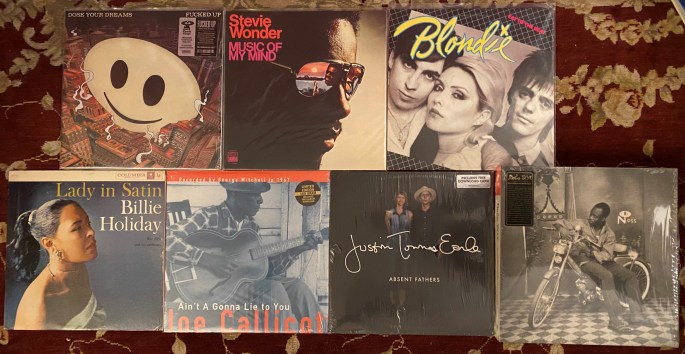
Fucked Up – Dose Your Dreams (2018) Toronto’s finest sextet have always been incredible musicians, but sometimes their subtlety and talent gets lost behind frontman Damian Abraham’s blowtorch of a voice. Here, on their fifth album, Abraham pulls back a little and the rest of the band flexes their muscles. I guess the story on Dose Your Dreams is a continuation of their 2011 masterpiece David Comes to Life. I have listened to David Comes to Life countless times and have only and elementary understanding of its story. The narrative on Dose Your Dreams is lost on me. So forget about that. Check out the rare mashup of hardcore punk and jazz saxophone at the end of “Raise Your Voice Joyce” (dig the synthesizer on the track, too). The title track is straight-up indie rock, while “Two I’s Closed” sounds like it could be the Dirty Projectors. If this sounds like the band leaving punk and throwing everything at the wall, fear not. The songs are still here, just not in the way you might expect.

Dose Your Dreams is the sound of Fucked Up spreading their wings. It will be interesting to see where they go from here.

Joe Callicot – Ain’t A Gonna Lie to You (2003) Don’t feel bad if you aren’t familiar with Mississippi Joe Callicot – I wasn’t either. Cruising the liner notes and the web, I found out that the dozen songs here were recorded in 1967, two years before his death. I could recite a few other facts but all you really need to know is that Callicot is an acoustic blues picker in the vein of fellow Mississippian John Hurt. Callicot’s voice isn’t as molasses-smooth as Hurt’s, but if you like the relaxed style of one, you’ll enjoy the other. These times are anxious enough. Put this on and unwind.

Blondie – Eat to the Beat (1979) In her autobiography, Debbie Harry describes Blondie as a nonstop circus of recording, tours and musicians. In the six year (and six album) blur between playing shows at CBGB and headlining arenas before breaking up, Harry has a point. Still, it would be nice if she slowed down to let fans savor the journey a little bit more. Blondie’s fourth album opens with the fantastic “Dreaming,” still a concert staple.  We also get the new wave dance classic “Atomic” and cinematic “Union City Blue.” Eat to the Beat is the only Blondie album I own, but every time I play it I’m reminded I need to seek out a couple more.

Billie Holiday – Lady in Satin (1958) As the final album released during Billie Holiday’s brief life, it’s hard not to listen to this album and not think about her tragic story and play the what-if game. Her ragged voice here is another constant reminder of her hard life. As an inspired artist, Holiday is able to use her ragged state to her advantage. The raw tension she infuses into every performance adds another dimension to songs like “Glad to Be Unhappy” and “You’ve Changed.” I also thought about this article and how racists in power conspired to make Holiday’s life even more difficult. I know it sounds fantastic, but just check out the reporting and get back to me. Rest in peace, Lady Day.

Stevie Wonder – Music of My Mind (1972) Stevie Wonder’s incredible run of classic albums usually begins with Talking Book, but the people who start there are missing the two great records that came before that landmark. Music of My Mind came out just six months before Book and lays the groundwork for all of the latter’s achievements. The synthesizers and clavinets that came to define Wonder’s sound are trotted out for the first time here. Music of My Mind is also the first album where Wonder plays most of the instruments himself. (Sayonara Funk Brothers.) The first side starts strong with the upbeat “Love Having You Around.” “Superwoman” is a reworking of a song from Wonder’s previous album. Its great in both forms. “I Love Every Little Thing About You” would fit fine on a playlist of Wonder love songs, right between “All I Do” and “As.” The second side is good as solid as well. Consider this a warm-up for Talking Book and jump in. It’s all there – almost.

Justin Townes Earle – Absent Fathers (2015) The first time I saw Justin Townes Earle in concert, he was part of his dad Steve Earle’s road crew. He came onstage (barefoot) at the end of the night to add extra guitar to “What’s So Funny ‘Bout Peace Love and Understanding.” Unfortunately, the father had to fire his son for excessive drug use before the tour was over. Keep in mind Steve Earle actually served time in the early ‘90s for heroin, cocaine and weapons possession, so outdrugging him is a pretty neat trick.

This bit of biography also frames the sadness that saturates the characters on Absent Fathers. None of these ten songs are about the perfect nuclear family, but Justin Earle inherited his dad’s knack for songwriting and inhabits these characters so well it’s hard not to be moved.

Bobo Yeye – Belle Epoque in Upper Volta (compilation) I am convinced – but willing to hear otherwise – that the roots of all music either goes back to Gregorian monks chanting in Europe or African drumming and singing. While both forms have their appeal, I’ll take the dirty African funk found here any day. Loud drums, horns, fuzzy guitars, soulful vocals, primitive recording. Yeah, this hits the sweet spot. Accompanying the three albums in this Numero collection is a hardcover book of photography and essays about the music. Feast your eyes and your ears.

Social Distancing Spins – Day 14

By Joel Francis

Here we go. Back into the stacks of wax.

L7 – Scatter the Rats (2019) If you were worried that L7 might have mellowed over the two decades since their last release, you can rest easy. The four females are just as fierce and uncompromising as you remembered from ‘90s alternative/punk classics Smell the Magic and Hungry for Stink. Honestly, Scatter the Rats is better than anything they’ve done since those two albums. Put this on and watch the paint peel from the wall.

Pink Floyd – Atom Heart Mother (1970) The pre-Dark Side Pink Floyd catalog is a lot more interesting to me than their commercial and artistic peaks in the mid-to-late 1970s. I love hearing them find their voice as a quartet, adding and subtracting elements. Atom Heart Mother is their dalliance with an orchestra. The strings on the Beatles’ “A Day in the Life” are a loose starting point here, but no one seems to know where they fit on the Floyd songs. That’s the first side, at least. The second side is more democratic, with each of the group’s three songwriters taking turns at the mic on original songs. The last track is a 13-minute instrumental called “Alan’s Psychedelic Breakfast,” whose title sums up the album perfectly.

Randy Newman – Land of Dreams (1988) I once played this album for a friend. After the first song, she politely demurred that this wasn’t what she normally enjoyed. Translation: It’s milquetoast old-people music. While Newman’s production is certainly lush and radio-friendly, his lyrics, storytelling and sly, subversive humor are more compelling than they may come off at first blush. Land of Dreams was supposed to be Newman’s musical autobiography. He gave up at some point, but we still get the captivating opener “Dixie Flyer” and most of the songs on side one. The ballad “Falling in Love” displays the cinematic touch that established Newman as an in-demand film composer. (Is it just me or is there a bit of “You’ve Got a Friend” in this tune?) The second side isn’t as successful, but it concludes on a couple of high notes: the hit “It’s the Money that Matters” and the wrenching ballad “I Want You to Hurt Like I Do.” It’s more than enough to make up for the embarrassing faux-rap of “Red Bandana.”

Tony Bennett – Jazz (compilation) This two-album collection pulls Tony Bennett’s collaborations with jazz musicians who are as proficient with their instruments as Bennett is with his incredible voice. It’s easy to take Bennett’s singing for granted. It seems he’s never encountered a song he can’t make his own. The treat, then, is hearing that voice spar and hang with the likes of Herbie Hancock, Stan Getz, Herbie Mann and Count Basie. I’m partial to the performance of “Just One of Those Things” with Art Blakey and the West Coast swing of “Clear Out of this World” but everything here is top-notch.

Leonard Cohen – Live at the Isle of Wight 1970 (2009) According to legend, this is the set that followed Jimi Hendrix at the legendary British music festival. Leonard Cohen only had two albums under his belt at the time of this recording, but it’s amazing to see how many songs included in this set would remain concert favorites until the end of his life. The performance also has a folky atmosphere, filled with acoustic guitars, fiddle, banjo and piano. The Isle of Wight performance shows little of the polished sophisticated sheen that Cohen’s later concerts would adopt. Put this on for a down-home experience with the poet extraordinaire.

Coleman Hawkins, Roy Eldridge, Johnny Hodges – Hawkins! Eldridge! Hodges! Alive! at the Village Gate (1962) Here is the sound of three pre-war titans muscling their way back into a musical conversation that has seemingly moved away from them. They do it not by adapting to a bop or modal vocabulary, but by stretching out and showing how those elements were always present in the swing music they helped popularize and pioneer. There are only three songs here – each of them well over 10 minutes – but they are more than enough to make the point.

Social Distancing Spins – Day 13

By Joel Francis

I hope everyone is staying inside and remaining healthy while we traipse through my album collection.

Chico Hamilton – The Further Adventures of El Chico (1966) Chico Hamilton was a drummer who played with Count Basie, Lester Young, Gerry Mulligan and Lena Horne. For this album he is joined by Clark Terry (another Basie alumnus) and Ron Carter. The set mixes jazz standards (“Stella by Starlight,” “Who Can I Turn To?”) with blues, a few originals and covers of then-contemporary pop songs. It works well for the most part, but the jumps to the Lovin’ Spoonful’s “Daydream” and the Mamas and Papas’ “Monday, Monday” are jarring and remind of the exact moment the album was recorded. The pop covers aren’t bad on their own – although they cling pretty faithfully to the original charts – but they work against the rest of the material.

Van Morrison – Three Chords and the Truth (2019) A friend summed it up perfectly: Van Morrison’s output for the past three decades is always good, rarely great. I couldn’t tell you that Three Chords and the Truth is any better than the two albums he released the year before this, or even the two albums he released the year before that. I could tell you that all but one of the tracks are new Morrison compositions. I can also tell you that guitarist Jay Berliner, who played on Astral Weeks, is back in the band. His distinctive guitar lines color the album effectively. With four full sides of music there is a lot for Morrison fans to digest. I don’t think this will win any new fans, but if you like anything he’s released since his classic run in the 1970s, there’s a good chance you’ll like this, too.

Ella Fitzgerald – The Duke Ellington Songbook (1957) I’m generally not a fan of lyrics being added to instrumental songs. This album is a delightful exception. Ella Fitzgerald scats and floats across Duke Ellington’s enduring melodies like a spring breeze kissing laundry on a clothes line. Of course having Ellington’s orchestra on hand doesn’t hurt, either. Dizzy Gillespie and Oscar Peterson also pop up. You already know most of these numbers, now hear them anew with Ella and the Duke as your tour guides.

I got this double-album set at an estate sale. The previous owner wrote down the date, location and price of album on the inside of one of the sleeves. I love these little touches that show how these songs were here long before we came along and will exist long after us as well.

Warren Zevon – self-titled (1976) The album that introduced Warren Zevon to the masses (or at least his devoted cult) plays like a greatest-hits album. Linda Ronstadt covered no less than four of the 11 tracks performed here. Jackson Browne produced the album and plays on most cuts. Members of Fleetwood Mac, Eagles and the Beach Boys also pop up in the musician credits. You may think you don’t know Zevon, but I bet you’ll recognize at least a couple songs here. And if you like that laid-back, 1970s L.A. singer/songwriter vibe, you’ll love everything here. A true classic.

Various Artists – American Epic: The Soundtrack (compilation) The majority of the 15 songs in this collection were recorded in the late 1920s and early 1930s. Fans of early folk and roots music will be familiar with most of these songs. What they likely haven’t heard is the clarity of these performances. The compilers cleaned up all the hiss and noise that usually comes with primitive recordings like these. The songs here by blues, country and folk pioneers aren’t just a nice collection of Depression-era musicianship. They are an essential part of who America is as a nation today. To learn why, you’ll need to watch the American Epic documentary. Enjoy.

Neil Young – Roxy: Tonight’s the Night Live (2018) Tonight’s the Night was the first of Neil Young’s so-called ditch trilogy, his non-commercial response to watching “Heart of Gold” hit No. 1. The studio version was held by the label for two years before finally seeing release. This live album comes from the same period (1973) but is less bleak than its studio counterparts. The songs are Young’s responses to the death of two close associates from drug overdoses. Their spirits hang heavy over the night, but the intensity is dissipated by Young’s stage banter about topless women, burlesque dancer Candy Barr, Perry Como and label honcho David Geffen. The band also goes into a short rendition of “Roll Out the Barrel.” The heavy emotion in the songs never flinches, but onstage Young allows the audience to take breaks. These moments of release are what makes Roxy a compelling bookend to the studio edition.

Social Distancing Spins – Day 12

Thirty days in the hole is a long time. I’ve got to mix things up to keep life fresh. Stay tuned.

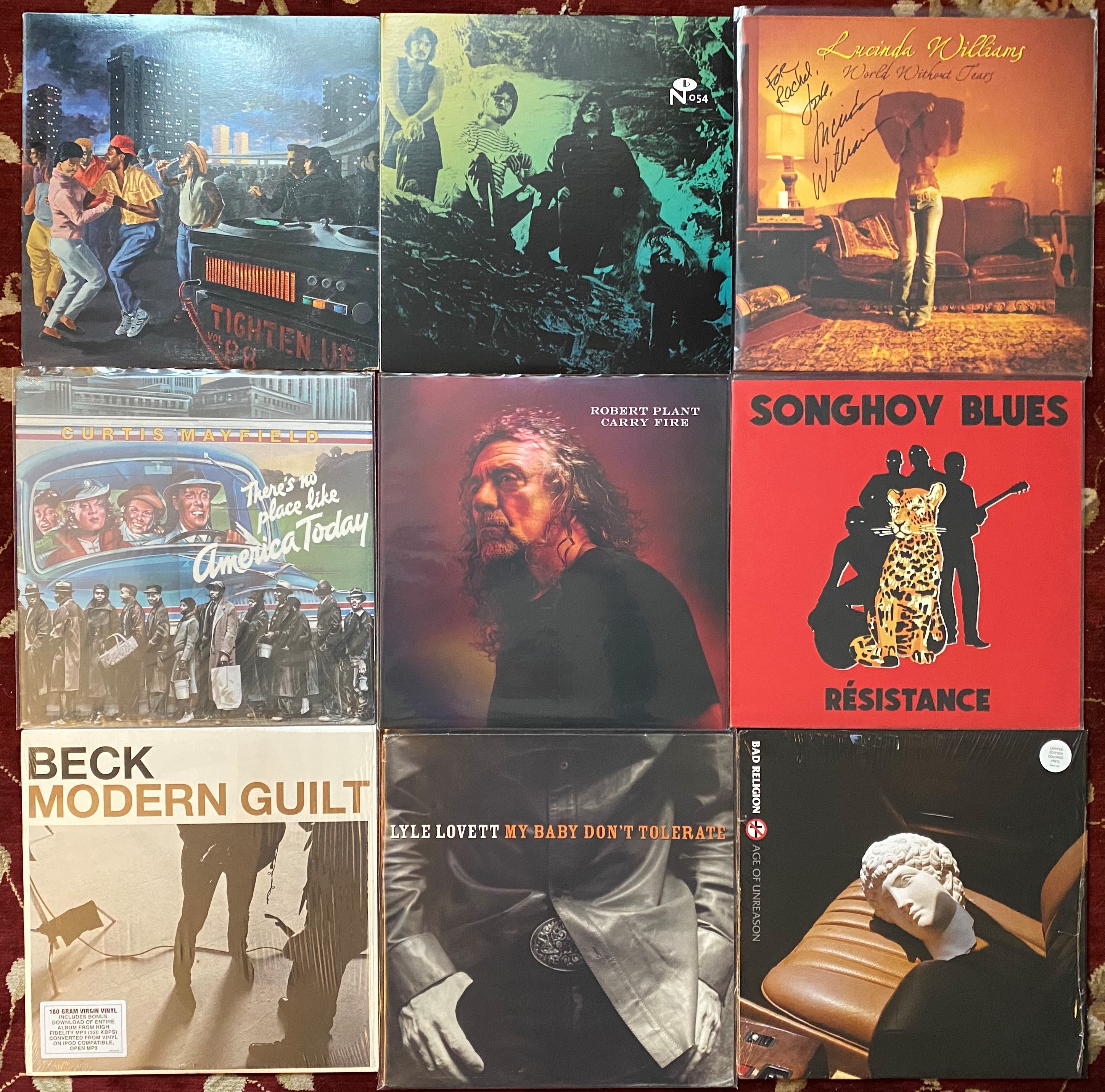
Various artists – Local Customs: Cavern Sounds (compilation)

Bad Religion – Age of Unreason (2019)

Songhoy Blues – Resistance (2017)

Curtis Mayfield – There’s No Place Like America Today (1975)

Lyle Lovett – My Baby Don’t Tolerate (2003)

Lucinda Williams – World Without Tears (2003)

Robert Plant – Carry Fire (2017)

Big Audio Dynamite – Tighten Up ’88 (1988)

Beck – Modern Guilt (2008)