(Above: The Old 97s road-test the new song “Every Night Is Friday Night Without You.”)
By Joel Francis
The Kansas City Star
The 16-year history of the Texas-born Old 97s follows a trajectory well worn by other bands: start out with plenty of youthful energy and fire in the belly and gradually grow more mellow and/or pop-oriented. For theirThursday night’s performance at Crossroads, the alto-country quartet shrugged off its pop trappings and attacked their material with vibrant intensity.
The first sign of the evening’s energy came on the second song, “Dance With Me.” Recorded as a pop song for their latest album, 2008’s “Blame It On Gravity,” guitarist Ken Bethea tore into the main riff like a buzz saw, pushing the tempo to nearly double its original speed. When bass player Murry Hammond was given the mic shortly thereafter for a cover of Merle Haggard’s “Mama Tried” the band pushed and prodded the laid-back vocalist.
Flanked by Bethea and Hammond in nearly matching red plaid shirts, photogenic singer/front man Rhett Millershook his hips like Elvis behind his Stratocaster. He yelped, yowled and screamed his way through the 90 minute set list that featured as many cuts from their first album – four- as their latest.
The band’s third album, “Too Far To Care,” is widely considered its best. They treated the crowd to six cuts, or nearly half the album and they consistently received the biggest responses of the night. “Big Brown Eyes” and “Barrier Reef” got everyone dancing and Miller took an audience request of “Niteclub” during the encore.
Miller seemed to enjoy playing the scorned lover and dumping extra venom into likes like “I hope you crash your momma’s car” and “Thought so much about suicide/parts of me have already died” on back-to-back trips down lonely street during “Lonely Holiday” and “Wish the Worst.” A couple songs later, on “Melt Show,” he emphatically kicked the air during the chorus.
Bethea spurred Miller’s energy, leaping into the air at the start of “The Fool,” dropping a Dick Dale-style guitar solo into “Smokers,” another Hammond vocal showcase,” and adding a nice countermelody to the most delicate and upbeat song in their catalog, “Question.” His solo leading into “Timebomb,” the traditional closer, turned the already fast number into something like a punk song.
Drummer Philip Peeples was the brick on the accelerator that never let up. His cadences consistently pushed the band harder and faster. His kit was at the center of “Every Friday Night Is Lonely Without You,” a staccato-riffed song from the band’s upcoming fall album. It was the only song the half-capacity crowd didn’t sing or air guitar along to all night, but embraced just the same. Peeples also took nice mini-solos during “Doreen” and “Early Morning.”
Lucero rock the Bottleneck in 2008.
The drum solo after “Early Morning” led into a reading of R.E.M.’s “Driver 8,” one of covers the band cut for its new “Mimeograph” EP. The arrangement hewed closely to the original, but it was interesting to hear the lyrics through Miller’s enunciation.
Normally the more rambunctious of the two bands, Lucero was more subdued that night. Singer Ben Nichols embraced the band’s mellow side with numbers like the gospel piano ballad “Goodbye Again,” “Kiss the Bottle” and the one-two of “Hey Darlin’ Do You Gamble?” and “Nobody’s Darlings.”
The five-piece band displayed its Memphis roots by adding a two-piece horn section for a set that featured several cuts from last year’s album “1372 Overton Park.” Early in the set the horns competed with the pedal steel in the mix, but they soon settled in adding extra punch and depth. The brass gave “That Much Further To Go” and “Sixes and Sevens” an E Street sound.
Lucero’s 65-minute set ended with nearly everyone taking a solo during the joyous “All Sewn Up.”
Old 97s setlist: Streets of Where I’m From; Dance With Me; Won’t Be Home; Mama Tried (Merle Haggard cover); Lonely Holiday; Wish the Worst; The Fool; Smokers; Melt Show; Question; Stoned; Up the Devil’s Pay; Barrier Reef; Driver 8 (REM cover); Early Morning; Can’t Get A Line; Big Brown Eyes; Doreen. Encore:Every Night Is Friday Night Without You; Niteclub; The Easy Way; Timebomb.
Steddy P takes care of his fans. Since Steddy’s debut album in 2008, fans have never had to wait more than a few months between new offerings. This month Steddy dropped the While You Were Sleeping EP/mixtape to keep fans happy until the emergence of his next full-length album. But While You Were Sleeping is more than a stopgap release. Six new cuts show Steddy’s recent activity in the studio. But more fun is the second part of the album: 13 tracks from the back catalog, remixed by DJ Mahf.
Mahf, who oversaw Steddy’s 2009 album, Style Like Mind, clearly had a blast marrying “Kenneth Arnold” to the “Super Mario Bros.” video game soundtrack. “Miss Your Coffee Table,” one of the few odes to the fairer sex on the mixtape, incorporates both Q-Tip of A Tribe Called Quest and LL Cool J’s “I Need Love.” Other tracks pay tribute to early Kanye West, Jay-Z, DJ Shadow and the Nappy Roots. That Steddy’s original verses stand up against such recognizable backgrounds is a testament to his clever wordplay and intricate delivery.
At times Steddy’s delivery recalls that of Blackalicious’ Gift of Gab. Steddy does a good job of changing textures when necessary, and recruits great guests such as Ces Cru, Mathias and Jbomb to further vary the vocal patterns. Steddy’s best performance across the 19 tracks comes early. “BARS (Loser’s Club Remix)” is Steddy’s answer to repeated invitations to freestyle battles. After calling out so-called Midwestern rappers who quickly vacate to the coasts he revs into double time. It’s not quite Twista-fast, but impressive nonetheless.
Although they appear first, the new tracks almost seem secondary. Steddy comes strong out of the chute on “Enough” and “Bars,” but the production falters on “Steddy Persistence Pt. II,” the third cut. Each song is handled by separate producers. The tracks don’t flow together well, and the quality fluctuates.
On “No Doz” Steddy uses a violent slasher/horror film metaphor to establish his lyrical dominance. His words are threatening, but try as it might, the chintzy synthesizer loop can’t be considered sinister. A similarly vanilla loop is featured in “And It’s Like That,” which manages to include a shout-out to Steddy’s former home turf of Mizzou, to KU and even to the UMKC Roos.
The final new song, “WindOverHead,” is the most successful. The production includes hints of the ambient and industrial, as well as snippets of saxophone and opera over an understated piano melody. Steddy shines across this landscape, calling out Tech N9ne and Mac Lethal and marking his IndyGround territory.
Despite a few minor missteps, While You Were Sleeping is a nice place for longtime fans to regroup and experience Steddy’s catalog in a different light. Newcomers will find the album a handy place to catch up. Best of all, it’s free.
(Above: Devo get “fresh” on the Jimmy Kimmel Show.)
By Joel Francis The Kansas City Star
Devo deserved better. Kudos to the local radio station for adding them to their Buzz Under the Stars lineup at City Market on Friday night, but the pioneering synth-pop band merited more than a 50-minute set shoehorned in with four other acts.
The five-piece band hasn’t played Kansas City in some time, and many in the crowd were seeing the band for the first time. They weren’t hard to spot. Many were sporting the group’s trademark blue energy dome hats that look like inverted Lego flower pots. Several more knew the precise moments to mimic singer Mark Mothersbaugh’s choreographed hand signals. At times they looked like a group of subversive air traffic controllers.
The five-piece band took the stage wearing matching gray suits with half-masks that looked like berets extending over the eyes. The kinetic keyboard riff to “Don’t Shoot (I’m A Man)” a track off the band’s first album in 20 years, showed they hadn’t lost any of their zany energy during the time off.
Music was only part of Devo’s multimedia message. A large LED screen behind the quintet showed clips from past music videos and footage designed to amplify the songs. The footage during “What We Do” commented on mass consumption and the arbitrary nature of elections as partying humans gradually regressed into simians. Another new song, “Fresh,” featured rapid-fire images of fruit and a bikini-clad derriere.
The diverse lineup prevented the crowd from completely gelling with the music for most of the night. The one exception came during “Whip It,” Devo’s Top 20 hit from 1980. For three minutes, everyone was a Devo fan, whipping the air and singing along.
The final third of the set was an about-face. Synthesizers were replaced with guitars as the band embraced the punk roots of its first two albums. Dressed in yellow radiation suits, the band delivered wonderfully sideways covers of “Satisfaction” and “Secret Agent Man.” Closing song “Jocko-Homo” found the crowd answering Mothersbaugh’s question “Are we not men?” with the hearty “We are Devo.” And then they were gone.
The transition from Devo to Silversun Pickups was jarring. The Los Angeles-based quartet opened with the dreamy wash of “Growing Old is Getting Old.” Their very vocal supporters made a lot of noise during a great performance of “There’s No SecretsThis Year” that somehow managed to find dynamics and texture in an abysmal sound mix.
Guitarist and singer Brian Aubert also gave a shout-out to all the fans that came out for the band’s free St. Patrick’s Day show at the Power and Light district last year. The 50-minute set ended with a run through three of the band’s biggest singles: “Substitution,” “Panic Switch” and “Lazy Eye.”
Ben Folds closed out the night. His one-hour set included favorites like “Kate” and “Annie Waits.” Accompanied only by his piano, the crowd was more than happy to pitch in. They sang all of Regina Spektor’s part on the duet “You Don’t Know Me,” provided three-part harmony to “Not the Same” and participated in a joyously profane call-and-response during “Rockin’ the Suburbs.” Folds also sang “Levi Johnston’s Blues” a track from his upcoming album, and rarities “Steven’s Last Night in Town” and “The Secret Life of Morgan Davis.”
Against Me! and Crash Kings completed the evening’s bill.
Devo setlist: Don’t Shoot (I’m a Man); Peek-A-Boo; What We Do; Going Under; Fresh; That’s Good; Girl U Want; Whip It; Planet Earth; Satisfaction; Secret Agent Man; Uncontrollable Urge; Jocko-Homo.
Few links remain to the golden age of Delta Blues. Most of the artists are dead, and the generation that followed grew up cities far away from sharecropping plantations. T-Model Ford’s appearance at Davey’s Uptown on Thursday night was a rare opportunity to witness firsthand the roots of the blues.
Ford drew a diverse group of about 60 fans, spanning several generations and including bikers, punk rockers, hipsters, musicologists and the curious. What they got was either an embarrassment of riches or way too much.
Fliers promised Ford would be performing with a band, but his only backing was Gravel Road drummer Marty Reinsel. Together the pair coaxed a sound that distilled nearly every traditional variety of the blues into one long shuffle. The guitar-and-drums duo played with a simplicity the White Stripes and Black Keys could only imagine.
There was no set list. For two and a half hours, including a 20-minute break, Ford flipped through the vast blues songbook in his mind and played whatever started coming out of his fingers. The results included well-known songs like “Hoochie Coochie Man” and “My Babe” and Ford originals such as “Chicken Head Man” and “Cut Me Loose.”
Seated on a cushioned chair, Ford looked completely relaxed. During the glacial pauses between verses he gazed across the room, a gentle smile on his face as if he had no cares in the world. Across Ford’s lap was Black Nanny, a Peavy electric guitar that looked like it had been stolen from a hair metal band. Ford twice called it the best guitar in the world.
Regardless of their origin, most songs were based on a two-chord shuffle that had nowhere to go and was in no particular hurry to get there. Most songs ambled along for about five minutes, several stretched to nearly twice that length. Ford’s smooth singing was almost stream-of-conscious, picking up verses halfway through, mixing stanzas and inventing new verses altogether.
Reinsel’s drumming was the element that held the set together. He held back on most songs, altering his emphasis ever so slightly to keep the endless boogies from becoming monotonous. The more aggressive rhythms on “Chicken Head Man” had a Keith Moon energy.
Between songs, Ford massaged the arthritis in his right hand. After one number, he declared it “Jack Daniels time” and downed the contents of the shot glass sitting on his amplifier. He told a story about getting married last week and told the women in the room that “If she flags my train, I’m going to let her ride.”
But what was hypnotic for some was tedious for others and near the end of the first set the chatter from the bar in the back of the room threatened to take over the space. After a 75-minute set, Ford took a break which eliminated many of the less-dedicated fans.
If the night had stopped there no one would have felt shortchanged. No one is sure of Ford’s age, least of all the man himself, but most peg his birth sometime during the Harding administration. Unlike many bluesmen, Ford didn’t start playing guitar late in life and didn’t record an album until 1997 when he was discovered by the Fat Possum label.
The hour-long second set reprised many of the favorites from the first set, including “Sallie Mae” and “That’s Alright.” By the third go-round of “Hoochie Coochie Man” what started as innocent started looking senile. It didn’t stop anyone from dancing, though. As a friend said at the end, when you’re 90 years old you can play the blues any way you want.
(Above: Sarah McLachlan and Emmylou Harris’ duet on “Angel” was the best musical moment of Lilith Fair 2010. The festival stopped in Kansas City on July 15.)
By Joel Francis The Kansas City Star
The sunglasses every artist wore onstage at Thursday’s Lilith Fair were more than a fashion accessory – they were as vital as the instruments.
For five of the festival’s eight hours of music, performers played directly into the sun. Singer/songwriter Ingrid Michaelson summed up the misery.
“It’s so hot out here I felt sweat dripping down my legs, and for a second there I thought I pulled a Fergie,” she said, referring to the pop star’s onstage pee incident.
The performers had it easy compared to the fans. After their 40-minute sets they could retreat to cooler confines. Fans had fewer options. Many ditched their seats and scrambled to whatever shade they could find. This made an already undersold Sandstone Amphitheater look even emptier.
All facilities past the second section of seating were closed. Drivers expecting to park in the main lot at the top of the hill were directed to the auxiliary lot. Fans with lawn tickets were upgraded to second-tier seats, while those with second-level seats could move down. As the sun shrank the crowd grew, filling most of the seating, but it was rough going for the early bands.
Vedera fared better than most acts. Sequestered to a tiny side stage, several hundred dedicated fans crowded into the awkward space to hear the local band deliver new gems like “Greater Than” and “Satisfy” in their half-hour set. Vedera was the last of three local acts, which also included singer/songwriters Julia Othmer and Sara Swenson.
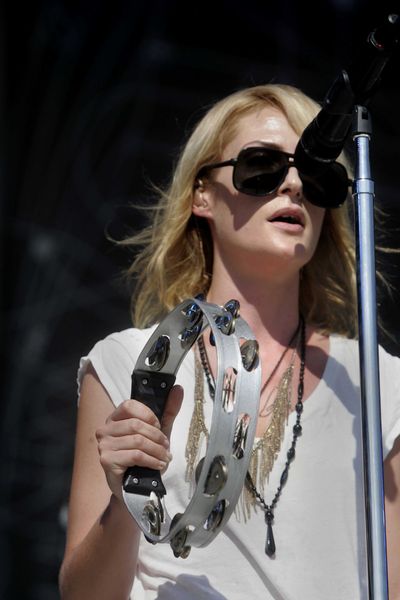
Emily Haines of Metric, looking hot and bothered.
Metric was the first band to appear on the main stage, and red flag the fact that holding an all-day event in a venue with little no cover was a poor idea. The relentless sun rendered moot any lighting or special effects. When it was finally dark enough for these tricks to emerge, the video screens captured a static image of the Lilith Fair logo, meaning fans in the back had no close-up view of events all day.
The four-piece indie band’s dark synth pop isn’t built for daylight. Sound problems plagued the first couple songs, but what the atmosphere didn’t kill the temperature did. When you’re sweating just standing still, it’s hard to be convinced to dance. Singer Emily Haines did a robotic dance to the Big Brother-esque lyrics of “Satellite Mind,” and prefaced “Gimme Sympathy” with a bit of Neil Young’s “Hey Hey, My My.” Their set was heavy on last year’s “Fantasies,” but surprisingly did not include their contribution to the latest Twilight film, “Eclipse (All Yours).”
Michaelson had better success connecting with the sparse crowd with her jangly pop. Backed by a five-piece band, Michelson bookended her set with ironic covers, incorporating Lady Gaga’s “Pokerface” into her own “Soldier” and closing with Britney Spears’ “Toxic,” which featured everyone onstage in a synchronized dance. Both moves drew big cheers. In between, she delivered her hit “The Way I Am,” which recalled Regina Spektor’s quirky vocal phrasing, the bouncy “Locked Up,” and new song “Parachute.”
Halfway through the Court Yard Hounds’ set, Emily Robison found herself in trouble.
“This is a quintessential chick song,” she said, intending to introduce Joni Mitchell’s “This Flight Tonight.” The chick the crowd knew, however, was Robison’s main gig with fellow Yard Hound and sister Martie Maguire, the Dixie Chicks. The unexpected burst of delight flummoxed Robison for a moment.
“No, no, not that chick,” she said, trying to recover. “I mean a hippie chick.”
Robison and Maguire released three Dixie Chicks albums before singer Natalie Maines arrived and turned the group into superstars. When Maines bowed out of making new music, the sisters soldiered on. Their sound hews closer to Americana and roots music than the Chicks’ pop country, but suffers without Maines’ feisty spirit. “It Didn’t Make A Sound” featured a nice honky tonk piano solo, and “The Coast” was a pleasant tribute to the sister’s native Texas beaches, but it was too gentle to engage the crowd.
Sisters Nancy (left) and Ann Wilson, the heart of Heart.
Conversation ceased, however, when the sisters unleashed a furious bluegrass instrumental that had fans on their feet, clapping and stomping along. The set ended with a moment out of “O Brother, Where Art Thou?” when Maguire’s 6-year-old twin daughters joined the ensemble, tentatively playing percussion alongside their mother.
Emmylou Harris is the Mother Maybelle Carter of her generation, collaborating with everyone from Bob Dylan and Neil Young to Ryan Adams and Lyle Lovett. The artists everyone else on the bill respect as legends, she calls contemporaries. Yet even her distinct, wonderful voice wasn’t enough to sway the crowd. As with most artists during the day, the audience was divided between hardcore fans, politely curious listeners and everyone else, waiting impatiently for their act to appear. The ambitious and diverse bill ended up leaving everyone out at some point during the day.
Harris and her four-piece Red Dirt Band leaned heavily on her 1999 album “Red Dirt Girl,” mixing in the good old country of “Wheels” and “Born to Run” (a Paul Kennerly song, not a Bruce Springsteen cover). The most riveting moments were the a cappella gospel arrangement of “Calling My Children Home” and Harris’ own hymn, “The Pearl.”
Harris also shared the day’s best musical moment when she joined Sarah McLachlan on “Angel.” These multi-artist bills should have more of this synergy. Witnessing Harris and the Hounds collaborate on a Bill Monroe bluegrass number, or Haines join McLachlan on “Possession” would have been special events fans would treasure long after they had forgotten the heat and the ticket price.
Lilith Fair found Sarah McLachland closed out the day.
It wasn’t until Heart took the stage at 8:45 that the fair had its first galvanizing musical moment. The raucous blast of “Barracuda” eradicated the gentle sway of the afternoon and invigorated a crowd that had traded the sun for the moon and was finally ready to move. Sisters Ann and Nancy Wilson delivered a heavy slab of ‘70s rock that had fists pumping and hips shaking. Guitarist Nancy Wilson concluded her acoustic intro to “Crazy On You” with a scissor kick, cueing the rest of the six-piece band. Singer Ann Wilson was in top form, belting the refrain from the Rolling Stones’ “Gimme Shelter” during their own “Even It Up” and easily finessing the dynamics of “Magic Man.”
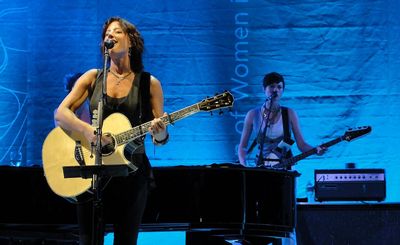
Lilith Fair founder Sarah McLachlan closed the day nearly eight hours after the first act appeared. The Vancouver native congratulated the crowd for braving the heat and rewarded them with many of her biggest hits, including “Building a Mystery,” “World On Fire” and “Adia.” She needlessly apologized before playing each of her three new songs, but the crowd responded well to those numbers as well.
Here’s a tip to established artists trying to introduce new songs: If you act proud of your new material, fans will be more likely to embrace it. Today’s new song is tomorrow’s sing-along.
The night ended with the gentle lilt of McLachlan’s “Ice Cream” before most of the day’s artists -– including Swenson, who shared a mic with the Court Yard Hounds -– joined together for a joyous romp through Patti Smith’s “Because the Night.”
Setlists:
Metric – “Twilight Galaxy,” “Satellite Minds,” “Help I’m Alive,” “Gold Guns Girls,” “Hey Hey, My My” > “Gimme Sympathy,” “Dead Disco.” Ingrid Michaelson – “Soldier” > “Pokerface,” “The Way I Am,” “Parachute,” “Maybe,” “Locked Up,” “The Way I Am,” “Toxic.”
Court Yard Hounds – “Delight (Something New Under the Sun,” “It Didn’t Make a Sound,” untitled new song, “Then Again,” “Fear of Wasted Time,” bluegrass instrumental, “The Coast,” “Ain’t No Son.”
Emmylou Harris – “Here I Am,” “Orphan Girl,” “Evangeline,” “Wheels,” “Born To Run,” “Calling My Children Home,” “Red Dirt Girl,” “Get Up John,” “Bang the Drum Slowly,” “Shores of White Sand,” “The Pearl.”
Heart – “Barracuda,” “Straight On” “Even It Up/Gimme Shelter,” “WTF,” “Hey You,” “Red Velvet Car,” “Alone,” “Magic Man,” “Crazy On You.” Encore: “What Is and What Should Never Be.”
Sarah McLachlan – “Angel” (with Emmylou Harris), “Building a Mystery,” “Loving You Is Easy,” “World On Fire,” “I Will Remember You,” “Forgiveness,” “Adia,” “Out Of Tune,” “Sweet Surrender,” “Possession.” Encore: “Ice Cream,” “Because the Night” (with most of the day’s perfomers).
(Above: Modest Mouse perform “Baby Blue Sedan” at a previous stop in Kansas City, Mo., at the Uptown Theater in March, 2009.)
By Joel Francis The Kansas City Star
Early in his first visit to Crossroads, Modest Mouse singer Isaac Brock was quick to point out the venue’s most distinctive feature. After the second song, he told the sold-out crowd the band had a “super awesome” gift for everyone: they each got to take home a wood chip.
The six members of the indie rock band were so excited about their present they flubbed the first verse of the next song “We’ve Got Everything.” After taking a brief moment to regroup they returned to the number with increased fervor. It was the only misstep of the two-hour set that found the band growing stronger with each number.
The set opened with slow, droning intro to “Gravity Rides Everything,” which gave way to a gentle wash of acoustic guitar. With three guitarists and two drummers, Modest Mouse’s songs were never lacking in texture. Frequently the band went one step further, substituting banjo, violin and keyboards. During “Gravity,” Brock held his acoustic guitar up to the speakers a la Pete Townshend for a nice burst of feedback. The combination of two trumpets and Brock’s banjo on “King Rat” and “Devil’s Workday” created a kind of demented Dixieland.
While two of the band’s biggest songs – “Float On” and “Florida” – were absent, they weren’t missed. The opening bars of nearly every number were greeted with huge cheers of recognition, regardless if it was a single like “Dashboard” or album cut like “Paper Thin Walls.” The 18-song setlist was democratically split between the band’s three most recent albums, with a few added nuggets. There was very little chatter during songs in the crowd or between them onstage; the music captured everyone’s attention.
“Whale Song” featured a lengthy opening and Brock’s signature guitar style. Brock has a way of bending notes while hitting them with the whammy bar that makes his guitar sound like a drunken Jew’s harp. Although touring guitarist Jim Fairchild, formerly of Granddaddy, shared the stage, Brock chose to do most of the heavy lifting. After “Whale,” each song seemed to build on the intensity of the previous performance. By “Devil’s Workday,” which featured another great stinging solo from Brock, and “Tiny Cities Made of Ashes” the band was cranking at 11.
That intensity made “Fire It Up” seem even more low-key, with the entire band riding Eric Judy’s loping bass line. “Blame it on the Tetons” had a gentle, folksy feel supported by Tom Peloso’s violin. New song “Here’s To Now” also featured Peloso’s fiddle, which had everyone clapping along to the two-step rhythm.
The biggest contrast of the night, however, may have been the response to “Parting of the Sensory.” Brock could never be mistaken for an optimist, but the audience danced and sang along to the nihilistic refrain of “someday you will die and somehow something’s going to steal your coffin” like it was the Jackson 5. It would have been the perfect ending, but the band had one more treat in “Black Cadillacs.” Even without the souvenir wood chip, it wasn’t a night anyone will soon forget.
Setlist: Gravity Rides Everything; The View; We’ve Got Everything; King Rat; Here It Comes; Fire It Up; Whale Song; Paper Thin Walls; Here’s to Now (new song); Baby Blue Sedan; Dashboard; Satin in a Coffin; Devil’s Workday; Tiny Cities Made of Ashes; Encore: Blame It On the Tetons; Third Planet; Parting of the Sensory; Black Cadillacs.
(Above: The primitive beauty of unaccompanied fireworks over the national Mall on July 4, 2010.)
By Joel Francis
The Daily Record
WASHINGTON, DC – Soul legend Gladys Knight took the stage staring into a sea of empty seats. It was three hours before show time, and the VIPs with reserved seats wisely avoided the blistering afternoon sun.
Knight, however, was undeterred. “This is a thing we used to call audience participation,” she hollered to the groundlings on the Capitol lawn who arrived hours before to stake a prime spot. Knight drew out each syllable of “par-tic-i-pat-ion” and drew cheers of delight from the exhausted but excited assembly of hundreds.
When Knight launched into a call and response, her words were thrown back with force and a smile crossed her face. After a few volleys, the band pumped the final vamp as she threw up her arms and walked from the stage. The 30-minute mini-set, which included a few instrumental runs through made the risk of heat stroke seem reasonable.
The blazing sun had been replaced with bright stage lights and television cameras when Knight re-emerged shortly after 8 p.m. After a brief welcome by MC Jimmy Smits, American Idol David Archuleta opened the show with the “Star-Spangled Banner.” Then it was time to get down to business.
The Empress of Soul emerged in a golden gown, flying into “Midnight Train to Georgia.” Knight’s voice was strong in the afternoon, but now she sang with even more soul and emotion. The words are the same, but the phrasing was different and they were delivered with a power has been honed over Knight’s half-century career.
Her voice rises in sharp contrast to Darius Rucker’s, who also sound checked in the afternoon. I realize his laid-back, what-you-see-is-what-you-get charm is a large part of his appeal, but there was very little difference between the run-through and televised performances. Rucker has a fine voice, but I hope he was paying attention.
Barely pausing after “Georgia,” the band hic-cupped into Knight’s 1969 hit “The Nitty Gritty.” Knight used the upbeat number to pay tribute to two of her departed Motown label mates, dropping in a healthy portion of the Jacksons’ “Shake Your Body (Down to the Ground)” and a sample of a Rick James number. Then it was time to finish business with her biggest hit, “I Heard It Through the Grapevine,” which showed no signs of age.
And that was it. Ten minutes, three songs, and she was walking offstage. Afterward people started asking me if it was worth it to trek to the Mall so early and broil for so long. Absolutely. Knight’s presence cemented my attendance, but I likely would have gone anyway. As far back as I can remember, my family always gathered around the television on the Fourth of July to watch the PBS broadcast from the capital. And now, with my parents rooting me on from their air-conditioned living room, I was there.
The performances I remember from growing up were classical and marching band pieces, so the National Symphony Orchestra’s patriotic overture from “George M.” and classical pianist Lang Lang’s solo adaptation of “Stars and Stripes Forever” resonated the most deeply. Once the shock of hearing Sousa’s most famous number without horns wore off, Lang’s performance was quite profound. The lines typically dominated by trombones and tubas was intricate and dissonant, while the familiar piccolo refrain had a ragtime feel.
Although the Capitol lawn is vast, it was easy to forget about the thousands of people standing behind me and the hundreds of thousands gathered behind the stage, on the Mall. In a way, the “Capitol Fourth” broadcast felt like any concert in the park, albeit one with TV cameras and A-list talent. As John Schneider (aka Bo Duke) led a recap celebrating the 30th anniversary of the broadcast, I abandoned the concert grounds and headliner Reba McEntire and to be part of the teeming masses camping around the Washington Monument.
The high-profile event disappeared with every step. The lawns on the Mall were filled with tents, displays and crowds oblivious to the concert behind them. Walking through one block I encountered an expanse of grass filled with multi-colored tents bearing signs like “Yoga and Meditation” and “Free Feast.” The tent most intriguing to me featured live traditional Indian music. The artists onstage were nearly obscured by smoke, and the crowd was sparse, but there were more people dancing than watching.
A block further, I spotted what I thought to be a poetry slam backed by a live drummer. Upon closer inspection it was a different sort of poet, a fevered evangelist in the middle of a passionate altar call. I briefly raised my hand in solidarity and pressed on.
An orange band hovered on the horizon above the Lincoln Memorial when the fireworks started shortly after 9 p.m. Unlike all previous July 4th celebrations I have attended, the carnival of explosions around the Washington Monument burst without accompaniment. The muffled pops and sizzles from each multi-color detonation was met by the collective oohs and ahs of thousands. In place of orchestration, my ears were treated to a kaleidoscope of accents, dialects and languages, punctuated by the occasional far-off siren or barking vendor. It was one of the rare moments in my life when music was rendered completely redundant.
For 20 minutes we stood united by a common gaze in the sky, a diverse collection of tourists from all parts of the map. Although the horde easily exceeded the audience created by the simultaneous emptying of Kauffman and Arrowhead stadiums, the Kansas Speedway and Sprint Center, there was no whiff of anger or danger. Small children danced in front of their strollers as teen-agers texted their friends and old-timers remembered when. It would be poetic to say that when the display ended we all went back to our respective lives, but in reality we all just swarmed to a different location – the subway stations.
Smokey Robinson and the Miracles – “The Tears of a Clown,” Pop #1, R&B #1
By Joel Francis
The Daily Record
One of pop music’s most unique and amazing properties is its ability to wrap the most heartbreaking lyrics in a bubbly, effervescent melody.
Think about it for a moment. While there are shades and degrees to consider, and this is obviously a simplification, because other types of art usually inhabit only one medium, i.e. words or images, a sad poem or a sad painting typically going to be predominately sad. I’m not saying music is the only art form to convey multiple emotions at once; that’s a ludicrous assumption. But it seems pop music does this a lot easier than most.
Few songs handle the light/dark juxtaposition as effortlessly as Smokey Robinson and the Miracles’ 1970 smash “The Tears of a Clown.” The song started out as an instrumental Stevie Wonder wrote with his producer Hank Crosby. Unsure what to do with what Wonder knew was a great track, he brought it to the Motown Christmas party in 1966 to see if Robinson had any ideas. Robinson said hear head a circus in the melody and wrote the lyrics. The finished track appeared as the final song on the Miracles 1967 release “Make It Happen.”
For three years the song lay hidden as a deep cut, ignored by both the label and the band. In 1969, Robinson announced he was tired of touring and being separated from his family. By leaving the Miracles, Robinson reasoned, he could spend more time in Detroit with his family and focus on his role as Motown’s vice president. From Robinson’s perspective, it was a sound plan. The trouble was, the Miracles were one of Motown’s biggest act in Europe and the band had delivered only one Top 10 hit over the last two years. Desperate for new material, Hitsville UK scoured the vaults and back releases and stumbled upon the long-forgotten “The Tears of a Clown.” After giving the song a new mix it was released as a single in February, 1970. The song shot to No. 1 on both sides of the Atlantic.
Fortunately for music fans everywhere, the song’s success made Robinson reconsider his decision to leave the Miracles. Motown re-released “Make It Happen” with a modified tracklisting as “Tears of a Clown” – even the cover art stayed the same – and Robinson stayed in the Miracles until 1973.
Thematically, “The Tears of a Clown” mirrors the Miracles’ 1965 hit “The Tracks of My Tears.” Both songs deal with a heartbroken lover masking his/her pain in public. The subject of both songs craves the estranged, but it too proud to share those feelings in all but the darkest, quietest places. Not happy stuff. But while it was impossible to escape the anguish of “The Tracks of My Tears,” listeners could be possibly forgiven for thinking “The Tears of Clown” was little more than a happy romp on the calliope. Wonder and Cosby’s upbeat melody is a perfect antonym for Robinson’s lyrics. One moment poignantly cuts at the heart of the song, however. The arrangement briefly pauses while Robinson confesses “when there’s no one around.” In those tender seconds, his soul is laid bare.
“The Tears of a Clown” was the Miracles biggest hit while Robinson was in the group. Unsurprisingly, several other bands wanted a taste of this success. “Clown” has been widely covered over the past 40 years. The English Beat delivered one of the best interpretations with their 1979 ska adaptation of the song. At the other end of the spectrum are the version cut by LaToya Jackson for her 1995 Motown covers album, and Enuff Z’Nuff’s hair metal reading. Somewhere in the middle lie Phil Collin’s version, included on his “Testify” album, and Petula Clark’s 2000 reading. Early ‘90s Swedish pop duo Roxette also worked the “Clown” melody into their hit “Spending My Time.”
To say that the Jackson 5’s formula was successful would be a terrific understatement. Three upbeat, bubblegum hits, all penned and produced by Berry Gordy and his faceless Corporation, all No. 1 pop and R&B smashes.
Gordy’s decision to break from the formula for the group’s fourth hit was shocking. Not known as one to mess with a sure thing, Gordy dumped the Corporation and partnered with Hal Davis, Willie Hutch and Bob Wests to craft a ballad that placed Michael Jackson directly the spotlight, and relegated his brothers to a support role.
The result was the J5’s most successful single ever, selling 4 million copies in the United States and cementing the band’s career beyond bubblegum. “I’ll Be There” was also the group’s last No. 1 hit; three more singles ceilinged at No. 2.
Only 12 years old at the time, Jackson dumps more emotion into his delivery than many singers twice his age possess. His clarion call to give love another chance is graceful and penetrating. Gordy positioned Diana Ross as the J5’s mentor – her influence shines in Jackson’s delivery, both in phrasing and tone.
“I’ll Be There” was covered by Mariah Carey and Trey Lorenz as a duet in 1992. The single was her sixth No. 1 hit, but the less said about her treacly reading the better. More interestingly, it appeared on the fourth album by Southern California punk rockers Me First and the Gimme Gimmes in 2003, who frequently recorded ironic covers. “I’ll Be There” graced two other Motown releases. The Temptations recorded a version for their 2006 album “Reflections” and sister La Toya Jackson cut it for her 1995 covers album. Many artists, including Carey, the New Kids on the Block, Jaime Foxx and Ne-Yo and Green Day performed “I’ll Be There” in tribute to Jackson after his death on June 25, 2009.
Michael Jackson performed “I’ll Be There” on all of his solo tours, frequently getting emotional and breaking down mid-song.
(Above: Marvin Gaye asks for a witness. He gets four go-go dancers.)
By Joel Francis
The Daily Record
For the past 46 years, few have been able to see “ The T.A.M.I. Show,” the 1964 concert film that captured early performances from the Beach Boys, Marvin Gaye, Smokey Robinson and the Miracles and the first major U.S. appearance of the Rolling Stones.
A tangle of legal issues sent the movie to exile almost immediately after it was sent to the theaters. The producer lost his rights and the film was never released on video rarely shown in public. For years fans would read about how incredible the “T.A.M.I. Show” was – particularly James Brown’s appearance, which Rick Rubin once said “may be the single greatest rock and roll performance ever captured on film” – without being able to see it. Thankfully this has finally been corrected. After decades of wrangling, Shout Factory has finally released the “T.A.M.I. Show” on DVD.
After a montage of all the stars arriving over one of the longest Jan and Dean songs ever, Chuck Berry takes the stage. His appearance ties the film back to “Rock Rock Rock” and the classic ‘50s rock and roll films, but halfway through “Maybelline,” the camera swings over to Gerry and the Pacemakers doing their version of the song. It’s a little disorienting at first, and doesn’t completely work, mostly because Gerry is so campy. He’s constantly playing to the camera, and the group clearly doesn’t have Berry’s talent or charisma.
Fortunately, an endless parade of go-go dancers in bikinis is on hand to distract from any lulls in the music. Constantly in motion, the dancers swarm across the stage – often directly in front of the performers – and on platforms in the back. The producers discovered what MTV perfected in the ‘90s with “The Grind:” buxom, gyrating dancers will make even the most execrable music enjoyable.
The showgirls hog the camera during the first number of Smokey Robinson and the Miracles’ set. Fortunately, lens eventually pulls back on the second number, and the quartet delivers the first great performance of the night. Robinson drops down, jumps up and throws his entire spirit into an extended “You Really Got A Hold On Me.” That energy carries into “Mickey’s Monkey,” that has everyone onstage and in the crowd dancing. Marvin Gaye continues Motown’s strong showing with a great “Stubborn Kind of Fellow.” For “Can I Get a Witness” he performs away from the band, flanked by two shimmying girls.
Director Steve Binder isn’t shy about cutting to the junior high and high school students in the audience screaming in delirium. One long shot accidentally allows a glimpse of policemen in helmets patrolling the aisles. There was clearly a hard line on the level of excitement that could be displayed.
It’s hard to believe Lesley Gore was the biggest star on the bill at the time, and that she didn’t become an even bigger star later. Gore dutifully performs her best-known songs, the No. 1 “It’s My Party” and its Top 5 sequel “Judy’s Turn to Cry,” but her poise, grace and presence suggest she should have had a much longer career. Gore It’s too bad she couldn’t keep up with the harder, psychedelic edge rock music was about to take.
Several of Gore’s songs are captured by a camera that looks like Vaseline has been smeared over the lens. In the commentary track, Binder said that was exactly what was done. He either couldn’t afford or didn’t have time to outfit the rigs with soft focus capability, so they went with this bargain basement substitute. Unfortunately, it looks like Gore is singing through a funhouse mirror.
Jan and Dean, the evening’s MCs, kick off the surf portion of the show, but they are outmatched by the Beach Boys, who follow. Jan and Dean’s harmonies seem thin and the skate-board-in-a-guitar-case trick can’t hold up to the Boys’ rich voices and Brian Wilson’s songwriting. The performance was filmed months before Wilson’s nervous breakdown forced him off the road. Here he looks completely at ease and happy.
After the movie’s initial run, the Beach Boys’ manager demanded his client’s four-song set be removed. When the inevitable “T.A.M.I. Show” bootlegs popped up, the Beach Boys were usually missing. This DVD finally restores the lush “Surfer Girl” and the freedom of “I Get Around.”
The film treads water through the Dakotas, Supremes and Barbarians until – finally – we get to James Brown and the Famous Flames. Honestly, there’s nothing he does here that wasn’t captured on the incredible “Live at the Apollo” album one year earlier. This, however, was his first major show in front of a white audience. It also gave fans the opportunity to see Brown work his magic in addition to just hearing it.
The Flames are razor-sharp as Brown kicks into “Out of Sight.” Showing his penchant for adventurous covers, Brown resuscitates Perry Como’s hit “Prisoner of Love.” He then directs the Flames into “Please, Please, Please” and the place goes nuts for the now-infamous cape routine. Brown’s pants, which were clean before the song, are scuffed and dirty at the knees from all the times he falls down (only to pop right back again.) During “Night Train” he does this crazy dance on one foot where he manages to wriggle across the stage. Not only does he not fall down, but he looks impossibly smooth.
In his commentary on the “T.A.M.I. Show” trailer, director John Landis, whose entire seventh grade class scored invites to the taping, said the Rolling Stones “were kind of boring after James Brown.” He’s right. The Stones open with a cover of Chuck Berry’s “Around and Around,” an odd choice considering Berry was onstage earlier. They don’t start to live up to their hype and billing until the terrific “Time Is On My Side” and “It’s All Over Now.”
It’s difficult to watch the early Stones without picturing the lazy spectacle they’ve become. There is a hunger in these songs and Mick Jagger is genuinely working to win the crowd’s approval. It’s odd to see Brain Jones so alive and so happy. It seems he was born with those omnipresent bags under his eyes that just grew sadder and deeper until the lids above closed forever.
But that was still several dark years off. The “T.A.M.I. Show” is a celebration that despite some dated production techniques and material still feels vibrant. It’s a peek behind a curtain to a world where artists from not only all over the world, as the song goes, but all genres, could party together on the same stage. In a way, it was a precursor to the weekend festivals that would pop up at the end of the decade and have resurfaced to dominate the summer musical landscape again today.


 Flanked by Bethea and Hammond in nearly matching red plaid shirts, photogenic singer/front man Rhett Millershook his hips like Elvis behind his Stratocaster. He yelped, yowled and screamed his way through the 90 minute set list that featured as many cuts from their first album – four- as their latest.





 joelfrancis.com