Social Distancing Spins, Day 5

By Joel Francis

In observance of St. Patrick’s Day, here are some of my finest albums with Irish ties.

The Pogues – If I Should Fall From Grace with God (1988) The only thing wrong with this album is that the title song is too short. The extended 12-inch version on the Pogues box set solves this problem. Mentioning the highlights is like reading the track listing, but I’ll narrow it down to the absolute best. “Fairytale of New York” is my absolute favorite Christmas song and is just as powerful in August as it is in December. Hearing Kirsty MacColl and Shane MacGowan trade stanzas in the final verse always crushes me. This song’s all-time status was cemented in my soul when Bill Murray slurred his way through it with David Johansen and Jenny Lewis in his Christmas special.

There may be no finer tribute to the hope and heartbreak of the 19th century immigrants who traveled to the United States to start a new life than “Thousands are Sailing.” And that’s just side one. We’d better move on or I’ll be here all day.

Stiff Little Fingers – Greatest Hits Live in London (2017) The glory days of this Belfast-born punk band were long over when this live set came out. Although most of the material here pulls from the groups mighty four-album run in the late ‘70s and early ‘80s the fire on this inflammable material has dimmed. I really bought this album because it was marked down on a Black Friday sale and signed by the current musicians. As it’s the only SLF I currently own, it will be what I spin when I need to hear “Tin Soldiers” or “Suspect Device.” Oh, one more thing: “Alternative Ulster” makes a great alarm song on your phone. It’s hard not to want to kick the day’s butt after hearing that first thing.

Thin Lizzy – Jailbreak (1976) Yeah, this is the album with “The Boys are Back in Town,” the only song that classic rock radio deigns to circulate, but this is a solid slab of rock from start to finish. “Jailbreak” blows out the speakers like a lost AC/DC song. “Cowboy Song” starts off like a campfire ballad before Phil Lynott’s storytelling takes over and the guitars plug in. Can we talk about Lynott’s lyrics for a moment? “Emerald” reads like a preview to a great lost epic poem. The story in “Romeo and the Lonely Girl” is just as majestic as Mark Knopfler’s masterpiece “Romeo and Juliet.” All with those dual guitars that can sting like a scorpion out of nowhere. Thin Lizzy gets nowhere near the respect they deserve.

The Chieftains – 3 (1971)

Van Morrison and the Chieftains – Irish Heartbeat (1988) If you blindfolded me and played me any one of the Chieftains first half-dozen albums, I’m fairly confident I couldn’t tell them apart. The traditional Irish troupe expanded their sound when they started adding guest artists and gimmicks in the ‘90s. (The Chieftains play movie themes! The Chieftains go to Nashville!) There are many moments to savor on those albums, but I like the unvarnished simplicity of the jigs and reels on their initial run.

Ironically, it was the success of Irish Heartbeat that paved the way for these cross-genre exercises. I don’t begrudge the Chieftains for trying to reach a broader audience but to my ears they’ve never found a better partner than fellow Irishman Van Morrison. For proof, take a look at the group’s star-studded release Long Black Veil from 1995. Everyone from Sting to the Stones shows up, but Morrison steals the album with his own “Have I Told You Lately.” Irish Heartbeat brings out a playful side of Morrison rarely heard, particularly on “I’ll Tell Me Ma” and “Marie’s Wedding.” Hoist a pint and turn it up.

Dropkick Murphys – The Meanest of Times (2007) Irish by way of Boston, the Dropkick Murphys combine the traditional feel of the Chieftains with Thin Lizzy’s hard rock and Stiff Little Finger’s punk attitude. When I played this album in the morning my son announced that he didn’t like it and left the room. That evening he was captivated by the Murphys’ live performance online. I tried to tell him they were the same band from earlier, but he didn’t believe me. I guess some things need to be seen to be believed. (By the way, streaming this concert was a brilliant idea and really seems to be taking off while all of us are stuck at home. According to the counter in the corner, 128,000 people were watching live. That’s a far bigger crowd than they ever could have hoped to reach by playing a St. Patrick’s Day show in Beantown.)

Flogging Molly – Within a Mile of Home (2004) It’s hard to imagine a Dropkick Murphys fan not liking Flogging Molly as well. Molly are slightly less hardcore than the Murphys on record but both acts generate a considerable mosh pit in concert. I found Within a Mile of Home at a ridiculously cheap price on CD shortly after its release. Seeing Lucinda Williams was featured on one track, I picked it up. A couple years later, I found Whiskey on a Sunday, the follow-up EP/DVD under the same circumstances. Watching those live performances convinced me I absolutely had to see this band in concert. While Within a Mile from Home is the only Molly vinyl I own, I’ve seen them a handful of times in person and never been disappointed.

U2 – Boy (1980) If it is possible to think about this divisive Irish quartet without the hype, bombasity and preening it has accumulated over the years, then Boy is it. With the exception of opening track “I Will Follow,” the rest of the album has been excluded from setlists and compilations (although some songs have gradually crept back onstage). The menacing “An Cat Dubh” almost sounds like an anthemic early Cure outtake (with glockenspiel!) that slides into The Edge’s wonderful guitar textures of “Into the Heart.” (Along with Bono’s earnest vocals. U2 were never not-earnest.) There aren’t many hints of The Joshua Tree or Achtung Baby here, yet all the essential elements of those albums are present. Sometimes spending time with the boy is more revelatory than hanging out with the man.

Social Distancing Spins, Day 3

By Joel Francis

Our trawl through my world of vinyl continues.

Various Artists – Stroke It Noel: Big Star’s Third in Concert (2017) To butcher the cliché, probably not everyone who bought a Big Star album back in the ‘70s started a band, but it’s a fair bet that at least one person from most of your favorite bands did (unless you are super into, say, Norwegian death metal, in which case, thank you for branching out and reading this blog).

It’s been ten years to the month since Big Star’s frontman Alex Chilton died on the eve of his celebration at South by Southwest. The impromptu tribute that emerged from that tragedy morphed into a series of concerts around the world celebrating Big Star’s troubling third album. It’s wonderful to hear members of Wilco, R.E.M., Yo La Tengo, the Posies, Semisonic, the dbs and more pass the mic and hike through these songs. But the live reproductions are so faithful they miss the fragile, alluring qualities that made the original studio versions that almost seemed to disintegrate before coalescing into beauty – if they made it that far. So yeah, I dig this, but hearing R.E.M.’s Mike Mills bounce joyfully through “Jesus Christ” or Django Haskins struggle with “Holocaust” doesn’t make me a bigger Big Star fan. It just makes me glad that the people I’m into have such immaculate taste.

Robert Fripp – Exposure (1979) I have a great deal of respect for King Crimson, Robert Fripp’s groundbreaking progressive rock ensemble, but to my heathen ears their music is like listening to calculus. I can get behind Exposure, though. You can almost hear Fripp smirking as he takes the listener from wordless, off-kilter a capella harmonies to an endlessly ringing phone and then a boogie woogie pastiche – all in about a minute. It’s almost like Fripp is daring us to meet us where he is, then abruptly changing course and challenging us to follow him over there. This is also an apt description of his entire career. Listening to Exposure is like playing tag. You never stay in one place and may find yourself out of breath at times with the quarry just out of reach, but it’s always fun to play. Special mention must be made of the definitive version of “Here Comes the Flood” with Peter Gabriel on vocals.

Madisen Ward and the Mama Bear – Skeleton Crew (2015) This mother-son duo was poised to be the next big thing to break out of the Kansas City music scene when this debut album came out. They appeared on one of the last episodes of The Late Show with David Letterman, the Today show, Later with Jools Holland and played Bonnaroo and the Newport Folk Festival. Things have been quiet since then – only one EP in 2018 – but these laid-back, folk blues romps are still a fun spin.

Kendrick Lamar – Damn. (2017) Damn. was my favorite album the year it came out and it remains a compelling listen today. The fact that I can say this despite a concert that nearly left me in tears is a testament to its strength. When the Damn. tour announced a date at the Sprint Center, I quickly jumped on tickets. Not wanting to take out a second mortgage, my friends and I got seats in the upper level, extreme stage right. The sound was fine for the opening acts, but when Lamar took the stage it was like the sound blew out in the speakers directed at our section. You know it sounds you’re just inside the doors, waiting to get in and the show starts without you? All bass with just a hint of vocals? That’s how it sounded inside the arena. Some ushers kindly moved us to another section where the sound was slightly better, but the spell had been broken and the show was a bust. All this and I still can’t wait to hear what Lamar does next.

Rush – Power Windows (1985) I know everyone loves the hard, sci-fi prog of Rush’s late-‘70s peak, but I am strongly partial to their synth-heavy early ‘80s material. This mostly boils down to the fact that during high school I played the band’s 1989 live album A Show of Hands so often I thought the laser would bore right through the CD. So you can have your “Cygnus X-1” and “By-Tor and the Snow Dog” and I’ll stick with “Marathon” and “Manhattan Project,” thank you very much.

Husker Du – Everything Falls Apart (1982) Playing this record (included in the Numero Group’s essential early-days collection Savage Young Du) is like flying down the interstate on a Japanese motorcycle without a helmet. Insects slap your face and the wind stings your eyes as gravity forces you closer to the ground. Danger is imminent, but you twist your wrist and accelerate even more. Stopping is not an option. Oh, and there’s an entire side of bonus tracks.

Johnny Cash – Mean as Hell! (1966) Mean as Hell! is the single platter version of Johnny Cash’s double-record concept album Sings the Ballads of the True West. I think I got this at a garage sale, because who can resist an album with this title (with mandatory exclamation point) where a gaunt, drugged out Cash is dressed like a cowboy, holding a gun? The music isn’t as exceptional as the cover. The spoken-word bits are a little too somber. Cash sounds like a Southern preacher crossed with a National Geographic narrator on the title track and the studio version of “25 Minutes to Go” is nowhere near as fun as the live version at Folsom Prison. Despite these shortcomings, I’ll still put on my spurs for the ballads: “I Ride an Old Paint,” “Sweet Betsy from Pike” and album closer “Bury Me Not on the Lone Prairie.”

Frank Black – Teenager of the Year (1994) No one liked this album when it came out. It didn’t sound like the Pixies, wasn’t as radio-ready as the Breeders and there was a lot of lingering animosity over how Frank Black ended the beloved Pixies. I didn’t know any of this at the time, however, because I was too busy listening to A Show of Hands. Coming to this album several years later, all I heard were nearly two dozen bright blasts of Black’s songwriting at its most accessible. Nurse a grudge all you want. I’ll be right over hear blasting “Freedom Rock” loud enough to drown out your whining.

Brian Eno – Reflection (2016) I don’t know enough about ambient music to tell you the difference between this album and Lux or the longer-form pieces on the Music for Installations collection. I can tell you that when it gets to the point in the day when I need some Eno, Reflection (and Lux) always comforts me. I also don’t think I have to get up to turn the record over as often with Lux, so there’s one difference.

Bruce Springsteen – The Wild, The Innocent and the E-Street Shuffle (1973) This is one of my absolute favorite Springsteen albums because it’s the sound of him fumbling through different sounds trying to figure out what he wants to be. It all clicked into place with Born to Run, his next album. The guitars at the beginning of “Sandy” sound like the Allman Brothers Band before the accordion whisks in foreshadowing the opening section of Billy Joel’s “Scenes from an Italian Restaurant.” Where else can you hear Springsteen rocking with a clavinet over a Doobie Brothers guitar line but on “The E Street Shuffle”?

The picture of the band is especially priceless. Half the guys have their shirts unbuttoned all the way, only a couple are wearing shoes and Springsteen is rocking a tank top and blue jeans. They look like a group that would get uncomfortably close and overly friendly with a stranger, ask to bum a cigarette and then inquire if he or she liked to par-tay.

Wild and Innocent is also the only time multi-instrumentals David Sancious appeared as Springsteen’s main musical foil. Sancious left to form his own band shortly after this album came out and went on to work with Stanley Clarke, Peter Gabriel, Sting, Eric Clapton and many others.

Lee Hazlewood – The LHI Years: Singles, Nudes and Backsides (compilation) If you’ve heard “These Boots,” then you’ve heard a Lee Hazlewood production. This collection doesn’t contain any of Hazlewood’s work with the Chairman of the Board’s daughter – which is good enough to warrant its own anthology – but it does contain duets with Ann-Margret and Suzi Jane Hokom and solo cuts that sound like cowboy songs in Cinemascope. Drag Phil Spector’s Wall of Sound to the wild west and your getting close.

R.L. Burnside – Too Bad Jim (1994)

T-Model Ford – The Ladies Man (2010) I saw T-Model Ford one time, right around the time The Ladies Man came out, a couple years before his death. The venue, Davey’s Uptown Rambler’s Club, or just Davey’s, was about as close as you could get to a juke joint in Kansas City. Split across two storefronts, the bar was on the left side, where you’d traditionally enter. The area with music was on the right side of the wall. If a performer moved too far stage right he or she was liable to bump into a door leading out to the street. That would be bad. Despite these shortcomings, the sight lines were decent, the drinks were cheap and the sound was usually OK. I mention all this because Davey’s, a century-old Kansas City institution, was gutted by a fire just a couple days ago. Everyone reminiscing online about the great times they had at the venue made me reach for this album.

R.L. Burnside’s blues were cut from the same primitive cloth as Ford’s. I don’t know if Burnside ever played at Davey’s but I’m sure he would have been welcomed and would have liked it. The good news is that the Markowitz family, who have run Davey’s since the 1950s, plan to rebuilt the space.

Loose Fur – self-titled (2003) Recorded before Wilco’s career-defining Yankee Hotel Foxtrot but released afterward, Loose Fur is the sound of Jeff Tweedy shaking off the weight of Wilco and getting acquainted with two new collaborators. Opening track “Laminated Cat” is one of my favorite Tweedy compositions. It’s more than seven minutes here, but Wilco frequently tear it down onstage like a Sonic Youth number and stretch it even longer. Jim O’Rourke’s “Elegant Transaction” provides a more relaxed counterpoint and while the album doesn’t get that relaxed again until the closing number, “Chinese Apple,” the opening pair frame the album as a balancing act between tension, experimental noise and release.

Benny Carter – Further Definitions (1961) Impulse Records are frequently viewed as the playhouse for avant-garde jazz workouts by saxophonists John Coltrane, Archie Shepp, Yusef Lateef and Sonny Rollins. Further Definitions is proof that Impulse wasn’t so one-dimensional (at least in the early years). Pre-war legends Benny Carter and Coleman Hawkins push each other to new heights in the confines of this small group anchored by Coltrane’s rhythm section. The result is an album that jazz fans can appreciate for its sophistication and intricacy but your mom can hum along with. A win for everyone.

Review: R.E.M. “Unplugged, 1991”

(Above: Michael Stipe introduces what “may well be his favorite song in the R.E.M. catalog.” The classic “Fall on Me” gets the unplugged treatment for MTV in 1991.)

By Joel Francis
The Daily Record

The first volume of R.E.M.’s “MTV Unplugged” collection is a perfect storm of both the band and the zeitgeist.

In 1991, “Unplugged” was just starting to take off, thanks to the success of Paul McCartney’s official bootleg from his appearance on the show. The show was gaining a reputation for a place where classic rock artists could rekindle their audience by playing stripped-down versions of hits and a venue for newer, but still established, bands could expand their palette.

The year was also a watershed for R.E.M. Signing with Warner Bros. and a massive tour for “Green” had catapulted the quartet from cult status. “Out of Time,” the follow-up to “Green” became R.E.M.’s first No. 1 album, and produced their biggest hit, “Losing My Religion.”

“Out of Time” was also uniquely suited for “MTV Unplugged.” After building success with riff-heavy arena-ready songs like “The One I Love” and “Orange Crush,” the band decided to scale back. Mandolin, acoustic guitar and organ dominated songwriting process and, in turn, the final recordings.

R-E-M-MTV-Unplugged-1991It seemed inevitable that R.E.M. would appear on the popular MTV show. The surprising part is that it took 23 years for the performance to see proper release. After surviving for nearly a generation as old, dubbed VHS copies and bootlegged CDs, R.E.M. “Unplugged” was finally released. It debuted in April as a Record Store Day Exclusive vinyl set paired with an encore 2001 “Unplugged” performance. Several months later, stand-alone editions of both shows were released in multiple formats.

As a time capsule, “Unplugged” stands somewhere between essential and curiosity. The 17-song set is dominated by “Out of Time.” More than half the album is present, along with one outtake. As such, the album does a great job fleshing out this under-recorded era. Because the band abandoned touring and focused on television appearances and music videos, “Unplugged” stands as one of R.E.M.’s longest sets of the early ‘90s.

That said, most of the arrangements stick pretty close to the album versions so there aren’t any big revelations present. The best songs include a jangly, sing-along version of “End of the World” and an energetic reading of “Radio Song” sans KRS-One that leans heavily on guest Peter Holsapple’s organ. A low-key, less urgent “Disturbance at the Heron House” is a rare revision of an electric number and makes me wish the band had tried a few more (“These Days” and “Driver 8” spring to mind).

Five bonus tracks that never made it to air follow the full broadcast performance. Driven by Bill Berry’s congas, “Get Up” takes on a new life. “Swan Swan H” and “World Leader Pretend” mirror their album counterparts. “Fretless” represents the one song that doesn’t work unplugged.  The studio version of this “Out of Time” outtake foreshadows the direction the band would take on “Automatic for the People.” Robbed of electricity, it lacks the sense of suspicion and dread that fuels the track.

R.E.M. did themselves a disservice by waiting so long to release this set. It undoubtedly would have sold better 20 years ago when the band was at its peak and fans were anxious for new material.  While die-hards and completists have owned this performance for years, the improved sound and bonus tracks make it a worthwhile addition to the catalog. Ultimately, “Unplugged 1991” is a nice complement to a band working at peak convergence of popularity and artistry.

Disclaimer: The Daily Record was sent a complementary review copy of “Unplugged 1991” from Soundstagedirect.com in exchange for promoting the site. Readers may purchase this album, or any other, with a 10 percent discount using code KWS10. Soundstagedirect.com is not the only online retailer carrying this title.

Keep reading:

R.I.P. R.E.M.

Rock Hall commemorates 35 years of Austin City Limits

Classic Christmas Carol: “Jesus Christ”

Neil Young, Santana celebrate the guitar

(Above: Santana and Nas put their spin on AC/DC’s “Back In Black” on the “George Lopez Show.” Believe it or not, this is one of the better moment’s on Santana’s new album.)

By Joel Francis
The Daily Record

It’s hard to believe it has been a ten years since “Supernatural.” Back then, Santana was just another fading Woodstock star. He has been living in the shadow of “Smooth” and “Maria Maria” ever since.

With a title like “Guitar Heaven: The Greatest Guitar Classics of All Time” one could be excused for thinking Santana’s latest album was a repackaging of “Oye Como Va,” “Soul Sacrifice” and the rest of the jams that made him a guitar icon. Instead we are gifted with an album much more panderous.

“Guitar Heaven” reunites Santana with label president/marketing guru Clive Davis for the first time since “Supernatural” and is the third consecutive album to follow its formula. The blueprint is simple: pair Santana’s guitar with some of the biggest pop voices of the moment in every genre. The twist this time is that every tune is a well-known cover, a great guitar classic, no less.

The result is a dozen pedestrian, uninspiring performances. None of the musicians associated with this project even pretend to muster the effort to add something new to these well-worn staples of classic rock radio stations. It’s hard to imagine anyone clamoring to hear Train’s Pat Monahan aping early Van Halen or anxiously waiting to see what Chris Daughtry could do with Def Leppeard’s “Photograph.”

Predictably, Davis invited Rob Thomas back into the fold, but this time the man who brought Santana his biggest hit is anything but smooth. The Matchbox 20 singer seems completely overwhelmed by “Sunshine of Your Love.” Joe Cocker fares better on the Jimi Hendrix staple “Little Wing,” but the performance still begs the question why anyone thought this project was necessary.

At best the outcome is merely redundant; at its worst it an embarrassment. The only inventive choices were including India.Arie and Yo-Yo Ma on “While My Guitar Gently Weeps” and rapper Nas trying to inject some hip hop into “Back In Black.”

Neil Young’s “Le Noise” is a true celebration of the guitar. For his 32nd album, Young worked with famed producer Daniel Lanois. Lanois’ productions are frequently criticized for their big echoy sound and stark separation of instruments. They can often sound like Lanois conformed the artists to his vision, rather than the other way around.

Although some of Lanois’ swampy trademark exists in “Le Noise,” his distinct fingerprints are absent for the most part. The reason is simple: there’s less for him to work with. All of the album’s eight tracks were cut live and feature only Young and his guitar. The result is a pastoral yet invigorating portrait of Young seated on his amp, volume cranked to 11, intimately and intently debuting his latest song cycle.

While the guitar makes all the noise, Young’s songwriting makes all the difference. Without a bed of strong material, “Le Noise” would be a curio, like “Arc,” the album-length experiment of feedback and noise Young released in 1991. These songs could just as easily been delivered acoustically. Fortunately, Young and Lanois muck them up with waves of feedback and distortion.

In the mid-‘90s, both Young and Santana were regularly releasing solid, if unremarkable albums that clearly came from the heart. Today their paths couldn’t be more different.

In movie terms, Young is the actor who with a questionable resume, but has remained unquestionably independent. Santana, on the other hand, resembles the washed-up actor willing to do anything to land one last big role.

But show-biz loves redemption stories. Let’s hope Santana has some Mickey Rourke in him.

Keep reading:

Review: “Neil Young – Long May You Run: The Illustrated History”

The Derek Trucks Band makes old-school rock new

CSNY – “Ohio”

Bruce Springsteen and Tom Morello – “The Ghost of Tom Joad”


John Legend and the Roots – “Wake Up!”

(Above: First Stephen Foster, then Ray Charles. Now John Legend and the Roots have “Hard Times.”)

By Joel Francis
The Daily Record

A little more than three months after releasing one of the best albums of their 17-year career, The Roots are back, this time with John Legend.

The pairing is inspired. The Roots have long have a reputation as the best band in hip hop. For the past couple years they’ve proved their mettle to the mainstream as the house band on “Late Night with Jimmy Fallon.” Legend is clearly a great talent, but often gets overwhelmed by slick production and light-weight songwriting. These 10 reinterpretations of classic soul protest songs offer the perfect platform for him to shine.

Legend lives up to the opportunity, singing with grit and emotion only hinted at on his solo albums, and feeding off the Roots’ vibe. Opening cut “Hard Times,” a lost Curtis Mayfield classic written for Baby Huey, feeds off a horn line ricocheting off of Ahmir “?uestlove” Thompson’s drums and Captain Kirk Douglas’ bright guitar. Black Thought’s rap in the middle reinforces the track’s message and feel. This is music to spark both revolution and revelry.

“Wake Up Everybody” features a guest rhyme from Common that feels like a verse from a lost hymn. Legend’s duet with Melanie Fiona here captures the same mood as a classic Marvin Gaye/Tammi Terrell number. “Little Ghetto Boy” – bolstered by another Black Thought cameo – and the buoyant gospel reading of Nina Simone’s “I Wish I Knew How It Would Feel to be Free” are other high points.

Unfortunately, the album can’t sustain these moments. Legend’s vocal shortcomings come to the foreground on “Wholy Holy.”Gaye’s voice soars effortlessly on the original, while Legend strains just to lift off. His over-singing on Bill Wither’s “I Can’t Write Left-Handed” is accidentally exposed by Douglas’ understated, tasteful soloing.

Not all of the blame lies at Legend’s feet. Normally an impeccable arranger, there are some surprising issues with Thompson’s choices. Les McCann’s “Compared to What” swings and skips like a rock skimming the top of a lake. Thompson’s slower arrangement is leaden in comparison. His treatment of Lincoln Thompson’s (no relation) reggae song “Humanity (Love the Way it Should Be)” hews closely to the original, but without the Jamaican patois it seems stiff and forced. The performance should have been reworked to emphasize what Legend could bring to the number.

“Wake Up” was inspired by Barack Obama’s 2008 presidential victory and Arcade Fire’s song “Wake Up.” The original plan was record an EP, and truthfully Legend and the Roots should have stayed with that concept. The handful of strong cuts present would have made for an outstanding mid-player. As is, this is a solid album with plenty of outstanding moments, but ample opportunity to skip to the next cut. Or, better yet, seek out the originals.

Keep reading:

Review: For The Roots It’s All In The Music

Marvin Gaye and Tammi Terrell – “Ain’t Nothing Like the Real Thing”

Fans delay Maxwell’s next album

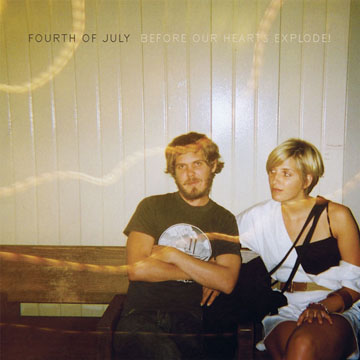
Fourth of July – “Before Our Hearts Explode”

(Above:  The video for “Self Sabotage” off the Lawrence band Fourth of July’s sophomore album.)

By Joel Francis
Ink magazine

Fourth of July singer Brendan Hangauer appears on the cover of the Lawrence-based, indie quintet’s sophomore album seated next to a pretty blonde. Although she’s looking at him and leaning in, his arms are crossed and eyes stare straight ahead. The pair may be close in proximity, but they seem miles apart emotionally.

This is often how it goes in the closing stages of a relationship, when the pair faces loneliness and, of course, vast tracts of time to flip the whole scenario over and endlessly analyze.

These are the times that Hangauer, his brothers Patrick and Kelly, and Brian and Brendan Costello — another pair of siblings — relive on Before Our Hearts Explode. Breaking up, as the saying goes, may be hard to do, but it has rarely sounded like this much fun.

The album opens with “Friend of a Friend,” the story of an ex-girlfriend’s rebound lover. Driven by acoustic guitar and organ and powered by a nimble  electric guitar, it’s too bouncy to be bitter. The track sets the template for the next 40 minutes: an intimate survey of love’s rubble,  via jangly guitars and slacker vocals. It’s Bob Dylan’s Blood on the Tracks filtered through Camper Van Beethoven.

It’s also a ruse, albeit an effective one. Hangauer is broken and hurt but refuses to let his guard down. For every telling lyric such as “Don’t be so sure of things/not even wedding rings” or “you know you ruined us/when you slept with that little slut” there are a plethora of la-la-la or ooh-ooh-ooh choruses to mask the betrayal.

The facade breaks in only a couple places. “Song for Meghan,” the first ballad, arrives midway through the record. Hangauer’s unvarnished craving for an absent love resonates in Adrianne Verhoeven’s lovely vocal countermelody.

This is followed by “Moving On,” a song as caustic and cynical as anything by Elvis Costello. It also has a sweet undercurrent as Hangauer recalls brighter days. The same trumpet that amplified Hangauer’s longing on “Song for Meghan” now cuts through the track like a ray of sunlight forcing its way into a dark room through a crack in the shades.

Before Our Hearts Explode succeeds at having it both ways — a breakup record that provides the perfect accompaniment for playing Frisbee. Like all relationships it is never black and white. The good times are tucked alongside the most painful.

Keep reading:

thePhantom – “Bohemian Seduction Grooves”

A Shooting Star finds home with the Young Dubliners

Catching up with the Hot Club of Cowtown

thePhantom – “Bohemian Seduction Grooves”

By Joel Francis
Ink Magazine

“Seduction” is the key word in the thesis-length title of thePhantom’s new EP, Bohemian Seductive Grooves for the Gay Soul. But thePhantom, aka Kansas City rapper/producer Kemet Coleman, would rather have you in his head than in his bed.

The five-track release is thePhantom’s attempt to translate the urban theory he’s been soaking up as a student at the University of Missouri-Kansas City into urban beats and rhymes. Dropouts needn’t worry. The vibe is more relaxed than the last day of school, with wordplay more effortless than a third-grade spelling test.

The low-key production on opening track “Midnight Seduction” sets the mood. ThePhantom’s words are set against a wash of synthesizers perfect for that late-night comedown when the energy starts to fade but sleep is still a long way off. “Downtown,” the second cut, bumps the tempo, but the rest of the album plays like lost tracks from a chill-out compilation.

ThePhantom says his master plan is to unite Kansas City’s diverse citizenry on the dance floor, a place where both blue-collar and artisans are equally comfortable. Of course if that effort creates a gathering of eligible women, thePhantom’s fine with that, too. On “Just Right” he makes the case for romance without stooping to the crass cliches common to the genre.

On December’s Destroy and Rebuild, thePhantom had an entire album to present his titular concept. Padded with a five-minute instrumental, the EP’s 22 minutes are ample time for thePhantom to gather his bohemians and gay souls, but not long enough to keep them on the dance floor. The result feels more like an outline than the conclusion. Sadly, that’s exactly what this is. ThePhantom has announced this EP will be his final project. Even so, he leaves behind a body of work worth further study.

Keep reading:

Steddy P and DJ Mahf – “While You Were Sleeping”

KC’s MCs throw down this weekend

Jazz, hip hop collide to celebrate landmark album

Steddy P and DJ Mahf – “While You Were Sleeping”

By Joel Francis
Ink Magazine

Steddy P takes care of his fans. Since Steddy’s debut album in 2008, fans have never had to wait more than a few months between new offerings. This month Steddy dropped the While You Were Sleeping EP/mixtape to keep fans happy until the emergence of his next full-length album. But While You Were Sleeping is more than a stopgap release. Six new cuts show Steddy’s recent activity in the studio. But more fun is the second part of the album: 13 tracks from the back catalog, remixed by DJ Mahf.

Mahf, who oversaw Steddy’s 2009 album, Style Like Mind, clearly had a blast marrying “Kenneth Arnold” to the “Super Mario Bros.” video game soundtrack. “Miss Your Coffee Table,” one of the few odes to the fairer sex on the mixtape, incorporates both Q-Tip of A Tribe Called Quest and LL Cool J’s “I Need Love.” Other tracks pay tribute to early Kanye West, Jay-Z, DJ Shadow and the Nappy Roots. That Steddy’s original verses stand up against such recognizable backgrounds is a testament to his clever wordplay and intricate delivery.

At times Steddy’s delivery recalls that of Blackalicious’ Gift of Gab. Steddy does a good job of changing textures when necessary, and recruits great guests such as Ces Cru, Mathias and Jbomb to further vary the vocal patterns. Steddy’s best performance across the 19 tracks comes early. “BARS (Loser’s Club Remix)” is Steddy’s answer to repeated invitations to freestyle battles. After calling out so-called Midwestern rappers who quickly vacate to the coasts he revs into double time. It’s not quite Twista-fast, but impressive nonetheless.

Although they appear first, the new tracks almost seem secondary. Steddy comes strong out of the chute on “Enough” and “Bars,” but the production falters on “Steddy Persistence Pt. II,” the third cut. Each song is handled by separate producers. The tracks don’t flow together well, and the quality fluctuates.

On “No Doz” Steddy uses a violent slasher/horror film metaphor to establish his lyrical dominance. His words are threatening, but try as it might, the chintzy synthesizer loop can’t be considered sinister. A similarly vanilla loop is featured in “And It’s Like That,” which manages to include a shout-out to Steddy’s former home turf of Mizzou, to KU and even to the UMKC Roos.

The final new song, “WindOverHead,” is the most successful. The production includes hints of the ambient and industrial, as well as snippets of saxophone and opera over an understated piano melody. Steddy shines across this landscape, calling out Tech N9ne and Mac Lethal and marking his IndyGround territory.

Despite a few minor missteps, While You Were Sleeping is a nice place for longtime fans to regroup and experience Steddy’s catalog in a different light. Newcomers will find the album a handy place to catch up. Best of all, it’s free.

Keep reading:

KC’s MCs throw down this weekend

Nas and Damian Marley – “Distant Relatives”

Jay-Z – “The Blueprint 3″

“T.A.M.I. Show” finally liberated

(Above: Marvin Gaye asks for a witness. He gets four go-go dancers.)

By Joel Francis
The Daily Record

For the past 46 years, few have been able to see “ The T.A.M.I. Show,” the 1964 concert film that captured early performances from the Beach Boys, Marvin Gaye, Smokey Robinson and the Miracles and the first major U.S. appearance of the Rolling Stones.

A tangle of legal issues sent the movie to exile almost immediately after it was sent to the theaters. The producer lost his rights and the film was never released on video rarely shown in public. For years fans would read about how incredible the “T.A.M.I. Show” was – particularly James Brown’s appearance, which Rick Rubin once said “may be the single greatest rock and roll performance ever captured on film” – without being able to see it. Thankfully this has finally been corrected. After decades of wrangling, Shout Factory has finally released the “T.A.M.I. Show” on DVD.

After a montage of all the stars arriving over one of the longest Jan and Dean songs ever, Chuck Berry takes the stage. His appearance ties the film back to “Rock Rock Rock” and the classic ‘50s rock and roll films, but halfway through “Maybelline,” the camera swings over to Gerry and the Pacemakers doing their version of the song. It’s a little disorienting at first, and doesn’t completely work, mostly because Gerry is so campy. He’s constantly playing to the camera, and the group clearly doesn’t have Berry’s talent or charisma.

Fortunately, an endless parade of go-go dancers in bikinis is on hand to distract from any lulls in the music. Constantly in motion, the dancers swarm across the stage – often directly in front of the performers – and on platforms in the back. The producers discovered what MTV perfected in the ‘90s with “The Grind:” buxom, gyrating dancers will make even the most execrable music enjoyable.

The showgirls hog the camera during the first number of Smokey Robinson and the Miracles’ set. Fortunately, lens eventually pulls back on the second number, and the quartet delivers the first great performance of the night. Robinson drops down, jumps up and throws his entire spirit into an extended “You Really Got A Hold On Me.” That energy carries into “Mickey’s Monkey,” that has everyone onstage and in the crowd dancing. Marvin Gaye continues Motown’s strong showing with a great “Stubborn Kind of Fellow.” For “Can I Get a Witness” he performs away from the band, flanked by two shimmying girls.

Director Steve Binder isn’t shy about cutting to the junior high and high school students in the audience screaming in delirium. One long shot accidentally allows a glimpse of policemen in helmets patrolling the aisles. There was clearly a hard line on the level of excitement that could be displayed.

It’s hard to believe Lesley Gore was the biggest star on the bill at the time, and that she didn’t become an even bigger star later. Gore dutifully performs her best-known songs, the No. 1 “It’s My Party” and its Top 5 sequel “Judy’s Turn to Cry,” but her poise, grace and presence suggest she should have had a much longer career. Gore It’s too bad she couldn’t keep up with the harder, psychedelic edge rock music was about to take.

Several of Gore’s songs are captured by a camera that looks like Vaseline has been smeared over the lens. In the commentary track, Binder said that was exactly what was done. He either couldn’t afford or didn’t have time to outfit the rigs with soft focus capability, so they went with this bargain basement substitute. Unfortunately, it looks like Gore is singing through a funhouse mirror.

Jan and Dean, the evening’s MCs, kick off the surf portion of the show, but they are outmatched by the Beach Boys, who follow. Jan and Dean’s harmonies seem thin and the skate-board-in-a-guitar-case trick can’t hold up to the Boys’ rich voices and Brian Wilson’s songwriting. The performance was filmed months before Wilson’s nervous breakdown forced him off the road. Here he looks completely at ease and happy.

After the movie’s initial run, the Beach Boys’ manager demanded his client’s four-song set be removed. When the inevitable “T.A.M.I. Show” bootlegs popped up, the Beach Boys were usually missing. This DVD finally restores the lush “Surfer Girl” and the freedom of “I Get Around.”

The film treads water through the Dakotas, Supremes and Barbarians until – finally – we get to James Brown and the Famous Flames. Honestly, there’s nothing he does here that wasn’t captured on the incredible “Live at the Apollo” album one year earlier. This, however, was his first major show in front of a white audience. It also gave fans the opportunity to see Brown work his magic in addition to just hearing it.

The Flames are razor-sharp as Brown kicks into “Out of Sight.” Showing his penchant for adventurous covers, Brown resuscitates Perry Como’s hit “Prisoner of Love.” He then directs the Flames into “Please, Please, Please” and the place goes nuts for the now-infamous cape routine. Brown’s pants, which were clean before the song, are scuffed and dirty at the knees from all the times he falls down (only to pop right back again.) During “Night Train” he does this crazy dance on one foot where he manages to wriggle across the stage. Not only does he not fall down, but he looks impossibly smooth.

In his commentary on the “T.A.M.I. Show” trailer, director John Landis, whose entire seventh grade class scored invites to the taping, said the Rolling Stones “were kind of boring after James Brown.” He’s right. The Stones open with a cover of Chuck Berry’s “Around and Around,” an odd choice considering Berry was onstage earlier. They don’t start to live up to their hype and billing until the terrific “Time Is On My Side” and “It’s All Over Now.”

It’s difficult to watch the early Stones without picturing the lazy spectacle they’ve become. There is a hunger in these songs and Mick Jagger is genuinely working to win the crowd’s approval. It’s odd to see Brain Jones so alive and so happy. It seems he was born with those omnipresent bags under his eyes that just grew sadder and deeper until the lids above closed forever.

But that was still several dark years off. The “T.A.M.I. Show” is a celebration that despite some dated production techniques and material still feels vibrant. It’s a peek behind a curtain to a world where artists from not only all over the world, as the song goes, but all genres, could party together on the same stage. In a way, it was a precursor to the weekend festivals that would pop up at the end of the decade and have resurfaced to dominate the summer musical landscape again today.

Keep reading:

Talking James Brown and King Records with Jon Hartley Fox

Talking Motown with Bill Dahl

Review – “King of the Queen City”

Review: The Temptations and Four Tops

(Below: The Beach Boys get around.)

Nas and Damian Marley – “Distant Relatives”

(Above: Damian Marley and Nas perform at the Beaumont Club in Kansas City, Mo. on June 26, 2009.)

By Joel Francis
The Daily Record

When the rapper Nas and reggae artist Damian Marley, youngest son of Bob Marley, first teamed up five years ago, the result was solid, but not spectacular. “Road to Zion” was a typical mash-up with Nas dropping a verse into the pocket of a mostly completed composition. There was little interaction between the two.

All of that immediately flies out the window on “Distant Relatives,” the new full-length collaboration between Nas and Marley. Open cut “As We Enter” finds the pair tag-teaming stanzas. As Nas spits “My man can speak patois/and I can speak rap star,” Marley drops the line “from Queens to Kingston/gunshot we use and govern the kingdom.”

The “rhythm piranhas” – as Marley dubs the duo – started toying with the idea of producing an EP to benefit school in Africa back in 2008, but the project grew as it progressed. Predictably, the lyrics find both vocalists working in a political vein, which is not a radical departure for either.

Nas shines in this environment, weaving street parables into Marley’s global paradigm. Marley, on the other hand, brings a sense of optimism lacking on most hip hop albums. His influence permits Nas to deliver his most straightforward and affirming lines this since “I Can” on the track “Count Your Blessings.”

Although “Distant Relatives” celebrates Africa, the only musician from the continent to appear on the record in person is K’naan, who blesses two tracks. The reset of the album captures the energy and rhythm of the motherland through samples that include Ethiopian jazz, Angolan singing and the Malian couple Amadou and Miriam. And while the pulse is definitely (defiantly?) African, the concrete jungle of Marley’s Jamaica and Nas’ New York are never far.

The only time the third world spell is broken comes on the song “My Generation.” Lil Wayne’s appearance on the track is passable, but feels like a ponderous attempt at mainstream radio play. The most egregious offender, however, is Joss Stone, ruins a decent production with an over-the-top delivery that seems to parody an American Idol wannabe.

Despite the title, the worlds of rap and reggae aren’t really that distant. Afrika Bambaata and Run-DMC dipped into the reggae in rap’s first decade. KRS-One later incorporated reggae into his 1987 hit “The Bridge is Over,” which famously dissed Nas’ home borough. The decade would also find KRS-One collaborating with Sly and Robbie and Shabba Ranks.

Likewise, Marley is no stranger to hip hop. His raspy voice has always worked better in a spoken cadence than in his limited singing range. Both of his major-label albums bounce with an urban beat. “Welcome to Jamrock,” the Grammy-winning album that fostered his meeting with Nas, also featured a track with The Roots MC Black Thought. In addition, Marley’s brother Stephen Marley, who produced two of the cuts on “Distant Strangers” oversaw a remix album of his father’s songs that featured The Roots, Chuck D of Public Enemy, Guru and former Fugee Lauryn Hill, who is married to Rohan Marley, another of Bob Marley’s sons.

“Distant Relatives” flattens this musical landscape. It is an ambitious project with global aims, not only musically, but lyrically, dealing with humanity, morality and messy nuances of emotion like greed and humility that can easily come across as clichés or preaching. Few artists have the vision to imagine a project of such scope, let alone pull it off.

Marley and Nas teamed up because they wanted to respond to the disasters in Haiti, Somalia and Darfur. Their intentions should be appreciated. The results should be celebrated.

Keep reading:

Review: The Original Wailers

Jazz, hip hop collide to celebrate landmark album

Review: Toots and the Maytals, the Wailers

Review: Bela Fleck’s Africa Project

Review: Sly and Robbie

Album review – “Stax: The Soul of Hip-Hop”

Review: Lee “Scratch” Perry

Jay-Z – “The Blueprint 3″