Lanois + Raffi = Eno

(Above: Raffi was a staple of The Daily Record’s early childhood. The oft-spun LP remains in its archives.)

By Joel Francis
The Daily Record

Like many adolescent males in the mid-‘60s, Canadian Dan Lanois pined for a guitar. But he didn’t just want to make music, he wanted to record it, too.

Armed with an instrument and a cheap, tiny cassette recorder, Lanois and his brother Robert started recording anything they could find. They soon found manipulating the results was almost as fun as making and capturing the sounds. The siblings eventually invested in a four-track recorder and set up a small studio in the laundry room of their mother’s Ancaster, Ontario home.

The domestic facility was named MSR Studios, and the brothers advertised that for $60 they would not only record a band’s demo, but arrange, play on and compose the tracks as well. A short time after MSR Studios opened for business in the mid-‘70s, the Lanois brothers’ ad caught the eye of Egyptian immigrant Raffi Cavoukian.

Cavoukian was a veteran of Toronto’s folk circuit, but his 1975 album, “Good Luck Boy” generated little heat. Cavoukian’s mother-in-law encouraged him to write and record some songs for the children at her preschool. Aided by his wife, kindergarten teacher Debi Pike, Cavoukian recorded a tape that was so successful other schools started requesting copies.

MSR Studios was everything Cavoukian was looking for. Cheap, efficient and local it even came with its own musicians. In 1976, Cavoukian borrowed $4,000 from a bank recorded his first children’s album, “Singable Songs for the Very Young,” at the Lanois brother’s small home studio. Dan Lanois also played mandolin, recorded, mixed and engineered the album.

The easygoing, folk-flavored “Singable Songs for the Very Young” was a smash that ranked among top children’s album more than two decades after it was released.  Boosted by sessions with Cavoukian, by now going by simply Raffi, Doug McArthur, another Toronto folkie, and rock band Simply Saucer, the Lanois brothers soon had enough money to move their studio to better quarters. In 1978 they purchased a Hamilton, Ontario house on Grant Avenue, which became, naturally, Grant Avenue Studio.

Raffi was one of the first artists to use Grant Avenue Studio. By now he and Dan Lanois had collaborated on two albums and would go on to record two more together. Their body of work together comprised Raffi’s first four children’s albums. Grant Avenue also boasted sessions by singer/songwriter Ian Tyson and new wave band Martha and the Muffins.

The Muffins had just come off a commercially successful tour opening for Roxy Music, but they lost two members in the process. When the remaining quartet decided to carry on, one of the new musicians they recruited was bass player Jocelyne Lanois, sister of Dan and Robert. The Muffins got permission from Virgin to make an album with Dan Lanois with the stipulation that they operate on a miniscule budget. This was no obstacle for Lanois, and the resulting album “This is the Ice Age” generated a Top 40 Canadian single.

The band and album didn’t do much outside of the Great White North, however, and they were dropped by Virgin. The Muffin’s relationship with Lanois, however, flourished through two more albums. Their 1984 album, “Mystery Walk,” featured guest drummer Yogi Horton. Horton was a veteran of the 1981 experimental album “My Life in the Bush of Ghosts” and was recommended by his boss during those sessions, Brian Eno.

Eno, of course, had cemented his legendary reputation with his work in Roxy Music and the solo albums he released in the first half of the 1970s, and his production work with Devo, David Bowie, Talking Heads and the “No New York” No Wave compliation in the second half of the decade. By the mid-‘80s, Eno and Lanois were longtime associates.

Lanois’ tape and recording manipulations first caught Eno’s attention in the late ‘70s. Although embroiled in producing the final chapter in Bowie’s “Berlin Trilogy” and on albums with both the Talking Heads and their bandleader David Byrne, Eno and Lanois met at Grant Avenue to experiment with sound and recording. In 1979, Eno recorded “The Plateaux of Mirror,” the second installment in his ambient series, with Harold Budd at Grant Avenue. Although they did not produce the album, “Bob and Danny Lanois” are thanked in the album credits.

In 1982, Lanois co-produced and played some on the fourth installment of Eno’s ambient series, “On Land.” The following year, Lanois received cover billing for his musical and production contributions to the “Apollo: Atmospheres and Soundtracks.” One of the album’s tracks, “Silver Morning,” was essentially a Lanois solo performance.

When U2 asked Eno to produce their fourth album, “The Unforgettable Fire,” in 1984 Eno brought Lanois with him. The next year, Eno recommended Lanois to Peter Gabriel to help with the “Birdy” soundtrack.

Ten years after opening MSR Studios in his mother’s laundry room, Lanois was an A-list producer. He and Gabriel collaborated on several landmark albums, including “So” and “Us.” Eno and Lanois also repeatedly re-teamed with U2 for “The Joshua Tree,” portions of “Rattle and Hum,” “Achtung Baby,” “All that You Can’t Leave Behind” and the Irish quartet’s most recent album, “No Line on the Horizon.” Lanois has also worked with Emmylou Harris, the Neville Brothers, Bob Dylan, Robbie Robertson, Hothouse Flowers, Willie Nelson and released several solo albums.
George Kalinsky: Painting with Light

ejjl1
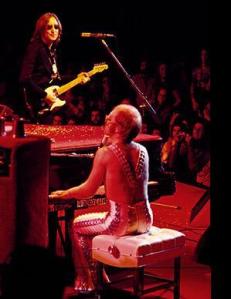
(Above: Elton John and John Lennon at Madison Square Garden, 1974.
All photos by George Kalinsky, courtesy of www.georgekalinsky.com.)

By Joel Francis

In his 34 years as Madison Square Garden’s official photographer, George Kalinsky has forgotten more games, concerts and events than many people could see in several lifetimes.

Kalinsky, who estimates he has shot more than 8,000 events, can be forgiven for having no memory of Bob Marley’s next-to-last performances in 1978, because what he remembers more than makes up for any lapses.

“November 28, 1974. Don’t ask me how I remember that, but I do,” Kalinsky said with a laugh. “Elton John was playing the Garden, and he surprised everyone by having John Lennon join him onstage. Those three songs they did together turned out to be the last time John Lennon performed before he was shot. The moment I captured won’t be there again.”

Several of Kalinsky’s favorite moments are on display for a current exhibit at the Rock and Roll Hall of Fame in Cleveland. “Live From Madison Square Garden: From the Lens of George Kalinsky” opened May 1 in the Ahmet M. Ertegun Main Exhibit Hall and will run through January 2010.

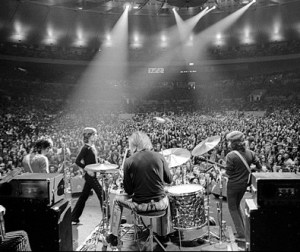
“I’ve always tried to paint with light,” Kolinsky said. “Shooting against a plain black background is not the most creative, but it’s what you usually see. These performers spend millions on lighting and effects. I always try to capture that as part of the atmosphere of the performance.”

fullscreen-capture-562009-34913-pmbmp1

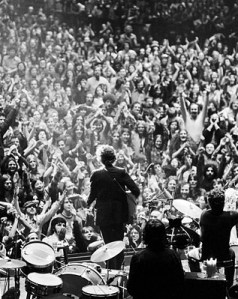
The atmosphere for the Rolling Stones’ Garden concert in 1969 was a frenzy. The show was one of the first arena rock concerts and the pandemonium was captured and released on the Stones’ great live album “Get Your Ya Ya’s Out.”

“That was the first time I saw a buzz, a reaction like that in the audience. Everyone wanted to be onstage and the crowd started gradually pushing forward,” Kalinsky said. “I went under the stage and went on in the back and got some amazing shots.”

Getting the audience’s reaction to the band was the key to recording the moment, Kalinsky said.

“I think a huge part of the story is the people and how they react,” he said. “There may not be too many pictures in this exhibit of the crowd, but I always try to include them. Every audience is different, just as a circus is different from a track meet and hockey is from basketball. The audience is a reflection of the performance.”

The crowd at a 1974 Bob Dylan performance played a key role in a shot Kalinsky called one of the top two or three photos he’s taken.

“Dylan is Dylan, the hair, the body language, all of it connecting and seeing the audience reach out to him is beautiful and telling,” Kalinsky said. “With him, the words are so important; when I look at Dylan I try to capture the aura of the man.

“I want to get a little closer to see what his face looks like,” Kalinsky continued, “and how it shows the years, not in terms of getting older, but the years of performing with the audience and how that bond grows stronger and stronger.”

fullscreen-capture-562009-35709-pmbmpDylan played a key role in George Harrison’s 1971 Concert for Bangladesh at the Garden. Shooting both of those shows not only taught Kalinsky that music was the true universal language, but showed him how far the Garden’s stage extended.
“I was in a cab recently and the driver was from Bangladesh,” Kalinsky said. “He couldn’t have been more than 35 or 40 years old, but he said in the hearts of his family and friends in Bangladesh they would never forget Madison Square Garden. They weren’t there (at the Concert for Bangladesh), but they’d never forget because that’s where people learned to help his country and family.”

Events at the Garden, Kalinsky said, “become part of our culture and part of our world. It wasn’t long ago we had 9/11 and that concert. Even if you weren’t there, you were there because everybody in the world tuned in to the Concert for New York City.”

What stands out in Kalinsky’s mind from that show isn’t the defining performances from Paul McCartney, the Who and artists with ties to the Big Apple like Jay-Z and Bon Jovi, but a moment backstage with Billy Crystal before he was about to go on.

“I asked him how does he project his talent when the audience is in tears and police and firefighters are holding up pictures (of their missing loved ones)?” Kolinsky said. “He said the hardest thing to do was be funny in the face of an audience who had lost so much.”

Although Kalinsky’s relationships and reputation allowed him backstage that day, he acknowledged access has been almost completely shut down from the early days when he would take pictures of Elvis Presley in the dressing room before his first Garden concert or Sly Stone’s groomsmen getting ready before Stone’s onstage wedding in 1974.

And just as backstage has become more restrictive, the window for taking performance photos has been confined to the first three songs. That doesn’t bother Kalinsky, though, because digital technology and automatic lighting systems within the camera let him do as much with those three songs as he could in an entire show in the days of film.

“However, in terms of taking pictures it always comes down to the eye and the moment,” Kalinsky said. “You have to recognize the moment and snap the picture. This is the most important aspect, whether you are shooting a concert, sporting event or portrait setting. It’s what I’m always looking for.”

Kalinsky’s duties have also given him a window on the 1994 Stanley Cup Finals, Knicks games, scores of the world’s top athletes and personalities. This diverse shooting background has provided enough photos to fill eight books and exhibits from the Museum of Modern Art to the baseball and basketball halls of fame.

“The Garden stage, whether it’s Muhammad Ali, the Pope or LeBron James, brings out the best in every performer,” Kalinsky said. “Every day I walk into the Garden I say what a privilege it is to be part of this arena and the best stage in the whole world.”

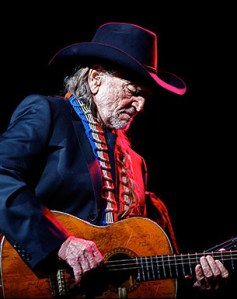
(Below: A recent portrait of the Red-Headed Stranger.)

fullscreen-capture-562009-40105-pmbmp

Keep Reading:

Rock Hall Celebrates 50 Years of Motown

Rock Hall Celebrates the 40th Anniversary of Woodstock

Bruce Springsteen Rocks the Hall (part one)

Bruce Springsteen Rocks the Hall (part two)

Little Arkansas Rocks

(Above: Al Hibbler, who wrote “Unchained Melody,” attended school for the blind in Little Rock, Ark.)

By Joel Francis

At a recent concert in Fayetteville, Ark., jazz legend Sonny Rollins remarked at how happy he was to be playing Louis Jordan’s home state for the first time.

Arkansas has never been known as either cutting-edge or influential. Not even Bill Clinton could save Arkansas from being a backwoods punchline – it’s the West Virginia of the Midwest, for readers who are mystified by what lies west of Virginia – but it’s spawned an amazing number of influential musicians. There’s Johnny Cash, who was born in Kingsland and raised in Dyess, and his brother Tommy, of course. Legendary Band drummer Levon Helm, who hails from Marvell. Those are the ones everybody knows.

Incredibly, soul legend Al Green was born in Forrest City. One of Green’s influences, gospel/rock and roll pioneer Sister Rosetta Tharpe, was born in Cotton Plant. Contemporary gospel star Smokie Norfull was originally from Pine Bluff. Delight brought us Glen Campbell, Colt was Charlie Rich’s first home and Conway Twitty was born Harold Jenkins in Helena. John Hughes, a pedal steel player who worked Twitty and numerous others, came from Elaine.

Louis Jordan (Brinkley) aside, the Natural State has also produced jazzman Joe Bishop from Monticello, who wrote the staple “Woodchopper’s Ball” and free jazz saxophonist Pharoah Sanders (Little Rock).

The state’s greatest legacy might be the amount of blues it birthed, including Luther Allison (Widener), Willie “Big Eyes” Smith (Helena), Son Seals (Osceola), Jimmy Witherspoon (Gurdon), Roosevelt Sykes (Elmar) and Robert Jr. Lockwood (Helena). West Memphis was the first stop north for many blues players. Sonny Boy Williamson II, Howlin’ Wolf, Elmore James, Big Boy Crudup and B.B. King all stopped there for a while. Stax pillar Rufus Thomas was a longtime West Memphis radio host.

The name Jim Dickinson (Little Rock) may not be familiar, but his work with the Dixie Flyers, Aretha Franklin, the Rolling Stones, Big Star, the Flamin’ Groovies, the Replacements, Mudhoney and the North Mississippi Allstars – which features his sons Luther and Cody – has been heard the world over.

On the pop side, founding Evanescence duo Amy Lee and Ben Moody are also both Little Rock Natives; R&B slickster Ne-Yo was born in Camden and Perryville begat Shawn Camp, who has written songs for Garth Brooks, George Strait and Brooks and Dunn.

Arkansas may be a forgotten state that ranks in 32nd in population and 29th in area, but if you can’t experience its Ozark Mountains in person, it’s at least worth a musical road trip.

Police On My Back: Five Musicians Convicted of Murder

(Above: Honorable mention R.L. Burnside, who was convicted of murder 1959 and sentenced to Parchman Farm. Burnside later said, “I didn’t mean to kill nobody. I just meant to shoot the sonofabitch in the head. Him dying was between him and the Lord.”)

By Joel Francis

Phil Spector is hardly the first musician to be convicted of murder. He’s not even the most famous or influential one. But he is the latest. In honor of Spector’s recent sentencing, The Daily Record recognizes five other musicians convicted of murder.

Cool C and Steady B

Cool C and Steady B both came of age in the 1980s Philadelphia rap scene. Steady, nee Warren McGlone, was one of the first Philly rappers to taste the mainstream, while Cool, born Christopher Roney, was a member of the Hilltop Hustlers. The two teamed up in the early ’90s to form C.E.B., which was short for Countin’ Endless Bank. Taking their moniker a little two seriously, the duo decided to rob an actual bank.

On Jan. 2, 1996 – perhaps fulfilling a New Year’s resolution – C, B and Mark Canty, another Philadelphia rapper, attempted to rob a PNC bank in the City of Brotherly Love. Needless to say, the heist didn’t go as planned. When officer Lauretha Vaird responded to the silent alarm, she was shot and killed by Cool C. Steady B exchanged shots with another officer as the trio hopped into a stolen minivan and made their escape.

Steady was arrested at his apartment shortly after the crime. When two handguns left at the bank were traced back to him, he confessed to the crime.

In October, 1996, Cool was convicted of first degree murder and sentenced to death by lethal injection. Steady got off with a second degree murder conviction and life in prison. Cool was granted a stay of execution in 2006, by Pennsylvania Governor Ed Rendell (probably a closet C.E.B. fan), but remains on death row. Steady also remains incarcerated.

Little Willie John

In the late 1950s, Little Willie John traveled in the same soul circles as his contemporaries Sam Cooke, Jackie Wilson and Hank Ballard. His parade of hits started in 1955 with “All Around the World” and included “Need Your Love So Bad” (later covered by Peter Green’s Fleetwood Mac) and “Fever,” which Peggy Lee made famous and took to the U.S. Top 10.

John had a golden voice, but he also had a bad temper and a taste of alcohol. Those three traits collided backstage at a concert in 1964 when John stabbed a man to death. He was convicted of manslaughter and sentenced to Washington State Prison. John was appealing his conviction and aiming for a comeback when he died of pneumonia in 1968.

Don Drummond

In the fall of 1964, trombone player Don Drummond was living the good life. The band he helped form, the Skatalites, were finally breaking through, thanks to a song he wrote. “Man in the Street” was a Top 10 U.K. hit and for many their first taste of reggae. One year later, Drummond’s arrangement of the Guns of Navarone also hit the U.K. Top 10. But 1965 was not as kind to Drummond.

Drummond earned the nickname “Don Cosmic” for the erratic behavior brought on by his manic depression. When the body of Drummond’s girlfriend exotic dancer Marguerita Mahfood was found in Drummond’s home with several knife wounds, the police quickly arrested Drummond and charged him with murder. Drummond was judged legally insane at his trial and committed to Bellevue Hospital in New York City. Drummond died in Bellevue in 1967 at the age of 39. His death was ruled suicide, but because no autopsy was performed conspiracy theories persist to this day.

Drummond left behind a catalog of more than 300 songs and pivotal role backing Lee “Scratch” Perry, the Wailers, Delroy Wilson at their earliest sessions.

Jim Gordon

Drummer Jim Gordon started his career backing the Everly Brothers in 1963. By the end of the decade he’d performed on “Pet Sounds,” “The Notorious Byrd Brothers” and numerous other albums. When Jim Keltner pulled out of a tour with Delaney and Bonnie, Gordon was brought in as the replacement. Gordon got on so well with the rest of the band, which included Eric Clapton, bass player Carl Radle and keyboardist Bobby Whitlock, that the quartet played on Clapton’s first solo album, the first post-Beatles album by Clapton’s friend George Harrison (“All Things Must Pass”) and even a session with Ringo.

The group is most memorable, however, for the album it produced with Duane Allman. As Derek and the Dominoes, Clapton was able to pour out his unrequited love for Harrison’s wife Patti Boyd and Allman was able to lay down some of his best licks. Gordon gained notoriety for writing the piano coda to “Layla.” He composed the piece independently and had to be persuaded to let Clapton incorporate into what became one of the biggest rock singles of all time.

After Derek and the Dominoes broke up in 1971, Gordon played in Joe Cocker’s Mad Dogs and Englishmen tour. He also toured with Traffic and Frank Zappa. Gordon’s session work also flourished. He played drums on Carly Simon’s “You’re So Vain,” and the Incredible Bongo Band’s “Bongo Rock” album. Gordon’s drum solo on “Apache” is one of the most sampled licks in hip hop.

In the late ’70s Gordon complained of hearing voices. Treated for alcohol abuse instead of schizophrenia, the voices had pushed Gordon out of music entirely by 1981. They pushed him even further in 1983 when Gordon killed his mother with a hammer. Gordon was properly diagnosed in his 1984 trial and sentenced to sixteen years to life with the possibility of parole. Gordon remains in prison.

Lead Belly

Most musicians wait until after they’re famous to start killing people. Not the man born Huddie Ledbetter. Before he recorded a note for Alan Lomax, the towering legend of folk and blues had escaped from a chain gang in Texas, served seven years for killing a relative in a fight over a woman. Lead Belly learned new songs and honed his craft while in prison, eventually earning a pardon from Texas Governor Pat Neff, who enjoyed the religious songs Lead Belly had played for him. Five years later, Lead Belly was back in prison, this time for attempted homicide. After serving three years for knifing a white man in a fight, he was discovered by John and Alan Lomax, who fell under his spell and petitioned to have him released.

After taking Louisiana Governor O.K. Allen a recording of “Goodnight Irene,” Lead Belly was released (the official reason was time off for good behavior). He recorded several albums for the Library of Congress based on his book “Negro Folk Songs as Sung by Lead Belly.” Unfortunately, Lead Belly could not shake his criminal past, and was back in jail again in 1939 for stabbing a man in a fight in New York City. Again, Alan Lomax jumped to Lead Belly’s defense, dropping out of graduate school and helping Lead Belly record an album of songs to pay for his legal expense.

Lead Belly became a fixture of the New York City folk scene in the 1940s. He appeared on the radio, performed with Brownie McGhee, Sonny Terry, Woody Guthrie, and others and recorded a wide range of music. Acolyte Bob Dylan once said Lead Belly was “One of the few ex-cons who recorded a popular children’s album.”

“Goodnight Irene” became Lead Belly’s most popular song. Unfortunately, he did not live long enough to see Pete Seeger’s group the Weavers make it a No. 1 hit.

Lead Belly died in 1949, leaving behind a treasure of songs that includes “Midnight Special,” “Cotton Fields” and “Rock Island Line.”

Five Jazz Legends Still Adding to Their Legacies

(Above: The Dave Brubeck Quartet “Take Five” at the Ottawa Jazz Festival.)

By Joel Francis

In a belated post-script to The Daily Record’s series on 15 jazz greats to emerge in the past 20 years, we look at five artists who are still significantly contributing to their legendary status. Although their reputations were cemented generations ago, it would be criminal to overlook their most recent works.

Roy Haynes

At the 2005 Newport Jazz Festival, Chick Corea, Pat Metheny, Christian McBride, Joshua Redman and several others all paid tribute to drummer Roy Haynes on the occasion of his 80th birthday. These musicians honored Haynes not only for his resume, which includes stints with Lester Young, Bud Powell, Thelonious Monk and Sarah Vaughan, but because he has allowed the younger artists to grow and learn under his guidance. Haynes has released six albums this decade, starting with “The Roy Haynes Trio,” which recaps his career through new performances, “Birds of a Feather,” a tribute to his former bandleader Charlie Parker, and the strong live set “Whereas.”

Dave Brubeck

One of the most important – and popular – jazz pianists of the post-War era, Dave Brubeck landed on the cover of Time magazine and became a legend with his groundbreaking, yet accessible, work with saxophonist Paul Desmond. Although the 16 years Brubeck and Desmond played together in the Dave Brubeck Quartet form the crux of his catalog, Brubeck has built an impressive resume in the 40-plus years since.

Brubeck’s current quartet, consisting of drummer Randy Jones, bass player Michael Moore and saxophonist/flautist Bobby Militello, may be the best ensemble he’s worked with since his mid-’70s pairing with Gerry Mulligan. Unlike many of his contemporaries, there has never been a Brubeck comeback; there are no lulls or low periods in his catalog. Brubeck has continued to write, record and perform regularly well past his 88th birthday. Of the nearly dozen albums Brubeck has released this decade, three stand out. “The Crossing” kicked off the 21st century with nine strong, new selections, including an ode to longtime drummer “Randy Jones,” Militello’s delightful solo on “Day After Day” and the title song, Brubeck’s interpretation of a chugging ocean liner. Brubeck blends old and new songs on “London Flat, London Sharp,” and the his quartet sizzles on the live album “Park Avenue South,” which mixes standards and favorites with more recent material.

Wayne Shorter

After two years of auditioning other horn players, Wayne Shorter’s saxophone turned out to be the piece missing in Miles Davis second great quintet. An alumni of Art Blakey’s Jazz Messengers, Shorter not only filled the spot vacated by John Coltrane, but contributed many key songs to the group’s repertoire. As if that weren’t enough, he was simultaneously cutting magnificent solo albums on Blue Note. Shorter followed his bandleader’s path into fusion, but took a more pop approach in Weather Report, the group he co-founded with keyboardist Joe Zawinul, another Davis alum. Shorter floundered in the days after Weather Report’s demise in the mid-’80s, but his three most recent albums are among the most inspired of his career. After a 12-year absence from recording, Shorter returned with “Footprints Live,” which documents his reinvigorated 2001 tour. He fronted an acoustic band for the first time in over a generation on “Algeria,” which paired Rollins and his “Footprints” rhythm section with Brad Mehldau for several selections. Shorter’s hot streak continued with his most recent album “Beyond the Sound Barrier” and his inspired playing on Herbie Hancock’s Grammy-winning “River: The Joni Sessions.”

McCoy Tyner

More people have probably heard McCoy Tyner than know who he is. The backbone and counterfoil in John Coltrane’s masterful quartet for six years, Tyner’s piano has graced well-known recordings like “My Favorite Things” and “A Love Supreme.” Tyner also put out several stellar albums under his own name on Blue Note and Impulse in the 1960s. No less active today, Tyner collaborated with Bobby Hutcherson for the live album “Land of Giants” and played tenor Joe Lovano and the awesome rhythm section of Christian McBride and Jeff “Tain” Watts for 2007’s  self-titled release. Tyner’s latest album, “Guitars,” was recorded over a two-day span that paired Tyner, Ron Carter and Jack DeJohnette with several of six-string luminaries, including John Scofield, Bill Frisell, Marc Ribot, Bela Fleck and Derek Trucks. Uninformed fans should stay away from 2004’s “Illuminations,” however. A dream pairing on paper of Tyner, McBride, Terence Blanchard, Lewis Nash and Gary Bartz, the performances are ruined by a glossy production that smothers the quintet’s interplay and is suitable only for shopping for a sweater at Nordstrom with your mom.

Sonny Rollins

Sonny Rollins’ legacy includes recordings with Charlie Parker, Miles Davis, Thelonious Monk, Dizzy Gillespie, Max Roach, Bud Powell and Clifford Brown – and that’s just in his first decade of playing. In the half-century since then, Rollins (along with contemporary John Coltrane) established himself as the preeminent post-Bird saxophonist. Although the pace of Rollins’ releases has slowed considerably, what he has put out have only added to his reputation. Recorded in Boston just four days after the Sept. 11 attacks in New York City, “Without A Song” is an emotional listen finding Rollins channeling his conflicted emotions through long solos. “This Is What I Do” continues Rollin’s penchant for transforming b-quality songs into must-listen melodies with the Bing Crosby standard “Sweet Leilani.” Rollins’ most recently release, “Road Songs, Vol. 1” mines the archives for several cherry-picked performances that prove that the passion on “Without A Song” was no fluke.

Keep Reading: 15 Jazz Legends to Emerge in the Last 20 Years

Part One

Part Two

Part Three

The Day the Music Survived

(Above: “True Love Ways” is The Daily Record’s favorite Buddy Holly song.)

By Joel Francis
The Daily Record

Fifty years ago this week, the plane carrying Buddy Holly, Ritchie Valens and the Big Bopper crashed in an Iowa cornfield, claiming its passengers and 22-year-old pilot Roger Peterson.

The event became known as “The Day the Music Died,” but the fact people were still talking about it 12 years later when Don McLean memorialized the moment with the song “American Pie” proves that music indeed survived.

The rock landscape had changed a lot between 1959 and 1971. The pioneers of the rock and roll were having hard time. Chuck Berry had bounced from Chess to Mercury and back and was seven years removed from his most recent Top 40 hit (although the No. 1 “My Ding-A-Ling” was right around the corner). Carl Perkins was performing as a sideman in Johnny Cash’s band and Little Richard, Bo Diddley, Fats Domino and Bill Haley dismissed as washed up. Only Elvis Presley and Jerry Lee Lewis retained a whiff of their ’50s fervor, but it took a televised “comeback” special and a genre hop to country and western for them to manage the trick.

That Holly was not only remembered, but celebrated in the aftermath of Woodstock and Altamont, in an era where rock’s excesses were just starting to steamroll, was not pure nostalgia.

Far from killing rock and roll, Holly planted the seeds that allowed it to flourish. Holly was one of the first artists to recognize the recording studio as creative environment, by experimenting with double-tracking and overdubs. He was the first songwriter to pilfer the Bo Diddley beat for “Not Fade Away.” He was the first rock and roll star to play a Fender Stratocaster, the guitar of choice for Eric Clapton, Jeff Beck, Jimi Hendrix, Stevie Ray Vaughan and countless others.

Although the Beatles often receive credit for being the first group to write their own material and put strings on a rock album, the truth is, Holly did both nearly a decade before them. It’s not a big leap from Holly’s “Raining In My Heart” to McCartney’s “Yesterday.”

But the most amazing of Holly’s feats is that he did it all by 22, an age at which Bob Dylan was just emerging from his Woody Guthrie fixation, Brian Wilson was begging out of tours because of stage fright and Neil Diamond was still trapped in the Brill Building.

Few mourn other ’50s rock casualties, like Eddie Cochran, who died a scant 14 months later, but Holly’s influence continues to be felt today. It’s  in Elvis Costello’s spectacles, Weezer’s Top 5 1994 hit, and the myriad of bands – ranging from the Rolling Stones to the White Stripes to the cover band in the bar around the corner – who regularly drop “Not Fade Away” into their sets.

The day the music died? Not even close.

KC Recalls: The Coon-Sanders Night Hawk Orchestra

coon

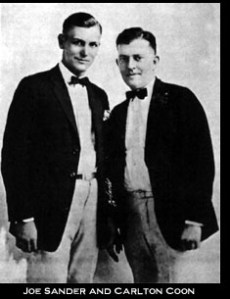
(Above: Joseph Sanders, left, and Carleton Coon.)

By Joel Francis

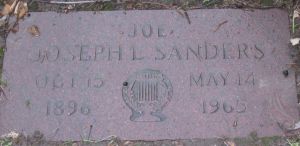
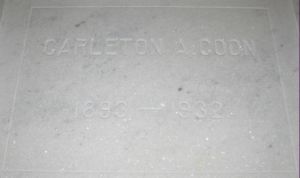
The music Carleton Coon and Joseph Sanders made for a dozen years together helped put Kansas City jazz on the map. Their Nighthawk Orchestra may have broken up in 1932, but it’s two bandleaders have been silently reunited for 40 years at Mt. Moriah Cemetery in Kansas City.

Coon and Sanders first met at a downtown Kansas City music store in 1918. Tall, handsome and quick-tempered Sanders, was an amateur baseball player on leave from the Army. He was practically the antonym of the pudgy, extroverted Coon. Despite their physical and temperamental differences, both men quickly found they shared a love of jazz and complementary tenor voices.

The following year, when Sanders got out of the Army, the two teamed up, formed a jazz combo and started booking gigs around Kansas City. With Coon handling business, Sanders writing songs and city boss Tom Pendergast ignoring prohibition with his “wide open” bars, clubs and brothels, the Coon-Sanders Novelty Orchestra was soon one of town’s in-demand outfits.

Shortly after Thanksgiving, 1922, the orchestra was booked to play on radio station WDAF. The success of that performance helped launch their weekly show, broadcast from 11:30 p.m. until 12:30 a.m. When the announcer let slip that “anyone who’d stay up this late to hear us would have to be a real night hawk,” thousands of listeners spread across Canada, Mexico and most of the United States let him know that they were proud to be “night hawks.”

Sanders quickly penned a theme song “Night Hawks Blues” and the pair rechristened their ensemble the Coon-Sanders Original Night Hawk Orchestra. In 1924, they recorded for the Victor record label in Chicago and agreed to let burgeoning Chicago promoter Jules Stein book a four-week tour. Stein parlayed his profits from that tour into his own booking company, which he called Music Corporation of America, or MCA.

On the strength of that tour, the Night Hawk Orchestra relocated to Chicago where their performance opening the Balloon Ballroom of the Congress Hotel was broadcast on KYW. Two years later, they moved to the Blackhawk Restaurant where fan Al Capone frequently left $100 tips for the band. On the strength of WGN radio broadcasts and reputation built playing around Chicago (including Capone’s Dells supper club in Morton Grove, Ill.), the Coon-Sanders Orchestra relocated once again in 1931.

Broadcasting weekly from Terrace Room in the Hotel New Yorker on CBS radio, Coon and Sanders found themselves in the same Big Apple circles as Bing Crosby and Guy Lombardo. Coon loved the night life, frequenting the Cotton Club and other Harlem jazz clubs, and making friends with Cab Calloway and Duke Ellington.

Sanders, on the other hand, was less enamored. He longed for the Midwest and made his sentiment plain the final number recorded by the Coon-Sanders Original Night Hawk Orchestra, “I Want to Go Home.”

Unfortunately, circumstances forced the bandleaders’ hands. Popular taste was shifting away from the Caucasian stylings of Coon and Sanders and toward all-black ensembles like the Ellington, Calloway and Kansas City’s Bennie Moten orchestras.

These circumstances, coupled with the Great Depression, forced the Night Hawks back to Chicago in April, 1932, for an engagement at the College Inn. Sander’s delight to be back in familiar territory was tempered when Coon was admitted to the hospital in critical condition. He died a few weeks later from blood poisoning from an abscessed tooth.

kc-graves_coon1

Coon’s 1932 funeral was one of the largest Kansas City had seen. Although his procession carried on for miles, his band’s legacy did not stretch so far. Less than a year after Coon’s death, Sanders dissolved the group and moved to Hollywood to write movie scores. Although Sanders was active in music for the rest of his life, he never regained the popularity he found with the Nighthawk Orchestra. In 1965, he died after having a stroke and was buried about 200 yards sound of his friend, Carleton Coon, at Mt. Moriah Cemetery.

Today, the Coon-Sanders Original Night Hawk Orchestra is a footnote in the Kansas City jazz story that includes big bands lead by Bennie Moten, Count Basie, Andy Kirk and Jay McShann, and soloists like Big Joe Turner, Mary Lou Williams, Walter Page and, of course, Charlie Parker. But Coon and Sander’s early triumphs helped paved the way for all who followed them out of Kansas City.

Ironically, the Night Hawks are most celebrated in Huntington, West Virginia, where the Coon Sanders Nighthawks Fans’ Bash has been held on the weekend after Mother’s Day for 39 years.sanders

Remembering Ron Asheton of The Stooges

(Above: The Stooges do “1969” in 2007.)

By Joel Francis
The Daily Record

When Ron Asheton started playing electric guitar in the mid-’60s, there were no signs pointing the way he wanted to go. The Beatles were just starting to experiment with feedback and backwards instrumentation on their albums; Pink Floyd was buried in the London underground and Andy Warhol had yet to champion the Velvet Underground (not that many were paying attention anyhow).

The closest things to the sounds in his head were Pete Townshend’s guitar riff on The Who’s “My Generation,” the surf guitar instrumentals of Dick Dale and the dirty blues of the Rolling Stones and the Yardbirds.

By the time Asheton, his brother Scott, and their longtime friend Dave Alexander hooked up with fellow Ann Arbor, Mich. musician Jim Osterberg there were a few more road signs. Home state natives the MC5 had kicked out their jams, and the free jazz freak-outs of John Coltrane and Pharaoh Sanders were regularly released on the Impulse label. But there still weren’t many fellow travelers on the Asheton brothers’ weird road during the Summer of Love. Osterberg, who would soon call himself Iggy Pop, was one hitchhiker they had to pick up.

Four years later, it was mostly over. In retrospect, it’s amazing the band lasted that long. The Stooges two albums, released in 1969 and 1970, were rawer than razor burn, more violent than the 1968 Democratic Convention and as combustible as the Hindenburg. When it was over, Asheton’s guitar work pointed the way that nearly every guitarist since has followed, or at lease acknowledged.

It’s difficult to imagine the furious stomp of the White Stripes and the six-string perversions of Sonic Youth and Dinosaur Jr without the expanded palette Asheton created. The Sex Pistols and the Damned both covered “No Fun” in concert. Heck, the blueprint of the grunge movement was mostly hijacked from the Stooges’ designs.

Of course David Bowie prodded the Stooges to reconvene in 1973 for “Raw Power,” but it wasn’t the same. Iggy’s name was out front and Asheton was confined to the bass guitar by Ig’s new best bud, James Williamson. There was even a piano player! Asheton’s rightful place on lead guitar was restored when the Stooges reunited a generation later for a couple guest shots on Iggy’s solo album, an R.L. Burnside tribute and, finally, an album of their own, but by then they were no longer leaders.

Ron Asheton’s name rarely comes up in “Guitar God” discussions. The music he made nearly 40 years ago remains difficult to assimilate by mainstream tastes. And like his long-overdue adulation, it took people a while to figure out he was gone. Six days after dying from a heart attack, Asheton’s body was discovered in his Ann Arbor apartment.

There was no obituary in the New York Times and little mention on the 24-hour news channels, but somewhere in heaven a white cloud is tarnished with soot and Asheton’s scary noise is driving the harp-plucking cherubs out of their minds. Which is as it should be.

Rock Hall Celebrates 50 Years of Motown

motownnew

Above: Part of the new Rock and Roll Hall of Fame exhibit celebrating 50 years of Motown Records. The exhibit is open all year. (Photo courtesy of the Rock and Roll Hall of Fame.)

By Joel Francis

It may seem hard to believe, but “the sound of young America” is 50 years old.

To celebrate a half-century of Motown records, the Rock and Roll Hall of Fame in Cleveland is hosting a new exhibit, “Motown: The Sound of Young America Turns 50,” all year in the Ahmet M. Ertegun Main Exhibit Hall.

“It’s an obvious anniversary, one we should do something about,” said Howard Kramer, director of curatorial affairs for the museum. “Lots of labels have anniversaries, but Motown still rings wide and true.”

One of the largest items on display is the upright bass Funk Brother James Jamerson played on all his Motown sessions until 1963. It’s the instrument heard on “My Guy” and “Heat Wave.”

“A lot of people maintain the key to Motown was the rhythm section: The snap of the drums, the gorgeously intricate bass line and then the percussion laid over the top,” Kramer said. “Jamerson was the primary bass player. He carried the weight of those recordings.”

Of particular interest to Kramer are four posters promoting Motown concerts. Two of the posters advertise Motown Revue shows, which featured several of the labels artists on the same bill.

“For the 1963 revue, Stevie Wonder was the headliner.Usually the person with the biggest hit at the time was the headliner, and in this case he was riding ‘Fingertips, Part 2,'” Kramer said. “It’s interesting to see both who’s on top and the volume of artists (on the bill). It’s also interesting to note that for the 1968 Motown Revue shows at the Fox Theater in Detroit, they played 9 or 10 days in a theater that seats 5,000.”

Together, the posters span five years and a range of venues from a high school gym to a civic sports arena.

“These posters give you an idea of the breadth of places Motown performers were playing,” Kramer said. “They’d play arenas, high schools, theaters and also posh nightclubs like the Copacabana in New York,” Kramer said. “They played every possible circuit.”

Other items in the exhibit include the dress Supreme Mary Wilson wore for the group’s first appearance on the Ed Sullivan Show after the departure of Diana Ross, the outfit and glasses Stevie Wonder wore for his halftime performance at the 1999 Super Bowl and a stage costume worn by Miracle Bobby Rogers in the 1970s.

“Rogers’ suit is an example of the over-the-top clothing vocal groups wore at the time,” Kramer said. “There’s no reason for this to have been made except for a performer. This is not street wear.”

Thanks to a loan from the Universal Music Group, which owns the Motown label, many of the artifacts have never been displayed before.

“A lot of Motown stuff didn’t make it past the original era,” Kramer said. “The only item we’ve shown before is Rick James’ bass.”

For many of the Motown session musicians, playing for Hitsville was just another gig. But 50 years later, the notes they laid down still resonate.

After 50 years and several generations Motown is still a staple of radio, music, movies, television, commercials,” Kramer said. “That’s part of (label founder Berry) Gordy’s vision to make the music palatable to all ages.”

To learn more about museum hours and ticket information, visit the Rock and Roll Hall of Fame Website.

Keep Reading:

Rock Hall Celebrates the 40th Anniversary of Woodstock

George Kalinsky: Painting with Light (Rock Hall photo exhibit)

Bruce Springsteen Rocks the Hall (part one)

Bruce Springsteen Rocks the Hall (part two)

Happy Clash-mas Eve

Above: Elvis Costello, Bruce Springsteen, Dave Grohl and Little Steven Van Zant do “London Calling” at the Grammys for Joe Strummer.

By Joel Francis

I remember getting the call from my brother-in-law like it happened yesterday. I was sitting in my apartment, it was the night before Christmas Eve, 2002 His words slowly trickled out: “Joe Strummer is dead.” The next day I loaded my CD changer with nothing but Clash and Mescelaros music and played it on shuffle for the entire day. Every Christmas Eve since then has been Clash-mas Eve, with at least a couple hours devoted to celebrating the art of Joe Strummer. To borrow a line from The Hold Steady’s “Constructive Summer,” let’s “raise a toast to St. Joe Strummer” and revisit five of his greatest moments.

“Letsagetabitarockin'” by the 101ers, from “Elgin Avenue Breakdown Revisited”
The 101ers drew more on the bluesy rock of the Rolling Stones and classic American rock and roll than they did on the jagged precursors of punk rock. Formed in 1974, Joe Strummer knew his band was done in 1976 after hearing just five seconds of the Sex Pistols. When the 101ers lone single, “Keys to Your Heart” came out later that year, the group was already over. Having seen the light, Strummer jumped ship to join the Clash, but the 101ers remained a curious footnote of Strummer’s pre-punk powers. In 1981, the group’s few studio and live recordings were cobbled together for release.
“Letsagetabitarockin'” kicks off that album with a shot high-octane rockabilly recorded in 1975 that would become the Stray Cats stock in trade several years later. Stylistically, it’s not much of a leap from this to the music Strummer was making in the Clash. The change in attitude and approach, however, is huge.

“1977” by the Clash, from “Super Black Market Clash”
Strummer eviscerates his former life as a pub rocker and skewers rock’s sacred cows with his cry of “no Elvis, Beatles or the Rolling Stones” on the chorus of “1977.” An early calling card for the band, it appeared on the b-side of their first single and helped establish them as the new guard of rock and roll.
Written by Strummer and Clash guitarist Mick Jones, the two packed a lot into their 99 seconds. In addition to denouncing the previous generation’s music, they draw on the Rastafarian prediction of July 7, 1977 bringing chaos and tip a hat to George Orwell’s novel “1984” by counting up to that year before ending abruptly.

“Brand New Cadillac” by the Clash, from “London Calling”
“Letsagetabitarockin'” and “Brand New Cadillac” are both rockabilly songs, but the similarity pretty much ends there. Strummer not only changed his surrounding musicians, his voice has transformed. His singing has the edge of a switchblade knife and you can hear his sneer as he angrily spits likes like “Jesus Christ, where’d you get that Cadillac?”
That line wasn’t in the 1958 version of “Brand New Cadillac” written and recorded by Vince Taylor and his Playboys. Taylor’s version was menacing in its own right back then, but he sounds less inclined to track his woman down. Strummer, on the other hand, is ready to do more than slash her tires.

“Magnificent Seven” by the Clash, from “Sandinista!”
Rap music wasn’t much older than punk when the Clash cut this track in 1981. Strummer throws stream-of-conscious lyrics over a bass loop composed not by Clash bass player Paul Simonon, but Norman Watt-Roy from the Blockheads. The arrangement over the loop is strongly influenced by reggae and dub, two of the cornerstones of the Clash’s sound.
The result, though, was unlike anything recorded up to that time. Preceding Blondie’s “Rapture” by six months, this was white rock’s first attempt to write a rap song.
Strummer delivers his story about a good working boy with his typical swagger, but throws a curveball in the third verse – the work isn’t to make ends meet, but to buy all the junk he sees advertised on TV. Emboldened by his anti-consumerist diatribe, Strummer tosses Ghandi, Karl Marx and Richard Nixon into the final verse before musing who’s better known, Plato the Greek or Rin Tin Tin.

“Straight To Hell (live)” by the Clash, from “From Here To Eternity: Live”
Recorded live at The Orpheum in Boston on the Combat Rock tour, the band stretches this reading of “Straight To Hell” more than three minutes longer than its LP run time. Given more space, the song becomes even more moody. Strummer wallows in the beat as he damns those who mistreat immigrants by closing steel mills or burning their communities.
The deliberately slow tempo shows how much the Clash have grown since their rapid-fire debut just five years earlier. The arrangement again echoes strongly of reggae and dub elements and was borrowed by M.I.A. for her hit “Paper Planes.”
The defining moment comes at the end when Strummer yells at the crowd to “sing in tune, you bastards.” For a man who always wore his emotions on his sleeve, it doesn’t get more heartfelt than this.