As “Sesame Street” celebrates its 40th anniversary this week, The Daily Record examines five of the show’s greatest musical moments.
Johnny Cash– “Nasty Dan”
Twenty years after “Cry Cry Cry” appeared in jukeboxes, Johnny Cash was singing with Oscar the Grouch on Sesame Street. “Nasty Dan” appears on the classic 1975 record “The Johnny Cash Children’s Album,” but Oscar is the perfect foil for the number. Cash enjoyed his fifth season spin on the Street so much, he returned to Jim Henson’s world of Muppets. In 1980, Cash hosted an episode of The Muppet Show. Cash was also the inspiration behind the 1990s Sesame Street character Ronnie Trash, who sang about the environment in Cash’s classic boom-chicka style.
The Fugees– “Just Happy To Be Me”
The Fugees immortal sophomore album “The Score” was one of the best-selling albums of the 1990s, but it wasn’t exactly kid-friendly material. Somehow, though, the divisive Elmo took a shine to the group and invited the trio to appear in his 1998 TV special. Although “Ready or Not” could have been adapted to a song about playing hide-and-seek, the Lauryn Hill, Pras Michel and Wyclef Jean opted to cover a newer song in the Sesame Street canon, “Just Happy To Be Me.” Jean has returned to the Street several times since, but Hill and Michel are perpetually M.I.A. This once prompted Snuffleupagus to hollar “Where Fugees at?”
Stevie Wonder– “1,2,3Sesame Street”
Stevie Wonder between albums and at arguably at the peak of his career when he appeared on the Sesame Street in 1973. In a rare Sesame Street-Soul Train crossover moment, Wonder and his full band performed his recent hit “Superstition.” He then returned with the original number “1,2,3 Sesame Street,” starting a new talk box fad at kindergarteners across the country.
Itzhak Pearlman – Easy and Hard
This isn’t as much a song as a lesson with the greatest classical violinist of his generation. Itzhak Pearlman was no stranger to Sesame Street when he appeared in this 1981 clip. Polio is all but forgotten today, but the message on disabilities and talent still rings true.
Cab Calloway– “Mr.Hi De HoMan”
Cab Calloway earned the nickname “The Hi De Ho Man” after his signature song, “Minnie the Moocher” became a hit in 1931. Half a century later, Calloway converted his handle to a greeting and performed on Sesame Street with the perpetually contradictive Two-Headed Monster. Calloway’s guest spot occurred during a late career resurgence. After spending almost a decade as a has-been, Calloway was back in the spotlight, thanks to his role in “The Blues Brothers” film. The movie was directed and co-written by John Landis, who was good friends with Muppeteer Frank Oz. Oz, who voiced Grover, Bert and Cookie Monster on Sesame Street and Miss Piggy, Fozzie Bear and Yoda, appears as the guard who returns Joliet Jake’s belongings at the beginning of “The Blues Brothers.”
Ray Charles– “The Alphabet”
This bonus clip is from Ray Charles’ second stop on the Street in 1977. Although he’s just singing the alphabet, there are few artists who could make 26 letters swing so hard.
(Above: Richard “Popcorn” Wylie’s version of “Money (That’s What I Want)” is one of music writer Bill Dahl’s favorite early Motown songs.)
By Joel Francis The Daily Record
Chances are good that Chicago-based music writer Bill Dahl has penned the liner notes to at least one of your favorite reissues or compilations. Since 1985, Dahl has been commissioned to write the notes for hundreds of blues, R&B, rockabilly and rock collections on both major and boutique labels.
In 1998, Dhal was recognized with a Grammy nomination for his essay on Ray Charles’ sax section included in the “Ray Charles – Genius and Soul: The 50th Anniversary Collection” box set. In 2000, he received the Keepin’ the Blues Alive award from the Blues Foundation in Memphis. His book, “Motown: The Golden Years” was published in 2001. Dahl’s latest project was co-authoring the amazingly comprehensive liner notes for each of the 12 volumes in the Hip-O Select “Complete Motown Singles” series.
Dahl also writes regularly on his Web site. He recently spoke to The Daily Record via e-mail.
The Daily Record: What was your first exposure to Motown and how did you become interested in writing about it?
Bill Dahl: I started buying quite a bit of Motown vinyl—the Miracles, the Temptations, Jr. Walker, Marvin Gaye, the Four Tops—during the early ‘70s as an outgrowth of my record collecting interests, which were expanding rapidly from my original love of ‘50s rock and roll. I was getting into soul, blues, rockabilly, etc., and loving it all (much to the chagrin of my mainstream rock-loving high school classmates, who ragged me unmercifully; I guess I never was much of a conformist).
TDR: What are some of the more interesting stories or facts you learned in researching these liner notes?
BD: One thing that always impresses me is the loyalty the great majority of Motown’s ‘60s artists have to the company and Mr. Gordy to this day. I was fortunate to attend a charity tribute to him a few years ago in LA, and a virtual galaxy of Motown stars performed and paid homage to their beaming boss. Later, all of them trooped up to the stage at the end to sing the old Hitsville fight song!
I’ve found it interesting that several of the better-known songwriting teams had a similar setup to that of Lennon-McCartney—if one wrote it, both names went on automatically. It’s been a pleasure tracking down a lot of the lesser-known acts, including a lot of the Rare Earth label rockers, to get their intriguing stories. They’re too often overlooked and made their own contributions to Hitsville history.
TDR: What are some of the biggest misconceptions about Motown?
BD: The goofy and totally unfounded rumors that the mob was involved with the label, solely because a few very competent Caucasians wielded power in the front office. The only color Mr. Gordy cared about was green, so he hired the best person for the job. There were more than a few R&B labels where “da boys” were in up to their eyeballs (no names here), but Motown wasn’t one of them.
TDR: Motown’s big stars get a lot of attention. Who are some of the unheralded Motown artists worth checking out? Were there any long-forgotten gems you discovered as a result of working on the Complete Motown Singles notes?
BD: I remember being amazed by Richard “Popcorn” Wylie’s version of “Money (That’s What I Want),” which is on the first Complete Singles box. It sounds like B. Bumble and the Stingers meet Hitsville!
Gino Parks’ “Same Thing” (which I knew about already) and several others of his songs are fantastic, as are Singin’ Sammy Ward’s early blues numbers, like “Who’s The Fool.” I love Jr. Walker’s early instrumentals – “Mutiny,” with James Jamerson’s jazz bass solo, is astounding – Shorty Long, Brenda Holloway, Kim Weston, the Velvelettes, and some of Little Stevie Wonder’s overlooked early outings. Los Angeles guitarist Arthur Adams’ “It’s Private Tonight,” which came out on Motown-distributed Chisa (it’s on the 1970 box), is the perfect marriage of blues and soul.
TDR: How detrimental do you think Berry Gordy’s favoritism toward Diana Ross was to the label? How much better would Martha Reeves, Gladys Knight, Kim Weston and Mary Wells have fared otherwise?
BD: It wasn’t detrimental in the slightest; the Supremes made some of the biggest hits of the ‘60s at a time when the British Invasion was otherwise dominating our charts, and Diana Ross had a coquettish mainstream appeal that none of the rest had. Mary Wells ruined her own career by walking away from Motown when she turned 21. Gladys Knight and the Pips were already stars when they arrived at Motown and far bigger ones when they left, though they got even hotter at Buddah. Kim Weston’s Motown career was inextricably intertwined with that of her husband, Motown A&R chief Mickey Stevenson, for both better and worse. And Martha Reeves and her Vandellas had a series of incredible hits, much like the Marvelettes, that made both groups long-term mainstays.
TDR: There has been some disagreement over Tammi Terrell’s involvement on the duet albums with Marvin Gaye that bear her name. Did she return to the studio after her collapse and is that her voice on those songs? What was (Motown songwriter) Valerie Simpson’s role in these recordings?
BD: It’s impossible to say for sure, since Valerie has never admitted any possible lead vocal involvement (Marvin Gaye’s biography stated such unequivocally, but I’d be less inclined to buy in). I doubt we’ll ever know one way or the other for sure, though Valerie’s role as co-producer and co-writer on many of them was so crucial that Tammi was no doubt channeling her vocal approach when she sang them (if indeed she was on the last couple hits).
TDR: The Complete Motown Singles Collection series ends in 1972. Why stop there? What is your favorite post-1972 Motown single or moment?
BD: That was the end of the Detroit era—the Golden Years—so it seems like a reasonable place to end it, though you’d have to ask my boss Harry Weinger (Vice President of A&R for Universal Music – ed.) there. I’m not sure I have too many post-1972 favorites—I’m very partial to the 1959-72 Motown era we’ve covered on the Complete Motown Singles series—but Gloria Jones, Yvonne Fair, Chicago blues guitarist Luther Allison, and Jr. Walker’s “Peace, Love and Understanding” come to mind.
TDR: In your mind, what was the greatest single factor in the label’s decline? Was it the departure of Holland-Dozier-Holland, the move to Los Angeles, Gordy’s interest in movies or something else?
BD: I don’t think we can accurately say Motown declined, since it’s still a going entity today and enjoyed a ton of hits after 1972. Times change and so do musical tastes, so keeping the same sound in 1972 that sold so well in the mid-‘60s would have been a recipe for disaster. Certainly HDH’s departure was a blow, but that gave other writers and producers more room to create their own soulful magic, like Norman Whitfield. The move to Los Angeles hurt the artists and musicians that chose to remain in the Motor City, and didn’t help the local economy either.
Mr. Gordy’s early ‘70s interest in the film industry made him a lot harder to reach on the phone at the time, much to the frustration of some staffers, but artistically it had a negligible effect since he wasn’t all that active musically by then anyway other than with the Jackson 5.
TDR: Ultimately, what do you feel is Motown’s greatest and most lasting impact on music today? Why?
BD: As the top indie label of the ‘60s, Motown turned the industry on its ear. There had been successful African-American owned record labels prior to Motown—Duke/Peacock, Fire/Fury, and Vee-Jay come to mind—but none were so monumentally successful. Gordy’s mantra of making R&B attuned to pop sensibilities had never been pulled off so convincingly. He also did a masterful job of delegating authority in the A&R department. It sounds like a cliché to say these classic recordings will never die, but they won’t.
TDR: Now that this project is over, what is your next venture? Are there any more Motown projects on the horizon?
BD: There are no Motown projects immediately scheduled, but I wrote the notes on Reel Music’s CD reissue of Jimmy Ruffin’s fine “Ruff ‘n Ready” Motown LP, complete with a fresh in-depth interview with the gracious Mr. Ruffin, which is just coming out.
I’m hoping and praying that Rhino Handmade finally releases the wonderful Wilson Pickett boxed set that it’s been sitting on for more than two years. A recent proclamation on the label’s website says it’s been scheduled. I wrote a huge track-by-track essay for it, much like the ones in the Motown boxes. It’s got everything he did for Atlantic on it and plenty more. Interestingly, the Funk Brothers played on Pickett’s first solo platters for Double L, a fact scantily documented before I started doing research for this box.
(Above: Bruce Springsteen isn’t even close to being the biggest legend onstage in this historic performance of “I Saw Her Standing There” from 1987.)
By Joel Francis The Daily Record
“Rock Hall Live,” an exquisite nine DVD box set of performances and speeches from the past 25 years of Rock and Roll Hall of Fame induction ceremonies is a treasure trove for all music fans, but it should especially attractive to Bruce Springsteen fans. Springsteen appears on all but two of the discs in more than a dozen performances and nearly as many speeches. As the unofficial MC of the collection, Springsteen makes more appearances than anyone else.
The Daily Record previously reviewed “Rock Hall Live.” On Monday and Friday of this week it will examine every Springsteen performance on the collection. Although these performances are scattered throughout the box set, we will look at them in chronological order. On Wednesday, The Daily Record will review Springsteen’s concert at the Sprint Center in Kansas City, Mo. (NOTE: Tuesday’s concert was cancelled because of the death of Springsteen’s cousin and road manager. On Wednesday The Daily Record will discuss Stevie Wonder’s 1968 hit “For Once in My Life.”)
1987 – “(Oh) Pretty Woman” (with Roy Orbison)
The footage from these early inductions – 1987 heralded the Hall’s second class of members – is shaky and the audio is questionable at best. Surrounded by Bo Diddley, Smokey Robinson, B.B. King, Carl Perkins and scores of other music legends, and awestruck Springsteen pays tribute to the man he immortalized in the lyrics to “Thunder Road.” Springsteen is so excited he forgets the song in a couple places, but his joy at being able to celebrate with Roy Orbison is infectious. Two years later, Orbison was gone and Springsteen paid him another tribute by performing “Crying” at that year’s ceremony.
1988 – “I Saw Her Standing There” (with Mick Jagger and the Rock Hall Jam Band)
It takes the cameraman a few moments to find the vocalist amongst the throng of performers onstage, but the camera finally lands on Billy Joel, belting out the first verse from the peanut gallery. Mick Jagger takes the second verse with an assist from George Harrison. Somewhere onstage, Ringo Starr is one of several happy drummers, making the occasion the closest thing to a Beatles reunion to happen until the Anthology project. (Paul McCartney was feuding with Harrison and Starr at the time and opted not to attend.) After a guitar solo from Jeff Beck, Springsteen finally gets the mic for the third verse. Despite forgetting a few of the words, he exuberantly finishes the number with Jagger.
1988 – “(I Can’t Get No) Satisfaction” (with Mick Jagger and the Rock Hall Jam Band)
In his 2004 speech inducting Jackson Browne to the Rock Hall, Springsteen says he wishes he’d written “Satisfaction.” Sixteen years earlier, Springsteen realized part of his dream by performing the number with half of its authors. Surrounded by John Fogerty, Bob Dylan, Harrison, Beach Boy Mike Love, Jeff Lynne, Tina Turner, Ben E. King and keytar-rocking band leader Paul Schaffer, Springsteen trades lines with Jagger on the chorus. Sporting a gray suit and bolo tie and backed by E Street drummer Max Weinberg somewhere in the swarm, Springsteen is little more than a vocal prop in this chaotic number.
1993 – “Green River,” “Born on the Bayou,” “Who’ll Stop the Rain” (all with John Fogerty and Robbie Robertson)
Springsteen plays rhythm guitar and adds backing vocals to this trio of Creedence Clearwater Revival classics. Still upset at his former CCR band mates, John Fogerty refuses to perform with Doug Clifford and Stu Cook. The tension between the three is evident during the acceptance speech, but it completely dissolves once Fogerty straps on his guitar and steps behind the mic. The songs don’t really need three guitarists, but Springsteen is elated to be performing with yet another idol and happy to let Robbie Robertson and Fogerty do all the heavy lifting. There is also rehearsal footage of Springsteen, Fogerty, Robertson and bass player Don Was playing around with different arrangements. Robertson is clearly in charge of the ensemble and again Springsteen seems content to observe. Springsteen does jump into action, however, to work out the harmony vocal line with Fogerty and to successfully lobby for the inclusion of “Green River.”
1994 – “Come Together” (with Axl Rose)
This is a bad idea on paper and it’s even worse onstage. Springsteen looks stiff, sharply strumming a black Stratocaster that matches his tuxedo. A few paces away, Axl Rose more relaxed wearing jeans and flannel as he bobs and weaves like a snake hearing some inaudible flute. This isn’t a duet so much as two performers doing the same song in a shared space. Rose’s voice is fine in its own context, but it’s rarely complementary. His performance here is so grating it makes one long for Aerosmith’s version (shudder). Springsteen seems relieved when the song finally ends.
(Above: Thirty seconds with Buck O’Neil is guaranteed to brighten your day.)
By Joel Francis
Buck O’Neil, Negro Leagues baseball player and ambassador of all things good, died at age 90 three years ago this month. Today we pay tribute to Buck by reprinting his longest music-only interview.
I spoke to Buck as an undergrad back in the summer of 1998 while freelancing for the Kansas City Blues Society. For some reason the article never made it into “Blues News,” and it languished until Ken Burns premiered his “Jazz” documentary series in 2001. I was working for The Examiner in Independence, Mo. at the time. They were all too happy to run my interview.
The day photographer and I took the picture that accompanied the story (not the one that appears online), we met Buck at the Blue Room then hit Arthur Bryant’s around the corner. Now *that’s* Kansas City.
(Above: U2 encourage America to “Walk On” in a live appearance broadcast less than two weeks after the Sept. 11 attacks.)
By Joel Francis
U2’s “All That You Can’t Leave Behind” had been out for nearly a year the morning two planes slammed into the World Trade Center, another collided with the Pentagon and a fourth flight was forced into the Pennsylvania farmland.
Following the trend of “The Joshua Tree” the first three songs were released to huge acclaim as singles. It was the fourth cut, though, that found the greatest resonance. By the time “Walk On” came out in November, 2001, the song had become an unofficial anthem of hope.
When the quartet performed the song live on the “America: A Tribute to Heroes” special just 10 days after the attacks it was prefaced with the first verse of “Peace On Earth.” Written about an Irish terrorism attack, the lyrics were poignant: “Heaven on Earth, we need it now.”
The words that didn’t make the broadcast, but ended most concerts on U2’s then-current tour were just as affecting. As pictures of missing loved ones were plastered on every available surface in New York City, and the names of the departed rolled up the video boards in arenas each night, Bono sang “They’re reading names out on the radio/All the folks the rest of us won’t get to know.”
I had only been to New York City briefly at that point. On our way to Cooperstown, N.Y., to watch my childhood hero George Brett get inducted into the National Baseball Hall of Fame in 1999, my dad and I saw Kansas City,Mo.-native David Cone make his first start in Yankee Stadium after throwing a perfect game. He got shelled and after driving in that afternoon for the game we slept at a hotel in New Jersey.
At that time, I didn’t know Battery Park from Battery Island. But listening to Bono sing “New York,” I felt like an honorary citizen. Songs like “When I Look at the World” and “Grace” spoke to my feelings of grief and confusion. Several months later, when Bruce Springsteen released “The Rising” my soundtrack was expanded. That album ended with “My City of Ruins,” the most poignant performance on the “Tribute to Heroes” telecast. As the first anniversary of the attacks rolled around, “Into the Fire” and “You’re Missing” helped quell all the resurfaced sentiment.
If the Big Apple was largely unknown to me, the Middle East was a greater enigma. The only images I had of the region and its inhabitants were those pumped over the news. Surely that wasn’t right. Not all of these people were monsters. They were regular Joes and Janes like you and me, trying to do whatever it was they did to make ends meet and survive, right?
“Passion,” Peter Gabriel’s 1989 soundtrack to the uber-controversial film “The Last Temptation of Christ,” was filled with music from the Middle East and Africa meant to evoke the time of Christ. The instrumental album was my way of relating to the people of Afghanistan and the region that gave birth to al Qaeda and the Taliban.
These albums were my balms in 2001 and 2002. Starting the album when I backed out of the driveway, it took me exactly four cuts off “The Rising” to reach the first anniversary 9/11 memorial service in downtown Kansas City. For more than an hour, Christians, Jews and Muslims celebrated and mourned together. We weren’t three sects, we were one collective.
And then it all seemed to evaporate. The services and events of Sept. 11, 2003 weren’t quite as elaborate. Within a couple years it seemed the only experience available away from the crash sites was a prayer breakfast or moment of silence. In 2007, the day was marked by rapper 50 Cent’s boast that he would sell more copies of his new album than Kanye West. He didn’t.
I have no problem with an open marketplace on national holidays. Johnny Cash’s final album, “American V: A Hundred Highways,” came out on July 4, 2006. I can think of no artist better suited to that day, but his record was merely a window-dressing to the occasion. Heck, I made time on Sept. 11, 2001, to pick up Bob Dylan’s new release, “Love and Theft.”
I take issue, however, when ephemera overshadow history. No one cared about 50’s album. All of its singles had vanished from the charts by Thanksgiving, yet the competition he invented to sell more records eclipsed the anniversary. This year the other artist to release a masterpiece on Sept. 11, 2001, Jay-Z, was going to put out the third installment in his “Blueprint” series on Sept. 11. (Because the album leaked the date was pushed up to Sept. 8.)
A proud New Yorker, Jay-Z appeared at the Concert for New York benefit in October, 2001, and is donating all profits from his Sept. 11, 2009, concert at Madison Square Garden to the New York Police and Fire Widows’ and Children’s Benefit Fund. If anyone gets Sept. 11, it’s Jay-Z, yet on his new album, he reduced the events to a crude metaphor for his prowess:
“I was gonna 9/11 them but they didn’t need the help
and they did a good job, them boys is talented as hell,
so not only did they brick but they put a building up as well
then ran a plane into that building and when that building fell
ran to the crash site with no mask and inhaled, toxins deep inside they lungs”
A friend recently reminded me that American culture doesn’t handle history very well. It can market the hell out of nostalgia, but history is another matter. Dec. 7, 1941, the Day of Infamy, has been reduced to a scratchy FDR soundbite. Memorial Day is for mattress sales. On top of that, the events of Sept. 11 are awkwardly unresolved. Victory has been declared, but not achieved. Were it to happen, no one in America or the Middle East has any idea what it would look like. There are no holidays, my friend said, marking the Tet Offensive or the charge at San Juan Hill. Additionally, Sept. 11 has become so politicized any organized event tied to the day is instantly and cynically scrutinized.
If record sales and a proposed day of community service aren’t the answers, perhaps the best solution is subtle one that’s somehow gone underground and survived: prayer. After all the speechifying, 8:46 and 9:03 a.m., EST, are always observed with a moment of silence. Each Sept. 11, take a moment to converse with whatever Supreme Being you believe in. Spill your guts, pause and listen for twice as long as you spoke. It might not change the world, but it could change your day.
“Kiss me once, then kiss me twice, then kiss me once again.”
Sammy Cahn’s lyrics spoke to millions of couples separated by … well the song doesn’t say, but everyone who sent it to No. 1 in two different versions at the end of 1945 knew all too well.
For six years the specter of World War II hung over America. A nation split by heated debates over participation until Pearl Harbor forced the nation’s hand became united through victory gardens and war bonds. The country was also united in its separation, as selective service split up thousands of couples when the men were called overseas.
But when Bing Crosby’s sweet voice sang “It’s Been A Long, Long Time,” the turmoil and anxiety of the war was finally fading. Effortlessly capturing the hope and sentimentality of the lyrics, Crosby couldn’t have needed more than a couple takes. What made the recording more interesting, though, was Les Paul’s guitar playing.
If Crosby’s voice was a bird chirping at the sunrise, Paul’s arrangement was the first rays of light piercing the horizon. His tone is just as mellow and natural as Crosby’s vocals. After opening with a few understated chords, Paul kicks into gentle jazz mode, strumming a countermelody that’s nearly as interesting as the one Jule Styne penned. The solo is understated, echoing the vocal line with a couple flourishes that show why Paul continues to influences the guitar gods of the 21st century.
That voice and that guitar was all the song needed to jump to No. 1. Sure, there’s a rhythm guitar in the background, but it’s only there to reassure the hapless listeners who couldn’t find the rhythm on their own.
Paul died last Thursday. He was 94. The legendary guitarist is best-known for “How High the Moon,” his signature Gibson guitar and recording innovations. Although his performance here predates those advances, it is no less inventive.
Crosby got most of the glory for “It’s Been A Long, Long Time,” which is probably right. The song and his singing resonate with the tenor of the times. (A competing version by Harry James with Kitty Kallen also hit No. 1 that winter.) Paul, however, visited the song repeatedly throughout his career. He cut a version with his wife Mary Ford in the 1950s and came back to it nearly 30 years later on the first “Chester and Lester” album with Chet Atkins. All readings are sublime, but none capture the wistful sentimentality and promise-filled romance of his pairing with Crosby.
There’s nothing harder than not knowing or being able to do anything about the well-being of a loved one. When I hear this song, I think about my grandparents. Both sets were separated by husbands who served in the war. I think about their joyful reunions and how they are now – temporarily – separated by the grave. But Les and Bing reassure us. And then we close our eyes and lean in for that kiss. Again.
(Above: Even thousands of miles and dozens of years removed from Woodstock, the message of Jimi Hendrix – musical or otherwise – still resonantes with those who did not attend.)
By Joel Francis The Daily Record
Exactly 40 years ago this weekend, an estimated 450,000 music fans, druggies, hippies and people looking to get laid packed Max Yasgur’s farm in upstate New York. In retrospect, the Woodstock Music and Art Fair has become the de facto Boomer event, but for every person who attended – or claims to have attended – dozens of their peers were either ignorant or indifferent to the happening… and have no regrets about their absence.
“My impression at the time was very negative,” said Sanford Beckett, then 23, recently married and living in Kansas City, Mo. “It was all about drugs, sex and the anti-war movement.”
Although his brother’s time in the army changed Beckett’s perspective on the Vietnam War, the culture of sex and drugs kept many others away as well.
“I’m glad I didn’t attend,” Dave Glandon, then 18, said. “It just wasn’t my lifestyle.”
Geography and responsibility kept Tom Rambo, then 18, from attending. He liked the music, but was getting ready to start his second year of college at Pittsburg (Kan.) State University.
“I think I realized something a little bit bigger than a concert had occurred,” Rambo said. “But the reality was Woodstock was something that happened half a country away from me.”
Woodstock made icons of Jimi Hendrix, Janis Joplin, the Grateful Dead and others, and crystallized their status in the eternal playlist of existing fans. Those who didn’t appreciate the music then, though, remained indifferent.
“The whole thing just sounded fantastic,” said Mark Brasler, then 24 and living in Chicago. “I still listen to many of the artists who appeared.”
Many rank Woodstock as the greatest musical event of the decade – ahead of the 1967 Monteray Pop Festival and 1965 Newport Folk Festival where Bob Dylan created chaos by going electric – but the event didn’t have the resonance of John Kennedy’s assassination or the moon landing.
“I will always remember where I was – in junior high health class – when our class was interrupted with the news of President Kennedy’s assassination,” Glandon said. “Woodstock does not have a role in my memories of the ‘60s.”
Rambo remembers Woodstock and the moon landing as positive events in a sea of unrest and a time that can never be restored.
“Attempts to recreate Woodstock are a joke,” Rambo said. “We’re too cynical for that kind of ‘what the hell, it’s a free concert from now on’ way of thinking. People crashing the gates would be tasered today.”
But even from thousands of miles and nearly two generations away, Woodstock stands as the brief moment when the counterculture forced its way into the mainstream and inserted a younger voice into the national discussion.
“Looking back, I think Woodstock brought together the nation’s youth,” said Ward Francis, then a 21-year-old college student. “It solidified the thinking of a whole generation.”
In a town littered with monuments and markings, the historic two-story red home in Arlington, Vir., has nary a plaque or sign. The house is close enough to the Pentagon that armed guards patrol a nearby parking facility, but what’s gone on inside its four walls for the past 30 years has been just as combative.
The residence on South Washington Blvd. is known worldwide to punk fans as the Dischord House, ground zero for the straight-edge and Washington, D.C., hardcore movement in the 1980s and the residence of Ian McKaye.
Today McKaye is best known as the force behind legendary hardcore punk outfits Minor Threat and Fugazi, but in 1980 he was a disenfranchised teenager trying to get his band recorded.
“The history of Dischord Records is pretty simple. Ian and Jeff (Nelson) were in Teen Idles, but the band broke up before they could release anything,” said longtime Dischord employee and spokesperson Alec Bourgeois. “At the time, there was no commercial structure. If you wanted it out, you had to do it yourself. The idea was to have something to sell at shows and to friends.”
McKaye and Nelson were responsible for all aspects of the initial run of 1,000 copies, from getting the LPs pressed, designing the artwork and assembling the sleeves. The final product, “Minor Disturbance” was the first entry in the Dischord catalog.
“The first records were so primitive,” Bourgeois said. “Ian literally pulled a 7-inch off the self, took it apart to see how it was made and took it to Kinkos, or whatever the equivalent was at the time and came back with a template to cut and paste around. They were literally handmade. Later he realized he could send the stuff off to someone familiar with the format.”
As Minor Threat started taking off, so – gradually – did Dischord. Other bands started coming to McKaye for help getting their music out.
The pair had two strikes against them – not only were they teenagers, but their band was kaput. By the time the Teen Idles 7-inch finally came out, McKaye was prospering in Minor Threat, and other bands were coming to for help getting records out.
“By the late ‘80s, early ‘90s there was a vibrant independent music scene (in D.C.),” Bourgeois said. “We felt connected with all the different labels, even though we all represented different communities. It’s one of the reason we carry all the local labels – because we feel connected to them. We don’t purport to represent DC by ourselves.”
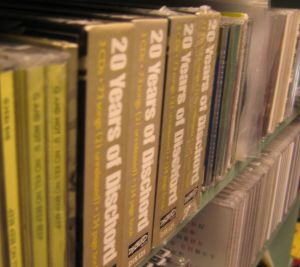
Today, Dischord has a worldwide relationship with distributors, pressing plants and the indie record industry, but the original DIY spirit is still intact. When the album from Fugazi drummer Brendon Canty’s first high school band was released in 2007, Dischord had the cardboard sleeve printed at a letter press, but assembled the rest of the packaging and inserted the CDs by hand.
“We just did an Edie Sedgwick record and got the bag, record and sleeves separately. We spent days putting them together because no one would do it how we wanted them to look (with orange LP placed on top of the sleeve),” Bourgeois said. “To do some of it, it feels good. Anytime you get your hands involved and feel directly involved with the manufacturing feels exciting”
Dischord’s approach hasn’t changed over the years but the rest of the music industry has. Major labels are in crisis and illegal downloading has killed many revenue streams.
“This is the first time the music listener has been put in charge,” Bourgeois said. “Many labels feel threatened. We don’t, because we have a decent relationship with our customers. They get to decide what format they want to listen in, we don’t – but that’s a good thing.”
According to Bourgeois, CD sales have fallen, but digital downloads and vinyl sales have increased. Most Dischord LPs come with a download code with access to a digital copy of the album, but Bourgeois said he doesn’t think physical product will ever completely disappear.
“We make records – we like having something to do,” Bourgeois said. “Digital sales feel impersonal. We find ways to keep involved. With digital you just push buttons. No one has to touch or move anything. It’s kind of a bummer. What we’ve done for 25-plus years is interact with people.”
Bourgeois keeps an eye out for interesting orders or orders containing a lot of one artist. When those pops up he generates a promo code for free songs that artist may have done with another band and sends a message to the customer.
“We want to keep the back-and-forth going,” Bourgeois said.” We’ve always had a nice exchange with our customers.”
Those conversations have kept Dischord steady while the rest of the industry struggles.
“We’re fairly immune to certain market trends,” Bourgeois said. “We were never involved directly with the market anyway.”
Although McKaye maintains an office at the Dischord House, Bourgeois and the other four full-time staff members do the lion’s share of the label’s work from a cluttered-but-cozy basement office stuffed below a dry cleaner across the street.
“This label has always represented a specific community within the D.C. scene,” Bourgeois said.” We don’t deal with contracts (on our artists). It’s a very personal group of friends.”
(Below: Bourgeois at his workspace in the Dischord office.)
(Above: Woodstock Festival organizer Michael Lang’s hand-drawn layout of the festival grounds. The drawing is part of a new exhibit celebrating the 40th anniversary of Woodstock at the Rock and Roll Hall of Fame and Museum. All photos courtesy of the Rock and Roll Hall of Fame and Museum.)
By Joel Francis
The enduring image of Woodstock is iconic: a fringed performer – Jimi Hendrix, Roger Daltrey, David Crosby or Sly Stone – onstage, in front of a staggering mass of people. But how did the performers get to the stage, and where do all the fans answer nature’s call?
“Woodstock: The 40th Anniversary,” a new exhibit at the Rock and Roll Hall of Fame, sheds light on the logistical side of America’s first and greatest rock festival.
“One of the things that interested me the most in putting this exhibit together was just seeing what went into planning of the festival,” said Jim Henke, chief curator at the Rock and Roll Hall of Fame. “There was a massive amount of planning involved, and a lot of it had to be done at the last minute because the city fathers of Wakill, N.Y. didn’t want that many people to descend on them and made the organizers move the site.”
Festival organizer Michael Lang didn’t get much rest in the weeks leading up to the Woodstock and as evidenced in the “Woodstock” film, Lang had his hands full throughout the event as well. Lang made quite the statement on film making several last-minute arrangements, deals and accommodations in a hand-designed leather vest, also fringed, of course. The vest is just one of several items Lang loaned to the hall for the exhibit.
“Lang’s vest is still in decent shape today,” Henke said. “I’m sure he didn’t get any sleep during that period, but it seems like for whatever reason he was able to keep it together.”
Other clothing in the exhibit includes the tie-dyed cape and jacket John Sebastian wore during his five-song set, and the spectacles Robbie Robertson wore during The Band’s performance.
Surrounding the garments is the contract Crosby, Stills, Nash and Young’s performance contract, drawings and layouts of the festival grounds, Lang’s handwritten management and operations plan, and an early press release stating the original location of Wallkill and that “Woodstock does not figure on gate crashers.”
“One of the more interesting items we have is a letter from Apple offering the services of James Taylor and Billy Preston for Woodstock,” Henke said. “It turned out Lang and the others didn’t get it in time, so no one appeared.
The letter offered the services of the Plastic Ono Band, which it described as “a series of plastic cylinders incorporated around a stereo sound system.”
“The letter didn’t say John Lennon and the Plastic Ono Band,” Henke said, “so I’m not sure if he would have been there or not. I do know Lennon played the Live Peace festival in Toronto a month later, so it could have been a possibility.”
“Woodstock: The 40th Anniversary” appears in the museum’s Ahmet M. Ertegun Main Exhibit Hall through November. The museum will be showing an edited version of the restored Woodstock film in the theater adjacent to the exhibit.
“In addition to having an amazing musical lineup, Woodstock was also the culmination of the anti-Vietnam war movement and the peace and love movement. It was a natural merger that pushed them of being underground movements,” Henke said. “For some of our visitors, this exhibit will bring back memories. The younger audience may not know as much going in, but hopefully they will learn how one of the seminal moments in rock and roll history came about.”
(Above: Jay Bennett and Jeff Tweedy perform the unreleased Wilco song “Cars Can’t Escape.”)
By Joel Francis The Daily Record
When I first heard Jay Bennett had been fired from Wilco back in 2001, I was worried the band had just lost their secret weapon. Jeff Tweedy may have been the wordsmith and idea man, but Bennett was the artist who polished those ideas to perfection.
Bennett died in his sleep May 24. He was 45 years old.
Bennett’s presence was felt from the moment he joined Wilco in 1995. Tweedy was still trying to crawl out from the shadow of Uncle Tupelo and establish his identity independent of his Tupelo cohort (and rival) Jay Farrar. Bennett’s presence on the band’s second album, “Being There,” added a new dimension to the arrangements and production.
“Summerteeth” is arguable Wilco’s finest hour and definitely the perfect product of the Tweedy/Bennett vision. For each of Tweedy’s dark moments, like “She’s A Jar” or “Via Chicago,” there are the sun-drenched pop anthems of “Nothing’severgonnastandinmyway(again)” and “I’m Always in Love.” Wilco’s music has never been happier and more optimistic than it is on “Summerteeth.” For proof, check out the opening riff in the title song. “Summerteeth” the song is the musical equivalent of a gentle breeze caressing the backyard hammock, or those Corona beach commercials.
Bookending the recording of “Summerteeth” are two albums using unused Woody Guthrie lyrics recorded with British folker Billy Bragg. Bennett’s touch is felt across both volumes of the “Mermaid Avenue” material; “Secrets of the Sea” and “Hoodoo Voodoo” continue that “Summerteeth” vibe.
Wilco’s next album, “Yankee Hotel Foxtrot,” famously found the band in transition and butting heads. But if “I Am Trying to Break Your Heart” and “I’m the Man Who Loves You” point to the band’s future without Bennett, “Jesus, etc.” and “Heavy Metal Drummer” still held plenty of Bennett’s sunny, radio-friendly magic.
Although Tweedy continued building critical acclaim and growing his fan base after “Foxtrot,” Bennett was not as successful on his own. That Bennett was working as a VCR repairman prior to joining Wilco says a lot about his craft. Bennett was a tinkerer, one who was best improving and polishing other’s creations. Left to both build and execute, he struggled.
Despite this, Bennett’s four solo albums still have merit. His first post-Wilco release, a collaboration with Edward Burch called “The Palace at 4 a.m.,” has a remake of the “Summerteeth” track “My Darling” that may top the original. This album and the two that follow it have more unused Guthrie material which makes for a nice “Mermaid Avenue” post script. (The post script continued this year with Wilco’s release of Guthrie’s “Jolly Banker.” Hopefully a “Volume Three” will appear sometime.) Bennett’s limited singing ability can grows wearisome across these releases, his production never does.
Bennett’s most complete solo statement was his second-to-last album, 2006’s “The Magnificent Defeat.” The second word in the title should be given more emphasis than the third. Bennett’s lyrics and delivery have a bit of Elvis Costello anger to them, but the fun he had putting the album together jumps out the speakers and makes for an infectious listen.
Today, Tweedy and bass player John Stirratt are all that remain of the Wilco lineup that brought us “Summerteeth” and “Being There.” But every time the band launches into “She’s A Jar” or “ELT” – as they frequently do – a little bit of Jay Bennett will be smiling on the audience. And they’ll be smiling back.



 Today, Dischord has a worldwide relationship with distributors, pressing plants and the indie record industry, but the original DIY spirit is still intact. When the album from Fugazi drummer Brendon Canty’s first high school band was released in 2007, Dischord had the cardboard sleeve printed at a letter press, but assembled the rest of the packaging and inserted the CDs by hand.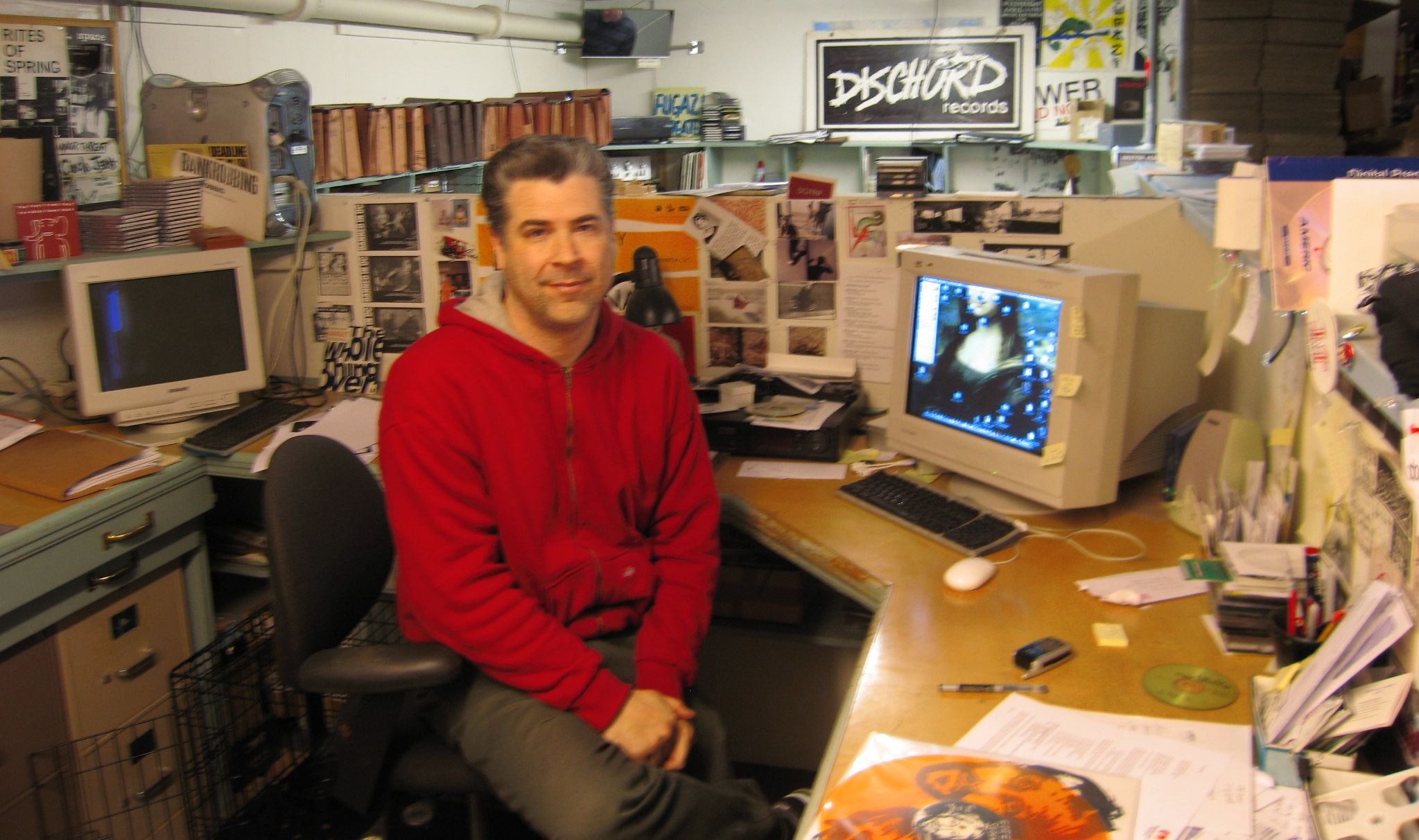

 Surrounding the garments is the contract Crosby, Stills, Nash and Young’s performance contract, drawings and layouts of the festival grounds, Lang’s handwritten management and operations plan, and an early press release stating the original location of Wallkill and that “Woodstock does not figure on gate crashers.”
 joelfrancis.com