Shorty Long – “Function at the Junction”

function

Shorty Long – “Function at the Junction,” Pop #97, R&B #42

Bluesman Shorty Long always sounded more like a Chess artist than someone on the Motown roster. His 1964 song “Devil With A Blue Dress” sounded like something coming out of a juke joint at midnight. “Function at the Junction,” released two years later, was no less conventional. While Long was one of the few Motown artists in the ’60s allowed to produce himself – Smokey Robinson was another –  he allowed the Holland-Dozier hit machine to apply their shiny production to this number. The result was something that sounded more like Little Richard’s Specialty output of the ’50s than any of the recent HDH hits, but there were a few Motown trademarks. The drums and tambourine are pushed to the front of the mix, but the piano riff propped up by a mean organ that drive the song.

Lyrically, Long’s number is similar to Willie Dixon’s “Wang Dang Doodle” which was a hit for Koko Taylor and Chess the previous year. While Taylor sings of Automatic Slim and Fast Talking Fanny, Long espouses “Ling Ting Tong from China” and 007, who is “bringin’ all the guys from ‘I Spy.'”

The debt “Function at the Junction” owes Little Richard wasn’t lost on the legend, who covered the number in 1971. Two years later jazzman Ramsey Lewis teased the song’s piano strains with his reading. Two decades later, Huey Lewis revived the tune for a greatest hits package. – by Joel Francis

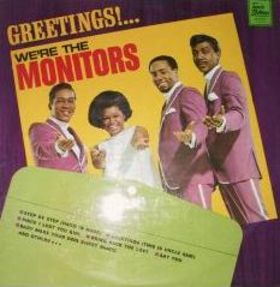
The Monitors – “Greetings (This Is Uncle Sam)”

monitors

The Monitors – “Greetings (This Is Uncle Sam),” Pop #100, R&B #21

The Monitors’ can thank the Valadiers, Motown’s first all-white group, for their only hit. Written in the early ’60s, the song took on new meaning just a few years later when the Vietnam war and military draft started building momentum.

Producer “Mickey” Stevenson does a great job dressing up this homage to a draft notice as a ’50s love ballad. Singer Richard Street playfully teases the phrase “I need you,” adding new meaning to the words, while the playful backing vocals recall “Gomer Pyle”‘s Sergeant Carter. Although the song is humorous now, it was probably a lot less funny at the time.

Although the Monitors released a handful of singles for Motown between 1964-68, this was their highest-topping effort. Several members of the group held other jobs within the company. Street was a member of Berry Gordy’s Quality Control team, and a stand-in for Temptation Paul Williams, who was struggling with alcoholism at the time. Street ultimately replaced Williams in the Temptations when he was fired in 1971.The rest of the Monitors faded into obscurity before briefly resurfacing with a reunion album in 1990. – by Joel Francis

Isley Brothers – “This Old Heart of Mine (Is Weak For You)”

isleys

Isley Brothers – “This Old Heart of Mine (Is Weak For You),” Pop #12, R&B #6

By Joel Francis

For the most part, Motown’s talent during its heyday was home-grown. Martha Reeves was a Hitsville secretary, Stevie Wonder was a kid pestering the Funk Brothers for lessons, Marvin Gaye and Smokey Robinson were part of Berry Gordy’s extended family and Diane Ross and her friends stopped by every day after school to pester staff for an audition.

In short, talent came to Motown, not the other way around.

Of course that mindset quickly changed when the Isley Brothers hit the free agent market in 1965. The brothers made their name with 1959’s “Shout!” (recorded for RCA) and 1962’s “Twist and Shout” (recorded for the Wand label and covered by the Beatles). But after bouncing between those two labels and the failure to establish their own imprint, the Isley Brothers were looking for a new home. Berry Gordy was all too happy to welcome them to his fold.

The Isley’s Motown debut, “This Old Heart of Mine (Is Weak For You) was their biggest success so far. Holland-Dozier-Holland definitely applied the Motown sound to their number. The drums lead the mix, and the string section sounds more like the Four Tops than the Isley Brothers’ gritty urban soul. The brothers had never sounded so slick before, but the results couldn’t be argued with. The song is infectious, fun and impossible to listen to without breaking into smiles or dance.

Unfortunately, the Isley-Motown marriage didn’t last long. Despite releasing two more albums, the group couldn’t find a follow-up hit and complained of being fed inferior, cast-off tracks. They had a point: “This Old Heart” was originally intended for the Supremes. The brothers left Motown in 1968 and signed with Buddha before finding long-term success with Epic.

The Elgins – “Darling Baby”

darling-baby

The Elgins – “Darling Baby,” Pop #72, R&B #4

The Elgins started as a trio in 1962 who called themselves The Downbeats. When they added frontwoman Sandra Edwards (nee Mallet) and another singer, they switched their name to the Elgins. That wouldn’t have been a problem, except copies of “Darling Baby” were already being pressed, so new labels had to be hastily printed. Copies of “Darling Baby” credited to the Downbeats carry a hefty price tag. (Original pressings of the Elgins’ “Darling Baby” run between $25 and $50.)

The group’s name choice is an interesting one. The Temptations went as the Elgins before Berry Gordy made them come up with a new handle. There was also a Los Angeles-based doo-wop group with the same name.

Unfortunately, all of this history is more interesting than the actual song. Penned by the usually spectacular Holland-Dozier-Holland team, “Darling Baby” is as generic as its title. Despite a fine vocal performance by Edwards, the backing vocals are laughably unconvincing, the rhythm plods and the arrangement is stagnant. Edwards pleads her departing lover to “talk it over one more time,” but it’s obvious there isn’t much being said.

Fortunately, the Elgins’ follow-up hit “Heaven Must Have Sent You,” atones for the misstep of “Darling Baby.” – by Joel Francis

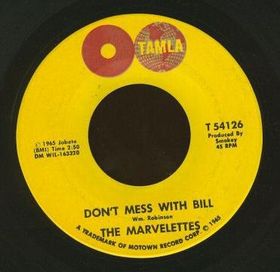
The Marvelettes – “Don’t Mess With Bill”

bill

The Marvelettes – “Don’t Mess With Bill,” Pop #7, R&B #3

The three years between this hit and the Marvelettes’ previous chart entry, “Beechwood 4-5789,” saw them slide from Barry Gordy’s go-to girl group to third fiddle behind Martha and the Vandellas and the Supremes. After passing on “Where Did Our Love Go,” which became a hit for the Supremes, they finally found success with this Smokey Robinson number.

Lyrically, this relationship may not be the most stable: Bill has put tears in lead singer Wanda Young’s eyes “a thousand times or more.” But “every time he would apologize/I loved him more than before.” Furthermore, Young isn’t sure Bill will come back; that said, she wants no competition.

The vocal deliveries may not be threatening, but the slinky organ underpinning the melody and saxophone solo add an element of danger. Any girl that’s tough enough to put up with what Bill hands out can definitely hold her own. – by Joel Francis

Stevie Wonder – “Happy Birthday”

(Above: Happy 80th, Dr. King.)

By Joel Francis
The Daily Record

Every few years, the calendar aligns so that my dad’s birthday lands on Martin Luther King Day. Most of the time, the extra day off works means we celebrate a bit longer. Stevie Wonder’s “Happy Birthday” is the perfect salute to these days, but it means even more this year, on the eve of Barack Obama’s inauguration.

King’s birthday was not a national holiday when Wonder penned this tribute. The song was a rallying point in the fight to establish King’s birthday as a holiday. Wonder performed the song at the Rally For Peace press conference in 1981, and wrote an essay about King that appeared on the album liner sleeve. Part of his words read:

“It is believed that for a man to lay down his life for the love of others is the supreme sacrifice. Jesus Christ by his own example showed us that there is no greater love. For nearly two thousand years now we have been striving to have the strength to follow that example. Martin Luther King was a man who had that strength. He showed us, non-violently, a better way of life, a way of mutual respect, helping us to avoid much bitter confrontation and inevitable bloodshed. We still have a long road to travel until we reach the world that was his dream. We in the United States must not forget either his supreme sacrifice or that dream.”

Wonder’s essay is accompanied by photos of King and the Civil Rights movement. The grim photos – which include depictions white police officers attacking black protesters – stand in contrast to the buoyant melody of the song. The synthesizers and drums may be dated, but the lyrics and sentiment capture the hope and love as well as U2’s more famous tribute. Wonder also understands that birthdays are about parties, so his homage to King is as much a celebration of life as a remembrance.

It was a touch disappointing to watch Wonder elect to perform “Higher Ground” at the “We Are One” concert that took place on the steps of the Lincoln Memorial in Washington, D.C. two days before Obama’s inauguration. In a day rife with symbolism and historic importance, the significance of performing “Happy Birthday” would have been amazing. Then again, more people are probably familiar with “Higher Ground.” And Stevie Wonder never met my dad.

Stevie Wonder – “Uptight (Everything Is Alright)”

uptight

Stevie Wonder – “Uptight (Everything Is Alright),” Pop #3, R&B #1

By Joel Francis

Nearly two years after success of “Fingertips,” Little Stevie finally found a follow-up hit – just in the nick of time. Motown had just about given up on him. Never mind that Wonder hadn’t been given much to work with: an album of Ray Charles covers, the “Fingertips” knock-off “Workout Stevie” and corny kids songs like “Happy Street” and “Hey Harmonica Man.” His dry spell was compounded by the fact that his voice was starting to change. Motown producers were wary of working with the onetime boy wonder, but Clarence Paul, who had acted as a mentor and father figure to the boy since his 1961 signing, liked his protégé’s newfound tenor.

The only thing uptight about this number is its title. The melody is fun, free and fresh. From the signature horn fanfare to the delight in Wonder’s voice, there are smiles all around. Every week Berry Gordy used to run each prospective single through a quality assurance committee who would vote on which numbers were released. The idea was a holdover from Gordy’s days on the assembly line. It’s hard to picture anyone not voting for this upbeat tune. I like to imagine that a spontaneous dance session broke out when it was played.

Once the song broke, everything was alright in Wonder’s world. Success may have been an early struggle, but it flowed effortlessly after this. With three exceptions, Wonder had at least one Top 10 hit per year from 1965 to 1985.

Rock Hall Celebrates 50 Years of Motown

motownnew

Above: Part of the new Rock and Roll Hall of Fame exhibit celebrating 50 years of Motown Records. The exhibit is open all year. (Photo courtesy of the Rock and Roll Hall of Fame.)

By Joel Francis

It may seem hard to believe, but “the sound of young America” is 50 years old.

To celebrate a half-century of Motown records, the Rock and Roll Hall of Fame in Cleveland is hosting a new exhibit, “Motown: The Sound of Young America Turns 50,” all year in the Ahmet M. Ertegun Main Exhibit Hall.

“It’s an obvious anniversary, one we should do something about,” said Howard Kramer, director of curatorial affairs for the museum. “Lots of labels have anniversaries, but Motown still rings wide and true.”

One of the largest items on display is the upright bass Funk Brother James Jamerson played on all his Motown sessions until 1963. It’s the instrument heard on “My Guy” and “Heat Wave.”

“A lot of people maintain the key to Motown was the rhythm section: The snap of the drums, the gorgeously intricate bass line and then the percussion laid over the top,” Kramer said. “Jamerson was the primary bass player. He carried the weight of those recordings.”

Of particular interest to Kramer are four posters promoting Motown concerts. Two of the posters advertise Motown Revue shows, which featured several of the labels artists on the same bill.

“For the 1963 revue, Stevie Wonder was the headliner.Usually the person with the biggest hit at the time was the headliner, and in this case he was riding ‘Fingertips, Part 2,'” Kramer said. “It’s interesting to see both who’s on top and the volume of artists (on the bill). It’s also interesting to note that for the 1968 Motown Revue shows at the Fox Theater in Detroit, they played 9 or 10 days in a theater that seats 5,000.”

Together, the posters span five years and a range of venues from a high school gym to a civic sports arena.

“These posters give you an idea of the breadth of places Motown performers were playing,” Kramer said. “They’d play arenas, high schools, theaters and also posh nightclubs like the Copacabana in New York,” Kramer said. “They played every possible circuit.”

Other items in the exhibit include the dress Supreme Mary Wilson wore for the group’s first appearance on the Ed Sullivan Show after the departure of Diana Ross, the outfit and glasses Stevie Wonder wore for his halftime performance at the 1999 Super Bowl and a stage costume worn by Miracle Bobby Rogers in the 1970s.

“Rogers’ suit is an example of the over-the-top clothing vocal groups wore at the time,” Kramer said. “There’s no reason for this to have been made except for a performer. This is not street wear.”

Thanks to a loan from the Universal Music Group, which owns the Motown label, many of the artifacts have never been displayed before.

“A lot of Motown stuff didn’t make it past the original era,” Kramer said. “The only item we’ve shown before is Rick James’ bass.”

For many of the Motown session musicians, playing for Hitsville was just another gig. But 50 years later, the notes they laid down still resonate.

After 50 years and several generations Motown is still a staple of radio, music, movies, television, commercials,” Kramer said. “That’s part of (label founder Berry) Gordy’s vision to make the music palatable to all ages.”

To learn more about museum hours and ticket information, visit the Rock and Roll Hall of Fame Website.

Keep Reading:

Rock Hall Celebrates the 40th Anniversary of Woodstock

George Kalinsky: Painting with Light (Rock Hall photo exhibit)

Bruce Springsteen Rocks the Hall (part one)

Bruce Springsteen Rocks the Hall (part two)

Kim Weston – “Take Me In Your Arms (Rock Me A Little While)”

kim-weston

Kim Weston – “Take Me In Your Arms (Rock Me A Little While),” Pop #50, R&B #4

By Joel Francis

Kim Weston is best remembered as Marvin Gaye’s duet partner on “It Takes Two,” but she did manage to score a few chart hits on her own. (Like seemingly every Motown hit of 1965) “Take Me In Your Arms” was written by the Holland-Dozier-Holland team. It was Weston’s most successful solo effort.

Weston faced the same obstacle that confronted every female Motown singer post-1964: She wasn’t Diana Ross. While label founder Berry Gordy was busy obsessing over Ross and the Supremes, Weston’s husband, longtime Motown A&R man Mickey Stevenson, was pouring the same energy into his wife. Unfortunately, the Motown machinery didn’t quite know what to do with her. Weston’s body wasn’t built for the dresses Gordy had designed for his female stars and Gordy’s sisters, who also worked at the label, grew resentful of all the time Stevenson spent grooming his wife. Aside from her tenure as Gaye’s duet partner, Weston was always a second-tier vocalist for the label.

After writing epic, sweeping arrangements for the Four Tops, the score for this number is pretty straightforward. There are no strings or horns. In fact, the entire song rests in the strength of the Funk Brothers rhythm section. “Rock Me” is the operative phrase from the title. The tambourine and drums pushed in the listeners face while equally strong guitar and piano work buried in the mix. Weston’s powerful singing drives everything home. If you’re feet aren’t moving 10 seconds into this number call the doctor, there’s something wrong.

The song was back on the R&B charts just two years later courtesy of the Isley Brothers. A different set of brothers, the Doobie Brothers rode the song to No. 11 on the pop chart in 1975. Blood, Sweat and Tears also covered the song on their 1971 album “BS&T 4.”

Martha and the Vandellas – “Love (Makes Me Do Foolish Things)”

882867

Martha and the Vandellas – “Love (Makes Me Do Foolish Things),” Pop #70, R&B #22

By Joel Francis

Martha and the Vandellas didn’t do many ballads. Their best-known songs – “Heat Wave,” “Jimmy Mack” and “Nowhere to Run” – are all relentlessly upbeat. Despite the drastic change in tempo, the three songs above share at least one similarity with “Love (Makes Me Do Foolish Things)”: They were all written by Holland-Dozier-Holland.

The HDH team really came into its own in 1965, the year “Love” was released. Rare was the week that one or more of their songs wasn’t found near the top of the charts. This number, however, was a rare misstep for the team.

Martha Reeves turns in a fine vocal performance, but the song never really ignites. The number never peaks. Once Reeves’ voice enters, everything just kind of sits there until the fade-out. Although the trio wrote captivating arrangements for “It’s the Same Old Song” and “I Hear a Symphony,” the arrangement here isn’t anything to write home about. The drums are prominent in the mix, but aren’t really saying anything. Likewise, one gets the impression the strings were just added to make the mix more full. Finally, the lyrics are solid, but don’t expose anything not given away in the title.

“Love (Makes Me Do Foolish Things)” never ignited with other artists, either. Berry Gordy tried to farm the song off to a couple other Motown artists, most notably the Supremes. The results of Kim Weston’s adventures with the tune languished in the Motown vaults until the historical reissues of 2005.

That said, it is never wise to write off a Holland-Dozier-Holland number, especially from this era. In the right hands, the song could be a surprising hit today.