Celebrating Buck O’Neil, Kansas City and Jazz

(Above: Thirty seconds with Buck O’Neil is guaranteed to brighten your day.)

By Joel Francis

Buck O’Neil, Negro Leagues baseball player and ambassador of all things good, died at age 90 three years ago this month. Today we pay tribute to Buck by reprinting his longest music-only interview.

I spoke to Buck as an undergrad back in the summer of 1998 while freelancing for the Kansas City Blues Society. For some reason the article never made it into “Blues News,” and it languished until Ken Burns premiered his “Jazz” documentary series in 2001. I was working for The Examiner in Independence, Mo. at the time. They were all too happy to run my interview.

The day photographer and I took the picture that accompanied the story (not the one that appears online), we met Buck at the Blue Room then hit Arthur Bryant’s around the corner. Now *that’s* Kansas City.

Keep reading:
Buck O’Neil: Sweet Times and Sweet Sounds at 18th and Vine.

Peter, Bjorn and John Heart Hip Hop

(Above: Kanye West and Peter, Bjorn and John marry indie rock to hip hop in  “Young Folks.”)

By Joel Francis
The Kansas City Star

The distance between whistling and beat-boxing shrank considerably once Kanye West got involved.

When West sampled Peter, Bjorn and John’s whistle-based sensation “Young Folks” for his mixtape, he not only united the worlds of indie rock and hip-hop, he also awakened Peter, Bjorn and John’s burgeoning love of urban music.

“When I first heard his version I thought it was a joke,” drummer John Eriksson said. “I didn’t think it’s strange, though, because a lot of hip-hop artists are trying to get more rock with a lot of electric guitars and the rest.”

West proved his indie rock cred when he asked the Swedish trio to perform the mashup during his set at the 2007 Way Out West festival. The collaboration helped open the band’s ears to new ways of presenting its music. The commercial follow-up to “Young Folks” was this year’s “Living Thing,” which disposed of guitars and traditional drumming and embraced icy synthesizers, spare arrangements and altered percussion.

“Many people think the drums on ‘Living Thing’ are programmed, but it’s not,” said Eriksson, whose band performs Friday night at the Granada in Lawrence. “Eighty percent of the sounds are acoustic but turned to make it sound like a drum machine or given a spaced-out, futuristic sound.”

Hip-hop wasn’t much of an influence when the band formed in 1999, but at the end of the “Living Thing” sessions, singer Peter Moren tried what would have been unthinkable 10 years ago and rapped an entire song.

“I didn’t think it was good enough (to make the album), so we tried to get someone else to do the vocals,” Eriksson said. “That’s how we met Mick Boogie, who helped us come up with the idea of having other people rap over all of our songs.”

The resulting remix album was dubbed “Re-Living Thing” and features original rhymes by GZA, Talib Kweli, Three 6 Mafia, Bun B and Rhymefest, with production from Jazzy Jeff, 6th Sense and Apple Juice Kid.

“I’ve only heard three versions so far. Jazzy Jeff did a fantastic job on his track, and I can’t wait to hear the others,” Eriksson said. “Knowing GZA from Wu Tang is on there makes me want to cry, almost. It seems surreal he’s doing something with one of our songs. I don’t know how Mick convinced him to take part. Maybe they played chess and Mick won.”

After the band released an online- and vinyl-only instrumental album last year and commissioned friends to make different arrangements of past singles for vinyl release, Eriksson feels like Peter, Bjorn and John fans should be up for anything.

“I think our fans are used to us doing weird, surprising stuff. A couple tracks on last year’s instrumental album have a Swedish narrative in the old dialect,” Eriksson said. “After five albums, by now people should be open to who we are. Maybe our next album will be trash-metal mixed with Stockhausen.”

Hesitant or curious fans won’t have to part with much to hear the results. “Re-Living Thing” will be released online today for free.

“That’s just how it works these days. Music is free,” Eriksson said. “When you make music, you don’t think about how to make money. Usually other people do that.”

Eriksson said most of the band’s money comes from licensing songs like “Young Folks” to TV shows and commercials. The corporate funds pay for the band’s creative ventures, like jazz and hip-hop remixes.

“When people ask us if they can use songs in commercials, we think about what the commercial is for. We won’t say yes to banks, McDonald’s and things we don’t agree with,” Eriksson said. “When it’s something we like — like TV shows, beer, maybe ice cream, stuff people need — we have no problem. It’s the only way we can make money. I wish we could sell albums, but most of our money is from that.”

Friday
Peter, Bjorn and John perform Friday night at the Granada, 1020 Massachusetts in Lawrence. Cowboy Indian Bear opens at 9 p.m. Tickets to the all-ages show are $15. Visit www.thegranada.com.

Dischord finds harmony in D.C. hardcore scene

dischord house


(Above: The Dischord house.)

By Joel Francis

In a town littered with monuments and markings, the historic two-story red home in Arlington, Vir., has nary a plaque or sign. The house is close enough to the Pentagon that armed guards patrol a nearby parking facility, but what’s gone on inside its four walls for the past 30 years has been just as combative.

The residence on South Washington Blvd. is known worldwide to punk fans as the Dischord House, ground zero for the straight-edge and Washington, D.C., hardcore movement in the 1980s and the residence of Ian McKaye.

Today McKaye is best known as the force behind legendary hardcore punk outfits Minor Threat and Fugazi, but in 1980 he was a disenfranchised teenager trying to get his band recorded.

“The history of Dischord Records is pretty simple. Ian and Jeff (Nelson) were in Teen Idles, but the band broke up before they could release anything,” said longtime Dischord employee and spokesperson Alec Bourgeois. “At the time, there was no commercial structure. If you wanted it out, you had to do it yourself. The idea was to have something to sell at shows and to friends.”

McKaye and Nelson were responsible for all aspects of the initial run of 1,000 copies, from getting the LPs pressed, designing the artwork and assembling the sleeves. The final product, “Minor Disturbance” was the first entry in the Dischord catalog.

The first records were so primitive,” Bourgeois said. “Ian literally pulled a 7-inch off the self, took it apart to see how it was made and took it to Kinkos, or whatever the equivalent was at the time and came back with a template to cut and paste around. They were literally handmade. Later he realized he could send the stuff off to someone familiar with the format.”

As Minor Threat started taking off, so – gradually – did Dischord. Other bands started coming to McKaye for help getting their music out.

The pair had two strikes against them – not only were they teenagers, but their band was kaput. By the time the Teen Idles 7-inch finally came out, McKaye was prospering in Minor Threat, and other bands were coming to for help getting records out.

“By the late ‘80s, early ‘90s there was a vibrant independent music scene (in D.C.),” Bourgeois said. “We felt connected with all the different labels, even though we all represented different communities. It’s one of the reason we carry all the local labels – because we feel connected to them. We don’t purport to represent DC by ourselves.”

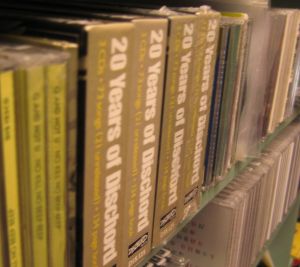
dischord albumsToday, Dischord has a worldwide relationship with distributors, pressing plants and the indie record industry, but the original DIY spirit is still intact. When the album from Fugazi drummer Brendon Canty’s first high school band was released in 2007, Dischord had the cardboard sleeve printed at a letter press, but assembled the rest of the packaging and inserted the CDs by hand.

“We just did an Edie Sedgwick record and got the bag, record and sleeves separately. We spent days putting them together because no one would do it how we wanted them to look (with orange LP placed on top of the sleeve),” Bourgeois said. “To do some of it, it feels good. Anytime you get your hands involved and feel directly involved with the manufacturing feels exciting”

Dischord’s approach hasn’t changed over the years but the rest of the music industry has. Major labels are in crisis and illegal downloading has killed many revenue streams.

“This is the first time the music listener has been put in charge,” Bourgeois said. “Many labels feel threatened. We don’t, because we have a decent relationship with our customers. They get to decide what format they want to listen in, we don’t – but that’s a good thing.”

According to Bourgeois, CD sales have fallen, but digital downloads and vinyl sales have increased. Most Dischord LPs come with a download code with access to a digital copy of the album, but Bourgeois said he doesn’t think physical product will ever completely disappear.

“We make records – we like having something to do,” Bourgeois said. “Digital sales feel impersonal. We find ways to keep involved. With digital you just push buttons. No one has to touch or move anything. It’s kind of a bummer. What we’ve done for 25-plus years is interact with people.”

Bourgeois keeps an eye out for interesting orders or orders containing a lot of one artist. When those pops up he generates a promo code for free songs that artist may have done with another band and sends a message to the customer.

“We want to keep the back-and-forth going,” Bourgeois said.” We’ve always had a nice exchange with our customers.”

Those conversations have kept Dischord steady while the rest of the industry struggles.

“We’re fairly immune to certain market trends,” Bourgeois said. “We were never involved directly with the market anyway.”

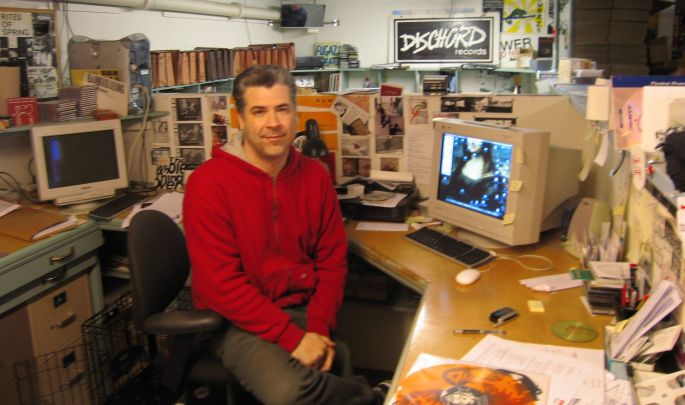
Although McKaye maintains an office at the Dischord House, Bourgeois and the other four full-time staff members do the lion’s share of the label’s work from a cluttered-but-cozy basement office stuffed below a dry cleaner across the street.

“This label has always represented a specific community within the D.C. scene,” Bourgeois said.” We don’t deal with contracts (on our artists). It’s a very personal group of friends.”

(Below: Bourgeois at his workspace in the Dischord office.)alec workspace

Jamie Foxx brings it to Sprint Center on Saturday

(Above: Jamie Foxx celebrates society’s greatest scapegoat.)

By Joel Francis
The Kansas City Star

Three days after Michael Jackson’s death, Jamie Foxx appeared as host of the BET Awards clad in a red leather, Thriller-era jacket and sequined glove. After performing “Beat It” and telling a few jokes about Jackson’s ever-changing nose, Foxx paid tribute to the fallen icon by moonwalking across the stage.

And when Foxx performs a concert at the Sprint Center on Saturday, Jackson again will have his moment.

“We definitely do a Michael Jackson moment at our shows and let his music play,” Foxx said in a recent telephone interview. “A lot of the media’s Michael Jackson coverage has become a circus. We try to concentrate on what he gave us — his music.”

After walking the tightrope of poking fun at Jackson without offending, Foxx closed out the BET Awards with a duet of “I’ll Be There” with Ne-Yo. After the pair finished, Jackson’s sister Janet and father, Joe, came out and thanked everyone for their support.

“My job that night was to keep things light, keep things fun,” Foxx said. “Having the family there was tough, because I wanted to be respectful and I knew Janet was going to come out at the end. I have to commend BET, though. They had to do an awards show when the biggest entertainer in the world passes away. With very little money and very little time, they completely turned the show around.”

When Foxx last played Kansas City at the Music Hall in March, 2007, he was best known for his Oscar-winning performance as Ray Charles and parodying that character on the hit single “Gold Digger” with Kanye West. For this tour, Foxx has the success and chops under his belt to prove that he’s not just another actor living out a fantasy as a musician.

“The biggest thing I’ve learned since the last tour is that you should go out while your record is hot, not wait two years,” Foxx said, remembering his 2005 hit “Unpredictable,” which he didn’t promote until 2007. “Right now, this very moment, ‘Blame It’ is still rolling (on the charts). It’s sizzling.”

When Stevie Wonder played Starlight Theatre recently, he stopped the show for a few minutes to have the soundman pump his favorite song this year through the PA. Within moments, the crowd that had been grooving to “Signed, Sealed, Delivered” and “Living for the City” was grinding to Foxx’s “Blame It.”

Even without the endorsements, “Blame It” is one of the unofficial songs of the summer. It topped the Urban Contemporary charts for 12 consecutive weeks and as of mid-July it had been in the Top 40 for 26 weeks.

Like many of the previous summertime hits, “Blame It” gets a boost from the ubiquitous T-Pain. He won’t be at the Sprint Center, but Foxx said audiences won’t miss T-Pain or any of the other artists that appear on his albums.

“For those songs with features, I have guys who sing those parts, so we don’t miss a step,” Foxx said. “My back-up singer does a great job performing T-Pain’s part. It’s a lot of fun, but it also taught me another lesson: Don’t lean on your features too heavily when recording, so you can still do them alone on tour.”

Before Foxx was an Oscar-winning actor or a comedian on “In Living Color” and “Def Comedy Jam,” he was a musician. Foxx started taking piano lessons at age 5 and released his first album in 1994. It took 11 years and an appearance on Twista’s “Slow Jamz” — again with West — before Foxx released a follow-up album.

When he began performing as a musician on the big stage, Foxx drew on his experiences as an actor and comedian.

“Through playing live I learned how to pace myself,” Foxx said. “I learned I could take my time with a slow song. As a comedian, I am always looking for a reaction. But when you sing a slow song, you don’t need an immediate reaction. Sometimes people want to take it all in before they respond. I don’t need to go all over the stage to make sure they like it.”

Whatever the tempo, Foxx pulls on his acting background and treats each song as if he’s playing a character. Upbeat songs get a character who knows how to party and have fun, Foxx said.

“When it’s time for slower music, I change clothes and put on a suit,” he said. “For ‘Blame It,’ I wear a sparkly jacket, because that’s what I felt that character would wear. Everything’s always a character.”

Foxx appeared as a different kind of musician earlier this year. In the movie “The Soloist,” he portrayed a homeless, schizophrenic, classically trained cellist. Don’t look for that character to appear onstage.

“No more cello for me,” Foxx said. “I just play piano.”


the show
Jamie Foxx and his 50-city “Intuition Tour” come to Kansas City at 8 p.m. Saturday at the Sprint Center. Doors open at 7. Tickets are $59.75 and $69.75 at www.ticketmaster.com.

Rock Hall celebrates the 40th anniversary of Woodstock

Rock & Roll Hall Of Fame

(Above: Woodstock Festival organizer Michael Lang’s hand-drawn layout of the festival grounds. The drawing is part of a new exhibit celebrating the 40th anniversary of Woodstock at the Rock and Roll Hall of Fame and Museum. All photos courtesy of the Rock and Roll Hall of Fame and Museum.)

By Joel Francis

The enduring image of Woodstock is iconic: a fringed performer – Jimi Hendrix, Roger Daltrey, David Crosby or Sly Stone – onstage, in front of a staggering mass of people. But how did the performers get to the stage, and where do all the fans answer nature’s call?

“Woodstock: The 40th Anniversary,” a new exhibit at the Rock and Roll Hall of Fame, sheds light on the logistical side of America’s first and greatest rock festival.

“One of the things that interested me the most in putting this exhibit together was just seeing what went into planning of the festival,” said Jim Henke, chief curator at the Rock and Roll Hall of Fame. “There was a massive amount of planning involved, and a lot of it had to be done at the last minute because the city fathers of Wakill, N.Y. didn’t want that many people to descend on them and made the organizers move the site.”

Festival organizer Michael Lang didn’t get much rest in the weeks leading up to the Woodstock and as evidenced in the “Woodstock” film, Lang had his hands full throughout the event as well. Lang made quite the statement on film making several last-minute arrangements, deals and accommodations in a hand-designed leather vest, also fringed, of course. The vest is just one of several items Lang loaned to the hall for the exhibit.

“Lang’s vest is still in decent shape today,” Henke said. “I’m sure he didn’t get any sleep during that period, but it seems like for whatever reason he was able to keep it together.”

Other clothing in the exhibit includes the tie-dyed cape and jacket John Sebastian wore during his five-song set, and the spectacles Robbie Robertson wore during The Band’s performance.

Rock & Roll Hall Of FameSurrounding the garments is the contract Crosby, Stills, Nash and Young’s performance contract, drawings and layouts of the festival grounds, Lang’s handwritten management and operations plan, and an early press release stating the original location of Wallkill and that “Woodstock does not figure on gate crashers.”

“One of the more interesting items we have is a letter from Apple offering the services of James Taylor and Billy Preston for Woodstock,” Henke said. “It turned out Lang and the others didn’t get it in time, so no one appeared.

The letter offered the services of the Plastic Ono Band, which it described as “a series of plastic cylinders incorporated around a stereo sound system.”

“The letter didn’t say John Lennon and the Plastic Ono Band,” Henke said, “so I’m not sure if he would have been there or not. I do know Lennon played the Live Peace festival in Toronto a month later, so it could have been a possibility.”

“Woodstock: The 40th Anniversary” appears in the museum’s Ahmet M. Ertegun Main Exhibit Hall through November. The museum will be showing an edited version of the restored Woodstock film in the theater adjacent to the exhibit.

“In addition to having an amazing musical lineup, Woodstock was also the culmination of the anti-Vietnam war movement and the peace and love movement. It was a natural merger that pushed them of being underground movements,” Henke said. “For some of our visitors, this exhibit will bring back memories. The younger audience may not know as much going in, but hopefully they will learn how one of the seminal moments in rock and roll history came about.”

For museum hours and ticket and general information, visit the Rock and Roll Hall of Fame Website.

Keep Reading:

Rock Hall Celebrates 50 Years of Motown

George Kalinsky: Painting with Light (Rock Hall photo exhibit)

Bruce Springsteen Rocks the Hall (part one)

Bruce Springsteen Rocks the Hall (part two)

George Kalinsky: Painting with Light

ejjl1
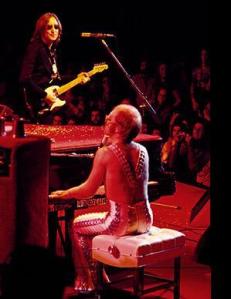
(Above: Elton John and John Lennon at Madison Square Garden, 1974.
All photos by George Kalinsky, courtesy of www.georgekalinsky.com.)

By Joel Francis

In his 34 years as Madison Square Garden’s official photographer, George Kalinsky has forgotten more games, concerts and events than many people could see in several lifetimes.

Kalinsky, who estimates he has shot more than 8,000 events, can be forgiven for having no memory of Bob Marley’s next-to-last performances in 1978, because what he remembers more than makes up for any lapses.

“November 28, 1974. Don’t ask me how I remember that, but I do,” Kalinsky said with a laugh. “Elton John was playing the Garden, and he surprised everyone by having John Lennon join him onstage. Those three songs they did together turned out to be the last time John Lennon performed before he was shot. The moment I captured won’t be there again.”

Several of Kalinsky’s favorite moments are on display for a current exhibit at the Rock and Roll Hall of Fame in Cleveland. “Live From Madison Square Garden: From the Lens of George Kalinsky” opened May 1 in the Ahmet M. Ertegun Main Exhibit Hall and will run through January 2010.

“I’ve always tried to paint with light,” Kolinsky said. “Shooting against a plain black background is not the most creative, but it’s what you usually see. These performers spend millions on lighting and effects. I always try to capture that as part of the atmosphere of the performance.”

fullscreen-capture-562009-34913-pmbmp1

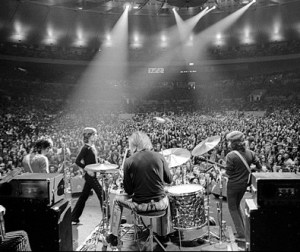
The atmosphere for the Rolling Stones’ Garden concert in 1969 was a frenzy. The show was one of the first arena rock concerts and the pandemonium was captured and released on the Stones’ great live album “Get Your Ya Ya’s Out.”

“That was the first time I saw a buzz, a reaction like that in the audience. Everyone wanted to be onstage and the crowd started gradually pushing forward,” Kalinsky said. “I went under the stage and went on in the back and got some amazing shots.”

Getting the audience’s reaction to the band was the key to recording the moment, Kalinsky said.

“I think a huge part of the story is the people and how they react,” he said. “There may not be too many pictures in this exhibit of the crowd, but I always try to include them. Every audience is different, just as a circus is different from a track meet and hockey is from basketball. The audience is a reflection of the performance.”

The crowd at a 1974 Bob Dylan performance played a key role in a shot Kalinsky called one of the top two or three photos he’s taken.

“Dylan is Dylan, the hair, the body language, all of it connecting and seeing the audience reach out to him is beautiful and telling,” Kalinsky said. “With him, the words are so important; when I look at Dylan I try to capture the aura of the man.

“I want to get a little closer to see what his face looks like,” Kalinsky continued, “and how it shows the years, not in terms of getting older, but the years of performing with the audience and how that bond grows stronger and stronger.”

fullscreen-capture-562009-35709-pmbmpDylan played a key role in George Harrison’s 1971 Concert for Bangladesh at the Garden. Shooting both of those shows not only taught Kalinsky that music was the true universal language, but showed him how far the Garden’s stage extended.

“I was in a cab recently and the driver was from Bangladesh,” Kalinsky said. “He couldn’t have been more than 35 or 40 years old, but he said in the hearts of his family and friends in Bangladesh they would never forget Madison Square Garden. They weren’t there (at the Concert for Bangladesh), but they’d never forget because that’s where people learned to help his country and family.”

Events at the Garden, Kalinsky said, “become part of our culture and part of our world. It wasn’t long ago we had 9/11 and that concert. Even if you weren’t there, you were there because everybody in the world tuned in to the Concert for New York City.”

What stands out in Kalinsky’s mind from that show isn’t the defining performances from Paul McCartney, the Who and artists with ties to the Big Apple like Jay-Z and Bon Jovi, but a moment backstage with Billy Crystal before he was about to go on.

“I asked him how does he project his talent when the audience is in tears and police and firefighters are holding up pictures (of their missing loved ones)?” Kolinsky said. “He said the hardest thing to do was be funny in the face of an audience who had lost so much.”

Although Kalinsky’s relationships and reputation allowed him backstage that day, he acknowledged access has been almost completely shut down from the early days when he would take pictures of Elvis Presley in the dressing room before his first Garden concert or Sly Stone’s groomsmen getting ready before Stone’s onstage wedding in 1974.

And just as backstage has become more restrictive, the window for taking performance photos has been confined to the first three songs. That doesn’t bother Kalinsky, though, because digital technology and automatic lighting systems within the camera let him do as much with those three songs as he could in an entire show in the days of film.

“However, in terms of taking pictures it always comes down to the eye and the moment,” Kalinsky said. “You have to recognize the moment and snap the picture. This is the most important aspect, whether you are shooting a concert, sporting event or portrait setting. It’s what I’m always looking for.”

Kalinsky’s duties have also given him a window on the 1994 Stanley Cup Finals, Knicks games, scores of the world’s top athletes and personalities. This diverse shooting background has provided enough photos to fill eight books and exhibits from the Museum of Modern Art to the baseball and basketball halls of fame.

“The Garden stage, whether it’s Muhammad Ali, the Pope or LeBron James, brings out the best in every performer,” Kalinsky said. “Every day I walk into the Garden I say what a privilege it is to be part of this arena and the best stage in the whole world.”

(Below: A recent portrait of the Red-Headed Stranger.)

fullscreen-capture-562009-40105-pmbmp

Keep Reading:

Rock Hall Celebrates 50 Years of Motown

Rock Hall Celebrates the 40th Anniversary of Woodstock

Bruce Springsteen Rocks the Hall (part one)

Bruce Springsteen Rocks the Hall (part two)

Police On My Back: Five Musicians Convicted of Murder

(Above: Honorable mention R.L. Burnside, who was convicted of murder 1959 and sentenced to Parchman Farm. Burnside later said, “I didn’t mean to kill nobody. I just meant to shoot the sonofabitch in the head. Him dying was between him and the Lord.”)

By Joel Francis

Phil Spector is hardly the first musician to be convicted of murder. He’s not even the most famous or influential one. But he is the latest. In honor of Spector’s recent sentencing, The Daily Record recognizes five other musicians convicted of murder.

Cool C and Steady B

Cool C and Steady B both came of age in the 1980s Philadelphia rap scene. Steady, nee Warren McGlone, was one of the first Philly rappers to taste the mainstream, while Cool, born Christopher Roney, was a member of the Hilltop Hustlers. The two teamed up in the early ’90s to form C.E.B., which was short for Countin’ Endless Bank. Taking their moniker a little two seriously, the duo decided to rob an actual bank.

On Jan. 2, 1996 – perhaps fulfilling a New Year’s resolution – C, B and Mark Canty, another Philadelphia rapper, attempted to rob a PNC bank in the City of Brotherly Love. Needless to say, the heist didn’t go as planned. When officer Lauretha Vaird responded to the silent alarm, she was shot and killed by Cool C. Steady B exchanged shots with another officer as the trio hopped into a stolen minivan and made their escape.

Steady was arrested at his apartment shortly after the crime. When two handguns left at the bank were traced back to him, he confessed to the crime.

In October, 1996, Cool was convicted of first degree murder and sentenced to death by lethal injection. Steady got off with a second degree murder conviction and life in prison. Cool was granted a stay of execution in 2006, by Pennsylvania Governor Ed Rendell (probably a closet C.E.B. fan), but remains on death row. Steady also remains incarcerated.

Little Willie John

In the late 1950s, Little Willie John traveled in the same soul circles as his contemporaries Sam Cooke, Jackie Wilson and Hank Ballard. His parade of hits started in 1955 with “All Around the World” and included “Need Your Love So Bad” (later covered by Peter Green’s Fleetwood Mac) and “Fever,” which Peggy Lee made famous and took to the U.S. Top 10.

John had a golden voice, but he also had a bad temper and a taste of alcohol. Those three traits collided backstage at a concert in 1964 when John stabbed a man to death. He was convicted of manslaughter and sentenced to Washington State Prison. John was appealing his conviction and aiming for a comeback when he died of pneumonia in 1968.

Don Drummond

In the fall of 1964, trombone player Don Drummond was living the good life. The band he helped form, the Skatalites, were finally breaking through, thanks to a song he wrote. “Man in the Street” was a Top 10 U.K. hit and for many their first taste of reggae. One year later, Drummond’s arrangement of the Guns of Navarone also hit the U.K. Top 10. But 1965 was not as kind to Drummond.

Drummond earned the nickname “Don Cosmic” for the erratic behavior brought on by his manic depression. When the body of Drummond’s girlfriend exotic dancer Marguerita Mahfood was found in Drummond’s home with several knife wounds, the police quickly arrested Drummond and charged him with murder. Drummond was judged legally insane at his trial and committed to Bellevue Hospital in New York City. Drummond died in Bellevue in 1967 at the age of 39. His death was ruled suicide, but because no autopsy was performed conspiracy theories persist to this day.

Drummond left behind a catalog of more than 300 songs and pivotal role backing Lee “Scratch” Perry, the Wailers, Delroy Wilson at their earliest sessions.

Jim Gordon

Drummer Jim Gordon started his career backing the Everly Brothers in 1963. By the end of the decade he’d performed on “Pet Sounds,” “The Notorious Byrd Brothers” and numerous other albums. When Jim Keltner pulled out of a tour with Delaney and Bonnie, Gordon was brought in as the replacement. Gordon got on so well with the rest of the band, which included Eric Clapton, bass player Carl Radle and keyboardist Bobby Whitlock, that the quartet played on Clapton’s first solo album, the first post-Beatles album by Clapton’s friend George Harrison (“All Things Must Pass”) and even a session with Ringo.

The group is most memorable, however, for the album it produced with Duane Allman. As Derek and the Dominoes, Clapton was able to pour out his unrequited love for Harrison’s wife Patti Boyd and Allman was able to lay down some of his best licks. Gordon gained notoriety for writing the piano coda to “Layla.” He composed the piece independently and had to be persuaded to let Clapton incorporate into what became one of the biggest rock singles of all time.

After Derek and the Dominoes broke up in 1971, Gordon played in Joe Cocker’s Mad Dogs and Englishmen tour. He also toured with Traffic and Frank Zappa. Gordon’s session work also flourished. He played drums on Carly Simon’s “You’re So Vain,” and the Incredible Bongo Band’s “Bongo Rock” album. Gordon’s drum solo on “Apache” is one of the most sampled licks in hip hop.

In the late ’70s Gordon complained of hearing voices. Treated for alcohol abuse instead of schizophrenia, the voices had pushed Gordon out of music entirely by 1981. They pushed him even further in 1983 when Gordon killed his mother with a hammer. Gordon was properly diagnosed in his 1984 trial and sentenced to sixteen years to life with the possibility of parole. Gordon remains in prison.

Lead Belly

Most musicians wait until after they’re famous to start killing people. Not the man born Huddie Ledbetter. Before he recorded a note for Alan Lomax, the towering legend of folk and blues had escaped from a chain gang in Texas, served seven years for killing a relative in a fight over a woman. Lead Belly learned new songs and honed his craft while in prison, eventually earning a pardon from Texas Governor Pat Neff, who enjoyed the religious songs Lead Belly had played for him. Five years later, Lead Belly was back in prison, this time for attempted homicide. After serving three years for knifing a white man in a fight, he was discovered by John and Alan Lomax, who fell under his spell and petitioned to have him released.

After taking Louisiana Governor O.K. Allen a recording of “Goodnight Irene,” Lead Belly was released (the official reason was time off for good behavior). He recorded several albums for the Library of Congress based on his book “Negro Folk Songs as Sung by Lead Belly.” Unfortunately, Lead Belly could not shake his criminal past, and was back in jail again in 1939 for stabbing a man in a fight in New York City. Again, Alan Lomax jumped to Lead Belly’s defense, dropping out of graduate school and helping Lead Belly record an album of songs to pay for his legal expense.

Lead Belly became a fixture of the New York City folk scene in the 1940s. He appeared on the radio, performed with Brownie McGhee, Sonny Terry, Woody Guthrie, and others and recorded a wide range of music. Acolyte Bob Dylan once said Lead Belly was “One of the few ex-cons who recorded a popular children’s album.”

“Goodnight Irene” became Lead Belly’s most popular song. Unfortunately, he did not live long enough to see Pete Seeger’s group the Weavers make it a No. 1 hit.

Lead Belly died in 1949, leaving behind a treasure of songs that includes “Midnight Special,” “Cotton Fields” and “Rock Island Line.”

Derek Trucks: 15 Nights with the Allmans

large_allmanclapton

(Above: Allman Brothers guitarists (from left) Woody Haynes, Derek Trucks with guest Eric Clapton at the Beacon Theater in New York, March 2009.)

By Joel Francis
The Kansas City Star

The Derek Trucks Band tour started last week, just days after the final show in the Allman Brothers’ 15-night residency at the Beacon Theater in New York City.

Numerous guests, including Dr. John, Chuck Leavell, members of Phish, Sheryl Crow and Kid Rock stopped by to help celebrate 40 years of the Allmans.

“This was the most enjoyable Beacon run I’ve been a part of in the 10 years I’ve been doing it. That first night with Taj Mahal and Levon Helm was great,” Trucks said. “The show on (March) 26th was the band’s actual 40th anniversary. We had no guests and did the first two records in order. That was probably the best show of the run.”

This year was also the 20th anniversary of the band’s first Beacon residency. For nearly as long, it has been rumored Eric Clapton would join the band onstage. This year he finally did, adding extra weight to the run of shows dedicated to founding guitarist and slide legend Duane Allman.

Each night opened with a montage of old photos as guitarists Haynes and Trucks played Allman’s moving acoustic instrumental “Little Martha.” Allman’s daughter was also present for each performance.

“It was a fitting tribute, but especially doing the Derek and the Dominos tunes with Eric and hearing the Allmans’ numbers with Eric was an amazing collision,” Trucks said of the legendary album “Layla and Other Assorted Love Songs” Clapton and Allman recorded together in 1970. “Obviously Duane was the key to that. I don’t think Eric and the band would be playing together otherwise.”

The Derek Trucks Band makes old-school rock new

derek_trucks_band

By Joel Francis
The Kansas City Star

Guitarist Derek Trucks was 12 years old when Bob Dylan asked him onstage during a show to play “Highway 61 Revisited.”

For Trucks, it was just another gig. The look on his dad’s face, however, told a different story.

“I knew who Dylan was because my dad was a massive fan, but it didn’t hit me then like it would have now or even 10 years ago,” Trucks said. “But even though I didn’t realize the significance, I could see it in my dad’s eyes that this was life-changing.”

Trucks and his father were both right. Playing with Dylan was just another encounter for the prodigy who would go on to play with Buddy Guy, Carlos Santana, Eric Clapton and numerous others. But it also opened the door to other possibilities.

Trucks, who turns 30 in June, now helms his own eponymous group (performing Friday at Harrah’s Voodoo Lounge) and also plays in the Allman Brothers Band. He returned Dylan’s favor with his supercharged blues cover of Dylan’s “Down in the Flood,” which opens his sixth and newest studio album, “Already Free.”

“I try to pick covers with some connection to the band,” Trucks said. “Part of that is Dylan is such a good songwriter with a great amount of tunes, but on top of that I figured after Katrina and the flooding in Iowa, the title and the lyrics were just a great metaphor for all that.”

Trucks didn’t go into the studio planning on cutting a record. Finding himself with downtime at his Jacksonville, Fla., home – atypical for a man who averages 300 shows a year – and a recently completed home studio called Swamp Raga Studio, Trucks and his band decided to lay down some tracks just to see how the room felt.

“The first day we wrote and ” Trucks said. “The next thing we recorded (the song) ‘Already Free,’ knew there were a dozen, then two dozen songs. We started calling people from (wife and blues guitarist) Susan (Tedeschi)’s band, Doyle (Bramhall II), Warren Haynes, Oteil Burbridge, to come in.”

The resulting release has a laid-back yet focused organic vibe that inhabits the best of the Allman Brothers’ Capricorn albums.

“It’s the most natural record I’ve done,” Trucks said. “It was very comfortable recording, and I think you can feel it. We captured tunes hours after they were written. There’s a freshness that comes across when songs are captured so quickly.”

Unsurprisingly, Trucks wanted to translate that urgency to the road as quickly as possible. The Derek Trucks Band tour kicked off last week.

For someone who has seemingly played with everyone, Trucks had the opportunity to encounter another legend and influence last year.

When you record two John Coltrane numbers on your debut album, and the opportunity to play with Coltrane’s longtime pianist McCoy Tyner arises, you don’t say no.

Still, Trucks was intimidated. Especially when he walked into the studio and saw bass player Ron Carter and drummer Jack DeJohnette.

“Those guys are legends in their own right, but McCoy is on his own level,” Trucks said. “He was such a sweet guy. He really made it feel comfortable.”

Trucks entered the studio with a list of four songs he hoped to play with the trio, but as the last guitarist on the session, some of his choices had already been recorded.

“My first choice of song was ‘Contemplations,’ but (jazz guitarist Bill) Frisell had already recorded it,” Trucks said.

The two-day session yielded collaborations with Trucks, Frisell, Bela Fleck, Marc Ribot and John Scofield. Trucks was the only “rock” guitarist invited, but he works well on his two featured cuts, “Slapback Blues” and “Greensleeves.” Trucks’ presence in the company of such eclectic legends is unsurprising given the range of covers his band performs – everything from Pakistani qawwali singer Nusrat Fateh Ali Khan to Delta bluesman Son House – and the diversity of the band playing them, which contains a four-decade age span.

Trucks said his innate musical curiosity has not only expanded his palate but has also given him a level of comfort playing with nearly anyone.

“It started at such a young age. I was always around musicians, so I’d try to pick their brains and see what influenced their music,” Trucks said. “A huge part of being able to stay on the road and on top of the game is to keep finding inspiration. You keep finding different things that turn you on, things that tweak different parts of the brain. In the long run you’re a better musician for it.”

Trucks hopes that same level of comfort and curiosity extends to his home Swamp Raga Studio.

“I’ve spent a lot of time with Willie (Nelson) in Maui, and anywhere he is has a clubhouse vibe. I can see that communal feeling. Wherever you are with him – on his bus, in his home – he makes sure everybody is absolutely comfortable,” Trucks said. “That’s kind of what it’s (Swamp Raga) starting to turn into in the month and a half we’ve gotten into it.”

Swamp Raga is not only musician-friendly but environmentally friendly as well.

“The beauty of building from scratch is that you can think about stuff ahead of time,” Trucks said. “When I figured the electric bill would be double, not only was that a financial hit, but psychologically I started feeling guilty because of all the energy we’d be using. We went out of our way to be conscious of that. We made it a point to do everything as efficiently as possible.”

To that end, Trucks and Tedeschi installed 26 solar panels on the studio and their home. And in the months when the family is out on tour, the local utility company pays them for the energy their panels generate.

“Sometimes our bill comes in right around zero,” Trucks said. “By doing the right thing it actually works out better in the end.”

Despite such 21st century enterprises, Trucks believes his band and his music are a throwback to a time where wooden instruments were hand-crafted and stepping onstage meant being ready to cut some heads.

“When you get on stage, you have to bring it,” Trucks said. “I get a sense from new music that the idea is to outsmart your audience or be so ultra-hip you can pull one over on them.

“With a band like ours, we try to represent a more honest music. We’re musicians representing our craft first and then trying to connect with people.”

Raphael Saadiq sends a love letter to soul makers and Motown

(Above: Raphael Saadiq runs the “100 Yard Dashfor Seattle’s excellent community radio station, KEXP.)

By Joel Francis
The Kansas City Star

Raphael Saadiq’s latest album, “The Way I See It,” is draped heavily in the sounds of Motown and Philly soul, but don’t call it a tribute album.

“Boyz II Men did a tribute; I wrote a bunch of songs,” Saadiq said about his all-originals album. “This was not intended to be a tribute album. It’s more like a secret love letter to the people I love.”

People like the Funk Brothers, Motown’s now-legendary stable of musicians, and the other unknown musicians who “took music to the level where it is today that I can come out and do this,” Saadiq said. “It’s not just about Smokey (Robinson) and Stevie Wonder, but a bunch of people we don’t even know about.”

He plays most of the instruments on the album himself, but Saadiq recruited two Funk Brothers to help him get that classic Motown sound. Jack Ashford’s tambourine has graced classics like “Nowhere to Run” and “You Can’t Hurry Love.” Paul Riser, who arranged the strings on Saadiq’s album, has worked with the Supremes, Marvin Gaye and Stevie Wonder.

“I brought Jack in because he added a sound I couldn’t have had without him,” said Saadiq, who performs Wednesday at the VooDoo Lounge. “With Paul Riser it was the same thing. You can feel the energy when they walk into a room.”

Having Stevie Wonder play harmonica on one song was ultimate validation. Saadiq even went so far as to introduce his guest like Wonder introduced Dizzy Gillespie on his 1982 hit “Do I Do.”

“Seeing Stevie walk into a room and play is something I’ve never gotten used to,” Saadiq said. “Having him play on this was a stamp of approval. I’ve worked hard for a long time to have him come play (on my album).”

The former Tony! Toni! Tone! singer, who named his first solo album “Instant Vintage,” is more worried about being called “neo soul” than being pigeonholed.

“Everybody knows I hate the term ‘neo-soul,’ ” Saadiq said. “If someone was playing the blues they’d want an old soul. I don’t want a new soul — then I’d sound like somebody on the radio today, which I hate.”

On an album with so much — ahem — old-school soul, Jay-Z’s guest spot on the final track, a bonus remix, probably surprised many listeners.

“That was Q-Tip’s idea,” said Saadiq, referring to the former MC of A Tribe Called Quest. “He was like, ‘You should put Jay-Z on this record’ and then went and got him, because I didn’t know Jay like that. Some people didn’t like it. They’re probably neo-soul fans. I did this for the other people.”

More on Raphael Saadiq from The Daily Record:
“The Way I See It” album review
“The Way I See It” caps the Top 10 albums of 2008