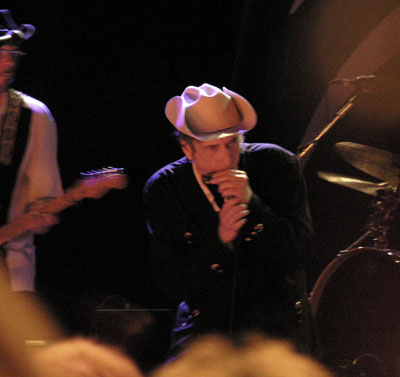
Buckwheat Brings It Back Home

Buckwheat Zydeco

Kansas City Star

By Joel Francis

After a 20-year estrangement, Stanley Dural Jr. is returning to his first love: the Hammond B-3 organ.
But fans of the man otherwise known as Buckwheat Zydeco needn’t worry. He has found a way to reconcile the differences between his main squeeze, the accordion, and the B3.
“When I was playing the accordion originally I had the organ onstage with me,” Dural said. “I had the tendency to run from the accordion to the organ, but it was cutting into my time with the accordion, so I took it off the stage.”
Dural will bring a road-size version of the B3 with him at Knucklehead’s Saloon on Wednesday, continuing a reunion that began when he used it on some tracks for his first studio album in eight years, “Jackpot!”
“If I was going to use it in the studio, it wouldn’t be fair to if people didn’t hear it on stage,” Dural said. “I’ve always had a keyboard but it was a simple one. I couldn’t fully express myself on it. Now I Can, and the fans are loving it.”
Dural’s B3 playing is featured on the album’s 18-minute trilogy, “Encore: Featuring Organic Buckwheat,” which includes a slow blues and a jazz tribute to Jimmy Smith. This might seem like a stretch from zydeco’s traditional territory, but from a man who has stretched the genre to include country, gospel, children’s music and rock, it’s just bringing it back home.
“I’m taking it to another level,” said Dural, who counts Eric Clapton, Mavis Staples, Willie Nelson and members of Los Lobos among his recorded collaborators. “I love rasta and Bob Marley so there’s a song called ‘Love and Happiness’ that’s all about unity that has a Jamaican reggae feel.”
Listeners may have to wait awhile to hear that song at home, though – it’s one of dozens of Dural’s new tracks that didn’t make it on the album.
“We cut near 30 songs, and I caught the blues trying to figure out what to put on and what to leave off (the album),” Dural said. “It was my worst nightmare.”
No one will have to wait 8 years for the next Buckwheat Zydeco studio album, though.
“I’m going to give this one a chance,” Dural said, “but please believe me there’s another one coming right behind it.”
Dural’s re-embrace of the B3 is a sort of homecoming. It’s the instrument he played as the founder of Buckwheat and the Hitchhikers, a 15-piece funk band that backed artists like Joe Tex, Solomon Burke and Bobby Bland in the early ‘70s and also precipitated his friendship with Eric Clapton in the mid-‘80s.
A jam session broke out after Buckwheat Zydeco’s set at the 25th anniversary party ofr Island Records, Dural’s label at the time. Spying a vacant B3, Dural’s manager asked if he wanted to play.
“I said not ‘yeah,’ but ‘hell yeah,’” Dural said. “There was an army of guitars and Eric was at the front of the stage, but somehow we got to trading licks. We kept going back and forth, and when we got done he walked to the back of the stage, put out his hand and said, ‘I’m Eric, who are you?’ I took his hand and said, ‘I’m Buckwheat.’ We hit it off.”
Clapton played the guitar solo on Buckwheat Zydeco’s 1987 remake of “Why Does Love Got to Be So Sad” and invited the band to open his 12-night stand at Royal Albert Hall in 1988.
“That was like a dream come true,” Dural said. “It was frightening, but it went over big time.”
If the concept of a zydeco band opening for a rock legend in one of London’s most hallowed music halls seems incongruous, consider Buckwheat Zydeco opening for U2 around the same time.
“If you think about U2 and Buckwheat, they don’t match. That’s a different audience,” Dural said. “But it worked.”
The major-label shakeups 10 years ago led Dural to start his own label, Tomorrow Recordings, which also handles younger talents. If he misses rubbing shoulders with other legends and playing large venues, Dural isn’t letting on.
“I feel like I’m in a place now where I’m opening a lot of doors,” Dural said. “It doesn’t matter where I perform as long as I see a smile on people’s faces.”

Review: Wakarusa Music Festival (2005)

Wilco

June 17-19, Clinton Lake, Lawrence (Kan.)

Kansas City Star

By Joel Francis

Son Volt – Friday afternoon, Sun Down Stage
Jay Farrar’s revamped Son Volt made their regional debut on Friday afternoon to a collective yawn. Maybe it was the early hour of the show – 3 p.m. – but more people were greeting each other than grooving to the music. Son Volt Version 2.0 leaned heavily on classic material from “Trace” and “Straightaways” in its hourlong set, but were not as country-leaning as the previous incarnation. Uncle Tupelo was no where to be found._The new lineup is rawer and plays up Farrar’s classic rock influences – a sound closer to Joe Walsh than Joe Ely.

Matisyahu – Friday afternoon, Campground Stage
Matisyahu’s novelty – a Hasidic Jew playing reggae music – may have drawn people to his tent, but his music made them stay.
Dressed in a white dress shirt and glasses and sporting a full black beard, he may have looked like a rabbi, but he sounded like Toots Hibbert. Matisyahu’s groove spread quicker than a flu bug in day care, and though the tent was too crowded to give the music the motion it deserved, no one seemed to mind, least of all Matisyahu, who had to rest a hand on his head to keep his yarmulke from flying off as he jumped up and down. After proving his reggae credibility, Matisyahu dismissed the band and began an a capella beatboxing, incorporating dub, hip-hop and techno rhythms culminating in a call-and-response with the drummer.

Ozomatli – Friday evening, Sun Up Stage
Ozomatli isn’t afraid to toss a rap into a Spanish melody. In fact, it doesn’t seem to be afraid of anything musically. The10-piece band blended Spanish, rock, African, Middle Eastern and hip hop into the most contagious and diverse groove of the day. The 75-minute set drew heavily from Ozomatli’s latest album, last year’s “Street Signs,” but the band worked in a new song, a rap driven by a Middle Eastern flute. The crowd thinned considerably when the String Cheese Incident took the adjacent stage, but there were enough hands raised in the air and bodies shaking to show that these folks weren’t just killing time.

Junior Brown – Saturday evening, Revival Tent
Junior Brown took a mostly full and enthusiastic Revival Tent crowd honky tonkin’ early Saturday evening. Wearing an immaculate three-piece suit and backed by a three-piece band, including his wife Tanya Rae, Brown kept the stage banter to a minimum and kept his music plowing along like the Orange Blossom Special. His deep voice was cribbed in the same fertile tone as Johnny Cash’s and he deftly switched from traditional country melodies to a Spanish language song and even a surf guitar medley.
The highlights were all of Brown’s tasteful guitar solos, performed on his trademark “guit-steel,” a double-neck six-string and pedal steel guitar, and his drummer of 31 years, who was able to do more with his simple snare and cymbal set than most can from an entire trap kit.

Neko Case – Saturday night, Sun Down Stage
Despite having a large crowd assembled in anticipation of headliner Wilco, Neko Case did not go out of her way to win any new converts Saturday night. Case’s hourlong restrained set never moved above mid-tempo and failed to engage the patient crowd. Taken individually, each song was quite good, but together they became a long, lonesome lullaby. Like a mournful train whistle crying out late in the night, Case and her four-piece band wallowed in love gone wrong. The material was well-done, but best suited for an intimate club and Case looked a little overwhelmed by the crowd, which was polite in spite of the pacing problems and the fact that few of her subtleties transferred effectively to the lawn.

Wilco – Saturday night, Sun Down Stage
Jeff Tweedy, Wilco’s frontman and songwriter, had the sold-out crowd eating out of his hand from the opening strains of the first number, “A Shot in the Arm.” The 90-minute show only got better from there. Wilco’s expanded six-piece line-up, including two keyboards and two guitars, fought like siblings in the sonic mélange. It shouldn’t have worked, but it did, creating the perfect atmosphere for each song. “Handshake Drugs” and “Kidsmoke (Spiders)” had thick walls of distortion that would have made Sonic Youth proud, while the folksier romps through the “Mermaid Ave.” material were warm and happy. If the audience participation bits failed, it was only because Wilco’s material isn’t really suited for it. Besides, Tweedy already had them at hello.

Proto-Kaw – Sunday afternoon, Sun Down Stage
Proto-Kaw will inevitably be compared to songwriter Kerry Livgren’s other band, Kansas, but the call-and-response in the opening number between Livgren’s guitar John Bolton’s flute should put those differences to rest. Formed in the early ‘70s, the band folded after failing to land a record contract and Livgren’s leap to a rival band and classic rock history. The septet belatedly reconvened when their archival demos were released to critical acclaim in 2002 and have since recorded an all-new album together. Proto-Kaw drew from both of those sources in their hour-long set that was enjoyed by the meager and decidedly older crowd that braved the mid-day sun for a set of progressive rock that somehow managed to replace arena-ready anthems with splashes of jazz and funk.

Jazz Mandolin Project – Sunday afternoon, Revival Tent
The Jazz Mandolin Project has more in common soncially with its good friends in Phish than it does the Preservation Hall Jazz Band, of which bandleader Jamie Masefield was once a member. Anyone expecting soothing acoustic jazz may have been pleased by the first number, but the songs grew more experimental and danceable as the set progressed. The quartet – mandolin, drums, upright bass and trumpet – is what the Flecktones would sound like if they were a jam band. The crowd was enthralled by the improvisation, but the bass and drums were sometimes so propulsive and funky one lost track of the mandolin. The 70-minute set culminated with the feel-good and danceable “Oh Yeah,” the best song of the night.

Old Crow Medicine Show – Sunday evening, Revival Tent
If, as the old saying goes, you can’t play sad music on a banjo, then Old Crow Medicine Show is the happiest band in the world. With half of the sextet on the jubilant drumhead five-string, the Crows threw a mighty hoedown as the sun set over the Wakarusa Music and Camping Festival.
The Revival Tent was about half full at the start of the set, but by the end the tent was so full that people were dancing outside. The clappin’ and stompin’ were nonstop throughout the 70-minute set, which included classics like “CC Rider,” “Poor Man,” “Take ‘Em Away,” a cover of “Bluegrass Bob” Marley’s “Soul Rebel” and plenty of down-home stage banter.

Keep Reading:

Wakarusa Music Festival (2006)

Wakarusa Music Festival (2007)

Wakarusa Music Festival (2008)

Concert Review: George Clinton, May 6, 2005 at the Beaumont Club

George Clinton

Kansas City Star

By Joel Francis

The list of 64-year-olds who can get away with rainbow-colored hair is a short one. Here’s an even shorter list: people soon to qualify for Social Security who can bring the heavy funk.
First on that list: George Clinton, who brought his band Parliament-Funkadelic before a near-capacity crown at the Beaumont Club on Friday night.
The show started with a keyboard solo from longtime Clinton cohort and fellow legend Bernie Worrell. From the beginning, the band show why many of Clinton’s tunes had so much influence but such little chart success. Songs like “One Nation Under a Groove” and “Bop Gun” got big cheers of recognition from the crowd and most ran well over 10 minutes.
Clinton didn’t appear onstage until an hour into the set, his multicolored locks covered by an all-white Philadelphia Phillies cap.
He slowly crept onstage, but as the set progressed he gained energy and his voice grew stronger. By the end of the back-to-back 20 minute jams of “Aqua Boogie” and “Flashlight,” he appeared invincible.
Throughout the show, the floor in front of the stage was a sea of hands, waving high in the air. Many of those bore a black “X” – too young to drink – a sign that Clinton and his troupe of two dozen performers are still attracting a younger crowd.
They weren’t disappointed. During the 3 _-hour set, Clinton and company interspersed their own hits with favorites from the backing singers, including a rap from Clinton’s granddaughter and covers of James Brown’s “Big Payback” and Genesis’ “That’s All.”
When “Atomic Dog” started up three hours into the show, it seemed like the perfect closer. Instead, Clinton followed that by launching into “Whole Lotta Shakin’ Goin’ On” and a Little Richard medley. It was a perfect twist: After demonstrating why his music continues to influence the hip-hop generation, Clinton turned to the music that influenced him.
It could have ended there, but it didn’t. As Clinton and most of the band left the stage, a few stuck around and kept jamming. When they put down their instruments, roadies immediately started tearing down the stage, but the band members stayed out front, leading the audience in chanting, “We want the funk.”
By that point, anyone who didn’t have it already was never going to get it.

Keep Reading:

Concert review: George Clinton (2007)

Feature: George Clinton is bringing the funk

Concert Review: George Clinton heats up cold night

Review: George Clinton and the P-Funk All-Stars (2009)

Top 10 Albums of 2004

Tom Waits - Real Gone

Tom Waits, “Real Gone”
Franz Ferdinand, “Franz Ferdinand”
Tift Merritt, “Tambourine”
Wilco, “A Ghost Is Born”
TV on the Radio, “Desperate Youth, Bloodthirsty Babes”
Bjork, “Medulla”
Gift of Gab, “4th Dimensional Rocketships Going Up”
Loretta Lynn, “Van Lear Rose”
Morrissey, “You Are The Quarry”
Mos Def, “The New Danger

Bob Dylan: All Along the Watchtower

By Joel Francis

Twenty-plus years after eschewing his “Christian phase,” Bob Dylan assumed the mantle of Old Testament prophet at his joint concert with Willie Nelson at the T-Bones minor league baseball park in Kansas City, Kan.

Dylan cried out warnings of the apocalypse with a voice burdened by so much wisdom and sorrow it frequently broke and scraped under its own weight. There was no alternative but to drench it in echo: This is the way Moses’ voice must have sounded booming down from the mountains, falling like a harsh rain on the sinners’ ears. Then again, if Moses were accompanied by Larry Campbell on steel pedal the way Dylan was, the idolaters likely would have started casting a new statue. Like Isaiah foretelling the destruction of the temple, Dylan’s echo-laden, sparse and mournful arrangement of “All Along the Watchtower,” driven by Campbell’s pedal steel, warns that the future isn’t as bright as many concert-goers would like to believe.

In this new arrangement, the joker and the thief watch in relative safety. From their vantage-point, the riders are no longer approaching, but inside the city walls, raping, ransacking and causing unimaginable destruction. Campbell’s playing suggests that the wind has been howling for some time now._“Look at it,” the thief says in dismay, not wanting to believe his eyes. “We tried to warn them, but no one wanted to listen. Now they’re paying the price.”

A tear trickles down the joker’s cheek as he sees more riders on the horizon. He has lied to the thief, and he knows it: There is no kind of way outta here. The only exit from this horrific scenario is to end the song and turn on the house lights, which is exactly what Dylan does, but only after another of Campbell’s solos. The crowd cheers rapturously, never knowing how close they came to oblivion._But then again, seldom are the prophets’ words heeded in time.

Too Close To Ground at Willie Nelson Concert

By Joel Francis

I’d love to discuss tonight’s Willie Nelson concert, but what I really want to tell you about is the crowd at the Willie Nelson show. You see, the good folks in Marshall, Mo. decided to host Willie and throw a concert in their city park. Now normally when a park contains a large hill, as the Indian Foothills Park does, one would place the stage at the bottom of the hill. Not the folks in Marshall, no sir. They put that stage right in the middle of the hill and made all of us watch it at a 15 degree angle.
Knowing what I do about angles and intoxication, I knew I would be in for some laughs, but I had no idea how big. The fun started before the show when the two white trash couples decided to punctuate their beers with some weed. The foursome passed a very small roach around for about 20 minutes before a Gatorade bottle was produced, which contained, I am very sure, not Gatorade. After a few swigs of whatever magic potion this bottle contained everyone seemed to be feeling a lot better. Coincidentally this is when Willie took the stage. So as the man in the Alan Jackson t-shirt put down the not-Gatorade and proceeded to line dance to the opening strains of “Whiskey River” he drew the ire of the crowd behind him. They needn’t of worried; it was the only time he was on his feet for the rest of the night.
You see, there was something in this wonderful concoction of weed and magic juice that when combined with the aforementioned 15 degree slope made it impossible to maintain a center of gravity. Not that our inebriated, high friend didn’t try. After tumbling too the ground he’d gingerly right himself by clinging to the lighting scaffolding. He’d tepidly place himself in his camping chair, but damn if that slope didn’t get him every time. Why if he could stay in that chair for more than 30 seconds without tumbling out and hitting his head on his scaffolding his wife was impressed.
The recumbent wife was not only not impressed – she was a little upset, too. Once, after her husband managed to place himself in his chair – and this was not an easy process for him – she started yelling at him. Expecting praise for completing such a difficult task, he started yelling back. Eventually the yelling got so intense that her chair toppled onto his, knocking both of them clean onto the ground. The Three Stooges would have been proud. Charlie Chaplain would have sued.
After much of the falling-down-bracing-on-the-scaffolding-sitting-in-the-chair-falling-down shenanigans (and they didn’t always happen in this order), the man decided all might be better if he just laid down for the remainder of the evening. This is pretty much what he did, except when the pesky police got involved. It seemed they didn’t believe a man could just lie unconscious of his own volution at a Willie Nelson concert. After shining a light in his eyes and lightly slapping his face, the boys in blue decided the best course of action would be to place him safely in his chair. I was silently praying they would, because I knew he would inevitably topple out and likely hit his head. Willie was churning through the hits – “Crazy,” “Night Life,” “Always on My Mind,” “All of Me” – but there was no way he could compete with this.
Of course as we all expected, the man in the Alan Jackson t-shirt promptly tumbled to the ground, nearly taking an officer with him. I would have felt guilty at laughing at all this had I not witnessed these people gleefully bringing themselves to this state. Using his classic deductive police logic, one of the officers inquired of the other white trash couple if they may have any idea what could have happened to this stupefied stranger. Despite supplying the marijuana and not-Gatorade, they had no ideas. Unfortunately they also had no balance. As the shirtless, white trash supplier leaned in to spill his guts to the officer (the guilty are very willing to be helpful, up until the point they know they have implicated themselves), he started to fall, nearly taking yet another officer with him. Luckily our public servant remained upright, but the man did not fare so well, falling not only down, but over the milk crate that was doubling as his seat. Our topless sage wisely decided this was the safest position for him and remained doubled over the crate for the duration of the evening. Meanwhile, the unconscious blot was left upright in his chair by the police, who decided since he couldn’t hurt anyone, let alone move, they would leave him be. On cue, once their backs were turned, the man rolled out of the chair and sprawled on the ground leaving passers-by to fend for themselves to maneuver around his carcass.
You might think this would be the end. You might think that, but you would be wrong. You see, there were a couple thousand people at this concert, hundreds of gallons of alcohol consumed and still that pesky 15 degree incline.
A few yards past all this excitement, a woman in her late 50s was gleefully imbibing and dancing to the strains of “Seven Spanish Angels,” and “Angel Flying Too Close to the Ground” that were now filling the air. To say this woman was of generous girth would be an understatement, but this did not prevent her from flailing around like Greta Garbo. Fortunately this also did not prevent gravity from taking her on several sideways caterwauls. After several near-falls, the plump peasant managed to rapidly meet the earth, taking her husband with her. I only wish I could have seen it with both eyes, for my gaze was fixed up Sir Willie performing “Always on My Mind,” “On the Road Again” or some obscure number, and I only caught the tumble peripherally. My concert compatriot, Alan, though, saw the whole thing, the lucky so-and-so.
After that, my fantasy became that some poor bastard would stumble over the unconscious guy and be clumsily propelled into the fat woman, whereupon the two of them would topple over and take down a whole crowd. Think of it as human bowling.
It never happened, though. Last I saw them, the woman had – with the help of many friends – tepidly placed herself in a camping chair (it appeared to be more sturdy and did not spill its contents, unfortunately). The wife of the senseless man suddenly reappeared (she was gone for quite a while and I didn’t think to ask her what had taken so long), and loving place his head in her lap and gently ran her fingers through his hair as she spoke to him softly. I couldn’t make out what she was saying, but she was probably reminisce about the times they had growing up together and what bears mom and dad could be.
Prior to this, the most fun I had experienced with a concert crowd was when we went to the Foo Fighters/Red Hot Chili Peppers show at Blandstone. It was just a couple days after Ozzfest had been through town and the turf back on the lawn was pretty torn up so to save the ground, the crew laid down mesh tarps. Unfortunately they got kicked up, revealing the slick underside, wet with the ground’s moisture. Understandably, no one wanted to stand on this slippery surface so it created what appeared to be a path in the swarm of people on the lawn. Many a sap unwittingly charged onto this lubricated runway, only to have their feet and head exchange places. I nearly fell down myself laughing at these poor souls.
That night had nothing on this, though. Why for the modest price of $25, I not only got two hours of Willie’s serenades, but so much slapstick tomfoolery that Buster Keaton would have blushed. Oh there was a lot more that happened that night – like the music itself, or the time I and a host of others were tricked into believe that we had met Willie himself – but that is another story altogether.

Warren Zevon Remembered

By Joel Francis

Warren Zevon died today, but like most things in his life, he did it on his terms.
Over a year ago, doctors gave Zevon three months to live. Of course he proved them wrong and stuck around not only to witness his grandsons births, but to write and record his final album and watch it debut in the Top 40 (a feat he hadn’t accomplished in 25 years). Death has a funny way of propelling forgotten careers.
If Mark Twain were a songwriter, he’d have been Warren Zevon. I’d like to think that right now Zevon and Twain are sitting around backstage in heaven smoking huge cigars, drinking brandy and arguing about who has to open for whom.
“When you get Dylan, Neil Young and REM to appear on your albums as sidemen, you come talk to me about headlining,” Zevon says.
“Yeah, well when you write a satire about racism that is still being banned and burned 150 years after publication, you come talk to me about acerbic wit,” Twain retorts.
The two end up laughing and embracing and a little brandy spills on Twain’s immaculate white suit.
“Crap, now I’ve got to go change before I go on. How do you think I’ll look in orange?” Twain jokes.
“Don’t worry, I’ll cover for you,” Zevon says, grabbing a guitar and heading for the curtain. Ninety minutes later Twain appears onstage with Mae West and Jack Lemmon to sing the backing vocals on “Excitable Boy.”
“Who says life’ll kill ya, anyway?” Zevon says, winking at the audience as the curtain falls.

A Life Full Of Jazz

By Joel Francis
The Examiner

A smile beams from Rusty Tucker’s face. Conversation has just shifted to jazz, his favorite topic and lifelong passion. Tucker can’t disguise his delight. In fact, he can’t get more than a couple sentences without breaking into laughter or pausing to effuse happiness.

“I met all the people who are great now, when they were just starting out, Little Richard, Ray Charles,” Tucker said. “When I met Ray he was singin’ like Nat King Cole.”

When one of Charles’ musicians was sick, Tucker filled in for a one-night stand in Wichita, Kan.

“He (Ray) always said he was going to drive the first 100 miles,” Tucker said with a laugh. “Several years later when I saw him and went backstage to say hello he told me, ‘I knew I’d seen you before.'”

If stories were touchdown passes, Tucker would be Joe Montana.

“One of the biggest pleasures I had was playing with Dizzy (Gillespie),” Tucker said. “Teddy Stewart, my drummer, used to play with Diz and when Dizzy learned that, he couldn’t believe it. He said, why don’t we do a number together with both bands. So we did ‘A Night In Tunisia.’ The house went wild and I had to play a solo in front of Diz. The people just went crazy.”

Don’t worry, there’s more.

Tucker and Myra Taylor share a laugh at a 2006 jazz symposium at the University of Kansas.

“One night we were at Tootie Mayfair’s club on U.S. 40. Bird (Charlie Parker) was playing on 18th Street, then he was going to meet up with us. We’d had no rehearsal or nothing, and about midnight Bird walks in,” Tucker said. “He said we’ll do things everybody knows like blues, ‘How High the Moon,’ ‘What is This Thing Called Love,’ and ‘Perdido.’

“The blues went all right, but when we did ‘What Is This Thing Called Love,’ our piano player was an accordion player learning piano, see,” said Tucker, interrupting himself.

The apprentice pianist botched a couple chords, drawing Parker’s ire.

“Bird called us together and said it ain’t no sin not to know a tune, but to say you know a tune and not know, you (messed up) those chords,” Parker yelled at the pianist.

Bird sent word out to bring in a new keyboard player, but none were to be found at 1 a.m.

“They got in a big argument and finally Bird just told the piano player, ‘you just lay out.’ ”

Tucker grew up in Birmingham, Ala. where he took trumpet lessons from W.C. Handy Jr. It wasn’t unusual to see the elder Handy, a veteran bluesman and writer of many songs including “St. Louis Blues,” wandering the halls of and speaking to his son’s music school.

“He would always give lectures,” Tucker said. “He told us how to write tunes and get them copyrighted. He said he was getting $30,000 a year off that one tune (“St. Louis Blues”) so to always copyright your tunes.”

One day the Punch Miller Band came to town and announced they were auditioning trumpet players. Tucker tried out and got a job to play with them at the state fair.

“He (Punch) looked like Louis (Armstrong) and played like Louis and said ‘That’s why I can’t make any money,’ ” Tucker said. “I played with them at the state fair then for four or five weeks we’d go around. Then they told me they wanted me to go on the road with them. I was 18 and ran away from home to go with them. They called me ‘school boy.’ ”

He was in love with both the music and several of the dancers.

“I fell in love and ran away. My parents didn’t know where I was,” Tucker said. “I fell in love with a lot of the dancers. That was my problem; that’s why I’ve been married three times.”

Tucker toured with Punch for three years.

“We played the state fair in Sedalia and my first wife got sick,” Tucker said. “She lived in Kansas and her folks were going to come and take her back. I was supposed to meet the show in New Orleans and during the time I was here (in Kansas City) I met The Scamps and other musicians. At that time they were starting shows at the Orchid Room down at 12th and Vine and needed a trumpet player.”

Tucker decided to stay in town and take the Orchid Room gig. That was 1947 or ’48, he can’t remember the exact year, and Tucker has been here ever since. These days he plays most Thursday, Friday and Saturday nights at the Phoenix Club as a member of either Tim Whitmer’s KC Express or The Scamps, which he joined 25 years ago.

“Sometimes the Scamps play from 4 to 8 Saturday, then I play 9 to 1 with Tim. It’s long but I got used to it,” Tucker said. “The Scamps usually play for an older crowd. We do the Ink Spots and Mills Brothers. Tim does more jazz tunes. When I was on the carnivals with Punch we used to play all day so I’m used to playing long hours.”

Tucker may be a veteran of the KC jazz scene, but he still performs like he has something to prove, said Rudy Massingale, pianist and only original member of the Scamps still performing with the group.

“I think Mr. Tucker is still reaching for his goal,” Massingale said. “It seems like he’s just starting out and has to make a big impression.”

Independence has been Tucker’s home for 30 years now. He lives just off Noland Road with his wife, Diane. His children, daughters DuJuan and Carla, and son Lynn, live in Kansas City.

“It’s quiet and I don’t get any noise,” Tucker said. “Everything is so convenient. We were looking at a place in Vegas but the stores were so far away and there are so many people it’s crowded out there.”

By stretching his talent, Tucker today counts drums and piano among the instruments he can play.

“He’s a good showman,” Massingale said. “The main thing is getting the crowd’s emotions into it and he has that gift.”

Local Doctor Claims He’s Treating Elvis

By Joel Francis
The Examiner

The King of Rock and Roll is alive and well, according to local psychiatrist Don Hinton.

Hinton, who works at Independence Regional Health Center, says he has been treating Elvis Presley for the past five years.

“What I’ve seen him mostly for is chronic pain,” said Hinton, who says he travels ‘somewhere in the South’ to treat Elvis. “He has severe arthritis, but I’ve also been there as a friend.”

Hinton is earnest but recognizes there will be skeptics and critics.

“There are people who wouldn’t accept it no matter what I would say or do unless he were here eye-to-eye, and then they would want a blood test or DNA test,” Hinton said.

“I’m a young doctor. This is my family, my career. I would not be doing this if it weren’t the truth.”

Becoming Elvis’ physician is no easy task. Hinton was a member of group of people who knew of Elvis’ existence for more than five years before he was finally able to speak to the King over the telephone.

“By the time I was in his presence it had been proven to me beyond the shadow of a doubt,” Hinton said. “I was allowed to meet him because I was a physician and trusted. Friends had known me for 10 years.”

Hinton said he and Elvis became such good friends that the King asked him to help with his book, “The Truth About Elvis Aron Presley, In His Own Words.”

“When I first started there was no talk of a book, and I had to promise not to tell a soul,” Hinton said. “In early ’98 he started talking about wanting to do a book.”

Shrewd Elvis fans may recognize that Elvis’ middle name is spelled “Aaron” on his gravestone at Graceland. However, in a letter on the book’s official Web site, http://www.thetruthaboutelvisjesse.com, Elvis himself explains that “I was the one who allowed the ‘A’ on my stone. … The extra ‘A’ was the first letter of the word ‘alive.’ ”

According to the book, Elvis staged his death in 1977 and assumed the identity of his twin brother Jesse who was born dead.

“This plan began back in 1976 and it was down to the last detail,” Hinton said. “In his mind what happened in 1977 was not a lie because it was necessary.”

Elvis, who became famous for songs like “Love Me Tender” and “Hound Dog,” and movies like “Jailhouse Rock” and “Viva Las Vegas,” died on Aug. 16, 1977, from an drug overdose. But now, Hinton says, Jesse, nee Elvis, is ready to reclaim the limelight.

“There is part of him that wants his fans to know the truth,” Hinton said. “He has to start talking about his life as Jesse and letting the fans know.”

And the book is just the beginning.

“This is just the tip of the iceberg of what’s coming,” Hinton said. “Beginning next month after his birthday there will be a TV special where celebrities who are his friends who know this is true will come forward. All of this will roll into the 25th anniversary in August.”

But Hinton is certainly not alone. Also among the inner circle of Elvis confidants is Linda Johnson, a neighbor and former co-worker of Hinton’s.

“My uncle was at one time his (Elvis’) dentist,” Johnson said. “That got me in through my relationship and honesty, just like Don. Really Don and I are the only ones in the same state.”

The Elvis book was not released by a major publishing house, Johnson said, because the King wanted to keep his book affordable for fans.

“We shopped around,” Johnson said. “We did our work.”

Larger publishers wouldn’t have accepted the work unless they saw the author typing it.

“He didn’t want to make it sensational or trashy,” Johnson said. “It wanted it to be inexpensive for fans. Most big publishers wanted him sitting in front of them writing.”

Today, Hinton and Johnson said, Elvis is a changed man.

“He’s a very spiritual man. I wouldn’t say he’s a monk, but it’s a completely different world for him,” Hinton said. “He’s turned off by money and show business.”

One thing important to Elvis, er Jesse, these days is privacy.

“He’s more protected than the president but still cannot trust people around him,” Hinton said. “This whole thing was his wish. If he didn’t want it to come out, I would have taken it to my grave.”

Hinton even kept it a secret from his wife, Heather, when they were dating.

“The phone would ring and he would just go into another room and shut the door and come out later,” Heather Hinton said. “He finally told me so I wouldn’t be frustrated or upset.”

Heather Hinton admitted she was skeptical at first.

“When he started explaining what was going on and when I saw things I believed,” Heather Hinton said. “He (Don Hinton) showed me pictures and different things that had been sent to him.”

Color Heather Hinton among the believers.

“I just went with whatever he said as long as it didn’t hurt the family,” Heather Hinton said. “I just thought he wouldn’t do something unless he was pretty sure.”

Don Hinton broke the news to his co-workers shortly before the book came out. He said the news hasn’t hurt his practice. Hinton’s co-workers at Independence Regional Health Center declined to be interviewed.

“It’s affected my practice just because of all the stress,” Don Hinton said. “I hear from people all over the world and 98 or 99 percent of it is positive.”

Life is a Cabaret

By Joel Francis
The Examiner

A 5-year-old boy stands on top of the soda counter at the corner store belting out a version of “Born Free.” The customers pause from their shopping to look up and smile appreciatively. A burst of applause greets the boy when he is finished.

The store owner gives the boy a treat and he hops down off the counter.

“I knew all the words and he’d give me candy,” Vernon Quinzy said. “Ever since then I knew I wanted to sing and act.”

This was the start of Quinzy’s show business career. Thirty-four years later he has returned to his hometown of Independence to regroup, spend time with his family and refocus.

“I’d gotten out of the acting end of things,” Quinzy said. “That, combined with my sister and her two boys.”

Since returning to the area, Quinzy appeared in “Little House on the Prairie” at the Coterie Theater and is currently starring in “Kansas City Cabaret” at the Quality Hill Playhouse, 303 W. 10th St., Kansas City.

“I think the theater work has stretched me,” Quinzy said. “It has allowed me to grow as a performer. In KC Cabaret, every song is about an artist or composer who spent time in the area, so I get to both act and sing.”

If Quinzy has enjoyed “Kansas City Cabaret,” the cast has enjoyed him more.

“He’s about the sweetest human being you’d ever want to meet,” said Cabaret co-star Teri Wilder. “I love his voice Ð he could sing to me anytime.”

Director J. Kent Barnhart agreed.

“He’s the easiest guy to work with. He’s very hard working and very kind,” Barnhart said. “It’s always interesting to see new people in this place because it is so small, but he’s taken very well to working with a smaller cast and theater.”

Ask Quinzy about his accomplishments and he’ll talk about them in a shy way where he isn’t really talking about them. But the truth is that he palled around with Prince in the ’80s, and Luther Vandross called him last week to make sure Quinzy could attend his concert.

“Do you remember the Morris Day and the Time video ‘The Oak Tree?’ ” Quinzy asked. “I’m the person cutting down the oak tree at the very first of the video. I also did videos with Vanity, Appelonia, the whole group of Prince artists.”

So how was working with the purple one?

“He’s really shy,” Quinzy said. “He’d give you directions, but never look at you directly Ð he’d look at your shoes. It seems like he saves it all, I guess for the performance, but one-on-one he’s completely different.”

After graduating from Fort Osage High School in 1980, Quinzy attended the University of Missouri-Kansas City and transferred after two years to the American Academy of the Arts in New York. He spent the better part of the 1980s modeling, singing and acting and maintaining apartments in Los Angeles, Chicago and New York.

“I would usually spend a few months in each place,” Quinzy said. “I would mainly do acting in L.A., in Chicago I would do print work (modeling) and some jingles and then in New York for singing. This is when I was the busiest.”

Quinzy’s acting work got him spots in Luther Vandross, Prince and other music videos and a role as a hospital intern in “Days of Our Lives.” It seemed he would break into stardom with Morgan Fairchild’s evening soap “Paper Dolls,” but the show was canned after one season.

“I really enjoyed getting the role on ‘Paper Dolls’ and how it happened,” Quinzy said. “I was brought on as someone with five lines, but the casting director at MGM was very interested in me. Had the show gone on the role would have been expanded.”

In New York Quinzy would sing commercial jingles for advertisements.

“I have a short attention span so it all worked great for me, but it brought me to a point where I decided I needed a focus,” Quinzy said.

Work at the jingle houses were slowing down and Quinzy missed his family. So he decided to go back to his roots.

“He’s very close to my boys,” said Joyce Fowler, Quinzy’s sister. “They love going to see any kind of musical or show he’s in.”

As a single mom, Fowler said she can see Quinzy’s impact.

“He’s made a difference in their lives as far as personality,” Fowler said. “He’s been a positive male role model for them.”

Quinzy may have relocated, but the work hasn’t slowed. He is still very much in demand, just won’t show it.

“He gets lots of offers to go places, but they all want him to go someplace for a year,” Fowler said. “But he doesn’t want to relocate.”

Church has played a major role in keeping Quinzy grounded, he said. He is an experienced Sunday School teacher, most recently teaching the junior class at Village Heights Community of Christ.

“It gives me a foundation and balance in my life,” Quinzy said. “I think without the church it would be easier to get caught up in the heady side of the business.”

And the children thought it was great their teacher was popular.

“When I was teaching Sunday School in Los Angeles I was doing modeling and they’d see me doing underwear ads and they’d cut them out and put it up on the church bulletin board,” Quinzy said.

Ask Barbara Wiley about Quinzy and her voice will light up. She watched him grow from a teen-age actor in church and school plays and recruited him to teach when he returned to his home congregation.

“The kids love him,” said Wiley, a member of the pastorate team at Village Heights. “He makes class interesting for them. He’s a dream of a church school teacher because he cares about the kids and he’s interested in them and they know it.”

Quinzy has enjoyed his time back home, but may be leaving soon. He has been offered a job to host a PBS series on 18th and Vine, the old Kansas City jazz district. The job will take him to Los Angeles.

“They have allowed us to do the pilot and it just kind of fell into place,” Quinzy said. “I’m sure I’m not going to be here for a lot longer.”

But for now, Quinzy is content.

“I’m working and I’m happy and I enjoy all the people I’m working with,” Quinzy said. “I’m living my dream because I’m working , but I’m sure work will take be back to New York and L.A.”