Review: Ben Folds

(Above: Ben Folds and Regina Spektor drop by Conan to perform “You Don’t Know Me.”)

By Joel Francis
The Kansas City Star

Ben Folds is so melodic that even when he writes bad tunes on purpose he ends up with something you can whistle and enjoy.

Case in point: Folds’ two-hour-plus, sold-out concert at the Uptown Wednesday night. Nearly half a dozen of the evening’s songs were spoofs that Folds and his band leaked to the internet before the release of his latest album, “Way To Normal.”

“We decided even though these songs were written to suck, we liked them anyway,” Folds told the crowd.

So while the album version of “Bitch Went Nuts” is about a man justifying a break-up by blaming the woman, the “fake” version is about a liberal woman who takes cocaine and goes Ralph Nader at her conservative date’s law-firm party. Folds was so enamored with his fakes that he A-side/B-sided them against the album versions two times during the night. Both times each version held its own.

As such, the night was heavy on “Normal” material. Opening act Missy Higgins joined Folds for the bouncy, synth-heavy “You Don’t Know Me”; “Frown Song” was propelled by not one, but two keytars. “Cologne” is a beautiful ballad about a deteriorating relationship that stands proudly among Folds best compositions.

“Brainwashed” recalled the best moments of the Ben Folds Five, and while his band jammed on the outro, Folds stood to the side of the stage with his hands together, beaming like a child at a talent show.

Folds peppered the setlist with fan favorites like “Landed,” “Zak and Sara” and a partial cover of Elton John’s “This Song Has No Title” (which he’d performed at a New York City benefit concert earlier this week).
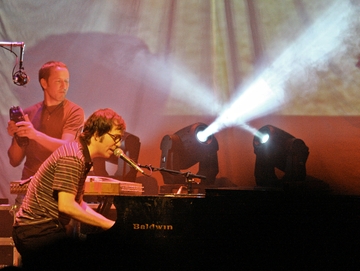
The encore was essentially a half-hour second set for the faithful. “Still Fighting It,” “Kate,” “Philosophy” and “Fair” were pure Folds gold that the crowd devoured. He’s not afraid to flip on the house lights to get the audience involved, and they were not shy about taking the cue. The crowd jumped on “Army” with a “Rocky Horror Picture Show” level of interaction, taking over the three-part-harmony bridge with no instruction.

The five-piece band included drummer Sam Smith, who played so hard the “V-O-T-E” letters fixed to his shirt gradually fell off. Folds frequently dismissed the extra keyboard player and percussionist for a pared down bass-drums-piano trio on the harder hitting numbers.

Higgins warmed the crowd up with a 45-minute set of radio-ready acoustic pop, playing in socks because, she said, her shoes got soaked on an afternoon expedition to Broadway Café. The highlight of her set was “Going North,” which featured a great acoustic guitar solo by Ben Edgar.

The concert was Folds third local performance of the  year, following a late-winter, students-only show at UMKC and a 70-minute set at Wakarusa in June. If that set was slightly truncated, Folds made amends by playing for more than two hours and returning for two encores Wednesday night. The first encore set ended with the fake version of “Frown Song.” It’s hard to imagine anyone leaving with anything but a smile.

Setlist: Way to Normal/Effington/This Song Has Not Title/You Don’t Know Me (with Missy Higgins)/Gone/Brainwashed/Dr. Yang (fake)/Dr. Yang/Anne Waits/Cologne/Frown Song/The Bitch Went Nuts/Landed/Kylie from Connecticut/Free Coffee/Free Coffee Town/Hiroshima/Zak and Sara/The Bitch Went Nuts (fake) Encore: Fair/Still Fighting It/Philosophy/Kate/Rocking the Suburbs/Underground/Army/Frown Song (fake)/Not the Same
The Temptations – “My Girl”


The Temptations – “My Girl,” Pop #1, R&B #1

By Joel Francis

Lightning definitely struck twice for Smokey Robinson and the Temptations. After struggling for years, Robinson gave the Temptations their breakthrough hit with “The Way You Do The Things You Do.” “My Girl,” their follow-up, is not only Motown’s biggest song, but one of the biggest soul numbers of all time.

Inspired by his wife Claudette, Robinson and fellow Miracle Ronald White wrote the one of the greatest Valentines of all time as an answer song to their previous hit “My Guy.” Bob Dylan may have been thinking of the lyric “I’ve got so much honey/the bees envy me” when he proclaimed Robinson “America’s greatest living poet” in 1965.

David Ruffin made his lead vocal debut delivering these deceptively simple lyrics. Though it seems a no-brainer in retrospect, the decision was controversial at the time. Eddie Kendricks and Paul Williams had shared the lead role prior to this song, and, to make matters worse, Ruffin was a ringer who replaced original Temptation Al Bryant. Ruffin got the nod after Robinson saw him singing “Under the Boardwalk” as part of their Motown Revue repertoire, and quickly became the group’s featured singer.

The Motown string section furthers Ruffin’s references to sunshine and fluttering birds, while Funk Brother James Jamerson’s signature two-note bass line anchors the entire performance.

It’s unclear why Robinson and White didn’t keep their song for The Miracles, but it didn’t take long for other acts to put their stamp on the number. Otis Redding added some blues for his 1965 reading; both the Rolling Stones and the Mamas and Papas cut it in 1967. Since then, everyone from Al Green to reggae artist Prince Buster to Dolly Parton to British shoegazers The Jesus and Mary Chain has reinterpreted this timeless classic.

Marvin Gaye – “How Sweet It Is (To Be Loved By You)”


Marvin Gaye – “How Sweet It Is (To Be Loved By You),” Pop #6, R&B #4

Marvin Gaye scored his second Top 10 hit with this song penned and produced by the Holland-Dozier-Holland team. Gaye’s love songs were rarely this straightforward. The vocal melody is so strong the background singers and percussion are basically window dressing. And who says Motown doesn’t do jazz – check out the boogie-woogie piano playing under Gaye’s buoyant singing.

Gaye’s career has been infamously bipolar. In the ‘60s, he was essentially two performers: a nightclub singer turned pop star and coveted duet partner. “How Sweet It Is” was released after Gaye’s lone album with Mary Wells, and a couple years before he connected with Tammi Terrell. For most casual listeners, Gaye’s first decade is summarized by “I Heard It Through the Grapevine,” a couple Terrell duets and this song.

Jr. Walker comes close to stealing Gaye’s song with his celebratory 1966 cover. Walker’s voice isn’t a smooth as Gaye’s, but his sax is. James Taylor took the song one spot higher – to No. 5 – in 1975. Listeners who enjoy a brief, deep nap can program Taylor’s cover against Michael Buble’s 1996 version. – by Joel Francis

[Note: This concludes the first disc on our road trip through the four-disc “Hitsville U.S.A.” box set.]

Review: Los Lobos

Above: “Chuco’s Cumbia” at Austin City Limits 2006

By Joel Francis

The Kansas City Star

For a band as accomplished as Los Lobos, the reach from Jimi Hendrix and Willie Dixon to Richard Thompson and Ritchie Valens is a small one. The gulf between the lip of the stage and the front row, however, can be trickier to navigate.

The sextet’s 16-song, two-hour set was a celebration of all forms of music from New Orleans soul to Spanish mariachi. However, bottom-heavy sound and fixed seating proved nearly insurmountable for the band during the latest entry in the “Cyprus Avenue Live at the Folly Theater” on Sunday night.

The show never completely got off the ground, but it had its share of inspired moments. “Chuco’s Cumbia” featured a dirty Latin groove, while a medley of “The Neighborhood” and “Wang Dang Doodle” bridged the South Side of Chicago to East Los Angeles. The first set ended with a cover of Richard Thompson’s “Shoot Out the Lights” anchored by a thunderous backbeat.

After a 25-minute break, the band returned with a second set guaranteed to knock the yawn out of any weary political supporters (there were plenty of T-shirts from Saturday’s rally throughout the crowd). The one-two of “Come On Let’s Go” and “Don’t Worry Baby” got people involved, if not on their feet. The band traded 88 piano keys for 22 guitar strings on their cover of Fats Domino’s “The Fat Man,” which included a shuffling solo from drummer Cougar Estrada.

The high point of the night was a surprise cover of Jimi Hendrix’ “Little Wing.” Between David Hildago’s lead guitar and Cesar Rosas’ vocals, they not only nailed the song, but stretched it out and made it their own.

There were plenty of covers, but the band also touched on all phases of its career. While lesser bands make a career out of mining the same niche, Los Lobos were able to transition from the early rockabilly of “Shakin’ Shakin’ Shakes” to the more experimental “Kiko and the Lavender Moon,” and from the Spanish festivity of “Maria Christina” to the quiet introversion of “The Valley.”

The sound was muddy for most of the night and Steve Berlin suffered the brunt of it. His keyboards and woodwinds were often barely audible in the mix. The Folly is a wonderful venue for intimate shows -– recent performances by the Dave Brubeck Quartet and Randy Newman were sonically incredible -– but it is ill-suited for six amplified musicians.

The rigid seating and formal environment also inhibited the dancing and shaking Los Lobos’ music cries for. Toots and the Maytals, an earlier “Cyprus Avenue”/Folly booking, faced the same problem at its reggae concert last year. The younger crowd that turned out that night was less inhibited about dancing in the aisles.

Hildago finally coaxed people to their feet before “I Got Loaded,” and the band followed up with the one number guaranteed to keep everyone on their feet: “La Bamba.” After a brief encore break, the band picked up where they left off with a blistering “Good Morning Aztlan” and a frantic “Cumbia Raza” that featured another drum solo from Estrada and guitar solos from Louie Perez and Hildago. Just as the band and audience were hitting the mark, the band closed the set. It was a shame they had to stop. It felt like they were just getting started.

Setlist: Short Side of Nothing, Chuco’s Cumbia, The Valley, Luz d Mi Vida, The Neighborhood/Wang Dang Doodle, Shakin’ Shakin’ Shakes, Shoot Out the Light (intermission) Maria Christina, Kiko and the Lavender Moon, Come On Let’s Go, Don’t Worry Baby, Little Wing, The Fat Man, I Got Loaded, La Bamba/Good Lovin'(encores) Good Morning Aztlan, Cumbia Raza

Review: Old 97s


Above: Of course they played “Roller Skate Skinny.”

By Joel Francis

There is something to be said for a band who can play an entire set without changing instruments.

The Old 97s are not quite that band – lead singer/songwriter/heartthrob Rhett Miller swapped his electric axe for an acoustic one a few times – but they are as close as we’re going to get. For almost two hours they entertained a nearly full Granada Theater in Lawrence, Kan. with little more than the instruments and songs on their backs.

The setlist encompassed more than two dozen songs, from radio favorites like “New Kid” to fan favorites like “Jagged” and new songs like “No Baby I.” When the band played “Question,” a recount of Miller’s wedding proposal, all the women pulled their men close and sang softly in their ears. “Barrier Reef” erupted into a raucous sing-along.

In a rare moment of between-song banter, Miller recalled the band’s first show in Lawrence at the Replay Lounge where they performed for a night of unlimited, free video games. A few songs later, those days were celebrated in “Niteclub.”

Miller may have the easiest job in showbiz. Offstage, all he has to do is write songs that combine the alt-country terrain plowed by Uncle Tupelo with the pop sensibility of Paul McCartney. Onstage, he just makes love with his eyes to all the doe-eyed women pressed against the stage and occasionally shake his ass while Ken Bethea takes a guitar solo.

Bethea plays lead guitar via chainsaw. Standing on the edge of the stage with his headstock hanging over the crowd, he rips through songs with a Chet Atkins-meets-Dick Dale style. On the other extreme of the stage, modest Murry Hammond cradles his bass like a baby and tosses out the harmony (and intermittent lead) vocals that push the songs from good to great.

Late-tour shows can be a mixed bag. When Wilco played the Uptown Theater in 2006 at the end of the Kicking Television tour they were tired of both the road and their material. But with only a couple dates left on their current tour the Old 97s played with the perfect mix of familiarity and abandon. “Doreen,” one of their hardest-rocking numbers, positively smoked.

The evening ended with the encore haymaker punches of “Murder (Or a Heart Attack),” “Big Brown Eyes,” “Dance with Me” and, of course, “Timebomb.” When it was over, everyone left a little drunker and a lot happier.

“Tell Tale Signs” Sheds Light on Legend

(Above: “Dreaming Of You” is one of many stand-out tracks on “Tell Tale Signs.”)

By Joel Francis

If there’s one detail to take away from “Tell Tale Signs,” the eighth installment in Bob Dylan’s Bootleg Series, its that “Mississippi” is as vital to his late-career renaissance as “Like A Rolling Stone” was to his electric rebirth.

The song opens both discs of the set (a third version appears on the bourgeoisie-only $130 “deluxe edition”). We first hear it as beautiful, slow folk ballad that features one of Dylan’s best vocal performances. Play this version for people who say Dylan can’t sing. It next appears as a more wirey, blues-influence tune that bears more of producer Daniel Lanois’ fingerprints.

Anyone who heard Sheryl Crow’s cover of “Mississippi” – she cut it for her “Globe Sessions” album before Dylan included it on “Love and Theft” – knows the song’s durability. It’s interesting to see Dylan add and shave layers before settling on a version suitable for release.

“Tell Tale Signs” is mainly a collection of shading and texture. With a few exceptions, hardcore Dylan fans will be familiar with all its 27 songs. What is surprising is the new contexts Dylan continually places them in.

“Most of the Time” is a gorgeous mood piece on “Oh Mercy,” but the alternate version replaces Lanois’ sheen with an acoustic guitar and places Dylan’s regret and pain at center stage. This motif is repeated across the set. Lanois produced two albums with Dylan and it’s telling that a majority of the cuts on this set draw from those sessions. Although their collaborations were critically acclaimed, Dylan and Lanois often struggled over differences in vision. These alternate versions are closer to the sound and feel that Dylan achieved alone on his ‘00s albums and could be seen as refutations of Lanois’ input.

There are only a handful of unheard songs, but what’s here is worth hearing. Lesser artists could build a career with the material Dylan discards. It’s unclear why the evocative “Dreaming of You” was left off “Time Out Of Mind,” but it is one of the brightest gems in this collection. There are two other “Time” discards – the gospel-flavored “Marching to the City” and the longing tale of lost love “Red River Shore.” “Can’t Escape You” is a sideways love song recorded in 2005, while the traditional “32-20 Blues” is an acoustic folk song from the “World Gone Wrong Sessions.”

The live cuts sprinkled throughout aren’t as illuminating, but still worthwhile. “High Water (For Charley Patton)” is angrier onstage, while an acoustic “Cocaine Blues” is a reminder of the amazing chemistry Dylan had with longtime touring guitarist Larry Campbell.

The inclusion of three previously released soundtrack songs is a bit puzzling. We’re given the superb “Cross the Green Mountain” from “Gods and Generals” and the haunting “Huck’s Tune” from “Lucky You,” but where is the Oscar-winning “Things Have Changed” from the “Wonder Boys” soundtrack? (A live version does appear on the $100 bonus disc.) Dylan’s swinging version of “Red Cadillac and Black Moustache” cut about the same time as “Love and Theft” for a Sun Records tribute would have been nice to have.

But these are minor quibbles. While this set doesn’t tell the faithful anything they don’t already know, that doesn’t mean they’re not worth hearing again in a different light.

The Supremes – “Baby Love,” “Come See About Me”


The Supremes – “Baby Love,” Pop #1, R&B #1
The Supremes – “Come See About Me,” Pop #1, R&B #3

By Joel Francis

(Note: Since the producers of the “Hitsville U.S.A.” box set programmed these tracks back-to-back, we’ll tackle them in one entry.)

For most people, the Supremes are Motown. Label founder Berry Gordy certainly didn’t hesitate to promote and encourage their singles, seemingly above all other releases. Gordy had been looking high and low to find a female face for his label. Early contender Mary Wells defected, and for some reason Martha Reeves and the Vandellas and Gladys Knight and the Pips didn’t fit his image. The answer was right under his nose the whole time.

Supreme Florence Ballard grew up in Detroit with future Temptations Paul Williams and Eddie Hendricks, who were performing as the Primes. Their management wanted a female group, so Ballard formed the Primettes with best friend Mary Wilson, who recruited schoolmate Diana Ross.

In 1960, Ross pestered her old neighbor Smokey Robinson for an audition at Motown. He thought the girls were too green, but snagged their guitarist to join the Miracles. Undaunted, the trio stopped by the Hitsville studio every day after school and bugged Gordy for a spot on his label. The persistence paid off and in 1961 The Supremes released their first Motown single.

The Supremes were hardly the overnight success history has made them out to be. Their first eight singles, released over three years) did absolutely nothing on the charts. In 1964 they were turned over to the Holland-Dozier-Holland machine and their fortunes improved.

“Baby Love” was the Supreme’s second No. 1 hit with HDH. Any listeners that Ross’ opening coo didn’t seduce were captured by the catchy chorus that opens the song. The Funk Brothers shuffle underneath the lyrics imitates the footsteps, but are they walking away or coming back? The sexy saxophone accompaniment seems imply a lover’s return, but Ross is so insistent throughout it’s impossible to be sure.

“Come See About Me” continued the Supreme’s No. 1 success. Yet another HDH song and production, the repeated musical and lyrical theme – a spurned Ross singing over a shuffling Funk Brothers track – the assembly-line criticism holds up in this case. Why did such lovely ladies do to be treated so badly and ignored by the men in their lives?

Both songs have risen to the top of the oldies pantheon, and performed by dozens of artists. As with most of his major hits, Gordy passed both numbers around his stable of singers. For my money, the definitive version of “Come See About Me” is Jr. Walker’s 1967 cover.

Review: Randy Newman

(Above: We’ve got a friend in Randy.)

By Joel Francis

The setup couldn’t have been simpler – a grand piano, bench, monitor, couple of microphones, a small rug. But add Randy Newman to that list and the payoff couldn’t have been greater Saturday night.

Strolling casually onstage at 8 p.m. sharp, Newman rolled into “It’s the Money That I Love.” Throughout the next two and a half hours (counting a 20 minute intermission), he walked through nearly three dozen album tracks and hits like “You’ve Got A Friend In Me,” “I Love L.A.” and “Short People” for a nearly sold-out Folly Theater crowd.

He may have been alone onstage, but Newman had a theater of fervent supporters. The audience of NPR-listening baby boomers was pin-drop quiet on the moodier numbers and clapping and laughing on the upbeat songs. When Newman finally enlisted their help on the chorus of “I’m Dead (But I Don’t Know It)” the enthusiastic response was startling. “You sound like a Queen record,” he joked.

Newman is as good at directing a crowd as he is an orchestra. He shifted effortlessly from the laugh-out-loud satire of “Korean Parents” to the melancholy “I Miss You” – a love song “for my first wife while I was married to my second one,” Newman said – to the upbeat children’s song “Simon Smith.”

Some of the evening’s best lines came between songs. “The World Isn’t Fair” was prefaced by a story about his son’s progressive pre-school where they would “sit around on cushions and come home with lice every couple weeks” He led into “I’m Dead (But I Don’t Know It),” a screed about rock stars who don’t know when to retire, by explaining “no one is applauding at home” and “no one is going to tell Paul his best work was with Wings.”

Every song was a highlight, but several numbers stood apart. “Dixie Flyer,” a song about Newman’s emigration from the Bayou State to Los Angeles, segued into “Louisiana 1927,” a historical recount of the great Mississippi flood. Two songs named after cities, “Birmingham” and “Baltimore,” were powerful paeans to the working class in decaying towns.

Although the generous setlist encompassed Newman’s entire catalog, it tipped toward his last two releases. All but one song from this year’s wonderful “Harps and Angels” was performed. That album provided one of the better political songs in recent memory, “A Few Words in Defense of Our Country.”

Newman let his songs do his stumping for him. Several of the numbers he wrote more than 30 years ago, like the bomb-happy “Political Science” and the plea “Mr. President (Have Pity on the Working Man)” sadly have a contemporary relevance.

Today, Newman is better known for his sweeping film scores and Pixar songs than stinging lyrics and clever songwriting. He did OK with only 88 keys to replicate his orchestrations. His more complicated songs, like “A Piece of the Pie” and “Harps and Angels” survived the transition more or less intact. “Love Song (You and Me)” actually sounded better stripped down.

Like many of his generation’s best songwriters – Bob Dylan, Neil Young and Tom Waits come to mind – Newman’s froggy voice is an acquired taste that is easily parodied. Saturday’s magical immersion in Newman’s world of five centuries of European history in three minutes (“The Great Nations of Europe”), senior forgetfulness (“Potholes”) and erotic humor (“You Can Leave Your Hat On”) was more than enough to convert the few who carried any reservations into the theater and leave the devoted a performance to cherish.

Setlist: It’s the Money That I Love/My Life Is Good/Marie/Short People/Birmingham/Bad News From Home/The World Isn’t Fair/Korean Parents/I Miss You/Simon Smith and the Amazing Dancing Bear/A Few Words in Defense of Our Country/Laugh and Be Happy/Losing You/You Can Leave Your Hat On/I’m Dead (But I Don’t Know It)/Political Science/<intermission>/Mr. President (Have Pity on the Working Man)/The Great Nations of Europe/Potholes/In Germany Before the War/Baltimore/Only A Girl/Love Story (You and Me)/Real Emotional Girl/You’ve Got a Friend in Me/Harps and Angels/Dixie Flyer/Louisiana 1927/Guilty/I Love L.A./God’s Song (That’s Why I Love Mankind)/A Piece of the Pie/I Think It’s Going to Rain Today/<encores>/It’s Lonely at the Top/Feels Like Home

Below: Because you were going to Google it anyway….

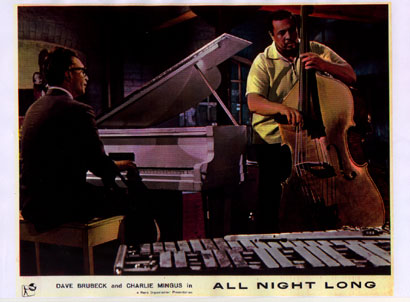
Dave Brubeck and Charles Mingus – “Non-Sectarian Blues”

By Joel Francis

The unlikely pairing of Dave Brubeck and Charles Mingus at a London film studio should have been a collision of worlds on par with the big bang.

In the early sixties, Brubeck was rewriting the jazz songbook with his legendary quartet that featured Paul Desmond, drummer Joe Morello and bass player Eugene Wright. Signed to Columbia Records, home to both Miles Davis and Doris Day, their “cool jazz” was both critically acclaimed and extremely accessible. In other words, it was jazz both hardcore fans and housewives could appreciate.

Charles Mingus, on the other hand, was the dark prince from the underbelly of the genre. His dense, avant-garde approach carried discordant melodies and boasted nearly impenetrable titles like “Pithecanthropus Erectus” and “If Charlie Parker Were a Gunslinger, There’d Be a Whole Lot of Dead Copycats.” He was on the threshold of a three-album deal with Impulse Records, the jazz label John Coltrane helped transform into the bastion of cutting-edge, experimental music.

Although Mingus and Brubeck’s music was world apart, the bassman and pianist first crossed paths in the post-War San Francisco jazz scene. The two met again in 1962 at Pinewood Studios in London.

The unfathomable union of Brubeck and Mingus occurred under the most commercial circumstances. Brubeck had been hired to write the score for “All Night Long,” a modern telling of “Othello” starring Richard Attenborough. In the liner notes to the 1991 Brubeck box set “Time Changes,” he describes their encounter.

“My contract for the film specified I would not play with Charlie Mingus, because I knew how demanding Charlie could be and I just wanted to avoid it. It was out of respect,” Brubeck said.

“And fear,” he added.

Mingus, who had also been hired to score certain scenes, kept bugging the director to play with Brubeck. Finally, Brubeck relented – with three stipulations: no rehearsal, no synching and no overdubbing. Everything had to be live and off-the-cuff.

With those rules in place, the pair decided upon a Mingus composition. “Non-Sectarian Blues” begins with Mingus thumping borrowed bass, walking the beat as Brubeck joins in on the piano. Mingus can be heard grunting and shouting encouragement to Brubeck as the pair play off each other with staccato piano riffs and pulsing, aggressive baselines. The result is so natural and engaging it’s hard to believe these men came from such seemingly disparate camps.

Although the song was recorded in1962, the performance remained unheard outside theaters until the Brubeck collection “Summit Sessions” was released in 1971.

“When it was over, Charlie picked me up off the floor and gave me a bear hug,” Brubeck said. “It was wonderful.”

Velvelettes – “Needle in a Haystack”

Velvelettes – “Needle in a Haystack,” Pop #45

The real action in “Needle in a Haystack” is happening away from the microphones and behind the glass. This song was the first single the late Norman Whitfield’s produced for Motown. Whitfield got his start at the label as a songwriter, co-writing Marvin Gaye’s hit “Pride and Joy,” but he made his name as a pioneering producer on the edge of the psychedelic soul movement.

In keeping with Berry Gordy’s assembly line mentality, the song sounds very much like the other Motown productions of the time. None of the experimental flourishes that mark Whitfield’s groundbreaking time with The Temptations are present. The promise of sounds to come, however, makes the song historically worth hearing.

History aside, there’s little that makes “Needle in a Haystack” stand out. The single was the Velvelettes’ second single for Motown and first charting effort. Although they had a follow-up hit, the Velvelettes, like Carolyn Crawford, are a footnote in Motown’s great history. – by Joel Francis