Isley Brothers – “This Old Heart of Mine (Is Weak For You)”

isleys

Isley Brothers – “This Old Heart of Mine (Is Weak For You),” Pop #12, R&B #6

By Joel Francis

For the most part, Motown’s talent during its heyday was home-grown. Martha Reeves was a Hitsville secretary, Stevie Wonder was a kid pestering the Funk Brothers for lessons, Marvin Gaye and Smokey Robinson were part of Berry Gordy’s extended family and Diane Ross and her friends stopped by every day after school to pester staff for an audition.

In short, talent came to Motown, not the other way around.

Of course that mindset quickly changed when the Isley Brothers hit the free agent market in 1965. The brothers made their name with 1959’s “Shout!” (recorded for RCA) and 1962’s “Twist and Shout” (recorded for the Wand label and covered by the Beatles). But after bouncing between those two labels and the failure to establish their own imprint, the Isley Brothers were looking for a new home. Berry Gordy was all too happy to welcome them to his fold.

The Isley’s Motown debut, “This Old Heart of Mine (Is Weak For You) was their biggest success so far. Holland-Dozier-Holland definitely applied the Motown sound to their number. The drums lead the mix, and the string section sounds more like the Four Tops than the Isley Brothers’ gritty urban soul. The brothers had never sounded so slick before, but the results couldn’t be argued with. The song is infectious, fun and impossible to listen to without breaking into smiles or dance.

Unfortunately, the Isley-Motown marriage didn’t last long. Despite releasing two more albums, the group couldn’t find a follow-up hit and complained of being fed inferior, cast-off tracks. They had a point: “This Old Heart” was originally intended for the Supremes. The brothers left Motown in 1968 and signed with Buddha before finding long-term success with Epic.

Flaming Lips deserve Super Bowl halftime show

(Above: Picture this on the 50-yard line: the Flaming Lips, “Race for the Prize.”)

By Joel Francis

The five years since Janet Jackson’s Super Bowl halftime “wardrobe malfunction” two things are clear: Nipple shields have not become the must-have fashion accessory everyone predicted; and halftime shows have never been better.

It would be easy to get tired of all the blue-chip baby boomer performers if they didn’t put on such compelling shows. The Rolling Stones abysmal 2006 act aside, it doesn’t get much better than hearing “Drive My Car” and “Runnin’ Down A Dream” at halftime. Yeah, they’ve been done to death, but they’re a lot better than whatever song Janet and Justin Timberlake were singing and Aerosmith’s pairing with Britney Spears. Does anyone remember those songs today?

Even fans tired of the oldies can’t argue with the energy that propelled Prince’s set in 2006 and Bruce Springsteen’s show last night into the top echelon of pop music performances.

Which is exactly why it’s time to change things up. The canary is choking; there’s not much more ore in the vein the NFL has mined these past five years. Let’s stop now, before Fleetwood Mac and the Eagles are serenading us with mid-game naps. It’s time to take the halftime show in a new direction. A direction hinted at in 2002 when U2 were brought in to play: dynamic bands that can connect with a huge audience, playing high-energy hits written within 20 years of their performance.

The Flaming Lips are the perfect band to open this new era. Imagine frontman Wayne Coyne rolling over the crowd in his giant hamster ball as “Race For the Prize” blasts through the stadium. Lasers penetrate the clouds of smoke as confetti, streamers and balloons rain on the crowd. Did we mention the Lips also come with their own space aliens and super heroes? Oh, and a flying saucer?

In their 25-year history, the Lips have twice rocked the massive crowds at Bonnarro and will have no problem connecting to the fans in the upper deck or on the couch. Their songs may not be as universally known as “American Girl,” but “She Don’t Use Jelly” was an MTV staple big enough to land the band on “Beverly Hills 90210.” And the “Yeah Yeah Yeah Song” will have as many people signing along as the outro of “Hey Jude.” The biggest obstacle will be cleaning up all the joyous debris on the field (lay down a tarp) and getting everyone to settle down enough to concentrate on the resumed game.

It wasn’t that long ago that the Blues Brothers (minus John Belushi) and Miami Sound Machine were given center-stage at the world’s biggest intermission. But there is a midway point between dinosaur bands and Top 40 vapidity. Once the Flaming Lips remind the audience of this territory, bands like the Foo Fighters, Arcade Fire and Robert Randolph and the Family Band are perfect future candidates.

Inoffensive doesn’t have to be the antonym of adventure. The Flaming Lips are the embodiment of the party atmosphere the NFL wants the Super Bowl to inhabit. It’s time to let them take the stage. Book them for 2010.

Read The Daily Record’s coverage of the Flaming Lips at Wakarusa in 2006 and 2008.

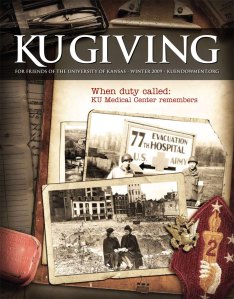
A war journal: Memories of KU’s 77th Evac

cover_large
KU Medical Center doctors and nurses formed the backbone
of one of World War II’s first mobile hospital units.

By Joel Francis

On the eve of U.S. entry into World War II, the War Department approved a plan to form mobile military hospital units to serve in a national emergency. Under the plan, certain units would be affiliated with outstanding medical civil institutions. U.S. Army Surgeon General James C. Magee wrote to Dr. H.R. Wahl, dean of medicine and administrator of the University of Kansas Hospitals, as KU Medical Center was known at the time. Would KU Hospitals accept the affiliation of the 77th Evacuation Hospital?

The medical center responded. KU faculty and staff joined with School of Medicine alumni and area physicians, dentists and nurses to form the unit. Activated in May 1942, the 77th Evac was attached to Gen. George Patton’s 7th Army during the North African Campaign and treated troops in the European Theater, moving to the point of greatest need over a three-year period.

In November 2008, KU Medical Center celebrated the 77th Evac with the release of a newly edited book and a documentary film. For this issue of KU Giving, three members of the unit shared snapshots from their experiences: Dr. James McConchie of Independence, Mo., the sole surviving physician from the original unit; Dr. John Shellito of Wichita, who joined later; and Louise Gilliland of Vero Beach, Fla., who served as a nurse.

In the spring of 1942, with just weeks to go in his rotating internship, KU medical resident James McConchie knew he would soon enter World War II. Where he would end up was in question. He had just learned that the 77th Evac, one of the first hospital units to be activated, had two openings. They invited him to join.

“They had openings in internal medicine and radiology. I don’t know how they picked me, but they did,” McConchie said. He talked to physicians who had served in World War I about his options. “They said if I took internal medicine I’d see a lot of shell shock and pneumonia. In radiology I’d be learning something new. I agreed and chose radiology, because no matter what I chose after the war, radiology would be part of it.”

Finally, McConchie’s orders arrived from the Army. It was official: He was to meet up with the rest of the unit at Fort Leonard Wood, Mo. With only a month of radiology training under his belt, McConchie departed for basic training and a crash course in radiology.

“Our unit was the best thing the Army had as far as our function,” he said. “We had the talent, the organization and the fraternization. Everyone knew everybody they were working with. We knew what someone could and couldn’t do.”

That knowledge and intimacy was based in the unit’s development and growth together at KU Hospitals. Before they worked near the front lines together, the core of the unit trained and worked side-by-side as Jayhawks at Bell Memorial Hospital in what is now Murphy Hall at the KU Medical Center in Kansas City, Kan.

Shock tubes and mud

After landing in Liverpool, England, that summer, the 77th Evac was sent to Oran, Algeria, to treat soldiers injured in the British and American invasion of Northern Africa. They were stationed there from November 1942 through January 1943 and spent the first few weeks in a hospital in the city.

“We had to use an old, non-shockproof X-ray machine that consisted of the X-ray tube and then several cables you pulled down from the ceiling and attached to the tube,” McConchie said. “These were bare wires. If you got close – about a foot away – the electricity could knock you across the room. We called it an electrocution device slightly modified for taking X-rays.”

In early December, the unit left the hospital as the Allied troops continued to advance. They moved to “Mud Flats,” a field south of Oran and closer to the front line, and set began shortly before the move, and sometimes the doctors and nurses were up to their knees in water and mud.

“We called that mud the ‘Oran Ooze,'” said Louise Gilliland, a nurse in the surgery ward. She had joined the 77th in New York and remained with the unit until the end of the war. “I remember on Christmas Eve I was going on duty, and a doctor had a record of ‘White Christmas’ he wanted to play. When I left to get it for him, I slipped and fell in the mud. I had to clean up again and change my uniform.”

Hospital ships transported the wounded across Oran Harbor to the evac hospital. For the soldiers who needed it, radiology was an early stop after going through admissions.

“When we were real busy, seeing up to 2,000 patients a day, John Bowser and I would work in shifts,” McConchie said. “We were the only two radiologists in the 77th. There were two X-ray machines with a full staff of technicians on each one. Then we had the Mole developing film.”

“The Mole” was Giovanni D’Amico, an Italian volunteer who spoke little English. He earned his nickname by reporting to the X-ray film-developing tent before sunrise and leaving after dark.

The doctors used what they had on hand to keep the mud away and to keep the film tent dark enough to develop the X-rays.

“The operating rooms draped sheets everywhere – that is, when they had them – to keep them sterile,” McConchie said. “When you went from tent to tent, you had to duck to go in through the flaps. When you got to our tent, you had to duck twice, because we were in a tent inside a tent.”

After D-Day

In July 1944, McConchie’s field experience was put to the test when the 77th arrived at Utah Beach, the westernmost of the five beaches designated for the D-Day invasion, 30 days after battle.

“We had to wait that long because it took them that long to get a big enough area cleared for us to set up our hospital,” McConchie said. “In the meantime, we were in England training, staying in contact with the local radiologists and studying.”

Although the heavy fighting was over when the 77th arrived, the area was riddled with reminders. German concrete pillboxes jutted out of the sand, houses and roads were pocked with shell marks, signs warned of grounds littered with land mines, and machine gunners sat tensely, alert for hostile aircraft.

“The lucky ones would walk in from the battlefield. We just took care of what came in,” McConchie said. “The triage docs would go over the patients as they came in. They’d divide who went where. The extremely bad cases would be set aside so we could get back to the others.”

John Shellito joined the 77th Evac shortly before the unit left England for Utah Beach.

“It was the most wonderful hospital. I couldn’t imagine such a place,” Shellito said. “They’d been through it all and knew exactly what to do. The reason I got on with such a wonderful outfit was that they needed an anesthesiologist. I wanted to be a surgeon; they wanted an anesthesiologist.”

The hospital was run in two 12- hour, 7 o’clock-to-7 o’clock shifts. Because the other anesthesiologist had two weeks of seniority and first pick, Shellito got the night shift. But he got up during the day to monitor use of the tracheotomy tube.

“The secret to good anesthesia is keeping an open airway,” Shellito said. “The best way to do this is to put a tube in the trachea and hook it up to an anesthesia machine or oxygen or whatever else you want to give them. This tube wasn’t something you could just go to the store and ask for. So I made do.”

He made the tube by placing a catheter alongside a larger tube and using half of a condom as an inflatable balloon to seal off leaks.

“I made another one of these a few years ago and sent it to a fellow at KU so he’d know,” Shellito said. “We guarded these very carefully. I didn’t want to have to make any more.”

One lost

In Verviers, Belgium, during the Battle of the Bulge, the 77th set up inside a schoolhouse. On the day before the hospital was scheduled to open in October 1944, German planes strafed the building and bombed the urology ward. Although no one was hurt that night, the bombing became a familiar occurrence.

“You could be a little afraid when the bombers went over,” McConchie said. “When I went to sleep, I always had my helmet right beside me. When I heard the bombers, I’d put my helmet on and hope. It was a rough way to sleep, but you kind of got used to it. There was nothing you could do about it, anyway.”

It was in Verviers that the 77th suffered its only fatality. Anne Kathleen Cullen, a Red Cross volunteer, was recovering from the flu on the third floor of the converted school. She went to the fourth floor – the top floor – to use the restroom. The moment she entered the doorway, a shell struck, and the room collapsed on top of her.

Louise Gilliland lived on the fourth floor. As luck would have it, she was on another part of it when the shell hit.

“I had my sleeping bag there with everybody else,” she said. “That night when I went to go to bed, I turned my bag open and found a large piece of shrapnel. If I had been sleeping in my normal position, it would have got me in the kidney.”

The hospital in Verviers was set up for 1,000 patients, but the staff soon was caring for 1,400. The battle was only a couple of hills away, and the wounded were shipped straight from the front line. If the staff was overwhelmed, they had been treating above capacity for most of the war anyway. At least they were working from a bricks-and-mortar structure.

“The way we were set up, there were rows of cots, and we had a desk with a box where we kept medications,” said Gilliland. “Patients came in with their EMT [emergency medical tags] and an envelope containing their records. We would feed and care for them, change their dressings and wash them if possible.”

Epilogue

Cease-fire orders came in 1945. Back home, James McConchie and John Bowser, his fellow radiologist in the unit, opened a practice together. John Shellito switched specialties from anesthesiology to surgery. From 1973 to 1985, he was an associate professor at the KU School of Medicine-Wichita. Louise Gilliland continued her nursing career in Pennsylvania and Florida.

Members of the 77th held regular reunions from 1945 until 2004. Robert Gerlach, an enlisted man who won a bronze star for streamlining the discharge process, planned many of the reunions. Surviving members met once more this past November.

“The 77th has become like family to many of us,” Gilliland said. “I felt a kinship with this group and the good work we did. Even though there’s not as many of us around today, I’m happy to be there and see who shows up.”

The Elgins – “Darling Baby”

darling-baby

The Elgins – “Darling Baby,” Pop #72, R&B #4

The Elgins started as a trio in 1962 who called themselves The Downbeats. When they added frontwoman Sandra Edwards (nee Mallet) and another singer, they switched their name to the Elgins. That wouldn’t have been a problem, except copies of “Darling Baby” were already being pressed, so new labels had to be hastily printed. Copies of “Darling Baby” credited to the Downbeats carry a hefty price tag. (Original pressings of the Elgins’ “Darling Baby” run between $25 and $50.)

The group’s name choice is an interesting one. The Temptations went as the Elgins before Berry Gordy made them come up with a new handle. There was also a Los Angeles-based doo-wop group with the same name.

Unfortunately, all of this history is more interesting than the actual song. Penned by the usually spectacular Holland-Dozier-Holland team, “Darling Baby” is as generic as its title. Despite a fine vocal performance by Edwards, the backing vocals are laughably unconvincing, the rhythm plods and the arrangement is stagnant. Edwards pleads her departing lover to “talk it over one more time,” but it’s obvious there isn’t much being said.

Fortunately, the Elgins’ follow-up hit “Heaven Must Have Sent You,” atones for the misstep of “Darling Baby.” – by Joel Francis

KC Recalls: The Coon-Sanders Night Hawk Orchestra

coon

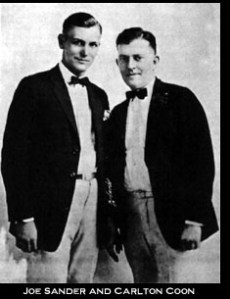
(Above: Joseph Sanders, left, and Carleton Coon.)

By Joel Francis

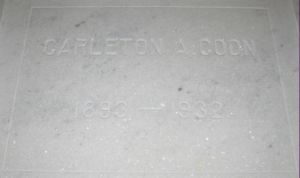
The music Carleton Coon and Joseph Sanders made for a dozen years together helped put Kansas City jazz on the map. Their Nighthawk Orchestra may have broken up in 1932, but it’s two bandleaders have been silently reunited for 40 years at Mt. Moriah Cemetery in Kansas City.

Coon and Sanders first met at a downtown Kansas City music store in 1918. Tall, handsome and quick-tempered Sanders, was an amateur baseball player on leave from the Army. He was practically the antonym of the pudgy, extroverted Coon. Despite their physical and temperamental differences, both men quickly found they shared a love of jazz and complementary tenor voices.

The following year, when Sanders got out of the Army, the two teamed up, formed a jazz combo and started booking gigs around Kansas City. With Coon handling business, Sanders writing songs and city boss Tom Pendergast ignoring prohibition with his “wide open” bars, clubs and brothels, the Coon-Sanders Novelty Orchestra was soon one of town’s in-demand outfits.

Shortly after Thanksgiving, 1922, the orchestra was booked to play on radio station WDAF. The success of that performance helped launch their weekly show, broadcast from 11:30 p.m. until 12:30 a.m. When the announcer let slip that “anyone who’d stay up this late to hear us would have to be a real night hawk,” thousands of listeners spread across Canada, Mexico and most of the United States let him know that they were proud to be “night hawks.”

Sanders quickly penned a theme song “Night Hawks Blues” and the pair rechristened their ensemble the Coon-Sanders Original Night Hawk Orchestra. In 1924, they recorded for the Victor record label in Chicago and agreed to let burgeoning Chicago promoter Jules Stein book a four-week tour. Stein parlayed his profits from that tour into his own booking company, which he called Music Corporation of America, or MCA.

On the strength of that tour, the Night Hawk Orchestra relocated to Chicago where their performance opening the Balloon Ballroom of the Congress Hotel was broadcast on KYW. Two years later, they moved to the Blackhawk Restaurant where fan Al Capone frequently left $100 tips for the band. On the strength of WGN radio broadcasts and reputation built playing around Chicago (including Capone’s Dells supper club in Morton Grove, Ill.), the Coon-Sanders Orchestra relocated once again in 1931.

Broadcasting weekly from Terrace Room in the Hotel New Yorker on CBS radio, Coon and Sanders found themselves in the same Big Apple circles as Bing Crosby and Guy Lombardo. Coon loved the night life, frequenting the Cotton Club and other Harlem jazz clubs, and making friends with Cab Calloway and Duke Ellington.

Sanders, on the other hand, was less enamored. He longed for the Midwest and made his sentiment plain the final number recorded by the Coon-Sanders Original Night Hawk Orchestra, “I Want to Go Home.”

Unfortunately, circumstances forced the bandleaders’ hands. Popular taste was shifting away from the Caucasian stylings of Coon and Sanders and toward all-black ensembles like the Ellington, Calloway and Kansas City’s Bennie Moten orchestras.

These circumstances, coupled with the Great Depression, forced the Night Hawks back to Chicago in April, 1932, for an engagement at the College Inn. Sander’s delight to be back in familiar territory was tempered when Coon was admitted to the hospital in critical condition. He died a few weeks later from blood poisoning from an abscessed tooth.

kc-graves_coon1

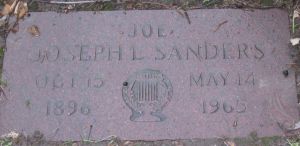
Coon’s 1932 funeral was one of the largest Kansas City had seen. Although his procession carried on for miles, his band’s legacy did not stretch so far. Less than a year after Coon’s death, Sanders dissolved the group and moved to Hollywood to write movie scores. Although Sanders was active in music for the rest of his life, he never regained the popularity he found with the Nighthawk Orchestra. In 1965, he died after having a stroke and was buried about 200 yards sound of his friend, Carleton Coon, at Mt. Moriah Cemetery.

Today, the Coon-Sanders Original Night Hawk Orchestra is a footnote in the Kansas City jazz story that includes big bands lead by Bennie Moten, Count Basie, Andy Kirk and Jay McShann, and soloists like Big Joe Turner, Mary Lou Williams, Walter Page and, of course, Charlie Parker. But Coon and Sander’s early triumphs helped paved the way for all who followed them out of Kansas City.

Ironically, the Night Hawks are most celebrated in Huntington, West Virginia, where the Coon Sanders Nighthawks Fans’ Bash has been held on the weekend after Mother’s Day for 39 years.sanders

Meet the New Boss: Pat Green

pat-green
By Joel Francis

The Kansas City Star

Pat Green may be a country singer from Texas, but his inspiration is a rock star from New Jersey.

“I’m trying to do what (Bruce) Springsteen did,” he said. “Jersey knew all about Springsteen before ‘Born in the U.S.A.’ came out and launched him.”

“Texas knows what I’m about. I can sell out as big of an arena as you want in Texas, but in Kansas City I’m playing a thousand-seater.”

Green will bring the music he describes as “if Springsteen and Willie Nelson had a kid” on Saturday to the Granada Theater in Lawrence. He’ll also be previewing his new album, “What I’m For,” which comes out Tuesday.

“When I get a new record out, I do like Springsteen and just make the shows longer. All the new stuff gets added to the old,” Green said. “You identify the bigger songs from that and throw them in the every-night pile.”

One new song he’s playing is “Country Star,” a country rewrite of Nickelback’s “Rock Star.” Green said he’s not sure if everyone will get the joke, and he’s fine with that.

“It’s a laughable notion to think of myself as a star,” he said. “Some of my guys know I’m kidding, that I’m not going to buy a shiny belt buckle and 10-gallon hat. But I like to write ambiguously, so that my songs can mean more than one thing to people. Others will laugh. Just picturing it is kind of funny.”

The flip side of that coin is “In It for the Money,” a soul-searching song about finding the right motivation.

“There is a quote by William Jennings I’m sure I’m going to butcher, but you have to do it for the right reasons. You have to care. This is not a dress rehearsal,” Green said. “Do you do it for love or do you do it for money?”

“What I’m For” also features a new arrangement of “Carry On,” a song Green has been carrying for more than a decade. The Police remake of their hit “Don’t Stand So Close to Me” inspired Green to take a different approach to his warhorse.

“That song is just part of my soul,” Green said. “Because I love it so much, I can move the furniture around without everyone getting upset with me. I never know how I’m going to play it in concert. Sometimes it’s just me and the guitar like a ballad. It’s been worn in every way you can wear it.”

Assisting Green for the first time is producer Dann Huff. The award-winning veteran has worked with artists as diverse as Bon Jovi, Megadeth and LeAnn Rimes.

“Keith Urban was mostly responsible for me hiring Dann Huff,” Green said. “I compared his work with Rascal Flatts and Faith Hill. Those albums sound completely different. They made me aware of Dan’s ability to wrap his hands around the individual artist and make the record toward them, rather than bending the artist to his vision.”

Pushing aside notions of trying to recapture the success of “Wave on Wave,” Green’s 2003 breakthrough hit, Green wrote an album that captured his life now as a father and family man.

“I’m not just going to sing anything to have a radio hit. I have to love it and believe it to sell it,” Green said. “I write about what I’m in tune with in this space, and that’s what Springsteen does, as well.”

Green, who happens to have his album coming out the same day as Springsteen’s “Working on a Dream,” has paid homage to the Boss by performing “Atlantic City” at his shows for years. For this tour he’s adding a new wrinkle.

“I think for this next tour I’m going to pull something off ‘The Rising’ for our encore,” Green said. “I have several songs in mind, but I don’t want to say what. If I go a different way, I won’t be caught lying.”

The Marvelettes – “Don’t Mess With Bill”

bill

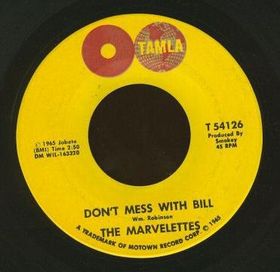
The Marvelettes – “Don’t Mess With Bill,” Pop #7, R&B #3

The three years between this hit and the Marvelettes’ previous chart entry, “Beechwood 4-5789,” saw them slide from Barry Gordy’s go-to girl group to third fiddle behind Martha and the Vandellas and the Supremes. After passing on “Where Did Our Love Go,” which became a hit for the Supremes, they finally found success with this Smokey Robinson number.

Lyrically, this relationship may not be the most stable: Bill has put tears in lead singer Wanda Young’s eyes “a thousand times or more.” But “every time he would apologize/I loved him more than before.” Furthermore, Young isn’t sure Bill will come back; that said, she wants no competition.

The vocal deliveries may not be threatening, but the slinky organ underpinning the melody and saxophone solo add an element of danger. Any girl that’s tough enough to put up with what Bill hands out can definitely hold her own. – by Joel Francis

Stevie Wonder – “Happy Birthday”

(Above: Happy 80th, Dr. King.)

By Joel Francis
The Daily Record

Every few years, the calendar aligns so that my dad’s birthday lands on Martin Luther King Day. Most of the time, the extra day off works means we celebrate a bit longer. Stevie Wonder’s “Happy Birthday” is the perfect salute to these days, but it means even more this year, on the eve of Barack Obama’s inauguration.

King’s birthday was not a national holiday when Wonder penned this tribute. The song was a rallying point in the fight to establish King’s birthday as a holiday. Wonder performed the song at the Rally For Peace press conference in 1981, and wrote an essay about King that appeared on the album liner sleeve. Part of his words read:

“It is believed that for a man to lay down his life for the love of others is the supreme sacrifice. Jesus Christ by his own example showed us that there is no greater love. For nearly two thousand years now we have been striving to have the strength to follow that example. Martin Luther King was a man who had that strength. He showed us, non-violently, a better way of life, a way of mutual respect, helping us to avoid much bitter confrontation and inevitable bloodshed. We still have a long road to travel until we reach the world that was his dream. We in the United States must not forget either his supreme sacrifice or that dream.”

Wonder’s essay is accompanied by photos of King and the Civil Rights movement. The grim photos – which include depictions white police officers attacking black protesters – stand in contrast to the buoyant melody of the song. The synthesizers and drums may be dated, but the lyrics and sentiment capture the hope and love as well as U2’s more famous tribute. Wonder also understands that birthdays are about parties, so his homage to King is as much a celebration of life as a remembrance.

It was a touch disappointing to watch Wonder elect to perform “Higher Ground” at the “We Are One” concert that took place on the steps of the Lincoln Memorial in Washington, D.C. two days before Obama’s inauguration. In a day rife with symbolism and historic importance, the significance of performing “Happy Birthday” would have been amazing. Then again, more people are probably familiar with “Higher Ground.” And Stevie Wonder never met my dad.

Bird lives! (and so will jazz)

(Above: Mos Def is a rapper, but his song “Umi Says” has a very jazzy feel.)

By Joel Francis
The Daily Record

The New York Times jazz and pop critic Ben Ratliff participated in a very enlightening Q and A with readers yesterday. It seems Kansas City jazz fans, like our friend at Plastic Sax, aren’t the only ones obsessed about the state of the genre.

Several people asked Ratliff why jazz didn’t have a bigger audience, what the media’s responsibility is to promote jazz to a larger audience, if there is a stigma against jazz in mainstream culture and, most bluntly, whether jazz was dead.

Similarly, several readers were concerned about the legacy of today’s jazz artists. They asked which contemporary artists have the best potential to join the pantheon of innovators like Miles and Duke, and whether the current crop of players are pioneers or regurgitators. One bold reader actually called out the elephant likely hiding behind many of these questions. “Pretty much all jazz sounds the same today,” he said.

It seems that just as baseball fans can’t wait to compare Albert Pujols to Stan Musial, jazzheads love debating the merits of John Medeski to Jimmy Smith or Joshua Redman to Sonny Rollins. They (we) are forever insecure that our moment in the sun won’t measure up to the established legacy. They are right. Just as no contemporary president will be as lauded as the Founding Fathers, and no slugging outfield can surpass Babe Ruth’s mythology, there is no way that the abilities of Jaco Pastorius or Christian McBride can exceed the monumental achievements of Charlie Mingus and Ray Brown.

But that doesn’t mean they can’t all be enjoyed. Trumpeter Roy Hargrove hasn’t redefined the instrument the way Louis Armstrong did in the Hot Five and Hot Seven, but I think his playing on D’Angelo’s “Voodoo” and Common’s “Like Water For Chocolate” is inventive and unique. There is no comparison between the works, because they can’t be compared. They exist in different worlds. And questions about “is it jazz” are as silly and insignificant as whether or not poker or Nascar are sports. It doesn’t matter.

One of the elements I enjoy most about jazz is watching how it absorbed in reinterpreted in new contexts. One can hear the free jazz influence of John Coltrane and Pharaoh Sanders in both the Stooges and the Soft Machine, but what they did with it was drastically different.

Ironically, “fans” might be the only ones worrying or arguing about these issues. Just as Hargrove had no problem working with Common and D’Angelo, I’m sure Ron Carter didn’t hesitate before recording with A Tribe Called Quest and Black Star. Artists make art, not distinctions.

To these ears, pieces like “Water” from the Roots’ album “Phrenology” or Mos Def’s “Modern Marvel” from “The New Danger” embody the spirit of jazz as much as anything Rudy Van Gelder recorded for Impulse or Blue Note.

Just as folk music survived the birth of the electric guitar (and Bob Dylan plugging in), and Sacred Harp has peacefully coexisted with gospel, jazz will survive. It will not be preserved in amber, but it is too indelible to be erased from American culture.

Although Ratliff’s answers were thoughtful and informative, he failed to pass along one key piece of advice to the Chicken Littles so worried about the future of their art: Pick up a horn and do it yourself.

Stevie Wonder – “Uptight (Everything Is Alright)”

uptight

Stevie Wonder – “Uptight (Everything Is Alright),” Pop #3, R&B #1

By Joel Francis

Nearly two years after success of “Fingertips,” Little Stevie finally found a follow-up hit – just in the nick of time. Motown had just about given up on him. Never mind that Wonder hadn’t been given much to work with: an album of Ray Charles covers, the “Fingertips” knock-off “Workout Stevie” and corny kids songs like “Happy Street” and “Hey Harmonica Man.” His dry spell was compounded by the fact that his voice was starting to change. Motown producers were wary of working with the onetime boy wonder, but Clarence Paul, who had acted as a mentor and father figure to the boy since his 1961 signing, liked his protégé’s newfound tenor.

The only thing uptight about this number is its title. The melody is fun, free and fresh. From the signature horn fanfare to the delight in Wonder’s voice, there are smiles all around. Every week Berry Gordy used to run each prospective single through a quality assurance committee who would vote on which numbers were released. The idea was a holdover from Gordy’s days on the assembly line. It’s hard to picture anyone not voting for this upbeat tune. I like to imagine that a spontaneous dance session broke out when it was played.

Once the song broke, everything was alright in Wonder’s world. Success may have been an early struggle, but it flowed effortlessly after this. With three exceptions, Wonder had at least one Top 10 hit per year from 1965 to 1985.