Stevie Wonder celebrates Michael Jackson at Starlight

(Above: Stevie Wonder performs “Never Can Say Goodbye” the day after Michael Jackson’s death. Wonder dedicated his performance at Starlight Theater to Jackson.)

By Joel Francis
The Kansas City Star

Stevie Wonder walked on stage at Starlight Theatre on Friday night with zero fanfare and cut to the heart of the night before playing a single note.

“God blessed us with a talented man who brought us joy with his dancing, music, videos and all of that,” Wonder said as part of his five-minute monologue about his friend and former Motown labelmate Michael Jackson.
Finally settling behind his grand piano, Wonder delivered a powerful acapella performance of “Love’s In Need of Love Today” that gave me goosebumps. After two verses, the band joined in. When the song was over, Wonder led them into a spontaneous version of “Kansas City” that caught most of the musicians off-guard.It was that kind of night. The mood altered between moving tributes to Jackson, who died the day before, upbeat hits and random moments.

It took Wonder a half hour to get the nearly sold-out crowd on its feet. Once “Master Blaster (Jammin’)” finally did the trick, Wonder ensured they stayed up by playing the signature bassline to “Billie Jean.” With no vocal support from the stage, Wonder let the crowd sing the entire song.

The audience did a good job at impromptu karoke the first time around, but was less successful in carrying “I Can’t Help It.” Wonder has good reason to be proud of the song he wrote for Jackson that ended up on his “Off the Wall” album, but few in the audience were familiar with the number.

The crowd did better on Wonder’s classic material. “All I Do,” “Higher Ground” and “Living for the City” all drew big responses.

Later in the set, Wonder led the band through a jam with his vocoder. Safe behind the distortion of this electronic vocal altering device, Wonder was surprisingly honest.

“Last night and today I was in so much pain,” Wonder said, “but I knew if I played for you I would play a little better.”

Still employing the vocoder, Wonder segued into the Jackson 5’s “Never Can Say Goodbye.” The poignant moment was made even more mournful by the vocal alteration and Wonder’s decision to let a male backing singer take the final verse. Emotions built as Wonder led the crowd through the chorus again and again, turning the song into a remembrance and a celebration.

Wonder was backed by a 14-piece band that included four backing vocalists – including his daughter Aisha Morris – two percussionists, keyboard players and guitarist and a rhythm and horn section.

Given his orchestrations on record, it was no surprise the band arrangements were sublime. The ensemble knew the right moments to back off and give Wonder the spotlight and the right time to come in and kick the performance up a notch. As usual, the sound at Starlight was great.

After the South American syncopation of “Don’t You Worry ‘Bout a Thing,” Wonder paused for a moment behind the keyboard. Playing a gorgeous piece of music, he started humming and mumbling until the words congealed into stream-of-consciousness thoughts about Jackson being “in the arms of God.” The energy from this moving melody was poured into an amazing reading of “You and I” that found Wonder showing of his vocal range and its resilience to time and age.

Randomness struck again in the last 30 minutes of the night when Wonder had his sound man play Jamie Foxx and T-Pain’s “Blame It (On the Alcohol)” over the PA while he rested his throat and the band hydrated. That was followed by a jazz number performed by Wonder’s daughter. The song was pleasant, but not what folks came to hear.

Two other shortcomings also bear mention. The only time Wonder played harmonica was during a cover of Chick Corea’s “Spain.” His solo brief solo there was both a tease and a crime. Also, Wonder’s ‘60s catalog was completely ignored. “Signed, Sealed, Delivered” from 1970 was as far back as Wonder went for the night, which meant “Uptight,” “Hey Love,” “My Cherie Amor” and others were forgotten.

Wonder ended the night with the murderer’s row of “I Just Called To Say I Love You,” “Sir Duke,” “Superstition” and “As” that more than erased any minor missteps. As the final notes of “As” died out, the strains of “ABC” faded in. The Jackson 5 number kicked off a pre-recorded medley of Wonder’s favorite Jackson moments.

As the tape played, everyone remained onstage dancing, singing along and brushing away stray tears. Two hours and 20 minutes after taking the stage, Wonder and his band filed slowly offstage as “Man in the Mirror” played. There was no encore, but there was nothing left to say.

sw2

Setlist: Love’s In Need of Love Today, Going to Kansas City> Bird of Beauty> As If You Read My Mind> Master Blaster (Jammin’), Billie Jean, Did I Hear You Say You Love Me> All I Do, I Can’t Help It, Vocoder Jam> Never Can Say Goodbye > Higher Ground, Spain> Don’t You Worry ‘Bout a Thing, Improvised MJ tribute> You and I, Living For the City, Signed, Sealed, Delivered, Blame It (On the Alcohol) (Jamie Foxx and T-Pain song played over PA), I’m Going to Laugh You Right Out of My Life (Aisha Morris, lead vocals), Sir Duke> Superstition, As, Michael Jackson medley (played over PA)

Keep reading:
More Stevie Wonder articles from The Daily Record.

sw1

More Michael Jackson Memories

(Above: The long version of “Don’t Stop ‘Til You Get Enough.” Soak in all six minutes – then play it again.)

By Joel Francis

In the wake of Michael Jackson’s death, I wrote about the Michael I liked best. The young Michael, who fronted the Jackson 5, grew into his own and delivered his greatest statement and one of the best pop/dance albums ever on the cusp of the ’80s.

But that isn’t the Michael Jackson I remember. I recall the Jackson’s Victory tour kicking off at Arrowhead in 1984. Everyone at swim lessons that day was talking about it, but I didn’t really know who Michael was and what the fuss was all about. I have no memories of Michael’s follow-up stops at Kemper Arena four years later.

Later, all I knew about Michael Jackson were the Weird Al parodies, the “sha-mon” self-parodies and – Eddie Van Halen and Slash’s guitar solos aside – a bunch of slick pop that didn’t conform to my burgeoning rockist sensibilities.

Retrospectively, it’s easy to turn the finger on myself and laugh at how ignorant and dismissive I was at the time. In my defense, “Bad” and “Dangerous,” the two Michael Jackson albums that hit when I was coming of musical age, were unsuccessful attempts to replicate “Thriller.” By the time giant Jacko statues were floating in the Thames River to promote “HISstory,” Jackson was so far removed from his glory days and so entrenched in the paparazzi-enabled tabloid journalism that defined his life that I couldn’t take him seriously as an artistic force.

When someone tried to explain to me that the ghost-white, thin-nosed Jacko on the talk shows was the same African-American child who sang those Jackson 5 songs, I balked for two reasons. Firstly, it’s still hard to believe anyone could transform so drastically over such a short period of time. More importantly, however, those songs were great! They may have been created with the same crass marketing motives that plagued post-“Thriller” Jackson, but somehow this stuff more than held up.

One of the guys in my dad’s National Guard unit used to play “ABC” so often that my dad said he never needed to hear the song again. I can see where my dad was coming from; that could be pretty annoying. But I can also understand the impulse to play that song over and over. Great songs create a world we get to live in for a few minutes. Usually that world vanishes into the next track sooner than we’d like, and when it does you have the immediate desire to return. At two minutes, 30 seconds, “ABC” is not long enough.

Fortunately, I can make a playlist shoving “ABC” against “I Want You Back,” “Black and White,” “I’ll Be There,” my all-time favorite Michael jam “Don’t Stop ‘Til You Get Enough” and the rest of his finest moments. It will be in the air for the rest of the weekend, allowing me to live in Michael’s musical world once again.

Michael Jackson: We want you back

(Above: Bill Cosby emcees the Jackson 5’s infectious reading of “Dancin’ Machine.”)

By Joel Francis
The Daily Record

Before Michael Jackson was the King of Pop or Wacko Jacko he was little Michael, the adorable child singer for the Jackson 5. Michael and his brothers were the final star group to come out of Hitsville U.S.A. Their career bridges the gap between Motown’s glory days in Detroit and its descent to becoming just another record label in Los Angeles.

Hannah Montana, the Jonas Brothers and all the other tween pop stars with arena tours and television shows would be nothing today without the groundwork Michael and the Jackson 5 laid in the early ‘70s. Motown founder Berry Gordy was among the first businessmen to recognize how lucrative the tweener market could be. He marketed the Jackson 5 to fans the same age as the performers. Black or white, young Americans tried to imitate the dance moves and routines they saw on the Ed Sullivan Show, network television specials and even the band’s own Saturday morning cartoon.

Like that other brilliant piece of musical marketing, the Monkees, the Jackson 5 didn’t write their own material. Holland-Dozier-Holland may have departed, but Gordy was able to round up another ad hoc songwriting team to write material for the teen sensations. Anonymously dubbed “The Corporation” so other labels wouldn’t steal them away from Motown, the team was responsible for “ABC,” “I Want You Back,” “The Love You Save,” “Maybe Tomorrow” and “Sugar Daddy” to name but a few of their J5 hits.

The music may have been marketed to tweens, but it more than holds up today. The titles alone of the aforementioned songs should be enough for smiles to spread on most faces. Don’t worry if they don’t, though. After a few bars have played, they will jolt the rest of the way into your consciousness, making you involuntarily start tapping your feet and grooving along with the happy rhythms.

In 1972, 14-year-old Michael started cutting his own records for Motown. His early solo hits include “Got to Be There,” a cover of “Rockin’ Robin.” Michael’s first No. 1 solo hit was the title song to the film “Ben.” The movie may have been about a boy and his pet rat (Ben was the rat, of course), but Michael’s song was nominated for an Academy Award for Best Original Song.

Jackson’s biggest moment occurred when he was no longer on the Motown label, but front and center on Motown’s stage. In 1983 a television special was shot in Los Angeles celebrating 25 years of Motown records. Many of the label’s biggest hits reunited or returned to pay tribute to Berry Gordy and Hitsville, U.S.A. After performing with his brothers as the Jackson 5 for the first time in eight years, Michael took the stage himself to perform his new song “Billie Jean” and debut the dance step that defined the ‘80s – the moonwalk.

That iconic moment helped propel Michael’s career to unfathomable heights, but his music was never as fresh, fun and invigorating as it was before. As the decade fell away, Michael fell into parody and a host of other well-known problems.

But forget about all of that. Tonight, celebrate the kid who couldn’t stop smilin’, dancin’ and singin’ in front of those day-glo bell bottoms and beret-topped afros. Remember Michael for his best years on Motown.

Keep Reading:
More Michael Jackson Memories
Stevie Wonder Celebrates Michael Jackson at Starlight

“Kind of Blue” coming to KC

(Above: Drummer Jimmy Cobb gets down with his So What band.)

By Joel Francis

Fifty years ago, Miles Davis walked in to the recording studio, handed everyone in his band slips of paper with outlines of melody and a couple scales and told them to start playing. What emerged from those two sessions is arguable the greatest and greatest-selling jazz album of all time.

“Kind of Blue” contains several numbers that have become standards, like “So What” and “Freddie Freeloader” and features the classic lineup of John Coltrane, Cannonball Adderley, Wynton Kelly, Paul Chambers, Jimmy Cobb an and Bill Evans.

As the only remaining member of that ensemble, drummer Jimmy Cobb has been touring the world this year celebrating “Kind of Blue” and the music of Miles, Trane and Adderley from that period with his So What band.

Although the official Jammin’ at the Gem concert lineup has yet to be announced, both Pollstar and the International Music Network are showing that Cobb will perform at the Gem Theater in the heart of Kansas City Mo.’s historic jazz district on Saturday, Oct. 17.

This is one of two U.S. dates Cobb has scheduled for the remainder of the year. The 80-year-old Cobb was recently named and NEA Jazz Master. His other works with Miles include “Sketches of Spain,” “Porgy and Bess” and “Someday My Prince Will Come.”

The members of Cobb’s So What band are as follows: Vincent Herring , alto saxophone,  Javon Jackson tenor saxophone, Wallace Roney, trumpet, Buster Williams, bass,  and Larry Willis, piano.

Ticket information is unavailable at this time.

Album review – “Stax: The Soul of Hip-Hop”

30535_03_HH_Book.qxd:-

By Joel Francis

When RZA needed a hook for “C.R.E.A.M.” he turned to the Charmels’ “As Long As I’ve Got You” and joined a large fraternity of rappers and producers who have leaned on the Stax catalog for their tracks. And though Stax has provided the samples for hits by Jay-Z, Public Enemy, Notorious B.I.G. and countless others, the source material has somehow remained in the secret province of crate-diggers.

Until now. “Stax: The Soul of Hip Hop” is 14 wonderfully selected, mostly obscure late-period Stax cuts released as part of Concord Record’s revitalization of the label. It’s unlikely that many Ghostface Killah fans listening to “Supreme Clientele” would have the urge to track down the source material for “The Grain.” But listening to Rufus Thomas’ “Do the Funky Penguin” on this compilation not only sheds light on the music that informed Ghostface – it’s fun enough to make the album more than a history lesson.

It’s great if De La Soul and Cypress Hill are the reasons these song sound familiar, but the collection succeeds because it dusts off great songs that are ignored on most retrospectives. 24-Carat Black’s lone album was ignored in 1973. That album’s title track “Ghetto: Misfortune’s Wealth” opens this compilation with a slab of socially conscious funk. The female trio the Emotions found their greatest success with Earth, Wind and Fire in the late ‘70s, but “Blind Alley” shows they were fully formed pop soul act long before Maurice White helmed their albums.

The Dramatics’ “Get Up and Get Down” foreshadows the disco movement, while Little Milton’s “Packed Up and Took My Mind” is the marriage of soul and blues that Robert Cray has been chasing for 20 years. The inclusion of Isaac Hayes and Booker T. and the MGs tosses a bone to casual fans, although two Hayes cuts may be one too many.

The only misstep is a song that dates from Stax’ early days with Atlantic Records. Wendy Rene’s 1964 track “After the Laughter (Come Tears)” is an unconvincing ballad whose best quality is a great calliope organ line. Complaining about this cut, the extra Hayes track and the wish that the producers would have packed the disc with more tracks, though, misses the point and spoils a great treasure.

This set not only proves that the hip hop samplers had immaculate taste, but that they weren’t just cherry picking.  While they may have only mined 10 or 15 seconds from each track, the ore runs consistently deep through each performance.

If hip hop is the reason for this collection to exist and that marketing angle will draw those fans to this music, then so be it. But a celebration this fun doesn’t need an excuse.

Elvis Costello – “Secret, Profane and Sugarcane”

spasc

By Joel Francis

When Elvis Costello picked up an acoustic guitar in the mid-‘80s after two baffling albums full of horns and keyboards, the result was one of the high points in Costello’s already-great discography. Costello teamed with producer T-Bone Burnett for that album, “King of America,” and 23 years later the two are back together for “Secret, Profane and Sugarcane.”

Costello has never quite eclipsed that peak, settling into a pattern of churning out reliable genre exercises in country, jazz, classical and rock and collaborating with Burt Bacharach, the Brodsky Quartet and Allen Toussaint. Burnett, on the other hand, has become the go-to man for Americana/roots recordings, winning a Grammys for his production on Robert Plant and Allisson Krauss’ debut album and the “O Brother Where Art Thou?” soundtrack. The reunion of Costello and Burnett creates an accessible entry point for a public that reaches beyond his usual audience of the core and the curious.

Unfortunately, the magic that sparked “King of America” is absent on “Secret, Profane and Sugarcane.” While Burnett has rounded up an all-star cast of bluegrass musicians, the music feels like a stiff genre exercise. It is almost as if Costello is guesting on his own “Pickin’ On” tribute, or starring in “O Brother Where Art Costello.” Costello’s decision to revisit two songs from his back catalog reinforces this notion. “Complicated Shadows” was a great Johnny Cash-inspired slow-burning rock song in its original incarnation back in 1996. Here, it’s half the length and feels like Costello slapped his old lyrics over a generic bluegrass arrangement.

It neither helps nor hurts the listening experience to know that these songs were culled from an unfinished opera about Hans Christian Anderson, previous albums and leftovers from other projects. With little exception, they are all painted with the same brush and do little to distinguish themselves from the gray wash of an album that is neither offensive nor interesting.

The songs that do stand out are the two co-written by Burnett and Costello. “Sulphur to Sugarcane” is an extended innuendo delivered with a broad poke in the ribs and exaggerated arched eyebrow. It recalls the routines of Dusty and Lefty, the off-color cowboy duo played by Woody Harrelson and John C. Riley in the film “A Prairie Home Companion.”

“The Crooked Line,” however, is a standout in the good way. This next-to-last tune rewards the listener for nearly making it through the album with the harmony vocals of Emmylou Harris. Harris may be the best and most underrated duet singer in music. She consistently works harder on her supporting vocals than most singers invest in their singles. Her voice soars, subtly complimenting the melody, adding a mesmerizing countermelody. Whether on Lyle Lovett’s “Waltz Through the Bottomland” or Bob Dylan’s “Mozambique,” her voice never ceases to inadvertently creep into the spotlight and eventually command full attention.

Drawing on the chemistry she and Costello established in their previous collaboration on his “Delivery Man” album and subsequent tour, Harris doesn’t disappoint on “The Crooked Line.” Like a jazz musician breathing life into a trite pop standard, Harris signing salvages a ho-hum song and arrangement and turns it into something worth repeated listens.

“Secret, Profane and Sugarcane” has been released on Starbuck’s Hear Music label, and it seems a perfect fit for the latte-drinking, NPR-listening caricature scribbled up in political circles. For this audience, Costello’s name means maverick, Burnett’s means quality and the country-folk stylings make it unique, yet comfortable. But fans of Costello, Burnett and bluegrass alike can do much better than this.

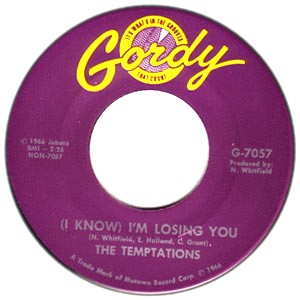
The Temptations – “(I Know) I’m Losing You”

362411
The Temptations – “(I Know) I’m Losing You,” Pop # 8, R&B # 1

By Joel Francis

The list of Motown songs based around a guitar riff is a short one, but this masterpiece should be at the top of that one and several others. Producer Norman Whitfield wrote the song with Edward Holland of Holland-Dozier-Holland, but the Temps’ road manager Cornelius Grant supplied the signature guitar line. Grant’s contribution not only got him co-writing credit, but earned him the spot to play on the record – that’s him you hear on guitar in the song.

The Temptations’ classic line-up was in full effect for this number. David Ruffin nails the vocals. The rasp in his voice makes it sound like he’s been up all night drinking, smoking and thinking about where this relationship has gone. When the rest of the Temps chime in with “looosing you” it sounds like a desperate cry echoing out of the abyss.

The subtleties in Whitfield’s arrangement take center stage in the last minute of the song, as the playing of Eddie “Bongo” Brown and the Funk Brothers horn section take over. Check out that great trombone line and how the long low note underscores the desperate feel of the song. You can hear Ruffin’s world collapsing as the horns ramp up and dance with the voices as the song fades out. The gravity of the situation would be dire if it weren’t so easy to dance to.

Seizing on the rock elements of the song, Rare Earth cut a 10 minute cover for their 1970 “Ecology” album. Motown cut the track down to three minutes and released it as a single that summer where it peaked at No. 7 on the pop charts, one slot higher than the Temptations’ original. The greatest bar band of all time, the Faces, cut their version a year later. It was also released as a single and appeared on Rod Stewart’s blockbuster “Every Picture Tells A Story” album. In 1983, Texas pop group Uptown Girls released a dance version of the song.

Review: Roy Ayers, the Impressions

(Above: Roy Ayers dedicates “Everybody Loves the Sunshine” to Miles Davis.)

By Joel Francis
The Kansas City Star

Before James Brown was black and proud and Marvin Gaye asked what’s going on, the Impressions were a winner who got people ready for the train a-comin’.

The Impressions message of racial harmony and black empowerment laid the roots for the black pride movement in soul and the native tongues/backpacker strain of hip hop today. The soul trio’s performance Saturday at the 40 Acres and a Mule Activity Campus in southeast Kansas City, Mo. capped the first day of the Juneteenth Family Festival, which celebrates the end of slavery in America.

Taking the stage in matching white suits, the Impressions quickly touched the sky with “Move On Up,” a song that established their leader and songwriter Curtis Mayfield as a solo artist. Although the set bounced between Impressions and Mayfield material, the songs were rooted in Mayfield’s late ‘60s/early ‘70s prime.

“Choice of Colors” felt like a hymn and was followed by the buoyant “We’re A Winner,” which got a healthy portion of the crowd of 300 clapping or on their feet. Impression Reggie Torian donned a black cape and white hat while the bass thumped the familiar melody to “Superfly.”

Torian had the unenviable job of taking Mayfield’s place. Although Mayfield, who died 10 years ago, will never be replaced, Torian did a good job capturing Mayfield’s rich falsetto on “I’m So Proud” and “I Loved and Lost.”

In an age of reunion bands and acts carrying on with only one original member, it would be easy to dismiss the Impressions as a Mayfield tribute act. Fortunately, the singers flanking Torian onstage are Fred Cash and Sam Gooden,  the very people who sang, toured and recorded alongside Mayfield back in the day.

Backed by a seven-piece band that included a nearly obscured three-piece horn section, the Impressions were swinging through “Woman’s Got Soul” when a 40 Acres staff member came onstage. Confused, the band ended the song and announced that it was time for them to go.  Ending with a rushed version of “It’s Alright,” they departed 40 minutes after taking the stage.

The Impressions’ set was likely cut short because Roy Ayers’ ran long.  Ayers immediately preceded the Impressions, and while he made his name blurring the lines between jazz and funk in the early ‘70s, his 70 minute set concentrated on the slick R&B that made him a radio staple in the last half of the decade.

Backed by the local octet Ronnie Reed and the Millennium, Ayers took the stage halfway through a jam based on the JB’s “Pass the Peas” and quickly showed why he’s been the go-to guy for everyone from the Roots to Fela Kuti.

Ayers’ playing is at once funky and smooth. His approach to the vibraphone renders it a sonic mutant of drums, piano and guitar. His solos were so captivating that they rendered Millennium’s horn players irrelevant. As Ayers’ hammered away backed by the bare minimum of a groove, the suddenly extraneous horn section were relegated to synchronized dancing duty.

After an instrumental introduction, Ayers took over the mic and romped through four crowd pleasers. “Everybody Loves the Sun” drew many to their feet and Ayers got the rest involved by leading them through the lyrics. “Running Away” stayed in the same vein and featured a lengthy trumpet solo. Ayers was gracious in letting everyone in Millennium take long solos throughout the night.

Ayers ended his set walking through the crowd personally giving out free copies of his new live album. It seemed generous at the time, but ended up being an exchange of live music for recorded. Although the Impressions seemed ready to give more, no one was complaining either.

Setlists:
The Impressions – Move On Up; Mighty Mighty (Spade and Whitey); Choice of Colors; We’re A Winner; Superfly; I Loved and Lost; Gypsy Woman; I’m So Proud; Woman’s Got Soul; It’s Alright

Roy Ayers – Pass the Peas; Everybody Loves the Sunshine; Running Away; Don’t Stop the Feeling; Searching

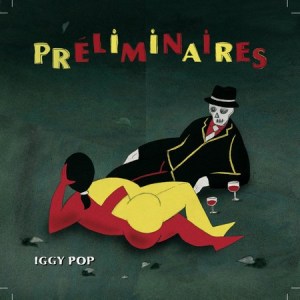
Iggy Pop – “Preliminaires”

IggyPop-02-big

By Joel Francis

Purists of all stripes can relax: Iggy Pop’s much ballyhooed 15 studio album, “Preliminaires,” is not the jazz album Pop talked up before its release.

That said, the album’s lone foray into the genre is actually one of its best songs. Borrowing enough of Louis Armstrong’s New Orleans hot jazz sound and arrangements to earn Satchmo a partial songwriting credit, “I Want to Go to the Beach” is surprising triumph that should throw a nice curveball into dinner party playlists.

The rest of “Preliminaries,” however, is more French café than bebop bistro. Pop opens and closes the album with two spoken word pieces in French and provides two versions of “She’s the Business” – both with and without French narration – that are straight from the Serge Gainsbourg model.

Other tracks find Pop channeling late-period Leonard Cohen for “I Want to Go to the Beach,” dropping in some acoustic Delta blues for “He’s Dead/She’s Alive” and delivering another spoken word piece about how dogs are the ultimate companion based on the Michel Houellebecq novel “The Possibility of an Island.” On the gentle yet foreboding “Spanish Coast,” Pop croons in a deep baritone on what could be a lost Marianne Faithful song. There’s also a cover of Antonio Carlos Jobim’s “How Insensative.”

Try as he might, Pop can’t repress his rock side for the entire album. “Nice To Be Dead” is a solid rocker that is one of the album’s best tracks and very much what one would expect from Pop. The electronic “Party Time” is to cocktail parties what “Night Clubbing” was to nights on the town.

While “Preliminaires” is a departure, it doesn’t arrive out of the blue. Pop first dabbled in jazz on a 1990 duet with Debbie Harry on Cole Porter’s “Well, Did You Evah!” He also did an entire album of jazz-tinged spoken word pieces. And although that album, “Avenue B,” was a disaster, “Preliminaires” succeeds in large part because Pop delivers each track with authority and authenticity.

While Pop’s genre hopping could be a bizarre recipe for disaster, he turns this into a strength, weaving the diverse threads together for a cohesive listen.  The resulting variance in mood and texture is another element that keeps “Preliminaires” from being as stilted and dreary as “Avenue B.” “Preliminaires” greatest strength, though, might simply be that Pop knows when to quit. Most songs hover between two and three minutes and the 12-track affair is over in a brief 36 minutes.

“Preliminaries” will not bump “Lust for Life” or “The Passenger” off the pedestal atop Pop’s catalog and likely won’t even stand as a major entry in his canon, but curious fans interested in what the Wild One can do when stripped of his raw power should find something to like.

The Four Tops – “Reach Out (I’ll Be There)”

Four-tops-reach-out-1966

The Four Tops – “Reach Out (I’ll Be There),” Pop # 1, R&B # 1

By Joel Francis

The dramatic introduction to “Reach Out (I’ll Be There)” owes more than a little to Phil Spector’s Wall of Sound and was Motown’s most cinematic chart-topper to date. While the flute gets the signature melody, check out James Jamerson’s uber-melodic bassline bubbling underneath the bevy of instruments. Paul McCartney gets a lot of (deserved) credit for his inventive basslines, but Jamerson’s brilliant countermelody here rivals anything McCartney came up with the Beatles – OK, maybe not “I Feel Fine” – and should permanently insert Jamerson into the ‘60s bass legends conversation.

The song was written by the white-hot trio of Holland-Dozier-Holland – there were actually other Hitsville employees at the time, although one wouldn’t know it by looking at the Billboard charts – but Norman Whitfield supplied the galloping percussion. Propelled by HDH’s rich arrangement, “Reach Out” starts strong and continues to build through the verse, dropping off and resting slightly before the Tops casually fall into the chorus. Lyrics could almost become superfluous with a melody this strong, but lead singer Levi Stubbs’ words of commitment and devotion are equally compelling.

Although the song became the Tops signature number, Stubbs initially felt his voice was too rough for the song and tried to recuse himself. Fortunately, HDH prevailed on Stubbs to give it a try. Stubbs promptly delivered one of the great vocals in the Motown catalog. Critics who pick on “overproduced” songs like this as examples of the slick Motown sound need to pay more attention to Stubbs’ vocals. His signing is as gritty and soulful as anything in the Stax cannon. Marvin Gaye and Smokey Robinson may sound a little stilted in singing in front of Stax’ incredible house band Booker T and the MGs. It’s not hard to imagine Stubbs being more than up to the task. Unfortunately such cross-pollination never occurred, but with the advent of ProTools and continued merger of major record labels, maybe the Motown and Stax catalog will end up under the same corporate umbrella and someone will give us a recreated session.

Stubbs’ soulful signing on “Reach Out” inspired a lot of people – unfortunately it inspired a lot of the wrong people. While the ability to sing soul music is not racial, a whole lotta white dudes certainly tried to make the case. Elton John, Michael Bolton and Michael McDonald all failed on this number. More successful were Diana Ross, who took her cover into the Top 40 in 1971, and Gloria Gaynor, who did a disco version just four years later.