“Tell Tale Signs” Sheds Light on Legend

(Above: “Dreaming Of You” is one of many stand-out tracks on “Tell Tale Signs.”)

By Joel Francis

If there’s one detail to take away from “Tell Tale Signs,” the eighth installment in Bob Dylan’s Bootleg Series, its that “Mississippi” is as vital to his late-career renaissance as “Like A Rolling Stone” was to his electric rebirth.

The song opens both discs of the set (a third version appears on the bourgeoisie-only $130 “deluxe edition”). We first hear it as beautiful, slow folk ballad that features one of Dylan’s best vocal performances. Play this version for people who say Dylan can’t sing. It next appears as a more wirey, blues-influence tune that bears more of producer Daniel Lanois’ fingerprints.

Anyone who heard Sheryl Crow’s cover of “Mississippi” – she cut it for her “Globe Sessions” album before Dylan included it on “Love and Theft” – knows the song’s durability. It’s interesting to see Dylan add and shave layers before settling on a version suitable for release.

“Tell Tale Signs” is mainly a collection of shading and texture. With a few exceptions, hardcore Dylan fans will be familiar with all its 27 songs. What is surprising is the new contexts Dylan continually places them in.

“Most of the Time” is a gorgeous mood piece on “Oh Mercy,” but the alternate version replaces Lanois’ sheen with an acoustic guitar and places Dylan’s regret and pain at center stage. This motif is repeated across the set. Lanois produced two albums with Dylan and it’s telling that a majority of the cuts on this set draw from those sessions. Although their collaborations were critically acclaimed, Dylan and Lanois often struggled over differences in vision. These alternate versions are closer to the sound and feel that Dylan achieved alone on his ‘00s albums and could be seen as refutations of Lanois’ input.

There are only a handful of unheard songs, but what’s here is worth hearing. Lesser artists could build a career with the material Dylan discards. It’s unclear why the evocative “Dreaming of You” was left off “Time Out Of Mind,” but it is one of the brightest gems in this collection. There are two other “Time” discards – the gospel-flavored “Marching to the City” and the longing tale of lost love “Red River Shore.” “Can’t Escape You” is a sideways love song recorded in 2005, while the traditional “32-20 Blues” is an acoustic folk song from the “World Gone Wrong Sessions.”

The live cuts sprinkled throughout aren’t as illuminating, but still worthwhile. “High Water (For Charley Patton)” is angrier onstage, while an acoustic “Cocaine Blues” is a reminder of the amazing chemistry Dylan had with longtime touring guitarist Larry Campbell.

The inclusion of three previously released soundtrack songs is a bit puzzling. We’re given the superb “Cross the Green Mountain” from “Gods and Generals” and the haunting “Huck’s Tune” from “Lucky You,” but where is the Oscar-winning “Things Have Changed” from the “Wonder Boys” soundtrack? (A live version does appear on the $100 bonus disc.) Dylan’s swinging version of “Red Cadillac and Black Moustache” cut about the same time as “Love and Theft” for a Sun Records tribute would have been nice to have.

But these are minor quibbles. While this set doesn’t tell the faithful anything they don’t already know, that doesn’t mean they’re not worth hearing again in a different light.

The Supremes – “Baby Love,” “Come See About Me”


The Supremes – “Baby Love,” Pop #1, R&B #1
The Supremes – “Come See About Me,” Pop #1, R&B #3

By Joel Francis

(Note: Since the producers of the “Hitsville U.S.A.” box set programmed these tracks back-to-back, we’ll tackle them in one entry.)

For most people, the Supremes are Motown. Label founder Berry Gordy certainly didn’t hesitate to promote and encourage their singles, seemingly above all other releases. Gordy had been looking high and low to find a female face for his label. Early contender Mary Wells defected, and for some reason Martha Reeves and the Vandellas and Gladys Knight and the Pips didn’t fit his image. The answer was right under his nose the whole time.

Supreme Florence Ballard grew up in Detroit with future Temptations Paul Williams and Eddie Hendricks, who were performing as the Primes. Their management wanted a female group, so Ballard formed the Primettes with best friend Mary Wilson, who recruited schoolmate Diana Ross.

In 1960, Ross pestered her old neighbor Smokey Robinson for an audition at Motown. He thought the girls were too green, but snagged their guitarist to join the Miracles. Undaunted, the trio stopped by the Hitsville studio every day after school and bugged Gordy for a spot on his label. The persistence paid off and in 1961 The Supremes released their first Motown single.

The Supremes were hardly the overnight success history has made them out to be. Their first eight singles, released over three years) did absolutely nothing on the charts. In 1964 they were turned over to the Holland-Dozier-Holland machine and their fortunes improved.

“Baby Love” was the Supreme’s second No. 1 hit with HDH. Any listeners that Ross’ opening coo didn’t seduce were captured by the catchy chorus that opens the song. The Funk Brothers shuffle underneath the lyrics imitates the footsteps, but are they walking away or coming back? The sexy saxophone accompaniment seems imply a lover’s return, but Ross is so insistent throughout it’s impossible to be sure.

“Come See About Me” continued the Supreme’s No. 1 success. Yet another HDH song and production, the repeated musical and lyrical theme – a spurned Ross singing over a shuffling Funk Brothers track – the assembly-line criticism holds up in this case. Why did such lovely ladies do to be treated so badly and ignored by the men in their lives?

Both songs have risen to the top of the oldies pantheon, and performed by dozens of artists. As with most of his major hits, Gordy passed both numbers around his stable of singers. For my money, the definitive version of “Come See About Me” is Jr. Walker’s 1967 cover.

Review: Randy Newman

(Above: We’ve got a friend in Randy.)

By Joel Francis

The setup couldn’t have been simpler – a grand piano, bench, monitor, couple of microphones, a small rug. But add Randy Newman to that list and the payoff couldn’t have been greater Saturday night.

Strolling casually onstage at 8 p.m. sharp, Newman rolled into “It’s the Money That I Love.” Throughout the next two and a half hours (counting a 20 minute intermission), he walked through nearly three dozen album tracks and hits like “You’ve Got A Friend In Me,” “I Love L.A.” and “Short People” for a nearly sold-out Folly Theater crowd.

He may have been alone onstage, but Newman had a theater of fervent supporters. The audience of NPR-listening baby boomers was pin-drop quiet on the moodier numbers and clapping and laughing on the upbeat songs. When Newman finally enlisted their help on the chorus of “I’m Dead (But I Don’t Know It)” the enthusiastic response was startling. “You sound like a Queen record,” he joked.

Newman is as good at directing a crowd as he is an orchestra. He shifted effortlessly from the laugh-out-loud satire of “Korean Parents” to the melancholy “I Miss You” – a love song “for my first wife while I was married to my second one,” Newman said – to the upbeat children’s song “Simon Smith.”

Some of the evening’s best lines came between songs. “The World Isn’t Fair” was prefaced by a story about his son’s progressive pre-school where they would “sit around on cushions and come home with lice every couple weeks” He led into “I’m Dead (But I Don’t Know It),” a screed about rock stars who don’t know when to retire, by explaining “no one is applauding at home” and “no one is going to tell Paul his best work was with Wings.”

Every song was a highlight, but several numbers stood apart. “Dixie Flyer,” a song about Newman’s emigration from the Bayou State to Los Angeles, segued into “Louisiana 1927,” a historical recount of the great Mississippi flood. Two songs named after cities, “Birmingham” and “Baltimore,” were powerful paeans to the working class in decaying towns.

Although the generous setlist encompassed Newman’s entire catalog, it tipped toward his last two releases. All but one song from this year’s wonderful “Harps and Angels” was performed. That album provided one of the better political songs in recent memory, “A Few Words in Defense of Our Country.”

Newman let his songs do his stumping for him. Several of the numbers he wrote more than 30 years ago, like the bomb-happy “Political Science” and the plea “Mr. President (Have Pity on the Working Man)” sadly have a contemporary relevance.

Today, Newman is better known for his sweeping film scores and Pixar songs than stinging lyrics and clever songwriting. He did OK with only 88 keys to replicate his orchestrations. His more complicated songs, like “A Piece of the Pie” and “Harps and Angels” survived the transition more or less intact. “Love Song (You and Me)” actually sounded better stripped down.

Like many of his generation’s best songwriters – Bob Dylan, Neil Young and Tom Waits come to mind – Newman’s froggy voice is an acquired taste that is easily parodied. Saturday’s magical immersion in Newman’s world of five centuries of European history in three minutes (“The Great Nations of Europe”), senior forgetfulness (“Potholes”) and erotic humor (“You Can Leave Your Hat On”) was more than enough to convert the few who carried any reservations into the theater and leave the devoted a performance to cherish.

Setlist: It’s the Money That I Love/My Life Is Good/Marie/Short People/Birmingham/Bad News From Home/The World Isn’t Fair/Korean Parents/I Miss You/Simon Smith and the Amazing Dancing Bear/A Few Words in Defense of Our Country/Laugh and Be Happy/Losing You/You Can Leave Your Hat On/I’m Dead (But I Don’t Know It)/Political Science/<intermission>/Mr. President (Have Pity on the Working Man)/The Great Nations of Europe/Potholes/In Germany Before the War/Baltimore/Only A Girl/Love Story (You and Me)/Real Emotional Girl/You’ve Got a Friend in Me/Harps and Angels/Dixie Flyer/Louisiana 1927/Guilty/I Love L.A./God’s Song (That’s Why I Love Mankind)/A Piece of the Pie/I Think It’s Going to Rain Today/<encores>/It’s Lonely at the Top/Feels Like Home

Below: Because you were going to Google it anyway….

Dave Brubeck and Charles Mingus – “Non-Sectarian Blues”

By Joel Francis

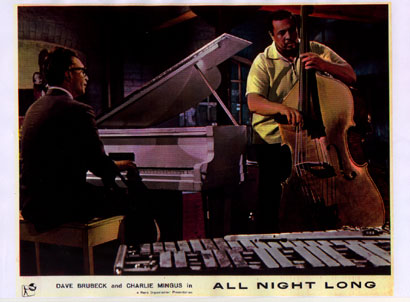
The unlikely pairing of Dave Brubeck and Charles Mingus at a London film studio should have been a collision of worlds on par with the big bang.

In the early sixties, Brubeck was rewriting the jazz songbook with his legendary quartet that featured Paul Desmond, drummer Joe Morello and bass player Eugene Wright. Signed to Columbia Records, home to both Miles Davis and Doris Day, their “cool jazz” was both critically acclaimed and extremely accessible. In other words, it was jazz both hardcore fans and housewives could appreciate.

Charles Mingus, on the other hand, was the dark prince from the underbelly of the genre. His dense, avant-garde approach carried discordant melodies and boasted nearly impenetrable titles like “Pithecanthropus Erectus” and “If Charlie Parker Were a Gunslinger, There’d Be a Whole Lot of Dead Copycats.” He was on the threshold of a three-album deal with Impulse Records, the jazz label John Coltrane helped transform into the bastion of cutting-edge, experimental music.

Although Mingus and Brubeck’s music was world apart, the bassman and pianist first crossed paths in the post-War San Francisco jazz scene. The two met again in 1962 at Pinewood Studios in London.

The unfathomable union of Brubeck and Mingus occurred under the most commercial circumstances. Brubeck had been hired to write the score for “All Night Long,” a modern telling of “Othello” starring Richard Attenborough. In the liner notes to the 1991 Brubeck box set “Time Changes,” he describes their encounter.

“My contract for the film specified I would not play with Charlie Mingus, because I knew how demanding Charlie could be and I just wanted to avoid it. It was out of respect,” Brubeck said.

“And fear,” he added.

Mingus, who had also been hired to score certain scenes, kept bugging the director to play with Brubeck. Finally, Brubeck relented – with three stipulations: no rehearsal, no synching and no overdubbing. Everything had to be live and off-the-cuff.

With those rules in place, the pair decided upon a Mingus composition. “Non-Sectarian Blues” begins with Mingus thumping borrowed bass, walking the beat as Brubeck joins in on the piano. Mingus can be heard grunting and shouting encouragement to Brubeck as the pair play off each other with staccato piano riffs and pulsing, aggressive baselines. The result is so natural and engaging it’s hard to believe these men came from such seemingly disparate camps.

Although the song was recorded in1962, the performance remained unheard outside theaters until the Brubeck collection “Summit Sessions” was released in 1971.

“When it was over, Charlie picked me up off the floor and gave me a bear hug,” Brubeck said. “It was wonderful.”

Velvelettes – “Needle in a Haystack”

Velvelettes – “Needle in a Haystack,” Pop #45

The real action in “Needle in a Haystack” is happening away from the microphones and behind the glass. This song was the first single the late Norman Whitfield’s produced for Motown. Whitfield got his start at the label as a songwriter, co-writing Marvin Gaye’s hit “Pride and Joy,” but he made his name as a pioneering producer on the edge of the psychedelic soul movement.

In keeping with Berry Gordy’s assembly line mentality, the song sounds very much like the other Motown productions of the time. None of the experimental flourishes that mark Whitfield’s groundbreaking time with The Temptations are present. The promise of sounds to come, however, makes the song historically worth hearing.

History aside, there’s little that makes “Needle in a Haystack” stand out. The single was the Velvelettes’ second single for Motown and first charting effort. Although they had a follow-up hit, the Velvelettes, like Carolyn Crawford, are a footnote in Motown’s great history. – by Joel Francis

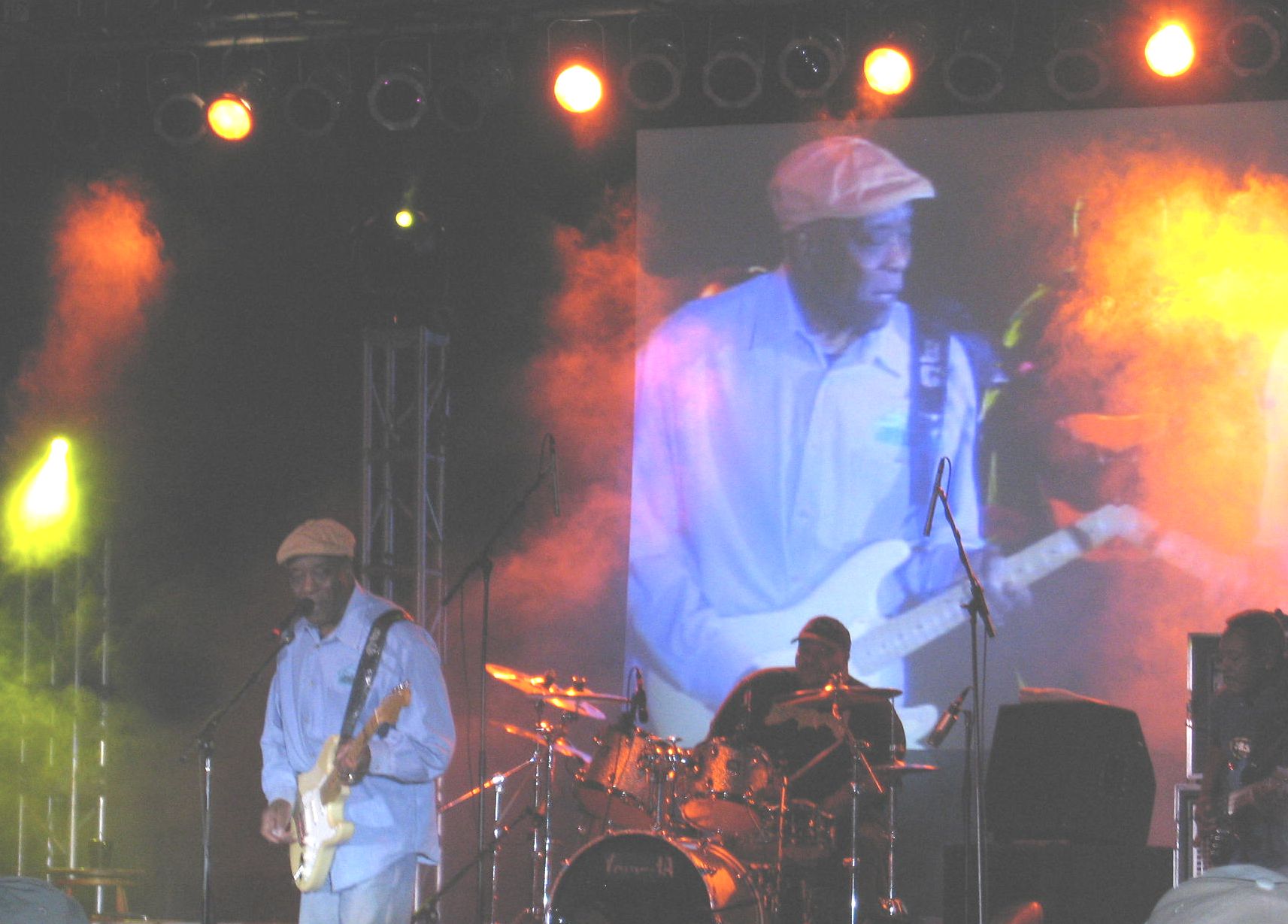
Review: Buddy and Bettye at Roots N Blues N BBQ Fest 2008

By Joel Francis

Buddy Guy

Buddy Guy is to the electric guitar what a match is to kerosene.

The 68-year-old blues legend lit into opening number “Best Damn Fool” like a house afire and closed out the Roots ‘n Blues ‘n BBQ Festival Saturday night in Columbia, Mo. with 90 minutes of barn-burning blues that skimmed through the encyclopedia of the genre.

After starting with a cut from his new album, “Skin Deep,” Guy tore through his classic “Hoodoo Man.” The song culminated with a guitar duel between Guy and his backing guitarist, who was more than capable of holding his own. After whipping the song into a frenzy, Guy put a finger to his lips and hushed both the crowd and his band. In whisper silence he noodled into “Love Her With a Feeling,” which merged with “She’s Nineteen Years Old.”

Guy’s mind is as frenetic as his fingers. He rarely plays a song all the way through, opting to mine the most joyous parts, then skip along to the next number that races through is brain. He treated the audience to a nearly two full minutes of his signature number “Damn Right I’ve Got the Blues,” before remembering he played Peggy Lee’s “Fever” at his last gig in Columbia 15 years ago and gave them all of that instead. No one seemed to mind.

“Boom Boom,” a tribute to John Lee Hooker, suddenly inspired “Strange Brew” and a shout-out to Eric Clapton and Cream. Guy hopped offstage and wandered through a shoulder-to-shoulder crowd a block deep and half a block wide to deliver “Drowning on Dry Land” and B.B. King’s “Rock Me Baby.”

Like a woman plied with one drink too many, Guy was able to coax things from his guitar beyond its natural limits. Armed with a cream-colored Fender Stratocaster instead of his trademark polka dot model, Guy hopped on a wah wah peddle to riff over the intro of Jimi Hendrix’ “Voodoo Child” before launching into Muddy Water’s “I Just Want To Make Love To You.”

The night ended with “Out in the Woods,” a boast about taming wild beasts. It was a great closing number, but also slightly redundant – at this point, Guy no longer had to prove how bad he was.

Bettye LaVette

In a perfect world, Bettye LaVette would be enjoying the same kind of success Tina Turner receives today.

After 47 years in the business and five years into her renaissance, LaVette’s raspy voice – no doubt enhanced by years of working smoky dives – is informed and enhanced by the pain and frustration of her wilderness years.

Her performance of early songs like “My Man – He’s A Lovin’ Man,” “Let Me Down Easy” and “Right in the Middle (Of Falling in Love)” hint at the career that could have been. But Lavette is not bitter. She can deliver a line like “I’ve been bruised, hurt and cheated on/ but still they couldn’t break me” (from “Close As I’ll Get to Heaven”) with both honesty and a smile.

Clad in a sleeveless black shirt and tight black pants, LaVette swayed and strutted across the stage channeling every note from her band, completely invested in every lyric. She added a swagger to her reading of “Joy” that songwriter Lucinda Williams could only dream of. Likewise, she added a level of sensuality to Leonard Cohen’s “You Don’t Know Me At All” unheard in the original. The sashay of her hips to a sizzling guitar solo said more than any of the verses.

Two years ago, LaVette put on a breathtaking performance at the Folly Theater in Kansas City. She was even better in the open air in Columbia and her band was the difference. For the earlier date, LaVette was backed by musicians who, like her, had been catapulted from juke joints to concert halls. Unlike her, they were not ready for the spotlight. Her new, four-piece band was tighter, funkier and able to keep up. They added a wash of psychedelic soul to “Sleep to Dream” and a superb gospel feel to “Choices.”

LaVette closed her 75-minute set with a riveting a cappella performance of a Sinead O’Connor song that summed up her life today: “I have all that I requested/And I do not want what I haven’t got.”

Doyle Bramhall

Drummer Doyle Bramhall grew up playing with the Vaughan brothers, so it makes sense that his Texas blues oscillate between the smooth strut of Jimmie and the rough and rocky bluster of  Stevie Ray. Unfortunately, there’s not much in between.

His five-piece band could turn it up when needed, like on a spirited cover of “Keep A Knockin’,” but for the most part they were content to keep the meat in the smoker instead of taking it out and slathering on the sauce.

Bramhall’s hour-plus set ran through songs from his solo catalog like “Top Rank Boxing” and “Cryin'” and a couple numbers he wrote with Stevie Ray. Predictably, “Change It” and “The House Is A Rockin’,” which closed the set, drew the greatest cheers.

Carolyn Crawford – “My Smile is Just a Frown (Turned Upside Down)”

Carolyn Crawford – “My Smile is Just a Frown (Turned Upside Down),” R&B #39

Smokey Robinson didn’t miss very often in the early ‘60s, but for some reason this number just didn’t hit like “Two Lovers,” “The One Who Really Loves You.” Why Robinson was able to jumpstart Mary Wells’ career with the aforementioned numbers while Crawford’s stalled is a mystery. All the right elements were in place – Crawford’s voice is delightful and inviting (perhaps the wrong mood given the lyrics) and the impeccable Motown sound hits in all the right places.

“My Smile” was the second and most successful of Crawford’s three Motown singles. After her departure from the label in 1965 she went back to being a backing vocalist, popping up in 1978 on Hamilton Bohannon’s disco single “Let’s Start the Dance.” That song reached No. 56. — by Joel Francis

Reunion bands: Ain’t nothing like the real thing

(Above: The two original members of Lynyrd Skynyrd and five other guys play “Free Bird.”)

By Joel Francis

When the Temptations and Four Tops took the stage Saturday night with only one original member in each ensemble, it raised questions of truth in advertising. Can a band be billed by its legendary name if only one of its musicians is an original legend?

Few bands are as fortunate as Los Lobos and U2 to have retained the same personnel since their debut. Some bands, like Wilco, have a different lineup on nearly every album.  But the reunion craze has accelerated hiring ringers to fill in for dead or uncooperative musicians.

When Journey played the Midland a few weeks ago, longtime singer Steve Perry had been replaced with Filipino Arnel Pineda, who was 8 years old when the band’s first album came out. No one complained, but Pineda’s job is essentially to sound like Perry while founding guitarist Neal Schon and the rest of the band deliver their signature sound.

Similarly, Yes were primed for a 40th anniversary tour when lead singer Jon Anderson fell ill. Rather than cancel the tour, the remaining members, who include Oliver Wakeman, son of original keyboardist Rick Wakeman, recruited a new singer off YouTube.

The majority of fans will tolerate a minor substitution. There were no grumbles when bass player Eric Avery sat out Jane’s Addiction’s second go-round. Most fans will recognize that age and time will prevent everyone from taking part. But when the skeleton of the original crew drag new faces out under the old name, it starts to take advantage of the people who kept the hunger for a reunion alive.

There’s also a slight double-standard in play. Few Beatles fans would be satisfied with a Beatles “reunion” featuring Paul, Ringo, Julian Lennon and Dhani Harrison, but The Who have completed not one but two successful (read: lucrative) tours minus the late John Entwistle and Keith Moon. Of course a true Fab Four reunion never happened, while The Who have launched a handful of “farewell” tours, but the rhythm section of Moon and Entwistle defined The Who’s sound just as much as John and George did for the Beatles.

Swapping drummers and bass players is one thing, but the road to finding a new frontman is fraught with peril. INXS failed miserably in their reality TV quest to carry on after the premature death of Michael Hutchinson. However, 14 years after Freddy Mercury died, Queen – minus drummer John Taylor – reconvened with former Free and Bad Company vocalist Paul Rogers. Many of the band’s East Coast concert date sold out quickly.

When Ray Manzarek and Robby Krieger hired Cult singer Ian Astbury to hit the road as The Doors they were faced with a lawsuit from drummer John Densmore and forced to tour as Riders on the Storm. The moniker didn’t alter any setlists, but it at least let the fans know they weren’t getting the same guys that worked together in the ‘60s.

Then there are the jazz orchestras that continue to tour despite the death of their bandleader. The Count Basie and Glenn Miller orchestras draw decent crowds when they visit the area, despite Miller’s disappearance during World War II and Bill Basie’s death a mere 25 years ago. The Gem Theater will host a Jazz Messengers reunion concert on October even though bandleader Art Blakey died in 1990.

The reason why a musician will resurrect his old band with ringers is obvious: Billy Corgan will sell a lot more tickets and albums as the Smashing Pumpkins than he would alone. And while there’s no clear-cut solution, I think this is a rare example of capitalism and artistry joining forces to provide the ultimate answer.

If a band’s catalog is strong enough, fans won’t mind shelling out $30 to $50 as they did Saturday night at Starlight to hear someone else sing “My Girl” and “Baby I Need Your Loving.” On the other hand, if bands plug on minus crucial components, they might be confined to the state fair/town festival circuit Three Dog Night and the Guess Who have been riding for years.

Review: The Temptations and Four Tops

(Above: Are they still tempting? “Papa Was A Rolling Stone” in 2008.)

By Joel Francis
The Kansas City Star

Halfway into his band’s set Saturday night at Starlight, Otis Williams, the last living original member of the Temptations, dedicated the evening’s performance to the late Motown producer Norman Whitfield.

It was fitting. Whitfield wrote several of the hits showcased during the night, like “Cloud Nine,” “Papa Was A Rolling Stone” and “Ain’t Too Proud To Beg.” It also matched the unofficial theme of the night: honoring the contributions of the departed.

The absence of late Temptations frontmen Eddie Kendricks and David Ruffin was obvious from the opening notes of “The Way You Do The Things You Do.” The group sounded good and the performance was strong, but something was missing.

Your verdict on the success of the show depends on how well you thought lead singer Bruce Williamson did filling some impossibly large shoes. It would be easy to cynically dismiss the night as nothing more than overblown karaoke, but it’s very hard to ignore the energy and delight they delivered to the crowd. The truth is these songs are so strong they sound good no matter who is singing them.

After opening with a cover of Marvin Gaye’s “How Sweet It Is (To Be Loved By You),” the Temps plowed through their classic catalog for nearly 30 minutes without taking a break. Every song had everyone on their feet, singing along.

Backed by a 10-piece horn section and four-piece band, the vocal quintet nimbly hopped from the propulsive “Ball of Confusion” to the tenderness of “I Wish it Would Rain” and the frustration of “Can’t Get Next To You.”

The only time the band veered from their prime years was to deliver a couple ballads. They also spiced up the set by performing a couple lesser-known numbers from their early Motown years. By the time they rolled into “My Girl” near the end of their 90-minute set it felt like the perfect conclusion. Unfortunately the song was followed by “Can I Get A Witness,” another Marvin Gaye cover. Despite its gospel flavor, the anti-climactic number trigged an exodus for the parking lot.

The Four Tops kicked off the night with a one-hour set. Although they sported as many original members – one – as the Temptations, they did not fare as well. The retirement of longtime lead singer Levi Stubbs was accentuated by slick production that was more Branson than Motown. Save for a pair of medleys that bookended the set, the band’s 1960s heyday was bypassed for ballads that bogged the momentum.

A tour-de-force cover of Heat Wave’s “Always and Forever” that included a long spoken introduction and tender, affecting vocals from Stubbs’ replacement Theo Peoples, drew the quartet’s biggest applause.

Although Starlight was far from sold out – partitions blocked off the back seating section and plenty of other empty chairs remained – few fans seemed concerned by the new faces singing the old songs. The consensus seemed to be, if these guys weren’t keeping the music and memories alive, would would? It’s a good question that doesn’t have an easy answer.

Setlists: Four Tops – Baby I Need Your Loving/Bernadette/It’s the Same Old Song/Just Walk Away/Still Water/Something About You/Ask the Lonely/Ain’t No Woman (Like the One I Got)/Always and Forever/Reach Out I’ll Be There/Standing in the Shadow of Love/I Can’t Help Myself (Sugar Pie Honey Bunch)

Temptations: How Sweet It Is (To Be Loved By You)/The Way You Do The Things You Do/Ain’t Too Proud To Beg/Ball of Confusion/I Wish It Would Rain/Just My Imagination/Papa Was A Rolling Stone/Can’t Get Next To You/You Are So Necessary In My Life/Get Ready/Treat Her Like A Lady/You’re My Everything/The Girl’s Alright With Me/Cloud Nine/Psychedelic Shack/My Girl/Can I Get A Witness

Review: Robert Plant and Allison Krauss


Above: Plant and Krauss get “In the Mood.”

By Joel Francis

Robert Plant may never outlive the shadow of his onetime partner Jimmy Page, but Tuesday night at Starlight he showed unimaginable growth with his unlikely new muse, bluegrass legend Allison Krauss.

The pair’s 23 song, two-hour set explored nearly every facet of American music with a subtly, nuance and beauty Plant’s former four-piece could only dream of. From a rockabilly cover of Ray Charles’ “Leave My Woman Alone” to Leadbelly’s “In the Pines” the pair’s voices waltzed in perfect, egoless harmony.

Clad in all black, Plant slinked around the stage like a cat burglar before spontaneously hopping into a spry dance step. Krauss stood in contrast in a bright floral dress, sporting a wide smile and, frequently, a violin on her shoulder.

“Black Dog” was reworked with a banjo delivering the main riff as Plant and Krauss’s voices circled each other on the call-and-response chorus. A spellbinding reading of “Killing the Blues” in the encore set may have been the ultimate demonstration of their musical synergy.

The hammer of the gods may have been missing, but classics like “When the Levee Breaks” (to which Plant snuck a snippet of Bob Dylan’s “Girl of the North Country”) and “Black Country Woman” had plenty of thunder. A cover of Townes Van Zandt’s “Nothin'” outrocked ‘em all, though. A harrowing tale of addiction much in the same vein as John Lennon’s “Cold Turkey,” one could feel the symptoms of withdrawal dripping from the stage as Plant unleashed a couple of his trademark primal wails.

It would be easy for a rocker of Plant’s status to command the stage and bring a captivating performance, but he was very much a team player. He turned the stage over to Krauss for a stunning a cappella reading of “Down to the River to Pray” (boosted by the stellar backing vocals of guitarist Buddy Miller and fiddle/banjo/mandolin player Stuart Duncan) and a haunting version of Tom Waits’ “Trampled Rose.” Even bandleader T-Bone Burnett, producer of Krauss and Plant’s “Raising Sand” album, the “O Brother Where Art There Soundtrack” got the spotlight for a song.

Other highlights included a chipper “Gone Gone Gone” performed in front of a shimmering gold curtain that helped the song feel like an autumn road trip. Plant’s solo hit “In the Mood” was married to the Irish melody of “Matty Groves” and was a welcome surprise. “The Battle of Evermore” was the rare Zeppelin number that wasn’t radically reworked.

The assembly of Miller, Duncan, Burnett, acoustic bass player Dennis Crouch and drummer Jay Bellerose defy the term “backing band.” Their collective resumes include work with Waits, Elvis Costello, Beck, Emmylou Harris and Steve Earle, to name a few. Amazing songwriters and musicians in their own right, each of these guys are more than capable of mesmerizing solo performances. Together, they might be the greatest band of ringers ever assembled.

The wealth of material worked up for this tour begs for proper release on an encore collaboration or concert release. The entire evening was a treat that deserves to be relived as many times as possible. Hopefully the tour of a lifetime will be preserved for even longer.