Review: The Flaming Lips – “Christmas On Mars”


Above: The “Christmas On Mars” trailer. You have been warned.

By Joel Francis

Blame the Flaming Lips for contributing to Christmas creep. Their long-awaited (holiday?) sci-fi flick lands on DVD next Thursday and will be shown on the big screen in select theaters around the country all month. If you live in Kansas City, Mo., you have two opportunities to see the film. Screenland will host viewings at 9 p.m. on Friday, Nov. 21 and at 8 p.m. on Saturday, Nov. 22. Below is a reprint of my review of a sneak peek screening at Wakarusa last summer.

“Christmas On Mars” – Friday night, the Flaming Lips tent

The chance to catch a band-hosted screening of the Flaming Lips’ seven-years-in-the-making movie “Christmas on Mars” overpowered the need for sleep for many Wakarusa campers.

Shortly after the Lips’ spectacular set on the Sun Down Stage, 200 fans lucky enough to snag a free ticket earlier in the evening were ushered into the band’s large “Eat Your Own Spaceship” tent. Inside, it felt a lot like summer camp. Everyone sat on long wooden benches and roadies handed out popcorn.

After a short personal introduction from lead Lip Wayne Coyne and a longer recorded interview, the film finally started around 1 a.m.

The movie follows the descent of paranoia and psychosis on a crew of astronauts in their Martian space station on Christmas Eve. Multi-instrumentalist Steven Drozd plays the main astronaut while Coyne portrays an emerald-hued, antennae-sporting Martian who swallows an asteroid, is detained by the space crew and then forced into the role of Santa Claus.

The results are pretty much what you’d expect from a group with no acting or screenwriting background, paying for their production as they go. Fans started sneaking out almost as soon as the rock-show volume movie started. When I finally succumbed an hour into the movie a herd of fans were seated on the ground outside the tent for the next showing. Live and learn.

The Music of James Bond: Part Two – The Seventies

(Above: Blondie’s superior, unused version of “For Your Eyes Only.”)

By Joel Francis

When Roger Moore replaced Sean Connery as James Bond, the producers retooled the series to include the grittiness of the recent Dirty Harry movies and “The French Connection.” In “Live and Let Die” Bond chases a corrupt Caribbean politician who deals heroin and happens to be black. They also snagged one of the biggest stars on the planet to write and perform the latest Bond theme – ex-Beatle Paul McCartney.

McCartney’s theme song reunited him with Beatles producer George Martin, who scored the film. Martin was the first person other than John Barry to score a Bond film.

Not only was McCartney’s song the first rock Bond theme, but it was the first one to be written and performed by the same person. The film’s producers had wanted a soul singer, but Martin prevailed and McCartney was allowed to sing. The song starts with a soft melody and understanding lyrics, before bursting into a whirlwind of strings and horns. The change in tempo and texture underscores the protagonist’s philosophical change, from “live and let live” to “live and let die.” The song is a staple of McCartney’s live shows and was performed at his Super Bowl halftime concert in 2005. The less said about Guns N’ Roses 1991 cover, the better.

Barry was back in the scoring saddle for “The Man With the Golden Gun.” He teamed with lyricist Don Black on the title song and the results were predictable. British singer Lulu made her name with the No. 1 hit “To Sir With Love,” the title song to Sidney Poitier’s 1967 film, but she’s given little to distinguish herself with here. Deep in the mix, a guitar spews crazy licks underneath a battalion of churning trombones, but Lulu’s vocals stay safely in the Bassey mold.

Proto-shock rocker Alice Cooper claimed his song “The Man With the Golden Gun” was written for the film but rejected by its producers. The song is an aggressive slab of hard rock completely out of step with anything the producers had used before, so its unsurprising Cooper’s version didn’t appear until it was included on the tastefully titled “Muscle of Love” album.

In 1977, Carly Simon became the second American (after Nancy Sinatra) to sing a Bond theme. “Nobody Does It Better” was the first Bond theme without the same name as its movie, in this case “The Spy Who Loved Me,” although songwriters Carole Bayer Sager and Marvin Hamlisch did work the title into the lyrics.

The song revitalized Simon’s career which had been in a five-year gradual decline since her 1972 hit “You’re So Vain.” It was No. 1 on the adult contemporary charts for seven consecutive weeks and was nominated for two Grammys.

Despite its soft rock arrangement, “Nobody Does It Better” works well as a Bond theme. Writing about the character instead of the film is a refreshing change. Simon’s vocals are nearly devoid of the sex most female Bond singers infused in their delivery. Simon’s approach is more of devotion than lust, which not only supports the arrangement, but makes the song more honest.

Moonraker” paired Bassey and Barry for the final time. Bassey’s third turn on a Bond theme happened after Johnny Mathis declined the song at the last moment. Her delivery is much smoother than on “Diamonds Are Forever” and “Goldfinger,” but it compliments Barry’s lush orchestration. For the first time, Barry’s horns are pushed far to the background. His strings are suspended, weightless in space, and the arrangement is accentuated with a light touch of disco.

The formula of pairing the score composer with a lyricist and giving the song to a pop singer was very much intact as the Bond film franchise entered the ’80s (and its third decade) with “For Your Eyes Only.” Unfortunately, the results were not as memorable. Sheena Easton set a precedent when she became the first singer to perform the title song onscreen. The gauze of synthesizers and strings and forced melody have rightfully relegated the song to footnote status. The producers would have been better served accepting Blondie’s title submission, which appeared on their 1982 album, “The Hunter.”

For his 13th Bond film, Barry turned to Tim Rice, Andrew Lloyd Weber’s lyricist, for help. The result, “All Time High,” was sung by Rita Coolidge. Like Carly Simon’s “Nobody Does It Better,” “All Time High” spent multiple weeks at No. 1 on the Adult Contemporary chart and does not share the its film’s title (in this case “Octopussy“). Unlike Simon’s song, though, “All Time High” hit the all-time low in Bond songs.

Keep reading:

The Music of James Bond: Part Three – The ’80s and Beyond

The Music of James Bond: Part One – The Classic Years

Below: Alice Cooper’s alternate “The Man With the Golden Gun.”

“Tippecanoe and Tyler Too:” Original Campaign Music

Above: They Might Be Giants do “Tippecanoe and Tyler Too.”

By Joel Francis

The eve of Election Day means the airways will soon no longer be clogged with campaign ads, and liberal songwriters can stop suing conservative politicians for hijacking using their music.

Music has a long relationship with politics, but the idea of the modern campaign song started with 1840s “Tippecanoe and Tyler Too.” The song, written by an Ohio jeweler, celebrated Whig presidential candidate William Henry Harrison’s role in the 1811 Battle of Tippecanoe. The Whigs’ election themes were timeless: War hero Harrison was just the man (of the people) to stand up to incumbent president democrat Martin Van Buren – an East Coast-elite, Washington insider! – who’d lived on the public dole too long.

The Battle of Tippecanoe occurred when some states were literally battlegrounds. As governor of the new Indiana Territory, Harrison negotiated the title to Indian lands in hopes enough whites would settle into the area to qualify it for statehood. These negotiations culminated at the Treaty of Fort Wayne in 1809.

Outraged, Shawnee leader Tecumseh preached resistance to the treaty and tried to get Harrison to nullify the agreement. Harrison, whose father-in-law was a congressman who held a healthy second job as developer and seller of many of the lands claimed in the treaty, was unmoved. On Nov. 8, 1811, Harrison led stationed troops at Tippecanoe in an attempt to intimidate the insurgent Indians. Undaunted, the natives charged Harrison’s encampment, but were beaten back. After they were forced to abandon their settlement, Harrison’s troops burned the Indian town to the ground.

Tecumseh, who was visiting the South at the time, continued to secretly build an army and wage war against the United States. He aligned with the British during the War of 1812. Tecumseh was killed in 1813 at the Battle of the Thames in Ontario near Detroit, when his tribal army was overtaken by Harrison’s troops.

It’s hard to believe these events would inspire a song more than a generation after the fact, especially since the 1840 election was essentially a rematch Van Buren and Harrison’s 1836 contest. That election was the only time a major party placed more than one candidate on the ballot. Although Harrison led the ticket in most states, the plan was to deny Van Buren the popular vote and let the Whig-controlled House decide the election. The plan backfired when Van Buren squeaked out barely 51 percent of the vote.

The lyrics of “Tippecanoe and Tyler Too” mention hard cider and log cabins, a reference to Harrison’s home whiskey distillery during his decade of retirement in Ohio. Tyler is Harrison’s running mate, John Tyler, who later served as 10th president of the United States. Little Van, the used-up man, is, of course, Martin Van Buren.

At just 90 seconds, the song is basically an extended jingle, but it’s a catchy and effective one. The repetition and echo of the lyrics not only reinforce its message, but lodge the melody in your head. It’s not hard to imagine Whigs tauntingly whistling this tune for months after the election.

Van Buren’s camp countered with a song of their own. Set to the tune of “Rockabye Baby,” this is the second of its three verses:

Rockabye, baby, when you awake
You will discover Tip is a fake.
Far from the battle, war cry and drum
He sits in his cabin a’drinking bad rum.

The song failed to motivate voters, however, and Harrison carried 19 states and 53 percent of the vote for the win. Van Buren only carried seven states; Missouri, the western-most state in the union, was one of them.

Harrison only served 32 days in office, but the impact of his song lives on today.

The Music of James Bond: Part One – The Classic Years

(Above: Johnny Cash’s alternate version of “Thunderball.”)

By Joel Francis

After nearly 50 years of slugging spies and bedding beauties, the premier of a James Bond movie has become an cultural event. The opening credit sequences of these films are events among themselves. Even though some of the biggest names in rock have performed a Bond theme song, the producers have always treated the number as a throwback to the Broadway and pop numbers of the 1950s.

When Bond made his big screen debut in 1962’s “Dr. No,” Ray Charles’ “I Can’t Stop Loving You,” variants of “The Twist” and the Four Seasons topped the Billboard charts. The theme song for “Dr. No” was a bizarre calypso arrangement of “Three Blind Mice.” Thankfully, the nursery rhyme is preceded by Monty Norman’s immortal James Bond theme. Norman’s theme was reinterpreted in every Bond film thereafter. It’s still exciting to hear the surf guitar race into the explosion of horns. The song is over-the-top, suspenseful and dangerous, but the swinging drums winkingly confide in the viewer that everything is in good fun.

Bond was back the following year with “From Russia With Love.” This time, producers hired Broadway songsmith Lionel Bart, best known for his work on “Oliver!,” to write an original theme song. Bart’s lyrics, coupled with soundtrack composer John Barry’s music, are the embodiment of the bachelor pad/Playboy image. Singer Matt Monro made his name performing in the nightclubs, caberets and lounges Bond would have haunted offscreen. Their lounge music is the embodiment of the bachelor pad/Playboy image that reeks of wood paneling, shag carpeting, hi-fi stereos and rotating beds. In other words, it’s straight out of Bond’s world.

Three-time Bond songstress Shirley Bassey made her debut with “Goldfinger.” Although the film hit screens during the year of Beatlemania, there is no hint of rock and roll in the title song written by the musical theater team of Leslie Bricusse and Anthony Newley. Barry’s bombastic horns are matched only by Bassey’s brassy delivery. “Goldfinger” is not only one of the most memorable Bond songs of all time, but it’s also the first memorable Bond song.

Barry and Bricusse didn’t stray far from the template when they approached Tom Jones to sing “Thunderball.” Jones puts his pelvis in the delivery, but the arrangement is essentially “Goldfinger”-redux. While they may have been working with a formula, it’s a strong one – “Thunderball” works nearly as well as “Goldfinger.”

An alternate “Thunderball” song was given to Johnny Cash to perform, but rejeced by the film’s producers. It seems even at the peak of his pills phase, Cash was more man than Bond could handle.

Rock and roll finally appeared in the serpentine guitar lick that opens Nancy Sinatra’s performance of “You Only Live Twice.” Even with the guitar, Sinatra’s sexy vocals rest on a pillow of strings accentuated by a harp. The number was Barry and Bricusse’s third consecutive teaming, and constructed from fragments of 25 separate takes. Bassey must have felt left out, because she covered the song in 2007, following in the footsteps of Coldplay, Bjork and Robbie Williams (who sampled the original for “Millennium”).

 “On Her Majesty’s Secret Service” is a misfit in the Bond cannon, musically and theatrically. The title sequence is a throwback to the orchestral opening of “Dr. No.” Barry’s instrumental theme is notable for its deep Moog synthesizer notes, chugging rock bass and the soaring trombone melody, later taken over on trumpet. Barry, who scored every Bond film to this point, composed a great alternate to Norman’s original Bond theme. During the mid-’90s electronic craze, the Propellerheads created a 10-minute remix of the song.

Barry teamed with Burt Bacharach’s lyricist Hal David to write the film’s love theme, “All The Time in the World.” Saturated by fingerpicked guitar and a saccharine string section, the song couldn’t be further from jazz, despite the vocals of Louis Armstrong. Satchmo is in full-on “What A Wonderful World” mode. Lesser singers would buckle under the weight of the arrangement, but Armstrong is able to emote the lyrics perfectly, even if someone else is playing the trumpet solo.

As the calendar flipped to the 1970s, Bassey was given her second stint on a Bond theme. “Diamonds Are Forever” is the sexiest Bond theme since Sinatra’s. Barry’s arrangement is full of the soft strings and horn punctuations that viewers had come to expect, but he tosses in an unexpected splash of funk at the halfway point. The wah wah guitar and subtle nod to Isaac Hayes’ Oscar-winning “Theme from Shaft” could be what drew Kanye West to the song when he sampled it for his 2005 hit “Diamonds of the Sierra Leone.”

Keep reading:

The Music of James Bond: Part Two – The Seventies

The Music of James Bond: Part Three – The ’80s and Beyond

Velvelettes – “He Was Really Sayin’ Somethin'”


Velvelettes  – “He Was Really Sayin’ Somethin’,” Pop #64, R&B #21

By Joel Francis

The Velvelettes’ final single for Motown was their most successful effort. Like their previous hit, “Needle In A Haystack,” this is another Norman Whitfield production. Unlike the house “assembly line” production on Whitfield’s earlier effort, this song bears more of his fingerprints. Listen to the punch of the brass, especially the deep notes from the trombones. That sound would define songs like “Get Ready” and Whitfield’s early collaborations with the Temptations.

 “He Was Really Sayin’ Something” is a step up on the writing side as well. Whitfield and Mickey Stevenson are joined by Eddie Holland of the famous Holland-Dozier-Holland team.

It took the Velvelettes two attempts to cut this single. An earlier performance cut in the fall of 1964 was discarded for this take, which was released two days after Christmas. Despite the questionable launch time, this was the group’s highest-charting single and the band was given an opening slot on an all-Motown tour. Life on the road was not sweet, however. The members disagreed about their musical direction and drifted apart. Lone founding member Carolyn Gill recruited two new members and attempted to press on, but Motown was wary of the group’s potential. Two follow-up singles failed to chart, while their final effort scraped No. 43 on the R&B charts in 1966. By then the Supremes had established themselves as Motown’s premier female group and the Velvelettes were cut loose.

In 1982, Bananarama revived the song and had a Top 5 U.K. hit.

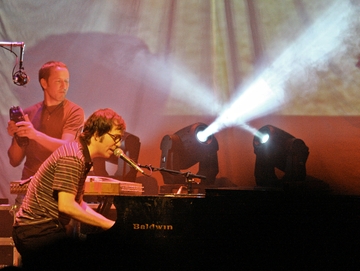
Review: Ben Folds

(Above: Ben Folds and Regina Spektor drop by Conan to perform “You Don’t Know Me.”)

By Joel Francis
The Kansas City Star

Ben Folds is so melodic that even when he writes bad tunes on purpose he ends up with something you can whistle and enjoy.

Case in point: Folds’ two-hour-plus, sold-out concert at the Uptown Wednesday night. Nearly half a dozen of the evening’s songs were spoofs that Folds and his band leaked to the internet before the release of his latest album, “Way To Normal.”

“We decided even though these songs were written to suck, we liked them anyway,” Folds told the crowd.

So while the album version of “Bitch Went Nuts” is about a man justifying a break-up by blaming the woman, the “fake” version is about a liberal woman who takes cocaine and goes Ralph Nader at her conservative date’s law-firm party. Folds was so enamored with his fakes that he A-side/B-sided them against the album versions two times during the night. Both times each version held its own.

As such, the night was heavy on “Normal” material. Opening act Missy Higgins joined Folds for the bouncy, synth-heavy “You Don’t Know Me”; “Frown Song” was propelled by not one, but two keytars. “Cologne” is a beautiful ballad about a deteriorating relationship that stands proudly among Folds best compositions.

“Brainwashed” recalled the best moments of the Ben Folds Five, and while his band jammed on the outro, Folds stood to the side of the stage with his hands together, beaming like a child at a talent show.

Folds peppered the setlist with fan favorites like “Landed,” “Zak and Sara” and a partial cover of Elton John’s “This Song Has No Title” (which he’d performed at a New York City benefit concert earlier this week).

The encore was essentially a half-hour second set for the faithful. “Still Fighting It,” “Kate,” “Philosophy” and “Fair” were pure Folds gold that the crowd devoured. He’s not afraid to flip on the house lights to get the audience involved, and they were not shy about taking the cue. The crowd jumped on “Army” with a “Rocky Horror Picture Show” level of interaction, taking over the three-part-harmony bridge with no instruction.

The five-piece band included drummer Sam Smith, who played so hard the “V-O-T-E” letters fixed to his shirt gradually fell off. Folds frequently dismissed the extra keyboard player and percussionist for a pared down bass-drums-piano trio on the harder hitting numbers.

Higgins warmed the crowd up with a 45-minute set of radio-ready acoustic pop, playing in socks because, she said, her shoes got soaked on an afternoon expedition to Broadway Café. The highlight of her set was “Going North,” which featured a great acoustic guitar solo by Ben Edgar.

The concert was Folds third local performance of the  year, following a late-winter, students-only show at UMKC and a 70-minute set at Wakarusa in June. If that set was slightly truncated, Folds made amends by playing for more than two hours and returning for two encores Wednesday night. The first encore set ended with the fake version of “Frown Song.” It’s hard to imagine anyone leaving with anything but a smile.

Setlist: Way to Normal/Effington/This Song Has Not Title/You Don’t Know Me (with Missy Higgins)/Gone/Brainwashed/Dr. Yang (fake)/Dr. Yang/Anne Waits/Cologne/Frown Song/The Bitch Went Nuts/Landed/Kylie from Connecticut/Free Coffee/Free Coffee Town/Hiroshima/Zak and Sara/The Bitch Went Nuts (fake) Encore: Fair/Still Fighting It/Philosophy/Kate/Rocking the Suburbs/Underground/Army/Frown Song (fake)/Not the Same

The Temptations – “My Girl”


The Temptations – “My Girl,” Pop #1, R&B #1

By Joel Francis

Lightning definitely struck twice for Smokey Robinson and the Temptations. After struggling for years, Robinson gave the Temptations their breakthrough hit with “The Way You Do The Things You Do.” “My Girl,” their follow-up, is not only Motown’s biggest song, but one of the biggest soul numbers of all time.

Inspired by his wife Claudette, Robinson and fellow Miracle Ronald White wrote the one of the greatest Valentines of all time as an answer song to their previous hit “My Guy.” Bob Dylan may have been thinking of the lyric “I’ve got so much honey/the bees envy me” when he proclaimed Robinson “America’s greatest living poet” in 1965.

David Ruffin made his lead vocal debut delivering these deceptively simple lyrics. Though it seems a no-brainer in retrospect, the decision was controversial at the time. Eddie Kendricks and Paul Williams had shared the lead role prior to this song, and, to make matters worse, Ruffin was a ringer who replaced original Temptation Al Bryant. Ruffin got the nod after Robinson saw him singing “Under the Boardwalk” as part of their Motown Revue repertoire, and quickly became the group’s featured singer.

The Motown string section furthers Ruffin’s references to sunshine and fluttering birds, while Funk Brother James Jamerson’s signature two-note bass line anchors the entire performance.

It’s unclear why Robinson and White didn’t keep their song for The Miracles, but it didn’t take long for other acts to put their stamp on the number. Otis Redding added some blues for his 1965 reading; both the Rolling Stones and the Mamas and Papas cut it in 1967. Since then, everyone from Al Green to reggae artist Prince Buster to Dolly Parton to British shoegazers The Jesus and Mary Chain has reinterpreted this timeless classic.

Marvin Gaye – “How Sweet It Is (To Be Loved By You)”


Marvin Gaye – “How Sweet It Is (To Be Loved By You),” Pop #6, R&B #4

Marvin Gaye scored his second Top 10 hit with this song penned and produced by the Holland-Dozier-Holland team. Gaye’s love songs were rarely this straightforward. The vocal melody is so strong the background singers and percussion are basically window dressing. And who says Motown doesn’t do jazz – check out the boogie-woogie piano playing under Gaye’s buoyant singing.

Gaye’s career has been infamously bipolar. In the ‘60s, he was essentially two performers: a nightclub singer turned pop star and coveted duet partner. “How Sweet It Is” was released after Gaye’s lone album with Mary Wells, and a couple years before he connected with Tammi Terrell. For most casual listeners, Gaye’s first decade is summarized by “I Heard It Through the Grapevine,” a couple Terrell duets and this song.

Jr. Walker comes close to stealing Gaye’s song with his celebratory 1966 cover. Walker’s voice isn’t a smooth as Gaye’s, but his sax is. James Taylor took the song one spot higher – to No. 5 – in 1975. Listeners who enjoy a brief, deep nap can program Taylor’s cover against Michael Buble’s 1996 version. – by Joel Francis

[Note: This concludes the first disc on our road trip through the four-disc “Hitsville U.S.A.” box set.]

Review: Los Lobos

Above: “Chuco’s Cumbia” at Austin City Limits 2006

By Joel Francis

The Kansas City Star

For a band as accomplished as Los Lobos, the reach from Jimi Hendrix and Willie Dixon to Richard Thompson and Ritchie Valens is a small one. The gulf between the lip of the stage and the front row, however, can be trickier to navigate.

The sextet’s 16-song, two-hour set was a celebration of all forms of music from New Orleans soul to Spanish mariachi. However, bottom-heavy sound and fixed seating proved nearly insurmountable for the band during the latest entry in the “Cyprus Avenue Live at the Folly Theater” on Sunday night.

The show never completely got off the ground, but it had its share of inspired moments. “Chuco’s Cumbia” featured a dirty Latin groove, while a medley of “The Neighborhood” and “Wang Dang Doodle” bridged the South Side of Chicago to East Los Angeles. The first set ended with a cover of Richard Thompson’s “Shoot Out the Lights” anchored by a thunderous backbeat.

After a 25-minute break, the band returned with a second set guaranteed to knock the yawn out of any weary political supporters (there were plenty of T-shirts from Saturday’s rally throughout the crowd). The one-two of “Come On Let’s Go” and “Don’t Worry Baby” got people involved, if not on their feet. The band traded 88 piano keys for 22 guitar strings on their cover of Fats Domino’s “The Fat Man,” which included a shuffling solo from drummer Cougar Estrada.

The high point of the night was a surprise cover of Jimi Hendrix’ “Little Wing.” Between David Hildago’s lead guitar and Cesar Rosas’ vocals, they not only nailed the song, but stretched it out and made it their own.

There were plenty of covers, but the band also touched on all phases of its career. While lesser bands make a career out of mining the same niche, Los Lobos were able to transition from the early rockabilly of “Shakin’ Shakin’ Shakes” to the more experimental “Kiko and the Lavender Moon,” and from the Spanish festivity of “Maria Christina” to the quiet introversion of “The Valley.”

The sound was muddy for most of the night and Steve Berlin suffered the brunt of it. His keyboards and woodwinds were often barely audible in the mix. The Folly is a wonderful venue for intimate shows -– recent performances by the Dave Brubeck Quartet and Randy Newman were sonically incredible -– but it is ill-suited for six amplified musicians.

The rigid seating and formal environment also inhibited the dancing and shaking Los Lobos’ music cries for. Toots and the Maytals, an earlier “Cyprus Avenue”/Folly booking, faced the same problem at its reggae concert last year. The younger crowd that turned out that night was less inhibited about dancing in the aisles.

Hildago finally coaxed people to their feet before “I Got Loaded,” and the band followed up with the one number guaranteed to keep everyone on their feet: “La Bamba.” After a brief encore break, the band picked up where they left off with a blistering “Good Morning Aztlan” and a frantic “Cumbia Raza” that featured another drum solo from Estrada and guitar solos from Louie Perez and Hildago. Just as the band and audience were hitting the mark, the band closed the set. It was a shame they had to stop. It felt like they were just getting started.

Setlist: Short Side of Nothing, Chuco’s Cumbia, The Valley, Luz d Mi Vida, The Neighborhood/Wang Dang Doodle, Shakin’ Shakin’ Shakes, Shoot Out the Light (intermission) Maria Christina, Kiko and the Lavender Moon, Come On Let’s Go, Don’t Worry Baby, Little Wing, The Fat Man, I Got Loaded, La Bamba/Good Lovin'(encores) Good Morning Aztlan, Cumbia Raza

Review: Old 97s


Above: Of course they played “Roller Skate Skinny.”

By Joel Francis

There is something to be said for a band who can play an entire set without changing instruments.

The Old 97s are not quite that band – lead singer/songwriter/heartthrob Rhett Miller swapped his electric axe for an acoustic one a few times – but they are as close as we’re going to get. For almost two hours they entertained a nearly full Granada Theater in Lawrence, Kan. with little more than the instruments and songs on their backs.

The setlist encompassed more than two dozen songs, from radio favorites like “New Kid” to fan favorites like “Jagged” and new songs like “No Baby I.” When the band played “Question,” a recount of Miller’s wedding proposal, all the women pulled their men close and sang softly in their ears. “Barrier Reef” erupted into a raucous sing-along.

In a rare moment of between-song banter, Miller recalled the band’s first show in Lawrence at the Replay Lounge where they performed for a night of unlimited, free video games. A few songs later, those days were celebrated in “Niteclub.”

Miller may have the easiest job in showbiz. Offstage, all he has to do is write songs that combine the alt-country terrain plowed by Uncle Tupelo with the pop sensibility of Paul McCartney. Onstage, he just makes love with his eyes to all the doe-eyed women pressed against the stage and occasionally shake his ass while Ken Bethea takes a guitar solo.

Bethea plays lead guitar via chainsaw. Standing on the edge of the stage with his headstock hanging over the crowd, he rips through songs with a Chet Atkins-meets-Dick Dale style. On the other extreme of the stage, modest Murry Hammond cradles his bass like a baby and tosses out the harmony (and intermittent lead) vocals that push the songs from good to great.

Late-tour shows can be a mixed bag. When Wilco played the Uptown Theater in 2006 at the end of the Kicking Television tour they were tired of both the road and their material. But with only a couple dates left on their current tour the Old 97s played with the perfect mix of familiarity and abandon. “Doreen,” one of their hardest-rocking numbers, positively smoked.

The evening ended with the encore haymaker punches of “Murder (Or a Heart Attack),” “Big Brown Eyes,” “Dance with Me” and, of course, “Timebomb.” When it was over, everyone left a little drunker and a lot happier.