Four Tops – “I Can’t Help Myself (Sugar Pie Honey Bunch),” Pop #1, R&B #1
By Joel Francis
The piano riff that kicks off this tune is instantly and universally recognizable – and with good reason. Depsite the apologetic lyrics, Levi Stubbs’ magnificent vocals are a ray of sunshine. He might be singing that he’s “weaker than a man should be,” but Stubbs is clearly having more fun than he should for a man in his predicament.
The string arrangement echoes the upbeat, impulsive melody – pay attention to the delightful vibraphone line – while Funk Brother Richard “Pistol” Allen’s offbeat drumming keep the feet moving. Stubbs’ vocals sound like the direct descendent of Kansas City, Mo. jazzman Big Joe Turner’s “shout” singing style. If they couldn’t bring his lover back, then the saxophone interlude should have sealed the deal.
Holland-Dozier-Holland’s song capped five straight No. 1 hits with the Supremes. Although the trio penned the Tops’ early hits like “Baby I Need Your Loving,” Berry Gordy thought they had lost their touch and passed the Tops to Mickey Stevenson and Ivy Jo Hunter’s pen for “Ask the Lonely.” After the success of “I Can’t Help Myself,” Holland-Dozier-Holland were given nearly exclusive rights to the Tops’ singles for the next three years.
In the summer of 1965, this song fought for the No. 1 spot with The Byrd’s “Mr. Tambourine Man” and “I Can’t Get No (Satisfaction)” by the Rolling Stones. What a summer that must have been.
“Ooo Baby Baby” didn’t hit the top of the chart, or even sell a million copies, but it was one of THE songs of the summer in 1965.
Despite a baby-talk title, the song starts melancholy and doesn’t waver. An unfaithful Smokey Robinson is heartbroken, miserable and penitent. Check out the way he sings the word “crying” at the end of each verse, echoing Roy Orbison’s heart-wrenching single of the same name. Robinson’s creamy vocals help the pain go down smoother, but the way the last note is left hanging, it’s clear there is no hope or delivery ahead.
And yet, Robinson and Pete Moore’s song was one of the most-played songs of the summer, and one of the Miracles’ most-covered tunes. Linda Ronstadt found a 1979 hit with the number, but not before Ella Fitzgerald, the Five Stairsteps and a slew of others tried their hands. – by Joel Francis
Brenda Holloway – “When I’m Gone,” Pop # 25, R&B #12
By Joel Francis
Brenda Holloway isn’t the biggest name in soul music, but she was on top of the world when this song hit 1965. She opened for the Beatles on their U.S. tour that year, and performed at the legendary Shea Stadium show.
The story behind “When I’m Gone” is more interesting than the song itself. Originally slated to be Mary Well’s follow-up to “My Guy,” the song was given to Holloway when Wells spurned Motown for 20th Century Fox Records. Despite being an alto to Well’s soprano, Berry Gordy thought Holloway was best-suited to put lead vocals to Well’s backing track.
“When I’m Gone” wasn’t as big a hit as “Every Little Bit Hurts,” but Holloway kept making singles for the next three years. Shortly after recording the original version of “You’ve Made Me So Very Happy” (later a huge hit for Blood Sweat and Tears), Holloway retired from the music business. Deeply religious, Holloway was disillusioned with Motown and conflicted about the lifestyle expected of a young star. Although she was just 22, Holloway had been making records for 6 years. After a 12-year absence, she returned with gospel album in 1980 and a pop album in 1999.
Martha and the Vandellas – “Nowhere To Run,” Pop #8, R&B #5
Every element positively soars in this song. The brief, simple horn riff lifts off and Martha Reeves’ voice pushes the listener into the stratosphere. Funk Brother Benny Benjamin’s bouncing drums and ascending backing vocals from the Vandellas keep the track in the air well past the run-off groove.
Reeves’ vain search to shake a no-good lover from her mind is further propelled by a light tickle of piano and hard-driving percussion than included a pair of snow chains bolstering the tambourine placed front and center in the mix. Holland-Dolland-Holland clearly knew what they were doing with this number. Heartbreak has never sounded so jubilant. – by Joel Francis
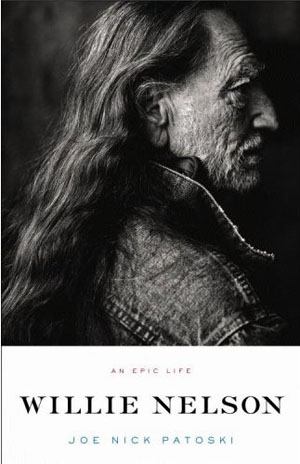
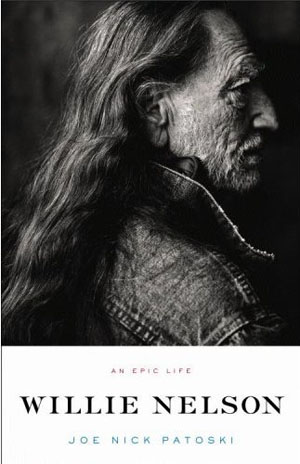
“Epic” is the key word in the title of Joe Nick Patoski’s 567-page biography on Willie Nelson. Drawn from dozens of interviews and scores of oral histories, books and articles, Patoski paints a comprehensive picture of his fellow Texan.
If Patoski skimps on Nelson’s childhood – less than 50 pages are devoted to his years as a minor – he makes up for it by piling chapter on top of chapter about Nelson’s early family life, struggles as a disc jockey and songwriter for hire and, finally, as a nascent country performer. Patoski also devotes an entire chapter on IRS struggles and puts in strong perspective how such horrible accounting could have transpired.
But while Patoski’s journalism skills and research is impeccable, he spends too much of his time telling and not enough showing. For example, there piles of anecdotes about Nelson’s generosity and his inability to say no. He sticks around for hours after concerts to sign autographs, and lavishly gifts his friends and family. When a credit card company asked him to put his face on their card, he said yes without thinking of the consequences. Manager Mark Rothbaum has to explain the implications.
“Well think about it: A third of all credit cards go into receivership, so a third of your fans will go bankrupt, and they will have to look at your picture on that card,” Rothbaum tells Nelson. “Every time they see your picture they will think, That prick is making money off of me.”
Nelson asked Rothbaum to get him out of the deal, but the reader is never given understanding of what compels Nelson to be so affable.
The person who shines best is Nelson’s longtime drummer Paul English. English doesn’t appear until a third of the way through, where he initially surfaces as a pimp who drills and robs pinball machines and operates backroom card games. When Nelson’s drummer failed to show up for a radio session, English is recruited. Even though he had never played drums before, but the experience went well enough English accepted Nelson’s invitation to walk away from the lucrative prostitution business and join the band on the road.
English’s skills with a gun and knife were handing in prying a reticent promoter away from the band’s money and bailing Nelson’s smart mouth out of fight. English was never shy about displaying the pistol he always carried, which was usually all it took to calm any disagreements. English’s black market background also came in handy procuring marijuana for the band.
Patoski’s meticulous exploration sheds light on Nelson’s long walk to fame, where record labels and producers try in vain to pigeonhole the artist, and Nelson’s inability to fit into their boxes, even when he gamely goes along. Later, as Nelson’s fame and wealth grows, he builds a studio on his Texas estate. Patoski conveys a laid-back atmosphere where music flows as freely as beer and songs are recorded as effortlessly as lighting a roach. That Nelson practically lived in his studio explains the prolificacy of his catalog (he released two albums in 2008), and the easygoing environment explains how his financial problems reached the boiling point.
The vision of Nelson unearthed in the book refuses to be worried about anything except his music, even when doing so compromised his family and friends. His nature reminds me of a line from the film “Walk the Line.” When Johnny Cash tells June Carter on the back of the tour bus that everything will work itself out, she replies “No, John. People work them out for you, and you think they work themselves out.”
That Nelson’s music has attracted rednecks and hipsters alike is less mystifying after this thorough examination of the man. The songs are merely an extension of the personality: Nelson is willing to meet anyone anywhere for a good time. The access Nelson provided for this thick tome can rest proudly alongside his albums as a testament to the man’s generosity.
It’s hard to listen to Raphael Saadiq’s new album, “The Way I See It,” without thinking it’s a lost Motown gem.
The record blasts off with “Sure Hope You Mean It,” a song that recalls the finer moments of Smokey Robinson and the Miracles. Later, Saadiq channels the Temptations on “Keep Marchin'” and “Staying In Love,” which features an effervescent call-and-response over a great rhythm.
The horns on “Big Easy,” courtesy of the Rebirth Brass Band, couple with an incessant guitar and snare drum to create a frantic atmosphere as Saadiq sings “somebody tell me what’s going on/I ain’t seen my baby in far too long.” Think Holland-Dozier-Holland lost in Mardi Gras and you’re almost there.
Saadiq strays from the Motor City to channel the Sound of Philadelphia for “Just One Kiss,” a duet with Joss Stone. Stone shows more restraint on this number than she did on the album Saadiq produced for her last year, “Introducing Joss Stone.” “Calling” starts with a Spanish introduction over flamenco guitar before sliding into a great doo-wop melody.
“Never Give You Up,” another Gamble-Huff-flavored moment, is the stand-out track. The arrangement pulls the listener in before Saadiq’s smooth voice kicks in, and the magnificent, swirling chorus seals the deal. That Stevie Wonder’s cameo after the third verse does not feel forced, speaks to the organic vibe Saadiq has not only created here, but sustained over most of the record.
The only misstep is the album-closing remix of “Oh Girl” featuring Jay-Z. While he offers some of his most soulful rapping to date – at points Jay-Z is nearly singing – the hip hop intrusion breaks the spell and rudely slams the album into the present.
Despite this, Saadiq’s third album is the best of his career. “The Way I See It” is more focused than his 2004 sophomore effort, “Ray Ray,” and tighter than his bloated (but otherwise excellent) debut “Instant Vintage.” From the sound of the guitar and the echo on drums to the mix and arrangement of the backing vocals, everything is spot-on. Even the timing is right – most songs are between two and three minutes.
Motown tributes are a dime a dozen. What elevates “The Way I See It” above the score of old school knock-offs is that it goes beyond the paint-by-numbers approach to inhabit and invigorate the true spirit of the music.
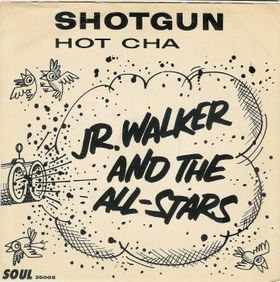
Junior Walker and the All-Stars – “Shotgun,” Pop #4, R&B #1
Motown raided the juke joints for Junior Walker’s biggest hit. The song is propelled by Victor Thomas’s Hammond organ as much as Walker’s sax, and is closer to the Southern styling of Booker T. and the MGs and King Curtis than the Motown sound.
At the time, Walker was better-known for his playing than his singing. Initially, a studio singer was booked to sing Walker’s response to the fad dances of the time, like “The Jerk” and “The Watusi.” When the singer failed to arrive, Walker reluctantly stepped behind the mic to cut what he thought would be a guide vocal. Producer Berry Gordy prevailed on Walker to leave the track as-is. Gordy’s judgement was accurate, as the song shot to the top of the chart and inspired several similar singles, including Curtis’ “Memphis Soul Stew.”
Walker’s quartet is rounded out by the sharp guitar punctuation of Willie Woods and the solid backbeat from drummer Benny Benjamin. – by Joel Francis
If Van Morrison’s 1968 release “Astral Weeks” is the album of a lifetime, then watching him perform it live in its entirety is the chance of a lifetime.
Kansas City’s own Irish troubadour Eddie Delahunt took advantage of that opportunity and booked a trip to see Van Morrison perform his seminal album on November 8, the last of two nights at the Hollywood Bowl in Los Angeles.
“It was historic,” Delahunt said. “I’ve seen Van before, and sometimes he can be grumpy with the material. This was the best I’d seen him. He played it straight and true. You could see he was real with it.”
Morrison opened the night by revisiting some of his bigger numbers, like “Gloria” and “Brown Eyed Girl” and lesser-known album cuts like “And the Healing Has Begun” and “Summertime in England.”
“‘Caravan’ was great, but there were no leg kicks like in ‘The Last Waltz,'” Delahunt said with a laugh, referring to Morrison’s performance in the 1978 Martin Scorsese film about The Band. “During ‘The Healing Game’ he did a little back-and-forth (call and response) with Richie Buckley on sax, trying to trip him up.”
Delahunt’s $250 terrace seats placed him dead center, about 40 yards from the stage. He said the high prices – tickets started at $350 – kept the crowd over 30 years old and the bowl under capacity.
“Van had the crowd in his hands for the first set,” Delahunt said. “Then they took a 15 minute break to rearrange the stage for ‘Astral Weeks’ and Van ran it straight through.”
For “Astral Weeks,” Morrison’s band, which was assembled in a semi-circle around him, was augmented by a three-piece string section and “Astral Weeks” album guitarist Jay Berliner. Original session bassist Richard Davis was also scheduled to join the group, but a last-minute family emergency kept him away.
Morrison shuffled the album’s order, slipping the closer “Slim Slow Slider” into the third spot and coupling the upbeat jazz numbers “Sweet Thing” and “The Way Young Lovers Do” into a powerful one-two punch.
“Everyone loved ‘Madame George,’ but ‘Cyprus Avenue’ was the best for me. He played it closest to the album and you could see he was enjoying it,” Delahunt said. “During a song like ‘Slim Slow Slider,’ he wasn’t just playing the harmonica, but humming into it.”
Morrison closed the evening with an one-song encore of “Listen To the Lion” and a twist on an old phrase.
“As Van said at the end,” Delahunt recalled, “‘You made a happy man very old.'”
Note: The performance was filmed for future release on DVD. Catch Eddie Delahunt in concert by checking out his concert calendar.
Above: Jack White and Alicia Keys do the latest James Bond song, “Another Way To Die.”
By Joel Francis
Duran Duran bass player John Taylor probably had the previous two James Bond themes in mind when he drunkenly approached producer Cubby Broccoli at a party and asked when they were going to get someone “decent” to do a Bond song.
It didn’t take long to learn the answer. Duran Duran’s “A View To A Kill” was a No. 1 hit, re-establishing Paul McCartney’s precedent of letting successful pop acts write and perform title songs hit. While the big synthesizers and processed drums haven’t aged well – few pop songs from the ’80s have – the chorus of “dance into the fire” remains as catchy as ever. The song also marked the last time original Duran Duran’s lineup recorded together for 16 years.
Encouraged by Duran Duran’s success, the Bonds producers handed the reigns to another pop act for 1987’s “The Living Daylights.” After being rejected by the Pet Shop Boys, who wanted to score the entire film, a-ha, the band best known for its 1985 No. 1 hit “Take On Me,” agreed to take on Bond. Sporting similar dated production as Duran Duran’s hit, but weaker songwriting and overly sensitive singing, “The Living Daylights” became another Bond footnote.
The lush orchestration associated with early Bond numbers was back for Gladys Knight’s “License to Kill” in 1989. Composer Michael Kamen did a good job incorporating the “Goldfinger” horn line into the main melody, but the lyrics and melody are bland. It’s a shame that Knight, who has one of the strongest soul voices of all time, wasn’t given stronger material. Bond’s further musical malaise is marked by the presence of Patti LaBelle’s end credits theme, “If You Asked Me To,” which was later covered by Celine Dion. Dion’s appearance marks the nadir of any expedition.
After a six-year hiatus and casting change, Bond returned in 1995’s “Golden Eye.” Written by U2’s Bono and The Edge, “Golden Eye” found the duo continuing in the same vein as their summer hit “Hold Me, Thrill Me, Kiss Me, Kill Me.” The arrangement wraps the duo’s discotheque infatuation around a haunting melody build on a horn line. Tina Turner masterfully teases Bono’s voyeuristic lyrics and was rewarded with a Top 10 hit in Europe. “Goldfinger” was the best Bond song in a generation and helped successfully jumpstart the franchise.
After the powerful, soulful voices of Knight and Tuner, Bond’s producers turned to another American female in 1997 for “Tomorrow Never Dies.” Sheryl Crow brought strong songwriting chops and chart-topping cache, but she lacked the voice to carry her melody. Her vocals fare well during the verses, but the chorus is too high for Crow’s register where her throat lacks the energy to carry the words and emotion. k.d. lang’s “Surrender,” written by the film’s composer David Arnold, fits firmly in the Bond mold of big strings and brassy horns and would have been a better opening number. Unfortunately, it was retitled and pushed to the closing credits once Crow signed on. Finally, pop-techno musician Moby was enlisted to remix Monty Norman’s “James Bond Theme.” The result was a rare update that successfully enhanced and modernized the original.
Arnold successfully married his large orchestration with light techno elements for “The World Is Not Enough.” Garbage singer Shirley Manson slithers through the lyrics with authority and the rest of the band maintains a tasteful balance between rock and orchestral while adding their stamp to the song.
Madonna was easily Bond’s biggest star pull since Paul McCartney when she signed up for “Die Another Day” in 2002. While the film may have been Bond-by-numbers, Madonna blew up the formula for her electronic theme song. Her manipulated vocals hide behind banks of synthesizers and strings and spout the memorable line “Sigmund Freud/analyze this.” Although the song spent 11 weeks at the top spot of the U.S. charts, it is unlike any other theme in the Bond cannon and, as a result, not without controversy. The Material Girl wouldn’t have it any other way.
Bond was rebooted once again in 2006 for “Casino Royale.” As the character became grittier, so did the music. Chris Cornell’s “You Know My Name” is easily the hardest number in the Bond cannon, cut from the same stone as Alice Cooper’s rejected “Man with the Golden Gun” that repulsed producers 30 years ago.
Confirming they were no longer afraid to rock out, White Stripes mastermind Jack White was enlisted to perform “Another Way To Die” for 2008’s “The Quantum of Solace.” Unsurprisingly, White’s song sounds like a heavily orchestrated White Stripes number given an urban twist courtesy of the piano and vocals of Alicia Keys. Stripped of the overproduction that plagues her solo releases, Keys shines under White’s watch. Her call and response with White’s dirty guitar licks halfway through the song channel “What I’d Say” through Jimmy Page’s amplifier. The number is the first Bond theme performed as a duet, but based on the openness Bond’s producers have shown in the past decade, it will likely not be the last.
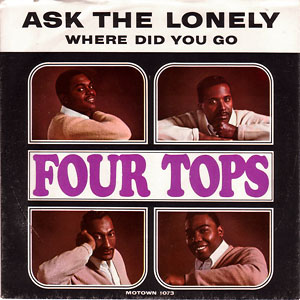
The name on the label says “Four Tops” but this is really a Levi Stubbs record. Stubbs was never one of Motown’s marquee vocalists, and the injustice of that act is amplified by his three-minute tour-de-force singing here. Mickey Stevenson and Ivy Hunter’s song and production is more mature than the typical Motown single. Stubbs’ classic soul voice is imbedded with the “hurting pain” he’s imploring his friend to avoid. The female backing vocals sound silly when they introduce the song, but blend well with the arrangement. The other three Tops are all but absent, but they’re not missed thanks to Stubbs’ heart-wrenching performance.
“Ask the Lonely” is stuck in the Tops’ limbo land. It wasn’t a big hit, but it was too good to be a footnote. The song is still performed at Four Tops concerts today – sans Stubbs’ vocals, of course – but unlike other Motown hits, it never made an impact on the covers circuit. Which is probably just as good. — by Joel Francis



 joelfrancis.com