The Miracles – “Mickey’s Monkey”

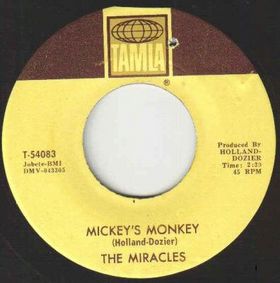
The Miracles – “Mickey’s Monkey,” Pop #8, R&B #3

One of the most infectious and upbeat singles in the Motown catalog is unique in two ways. First, it was not written by main Miracle Smokey Robinson, but by the hot house songwriting team of Holland-Dozier-Holland. Second, it is one of few Motown songs to appropriate the Bo Diddley beat.

As Robinson’s voice joyously soars over the Funk Brothers groove, the Miracles, Martha and the Vandellas and members of the Supremes, Temptations and Marvellettes chip in on backing vocals.

The HDH production team did a great job of capturing a live sound that, like “Do You Love Me,” sounds like it was beamed directly from the greatest party in the world. Robinson’s multi-octave range is a marvel, but honestly anything over that groove would have been a hit.

“Mickey’s Monkey” was one of the Miracles biggest hits. Unsurprisingly, Berry Gordy tried to bottle lightning a second time by having Martha and the Vandellas cut a version, but neither their cover nor subsequent readings by The Rascals, The Hollies or John Cougar Mellencamp made an impact.

The “cat named Mickey from out of town” was based on Motown’s A&R director Mickey Stevenson. Stevenson wrote several Motown hits with Marvin Gaye, including “Beechwood 4-5789,” “Pride and Joy” and “Dancing in the Street.” — by Joel Francis

The Temptations – “The Way You Do The Things You Do”

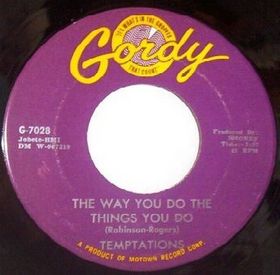
The Temptations – “The Way You Do The Things You Do,” Pop #11
Several Motown songwriters had tried to write a hit for The Temptations before Smokey Robinson teamed with fellow Miracle Bobby Rogers to pen this gem.
Sung by high tenor Eddie Kendricks, the lyrics are equal parts pick-up lines and nursery rhyme. Few could rhyme “candle” with “handle” and “money” with “honey” without sounding trite and cliched, but somehow Robinson and Kendricks pulled it off.
Whatever worked in the song then, still holds up today. UB40 released a reggae-tinged cover 35 years after the Temptations and bettered the original by five spots (No. 6) on the charts. Radio Disney performer Jordan Pruitt — who wasn’t even born when UB40’s version was released — is scheduled to include a version on her second album later this year. — By Joel Francis

Martha and the Vandellas – “(Love is Like A) Heat Wave”

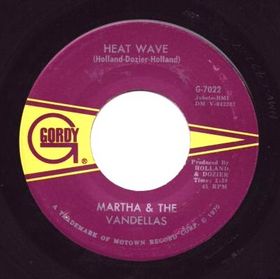
Martha and the Vandellas – “(Love is Like A) Heat Wave,” Pop #4, R&B #1

When the mercury starts pushing past the century mark my first inclinations are to shave my head and hibernate near the air conditioning. If actual heat waves were more like this song, I’d be dancing in the streets.

Holland-Dozier-Holland wrote it and Martha Reeves sang the heck out of it, but the real credit should go to the Funk Brothers, Motown’s stable of uber-talented, under-recognized musicians. The drums open the song with the buoyancy of an oceanic wave, while a swiftly strummed guitar tells your feet when to move. Add a spritely horn section and peppy piano and you’ve got a hit before Reeves nails the first note.
With so many upbeat elements it’s easy to miss the pain in the lyrics. “Whenever he calls my name/Sounds so soft sweet and plain/Right then, right there/I feel this burning pain/This high blood pressure’s got a hold on me/I said this ain’t the way love’s supposed to be/It’s like a heatwave burning in my heart/I can’t keep from crying/Tearing me apart.” Divorced from the melody and arrangement and the words have the same longing and pain as Bruce Springsteen’s “I’m On Fire.” But together bad love and frustration never felt so good.
Berry Gordy tried to replicate his success by lending the number to the Supremes in 1967. A year earlier The Who covered it a for their second album, but neither version measured up. How could it? Stick “Heat Wave” in your summer cookout playlist alongside Sly and the Family Stone’s “Hot Fun in the Summertime” and any number of Beach Boys tunes and you’ve got a recipe for success. — By Joel Francis

Stax vs. Motown (part one)

With the recent passings of Jerry Wexler and Isaac Hayes and The Daily Record’s ongoing walk through the Hitsville U.S.A. box set, I thought this would be a good time to examine the histories of the twin titans of soul music, Stax and Motown. Joining me in this conversation is Brad, friend of the blog and the man who puts the “B” in “R&B.” This is part one of three in the series.

Joel Francis: To me, Motown and Stax are two sides of the same coin. Like most people born after the baby boom, I first heard Motown and Stax records on the oldies station. I didn’t know much about the artists, but I could tell that certain songs sounded similar and stood apart. It wasn’t until college that I could differentiate the Temptations from the Four Tops. Around the same time, I learned that the Booker T and the MGs were the backing band for most of the Stax singles I loved. Brad, as a fellow soul music fan, tell me about how you were introduced to Stax and Motown and why Stax holds ultimate appeal for you.

Brad S.: In my hometown, we had the Top 40 station, the country station, the “background music” station, the “farm report” station and static. So it took a little bit of work to discover soul music beyond the omnipresent James Brown “I Got You (I Feel Good).” But being a child of the 80’s, a few factors put soul on my radar:

(1) Some soul classics came along with the oldies music that came out of a Hollywood retro trend – “Dirty Dancing,” “The Big Chill,” “Peggy Sue Got Married,” “Back to the Future,” etc.

(2) The baffling cultural mini-phenomenon of the California Raisins advertising campaign.

(3) Being a Hall & Oates fan, who followed their popular “Big Bam Boom” album with “Live at the Apollo with David Ruffin and Eddie Kendrick.”

(4) Discovering the Blues Brothers movie.

This last factor was the most significant. That musical stew of blues,R&B and soul – featuring Stax alums Steve Cropper and Donald “Duck” Dunn – really drew me in. The music was a blend of classic and re-recorded numbers that enabled it to sit alongside of contemporary rock without feeling diminished in comparison. It also had a gritty edginess that I felt the Motown stuff lacked. I perceived Stax to be the “rock” to Motown’s “pop.” Motown’s impeccable production sometimes felt “overproduced” to my sensibilities – like all the edges had been sanded down. It felt like it was trying to appeal to the “white” audience, and in that it was successful. But my personal preferences lie elsewhere.

I tend to oversimplify in the following way: Motown is sweet and smooth; Marvin Gaye is Motown’s archetypical vocalist. Stax is raw and gritty; Otis Redding is its archetypical vocalist. Beyond its oversimplification, I’m curious if you – being better-read on the matter – think my musical shorthand is accurate or not.

JF: Oh man, “The Blues Brothers.” What a cultural discovery that was. I think I first saw that movie my freshman year of high school. Like you, I knew several of the songs from oldies radio, but seeing them performed added a completely new dimension to the song.

Being a few years younger than you, I really got into the California Raisins. I saved up my allowance to buy their cassette, which featured “You Can’t Hurry Love” and a couple other Motown songs. I didn’t learn until recently that Buddy Miles, the great drummer in Jimi Hendrix’ Band of Gypsys, was the voice of the Raisins.

The prevalence of Motown on the oldies station – my mom’s favorite station – and the grit of the Blues Brothers drove me away from Motown for a while. The sweet strings just couldn’t match the punchy horns. That lasted until I went off-dial and discovered the Motown songs untouched by our microscopic oldies radio playlist. Songs from the late ’60s and early ’70s by Stevie Wonder, Marvin Gaye and the Temptations. That drove me right back in.

Continue on to part two.

Isaac Hayes: Forever a Soul Man

By Joel Francis

When Isaac Hayes played at the Voodoo Lounge last October, I jumped at the opportunity. Well, that’s not exactly true. My wife, who had been seduced by my Ultimate Isaac Hayes collection, was elated at the prospect and convinced me to buy tickets. I figured this might be our last chance to see him perform in Kansas City, but I didn’t think he’d be dead less than a year later. While the show was solid, Hayes looked shaky. Regardless of his health, or the reason for his frailty, it was still a treat to hear “Walk On By,” “Theme From Shaft” and “I Stand Accused” performed by many of the same men who recorded them over a generation ago.

More than even Booker T and MGs, Hayes was the backbone of Stax Records. In the ‘60s, Hayes and David Porter were the label’s go-to songwriter team, turning out hits like “Soul Man,” “Hold On, I’m Comin'” and “B-A-B-Y” for artists like Sam and Dave, Carla Thomas and Johnnie Taylor. After the near-simultaneous loss of Otis Redding in a plane crash and the label’s back catalog in a bad distribution contract with Atlantic Records, Hayes became the label’s biggest star.

Stax may have expected more sharp, pop hits when Hayes finally started producing his own albums, but he went the opposite way, transforming unlikely covers into epic slabs of funk and soul. With a deep voice, second only to Barry White as the definitive baby-making crooner, Hayes took left-field selections like Bread’s “Baby I’m-A Want You” to a black audience.

The songs may have not been Hayes originals, but the arrangements were. Burt Bacharach’s “Walk on By” ran past 12 minutes with a stirring string arrangement in its first half and stinging guitar and organ interplay in the second half. Running times of more than 10 minutes had become a Hayes trademark. The seminal “Hot Buttered Soul” album had just four tracks and clocked in at 45:05.

Even though edited versions were released for radio play, these sweeping performances could not be contained on a 45 and, for the first time, urban audiences started buying albums over singles. And not only were they buying albums, but many of Hayes’ releases were double-LP sets.

In the early 1970s, Hayes was the Soul Man. Adorned in gold chains, he was Black Moses. Standing alongside labelmates the Staple Singers, he headlined the 1972 Wattstax Concert, performing in front of a crowd of 100,000 fans. A few months after Wattstax, Hayes received the best song Oscar for “Theme From Shaft.” He was at the pinnacle of his artistry.

His success continued, but by 1975 he was a shadow of his artistic and commercial success. Although Hayes continued making albums at his regular pace, disco and bankruptcy hurt his music career. By the ‘80s, Hayes put music on the back burner so he could focus on acting. He popped up on “The Rockford Files,” “The A-Team” and “Miami Vice” and had supporting roles in Mel Brooks’ “Robin Hood: Men In Tights” and “Escape from New York.”

In 1988 he helped the pre-“In Living Color” Wayans brothers lampoon the blaxploitation genre he helped define, as Hammer in “I’m Gonna Git You Sucka.” Hammer meets an untimely and hilarious demise when, after gearing up with an obscene amount of guns, ammo and grenades, he trips and falls on a stray bullet and is consumed by his own arsenal.

Today, Hayes is best known from “Shaft” and his role as Chef on “South Park,” but thanks to sampling, his radio presence hasn’t diminished. Jay-Z’s debut album, “Reasonable Doubt,” could still have been a classic without “Can I Live.” However, it is telling that this song, supported by a sample of Hayes’ arrangement of “The Look of Love,” is the only number from this album that Jay-Z regularly performs.

A proud legacy? You’re damn right.

Review: Jill Scott at Starlight

By Joel Francis
The Kansas City Star

As her 11-piece band vamped, Jill Scott casually walked onstage Thursday night at Starlight, a notebook tucked under her arm, like she was a guest on a talk show. The crowd greeted her like she was Oprah.

It was an appropriate introduction for a show that was equal parts Apollo Theater and confessional conversation. The two-hour setlist leaned heavily on Scott’s most recent album, “The Real Thing,” which documents the end of Scott’s 12-year relationship with ex-husband Lyzel Williams.

For someone delivering the 21st century edition of “Here My Dear,” Scott was surprisingly exuberant. The album’s title song is built on an arena rock guitar riff and ‘80s drum sound, and was so important to Scott that she repeated the second verse a capella after the song was over and brought the full band back in for a reprise.

For songs from her first album, most of which were written about her love for Williams, Scott relied on the audience to carry her.  She introduced “A Long Walk” as a tribute to Roy Ayers before a sing-along erupted so forcefully that Scott relinquished the mic and let the crowd take over. It was a pattern repeated on much of her earlier material.

Scott is less a soul diva than a poet with pipes. Her spoken-word background shone when she would break a song down to discuss its themes. Scott is so comfortable talking with the audience that the moments chatting about relationships, sandals and women in music videos felt like friends dropping by for a living room chat.

She paused during “All I” to lament radio’s definition of old school – anything recorded between 1998 and 2004 – and showcase her backup singers with a medley of true old school classics: the Isley Brothers’ “Between the Sheets,” Teena Marie’s “Portuguese Love” and Prince’s “Do Me Baby.” Scott later started the encore set with “Gimme,” her version of old school, complete with a Kool and the Gang bassline and “sock it to ya” backing vocals.

Starlight was far from full – screens were placed across the back section of seats – and while the heavily female crowd was attentive, there were plenty of side conversations happening. Scott may have been Queen Bee for the night, but she still had to share time with other friends.

Scott’s singing is more Ella than Aretha. “He Loves Me (Lyzel in E Flat)” – a surprising selection given the subject matter – opened with a piano solo and a near-operatic delivery. The show should have ended there. Scott introduced her band, left the stage and the house lights came on. But as people were filing toward the exits, she returned to deliver “And I Heard,” a new number she had to get off her chest. Less a song than a poem set to melody, Scott had the audience singing like a gospel choir as her band quietly shuffled offstage again. It was an ending that affirmed the endurance of love, despite the pain it might bring.

Opening act Bilal took the stage at 7:30 sharp for a solid half-hour set that saw a lot of people still finding their seats. The high point was the keyboard/conga interplay topped with Bilal’s scat vocals that blurred the lines between jazz and soul and led into “Sometimes.” Bilal dedicated his song “Soul Sister” to the late record producer J. Dilla. 

Setlist:

The Rightness, Let It Be, The Real Thing, A Long Walk, Epiphany, Insomnia, Only You, Whenever You’re Around, Slowly Surely, Is It The Way, Do You Remember Me, How It Make You Feel, All I/Old School Medley, Come See Me, Imagination, Crown Royal (Encore:) Gimme, It’s Love, Golden, Hate On Me, He Loves Me (Encore 2:) And I Heard (new song)

Stevie Wonder – “Fingertips (Part Two)”

Stevie Wonder – “Fingertips (Part Two),” Pop #1, R&B #1

Little Stevie Wonder’s first single joins Pink Floyd’s “Another Brick in the Wall (Part Two)” as the only “part twos” to hit No. 1 on the U.S. chart. Another notable “part two” is Gary Glitter’s “Rock and Roll (Part Two),” which was a No. 7 U.S. hit.

Not only did Wonder not write this song, he didn’t even need the whole number to sell his charisma and talent. “Fingertips (Part Two)” is less a song than a vamp that Wonder builds up with his harmonica playing and joyous singing. Even if there aren’t any real lyrics, it’s impossible not to smile and sing along.

It took Wonder nearly two years to land on the charts with this song and nearly as long to find a follow-up hit, 1965’s “Uptight (Everything Is Alright).” The complete 6-minute performance of “Fingertips” opens Wonder’s 1963 live album, “Recorded Live, The 12 Year Old Genuis.” — By Joel Francis

Marvin Gaye – “Pride and Joy”

Marvin Gaye – “Pride and Joy,” Pop #10, R&B #2

The bouncy piano that opens and propels this track may be pure Chicago blues and Gaye’s singing more jazz than soul, but the backing vocals are pure Motown.

Supported by Martha and the Vandellas, Gaye reunited with Norman Whitfield and Mickey Stevenson for this jaunty ode to label boss Barry Gordy’s sister, Anna. This songwriting trio may have misfired on “Beechwood 4-5789,” but everything works here. Not only was the song Gaye’s first Top 10 hit, but Anna Gordy went on to marry Gaye. — By Joel Francis

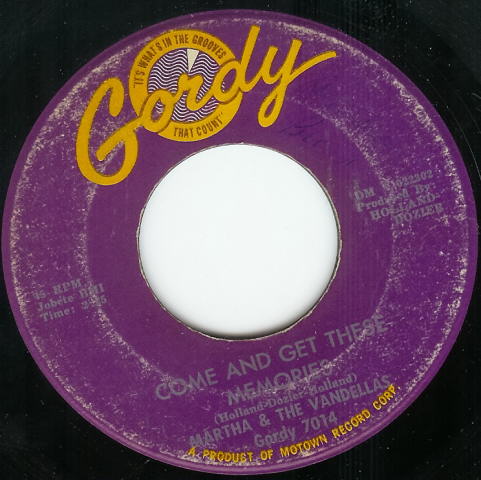
Martha and the Vandellas – “Come and Get These Memories”

Martha and the Vandellas – “Come and Get These Memories,” Pop #29, R&B #6

“Come and Get These Memories” would be less memorable were it not the Motown debut of both singer Martha Reeves and the songwriting team of Brain Holland, Lamont Dozier and Eddie Holland.

Though Holland-Dozier-Holland would dominate both the charts and the Motown landscape during the mid-‘60s, they got off to an inauspicious start here. Reeves is confident in her delivery, but the songwriting and arrangement is tepid. Before the first minute is over we’ve heard the chorus three times and two verses. The piece sounds more like a jingle than a song at this point. The horns bop back and forth without swinging and the backing vocals of “come and get ‘em” are too peppy to convey any sense of heartbreak.

The song fares better in its second half. The horn break at the halfway mark is like flipping a light switch. The brass arrangement grows more aggressive and supportive and Martha, the Vandellas and the Motown musicians really swing through the bridge (“because of these memories/I never think of anybody but you”) that fades into the outro. It’s as if the cast has finally been given direction.

According to legend, Tom Petty and the Heartbreakers were in the studio working out the arrangement to “Breakdown,” when someone walking by in the hall recommended they move the guitar lick from the outro to the beginning. It’s a shame that no one offered similar advice here. Instead the public would have to wait five months for Martha and Holland-Dozier-Holland’s follow-up effort, “Heatwave.” They had mastered the learning curve by then. — by Joel Francis

The Miracles – “You’ve Really Got A Hold On Me”

The Miracles – “You’ve Really Got A Hold On Me” Pop #8, R&B #1

Another stone classic from the pen of Smokey Robinson. Counting his songs for Mary Wells, this is Robinson’s fourth No. 1 hit (his first song with Wells stalled at No. 2 on the R&B charts). The song was famously covered by the Beatles It continues to be popular today. Cyndi Lauper covered it in 2003 and it popped up earlier this year on actress Zooey Deschanel’s delightful album with M. Ward, “She and Him.”

It’s no surprise so many artists have been drawn to this song. The melody and backing vocal lines are strong and supportive enough that the lead singer doesn’t need a great voice to pull it off (check out Cher’s version with then-husband Gregg Allman for proof). On the other hand, good vocalists have plenty to make their own. British invasion bands loved it for the snakey guitar line that could cover missing piano and horn parts.

The Miracles have the whole package, though: Robinson’s great singing, the full complement of Motown’s Funk Brothers musician’s stable and Barry Gordy’s impeccable production. The crescendo peaks with Robinson playing off the Miracles and pleading with his woman to “hold me (please)/hold me (squeeze)/hoooold me.” This certainly wasn’t the first time backing vocalists had been used so effectively, but it is a great demonstration of the subtle creativity Robinson employed in arranging the song. It’s no wonder the Beatles were so anxious to pay tribute to their idol when they finally reached American shores a little over a year after this song was released. — By Joel Francis